By CA Manish Gugliya, FCA, DISA (ICAI)
Key Takeaways
- A suji manufacturing plant processes wheat through roller milling to produce suji, rawa and related fractions. A structured project report is essential before committing capital to such a venture.
- This guide covers capacity planning (25–150 TPD wheat input), machinery, land and building, project cost, working capital and bank finance assumptions for an Indian context.
- Suji plants are typically configured as part of an integrated roller flour mill rather than a standalone unit, directly affecting product mix, extraction rate and profitability.
- Project Report Bank, led by CA Manish Gugliya, prepares customised Detailed Project Reports, CMA Data, financial projections and feasibility studies for suji and flour mill projects across India.
- The article also covers risks, licences, DSCR and ROI analysis, and practical bankability requirements to help promoters build a realistic, finance-ready suji manufacturing business plan.
Introduction – Suji Manufacturing Plant Project Report & DPR in India
Suji, also known as semolina or rawa, is a coarse-granulation wheat product widely used across Indian kitchens and food processing units. Wheat flour is primarily consumed as atta in India, but suji occupies an important place among basic food ingredients used in sweets, snacks, pasta and bakery products. India produces over 70 million tonnes of wheat annually, making it one of the world’s largest producers of this food crop, and a significant share of this wheat enters the flour milling value chain.
A suji manufacturing plant project report is not simply a machinery list. It is a comprehensive DPR covering technical design, market analysis, project cost, means of finance, working capital, DSCR and profitability projections. DPRs assess project costs and financial projections systematically, and they are essential for securing bank loans and investments.
This guide focuses on commercial plants-for example, 50–150 TPD wheat input-supplying packaged brands, B2B food processors, hotels, caterers and institutional buyers, not small domestic atta chakki units. The content complements related resources such as a mini flour mill project report and broader flour mill project overview material already used by entrepreneurs for planning.
What Is Suji (Semolina) and How Is It Manufactured?
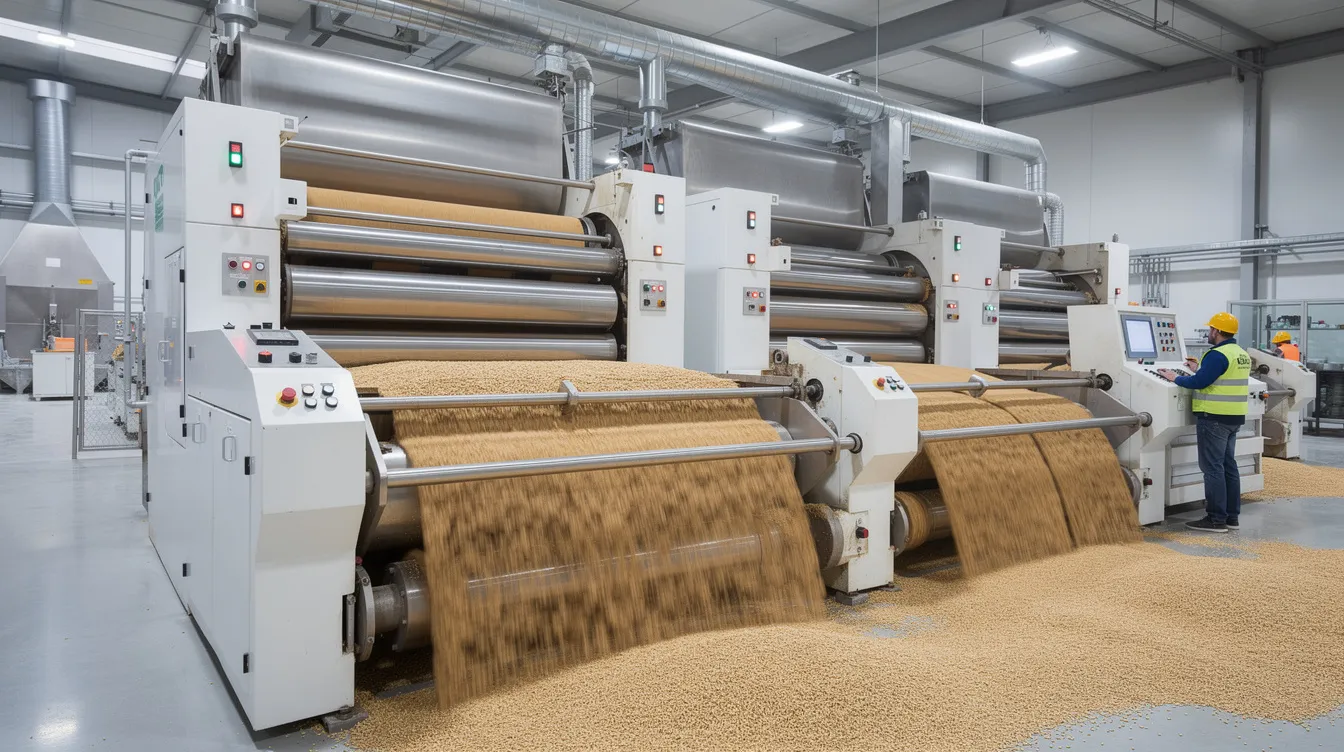
In a typical flour mill project profile, the product mix includes atta, maida, suji and bran. Suji is produced during wheat milling as a co-product alongside maida. The manufacturing process involves controlled break-roll milling, sifting through plansifters, purification of endosperm particles, grading by particle size, and final packing. Wheat quality affects the granulation, colour and taste of suji, and raw material quality is critical for maintaining consistent product standards. Wheat flour is used in various food products like rotis and bread, while suji serves distinct culinary and industrial applications.
Atta is primarily made from two wheat varieties-Durum and Aestivum. Durum wheat tends to produce harder, more vitreous semolina suited for pasta, while common wheat (Aestivum) produces softer suji used in Indian sweets and snacks. The moisture level in wheat flour should not exceed 12% for storage stability, though conditioning during milling may temporarily raise moisture to aid separation.
Understanding Suji, Rawa and Semolina
The terms suji, rawa and semolina are often used interchangeably in Indian trade. In North India, “suji” is more common; in western and southern markets, “rawa” or “rawwa” predominates. FSSAI defines semolina as a product obtained from clean wheat, free from contaminants. Industrial buyers may specify mesh size ranges, ash content and colour requirements, which the project report should document clearly. Suji for halwa and upma may differ from semolina for pasta or extruded products, so the DPR should identify target segments upfront.
Industrial Applications of Suji
Key applications include packaged retail suji, institutional supply to hotels and canteens, namkeen and snack manufacturing, biscuits, pasta, vermicelli, breakfast cereals and ready-to-cook mixes. Suji is packaged to prevent moisture absorption and pest infestation, with packaging that must comply with hygiene and safety standards set by FSSAI. Retail packs (500 g, 1 kg) and bulk bags (25–50 kg) serve different market segments with distinct pricing and margin structures. The caloric content and b vitamins present in whole wheat flour and its fractions make these food products attractive to health-conscious consumers.
Standalone Suji Plant vs Integrated Wheat Milling Plant
In practice, most suji plants in India operate as integrated roller flour mills because this improves extraction economics and allows cross-subsidisation between suji, maida and bran sales.
| Parameter | Standalone Suji Plant | Integrated Roller Flour Mill |
|---|---|---|
| Raw material | Wheat (targeted variety) | Wheat (multiple grades) |
| Product mix | Primarily suji; limited other output | Atta, maida, suji, bran |
| Machinery | Specialised purifiers, limited rolls | Full roller mill with purifiers |
| By-product revenue | Lower, limited fractions | Higher, diversified |
| Capital expenditure | Higher per unit of suji | More efficient per product |
| Operating flexibility | Lower | Higher |
Market Opportunity for Suji Manufacturing in India
Growth in packaged foods, instant mixes, pasta and bakery products is driving demand for standardised suji quality. Market analysis should assess demand from households, bakeries and food manufacturers across regional markets. Western and southern Indian cuisines show strong suji consumption, while northern India uses suji extensively in sweets.
Proximity to raw wheat sources reduces logistics costs for suji plants. Major wheat procurement centres include Madhya Pradesh, Uttar Pradesh, Rajasthan, Punjab and Haryana. Competition from established flour mills, branding versus bulk trading strategies, trade margins and credit periods all affect market entry. Unlike other grains, wheat enjoys a well-developed mandi infrastructure, making procurement relatively structured. The wheat flour mill business thrives in states close to wheat field clusters.
Suji Manufacturing Plant Capacity Planning
Correct capacity selection is critical in any suji manufacturing plant project report. The difference between TPD wheat input capacity and TPD suji output must be understood clearly. Wheat milling generates by-products like maida and bran, and suji recovery typically ranges between 5–10% in standard configurations, rising to 15–18% in specialised setups.
| Wheat Input (TPD) | Category | Annual Input (~300 days, 75% utilisation) | Approx. Suji Output (8%) | Market Orientation |
|---|---|---|---|---|
| 25 | Mini flour mill | ~5,625 MT | ~450 MT | Local |
| 50 | Medium | ~11,250 MT | ~900 MT | Regional |
| 100 | Large | ~22,500 MT | ~1,800 MT | State-level |
| 150 | Large | ~33,750 MT | ~2,700 MT | Multi-state/export |
DPRs typically cover production capacity and raw material planning at this level of detail. Over-sizing can depress DSCR due to under-utilisation, while under-sizing may restrict growth.
Capacity Utilisation and Production Planning
A realistic DPR should assume phased capacity utilisation: approximately 60% in Year 1, 70–75% in Years 2–3, stabilising at 80–85% from Year 4. Planning for 2–3 shifts per day, maintenance downtime and seasonal wheat procurement affects actual throughput. Small changes in utilisation have leveraged impact on profitability, EBITDA and the DSCR that banks evaluate. This is consistent with the financial projection approach for roller flour mills.
Suji Manufacturing Process and Flow Chart
The flour milling process requires specific machinery for production at each stage. The cleaning process includes removing impurities, stones and dust through aspirators, destoners and magnetic separators. Quality control measures include testing for moisture, ash and protein content at multiple stages.
Process overview:
Wheat intake → Pre-cleaning & destoning → Conditioning/tempering → Break roller milling → Plansifter separation → Purifier (semolina cleaning) → Grading & classification → Quality testing → Packing & storage
Extraction rate and granulation are controlled by adjusting roll gaps, sieve combinations and purifier settings. Bran and fine flour streams are collected and sold separately. The DPR must incorporate their tonnage and realisation values. For a detailed atta manufacturing process and flow chart, our related guide provides additional context on the shared milling stages.
Suji Manufacturing Plant Machinery and Equipment
A detailed machinery schedule should itemise equipment required for production. The configuration resembles a compact roller flour mill tuned for suji extraction, with emphasis on efficient cleaning, precise roller milling and semolina purification. A reliable backup power supply is essential for roller mills, as unexpected shutdowns can damage in-process material. Wheat flour production requires milling equipment that, at entry level, may start from approximately $50,000 for basic configurations, scaling significantly for automated plants.
| Equipment | Function | Key Selection Considerations |
|---|---|---|
| Vibro separator & destoner | Remove stones, impurities | Capacity, food-grade contact surfaces |
| Magnetic separator | Remove metal contaminants | Strength, placement in flow |
| Conditioning bins | Moisture tempering | Capacity, timer controls |
| Break & reduction roller mills | Crack wheat, produce fractions | Roll gap precision, power rating |
| Plansifters | Size-based separation | Number of decks, sieve area |
| Semolina purifiers | Remove bran specks from suji | Air volume, sieve mesh options |
| Pneumatic conveying | Material transport | Energy efficiency, sealing |
| Dust collectors & bag filters | Dust control, hygiene | Filtration capacity, compliance |
| Auto packaging machines | Form-fill-seal packing | Speed, weight accuracy |
| MCC & electrical panels | Power distribution, control | Automation level, safety features |
For a 50 TPD integrated plant, machinery cost typically ranges from ₹90 lakh to ₹1.8 crore for semi-automatic to partially automatic configurations. Fully automatic suji manufacturing plant setups cost more. The differences between semi-automatic and fully automatic plants affect labour needs, consistency and energy efficiency.
Land, Building and Factory Layout Requirements
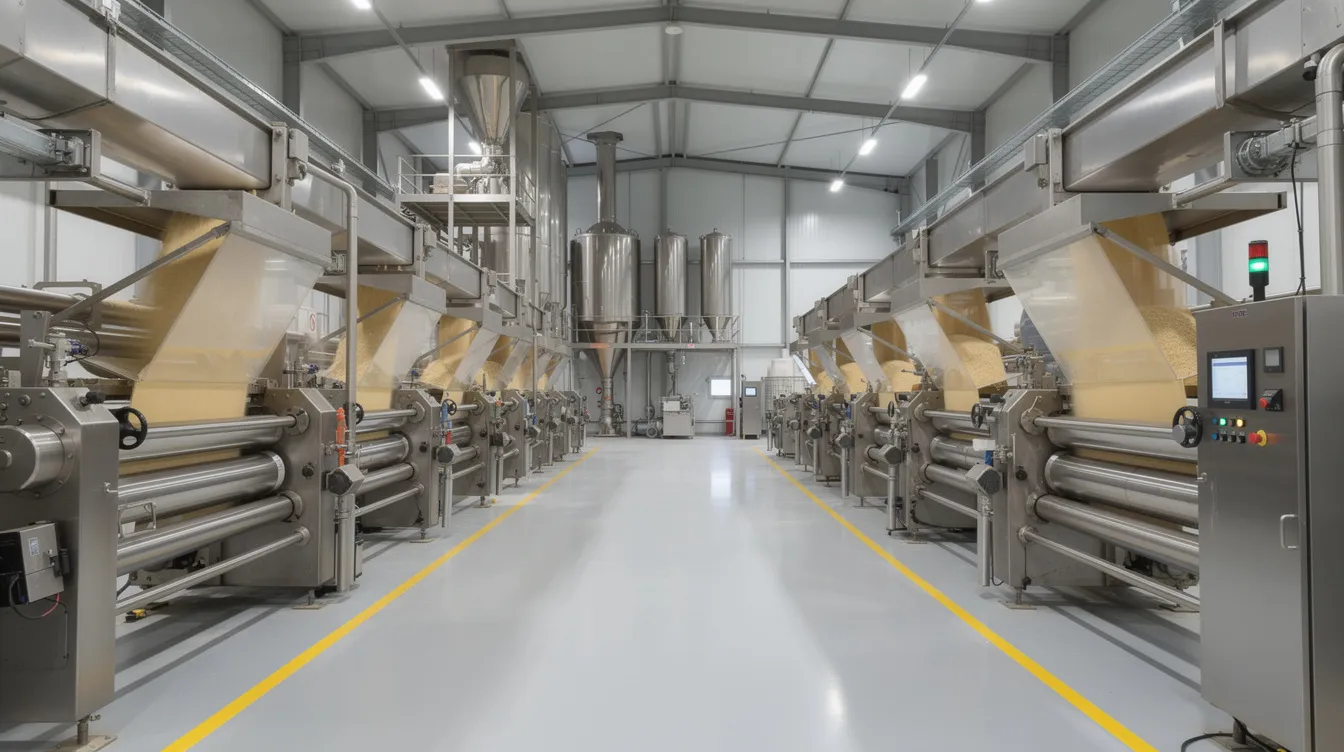
Location analysis must consider land and infrastructure requirements carefully. A 50 TPD integrated suji and roller flour mill may require a few hundred to a couple of thousand square metres, depending on vertical layout, storage strategy and truck circulation. Typical built-up areas include raw wheat godown, cleaning section, multi-storey milling floor (for gravity flow), finished goods warehouse, packaging area, quality lab and utilities block. The atta chakki plant land and layout guide provides additional planning reference for wheat processing projects. Food safety standards, local building by-laws and fire safety norms should be incorporated into layout planning.
Suji Manufacturing Plant Project Cost in India (Illustrative 50 TPD Example)
The following illustrative project cost is for a 50 TPD wheat-input integrated suji and roller flour mill, based on broad industry norms rather than binding supplier quotations.
| Cost Component | Indicative Amount (₹ Lakh) |
|---|---|
| Land & site development | 50–80 |
| Factory building & civil works | 100–150 |
| Plant & machinery (incl. installation) | 120–180 |
| Electricals & utilities (transformer, DG, compressor) | 30–50 |
| Material handling & storage systems | 15–25 |
| QC lab, furniture, office equipment | 8–12 |
| Pre-operative & preliminary expenses | 15–25 |
| Contingency | 15–25 |
| Total Fixed Capital | 353–547 |
| Margin for working capital | 200–300 |
| Total Project Cost | 553–847 |
Actual suji manufacturing plant cost in India varies by location, land prices, level of automation, imported versus indigenous machinery and project execution strategy. Promoters should obtain updated quotations during DPR preparation. A DPR should include a detailed project layout and machinery requirements alongside these cost estimates. For related cost benchmarking, refer to the atta chakki plant project cost and means of finance guide.
Means of Finance and Bank Loan Structure
DPRs are essential for securing bank loans. A typical means of finance for the above 50 TPD example may look as follows:
| Source | Amount (₹ Lakh) | Approximate Share |
|---|---|---|
| Promoter’s equity contribution | 200–280 | ~35% |
| Bank term loan | 350–500 | ~60% |
| Other sources (unsecured loans, if any) | 0–70 | ~5% |
| Total | 553–847 | 100% |
Loan structuring is a key component of bank finance reports. Banks examine promoter contribution, collateral, net worth and repayment capacity. Term loan tenure is commonly 7–9 years with a moratorium of 6–12 months. CMA Data is essential for bank loan applications, and CMA Data preparation should be aligned with DPR assumptions. Interest rates may range between 9–13% depending on lender policy and MSME status.
Working Capital Requirements for a Suji Manufacturing Plant
Working capital assessment is vital for manufacturing projects, particularly wheat-based ones where bulk wheat purchase during harvest seasons, credit to dealers and holding finished goods create significant funding requirements.
| Current Asset Component | Basis | Illustrative (₹ Lakh) |
|---|---|---|
| Raw wheat inventory (1 month) | ~1,050 MT × ₹25,000/MT | 262 |
| Packaging materials | 2 weeks’ stock | 8 |
| Finished goods (suji, maida, bran) | 2 weeks’ sales | 65 |
| Trade receivables | 30 days’ sales | 130 |
| Cash & bank balance | Minimum operating needs | 10 |
| Total current assets | ~475 | |
| Less: Supplier credit & payables | ~175 | |
| Net working capital gap | ~300 |
Banks evaluate drawing power against stock and receivables. The working capital cycle directly affects liquidity and DSCR performance.
Suji Manufacturing Plant Financial Projections
Financial projections are crucial for project finance advisory. A robust suji manufacturing plant project report must include 5–7 year projected profit and loss accounts, balance sheets and cash flow statements. Production assumptions should reconcile wheat input with output through a material balance.
Illustrative Stabilised-Year Operating Statement (50 TPD, ~75% utilisation):
| Item | Quantity/Value |
|---|---|
| Wheat input | ~11,250 MT |
| Suji output (~8%) | ~900 MT |
| Maida output (~52%) | ~5,850 MT |
| Bran + other (~37%) | ~4,160 MT |
| Losses (~3%) | ~340 MT |
| Total sales revenue | ₹32–38 crore (indicative) |
| Wheat cost (~75% of revenue) | ₹24–28 crore |
| Other operating costs | ₹3–5 crore |
| EBITDA | ₹3–5 crore |
| Net profit margin | 4–8% (indicative) |
These are illustrative figures. Actual outcomes depend on wheat prices, product realisations and operational efficiency.
Suji Manufacturing Plant Profitability and Break-Even Analysis
Profitability depends on the spread between wheat cost and weighted average realisation from all products after conversion costs. The report should demonstrate project profitability through break-even analysis, identifying fixed costs (salaries, interest, depreciation) and variable costs (wheat, bags, power). Higher wheat prices, lower suji recovery or weak selling prices can squeeze contribution margins. Banks focus on cash accruals and DSCR rather than reported net profit alone. No guaranteed profit margin should be promised in a DPR.
DSCR, ROI, IRR and Payback Period
DSCR analysis helps assess loan repayment capacity. The ratio of cash available for debt servicing to annual principal-plus-interest obligations should remain comfortably above 1.25 on average over the loan tenure. ROI and IRR measure overall project attractiveness-promoters may target IRR in the 20–25% range for medium plants, though conservative modelling is advisable. Payback period for suji manufacturing plants is typically 4–6 years under favourable conditions. For a deeper technical explanation, the roller flour mill ROI, IRR and sensitivity analysis guide provides useful reference for a similar industry context.
Suji Manufacturing Plant Feasibility Study
A feasibility study evaluates project economics before investment decisions. It examines technical, market, financial, commercial and regulatory dimensions. Project feasibility studies assess the viability of manufacturing projects comprehensively. Feasibility studies include financial projections and cost assessments, and they help identify potential risks in manufacturing projects. Key dimensions include wheat availability and seasonality, proximity to markets, competition from existing roller flour mill and atta chakki plant operators, logistics infrastructure and power availability. For formal feasibility assessment, Project Report Bank’s feasibility study services offer structured support.
Risks and Sensitivity Analysis in Suji Manufacturing
Sensitivity analysis evaluates risks related to price fluctuations and production volatility. Wheat-based projects are inherently sensitive to commodity price swings and operational reliability.
| Risk Factor | Likely Impact & Possible Mitigation |
|---|---|
| Wheat price increase (+5–10%) | Directly compresses margins; mitigate through harvest-season procurement and forward contracts |
| Lower suji recovery than projected | Reduces suji revenue significantly; ensure proper equipment calibration and wheat selection |
| Fall in market realisation | Squeezes EBITDA; diversify product mix and customer base |
| Power outages / high tariffs | Disrupts milling; invest in backup DG set and energy-efficient machinery |
| Delayed receivables | Strains working capital; enforce credit policies, use cash credit facilities |
| Machinery breakdown | Production loss; preventive maintenance schedules and critical spares inventory |
| Project implementation delays | Cost overruns and delayed revenue; maintain realistic implementation schedule with buffers |
A ±5% change in wheat cost or selling price, or ±10% in capacity utilisation, should be tested against EBITDA, cash flow and DSCR projections.
Licences and Regulatory Requirements
Suji manufacturing falls under food processing. Key regulatory requirements include FSSAI licence and food safety compliance, entity registration, Udyam registration for MSME status, and local trade licences. Other typical approvals include factory registration under the Factories Act, consent from State Pollution Control Board where applicable, fire safety NOC and building plan approvals. Proper waste management is essential for both environmental compliance and operational efficiency. GST registration, HSN classification for wheat products and Legal Metrology requirements for packaged commodities must be addressed. Requirements vary by state and project size.
What Should Be Included in a Bankable Suji Manufacturing Plant DPR?
A bankable DPR differs substantially from a brief flour mill project profile or brochure. A Detailed Project Report includes market research and feasibility study alongside technical and financial analysis. An implementation schedule should outline all stages of the project setup.
Essential chapters include:
- Promoter background and business objectives
- Product description and market analysis
- Technical configuration and manufacturing process
- Capacity, plant layout and machinery requirements
- Project cost estimates and implementation schedule
- Means of finance and working capital assessment
- 5–7 year projected financial statements
- Break-even, DSCR, ROI and IRR analysis
- Sensitivity analysis and risk mitigation framework
- Supporting enclosures: KYC, quotations, land documents
Project Report Bank prepares customised, bank-compliant DPRs and CMA Data for suji, roller flour mill and related agro-processing units under the guidance of CA Manish Gugliya.
How Project Report Bank Assists with Suji Plant DPR & Project Finance
CA Manish Gugliya and the Project Report Bank team engage with promoters by understanding proposed capacity, location and market plan, collecting technical inputs and quotations, and building realistic financial models.
Core services for suji plants include bank finance DPR preparation, CMA Data for bank loans, 5–7 year financial projections and financial modelling, project cost and means of finance planning, working capital assessment, and DSCR and loan repayment analysis. Professional fees for Bank Finance DPR and Loan Proposal Assistance start from ₹25,000, with final fees depending on plant size and complexity. Payment terms: 30% advance at commencement, 70% after submission of the first complete draft.
Project Report Bank is a financial and project-planning advisory, not a machinery supplier. Technical specifications should be supported by equipment manufacturers or qualified technical consultants.
Planning a suji manufacturing plant in India? Contact us on WhatsApp to discuss your proposed plant capacity, project investment and DPR requirements.
Frequently Asked Questions (FAQ)
The following FAQ addresses common practical questions entrepreneurs ask when exploring a suji manufacturing plant project report or mini flour mill project in India. Answers are indicative-project-specific clarifications should be obtained through a customised DPR and professional consultation.
What is a realistic starting capacity for a new suji manufacturing plant in India?
Many first-time promoters start with 40–60 TPD wheat-input plants serving a regional market. Capacity choice depends on raw material access, distribution strength and available finance. A wheat flour mill project at this scale balances investment efficiency with market development risk. Larger capacities of 100–150 TPD suit promoters with established distribution and stronger financial resources.
Can I convert my existing mini flour mill into a suji manufacturing unit?
A basic mini flour mill designed only for whole wheat flour or atta grinding may lack the roller configuration, plansifters and purifiers needed for consistent suji production. Depending on the existing setup, some upgrades are possible, but a technical study is required to evaluate feasibility and economics. The flour mill business proposal should include a machinery gap analysis and additional capex estimate.
How long does it usually take to prepare a bankable suji plant DPR?
A typical timeframe is 2–4 weeks after receiving complete project inputs and initial quotations. Complex configurations, multiple product lines or delayed data from the promoter can extend this timeline. The DPR process involves iterative review of assumptions and financial modelling.
Do I need separate licences if I also pack atta and maida along with suji?
The same FSSAI licence can normally cover multiple wheat products if properly described in the application. However, labelling, GST classification and Legal Metrology compliance must be ensured individually for each packed item. Starch production or gluten flour extraction, if added, may require additional product registrations.
Will banks insist on CMA Data along with the suji project report?
For term loans and working capital limits above certain thresholds, many banks require CMA Data formats summarising projected balance sheets and working capital assessment. This is a standard part of bank loan appraisal. Project Report Bank prepares CMA Data alongside the DPR to ensure consistency across all documents submitted to the lender.