Getting a hotel loan requires a solid financial presentation – far more than filling in a loan application and attaching a few financial statements. Banks and lenders evaluate hotel loans based on income potential and the borrower’s financial strength, which means they need a thorough understanding of the promoters, the project, the property, the funding structure, and long-term commercial viability. Hotel business loans can be customized to borrower needs, but the documentation and appraisal process remains rigorous regardless of the loan amount.
In my practice as a Chartered Accountant working on hotel DPRs, CMA Data and project finance proposals across India, I have seen well-documented proposals move through credit appraisal smoothly – and poorly assembled ones stall for months. This article is a practical, India-focused checklist to help hotel promoters, investors and professionals understand exactly what documents to prepare and what the bank examines before sanctioning a hotel loan.
Key Takeaways
- Hotel loan documentation spans promoter KYC, entity papers, property title, approvals, DPR, project cost evidence, means of finance, financial projections, CMA Data, working capital details and security documents.
- Different lenders – public sector banks, private banks, NBFCs – may ask for slightly different documents and eligibility criteria, but the broad checklist remains similar across the hospitality industry.
- Banks look well beyond basic KYC: they assess promoter profile, credit history, project cost reasonableness, debt-equity structure, hotel feasibility, DSCR, working capital and collateral before sanctioning a hotel business loan.
- A professionally prepared DPR, CMA Data and realistic hotel financial projections reduce queries, delays and back-and-forth with the credit team.
- This article is a practical reference written from my experience with hotel term loans and project finance – use it as a starting point and verify specific requirements with your lender.
Explore Hotel Bank Loan, Project Finance & Feasibility Guides
Explore our hotel finance guides covering bank loans, term loan assessment, DSCR, working capital, CMA Data, project cost, financial projections, feasibility, documentation and debt structuring.
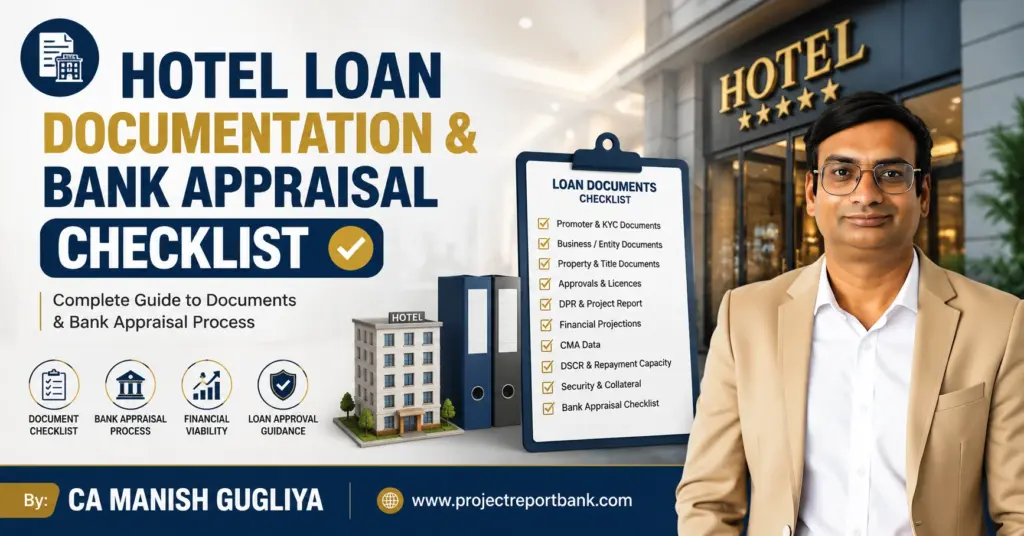
Hotel Loan Documentation – Complete Checklist
Hotel loan documentation is not a single-page exercise. A bank needs a full picture: who the borrower is, what hotel is being proposed, whether the project cost is reasonable, how funds will flow in, whether projected revenue assumptions hold up, and whether the property being offered as security has a clean title.
For larger hotel project finance proposals – say, term loans above ₹5–10 crore – the documentation and due diligence tend to be deeper than for a small working capital or top-up business loan. Even smaller hotel loans, where some lenders process amounts up to Rs. 1 crore, require organized documentation for quick disbursal.
Here is the master checklist:
| Document Category | Documents / Information | Why the Bank Reviews It |
|---|---|---|
| Promoter KYC | PAN card, Aadhaar card, address proof, photographs, net-worth statement, income tax returns, bank statement, credit score report | Assess promoter identity, financial strength, credit history |
| Entity / Constitution | Incorporation certificate, MOA/AOA, partnership deed, GST registration, Board resolutions, Udyam registration | Confirm legal standing and borrowing authority |
| Land & Property | Sale deed, lease deed, encumbrance certificate, approved building plans, land records, valuation report | Verify clean title, marketable security |
| Project Approvals | Building sanction, fire NOC, pollution clearances, FSSAI, trade licence, hotel licence | Confirm regulatory compliance |
| DPR / Project Report | Promoter profile, project concept, market study, cost, means of finance, projections, DSCR | Evaluate project viability and repayment capacity |
| Project Cost Support | Vendor quotations, BOQs, architect estimates, paid invoices | Verify cost reasonableness |
| Means of Finance | Promoter contribution evidence, subsidy letters, unsecured loan documentation | Confirm funding structure and equity |
| Financial Projections | Projected P&L, Balance Sheet, Cash Flow, DSCR schedule | Test revenue assumptions and loan repayment capacity |
| CMA Data | Past audited financials, current estimates, projected financials, working capital schedules, ratio analysis | Structured credit monitoring and appraisal format |
| Working Capital | Inventory details, receivable/payable analysis, bank statements, operating cycle | Assess short-term funding needs |
| Security / Collateral | Mortgage deed, hypothecation, insurance, personal guarantees, valuation | Secure the loan exposure |
Not every document in the above list is compulsory for every hotel business loan. Requirements vary depending on the bank, loan amount, nature of the hotel, and whether you are financing a new property or an existing hotel.
Promoter and KYC Documents
In hotel project finance, banks first appraise the promoter. Lenders assess the borrower’s financial credibility along with project cash flow, so your personal and financial profile matters as much as the project itself. KYC documentation is mandatory for all hotel loan applicants.
Key documents for hotel financing include personal financial statements and tax returns. Specifically, you should prepare:
- PAN card and Aadhaar card (or other acceptable identity documents such as passport, driving license or voter ID)
- Address proof – utility bill, registered rent agreement or bank statement showing address
- Recent photographs as required by the lender
- Promoter profile note: educational background, professional experience, years in the hotel business or related sectors, details of other ventures
- Personal net-worth statement with assets and liabilities – immovable property, investments, vehicles, loans and guarantees given, if any
- Income tax returns – typically the latest ITR for the past 3 years
- Personal bank statement for the last 6–12 months
- Details of existing loans, liabilities and banking relationships
- CIBIL or other credit bureau report – banks check credit score, overdue accounts and overall credit discipline of both the borrower and any guarantor
Promoter background and financial standing directly influence the bank’s comfort level with the proposal. A self employed promoter with strong hospitality industry experience and a clean credit history will typically find the appraisal process smoother.
Constitution and Business Entity Documents
The borrower for a hotel loan can be a proprietorship concern, partnership firm, LLP, or private limited company. Lenders ask for constitution-specific documents required to confirm legal standing and borrowing authority.
- Proprietorship: Registration certificate, Shops & Establishment certificate, GST registration, PAN, Udyam/MSME registration if applicable, bank statement in the firm’s name
- Partnership firm: Partnership deed, registration certificate (if registered), PAN, GST, list of partners with capital contributions, authority letter for borrowing
- LLP: LLP Agreement, Certificate of Incorporation, PAN, GST, designated partners’ details and KYC
- Private limited company / companies: Certificate of Incorporation, CIN, Memorandum and Articles of Association, PAN, GST, latest shareholding pattern, list of directors with DINs, Board resolutions for borrowing and creating security
Additionally, Udyam/MSME registration for eligible small and medium enterprises in the hotel sector, professional tax registration and any other local registrations may be required. The exact list differs by lender – banks will share their own checklist at the proposal stage.
Land, Building and Property Documents
For hotel term loans, the property (land and building) is usually the primary security. Clean and marketable title is critical for bank appraisal. Hotel loans can cover property purchase or lease costs, so the title chain must be impeccable.
- Registered sale deed or conveyance deed; lease deed for leasehold plots
- Allotment letters from development authorities where applicable
- Local land records: 7/12 extract, khata, jamabandi as per the state
- Encumbrance certificate (typically 13–30 years depending on local practice) and non-encumbrance declarations
- Land-use conversion or change-of-land-use approvals where applicable (e.g., agricultural to commercial)
- Approved building plans, sanctioned drawings, and completion/occupancy certificates for existing structures
- No-objection certificates from society, development authority, or airport authority where relevant
- Construction estimates from architect/engineer, item-wise BOQs, and architect certificates on stage-wise progress if construction is ongoing
- Municipal property tax paid receipts
Banks often appoint their own advocate and valuer for title search and valuation. Promoters should be ready to share complete chains of documents. This article does not constitute legal advice – always verify property documentation requirements with your lender and an experienced property lawyer.
Hotel Project Approvals and Licences
Approval documents vary depending on the type of hotel project being financed. The licences and permits needed depend on project location, size, star category, F&B operations and applicable laws. Legal compliance is crucial before submitting a loan application.
- Building plan sanction, building permit, height and zoning clearances, commencement certificate
- Occupancy/completion certificate from municipal authorities (for existing buildings)
- Fire safety NOC, fire system design approvals and periodic renewals
- Environmental site assessments are required to check for contamination in hotel financing; consent to establish/operate from State Pollution Control Board; environmental clearance for resorts in ecologically sensitive zones
- Banks may require environmental and safety permits for hotel operations, especially for larger projects
- Trade licence or hotel licence from local municipal or tourism authorities
- FSSAI registration/licence for food operations; bar/liquor licence where applicable
- Tourism classification or star rating certificate from the Ministry of Tourism, if being pursued
- Hotel loans also help cover licensing and permit fees as part of the project cost
Banks do not always insist that every approval be in hand before sanction, but they will want reasonable clarity that required permissions are obtainable within the implementation schedule. Fees for these approvals are a legitimate part of the project budget and can be included in the cost estimates.
Hotel Project Report (DPR) and Its Documentation Role
For a new or expansion hotel project, the Detailed Project Report is the central document. A detailed business plan is essential for loan approval, and lenders require detailed project reports covering projected financials and operating assumptions. A business plan detailing the hotel concept and market analysis is essential for financing.
A well-structured DPR typically includes:
- Executive summary and promoter background
- Project concept: type of hotel, category, targeted guests, guest experiences positioning
- Location analysis: city, micro-market, access, connectivity, local demand generators
- Proposed room inventory, F&B outlets, banquets, spa, parking, additional services
- Market and demand analysis: tourism and business traffic, competitor hotels with their ARR/ADR and occupancy, SWOT analysis, positioning strategy
- Project implementation schedule with realistic milestones: land, approvals, construction, fit-out, recruitment, pre-opening
- Project cost broken down by major heads
- Means of finance: promoter contribution, term loan, other sources
- Revenue assumptions: occupancy ramp-up, ARR, RevPAR, F&B and banquet revenues, seasonality
- Operating cost assumptions: departmental costs, staff, utilities, marketing, management or franchise fees
- Projected P&L, Balance Sheet, Cash Flow, DSCR, break-even analysis and sensitivity analysis
All numbers in the DPR – project cost, loan requirement, means of finance and projections – must reconcile. Banks quickly flag internal inconsistencies during credit appraisal.
Project Cost Documents and Evidence
Banks do not rely on a single project cost figure. They expect documentary support to verify that the budgeted cost is realistic.
Key cost heads that should be supported with quotations and estimates:
- Land purchase or lease premium
- Civil construction, structural work and external development
- Funds can be used for renovation and interior design of public areas and rooms
- Loans can finance furniture and essential equipment purchases including kitchen equipment, laundry systems and housekeeping items
- Elevators, HVAC, electrical installations, fire detection and firefighting systems
- IT infrastructure, hotel PMS, Wi-Fi, CCTV, AV systems for banquets
- Funds can be allocated for hiring and training staff during the pre-opening phase
- Loans can support marketing and promotional activities as part of pre-opening expenses
- Consultancy fees, interest during construction, contingencies
- Working capital margin for the initial 6–12 months of operations
Inflated or unsupported project cost estimates raise red flags about viability, over-financing and diversion risk. Include current vendor quotations, detailed BOQs and, where work has started, paid invoices.
Means of Finance and Promoter Contribution Documentation
The basic identity is straightforward: Total Project Cost = Promoter Contribution + Term Loan + Other Eligible Sources. Banks carefully test whether this structure is realistic. Loan documentation for hotels commonly includes sources and uses of funds statements.
- Documentation for promoter contribution: bank statement showing available funds, liquid investment statements, sale deeds of assets being sold, sanction letters for unsecured loans where acceptable
- Subsidy sanction letters if applicable (e.g., state tourism incentives)
- Banks will expect clear evidence of promoter margin being brought in at appropriate stages – not only at the end
- Debt-equity ratio typically acceptable ranges around 2:1 to 2.5:1, though this varies by lender and project risk
For a detailed discussion of hotel project cost and means of finance, including how to structure promoter contribution and term loan components, refer to the dedicated guide. Different lenders have different comfort levels on leverage and promoter contribution percentage, so avoid treating any single ratio as a universal rule.
Financial Projections Required for Hotel Loan Appraisal
Banks rely heavily on projected financial statements. Loan applications require financial projections and revenue forecasts covering at least 5–10 years, clearly separating pre-opening, ramp-up and steady-state periods. Projected income statements and cash flow statements are necessary for hotel loan applications.
- Number of rooms, available room nights, occupancy ramp-up, ARR/ADR, RevPAR
- F&B, banquet and ancillary revenues with seasonality assumptions
- Operating expenses: departmental costs, staff costs, utilities, maintenance, G&A, tour operators commissions
- EBITDA, interest, depreciation, applicable taxes, net profit, cash accruals
- Loan repayment schedule with closing balances, allowing DSCR computation year by year
- Sensitivity analysis under adverse scenarios
For guidance on preparing hotel financial projections for bank loan proposals, including structuring assumptions and building credible models, refer to the detailed resource. Assumptions matter more than spreadsheets – without narrative support, projections invite queries.
CMA Data for Hotel Bank Loan
CMA (Credit Monitoring Arrangement) Data is a structured format of past, current and projected financials that many Indian banks – especially public sector banks – use for term loan and working capital appraisal.
- Past 2–3 years audited financial statements and balance sheet data (if available)
- Current year estimated results
- 3–5 year projections including working capital schedules, borrowing levels and ratio analysis
- Fund flow statements and detailed schedules of income, expenses and capital
For greenfield hotel projects without historical financials, CMA primarily focuses on projections and funding details, supplemented by promoter financials and the DPR. A Chartered Accountant can assist in preparing CMA Data based on information and assumptions provided by the promoter, but this does not mean projected CMA Data is automatically “certified” – it is a presentation of assumptions, not a guarantee. Some smaller ticket loans or purely unsecured business loans may not require full CMA Data depending on lender policy. For more on CMA Data requirements for hotel finance, see the complete guide.
Working Capital Documentation and Assessment
Beyond the term loan for construction and fixed assets, hotels often require separate working capital limits. Working capital covers salaries, utilities, food and beverage inventory, guest supplies, marketing spends, routine maintenance and overheads.
Banks estimate working capital using the projected operating cycle, inventory levels, credit terms with suppliers, expected receivables from corporates and travel agents, and cash requirements. Documentation includes projected working capital statements, aging analysis for existing businesses, and bank statements showing historical cash flow patterns.
Working capital may be funded through cash-credit limits, an overdraft facility, or a separate short-term loan. For a deeper look at working capital assessment for hotels, refer to the dedicated article.
DSCR and Loan Repayment Capacity
DSCR – Debt Service Coverage Ratio – measures cash available for debt service against total debt service (interest plus principal repayment) for a given period. Lenders look at year-wise DSCR and average DSCR over the loan tenure to judge whether the hotel’s income can comfortably cover repayment.
- Projections should show DSCR for each year, reflecting moratorium periods and interest rate assumptions
- Flexible repayment tenures are often available for hotel loans, with total tenure typically ranging 5–10 years and greenfield projects sometimes receiving a 12–18 month moratorium on principal
- Banks stress test DSCR under less favourable scenarios – lower occupancy, lower ARR, higher costs – to check resilience
- Interest rates reflect the inherent risks of the hospitality sector, which can be more volatile than many other industries
- There is no single DSCR figure applicable to every bank; many lenders look for an average DSCR of at least 1.20x, though conservative banks may seek 1.35–1.50x
For detailed discussion on DSCR analysis for hotel finance, including computation methodology, see the dedicated resource.
Feasibility and Commercial Viability Documents
Strong documentation cannot compensate for a commercially weak hotel project. Lenders typically consider operational viability of the hotel brand when approving loans and focus heavily on feasibility alongside the loan documents.
- Location profile, access, connectivity, demand generators (commercial hubs, tourist attractions, airports)
- Competitor supply, expected occupancy, ARR/ADR and RevPAR benchmarks based on comparable hotels
- Realistic stabilization timelines – typically 2–3 years to reach steady-state occupancy
- Break-even analysis, expected profitability and sufficient surplus for loan servicing and future investment
For a structured approach to hotel feasibility study and financial viability, see the detailed guide.
What Does a Bank Examine During Hotel Loan Appraisal?
Once documents are filed, the bank’s credit team performs a structured appraisal covering every dimension of the proposal. Here is what the process typically looks like:
| Appraisal Area | What the Bank Checks | What the Promoter Should Prepare |
|---|---|---|
| Promoter Assessment | Identity, background, experience, integrity | Complete KYC, promoter profile, details of other ventures |
| Credit History | CIBIL/credit score, past loan conduct, defaults if any | Clean credit record, disclosure of all existing loans |
| Net Worth | Personal assets vs liabilities, financial capacity | Net-worth statement, ITRs, bank statements |
| Project Location | Micro-market, access, demand generators, competition | Location analysis in DPR, local demand data |
| Title & Property | Clean title, marketable security, encumbrances | Complete property chain, encumbrance certificate, legal opinion |
| Statutory Approvals | Building sanction, fire, environment, FSSAI, licences | List of obtained and pending approvals with expected timelines |
| Project Cost | Reasonableness, quotation support, no inflation | BOQs, vendor quotes, architect estimates |
| Means of Finance | Promoter contribution, debt-equity, funding timeline | Source evidence, bank statements, subsidy letters |
| Revenue Assumptions | Occupancy, ARR/ADR, RevPAR, F&B, seasonality | Market study, competitor data, realistic ramp-up plan |
| Cash Flow & DSCR | Ability to service debt from operating income | Year-wise projected cash flow, DSCR schedule, sensitivity |
| Working Capital | Short-term funding adequacy | Operating cycle analysis, inventory/receivable norms |
| Security / Collateral | Mortgage, hypothecation, guarantees | Valuation report, insurance, guarantee documentation |
| Implementation Schedule | Realistic timeline, milestones | PERT/milestone chart, contractor arrangements |
| Sensitivity | Impact of lower occupancy, lower ARR, cost overruns | Sensitivity tables in DPR and projections |
For larger hotel projects, appraisal may also involve site visits, external industry reports and independent valuations. For a deeper dive into how banks assess hotel term loans, see the dedicated article on appraisal methodology.

How Banks Test Hotel Revenue Assumptions
Banks are cautious about overly optimistic projections and will closely question key assumptions to manage repayment risk.
- Number of rooms, available room nights per year and occupancy ramp-up path
- ARR/ADR used in projections compared to local competitor performance – not generic national averages
- F&B sales, banquet and event income, conference revenue and ancillary income as percentages of total revenue
- Seasonality, demand cycles and realistic stabilization periods
- Credit officers may require explanation notes or annexures justifying occupancy and rate assumptions based on competitor analysis, tourism statistics and business growth data
Hotel Loan Security and Collateral Documentation
Primary security for hotel loans is generally the mortgage of land and building plus hypothecation of movable assets like furniture, fixtures and equipment financed from the term loan. Assets like property and equipment may serve as collateral. Collateral evaluation is necessary to meet lender requirements.
- Hypothecation and mortgage deeds, MOD where applicable
- Collateral security (additional property or other acceptable assets) if primary assets alone are insufficient
- Personal guarantees from promoters and corporate guarantees from group entities where applicable
- Valuation reports from bank-approved valuers, insurance policies with bank clause
- Collateral requirements vary among lenders for hotel loans – understanding collateral requirements is crucial for informed decisions
- Lenders may require collateral based on perceived lending risks of the specific project
- Some lenders offer collateral free loans for hotel businesses, particularly for smaller ticket sizes
Interest rates for hotel loans are competitive compared to other industries, and can start as low as 1% per month for certain lender products. Low interest rates reduce borrowing costs for hotel owners, but the exact rates depend on the borrower’s profile, security and lender policy.
Existing Hotel vs New Hotel – Documentation Differences
Existing operational hotels and greenfield hotel projects face different appraisal approaches:
| Aspect | Existing Operating Hotel | New (Greenfield) Hotel Project |
|---|---|---|
| Financial History | Last 3 years audited financials, GST returns, income tax returns, bank statements | Not available – relies on projections |
| Operational Data | Historical occupancy rates and revenue statistics support loan applications | Market study and feasibility assumptions |
| DPR Emphasis | Supplementary to actuals | Central document for appraisal |
| Cost Documentation | Primarily for expansion/renovation component | Full project cost with quotations |
| Security | Existing property already valued and operational | Property under construction, valued progressively |
| Promoter Assessment | Track record in running the hotel | Background, capacity, experience elsewhere |
Historical operating statements are needed for hotel acquisition financing. For hybrid cases – substantial renovation or expansion of an existing hotel – both sets of documents are required: past performance data and detailed project documentation for the expansion.
Common Reasons Hotel Loan Proposals Face Queries or Delays
Even viable hotel projects face delays when documentation is incomplete or inconsistent. Common issues include:
- Missing or partial KYC, incomplete property title chains
- Discrepancies between DPR project cost and the figure in the loan application
- Lack of quotations supporting major cost heads
- Different revenue or occupancy assumptions in DPR vs CMA Data
- DSCR calculations that do not tie to projected cash flows
- Unrealistic occupancy, ARR or cost assumptions; underestimated expenses
- Non-disclosure of existing liabilities or pending legal issues surfacing during due diligence
- Overly aggressive implementation schedule
None of these issues automatically results in rejection, but they increase the time taken for appraisal and may result in reduced sanction amounts or stricter terms. Quick loan processing can take as little as 48 hours for simpler proposals, but complex hotel projects with documentation gaps can take much longer.
Pre-Submission Hotel Loan Checklist
Before approaching the bank, verify:
- All promoter KYC documents compiled and self-attested
- Entity registration and constitution documents updated
- Promoter profile note and net-worth/asset-liability statements prepared
- Complete chain of title deeds, land records, tax receipts, approvals and building plans grouped systematically
- Finalized DPR with feasibility note, project cost break-up, quotations, means of finance sheet
- Evidence of promoter contribution sources (bank statements, investment documents)
- Financial projections (P&L, Balance Sheet, Cash Flow, DSCR) and CMA Data internally consistent and reconciled with the DPR
- Working capital assessment, draft repayment schedule, security/collateral details organized
- List of existing loans prepared, implementation timeline documented
- All major numbers – project cost, loan requirement, promoter equity, revenue figures – reconciled across all documents
Coming prepared to the first bank meeting with this complete set significantly improves the efficiency of the credit appraisal process.
Importance of Consistency Across DPR, CMA Data and Loan Application
One of the most common weaknesses I see in hotel loan files is inconsistency between the DPR, CMA Data, financial projections and the loan application summary.
- Total project cost must be identical in all documents
- Term loan requirement should match the means-of-finance table and the sanction request
- Revenue projections must reconcile with room inventory, occupancy and ARR used in the analysis
- CMA projections, DPR financial model and separately shared projected financial statements should broadly align for overlapping periods
- Promoter contribution must tally with the funding plan and bank statements
Professional presentation is not about making projections look attractive. It is about making assumptions clear, supportable and internally consistent – which builds lender confidence.
How a Chartered Accountant Can Assist in Hotel Loan Documentation
In my practice, I regularly assist hotel promoters with the financial structuring of their loan proposals. Professional assistance typically includes:
- Preparing a bankable hotel DPR with realistic assumptions and proper market context
- Structuring hotel project cost and promoter contribution in a manner that aligns with lender expectations
- Preparing financial projections, DSCR analysis, break-even analysis and sensitivity modelling
- Compiling CMA Data in bank-prescribed formats
- Assessing working capital requirements and operating cycle
- Reviewing all documentation for internal consistency and identifying likely bank queries
- Coordinating with architects, valuers and consultants so technical, financial and market assumptions align
A CA can strengthen the presentation of a proposal, but loan approval remains entirely at the discretion of the bank or lender. Sanction depends on credit policy, risk appetite, security comfort, borrower profile, project viability and applicable regulations. No professional can guarantee loan sanction.
If you need assistance with your hotel DPR, CMA Data, financial projections or loan proposal structuring, CA Manish Gugliya and ProjectReportBank can help you build a strong, consistent submission for your hotel finance proposal.
Frequently Asked Questions
Here are answers to questions hotel promoters commonly ask about the documentation and appraisal process.
What documents are typically required for a hotel bank loan in India?
The main categories include promoter KYC (PAN card, Aadhaar card, address proof, income tax returns, bank statement, credit score report), business entity documents, property and title papers, project approvals and licences, a Detailed Project Report with feasibility study, financial projections, CMA Data where required, and security/collateral details. The exact documents required vary depending on the lender, loan amount, type of hotel project and the borrower’s eligibility criteria.
Is a Detailed Project Report (DPR) mandatory for every hotel loan?
For new hotel projects, capacity additions or major renovations involving term loans, most banks expect a structured DPR. For small working capital limits or minor top-up loans, lenders may rely on simpler project notes and historical financials. However, a detailed business plan detailing the hotel concept and market analysis is essential for any meaningful financing proposal.
Can a new hotel without any past financial statements still obtain bank finance?
Yes. Many hotel term loans are sanctioned for greenfield projects with no historical hotel P&L. Lenders then place greater weight on promoter background, DPR quality, project cost support, the feasibility study, projected cash flows and available security. Loan processing for well-documented greenfield proposals can sometimes move within 48 to 72 hours for initial approval at certain lenders, though complex projects take longer.
Does a Chartered Accountant certify projected CMA Data?
A CA can prepare or assist in preparing CMA Data based on financial information and assumptions provided by the promoter. However, projected CMA Data represents forward-looking assumptions – it is not “certified” in the same sense as audited historical accounts. The distinction matters, and promoters should not represent projected CMA Data as carrying an assurance opinion unless a separate engagement specifically provides one.
How much promoter contribution is typically expected for a hotel project?
Promoter contribution requirements vary depending on the lender, project risk and applicable scheme, but generally fall in the 20–30% range of total project cost. Greenfield or higher-risk projects may require a larger margin. Banks will also examine the source and timing of the promoter’s money – it should be credible, documented and brought in at appropriate project stages.
Continue Exploring Our Hotel Project Finance & Bank Loan Guides
Continue with our detailed hotel finance resources covering bank loan appraisal, project cost, CMA Data, working capital, DSCR, financial projections, feasibility, documentation and loan repayment structuring.