Key Takeaways
- Grains like maize, broken rice and wheat are converted into fuel grade ethanol through a sequential chain of milling, slurry preparation, enzymatic liquefaction and saccharification, yeast-driven fermentation, multi-column distillation and molecular sieve dehydration.
- Process efficiency parameters such as ethanol yield per tonne of grain, specific steam and power consumption, and DDGS recovery directly influence project profitability, DSCR and bankability for Indian ethanol plants.
- A robust, technically detailed grain based ethanol manufacturing process flow chart and mass balance are mandatory inputs for any serious DPR, CMA Data submission and bank finance appraisal.
- DDGS production, carbon dioxide recovery, effluent treatment and zero liquid discharge systems are integral parts of a modern grain based ethanol plant, not optional add-ons.
- Project Report Bank, led by CA Manish Gugliya, FCA, DISA (ICAI), supports entrepreneurs with customised DPRs, feasibility studies and project finance advisory for grain based distilleries across India.
Introduction – Understanding the Grain-Based Ethanol Manufacturing Process in India
India’s energy security strategy has placed grain-based ethanol manufacturing at the centre of its biofuel programme. The Ethanol Blending Programme aims for 20 percent blending by 2025, an ambitious target advanced five years ahead of the original schedule. To appreciate the scale of this shift, consider that only 5 percent ethanol blending was achieved in 2018-19 and approximately 1.73 billion litres of ethanol were procured in 2019-20. The required ethanol for 10 percent blending alone is 3.6 billion litres, and the government plans to establish 150 new distilleries to bridge the supply gap. Around 150 distilleries are being established or modernised across the country to meet this demand.
At its core, the grain based ethanol manufacturing process converts starch-rich grains into fuel grade ethanol through sequential operations: milling, slurry preparation, liquefaction, saccharification, fermentation, distillation and molecular sieve dehydration. Unlike traditional molasses-based distillery operations where fermentable sugars are already present in the feedstock, grain-based plants must first break down starch into glucose before fermentation can begin. This adds process complexity, enzyme costs and higher steam requirements, but also provides feedstock flexibility and year-round production capability independent of sugarcane crushing seasons.
From a project finance perspective, understanding each manufacturing step is essential before assessing capital cost, working capital needs and loan repayment capacity. Achieving E20 targets does not automatically guarantee unlimited ethanol demand. Promoters must evaluate confirmed offtake arrangements, feedstock availability, realistic capacity utilisation and evolving policy conditions. This article provides a step-by-step process guide for Indian entrepreneurs and project promoters planning grain based ethanol manufacturing units.
What Is Grain-Based Ethanol Manufacturing?
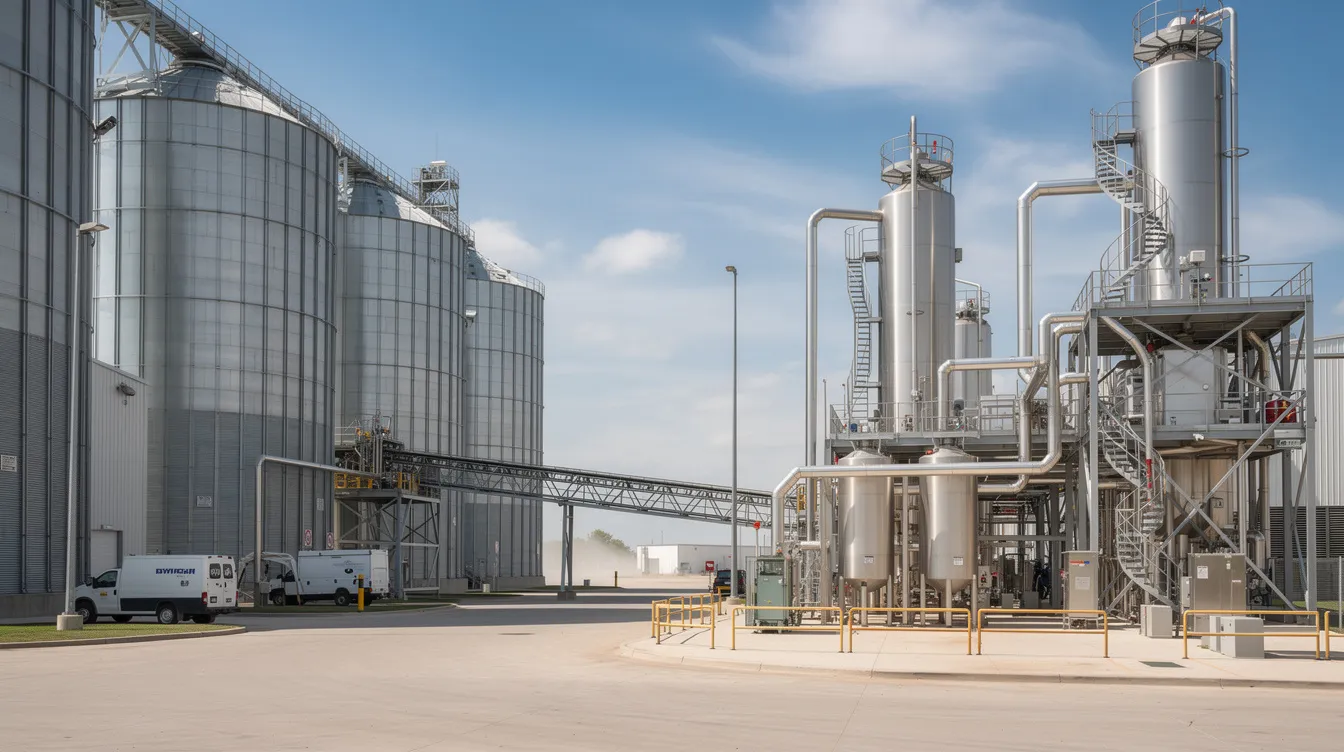
Grain-based ethanol manufacturing is first-generation bioethanol production from starch-rich grains. Ethanol production methods differ based on raw feedstock types: saccharine (sugarcane, molasses), starchy (grains) and lignocellulosic (crop residues). In the starchy route, enzyme science breaks down complex starch molecules inside grains into fermentable sugars, which yeast then converts into ethanol and carbon dioxide.
Common Indian feedstocks include maize (corn), broken rice, wheat and other legally permitted damaged foodgrains. Corn is the dominant feedstock for ethanol globally, especially in North America, while India’s grain ethanol programme leverages surplus rice stocks and maize depending on regional availability. Promoters evaluating Maize-Based Ethanol Plant Project Report & DPR in India should note that maize varieties typically contain 60-70 percent starch in dry matter, while broken rice has variable quality depending on source. Those considering rice-derived feedstock can explore the Broken Rice & Damaged Foodgrain Ethanol Plant Project Report.
Fuel grade ethanol for blending with petrol must meet stringent purity standards and is distinct from beverage-grade alcohol and industrial alcohol in terms of denaturing requirements and end use. Grain composition parameters including starch content, moisture, impurities and mycotoxin levels influence ethanol yield, DDGS quality and overall plant efficiency. High-moisture grains (above 14-15 percent) increase drying cost and reduce yield per tonne, while impurities damage mills and reduce enzyme effectiveness.
Grain-Based Ethanol Manufacturing Process Flow Chart
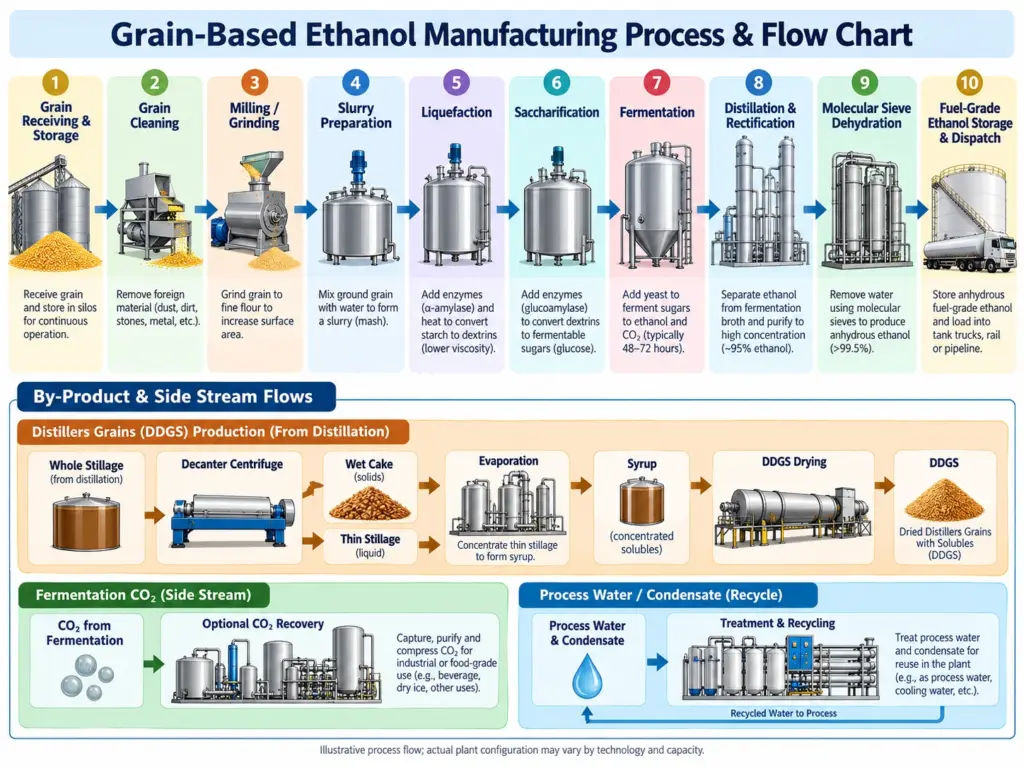
The following is a simplified grain based ethanol process flow chart for conceptual understanding and DPR preparation, not a detailed piping and instrumentation diagram. Specific technology licensors may use integrated cooking, simultaneous saccharification and fermentation (SSF), or different column configurations.
Main Ethanol Production Process:
Grain Receiving & Storage ↓ Grain Cleaning & Impurity Removal (de stoner, magnetic separators, scalpers) ↓ Grain Milling / Grinding (hammer mill) ↓ Slurry Preparation (milled flour mixed with process water) ↓ Liquefaction / Starch Gelatinisation (alpha-amylase enzyme, liquefaction tank) ↓ Saccharification / Enzymatic Hydrolysis (glucoamylase converts dextrins to glucose) ↓ Fermentation (yeast converts glucose to ethanol + CO₂) ↓ Fermented Wash / Beer Collection ↓ Distillation & Rectification (distillation columns, rectification column) ↓ Molecular Sieve Dehydration ↓ Fuel Grade Ethanol (≥99.5% purity) ↓ Quality Testing, Storage & Dispatch
By-Product Recovery Streams:
- Whole Stillage → Decanter Centrifuge → Wet Cake + Thin Stillage → Multi-Effect Evaporator (forced circulation) → Concentrated Syrup → DDGS Dryer → DDGS Storage
- CO₂ from Fermentation → Collection → Purification → Compression → Optional Liquefaction → Storage
- Process Condensate / Effluents → ETP → Evaporation / ZLD → Condensate Recycled or Safe Disposal
Ethanol production from grains broadly involves six main steps at a high level: milling, liquefaction, saccharification, fermentation, distillation and dehydration. Continuous operation across all sections, from grain handling through fermentation, distillation, DDGS processing and utilities, is critical for steady ethanol output and sound plant economics. Any bottleneck in one section, whether a slow DDGS dryer, an undersized boiler or an unreliable cooling tower, cascades into reduced throughput and higher cost per litre. This is why the ethanol plant process flow diagram must be designed as an integrated system, not a collection of independent unit operations.
Step-by-Step Grain-Based Ethanol Manufacturing Process
The following subsections describe the ethanol manufacturing process step by step, from grain intake to fuel grade ethanol dispatch. While broad steps are similar across plants, individual operating conditions such as temperature ranges, residence times and enzyme dosages vary by technology provider and must follow licensor recommendations.
Step 1 – Grain Receiving, Cleaning and Storage
Grains arrive by truck or rail, are weighed on a weighbridge, sampled and tested for moisture, foreign matter and starch content before unloading. Cleaning systems including scalpers, magnetic separators, de stoners and aspiration units remove stones, metals, husk and dust to protect downstream equipment. Storage options include steel silos or RCC warehouses with aeration and fumigation to prevent fungal growth.
In a DPR, grain inventory norms (typically 15-30 days of stock) and storage losses must be factored into working capital and project cost. Poor-quality or high-moisture grains reduce ethanol yield, may increase DDGS moisture and can cause fermentation instability, impacting both operations and financial performance.
Step 2 – Grain Milling and Particle Size Reduction
Dry-milling is the most common method for fuel ethanol production. The first step is milling the corn or other grain to meal using a hammer mill or similar equipment. Cleaned grain passes through the mill to produce uniform flour with particle size optimised for efficient slurry preparation and enzymatic action.
Too coarse a grind leads to incomplete starch exposure and lower ethanol recovery. Excessively fine grinding increases energy use, slurry viscosity and potential handling problems. For multi-feedstock plants processing maize, broken rice or wheat, mill settings and screen sizes need adjustment to suit different grain hardness and moisture levels. Dust collection and aspiration systems are essential for safety and environmental compliance.
Step 3 – Slurry Preparation
Milled grain meal is mixed with process water, and recycled thin stillage or process condensate where design permits, in slurry tanks equipped with agitators to create a homogenous mash. Slurry preparation determines mash concentration, which affects enzyme performance, pumpability, heat transfer and ultimately ethanol yield.
The mixture is pumped through flow meters with basic instrumentation for temperature and density monitoring. The optimum slurry concentration varies by technology licensor and feedstock, so no single grain-to-water ratio should be assumed universally. Dilution levels directly affect downstream steam consumption and distillation load.
Step 4 – Liquefaction and Starch Conversion
In the liquefaction section, the grain slurry is heated, often through a jet cooker or plate heat exchanger, to gelatinise starch granules. Alpha-amylase enzyme is added to partially break long-chain starch molecules into shorter dextrins, reducing mash viscosity. The liquefaction tank is filled with the heated slurry and maintained at controlled pH (typically 5.5-6.5) and temperature (70-95°C depending on design).
Equipment includes jet cookers, steam control valves, retention tubes, flash coolers and liquefaction tanks with agitators. Inefficient liquefaction from inadequate cooking, incorrect pH or insufficient enzyme leads to unconverted starch and higher residuals in DDGS instead of ethanol, reducing output per tonne of grain. The reaction must be monitored closely.
Step 5 – Saccharification Process
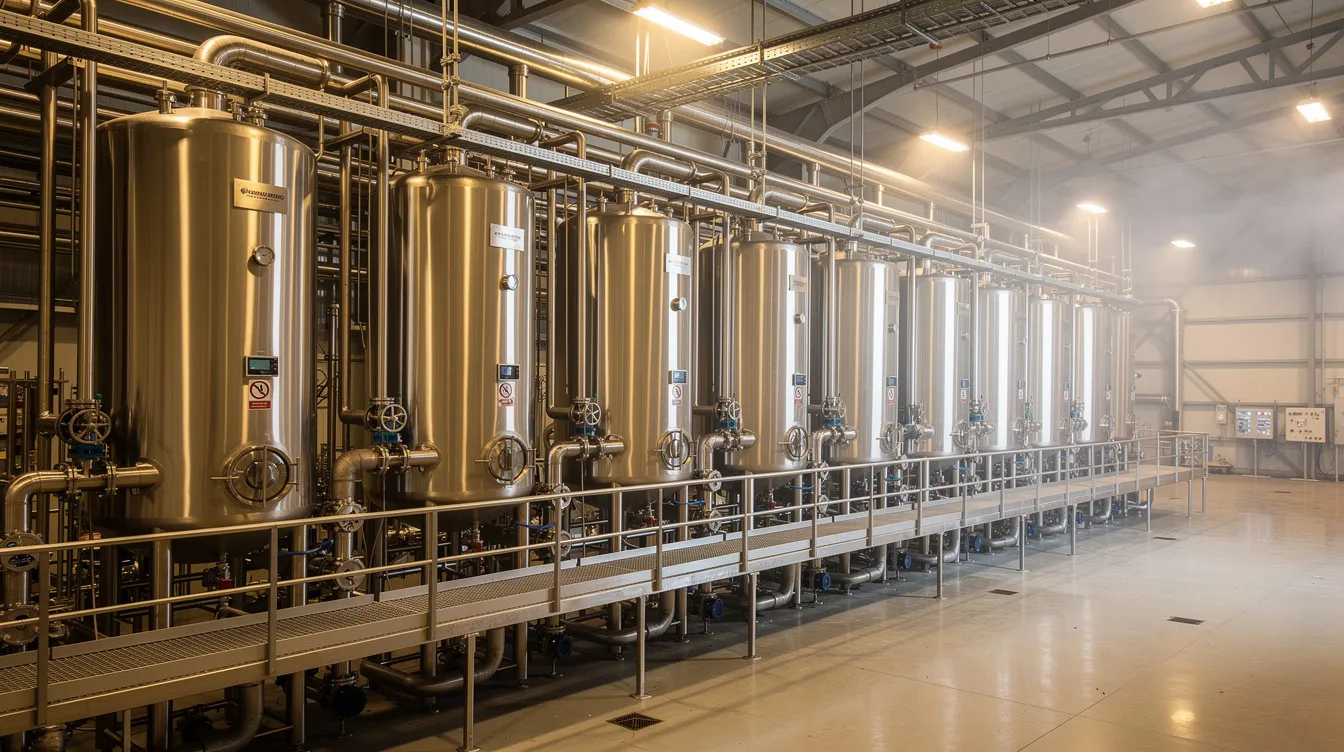
Saccharification converts dextrins into simple fermentable sugars using glucoamylase. The liquefied mash is cooled to the optimal temperature range (55-65°C) and treated with glucoamylase enzyme, which converts dextrins primarily into glucose.
Some ethanol plant technologies use separate saccharification followed by fermentation, while others prefer simultaneous saccharification and fermentation (SSF) in combined vessels. Equipment includes saccharification tanks with agitation, pH and temperature control, and dosing systems. High sugar conversion in this step is essential for good ethanol yield; low conversion translates directly into lost revenue and weaker DPR economics.
Step 6 – Fermentation Process
In the fermentation process, yeast metabolises glucose to produce ethanol and carbon dioxide. The simplified biochemical reaction is: C₆H₁₂O₆ → 2 C₂H₅OH + 2 CO₂. Yeast ferments sugar into ethanol within 72 hours, depending on technology and operating conditions.
Fermenters are large agitated tanks, cooled to maintain optimal temperature, with pH monitoring, contamination control and CIP systems. The output, called beer or fermented wash, contains ethanol, water, residual sugars, yeast cells and suspended solids. It is transferred to a beer well before distillation. The gap between theoretical ethanol yield and actual industrial recovery reflects conversion inefficiencies, evaporation losses and process upsets, all of which must be conservatively modelled in project financials.
Step 7 – Distillation and Rectification
Fermented wash from the beer well is preheated and fed to the distillation system, typically comprising multiple distillation columns including an analyser column, rectifier column and recovery or heads column. Multi-pressure distillation arrangements recover heat between columns to reduce steam consumption per litre of ethanol.
Distillation concentrates alcohol to approximately 96 percent v/v strength by separating ethanol from water using differences in boiling points. Vapors rise through the column and are condensed, while whole stillage exits from the bottom. Steam condensate and heat integration between columns are important for energy efficiency. Fusel oil, a mixture of higher alcohols, is separated as a minor by-product during rectification. However, distillation plus rectification cannot produce fully anhydrous fuel grade ethanol because of the ethanol-water azeotrope.
Step 8 – Molecular Sieve Dehydration
Molecular sieve dehydration is the industry standard for ethanol production of anhydrous fuel grade product. Dehydration processes produce anhydrous ethanol at 99 percent purity or higher for fuel use, meeting applicable Indian standards and OMC procurement requirements.
The technology uses hydrophilic adsorbent beds, often zeolite-based, that selectively adsorb water from hydrous ethanol under pressure. Beds operate in swing mode with regeneration cycles using vacuum or purge gas. A typical flow involves rectified spirit feed passing through a pre-heater, then the molecular sieve adsorption beds, and emerging as anhydrous ethanol product which is cooled before storage. Sieve life is typically 5-7 years.
Step 9 – Ethanol Storage, Quality Testing and Dispatch
Product storage uses fixed-roof or floating-roof tanks with dyke walls, flame arrestors, level gauges, nitrogen blanketing where required, and compliant fire protection systems. Key quality-control tests include strength, water content, acidity, pH, aldehydes, sulphate and conductivity.
Operational steps cover product sampling, certification, denaturing where mandated, and tank-to-tanker transfer through metering systems. Statutory compliance includes PESO norms, hazardous area classification, earthing and bonding, and record maintenance for excise and GST. Robust QC and traceability from grain to ethanol dispatch support both safety and bank confidence.
DDGS Manufacturing Process in Grain-Based Ethanol Plants
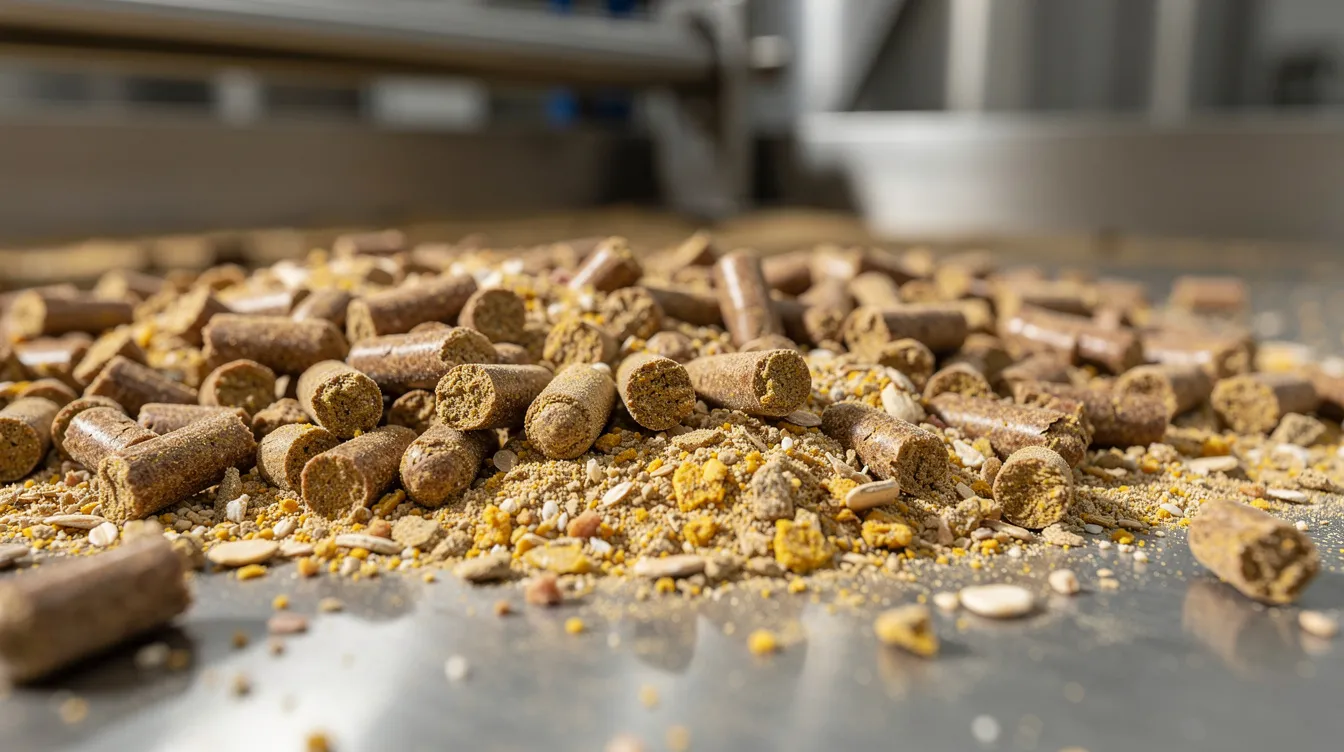
The main by-product of grain-based ethanol production is Distillers Dried Grains with Solubles (DDGS), used as a high-protein ingredient in cattle, poultry and aquaculture feed. Whole stillage from distillation is fed to decanter centrifuges, which separate it into wet cake and thin stillage (also called thin slop in some configurations).
Thin stillage is concentrated in a multi-effect evaporator using forced circulation to produce a condensed syrup, with part of the process condensate recycled as process water. The syrup is blended with wet cake and dried in rotary, ring or flash dryers to achieve target DDGS moisture below 10-12 percent. DDGS quality depends on feedstock: maize-based DDGS typically has higher protein and fat content than rice-based DDGS. Revenue from DDGS significantly affects project economics, but assumptions must be realistic and region-specific.
Carbon Dioxide Recovery and Other By-Products
Carbon dioxide is generated naturally during fermentation. Many plants currently vent this gas after basic scrubbing. Optional CO₂ recovery involves collection, foam knock-out, moisture removal, compression, purification and, where required, liquefaction into liquid CO₂ for industrial or food-grade applications.
CO₂ recovery involves additional capital and operating costs and must be justified based on local market demand and long-term offtake contracts. Other minor by-products like fusel oil and recovered oils from stillage can occasionally be separated and sold, but their contribution is usually limited. In a bankable DPR, any by-product income should be treated conservatively. ENA production (extra neutral alcohol) is a separate product category relevant to beverage-grade distilleries and typically not produced in fuel ethanol plants.
Major Machinery and Equipment Used in an Ethanol Manufacturing Plant
Equipment sizing depends on KLPD capacity, number of fermenters and chosen process configuration. The following table summarises key machinery:
| Process Section | Major Equipment | Primary Function |
|---|---|---|
| Grain Handling | Intake hoppers, bucket elevators, conveyors, cleaners, de stoners, silos | Grain storage and preparation |
| Milling | Hammer mills, aspiration and dust collection systems | Particle size reduction |
| Slurry & Liquefaction | Slurry tanks, agitators, jet cookers, heat exchangers | Starch processing and gelatinisation |
| Saccharification | Enzyme dosing systems, saccharification tanks | Sugar conversion |
| Fermentation | Fermenters, cooling systems, CIP skids, beer wells | Alcohol production |
| Distillation | Distillation columns, rectifier column, condensers | Alcohol separation and concentration |
| Dehydration | Molecular sieve units, pre-heaters, product coolers | Residual water removal |
| DDGS Processing | Decanter centrifuges, multi-effect evaporators, dryers, coolers | By-product recovery |
| Utilities | Boiler, cooling towers, air compressors, water treatment | Process support |
| Environmental | ETP, evaporation systems, ZLD equipment | Wastewater management |
Detailed machinery specifications, material of construction, automation level and vendor quotations are essential for capital cost estimation. For comprehensive equipment sizing and cost considerations, refer to Ethanol Distillery Machinery, Equipment & Cost in India.
Grain-Based Ethanol Plant Capacity and Production Planning
Typical Indian grain-based ethanol capacities include 60 KLPD, 100 KLPD, 150 KLPD and 200 KLPD, where KLPD means kilo-litres per day of installed nameplate capacity. Grain-based distilleries can produce 6.9 billion litres of ethanol by 2022-23, according to government projections, with around 150 distilleries being established or modernised across the country.
Actual annual output depends on operating days, maintenance shutdowns, feedstock availability and utility reliability. A DPR should consider 320-340 operating days per year, with capacity utilisation ramping from 70-80 percent in year one to 90-95 percent in subsequent years. Annual ethanol production is computed as: installed capacity (KLPD) × operating days × capacity utilisation percentage. Identical 100 KLPD plants can deliver different annual outputs and cost structures depending on actual utilisation and operational discipline.
Ethanol Yield from Maize, Broken Rice and Other Grains
Ethanol recovery per tonne of grain is a central determinant of project viability. Based on government policy benchmarks, approximate yields are:
| Feedstock | Indicative Yield (Litres/Tonne) | Grain per Litre (kg) | Key Consideration |
|---|---|---|---|
| Maize | ~380 | ~2.6 | Higher starch, widely available |
| Broken Rice | ~400 | ~2.5 | Variable quality, high starch |
| FCI Rice | ~450 | ~2.2 | Government-allocated surplus |
| Wheat | Variable | Variable | Regional availability |
Commercial yield is always lower than theoretical maximum due to conversion losses, residual sugars and evaporation losses. Project reports should use vendor-supported yield ranges for each specific feedstock rather than a single generic figure. Over-optimistic yield assumptions inflate projected revenues, distort DSCR and can lead to project underperformance, particularly when grain prices rise.
Multi-Feedstock Ethanol Manufacturing Technology
A multi-feedstock grain-based ethanol plant processes more than one type of grain based on seasonal availability and economics. Feedstock switching affects front-end operations including milling settings, slurry preparation parameters, enzyme combinations and liquefaction conditions. Downstream impacts include differences in fermentation performance, DDGS protein and fibre profile, and evaporator load.
A multi-grain plant is technically different from a hybrid unit designed to handle both grain and molasses, which needs additional tanks, pipelines and sometimes separate fermentation lines. Promoters evaluating flexible configurations should consider logistics, procurement contracts and price volatility alongside technical adjustability. For detailed DPR support, see the Multi-Feedstock Ethanol Distillery Project Report.
Grain-Based vs Molasses-Based Ethanol Manufacturing Process
Grain-based plants require starch conversion through liquefaction and saccharification, whereas molasses-based units ferment sugars already present in the feedstock. B heavy molasses and C heavy molasses are common molasses-based feedstocks with different sugar content and handling requirements.
| Parameter | Grain-Based | Molasses-Based |
|---|---|---|
| Feedstock | Maize, broken rice, wheat | B heavy molasses, C heavy molasses |
| Pre-treatment | Milling, liquefaction, saccharification | Dilution, pH adjustment |
| Enzyme Use | Alpha-amylase, glucoamylase | Minimal or none |
| By-products | DDGS | Spent wash, press mud |
| Steam Use | Higher (3.5-5.6 kg/L) | Lower (2.5-3.5 kg/L) |
| Feedstock Flexibility | Year-round, multiple grains | Seasonal, tied to cane crushing |
| Technology Complexity | Higher | Moderate |
For an in-depth financial and policy perspective, see Grain-Based vs Molasses-Based Ethanol – Cost & Viability in India.
Utility Requirements for Grain-Based Ethanol Manufacturing
Major utilities include steam, electrical power, process water, cooling water, compressed air and boiler fuel (coal, biomass, briquettes). Steam consumption across the plant ranges from 3.5 to 5.6 kg per litre of ethanol produced, covering liquefaction, distillation reboilers, evaporation and DDGS drying. A practical design for a 60 KLPD plant shows steam breakdown as: liquefaction ~0.7 kg/L, distillation ~1.8 kg/L, molecular sieve dehydration ~0.55 kg/L, evaporation ~1.0 kg/L, DDGS dryer ~1.6 kg/L. Boiler sizing for such plants is approximately 15-18 TPH at 45 kg/cm² pressure.
Electrical power consumption ranges from 0.35 to 0.55 kWh per litre. Process water internal consumption is typically 3-5 litres per litre of ethanol in modern plants. PLC and SCADA systems are essential for stable utility operation and energy efficiency monitoring. In financial modelling, specific steam, power and water benchmarks must align with licensor guarantees and be tested through sensitivity analysis.
Water Consumption, Effluent Treatment and Zero Liquid Discharge
Modern grain-based ethanol plants reduce net water intake by maximising condensate recovery, recycling process water and optimising cooling-tower cycles. Major wastewater streams include thin stillage not converted into DDGS, evaporator condensate, spent wash from distillation, boiler and cooling tower blowdown.
Typical treatment schemes involve equalisation, anaerobic and aerobic biological treatment, clarification and filtration. ZLD configurations concentrate remaining high-COD streams in multi-effect evaporators under vacuum and mix concentrated solids into DDGS or approved disposal routes. Design must comply with CPCB guidelines and State Pollution Control Board norms. Non-compliance risks plant shutdowns and materially affects loan servicing capacity.
Quality Control and Process Monitoring
Consistent fuel grade ethanol production depends on continuous monitoring at each stage:
| Process Stage | Parameter Monitored | Why It Matters |
|---|---|---|
| Grain Receiving | Moisture, starch content, impurities | Determines yield potential |
| Slurry | Specific gravity, temperature | Affects enzyme performance |
| Liquefaction | pH, temperature, DE value | Ensures starch conversion |
| Saccharification | Dextrose equivalent, residual starch | Maximises fermentable sugars |
| Fermentation | Alcohol content, pH, temperature | Controls ethanol yield |
| Distillation | Column pressure, reflux ratio | Maintains separation efficiency |
| Dehydration | Product purity, water content | Meets fuel grade specifications |
| DDGS | Moisture, protein content | Determines market value |
PLC/SCADA systems with online analysers and laboratory instruments help maintain the process within narrow control limits. Well-documented quality procedures support project credibility before banks and regulatory agencies.
Grain-Based Ethanol Plant Setup Cost – Technical Factors Affecting Investment
Total project cost depends strongly on process configuration and technology choices. Major cost drivers include capacity (scaling from 60 to 200 KLPD), degree of process integration, automation level, number of fermenters, distillation complexity, DDGS dryer type, CO₂ recovery provisions, ETP/ZLD systems, boiler and power plant, and civil structures.
Choosing high-efficiency but more capital-intensive equipment can lower steam and power consumption, improving long-term profitability. This trade-off must be analysed in feasibility and IRR calculations. Land development, buildings, fire-fighting systems and pre-operative expenses must all be captured accurately. For benchmark investment ranges, refer to Grain-Based Ethanol Plant Setup Cost in India.
How Manufacturing Efficiency Affects Ethanol Project Profitability
From a project finance viewpoint, small improvements in manufacturing efficiency can meaningfully change DSCR, IRR and payback period. Grain ethanol is priced at 52.95 Rs per litre in India under certain procurement conditions, which sets the revenue baseline. The benefits of achieving even marginally higher yield per tonne or lower steam consumption are significant at scale.
Contribution per litre = Ethanol sales realisation + Net by-product realisation − Variable manufacturing costs (grain, utilities, enzymes, consumables)
Core profitability levers include feedstock cost per tonne, ethanol yield per tonne, DDGS realisation, specific steam and power consumption, and plant utilisation percentage. Joint costs must be reasonably allocated between ethanol and DDGS. Sensitivity analysis should routinely examine higher grain prices, lower ethanol recovery, reduced DDGS prices, slower capacity ramp-up and increased utility tariffs. Conservative but realistic assumptions improve the reliability of financial projections.
Manufacturing Process Details Required in a Bankable Ethanol Plant DPR
Banks require a technically coherent description of the manufacturing process accompanied by data-driven mass and energy balances. Key technical inclusions are: raw material and product specifications, detailed process flow diagram, mass balance, utility balance, machinery and equipment list with quotations, layout concept, implementation schedule and environmental compliance plans.
These assumptions must connect with financial sections covering production capacity, operating days, yield, utility consumption, manpower, maintenance and environmental compliance costs. Financial projections are essential for assessing the viability of projects, and investor pitch decks are critical for securing funding and investor interest. Project finance firms provide customised financial modelling and feasibility studies to support these requirements.
Promoters can seek professional support through Bank Finance DPR & Loan Proposal Assistance and CMA Data Preparation Services. No consultant can guarantee loan sanction or future profits, but consistency between engineering assumptions and financial projections is essential.
Common Technical and Commercial Challenges in Grain-Based Ethanol Manufacturing
Key technical challenges include seasonal variation in grain quality, higher-than-expected moisture or impurities, starch content variability, fermentation contamination or stuck fermentation, distillation column scaling or molecular sieve fouling, and DDGS dryer bottlenecks.
Commercial risks encompass grain price volatility, competition from other grain users (particularly the poultry and feed industries), changes in government policy on grain diversion, variations in ethanol procurement prices and evolving environmental norms. Operational risks include unplanned shutdowns from boiler or power failures and human-resource constraints in maintaining continuous 24/7 operations.
Mitigation strategies include long-term grain procurement contracts, preventive maintenance schedules, adequate spares inventory, operator training and robust automation. Promoters should incorporate contingencies, conservative utilisation in initial years and appropriate insurance covers in their DPR and financing plan.
Frequently Asked Questions
What is the basic grain-based ethanol manufacturing process in simple terms?
Grains are cleaned and milled into meal, mixed with water to form slurry, heated and treated with enzymes to convert starch into sugars, fermented with yeast to produce a low-strength alcoholic beer, then distilled and dehydrated through molecular sieve dehydration to obtain fuel grade ethanol. The stillage from distillation is concentrated and dried to produce DDGS as a valuable feed by-product.
Can one ethanol plant use both maize and broken rice as feedstock?
Modern multi-feedstock plants can process maize, broken rice and other permitted grains in the same equipment. However, front-end operations including milling, slurry preparation and enzyme dosing must be adjusted each time the feedstock changes. The plant should be designed upfront as a flexible multi-grain unit for the future, with appropriate operational flexibility built into the process design.
Is CO₂ recovery compulsory in a grain-based ethanol plant?
CO₂ recovery is not technically compulsory. Many plants initially vent fermentation CO₂ after basic scrubbing due to additional capital and operating costs. Promoters should evaluate regional CO₂ demand, pricing and offtake agreements before including a recovery unit in the project cost.
How important is DDGS revenue for project viability?
DDGS is usually the second-largest revenue stream after ethanol and can significantly improve contribution per litre when marketed properly. However, DPRs should use realistic DDGS price assumptions based on local feed markets and grain choice. Over-optimistic DDGS projections can distort feasibility analysis.
Why does a bank insist on detailed mass and energy balances in the DPR?
Mass and energy balances show quantitatively how much grain, water, steam and power are required to produce each litre of ethanol and each tonne of DDGS. These figures underlie cost estimates, working capital needs and cash-flow projections, helping banks assess whether the proposed plant can service its loans under reasonable operating conditions.
Conclusion – Planning an Efficient and Bankable Grain-Based Ethanol Plant
Successful grain based ethanol manufacturing in India depends on efficient conversion of grain starch to fermentable sugars and ethanol, robust DDGS recovery, optimised steam and power usage, and reliable environmental management. Technology selection covering liquefaction and saccharification systems, fermentation configuration, multi-pressure distillation and molecular sieve dehydration must be aligned with feedstock availability, desired capacity and financial constraints.
From a professional project finance viewpoint, bankable project reports must transparently integrate technical process assumptions with realistic financial projections covering project cost, means of finance, working capital, DSCR, break-even and sensitivity analysis. While expert planning and sound manufacturing processes increase the chances of success, ethanol projects remain subject to market, policy and operational risks, and no consultant can guarantee returns or bank sanction.
Planning a Grain-Based Ethanol Manufacturing Plant in India?
Project Report Bank, led by CA Manish Gugliya, FCA, DISA (ICAI), provides customised Detailed Project Reports, CMA Data preparation, financial projections, feasibility studies and project finance advisory for manufacturing and industrial projects. Serious promoters planning 60-200 KLPD grain-based ethanol plants are welcome to discuss their proposed capacity, feedstock selection, location and financing requirements through the website’s WhatsApp enquiry facility.