
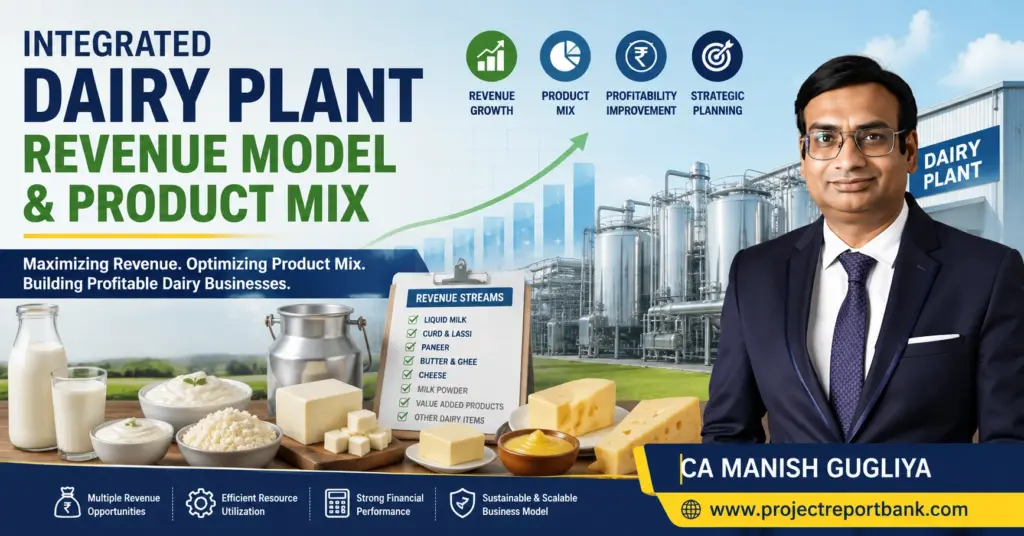
The financial performance of an integrated dairy processing plant depends not merely on how much milk it can handle but on how that milk is converted into a commercially viable mix of products. Two plants with identical installed capacity can produce vastly different returns depending on their product selection, pricing strategy and operational discipline. This guide, written from a DPR and project finance perspective, breaks down how the revenue model actually works.
Key Takeaways
- An integrated dairy plant earns revenue from multiple dairy plant revenue streams-packaged milk, curd, paneer, ghee, cheese, flavored milk, UHT milk and more-each with different yields, margins and working-capital profiles.
- Two dairy plants with the same 1 LLPD or 2 LLPD capacity can have very different turnover, gross margin and dairy plant ROI based purely on their chosen product mix and net realisation strategy.
- The integrated dairy plant revenue model is built on product-wise yields, realistic capacity utilisation ramp-up, selling prices net of distributor margins, and disciplined working-capital planning-not on consumer MRP or 100% utilisation assumptions.
- Milk procurement quality, fat and SNF profile, seasonality and milk collection infrastructure directly limit or enable profitable value-added dairy products like paneer, ghee, cheese and UHT milk.
- Profitability in integrated dairy plants depends on optimizing the product mix and production efficiency, and this article approaches the topic from a DPR, project finance and bank appraisal perspective to help entrepreneurs structure a financially viable dairy processing plant revenue model.
What Is an Integrated Dairy Plant Revenue Model?
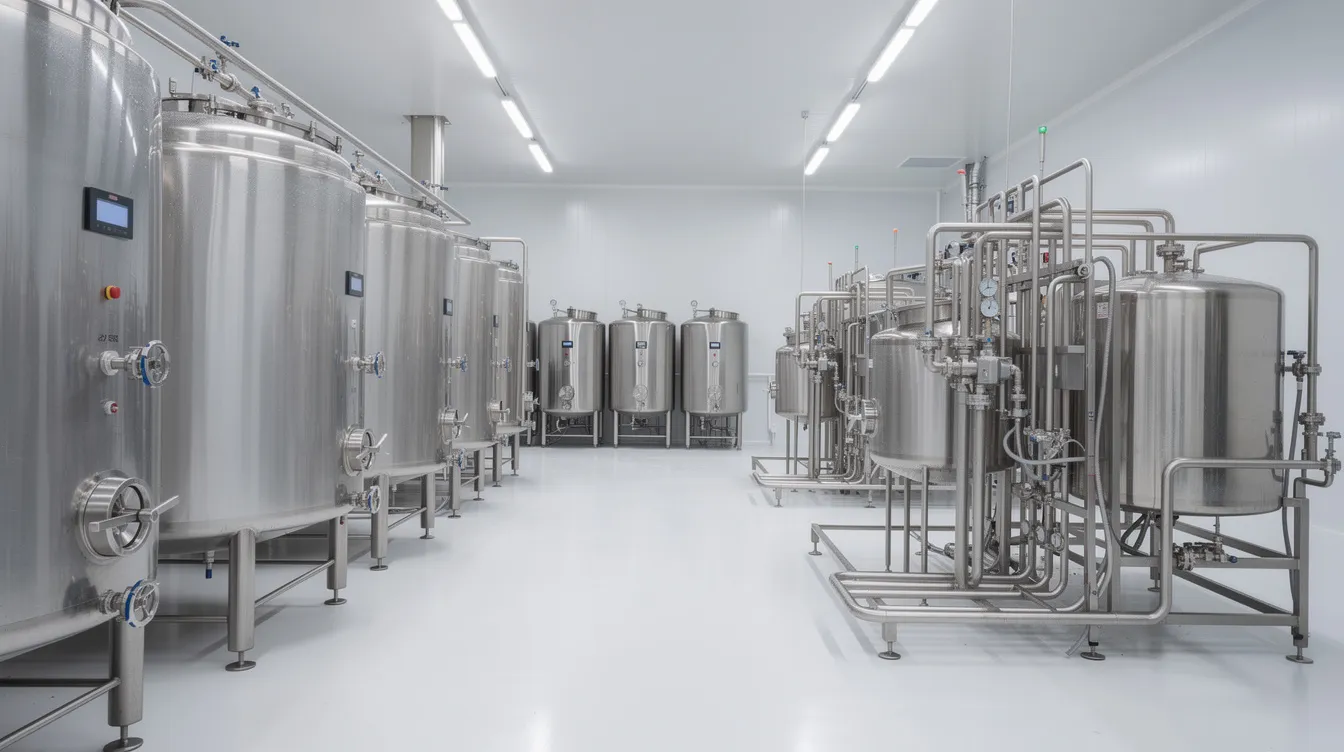
An integrated dairy processing plant is a single milk processing unit that converts procured raw milk into multiple dairy products-packaged pasteurised milk, curd, paneer, ghee, butter, cream, cheese, flavored milk, UHT milk, milk powder and other finished products. Unlike a simple chilling or pouch-packing operation, an integrated plant captures value at multiple processing stages.
The integrated dairy plant revenue model describes how this dairy plant earns income from different revenue streams, based on product-wise allocation of milk, conversion yields, selling prices and capacity utilisation. “Integrated” does not mean the plant must manufacture every possible dairy product. The practical dairy plant product portfolio should match local demand, available technology, capital availability and distribution strength.
Revenue is not determined solely by installed capacity. A 1 LLPD plant routing 80% of milk into pouched liquid milk will have a fundamentally different turnover and margin profile than one allocating 40% to value-added products. For a professional integrated dairy plant project report, the promoter must translate technical configurations and milk flows into realistic dairy plant financial projections supported by defensible sales assumptions.
Major Revenue Streams in an Integrated Dairy Processing Plant
Every integrated dairy plant in India can potentially generate income from the following categories of products. Not every plant will manufacture all of them-selection depends on feasibility study findings, market conditions, machinery investment and operational capability.
Liquid Milk Revenue. Packaged pasteurised milk, standardised milk, toned and double-toned milk form the backbone. Liquid milk sales generate stable income and are typically lower-margin-EBITDA around 4–6% according to CRISIL sector research-but this line is critical for daily cash flow, brand visibility and base plant utilisation. High daily milk throughput reduces per-unit processing and packaging costs.
Fresh Dairy Products. Curd, dahi, lassi, buttermilk, paneer and fresh cream offer better margins than plain milk. Urban consumers prefer brandable dairy products with hygiene standards, and institutional demand from hotels, restaurants and caterers is strong. However, cold chain integrity prevents spoilage and extends product shelf life, making reliable refrigerated distribution non negotiable for this category.
Fat-Based Products. Butter, white butter, table butter and ghee allow the plant to monetise milk fat efficiently. Ghee yield is approximately 1 kg from 18 litres of milk at around 6% fat content. These products help absorb seasonal fat surpluses during flush season and can be stored longer than fresh items.
Value-Added Dairy Products. Processed cheese, mozzarella, cheese slices, flavored milk, probiotic curd and premium paneer carry higher realisation and margins-cheese EBITDA can reach 11–13%, specialty cheese 16–18%. However, they require more complex dairy processing equipment, branding investment and marketing effort. Value-added products significantly boost profitability in dairy processing when executed well.
Longer Shelf-Life Products. UHT milk and ambient dairy beverages reduce wastage risk and enable distribution to distant markets without continuous cold chain. The trade-off is high CAPEX for aseptic processing and packaging systems, plus the need for strong branding to justify premium pricing.
Milk Powder and Milk Solids. Skimmed milk powder (SMP), whole milk powder (WMP) and dairy whitener serve as buffer products during flush season when total milk production exceeds fresh-product demand. Approximately 10.5 litres of skim milk yield 1 kg SMP. However, drying plants demand very high machinery cost, heavy steam and power loads, and access to institutional buyers-not advisable for every project. India’s dairy export is steadily increasing, and high-demand products include ghee, SMP and whey protein for international markets.
Other Income. Byproduct utilization is essential for maximizing efficiency: sale of whey from paneer or cheese manufacturing, cream sold to third parties, contract or third-party processing, and private-label manufacturing for retail brands. Secondary revenue from selling agri-inputs and services to local dairy farmers is common in integrated operations. Three essential licenses are required for dairy processing plants-FSSAI Manufacturing License (mandatory for dairy operations), State Pollution Control Board NOC, and local trade licenses from municipal authorities. GST registration is required if turnover exceeds ₹20 lakhs annually.
Dairy Plant Product Mix – Why It Matters
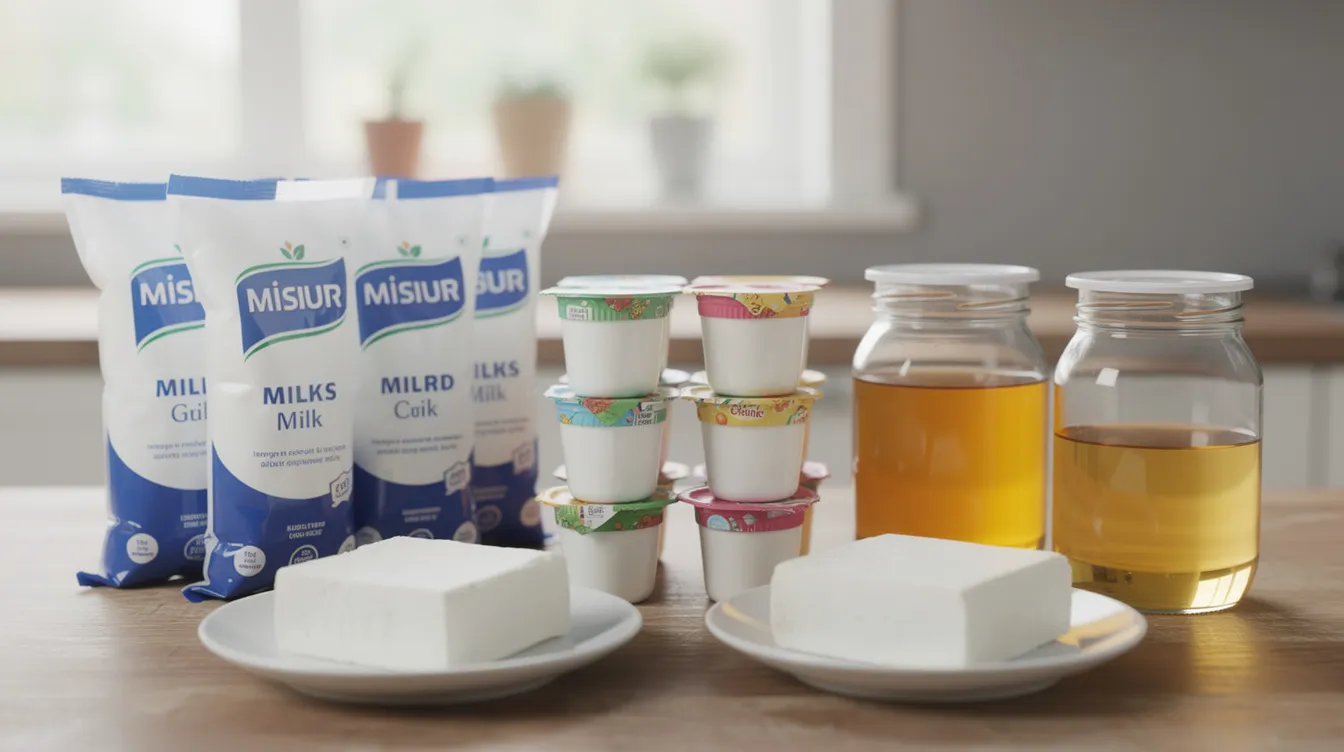
Product mix refers to the percentage of total daily milk input routed to each product line. For example, a plant might direct 60% to liquid milk, 20% to curd, 10% to paneer, and 10% to ghee and other value-added items. This allocation is the single most important commercial decision in the dairy plant business model.
Consider a simple illustrative assumption: a 1,00,000 litres per day milk processing plant allocating milk among packaged milk, curd, paneer, ghee/butter and other value-added dairy products. Even with a relatively modest share going to higher-value lines, the revenue contribution from those lines can be disproportionately large compared to their milk allocation.
The product mix affects not only total revenue but also dairy plant profit margin, gross margin, working-capital cycle, distribution requirements and risk profile. An integrated dairy plant controls the entire supply chain from milk procurement to retail distribution, and diversifying output allows integrated dairy plants to capture margins at multiple stages. For bank appraisal, a coherent, well-argued product mix is more credible than an over-diversified list without clear volume and sales assumptions. Actual product mix must be finalised only after a proper technical and market feasibility study.
Illustrative Product-Mix Table and Revenue Characteristics
The following table illustrates how different product categories consume milk and generate revenue for a hypothetical 1,00,000 LPD integrated plant. All figures are illustrative assumptions only.
| Product Category | Indicative Milk Allocation | Revenue Characteristic | Margin Characteristic | Shelf-Life | Distribution Requirement |
|---|---|---|---|---|---|
| Packaged Liquid Milk | 55–65% | High volume, moderate value | Low (4–6% EBITDA) | Short (2–5 days) | Local cold chain, daily delivery |
| Curd / Dahi / Lassi | 10–15% | Moderate volume, good value | Medium (10–12% EBITDA) | Short (7–15 days) | Local cold chain |
| Paneer | 5–10% | Lower volume, high per-unit value | Medium-High (20–40% gross) | Short (5–10 days) | Cold chain, institutional + retail |
| Ghee / Butter | 5–10% | Moderate volume, strong value | Medium (6–10% EBITDA) | Long (6–12 months for ghee) | Ambient storage feasible |
| Value-Added / UHT / Flavored | 5–10% | Lower volume, highest per-unit value | Higher (11–18% EBITDA) | Medium-Long | Wider geography possible |
Even with only 5–10% of milk allocated to paneer or cheese, these lines can contribute 12–20% of total turnover due to higher net realisation per litre. Product-wise yields, fat and SNF usage, and local pricing will change these percentages in every real DPR. This table is a conceptual tool for understanding the integrated dairy plant revenue model-not a standard industry benchmark.
Volume vs Value-Added Strategy in Dairy Plant Revenue Streams
A volume-driven strategy dominated by packaged liquid milk offers predictable daily cash flow but relatively thin margins, intense competition and price sensitivity. A value-added strategy tilts toward paneer, cheese, ghee and flavored milk, offering higher margin per litre of milk but requiring more complex processing, packaging and marketing infrastructure. Integrated dairy models can improve margins compared to traditional milk-only sales by capturing additional value.
Paneer and ghee offer profit margins of 20 to 40 percent at the gross level, while liquid milk operations typically break even in 18 to 24 months. Value-added products achieve full ROI in 3 to 5 years. Core revenue sources for integrated dairy include liquid milk sales and value-added products working together.
Key cost factors beyond selling price include: product yield (approximately 5 litres of milk per kg of paneer, 18 litres per kg of ghee), fat and SNF usage, ingredient costs (cultures, flavours, stabilisers), packaging material, labour, energy consumption, refrigeration load, and distribution and dealer margins. Short shelf-life products like curd, lassi and paneer face higher market returns and wastage, which must be factored into the dairy plant financial model. Good packaging communicates quality to customers before purchase and directly influences retail acceptance.
A balanced dairy plant product mix combines the stability of high-volume milk sales with the profitability of value-added dairy products. Direct-to-consumer sales enable dairy plants to bypass distributor margins and capture retail markups-local dairy brands should prioritize fresh product delivery. Using WhatsApp Business can streamline order processing with local retailers, and optimizing Google Business Profile enhances local search visibility for regional dairy brands.
Product Yield, Capacity Utilisation and Revenue Calculation
Accurate DPR projections depend on realistic product-wise yields and saleable output. Two essential formulas apply:
- Annual Sales Volume = Daily Saleable Production × Operating Days × Capacity Utilisation
- Annual Product Revenue = Annual Saleable Quantity × Average Net Realisation per unit
Net realisation should be calculated at the dairy plant level after deducting distributor margins (8–12%), retailer margins (15–20%), scheme discounts and trade deductions-not at consumer MRP. Using MRP as plant realisation is one of the most common and damaging errors in dairy plant financial projections.
Capacity utilisation should ramp up over time. Industry evidence suggests 40–60% in Year 1, progressing to 70–85% by Year 3, depending on milk procurement capability, market penetration, brand building and distribution width. Capacity utilization is crucial for reducing per-unit processing and packaging costs. For a dairy plant DPR for bank loan, promoters must present year-wise projections that reflect achievable market absorption. Optimistic yields that ignore processing losses, whey losses or rejection will make dairy plant profitability look artificially high and reduce credibility with lenders.
Milk Procurement, Seasonality and Their Impact on Product Mix
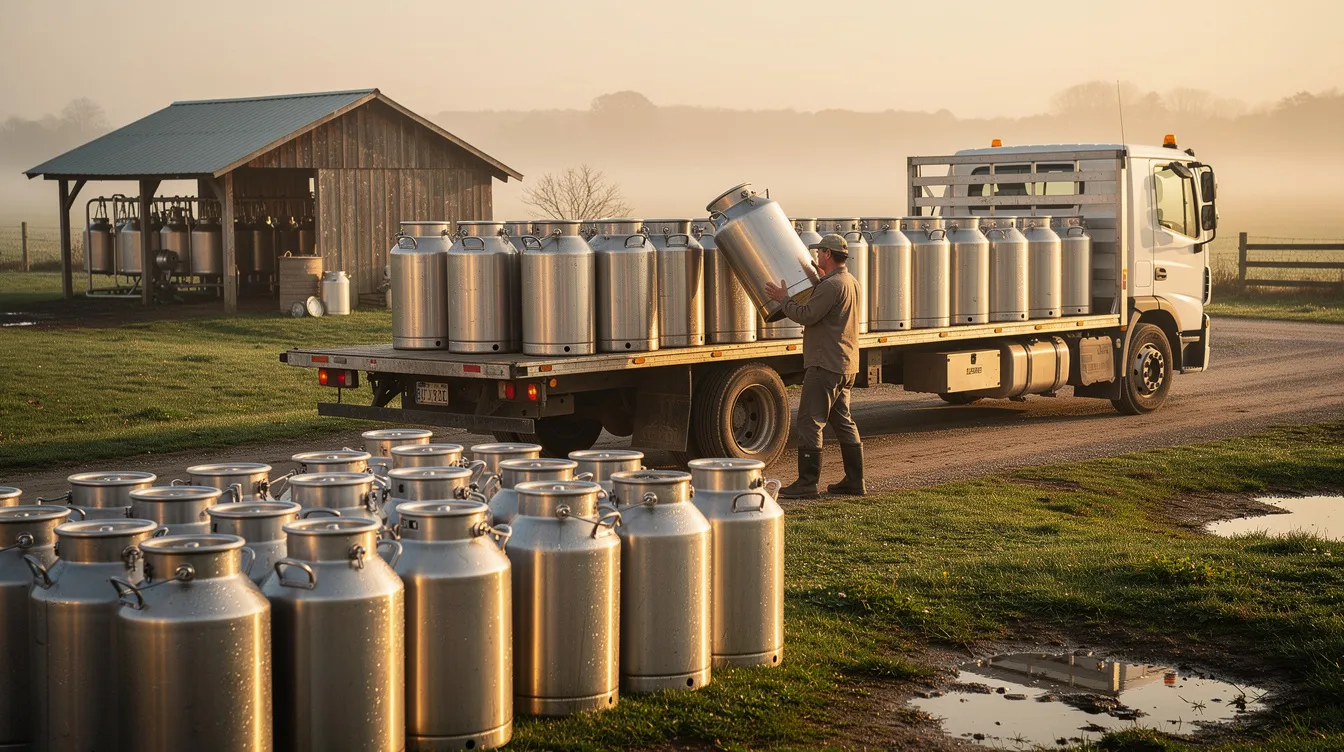
No integrated dairy plant revenue model is valid unless it aligns with actual milk procurement volume, milk quality, fat and SNF profile, and seasonal availability. Effective procurement strategies include sourcing raw milk directly from farmer cooperatives and establishing trust with local dairy farmers, which boosts loyalty and supply reliability.
Managing seasonal milk supply variations impacts dairy pricing and profitability-plants may increase ghee or SMP production when milk is abundant during flush season and focus on fresh products in lean months. Procurement price per litre, payment terms to raw milk suppliers and dairy farmers, and milk quality (fat, SNF, bacterial load including harmful bacteria) determine the true raw material cost. Weaker procurement systems force dependence on traders and tanker milk, narrowing margins. For detailed guidance on building a reliable procurement network, refer to the article on milk collection and procurement infrastructure for a dairy plant.
Linking Product Mix with Capacity, Machinery, Utilities and Project Cost
The chosen product mix directly shapes every other dimension of the project:
- Capacity planning: Higher-value products may not require the same sale volume as pure milk plants to achieve target turnover. A well-selected mix can justify smaller capacity while maintaining strong returns. See the detailed guide on dairy plant capacity planning for scale-wise analysis.
- Machinery: Paneer, ghee, cheese, UHT milk and milk powder each require dedicated processing and packing equipment. This is covered in depth in the article on dairy processing plant machinery and equipment cost.
- Utilities: Energy management significantly affects the gross margins of dairy processing. Different products have different power, steam, refrigeration and water supply intensity. Detailed requirements are discussed in the guide on power, water, steam, refrigeration and ETP requirements for a dairy plant.
- Land and building: Additional product lines require extra production areas, cold rooms, warehousing and quality control laboratories. Refer to the article on dairy plant land, building and infrastructure requirements.
- Project cost and finance: Product mix directly affects total investment, working capital and funding structure. A small dairy processing plant costs ₹20 to ₹30 lakhs, while a larger 2,000-litre-per-day unit costs ₹50 to ₹70 lakhs. For comprehensive guidance, see articles on integrated dairy processing plant setup cost in India and dairy plant project cost and means of finance. The PMFME scheme offers grants up to ₹10 lakhs, NABARD’s scheme provides 25% to 33.33% capital subsidy, and various state governments offer reduced land costs for dairy businesses through state-level programs supporting dairy entrepreneurs in India. Government subsidies and financial assistance can meaningfully reduce the promoter’s equity requirement.
A diversified dairy plant product mix can raise project cost significantly, so the integrated dairy plant project report must demonstrate commensurate revenue, margins and DSCR to justify the total expenses and total investment.
Illustrative Integrated Dairy Processing Plant Revenue Model
Illustrative Example – Not a Standard Industry Benchmark
Assumptions: 1,00,000 LPD installed capacity, Year 3 stabilised operations at approximately 80% capacity utilisation (80,000 LPD effective), 310 operating days per year.
| Product | Milk Allocation (LPD) | Approx. Saleable Output/Day | Illustrative Net Realisation | Indicative Annual Revenue (₹ Lakh) |
|---|---|---|---|---|
| Packaged Milk | 48,000 L | 48,000 litres | ₹38/L | ₹5,654 |
| Curd / Dahi | 12,000 L | 12,000 kg | ₹48/kg | ₹1,786 |
| Paneer | 8,000 L | 1,600 kg | ₹220/kg | ₹1,091 |
| Ghee | 7,000 L | ~389 kg | ₹420/kg | ₹506 |
| Flavored Milk / UHT | 5,000 L | 5,000 units (200ml) | ₹12/unit | ₹186 |
| Total | 80,000 L | – | – | ≈ ₹9,223 |
Key observations: Liquid milk, despite consuming 60% of milk input, generates roughly 61% of revenue. Paneer, using only 10% of milk, contributes about 12% of turnover due to higher per-unit realisation. Yield optimization maximizes the efficiency of converting milk solids into higher-value products. Actual selling prices vary depending on geography, brand, packaging size and B2B versus retail channel mix. Dairy products can achieve profit margins of 20 to 40 percent at the product level, but plant-level EBITDA will be lower after operating costs and operational expenses.
Revenue Mix, Gross Margin, Working Capital and Risk
The distinction between milk allocation percentage and revenue contribution percentage is critical. Value-added dairy products produce a disproportionately higher share of turnover relative to their milk input-this is precisely why the dairy plant product mix matters more than raw capacity.
A simple contribution analysis framework:
Revenue – Raw Milk Cost – Other Ingredients – Packaging – Variable Processing & Utilities – Variable Selling/Distribution = Product Contribution
Fixed expenses and finance costs sit below this line. Independently managing production and distribution enhances profitability in an integrated dairy system.
Key working-capital considerations include: daily raw milk payments (often within 7–15 days to local dairy farmers and cooperatives), packaging inventory, finished products held in cold storage, distributor and retailer credit, and institutional credit terms. Short shelf-life fresh products generate faster cash turnovers but higher wastage risk, while cheese or UHT milk involve longer inventory cycles with higher working-capital locking.
Promoters should examine dairy plant turnover calculation, break-even position, DSCR and sensitivity analysis-for example, the impact of a 5–10% change in milk price or selling price-before finalising the product mix. Integrated dairy operations can recycle waste for energy production and fertilizer, adding marginal but real value. Avoid over-dependence on a single product or conversely over-loading the mix with niche items without proven demand.
Revenue Projections, Bank Appraisal Perspective and Product-Mix Selection Framework
For revenue projections in a dairy plant DPR, the following inputs must be defined product-wise: installed capacity, achievable capacity utilisation by year, yield assumptions, operating days, net realisation, price-escalation assumptions, channel mix and expected returns or wastage.
From a bank appraisal perspective, lenders typically examine: reasonableness of proposed capacity versus milk availability, credibility of milk procurement arrangements with local dairy farmers and dairy farms, realism of proposed product mix for market conditions, justifiable pricing and margin assumptions, and alignment between projected turnover, working-capital needs, repayment obligations and DSCR. Safety standards and quality control systems must meet high standards including FSSAI compliance.
Common revenue-projection mistakes to avoid:
- Using consumer MRP as plant realisation
- Assuming 100% capacity utilisation from Year 1
- Ignoring distributor margins and trade schemes
- Underestimating packaging and utility costs
- Assuming unrealistic product yields with zero processing losses
- Adding too many products without matching machinery and infrastructure
Practical framework for selecting the right dairy plant product mix:
- Local milk availability and fat/SNF profile from dairy farms
- Existing competition and market demand
- Consumer preferences and shelf-life constraints
- Cold-chain and supply chain strength
- Total investment capacity and working capital tolerance
- Expected contribution per litre of milk
- Promoter’s marketing, operational capability and five years business vision
Strategic planning around these factors allows promoters to explore opportunities while managing risk effectively.
Conclusion – Integrating Product Mix with Overall Dairy Plant Viability
A sound integrated dairy plant revenue model connects milk availability, processing capacity, product mix, pricing, margins, utilities, working capital and market demand into one coherent business plan. The dairy industry in India offers substantial opportunity-total milk production continues to grow at 4–5% annually-but success depends on how well promoters operate and manage their dairy business rather than on capacity alone.
The objective is not to manufacture the maximum possible number of milk products but to design a commercially sustainable mix that balances volume, value-added items, risk profile and operational complexity. Dairy plant profitability estimates should withstand scrutiny from lenders and investors, not serve as reverse-engineered figures to achieve a desired ROI.
CA Manish Gugliya assists entrepreneurs, MSMEs and companies in preparing integrated dairy plant project reports, financial models, CMA Data and bank-loan documentation for dairy processing and other industrial projects through ProjectReportBank.com. If you are evaluating the viability of a dairy processing plant-whether a focused 20,000 LPD unit or a large-scale integrated facility-professional DPR preparation can help you establish a bankable, well-structured project from the outset.
Frequently Asked Questions (FAQs)
The following questions address practical doubts that promoters commonly raise when preparing their dairy plant DPR and revenue projections.
How much of my milk should go into liquid milk versus value-added products?
There is no fixed ideal percentage-it depends on local demand, brand strength, cold-chain reach, procurement price and investment capacity. Many integrated plants initially allocate more than 50% to packaged milk for market presence and gradually increase the share of curd, paneer, ghee and other value-added dairy products as sales channels mature and the companies establish distribution networks.
Can a small dairy processing plant (e.g., 20,000 LPD) be truly integrated and profitable?
Yes. Even a 10,000–20,000 LPD plant can operate as an integrated unit by handling a focused mix-packaged milk, curd, paneer and ghee. Profitability depends more on well-chosen products, efficient dairy operations and realistic pricing than on very large capacity. Over-diversification at small scale can increase costs and hurt margins rather than help.
Is it necessary to include milk powder in every integrated dairy plant project?
Milk powder or drying facilities are not mandatory. They require very high CAPEX, strong steam and power supply, and access to buyers who can absorb SMP or WMP at viable prices. Many successful integrated dairy plants in India run profitably without a powder plant by focusing on liquid milk and fresh or value-added products.
How often should I revise my selling prices and product mix in practice?
Formally review selling prices and product mix at least annually in the DPR and financial model. Track milk prices, competitor pricing and product-wise contribution monthly or quarterly. Frequent small price adjustments and tactical changes in mix-for example, more ghee production in flush season-are standard practice in professionally managed dairy plants.
At what stage should I involve a DPR and project finance consultant for my dairy plant?
Involve a professional consultant once preliminary feasibility-milk availability, broad demand and location-is positively established, but before finalising equipment orders or large civil construction. An experienced Chartered Accountant and project finance professional can help align capacity, product mix, revenue model, funding structure and bankability through a structured integrated dairy plant project report.
📊 Operations & Financial Planning: Utilities | Revenue Model & Product Mix | Financial Projections | Working Capital | CMA Data | DSCR & Repayment Capacity
🏦 Bank Finance, Viability & Returns: Bank Loan & Project Finance | Term Loan Assessment | Feasibility & Viability | Break-Even Analysis | ROI, IRR & Payback | Sensitivity & Risk Analysis