
Key Takeaways
- LLPD stands for Lakh Litres Per Day; 1 LLPD = 1,00,000 litres/day. Installed capacity is different from actual milk handled or sold on any given day.
- Choosing between a 1 LLPD, 2 LLPD, 5 LLPD or 10+ LLPD dairy processing plant depends jointly on milk procurement potential, market demand, product mix, capital and working capital strength.
- Over-sized plants suffer from low capacity utilisation, high fixed costs and weak DSCR; under-sized plants face lost procurement opportunities and costly future expansions.
- Capacity planning must integrate procurement planning, processing lines, utilities, cold chain, distribution and project finance rather than treating each item in isolation.
- A professional DPR and financial model are essential to test different capacity scenarios before committing crores of rupees to a milk processing plant.
Introduction – Why Dairy Plant Capacity Planning Matters
In the Indian dairy industry, selecting the right plant size is often a more consequential decision than choosing a machinery brand or exact location. Effective capacity planning in a dairy plant is critical due to the perishable nature of milk; raw milk must be processed quickly to prevent spoilage, and every hour of delay increases the risk of contamination and bacterial growth. A mismatch between installed capacity and actual operations can erode profitability for years.
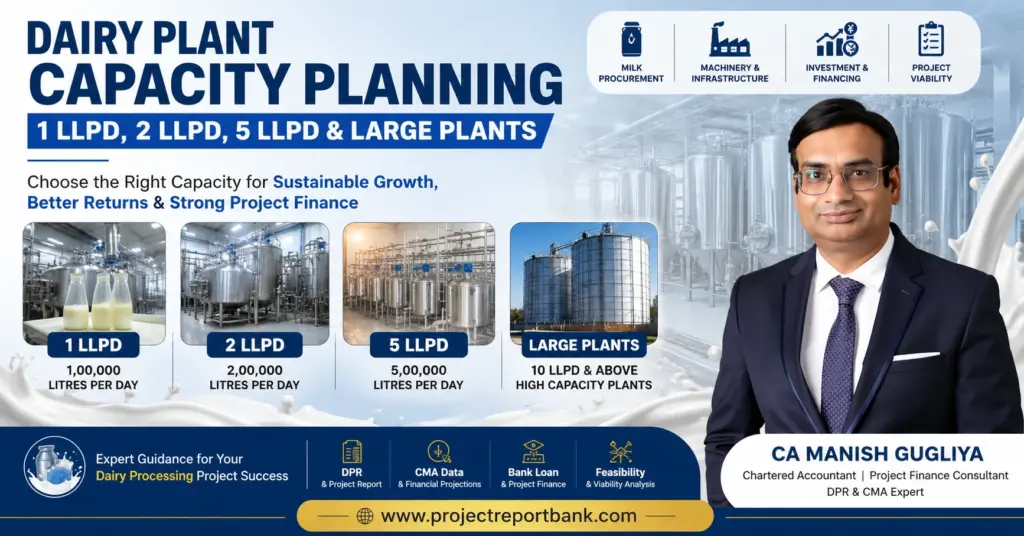
LLPD stands for Lakh Litres Per Day. Throughout this article: 1 LLPD = 1,00,000 litres/day, 2 LLPD = 2,00,000 litres/day, 5 LLPD = 5,00,000 litres/day, 10 LLPD = 10,00,000 litres/day. Dairy plant capacity planning is central for any modern milk processing plant, whether greenfield or expansion.
Under-sizing risks:
- Lost milk procurement when farmers find no buyer
- Production bottlenecks during flush season
- Early need for expansion at higher incremental cost
- Inability to serve institutional buyers or new markets
Over-sizing risks:
- Idle machinery and low capacity utilisation
- High interest burden and heavy depreciation
- Large working capital requirement with thin cash flows
- Weak DSCR and risk to bank repayment
This article, written as CA Manish Gugliya for ProjectReportBank.com, compares 1 LLPD, 2 LLPD, 5 LLPD and larger dairy plants from both technical and project finance perspectives.
Understanding Dairy Plant Capacity, LLPD and Utilisation
Dairy plant capacity is usually expressed in litres per day or LLPD, but actual milk handled depends on shifts, operating hours and product mix. A plant designed for 2 LLPD does not automatically process 2,00,000 litres every day of the year.
- Installed capacity (nameplate): maximum processing volume the plant is engineered for under full-running conditions
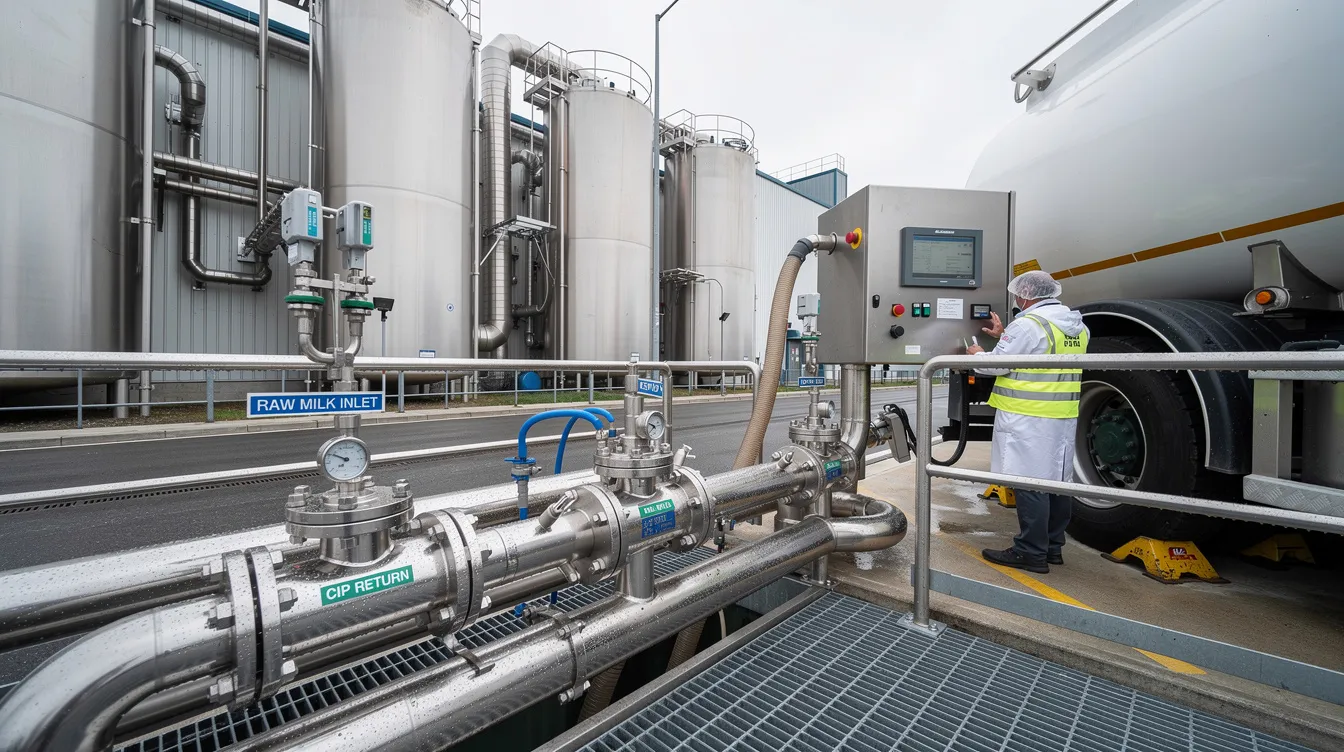
- Milk reception capacity: ability to unload, weigh, test and chill incoming raw milk; this can limit throughput even when processing machinery is larger
- Processing capacity per shift: pasteurisation, cream separation, homogenisation and further processing throughput per 8-hour shift
- Packaging capacity: pouch filling, cup sealing or bottling speed, which often creates a separate bottleneck
- Cold storage holding capacity: must align with daily intake spikes to prevent distress dumping of unsold stock
Seasonal variation is strong in India. Raw milk production peaks during winter flush months and drops during lean season. A 2 LLPD milk processing plant may see 2.5 LLPD equivalent milk offered in flush and only 1.3 LLPD in lean, depending on procurement radius. Rajasthan cooperative data confirms monthly procurement swings that force capacity planning to account for peak volume surges without excessive idle capacity during troughs.
Multiple shifts (16-20 hours/day) can allow a 1 LLPD pasteuriser line to handle more than 1,00,000 litres in staggered batches, but utilities, labour costs and mandatory Cleaning-in-Place (CIP) cycles between product runs reduce effective output. CIP downtime directly affects production capacity; cleaning and sanitation processes can constrict production capacity by 10-15% of theoretical maximum. Buffer storage such as intermediate silos can absorb supply spikes during reception hours.
Capacity utilisation = actual milk processed ÷ installed capacity. DPRs generally assume a ramp-up period: Year 1 at 40-60%, Year 2 at 60-75%, Year 3 at 70-85%, rather than full utilisation from commissioning.
Key Factors Determining the Right Dairy Plant Capacity
Capacity selection must balance milk supply, market absorption, technical configuration and finance. Effective dairy capacity planning includes managing upstream and downstream processes synchronously rather than treating procurement, processing and sales as independent decisions. Product mix and seasonal availability impact overall production capacity in dairy manufacturing.
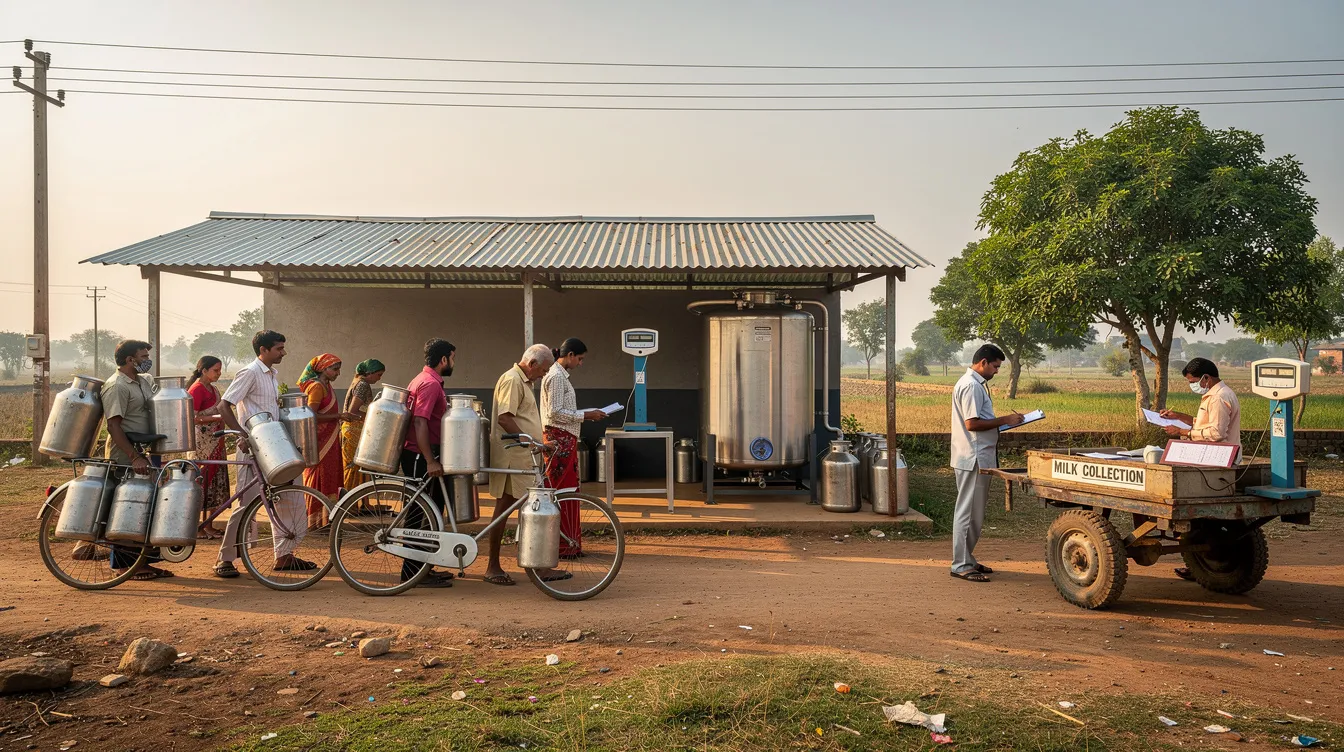
- Milk procurement potential: Realistic milk availability within 80-120 km radius after accounting for competition from cooperatives and private dairies; number of collection centres; lean-season security; milk must be chilled within two hours of milking to control bacterial growth, so transport logistics and chilling infrastructure set hard limits
- Market demand: Local demand for pasteurized milk, regional demand for curd, paneer, ghee and butter, institutional contracts for cream, milk powder or UHT milk; a plant produces various products, and each product has distinct distribution and shelf life characteristics
- Product mix: A plant focusing on liquid milk needs strong daily market but simpler processing. Paneer, ghee and curd are profitable dairy products with margins of 20 to 40 percent. Shrikhand is popular in Gujarat and Maharashtra markets; mishti doi has strong demand in West Bengal; lassi and makhan are culturally significant in Punjab. A dairy processing plant can also produce butter and yogurt. Flexibility in production processes allows better handling of varying product demands across regions
- Geographic market reach: Cold-chain radius typically limits pasteurised pouch milk distribution to 150-200 km; cold storage, reefer vans and stockist networks determine how far the dairy business can sell fresh products
- Capital and working capital strength: A small dairy processing plant costs ₹20 to ₹30 lakhs, while a larger 2,000-litre-per-day unit costs ₹50 to ₹70 lakhs. Scaling up to 1 LLPD or above requires crores in both term loan and working capital. A 5 LLPD dairy plant can require several crores of working capital daily just to buy milk, even after machinery and civil construction are financed
- Future expansion: Modular planning; designing land, building and utilities for 5 LLPD while initially installing 2 LLPD milk processing capacity can reduce future redesign costs. Capacity planning must incorporate future expansion considerations to avoid costly retrofits
1 LLPD Dairy Plant Capacity Planning (1 Lakh Litres Per Day)
A 1 LLPD milk processing plant is a medium-scale commercial unit suitable for strong district-level brands, cooperatives or entrepreneurs upgrading from smaller operations.
- Typical promoter: regional dairy entrepreneurs with a farmer network, or an existing 50,000 LPD plant planning upgrade to a modern milk processing plant
- Procurement: approximately 1.2-1.3 lakh litres/day in flush to balance product mix; 30-60 village collection centres with bulk milk coolers; tie-ups with local chilling centres. Milk variability in fat and SNF content must be considered in planning reception and standardisation
- Product mix: generally 60-70% liquid pouch milk, balance in curd, paneer and ghee. A well-operated paneer business can achieve 20-30% profit margins at this scale
- Machinery: one pasteurisation line of 10,000-15,000 LPH running multiple hours, homogeniser, cream separator, milk silos (2-3 of 50,000 litres each), curd section, paneer vat, ghee kettle, CIP system and basic automation. CIP downtime should be considered in capacity planning to avoid unexpected operational stoppages
- Land and building: indicative requirement of 1.5-3 acres depending on layout, including milk reception, processing, utilities, ETP and parking. For reference, a 500-litre-per-day plant needs just 1,500 to 2,000 square feet
- Utilities: moderate boiler size; refrigeration capacity and steam generation are critical constraints in dairy processing. Water requirement of roughly 2.5-3 litres per litre of milk processed. DG backup for uninterrupted power
- Manpower: plant head, QA officer, production supervisors, maintenance team, lab staff; about 60-100 total employees depending on automation level
- Working capital: daily milk purchase outflow, credit to distributors, packaging material inventory; distribution serviceable within one or two nearby districts
- When appropriate: strong local brand, limited equity, desire to test market before scaling, and adequate land for future expansion
2 LLPD Dairy Plant Capacity Planning (2 Lakh Litres Per Day)
A 2 LLPD dairy processing plant positions the promoter as a serious regional player, often serving multiple districts and institutional buyers.
- Procurement: more complex than 1 LLPD, requiring 80-120 collection centres, multiple tanker routes, and higher exposure to lean-season shortages. Competition from established cooperatives and private players increases
- Machinery: two processing lines or one higher-capacity line (20,000+ LPH), multiple milk silos (4-6 of 50-75 KL), higher-speed packaging machines, dedicated curd and paneer lines, and possibly ghee/butter integration. Dairy plants often manage multiple product lines which place different demands on resources. Actual capacity must consider cleaning, maintenance and production changeover times for accuracy
- Utilities: larger refrigeration system, bigger boiler with redundancy, higher-power electrical sub-station, larger ETP sized for increased effluent (a State Pollution Control Board NOC is mandatory), more extensive cold rooms
- Land: typically 2-4 acres with provision for future expansion and separate tanker/goods movement
- Market: must expand beyond one district; super-stockist and distributor network needed; institutional sales to hotels, QSR chains or sweets manufacturers can absorb surplus
- Investment: NDDB data and Bihar tender records show a 2 LLPD plant costs more than 1 LLPD but not exactly double, due to shared land, building and utility costs. In Purnea, Bihar, a 1 LLPD plant was estimated at ~₹27 crore while a 2 LLPD plant at the same site was ~₹28.9 crore
- Risks: higher dependence on sustained procurement, price competition vulnerability, and need for professional management with MIS systems
- Justified when: strong cooperatives or FPOs have assured milk, existing regional brands plan expansion, or institutional investors back the project
5 LLPD Dairy Plant Capacity Planning (5 Lakh Litres Per Day)
A 5 LLPD dairy plant (5 lakh litres per day) is a large industrial dairy processing plant comparable to major private players and strong cooperative unions. NDDB estimated the cost of a 5 LLPD facility at approximately ₹160 crore (excluding land, 2015-16 prices).
- Procurement: multi-district operation requiring hundreds of village collection centres, multiple chilling centres, and a tanker fleet with GPS tracking. Electronic testing and payment systems at collection points are essential
- Processing: multiple high-capacity pasteurisers, separate milk reception bays, automated unloading, in-line standardisation, PLC/SCADA automation and an advanced quality control laboratory. Compliance with food safety management systems (FSSAI Manufacturing License is mandatory) dictates design tolerances
- Product mix: at this scale, plants cannot rely only on pouch milk. Integration of curd, flavoured milk, paneer, butter, ghee and possibly milk powder or UHT milk is needed to handle flush-season surpluses
- Utilities and ETP: large ammonia-based refrigeration plant, high-capacity boilers, sophisticated compressed air and chilled water systems, and a fully engineered effluent treatment plant. ETP costs at 1,000+ KLD scale can reach ₹4-9 crore depending on product mix
- Land and layout: 5-10 acres or more including future expansion, tanker parking, warehouses and staff facilities; hygienic flow must separate raw material and finished product movement
- Working capital: daily milk procurement at 5 LLPD implies very large cash outflows; strong banking lines, efficient debtor management and risk controls are non-negotiable
- Management: professional team, ERP systems, documented SOPs, internal audit and quality assurance (ISO, HACCP, FSSC 22000)
- 5 LLPD capacity should only be attempted after detailed DPR, market study and sensitivity analysis. Simple multiplication of a 1 LLPD model by five is not realistic
10 LLPD and Larger Industrial Dairy Processing Plants
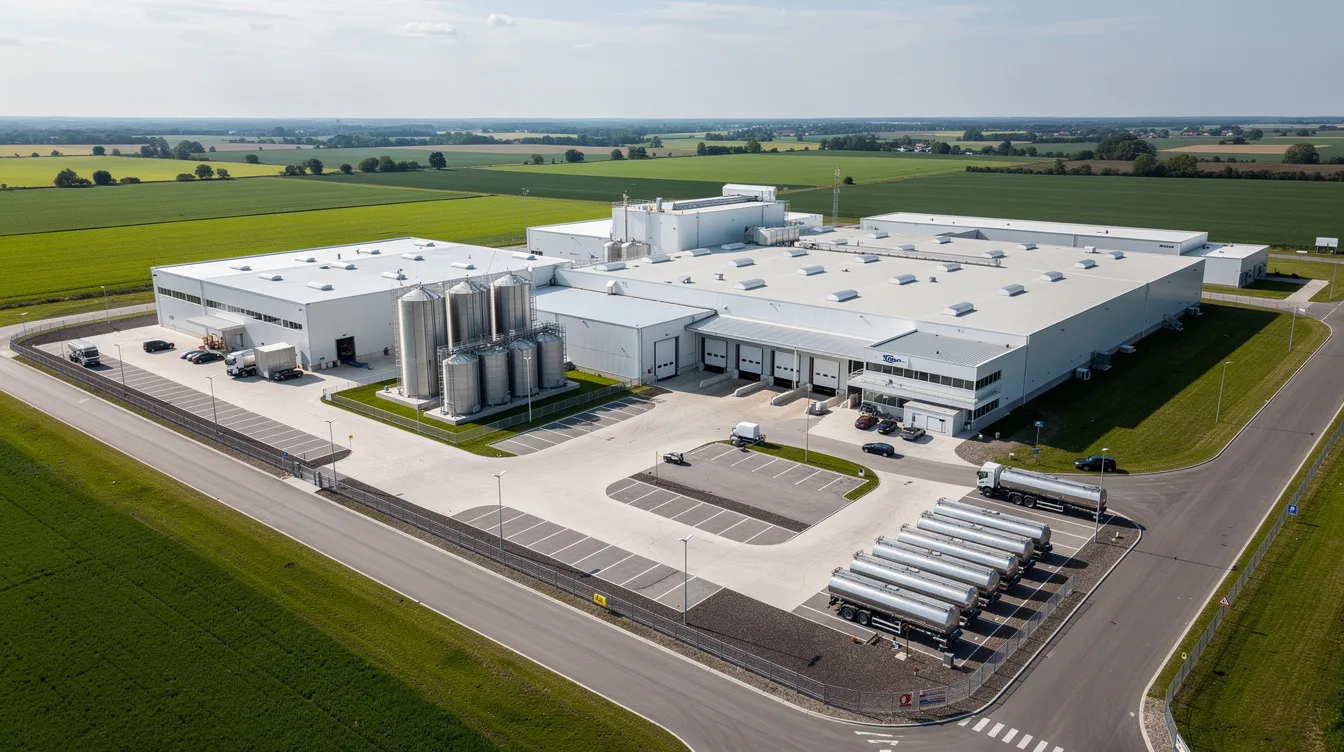
Plants of 10 LLPD (10 lakh litres per day) and above are very large-scale industrial units, typically operated by national brands or dairy federations. NDDB budgeted approximately ₹196 crore for a 10 LLPD plant (excluding land).
- Procurement: multi-state or multi-cluster operations with bulk milk coolers, satellite chilling plants, online milk testing and automated data capture
- Product portfolio: SMP, WMP, butter, ghee, cheese, UHT milk, dairy whitener and other value-added dairy products. This diversification stabilises revenue and manages seasonal surplus
- Infrastructure: multiple reception bays, parallel processing lines, advanced ETP with energy recovery, integrated utilities management. Overall Equipment Effectiveness (OEE) tracking becomes essential for monitoring equipment performance across dozens of machines
- Distribution: pan-regional or national cold chain, institutional contracts, reefer fleets and third-party logistics
- Project finance: investment runs into hundreds of crores. Detailed technical feasibility, long-term offtake planning and sophisticated financial modelling involving banks, DFIs or private equity are standard. GST registration is mandatory once turnover crosses ₹20 lakhs, and Udyam Registration grants access to additional government scheme benefits
- Such plants are rarely first projects for new entrepreneurs; they are expansion or consolidation plays by established dairy business groups
Comparing 1 LLPD, 2 LLPD, 5 LLPD and 10+ LLPD Dairy Plants
The comparison below uses qualitative descriptions since precise values depend on project configuration, location and product mix.
| Parameter | 1 LLPD | 2 LLPD | 5 LLPD | 10+ LLPD |
|---|---|---|---|---|
| Project scale | District-level | Multi-district | State-level | Multi-state |
| Procurement complexity | Moderate | High | Very high | Extremely high |
| Product diversification | Limited | Moderate | Broad | Very broad |
| Automation level | Basic to moderate | Moderate | High (PLC/SCADA) | Advanced (ERP-integrated) |
| Cold-chain requirement | Local | Regional | State-wide | National |
| Working capital intensity | Moderate | High | Very high | Extremely high |
| Management complexity | Owner-managed | Professional team needed | Full corporate structure | Multi-department organisation |
| Expansion scope | To 2-3 LLPD | To 5 LLPD | To 10 LLPD | Greenfield additions |
- Moving from 1 LLPD to 2 LLPD offers better per-litre cost economics in civil work and utilities
- The jump from 2 LLPD to 5 LLPD increases financial and operational risk disproportionately because procurement network, working capital and distribution must all scale in parallel
- Align plant size with proven procurement plus realistically achievable market share over the first 3-5 years
- A hierarchy of planning can optimise dairy production across strategic and operational levels; capacity should follow strategy, not the reverse
Dairy Plant Capacity vs Machinery and Utilities Requirement
Every increase in plant capacity requires corresponding scaling of key machinery, utilities and storage. Effective capacity calculation requires synchronization of equipment and processes across stages; a fast pasteuriser paired with a slow packaging line creates bottlenecks.
- Equipment that scales with capacity: milk reception docks, weighbridges, dump tanks, plate heat exchangers, pasteurisers, homogenisers, cream separators, standardisation systems, silos, curd and paneer equipment, ghee and butter plant, packaging lines
- Utilities: boilers, refrigeration compressors, chilled water systems, air compressors, water treatment, power systems and ETP. Under-sized utilities choke an otherwise well-designed plant. Effective capacity must account for historical performance of production equipment, not nameplate ratings alone
- Engineers design for peak-hour load and number of shifts. Individual machines may have higher hourly throughput than average daily intake
- For item-wise cost considerations, refer to the detailed resource on dairy processing plant machinery and equipment cost; this article focuses on capacity-planning logic
- Machinery selection should follow a clear capacity and product-mix decision, supported by a proper process-flow diagram. Advanced machinery with automation reduces per-litre processing cost at higher LLPD levels
Dairy Plant Capacity vs Project Setup Cost and Means of Finance
Capacity has a major impact on CAPEX, but project cost does not rise in direct proportion to plant size. In Bihar, a 1 LLPD plant cost ~₹27 crore while a 2 LLPD plant at the same site cost ~₹28.9 crore; utilities, admin buildings and site development served both capacities.
- Major CAPEX heads: land and site development, civil construction, processing machinery, packaging lines, refrigeration and utilities, laboratory and quality control systems, ETP, internal roads
- Some costs (land, boundary, basic admin block) do not double when capacity doubles, while process machinery and cold-chain investments grow more directly with LLPD
- For a deeper CAPEX breakdown, refer to the article on integrated dairy processing plant setup cost in India
- Means of finance typically includes promoter contribution, term loan and working capital limits. Higher capacities demand stronger equity and comfortable DSCR
- Financial assistance is available through multiple channels: NABARD offers 25% to 33.33% back-ended capital subsidies for eligible dairy projects, the PMFME Scheme provides grants up to ₹10 lakhs for micro food processing, and state-specific dairy schemes exist alongside central programs. Additional subsidies are available for SC/ST and northeastern entrepreneurs
- Large capacities with thin margins can appear attractive but may lead to stretched cash flows and loan repayment pressure in initial years
- For detailed financing-structure discussion, refer to dairy plant project cost and means of finance
Capacity Utilisation and Ramp-Up Assumptions in DPRs
Capacity utilisation is one of the most sensitive assumptions in any dairy plant DPR submitted to banks. Dodla Dairy’s disclosures show that even established players peak around 80% utilisation in strong quarters and operate lower in others.
- Typical ramp-up: Year 1 at 40-60%, Year 2 at 60-75%, Year 3 at 70-85%, varying with procurement and market development
- Key drivers: time to build milk procurement routes, farmer trust, distributor network, retailer acceptance, and consumer awareness of new dairy products
- Utilisation directly influences: turnover → EBITDA → cash accrual → DSCR → ability to service term loans. A 5 LLPD plant at 50% utilisation generates half the revenue but carries full fixed-cost burden
- Over-aggressive projections (90-100% from Year 1) are viewed sceptically by banks unless backed by firm supply and offtake contracts
- Test multiple scenarios (base, optimistic, conservative) before deciding final capacity and debt level
Milk Procurement Planning for Different Capacities
Sustainable milk procurement is more critical than installed capacity. Without milk, even the best-designed milk processing plant remains idle. Raw milk must be processed quickly; the country’s dairy sector loses quality every hour milk remains unchilled.
- 1 LLPD: 30-60 villages covered, 1-2 chilling centres or several bulk milk coolers, simple tanker logistics within one district
- 2 LLPD: more routes, additional tankers, higher dependence on bulk coolers, possible procurement from neighbouring districts, stronger field staff
- 5 LLPD and 10+ LLPD: multi-district or multi-state procurement, satellite chilling plants, electronic fat/SNF testing and payment systems, procurement policies to maintain quality and loyalty
- Quality control at procurement: fat and SNF testing, adulteration checks, temperature monitoring. Milk reception and quality control capacity must match overall LLPD
- Overestimating sustainable procurement based on theoretical village milk production often leads to under-utilised plants and financial stress. Sales and Operations Planning (S&OP) involves analysing historical data to forecast procurement and demand patterns realistically
Market Planning, Product Mix and Capacity Balancing
Three capacities must align: milk procurement, processing and market absorption. When any one lags, the dairy business suffers.
- 1 LLPD can focus on local fresh milk and curd; 5 LLPD and larger plants must spread across regions and product categories
- Product balancing: allocate milk across liquid milk, curd, paneer, ghee, butter and possibly milk powder, considering shelf life and contribution margins. Plants with a higher share of longer-shelf-life products (ghee, SMP, UHT) manage procurement fluctuations better
- Dairy processing plants in states like Tamil Nadu, Uttar Pradesh and Madhya Pradesh tailor product mix to regional consumption patterns. This flexibility in production directly affects nutritional value delivery and batch economics
- DPR should model different mix options at each capacity to see impact on revenue and profitability. Capacity choice should facilitate a sensible product portfolio rather than force distress sales of surplus liquid milk
Phased Expansion vs Installing Full Capacity on Day One
A common dilemma: build 5 LLPD when current assured procurement is only around 1 LLPD?
- Advantages of phased expansion: lower initial CAPEX, easier ramp-up, reduced debt, manageable procurement build-up, and opportunity to correct design issues
- Disadvantages: additional cost of future civil modifications, machinery integration challenges, possible downtime during expansion, risk that land becomes insufficient if the dairy business grows to 10 LLPD
- A practical approach: install 1-2 LLPD now, design infrastructure for 5 LLPD. Acquire a larger land parcel, keep building layout expandable, slightly over-size utility corridors and ETP for future upgrades
- The decision should rest on realistic procurement and market studies, the promoter’s risk appetite and finance strength
Common Dairy Plant Capacity Planning Mistakes
Many failing dairy projects suffer not from poor modern technology but from wrong capacity selection and unrealistic assumptions.
- Choosing capacity only because land is cheap or copying a competitor’s plant size without an independent feasibility study
- Assuming 100% capacity utilisation from Year 1; ignoring lean-season milk shortages and procurement competition
- Assuming all raw milk will convert into high-margin products while ignoring that distribution, cold storage and consistency of demand vary by product
- Underestimating procurement competition from cooperatives and private players already active in the same radius
- Ignoring cold-chain costs, underestimating ETP capacity, and mis-sizing utilities (boiler, refrigeration, water treatment)
- Financial mistakes: insufficient working capital for large LLPD plants, optimistic sales prices, ignoring distributor payment delays, not factoring cost escalation before commissioning
- Each mistake translates into lower DSCR, inability to service the term loan, liquidity crunches and loss of promoter equity
- Get the DPR stress-tested for these issues before locking in plant capacity and machinery orders
Capacity Planning from a Banker’s Perspective and Sensitivity Analysis
Banks examine viability, sustainability and repayment capacity when evaluating a dairy plant DPR, regardless of LLPD size.
- Key areas scrutinised: justification for plant size, link between procurement and sales projections, realistic capacity utilisation ramp-up, adequacy of working capital, and promoter background in the dairy sector or industry
- Financial metrics: DSCR (banks typically expect ≥1.2-1.3 under base case), break-even point, and whether projected cash accruals comfortably cover instalments
- Sensitivity analysis: testing lower utilisation, higher procurement price, lower selling price or increased power and fuel costs on project viability. For large plants (5 LLPD and above), small percentage deviations translate into large rupee impacts
- Treat banker queries as useful feedback to refine capacity decisions rather than as obstacles
Practical Capacity Selection Framework for Dairy Entrepreneurs
A step-by-step approach for entrepreneurs, cooperatives and FPOs deciding between 1 LLPD, 2 LLPD, 5 LLPD or larger.
- Step 1-3: Survey village-level milk availability, estimate sustainable procurement after accounting for competition, and study market demand for pouch milk and dairy products in target districts
- Step 4-6: Decide product mix (liquid vs value-added), translate procurement and mix into required processing capacity and shifts, and prepare preliminary machinery and utilities list
- Step 7-8: Estimate CAPEX and working capital for one or two capacity options using industry benchmarks and vendor budgets
- Step 9-10: Develop financial projections with capacity utilisation ramp-up, cash flows and DSCR; run sensitivity scenarios
- Step 11: Select capacity offering the best balance between utilisation, profitability, funding comfort and future scalability; then move to detailed DPR, design and approvals
Illustrative Dairy Plant Capacity Planning Example (Hypothetical)
This is an illustrative example, not a recommendation.
- A promoter in India expects access to around 1.8 lakh litres/day across villages in the procurement zone. After accounting for competition and lean-season drop, realistic procurement in the first two years is 1.2 lakh litres/day
- Instead of installing a 5 LLPD dairy plant, the DPR evaluates 1 LLPD and 2 LLPD options, models different utilisation trajectories and product mixes (liquid milk vs curd/paneer/ghee), and calculates DSCR for both
- Analysis reveals 2 LLPD has better long-term economies of scale but requires higher equity and carries more risk if market penetration is slower
- The promoter chooses to implement 1 LLPD capacity with site and utilities designed for 2-3 LLPD future expansion once procurement and market stabilise. Money saved on initial over-sizing reduces debt and strengthens early-year cash flows
Role of a Professional DPR in Dairy Plant Capacity Planning
A well-prepared Detailed Project Report is not just a bank finance document but a capacity planning tool combining technical, commercial and financial analysis.
- Technical components: milk procurement study, market assessment, process-flow design, product mix analysis, layout and utility sizing
- Financial components: detailed project cost, means of finance, projected P&L, cash flow statements, break-even analysis and DSCR under different utilisation scenarios
- DPR should explicitly justify selected capacity (e.g., 2 LLPD vs 5 LLPD) with reference to data and analysis, improving both promoter confidence and banker trust
- As CA Manish Gugliya, the focus is on integrating realistic assumptions, conservative stress tests and practical implementation timelines before the proposal reaches lenders
Conclusion – Choosing the Right Dairy Plant Capacity
The best dairy plant capacity is not the largest LLPD the promoter can finance. It is the capacity that can be sustainably supported by milk procurement, market demand, product mix and adequate working capital.
- The matching chain: Milk Procurement → Processing Capacity → Product Mix → Market Demand → Investment → Working Capital → Debt Servicing Capacity
- Both over-sizing and under-sizing carry long-term financial consequences; banks will scrutinise capacity assumptions carefully
- Entrepreneurs, cooperatives and investors planning 1 LLPD, 2 LLPD, 5 LLPD or larger integrated dairy processing plants can seek support from CA Manish Gugliya via ProjectReportBank.com for DPR preparation, financial projections, CMA data and bank finance documentation. Loan approval depends on project merit and lender assessment
FAQs on Dairy Plant Capacity Planning
Below are answers to common capacity-related queries from promoters and consultants.
What does 1 LLPD, 2 LLPD or 5 LLPD actually mean in day-to-day operations?
These refer to installed daily processing capacity in lakh litres per day. A 2 LLPD plant running at 60% utilisation will process about 1.2 lakh litres/day. DPRs must be based on such realistic utilisation levels rather than theoretical maximums. The actual milk handled depends on procurement, shift hours, CIP schedules and market demand for finished produce.
How much land is generally required for a 1 LLPD or 2 LLPD milk processing plant?
Indicative ranges: 1.5-3 acres for 1 LLPD and 2-4 acres for 2 LLPD. Final land requirement depends on layout, product mix, provision for future expansion and statutory setbacks. Acquiring slightly more land than immediate need allows the facility to expand beyond initial LLPD without relocation.
Does project cost increase in direct proportion when capacity doubles?
Some items (process machinery, cold rooms, packaging equipment) scale roughly with capacity, but others (land, boundary wall, basic buildings) do not. A 2 LLPD plant costs more than 1 LLPD but not exactly double. Readers wanting detailed cost analysis should refer to the article on integrated dairy processing plant setup cost in India rather than relying on a single universal rupees-per-litre figure.
Can a 1 LLPD dairy plant be expanded to 2 LLPD or 5 LLPD later?
Phased expansion is common, provided initial design allows for additional milk reception, processing lines, utilities and ETP without demolition. Plan land, building orientation and utility corridors from Day One with a clear long-term capacity target.
How does plant capacity choice affect working capital requirement?
Higher LLPD means proportionately higher daily milk procurement, packaging material and operating expenses, while sales realisation comes with a credit lag. Many large dairy projects struggle not with term loan but with inadequate working capital. Capacity planning must always include a detailed working capital assessment tied to realistic procurement volumes and distributor credit periods.
📊 Operations & Financial Planning: Utilities | Revenue Model & Product Mix | Financial Projections | Working Capital | CMA Data | DSCR & Repayment Capacity
🏦 Bank Finance, Viability & Returns: Bank Loan & Project Finance | Term Loan Assessment | Feasibility & Viability | Break-Even Analysis | ROI, IRR & Payback | Sensitivity & Risk Analysis