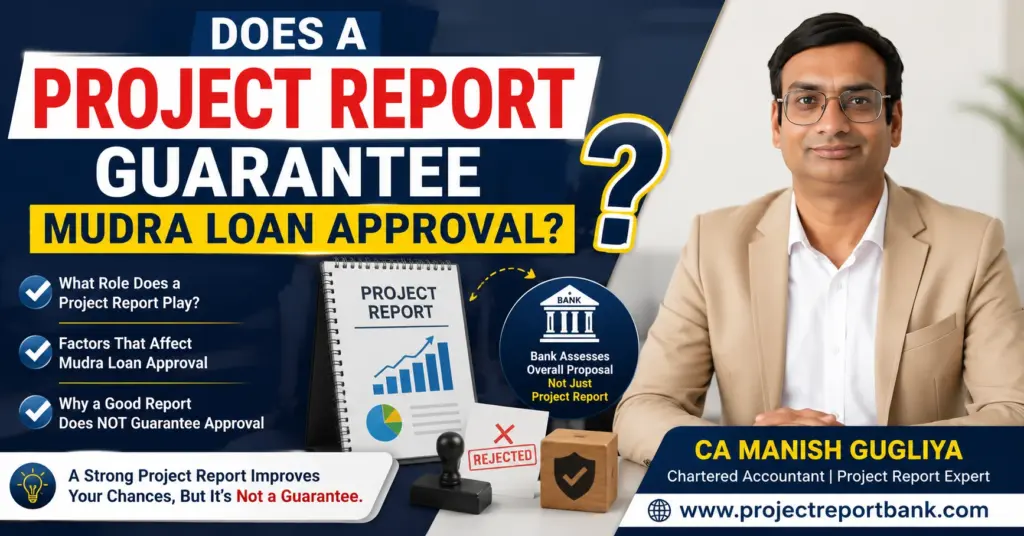
Many applicants spend weeks preparing a detailed project report for their Mudra Loan application. They hire professionals, build financial projections, attach quotations-and naturally expect that a well-prepared report should lead to approval. This assumption is understandable, but it is incorrect. A project report is one of the most important documents you submit, but it does not guarantee that a bank will sanction your loan. Let me explain exactly why, what the report actually does, and what else determines your Mudra Loan outcome.
Key Takeaways
A project report does not guarantee Mudra Loan approval, regardless of how professionally it is prepared or who signs it. The lending decision depends on the complete assessment of your application, not one document alone.
- A project report is only one part of the bank’s appraisal process. Other factors-eligibility under the mudra scheme, banking history, repayment capacity, existing liabilities, and documentation quality-carry equal or greater weight.
- A strong, realistic project report can improve Mudra Loan approval chances by clearly explaining business viability, project cost, means of finance, and projected cash flows. But it cannot create a legal or practical right to sanction.
- Under Pradhan Mantri Mudra Yojana (PMMY), banks assess overall risk, not just projected profit figures. Key factors influencing PMMY loan approval are business viability and repayment capability. PMMY loan categories include Shishu, Kishor, Tarun, and Tarun Plus, offering collateral-free loans up to ₹10 lakh for micro enterprises and micro units engaged in non-farm activities across India.
- The scheme was launched under the vision of the Hon’ble Prime Minister to support micro units development and refinance agency functions for small business lending across financial institutions.
As a CA working with MSME clients, I have seen well-prepared reports get rejected and simple reports get approved. The difference almost always comes down to what lies beneath the document-the actual business, the real numbers, and the applicant’s overall financial standing. This article will give you honest, non-misleading guidance on what a project report can and cannot do for your mudra loan application.

Does a Project Report Guarantee Mudra Loan Approval?
No, a project report does not guarantee Mudra Loan approval, even if it is accurate, detailed, and signed by a Chartered Accountant.
A Mudra Loan project report describes your business plan-it communicates what you intend to do, how much it costs, how you plan to fund it, and how you expect to repay. It is an appraisal tool, not an assurance of sanction. The final lending decision rests entirely with the bank or lending institutions processing your application, based on their own credit policy and risk assessment.
There is a critical difference between these steps:
- Preparing a project report – documenting your business idea, project cost, and financial projections.
- Submitting a complete Mudra Loan application – providing the report along with KYC, financial documents, quotations, and other supporting papers.
- Eligibility check – the bank verifying whether your business and profile meet the basic PMMY eligibility requirements.
- Bank appraisal – the lender evaluating your proposal’s viability, repayment capacity, banking conduct, and documentation consistency.
- Final sanction and disbursement – the bank’s decision to approve (fully, partially, or not at all) and release funds.
A project report supports step 4, but it cannot force the bank through step 5. Projections are assumptions. Banks test them against real-life factors: your banking conduct, income stability, existing liabilities, business model, and local market conditions. No document-however polished-can override these checks. The phrase “project report guarantee Mudra Loan approval” reflects a common hope, but not a financial reality.
Table of Contents
What Role Does a Project Report Play in Mudra Loan Approval?
The project report is still very important under Pradhan Mantri Mudra Yojana. It is the primary document that helps the bank understand your proposal in a structured way. For many small borrowers-especially first-time entrepreneurs applying for a business loan-the report is the main vehicle summarising their business idea, project cost, means of finance, and repayment capacity.
If you want to understand the fundamentals in detail, you can start with Mudra Loan Project Report Basics. The depth of report required may vary depending on the loan size, the lender, and the nature of business, but the underlying objective-explaining financial feasibility-remains similar whether you approach commercial banks, small finance banks, cooperative banks, or other financial intermediaries.
MUDRA itself operates partly as a refinance agency, meaning the actual lending happens through banks and NBFCs. These lenders use the project report as one of the key areas for evaluating your proposal.
Explaining the Proposed Business
This section of the report should describe your business activity clearly. Whether you run a mobile repair shop, a small manufacturing unit, or a trading enterprise dealing in electrical goods, the description should use plain, non-technical language that any bank officer can understand.
Cover these elements:
- Products and services offered-mentioning all the products and services you plan to deal in
- Target customers and market
- Business location and space or land requirement
- Sales channels (offline shop, online platforms, or both)
- Brief competition overview and your positioning
The bank uses this narrative to check whether the activity is permitted under mudra yojana (non-farm, non corporate enterprise) and whether demand is realistic in your area. They also evaluate the promoter’s education qualification, experience, and industry knowledge favourably when assessing the project company profile and the company’s background.
A copied or generic business description downloaded from the internet reduces credibility instantly. Write about your actual business, not a template description.
Establishing the Project Cost
The report must present the total project cost with an item-wise breakup. This includes machinery, tools, furniture, computers, vehicles, shop renovation, preliminary expenses, and initial stock-essentially every component needed to get the business running.
Banks want to see that the proposed loan amount-whether it falls under Shishu, Kishore, or Tarun category-is backed by reasonable, specific cost estimates. For businesses involving commercial manufacturing processes, the project logistics details around equipment capacity, installation, and space become especially relevant.
For example, if you are setting up a small packing unit and have a 2026 quotation of ₹2.50 lakh for a packing machine from a vendor with GST registration, include it. Real quotations with required third party details (vendor name, GST number, specifications) make a much stronger impression than round-figure estimates.
An exactly ₹10,00,000 project cost with no breakup raises questions. Banks prefer seeing the actual land requirement, equipment needs, and working capital requirements laid out transparently.
Showing Means of Finance
The report should clearly show how the project cost will be funded:
| Source | Example Amount |
|---|---|
| Promoter contribution (own funds) | ₹1,50,000 |
| Proposed Mudra Loan | ₹5,00,000 |
| Other sources (family, savings) | ₹50,000 |
| Total project cost | ₹7,00,000 |
Many banks expect at least some margin money from the applicant, often around 10–25% of the project cost depending on the bank’s policy and the loan amount. The report should detail the funding needs clearly and show how each source contributes to the total.
Banks look at the source of own contribution-whether it comes from savings, family support, or capital from an existing business-to judge commitment and financial discipline. If you claim ₹2 lakh in own funds but your bank statements show minimal balances, the mismatch will hurt your appraisal even if the project report is technically correct.
Presenting Sales and Profit Projections
Projected monthly and annual sales, gross profit, and net profit help the bank evaluate business viability and debt-servicing capacity. The report should detail expected revenue across a reasonable timeline.
Financial projections should cover 3 to 5 years and include P&L statements and cash flow estimates. Year-wise projections with reasonable growth assumptions-not a 300% sales jump in Year 1 without justification-demonstrate maturity. Different business types have different margin structures: a grocery shop operates on thin margins with high volume, while a small job-work factory may have higher margins but fewer orders.
The report should clearly connect projected profit to the repayment schedule. If your proposed EMI is ₹15,000 per month, the projections should show how your monthly net surplus comfortably covers that amount after all expenses.
For businesses with achievements export orders or plans to develop export-oriented products, include those projections separately with supporting documentation.
Assessing Repayment Capacity
Repayment capacity depends on cash flow, not just paper profit. This is one of the most misunderstood aspects of project reports.
A business might show ₹3 lakh annual profit but have months where cash collections are thin due to credit sales or seasonal cycles. Banks check whether the projected EMI for the Mudra Loan fits safely within expected net monthly surplus after all business and household expenses.
The Debt Service Coverage Ratio (DSCR) is crucial for demonstrating repayment ability. Banks commonly expect a DSCR of at least 1.25, meaning your available cash for loan repayment should be at least 1.25 times the annual loan obligation. A repayment schedule is a crucial component of the project report.
Existing EMIs-personal loan, two-wheeler loan, credit card dues-must be factored in. If your existing obligations consume most of your monthly surplus, even a profitable project report will not convince the bank.
Supporting Bank Appraisal
A neat, consistent project report saves time for both the applicant and the banker by answering basic questions upfront. Well-structured reports often lead to fewer queries, faster appraisal, and more confidence in the borrower’s understanding of their own business.
For readers who need a beginner-friendly overview, I recommend reading about what a Mudra Loan project report is. The project report format should be neat and easy to understand-banks require a standard format for Mudra Loan project reports, and following that format reduces friction during the process.
But let me be clear: supporting appraisal means helping the bank decide. It does not mean compelling the bank to approve the loan.

Why Can a Mudra Loan Be Rejected Even With a Good Project Report?
Many applicants feel surprised or frustrated when a Mudra Loan is declined despite a polished project report. I have seen this happen repeatedly. The confusion usually stems from treating the report as the entire application, when in reality it is just one input.
A good document cannot compensate for weak eligibility, stressed banking history, excessive existing debt, or unviable business assumptions. Each bank-whether public sector, private, or cooperative-has its own credit norms, risk appetite, and documentation standards. What follows is not an exhaustive list, but these are the most common reasons for rejection even when the report itself is well-prepared.
Applicant Does Not Meet Eligibility Requirements
Under the mudra scheme, basic eligibility themes include:
- The business should be a non-farm, non corporate micro or small enterprise
- The loan requirement should generally be up to ₹10 lakh (the beneficiary micro unit must qualify under PMMY norms)
- The purpose must be business-related, not personal consumption or land purchase
- The applicant should not be in default with any bank or financial institution
If the proposed activity does not fall under permitted categories, no project report can make it acceptable. Age requirements, KYC norms, and business registration requirements (where applicable) must be satisfied independently of report quality. Some banks may also have internal criteria regarding minimum account vintage, residence, or segment focus.
Weak Repayment Capacity
Lenders check total EMI burden compared with documented income and projected business surplus. If total EMIs after sanction would absorb most of the projected monthly surplus, the application may be declined-regardless of how attractive the projections appear.
For instance, if your projected monthly net surplus is ₹18,000 and existing EMIs plus the proposed Mudra Loan EMI total ₹16,500, the bank sees almost no repayment cushion. Overstated income or understated household expenses in the report can be questioned during appraisal, damaging credibility further. Banks evaluate repayment capacity at realistic levels, not at best-case sales assumptions only.
Existing Financial Obligations
Existing home loans, gold loans, personal loans, vehicle loans, and credit card dues covering loans across multiple lenders significantly affect the banker’s view of overall leverage. All existing obligations must be honestly disclosed in the project report and application.
Hiding them never works-banks check credit bureau reports and will detect undisclosed liabilities. Even if the project appears profitable, too many concurrent EMIs may still lead a prudent banker to decline or reduce the Mudra Loan amount. In some cases, lenders may agree to a lower sanction instead of the full requested limit based on this factor.
Unrealistic Financial Projections
Projecting very high sales within the first few months, or unrealistically high profit margins, can make the project report look unreliable. Common mistakes include:
- Ignoring rent, electricity, advertising strategies costs, staff salary, and maintenance to artificially boost profit
- Showing 50% net margins in a business where 15% is the industry norm
- Claiming full capacity utilisation from Day 1
Bankers compare assumptions with similar businesses in the locality to test realism. Investors prefer a conservative estimate for revenue projections to avoid red flags during evaluation-and the same applies to bankers. A bank may treat inflated projections as a red flag and either reject or ask for a revised, more conservative project report.
Insufficient Promoter Contribution
In practice, many banks prefer that promoters bring some share of project cost from their own funds rather than relying 100% on debt. Own contribution demonstrates seriousness and provides a cushion if sales are slower than expected.
If own contribution is very low or the source is not satisfactorily evidenced in financial documents or bank statements, approval chances may reduce. This is not a fixed percentage rule across all banks, but a common appraisal consideration.
Documentation Problems
Typical documentation issues that derail applications include:
- Incomplete KYC
- Mismatched signatures or names across documents
- Outdated financial statements
- Discrepancies between application form and project report
- Missing GST returns or Udyam registration where required
Banks check for a clean credit history and track record when evaluating loan applications. Documentation inconsistencies can stall or invalidate loan applications. Even a technically perfect project report cannot overcome serious documentary gaps or suspicion about authenticity of data. Information in bank statements, ITRs, and GST returns should broadly align with assumptions made in the report to provide complete financial information.
Business Viability Concerns
Banks may still decline if they genuinely doubt the market demand, location suitability, pricing, competition handling, or long-term sustainability of the proposed project. For example, opening a general store in a lane that already has five similar shops-or near a big bazaar or large retail outlet that dominates local trade-may raise viability concerns.
Highly seasonal businesses without adequate off-season planning face similar scrutiny. Real-world viability matters more to lenders than attractive spreadsheets, especially under small-ticket Mudra finance. Lenders may also consider sector-specific risks and recent local economic trends while judging viability.
Mismatch Between Project Report and Actual Business
Situations where the project report mentions one activity (e.g., readymade garment shop) but the applicant’s discussion with the banker or GST registration reveals another (e.g., electronics trading) create serious problems.
Item-wise project cost in the report should broadly match actual quotations, invoices, or proposed assets. Third party details on quotations should be verifiable. Such mismatches raise doubts about whether the applicant genuinely understands and intends to follow the plans shown in the report. Keep all documents-project report, application, quotations, registrations-aligned to avoid this issue.

Can a CA-Prepared Project Report Guarantee Mudra Loan Approval?
No, even a CA-prepared project report does not guarantee Mudra Loan approval.
A Chartered Accountant can bring genuine expertise to the table: structuring realistic financial projections, ensuring internal consistency between P&L, cash flow, and balance sheet, and presenting data professionally. A CA’s knowledge of financial ratios, DSCR calculations, and credit assessment norms can significantly improve report quality.
But the professional preparing the report does not control the lender’s sanction decision. Banks assess the proposal independently, and they are not bound to approve merely because a professional has signed the project report. There is no credit guarantee attached to a CA signature.
I want to warn applicants directly: marketing phrases like “100% approval” or “guaranteed Mudra Loan with CA project report” are misleading. No ethical professional should make such claims. If someone is promising guaranteed sanction, treat it as a red flag, not a reassurance.
For readers evaluating whether to hire a professional or do it themselves, this guide on who can prepare a Mudra Loan project report provides a balanced perspective.
What professional preparation can realistically help with:
- Structured financial projections with proper format
- Accurate project costing and means of finance
- Realistic profitability estimates
- Cash-flow planning aligned with repayment schedule
- Financial consistency across all report sections
- Professional presentation that builds confidence
What it cannot do: override bank policy, fix poor credit history, substitute for missing eligibility, or create business viability where none exists.
Does a Profitable Project Report Mean the Bank Will Approve the Loan?
Projected profit on paper is only one part of the story. Banks focus more on how and when cash will actually be generated to repay EMIs. This distinction matters enormously, and most applicants miss it.
Consider the difference:
| Concept | What It Means |
|---|---|
| Accounting profit | Revenue minus all expenses including depreciation on paper |
| Cash available for repayment | Actual money in hand after paying suppliers, salaries, rent, taxes, and household expenses |
| Repayment capacity | Cash surplus available to service proposed loan EMI after covering all obligations |
A seasonal business-say, a rainwear trading enterprise-may show healthy annual profit but face three or four months of virtually zero income. If your EMI falls during those months, the bank sees a repayment risk that no annual profit figure can address.
Similarly, a business with heavy credit sales (where customers pay after 60–90 days) may appear profitable but struggle with monthly cash flows. Lenders consider stability and predictability of cash flows when deciding Mudra Loan approval and repayment period.
Profitability improves approval chances. It does not convert into a guarantee of sanction.
What Does a Bank Look at Beyond the Project Report?
Banks treat the project report as a starting point, then examine multiple other aspects during Mudra Loan appraisal. The report provides the narrative and numbers, but the bank builds a broader picture.
Here is what lenders typically focus on in regard to overall assessment:
- Applicant profile: Personal details, education qualification, and prior business or employment experience
- Nature of activity: Whether it qualifies under PMMY and whether the bank has appetite for that sector
- Banking history: Account conduct, transaction patterns, any cheque returns or overdraft misuse
- Existing liabilities: Current EMIs, outstanding loans, credit card dues
- Own contribution: Source and adequacy of promoter funds
- Financial statements: For existing businesses, past P&L, balance sheets, ITRs, and bank account turnover help cross-verify projected figures
- Quotations and invoices: Where applicable, third party details on machinery or equipment quotations with GST numbers
- Overall viability: Whether the proposal makes commercial sense given the location, competition, and market conditions
Banks like ICICI Bank, SBI, and other commercial banks each have their own internal credit scoring models. Financial intermediaries and small finance banks may apply different weightages. The total number of factors considered goes well beyond the project report alone.
These broader checks ensure responsible lending and protect both borrower and bank from unsustainable debt.
What Makes a Mudra Loan Project Report More Credible?
This section provides practical guidance on improving the credibility of your project report, which can positively impact your Mudra Loan approval chances. The goal is not to manipulate numbers but to present realistic, well-supported assumptions consistent with your financial documents and market conditions.
Before preparing your report, review the information required for a Mudra Loan project report to ensure you collect the right data upfront.
Use Realistic Sales Assumptions
Avoid aggressive first-year revenue projections, especially if you have limited experience or a new location. Base your assumptions on shop capacity, local demand, number of working days, and average daily sales estimates that make commercial sense.
Use modest growth rates-10–20% per year is reasonable for most small businesses unless you have a strong, documented reason for higher growth. Use local market conditions as your reference point rather than aspirational industry benchmarks. Realistic numbers increase banker trust more than large but poorly justified figures.
Estimate Expenses Properly
Include all key operating expenses:
- Rent
- Electricity and utilities
- Telephone and internet
- Salary for employees working in the business
- Transport and delivery
- Packaging materials
- Maintenance and repairs
- Advertising strategies and marketing costs
- Insurance
- Miscellaneous and contingency
Missing major expenses makes projected net profit look artificially high, and experienced bankers will immediately question it. Include a specific line for owner’s household expenses or drawings to show the complete cash requirement picture. Cross-check expense levels with similar existing businesses or available local benchmarks for greater credibility.
Calculate Project Cost Carefully
Break project cost into fixed assets (plant, machinery, equipment, furniture) and current assets (opening stock, receivables, cash balance). Arbitrary totals without item-wise detail look weak during appraisal.
Use recent quotations (2025–2026) with GST details where applicable to support major asset costs, especially for Kishore and Tarun category loans. Under-estimating project cost creates working capital pressure later, while over-estimating may raise doubts about seriousness of proposal.
Match Machinery Costs With Quotations
For manufacturing units or service businesses requiring equipment, lenders often ask for vendor quotations to validate figures in the project report. The brand, model, capacity, and price in the report should match the attached quotations wherever possible.
Significant differences between quoted and projected costs may prompt banks to recalculate the loan requirement or ask for clarification. This practice improves transparency and reduces the risk of inflated or guessed project costs. Always verify required third party details on quotations-vendor name, address, GST number.
Provide Adequate Working Capital
Many applicants underestimate working capital needs-stock, credit extended to customers, and a small cash buffer. The project report should include a reasonable level of initial working capital based on inventory cycle and expected credit terms.
Insufficient working capital can force borrowers to depend on high-cost informal borrowing despite having a Mudra Loan. Adequate working capital planning strengthens perceived viability and repayment capacity.
Keep Repayment Projections Realistic
Match the proposed EMI amount and tenure with the business’s expected monthly net surplus after all expenses and existing EMIs. Choosing the longest possible tenure is not always ideal-balance between EMI comfort and overall interest rates burden should be shown in the report.
Include a simple month-wise or year-wise schedule showing how cash flows will comfortably cover repayments throughout the loan term. Banks may adjust tenure or installment structure during appraisal based on these projections.
Maintain Consistency Across Documents
Data in the project report-sales, profit, capital, existing loans-should not contradict information in bank statements, ITRs, or the loan application form. Even minor discrepancies in dates, addresses, business names, or turnover can trigger additional queries and delay approval.
Review all documents together before you submit the application to ensure a consistent story. The project report should not be lengthy and must be clear, with figures that align across every supporting document. A standard project report format is accepted by most banks, so following a proven structure helps maintain this consistency. Consistent information signals reliability and strengthens the lender’s comfort level.
Can a Strong Project Report Improve Mudra Loan Approval Chances?
Yes, a strong project report can definitely improve the chances of Mudra Loan approval. But it still does not guarantee sanction.
When the report clearly communicates business model, project cost, means of finance, profitability, and repayment plan, it helps the banker appreciate the proposal better. A strong project report can increase the chances of loan approval by demonstrating that the applicant has genuinely thought through the business.
The practical benefits include:
- Reduced confusion during appraisal
- Fewer queries and follow-up requests
- Quicker understanding of risk by the credit team
- Greater confidence in the applicant’s preparedness and knowledge of their own business
But the distinction must be clear: improved approval chances ≠ guaranteed approval. The bank’s final decision depends on the totality of credit assessment, not just the quality of one document. View the project report as a tool to support a sound application, not as a shortcut to bypass eligibility or risk checks.

Common Mistakes Applicants Make About Project Reports and Loan Approval
In my practice helping clients with Mudra Loan documentation, I see certain misunderstandings repeatedly. Addressing these can significantly improve both the project report and the overall application.
Believing that submission equals sanction. Many applicants think that once they submit a project report with all documents, the loan must be sanctioned. Submission starts the evaluation process. It is not a commitment by the bank.
Assuming higher projected profit automatically improves approval. Banks do not approve loans based on the biggest profit number. They look at whether the profit is realistic and whether the cash flows support repayment. A ₹5 lakh projected profit means nothing if your assumptions are unsupported.
Inflating projected turnover without basis. Showing ₹25 lakh annual turnover for a new roadside food stall without explaining how that is achievable creates doubt rather than confidence. Base projections on capacity, location footfall, and average ticket size.
Copying a generic project report. Applicants can create their project report online using templates, but simply downloading someone else’s report and changing the name is a mistake. Banks often notice when a report describes a business model that does not match the applicant’s actual situation. A project report includes business description and market analysis-these must be specific to your enterprise, not generic.
Ignoring existing loan obligations. If you already have ₹8,000 per month in EMIs and your projected surplus is ₹12,000, the bank will see that a new EMI of ₹7,000 pushes your total obligations close to or beyond your surplus. Hiding this does not help-it shows up on credit bureau reports.
Assuming a CA signature guarantees sanction. As mentioned earlier, professional preparation improves quality and consistency, but it does not shift the bank’s independent risk assessment. A CA’s expertise is in presenting your financials accurately-not in controlling the bank’s lending decisions.
Giving conflicting information. Telling the bank officer verbally that your monthly sales are ₹80,000 while the written report shows ₹1,50,000 creates an immediate credibility problem. Every number-whether mentioned orally or in writing-should align with details information in your documents.
Focusing only on presentation rather than viability. A beautifully designed report with colour charts and graphics but unrealistic numbers will not impress an experienced banker. Content and accuracy always outweigh formatting.
Practical Example – Good Project Report but Loan Still Not Approved
This is an illustrative example only, created to explain how loan appraisal works in practice.
Consider Mr. Rahul, who plans to set up a small food processing unit in 2026. He applies for a ₹7 lakh Mudra Loan under the Tarun category and submits a well-prepared project report. The report includes:
- Clear business description with product range and target market
- Item-wise project cost of ₹8.5 lakh (machinery ₹4 lakh, renovation ₹1.5 lakh, working capital ₹2 lakh, miscellaneous ₹1 lakh)
- Means of finance showing ₹1.5 lakh own contribution and ₹7 lakh Mudra Loan
- Monthly sales projections starting at ₹1.2 lakh, growing to ₹2 lakh by Year 2
- Net monthly surplus of approximately ₹18,000 after all business expenses
- Attached quotations from verified vendors with GST numbers
On paper, this looks solid. The DSCR is above 1.25. The projections appear reasonable.
However, during appraisal, the bank discovers:
- Mr. Rahul already has a personal loan EMI of ₹6,000 and a two-wheeler loan EMI of ₹3,500
- His bank account shows three cheque returns in the last eight months
- His credit score reflects a delayed payment pattern on an old credit card
After factoring in existing obligations, the actual monthly surplus available for the new loan EMI drops significantly. The cheque returns and credit history raise further concerns.
The bank offers Mr. Rahul a reduced sanction of ₹4 lakh instead of ₹7 lakh, suggesting he close the personal loan first and reapply for the balance in the next phase.
The project report was technically sound. But the overall credit assessment-existing liabilities, banking conduct, and credit history-changed the outcome. This is exactly why documentation quality does not override fundamental risk and repayment concerns in Mudra Loan decisions.
How Can You Improve Your Mudra Loan Application Along With the Project Report?
Here is a practical checklist for applicants who want to strengthen both their project report and full Mudra Loan application:
- Size your loan requirement realistically. Borrow only what the business truly needs and can service, not just the maximum ₹10 lakh limit under PMMY. Mudra loans offer up to 10 lakh for small enterprises, but the right amount depends on your actual project cost and repayment capacity.
- Collect proper quotations. Get written quotations from vendors for major assets. Include vendor name, GST number, specifications, and price. These support the project cost and develop confidence in your numbers.
- Prepare an item-wise project cost and align the requested loan amount with that cost and your own contribution.
- Review your existing liabilities. Check your credit report, outstanding loans, and credit card dues before applying. If possible, close or reduce high-cost debts.
- Clean up your bank statements. Check for bounced cheques, irregular transactions, or prolonged low balances. If there are problems, work on improving account conduct for a few months before applying.
- Ensure document consistency. Business name, address, turnover figures, and nature of activity should match across the project report, loan application, GST registration, Udyam certificate, and bank statements.
- Understand your own report. The applicant must personally understand and be able to explain the figures and assumptions in the project report during discussion with bank officials. If you cannot explain why you projected ₹1.5 lakh monthly sales, the banker will doubt the entire document.
- Disclose everything honestly. Hiding existing loans, pending legal issues, or past defaults will surface during credit checks and create a worse impression than honest disclosure.
Frequently Asked Questions
These questions go slightly beyond the main discussion and address practical doubts that Mudra applicants frequently raise. Answers are general in nature-actual bank requirements may differ by institution and time. These are written from the practical viewpoint of a Chartered Accountant dealing with project reports and MSME finance.
Is a project report compulsory for every Mudra Loan?
For very small shishu loans (Shishu category loans are up to Rs. 50,000), some lenders may accept a simplified application without a detailed project report, while others still prefer a basic write-up. For Kishore category loans (ranging from Rs. 50,001 to Rs. 5 lakhs) and Tarun category loans (ranging from Rs. 5 lakhs to Rs. 10 lakhs), many banks commonly ask for at least a concise project report or financial proposal. No collateral is required for loans up to 10 lakhs under PMMY, but that does not eliminate the need for a project report.
For detailed reasoning, read about why a project report is required for a Mudra Loan. I advise checking specific requirements of your chosen bank branch, as practices can differ even within the same bank. The Reserve Bank guidelines provide a broad framework, but individual lenders adapt their internal documentation checklists.
Can a bank reject my Mudra Loan after accepting the project report?
Yes. Acceptance or receipt of documents by the bank only means they will be evaluated-it is not an indication of approval. During appraisal, the bank may still reject the application based on eligibility, credit history, financial documents, or internal policy, even if they have kept the project report on record.
Treat document submission as the start of evaluation, not as evidence of sanction. Banks may also approve a lower amount than requested if they find the full requirement unsupported by projections or repayment capacity.
Does a CA project report increase Mudra Loan approval chances?
A CA-prepared project report can improve structure, financial logic, and presentation, which often helps bankers understand the proposal faster. This may enhance approval chances where the underlying business is viable and the applicant’s credit profile is acceptable.
However, even with a CA’s signature, there is no guarantee of Mudra Loan approval. The final decision remains solely with the lender. Focus on genuine viability rather than simply obtaining a professional signature.
Can I prepare my own project report for a Mudra Loan?
Many small entrepreneurs can prepare a simple yet effective project report themselves, provided they understand their business, costs, and expected sales. Self-prepared reports should follow a clear structure: business profile, project cost, means of finance, sales projections, expenses, and repayment plan.
For step-by-step guidance, see how to prepare your own Mudra Loan project report. Where figures are complex or larger amounts are involved, taking professional help may be sensible to avoid mistakes in financial projections and cash flow calculations.
Does the required project report detail change with loan amount?
In practice, smaller Shishu loans may be appraised on simpler information, while higher Kishore and Tarun amounts usually require more detailed project reports and financial documents. Banks may expect deeper analysis-break-even calculations, detailed cash-flow statements, and sensitivity analysis-as the ticket size approaches ₹10 lakh.
For a more elaborate discussion, explore whether the Mudra Loan amount affects project report requirements. Each bank can have its own internal documentation checklist aligned to Reserve Bank and PMMY guidelines.
Conclusion: How to Think About Project Reports and Mudra Loan Approval
A project report is a crucial document for explaining business viability, project cost, means of finance, and repayment capacity to a lender. It helps the bank understand your proposal in a structured, professional way. But it does not guarantee Mudra Loan approval-no single document can.
The strongest applications combine a realistic project report with an appropriate project cost, adequate own contribution, honest financial documents, satisfactory banking conduct, and a credible repayment track record. Applicants should treat the report as a transparent communication tool with the bank-an honest explanation of what you plan to do and how you plan to repay-not as a marketing brochure or a promise of certain profit.
As CA Manish Gugliya, my advice is straightforward: prepare your project report with integrity. Base it on real numbers, genuine market understanding, and conservative assumptions. Let it speak for your business honestly. A lender who understands your proposal clearly is far more likely to support it than one who sees inflated numbers or inconsistent documentation. Build a finance-worthy business first, and let the project report reflect that reality.
- Mudra Loan Project Report Online – Can It Really Be Done?

- Does a Project Report Guarantee Mudra Loan Approval? (Expert Guide by CA Manish Gugliya)
- Does Mudra Loan Amount Affect Project Report Requirements?
- When Does a Bank Ask for a Project Report for Mudra Loan?
- What Information Do You Need Before Preparing a Mudra Loan Project Report?
- Project Report vs Business Plan for Mudra Loan: Which Is Better for Your Application?
- Can I Prepare My Own Project Report for Mudra Loan?
- Who Can Prepare a Project Report for Mudra Loan?

- Why Is a Project Report Required for Mudra Loan?