Key Takeaways
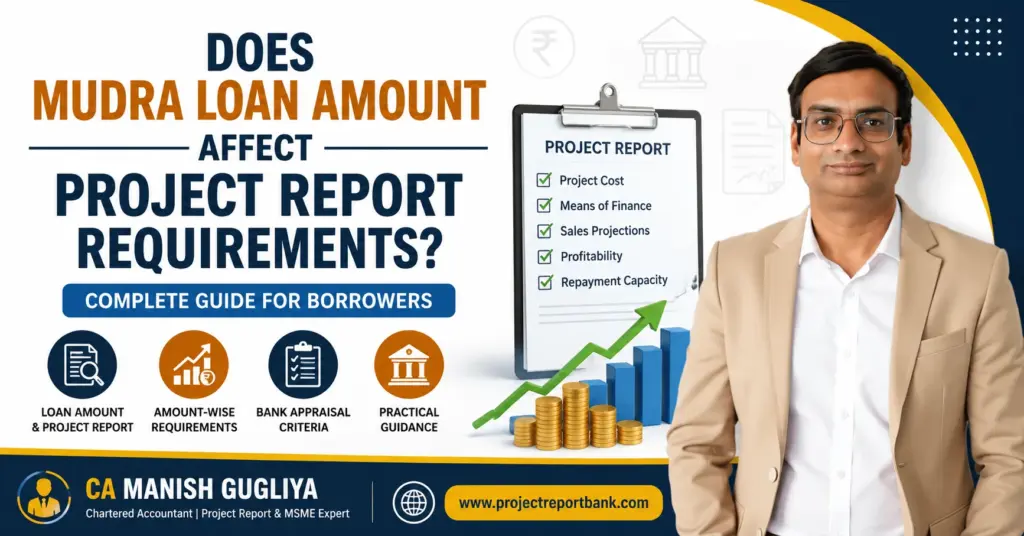
A higher Mudra Loan amount generally leads to deeper project report scrutiny and more detailed financial projections. However, there is no single government-mandated rupee threshold at which a project report automatically becomes compulsory across all banks.
- Banks can ask for a project report even for smaller Shishu or Kishor loans, particularly for new businesses, asset purchases, or proposals where repayment capacity is not immediately obvious from existing financial documents.
- Documentation depth depends on multiple factors: business type, new vs existing enterprise, total project cost, risk perception, and each bank’s internal credit appraisal policy – not just the loan amount in isolation.
- For ₹5 lakh, ₹10 lakh, and especially ₹20 lakh Mudra proposals, well-prepared financial projections with clear repayment capacity explanation are practically expected during appraisal. Inflated sales figures can lead to loan rejection.
- From my experience as CA Manish Gugliya, borrowers should focus on building a bankable proposal proportionate to their project size, rather than trying to stay below an assumed “no project report” limit.
- If you are new to the concept and need foundational understanding, I recommend starting with Mudra Loan Project Report Basics before diving into the amount-specific guidance below.
Introduction: Mudra Loan Amount vs Project Report Requirement
One of the most common questions I get from small business owners and first-time entrepreneurs is: does the Mudra Loan amount I apply for change whether I need a project report, and how detailed that report needs to be? The short answer is yes – the amount matters. But the full picture is more nuanced than a simple yes-or-no threshold.
Under the Pradhan Mantri Mudra Yojana (PMMY), the government categorizes loans based on business growth stages. Mudra loans are categorized into Shishu (up to ₹50,000), Kishor (₹50,000 to ₹5 lakh), and Tarun (₹5 lakh to ₹10 lakh). Mudra loans can be up to ₹10 lakh without collateral. Additionally, a newer category – Tarun Plus – extends collateral free lending up to ₹20 lakh for borrowers who have successfully repaid previous Tarun loans. Mudra loans can cover both term loans and working-capital requirements across all these categories.
However, there is no single statutory “Mudra Loan project report limit” prescribed in the central PMMY guidelines. The project report requirement for a given Mudra Loan amount depends largely on banks’ internal credit policies. Banks – whether PSU banks like SBI and PNB, private sector banks like HDFC Bank, Axis Bank, and ICICI Bank, or regional lenders like Union Bank – look at the nature of business, total project cost, repayment capacity, and the applicant’s profile alongside the requested loan amount.
If you need a basic definition of what a Mudra Loan project report is, I recommend that article first. This piece focuses specifically on how the Mudra Loan amount you request changes the depth of the project report banks expect from you – including practical guidance for ₹5 lakh, ₹10 lakh, and ₹20 lakh proposals.

Table of Contents
Is Project Report Requirement Directly Linked to Mudra Loan Amount?
There is a relationship between the loan amount and project report expectation, but it is not strictly linear or automatic. Loan amount is one of several factors that influence how detailed a project report needs to be.
- As the requested exposure increases – for example, closer to ₹10 lakh under the Tarun category or even ₹20 lakh under Tarun Plus – banks typically demand more structured financial projections and supporting documents. The logic is straightforward: higher lending risk requires stronger financial justification.
- Even for smaller mudra yojana loans, many bank branches today insist on at least a basic project report, especially for new businesses or machinery purchases. All Mudra loan categories require a project report for approval, though the depth varies considerably.
- A formal project report is mandatory for Kishor, Tarun, and Tarun Plus loans in most lending institutions. For Shishu loans, some branches may accept a simplified project note within the application form, but this is branch-specific, not guaranteed.
- The requirement varies across different banks, branches, and even individual credit officers. Whether a project report is required for a given Mudra Loan amount is ultimately a practical question, not purely a legal one.
For background on why a project report is required for a Mudra Loan in the first place, that linked article covers the appraisal and viability context in detail.
Is There a Fixed Mudra Loan Amount Above Which Project Report Is Mandatory?
As per current PMMY and Mudra guidance, there is no universally notified rupee threshold – such as ₹2 lakh or ₹5 lakh – above which a project report becomes legally compulsory in every bank across the country. I want to be very clear about this because it is one of the biggest areas of confusion among borrowers.
Phrases like “Mudra Loan project report limit” or “project report mandatory above how much Mudra Loan” are search phrases reflecting borrower intent, not official terminology found in the PMMY scheme documents. The official documents focus on loan limits, eligibility criteria, margin requirements, and repayment periods – not a universal project report trigger amount.
That said, individual banks do set internal cut-offs. For instance, some branches start asking for more detailed appraisal documentation from around ₹2–3 lakh upwards, and almost universally for the Tarun category (₹5 lakh and above). But these are policy choices made by individual lenders, not statutory rules. I always advise borrowers to check with their specific branch before assuming they fall below any threshold.
CA Manish Gugliya’s Practical View: Do not design your borrowing amount purely around a perceived project report threshold. If your business genuinely needs ₹7 lakh, applying for ₹4.9 lakh just to avoid a “more detailed” report is counterproductive. Focus on realistic project cost and a bankable proposal. The project report is there to support your case, not to trip you up.
Even below any informal thresholds, be prepared to share at least a simple project note – particularly if your business is new or your projected revenue assumptions are optimistic.
How Loan Amount Can Change the Level of Project Report Detail
The real change that comes with a higher loan amount is typically in the depth and rigour of information required, not simply a binary yes-or-no to whether a project report is needed. Think of it as a spectrum.
At one end, a ₹30,000 Shishu loan for purchasing raw materials for a home-based food business may need only a brief project summary. At the other end, a ₹15–20 lakh term loan for purchasing industrial machinery under Tarun Plus requires detailed financial projections, machinery quotations, capacity analysis, and a clear repayment schedule. The core document is the same – it is a project report. But the depth scales with the proposal.
Let me break this down across three levels, without quoting any specific rupee amount as a statutory boundary.
Smaller Mudra Loan Requirement (Typically Shishu & Lower Kishor)
For smaller Mudra Yojana loans – say up to about ₹1–2 lakh or basic working capital needs – many banks accept a brief project summary rather than a detailed 25–30 page report.
- Typical elements include: a business overview, purpose of the loan (for example, stock purchase or a small piece of equipment), approximate monthly sales and expenses, and a simple repayment plan.
- Shishu loans offer up to ₹50,000 for small businesses, and at this level the documentation burden is lighter.
- However, some branches now use standardised Mudra application forms that capture mini-project report details within the form itself. Do not assume “no project report” by default.
- If you are starting a business from scratch, expect to provide basic financial projections and a short description of your business plan, even at this level.
- The documentation may be lighter, but it still needs to be internally consistent and realistic. Even a one-page summary should connect your business activity to your loan and your ability to repay.
Medium Mudra Loan Requirement (Mid-Kishor to Tarun Range)
In the mid-range – for example, ₹2–₹7 lakh, often falling into the higher Kishor or lower Tarun category – banks generally prefer a structured project report with 2–3 year financial projections.
- Expected items include: detailed project cost covering machinery, furniture, and initial stock; working capital needs; sales estimates; operating expenses; and a monthly or annual repayment chart.
- At this level, branches are more likely to insist on written projections rather than accepting only verbal discussion, especially for new manufacturing and service units.
- Banks may ask for basic financial documents like bank statements, GST summaries, or ITRs if it is an existing business, to support the projections in the report.
- Kishor loans range from ₹50,000 to ₹5 lakh for business needs, and at the upper end of this range, lender expectations begin to approach those of the Tarun category.
- A standard project report format is accepted by most banks, so borrowers do not necessarily need a highly customised document – but it must be tailored to your actual business, not copied from a generic sample.
For readers wanting the full list of inputs needed, I recommend the guide on information required for preparing a Mudra Loan project report.
Higher Mudra Loan Requirement and Beyond (Upper Tarun and Similar Exposure)
For applications closer to the ₹10 lakh Mudra ceiling under the Tarun category, and for similar-sized loans under MSME schemes or Tarun Plus, banks conduct more detailed appraisal.
- Typical contents include: full project cost, means of finance clearly showing own contribution versus bank loan, machinery quotations, working-capital assessment, projected Profit and Loss statements, a simple projected balance sheet, and a detailed repayment schedule.
- The report must include a repayment schedule for the loan that maps projected cash accrual (profit plus depreciation) against EMI obligations.
- For higher exposures, officers may calculate or expect DSCR (Debt Service Coverage Ratio), break even point analysis, and sensitivity to lower-than-expected sales. Banks prefer a Debt Service Coverage Ratio (DSCR) above 1.5 for comfortable repayment coverage.
- Tarun loans provide funding from ₹5 lakh to ₹10 lakh, and at this level, a comprehensive project report is strongly advisable even when not every branch formally mandates every component.
- For complex proposals, borrowers often seek professional help from a CA or experienced consultant instead of preparing financial projections entirely on their own.

Project Report for ₹5 Lakh Mudra Loan
If you are applying for a ₹5 lakh Mudra Loan, banks will often expect at least a moderately detailed project report, especially for new or expansion projects. This is the boundary between Kishor and Tarun categories, and many lenders treat it as a point where structured documentation becomes practically necessary.
Consider two contrasting scenarios:
Scenario 1: An existing kirana store seeking ₹5 lakh in working capital. Here, the bank already has access to your business history – bank statements, GST turnover, purchase patterns. The project report can focus more on justifying the incremental credit: why your stock levels need to increase, how additional inventory will translate to higher sales, and how the additional cash flow will cover repayment. Financial statements from prior years do much of the heavy lifting.
Scenario 2: A new small printing unit purchasing a machine costing ₹6–7 lakh, with ₹5 lakh financed through Mudra. Here, there is no track record. The project report must include machinery quotations, installed capacity, expected utilisation, raw material cost, selling prices, and projected revenue. The bank needs to understand the complete financial picture, including project commercial aspects and project logistics details.
For either case, expect to present 2–3 year P&L projections and demonstrate that monthly cash accrual covers EMI obligations. A structured project report in correct project report format increases clarity and speeds up appraisal, even if the branch does not explicitly insist on a 20-page document. The report should detail funding needs and expenditure plans in a way the credit officer can quickly assess.
Project Report for ₹10 Lakh Mudra Loan
At or near the ₹10 lakh Mudra ceiling, most banks will practically insist on a well-documented mudra loan project report with clear financial projections. This is the upper limit of the Tarun category, and the exposure is significant enough that branches rarely approve without proper documentation.
Banks generally expect: total project cost, promoter’s margin (own contribution), the proposed loan amount, asset details information with machinery and equipment breakdowns, working-capital cycle, sales assumptions, and a profitability analysis covering the loan tenure.
For a ₹10 lakh term loan for machinery, officers will often compare projected cash accrual with annual instalments to assess repayment capacity. Five-year Profit and Loss statements are essential in the report at this level, and financial projections should cover at least five years to demonstrate sustainability beyond the initial period.
Even if the loan is for a service or trading business – say a small restaurant, coaching centre, or wholesale distributorship – a reasonably detailed forecast of revenues and expenses helps convince the bank. A Mudra loan project report includes anticipated revenue projections and these need to be grounded in realistic, defensible assumptions, not optimistic guesses.
While no RBI circular mandates a specific page count, the complexity at this level usually justifies engaging a CA or experienced consultant, or using a reliable project report preparation platform. Key components of a Mudra loan project report include business overview and financial projections, and at ₹10 lakh, both need to be thorough.
Project Report for ₹20 Lakh Proposal Under Mudra and Other MSME Schemes
Let me clarify something important here. The core PMMY categories – Shishu, Kishor, and Tarun – cover loans up to ₹10 lakh. A ₹20 lakh requirement typically falls under the newer Tarun Plus category introduced from October 2024, or under other MSME business loan products sometimes marketed alongside Mudra.
Tarun Plus loans provide financing from ₹10 lakh to ₹20 lakh for successful previous borrowers who have repaid a Tarun-category loan. Collateral-free lending is available up to ₹20 lakh under the PMMY through this route. In Maharashtra alone, as of mid-2025, over 34,697 accounts amounting to more than ₹4,930 crore had been sanctioned under Tarun Plus, showing growing adoption.
When someone searches for “project report for 20 lakh Mudra Loan,” the intent typically reflects borrowers wanting to understand documentation for projects needing ₹15–₹20 lakh in bank finance, whether under Tarun Plus, a combined Mudra plus MSME loan, or schemes like pmegp loan or Stand-Up India.
At around ₹20 lakh exposure, banks generally expect a full set of financial projections: 3–5 year Profit and Loss, simple projected balance sheets, cash flow statement projections, and DSCR-style repayment analysis. Officers will closely review historical financial performance (if existing business), incremental turnover expected from the new investment, and debt servicing capability considering all existing loans.
At this level, a professionally prepared, well-structured project report typically adds credibility and significantly reduces the back-and-forth with the bank. The depth of complete financial information expected is considerably higher than for a ₹3–5 lakh proposal.
Why Two Borrowers Asking for the Same Loan Amount May Face Different Requirements
A project report requirement for any Mudra Loan amount is not determined by amount alone. Business profile, risk perception, and clarity of the proposal play equally important roles.
Even for the same ₹5 lakh or ₹10 lakh loan amount, two applicants can face very different documentation expectations from the bank. Let me illustrate this with three examples drawn from my practice.
Example 1: Existing Trader Seeking Working Capital
Consider an established trader with 3–4 years of GST returns and regular bank turnover applying for a ₹7 lakh Mudra working-capital loan or CC limit enhancement.
Here, the bank can rely heavily on actual financial documents – bank statements, stock levels, purchase and sales data. The project report may be relatively shorter because historical performance already demonstrates repayment capacity.
However, even for such a borrower, the report should clearly state how the additional funds will increase turnover and margins. Simply writing “loan is needed for business expansion” without supporting it with numbers is not enough. The project company profile and past achievements export orders or sales growth should be evident.
Example 2: New Manufacturing Unit Purchasing Machinery
Now consider a first-time entrepreneur planning a small fabrication unit requiring ₹10 lakh under Mudra Tarun for machinery.
This applicant needs a significantly more detailed project report: machinery quotation, installed capacity, expected utilisation percentage, raw material sourcing, selling price assumptions, commercial manufacturing processes involved, and projected cash flow over the loan tenure.
Despite requesting the same loan amount as the trader above, the absence of historical data pushes the bank to depend entirely on projections and technical feasibility. Bankers may test these projections by comparing them with local market rates and peer units’ performance. The education qualification and prior experience of the promoter also become relevant to establishing credibility.
Example 3: Existing Business Planning Expansion
An existing diagnostic centre or workshop seeking ₹20 lakh for additional equipment or expansion of premises via a Mudra plus MSME loan package presents yet another scenario.
Banks will examine past financial statements to understand current profitability, then scrutinize projections for incremental revenue from the new investment. The project report must clearly separate “existing” and “proposed” operations, showing how the new loan will be serviced from incremental profits.
Even with robust past performance, banks want a clear linkage between the investment, increased capacity, and additional cash generation. The company’s background and track record matter, but so does the forward-looking financial analysis.

What Factors Besides Loan Amount Affect Project Report Requirements?
Documentation depth is multi-dimensional. Several factors beyond rupee amount influence what a bank expects in the project report for a bank loan application.
New Business vs Existing Business
Brand-new ventures usually require more detailed project reports because there are no historical financial documents to support repayment capacity. The promoter must compensate with stronger projections, market analysis, and demonstration of skills or experience.
Existing MSMEs with at least 2–3 years of financials – ITR, GST returns, bank statements – can often submit a slightly shorter project report because the bank can verify assumptions against actual performance. In practice, many banks are noticeably more flexible with documentation for established borrowers at similar loan amounts.
Nature of Business: Manufacturing, Trading, Services
Manufacturing projects typically require deeper technical and cost details: machine capacity, raw material consumption, wastage percentages, labour costs, and commercial manufacturing processes. These feed directly into the financial projections.
Trading businesses emphasise inventory levels, credit terms, and the working-capital cycle. The project report focuses more on stock turnover and margin analysis. Banks want to see all the products being traded and the gross profit assumptions for each.
Service-sector proposals – coaching centres, salons, consulting firms – may focus on occupancy rates, seat utilisation, client acquisition strategies (including advertising strategies), and pricing models. Banks still expect to see these translated into revenue projections.
Machinery and Equipment Finance
Whenever a Mudra Loan is used to purchase machinery or vehicles, banks almost always insist on vendor quotations and GST-inclusive cost breakdowns as part of the project report. Required third party details such as vendor names, quotation numbers, and delivery timelines may also be needed.
The report must show how the new asset will generate additional revenue sufficient to cover instalments. Banks may compare invoice values with market prices, and inconsistencies can raise questions and delay sanction.
Working Capital Requirement
For pure working capital loans – stock and receivables funding – the focus shifts to turnover, gross margins, and the cash cycle rather than machinery cost.
The project report should highlight inventory days, debtor days, and how the requested limit aligns with expected monthly sales. Existing business bank statements and GST returns become critical supporting documents for working-capital proposals.
Total Project Cost vs Loan Component
Banks always want to see the complete project cost and not only the loan amount. The means of finance section should clearly show own contribution versus bank finance.
The project report must present the entire project – building, machinery, furniture, preliminary expenses, space or land requirement, and working capital – not only what the bank is financing. Mudra loans require a breakdown of total project costs and means of finance, and this breakdown must be consistent across all financial statements in the report.
Repayment Capacity and Cash Flow
Banks ultimately sanction loans based on whether projected cash flow covers EMIs comfortably over the tenure. Higher loans require more careful cash flow and DSCR-style analysis, which needs to be visible in the project report.
Unrealistic projections may lead to either outright rejection or heavy modification of loan terms by the sanctioning authority. A cash flow statement showing clear surplus after debt servicing is one of the most important elements the bank evaluates.
Existing Financial Performance and Obligations
For existing businesses, banks read past ITRs, audited accounts, and loan statements alongside the project report to test whether projected growth is reasonable. A comparative study of past versus projected performance strengthens the case.
Existing EMIs for housing, personal loans, or other obligations are also considered. The project report should realistically capture promoter drawings, personal expenses, and all existing liabilities. Stronger historical performance can sometimes reduce the documentation depth the bank insists on.
Bank’s Internal Appraisal and Documentation Policy
Each bank – SBI, HDFC Bank, PNB, ICICI Bank, Axis Bank, regional rural banks, co-operative banks – has its own internal credit policy influencing what must be in the project report for a given loan amount.
Within the same bank, different branches or zonal offices can apply guidelines with varying strictness. Employees working in credit departments at one branch may demand a full CMA-format report while another branch of the same bank accepts a simpler format for a similar proposal. Treat sample reports generated from generic templates as guides, but be ready to adjust if your particular branch requests additional sections.
Loan Amount vs Project Cost – Do Not Confuse the Two
Many applicants believe the project report should only cover the Mudra Loan amount they are requesting. This is incorrect. The report must show the full cost of the project.
Here is a simple example:
| Component | Amount (₹) |
|---|---|
| Total Project Cost | 12,00,000 |
| Own Contribution (Margin) | 3,00,000 |
| Mudra Loan / Bank Finance | 9,00,000 |
The project report should present both the total cost and how it will be financed. This is not an exhaustive list but illustrates the core structure:
- Project cost includes all components: fixed assets (machinery, furniture, vehicles), initial working capital, pre-operative expenses, and any space or land requirement.
- If a borrower requests ₹10 lakh for a ₹10 lakh project cost, banks often question the absence of owner’s contribution. Even a modest margin – 10% to 25% – adds credibility to the proposal.
- Clear separation of project cost and loan amount improves transparency and helps avoid appraisal queries. The difference between a project report and business plan for Mudra Loan is also worth understanding, because a business plan alone may not provide the structured financial breakdown banks need.
Does a Higher Mudra Loan Require More Financial Projections?
Yes. Higher loan amounts generally lead banks to expect more structured financial projections, though there is no uniform statutory checklist mandated across every case.
As the exposure rises, the following projections become increasingly important:
- Projected sales and revenue by month or year
- Gross profit and operating expenses
- Net profit after tax
- Cash accrual (profit plus depreciation)
- Projected balance sheets (at least a simplified version)
- Cash flow projections showing timing of inflows and outflows
- Working capital cycle analysis
- Detailed repayment schedule against cash surplus
- DSCR and ratio analysis where the bank’s credit policy requires it
- Break even point analysis for manufacturing and service units
DSCR and break-even analysis are commonly used by bankers in background appraisal, but not always explicitly requested from every small borrower. However, well-prepared projections should include these, with assumptions briefly explained in the text of the project report rather than just numbers in tables.
Financial projections should cover at least five years to give the bank confidence that your business can sustain repayment beyond the initial growth phase. A Mudra loan project report describes your business plan in financial terms – the projections are where that plan becomes measurable.
For foundational understanding of how to structure these, see Mudra Loan Project Report Basics.
Can a Bank Ask for a Project Report Even for a Small Mudra Loan?
Yes, it can. Banks are free to request a project report for risk assessment even for small Shishu or lower Kishor loans if they consider it necessary for appraisal.
Situations where this is common:
- New business with no track record or prior banking relationship
- Unusual or higher-risk business models
- Loan requested for asset purchase (even a small machine or vehicle) rather than pure working capital
- The applicant’s repayment capacity is not obvious from existing financial documents or bank statements
- The bank’s internal policy requires a basic project note for all mudra scheme applications regardless of amount
Some banks have standardised this by requiring at least a basic project note – sometimes just 2–3 pages – for almost every Mudra application. A project report includes business description and market analysis, and even a brief version of this helps the credit officer process the proposal faster.
A concise, well-organised project report can improve approval chances even when not explicitly demanded, by reducing clarifications and follow-up questions. For more on the scenarios that trigger this, see when a bank may ask for a Mudra Loan project report.
Does a Small Loan Amount Mean a Simple One-Page Project Report Is Enough?
Using a random one-page template downloaded from the internet, without tailoring it to your actual business, often causes more harm than good – even for small Mudra Loans. I have seen applications delayed for weeks because the one-page “project report” submitted was so generic that it raised more questions than it answered.
A project report, however short, must clearly connect:
Business Activity → Investment → Funding → Operations → Sales → Profit → Cash Generation → Repayment
If any link in that chain is missing or unconvincing, the bank officer has reason to ask for more details information or reject the proposal outright.
Unnecessary complexity should also be avoided. Adding sophisticated ratio analysis and five-year balance sheets for a ₹40,000 Shishu loan is overkill. Clarity and internal consistency matter more than page count.
For very simple proposals, many borrowers can successfully prepare your own Mudra Loan project report using structured guidance. But even when self-preparing, avoid the common mistake of adjusting projections solely to make EMI coverage look perfect. Start from realistic sales and expense estimates, and let the repayment capacity emerge naturally from those numbers.
What Should a Mudra Loan Project Report Contain Based on Proposal Size?
The content depth of a mudra loan project report scales with the size and complexity of the proposal. Here is how key areas of the report typically change:
| Particular | Smaller/Simple Proposal | Medium Proposal | Higher/Complex Proposal |
|---|---|---|---|
| Business profile / project company profile | Basic overview | Detailed description | Detailed with promoter background |
| Project cost | Required as relevant | Detailed breakdown | Comprehensive with quotations |
| Means of finance | As applicable | Important, clear split | Detailed with margin evidence |
| Machinery / equipment details | If applicable | Detailed if applicable | Detailed with vendor third party details |
| Sales assumptions | Basic and reasonable | Detailed with basis | Detailed with market justification |
| Expense projections | Basic | Detailed | Detailed with sensitivity |
| Profitability | Relevant | Important | Important with trend analysis |
| Cash flow / cash flow statement | Depending on appraisal | Often useful | Strongly expected |
| Repayment analysis | Required conceptually | Detailed repayment schedule | Detailed with DSCR coverage |
| Balance sheets | Rarely needed | Sometimes useful | Often expected |
| Supporting evidence | As applicable | Greater documentation | Greater with certifications |
Note: This table reflects practical guidance based on my experience as a CA preparing these reports. It is not a statutory list binding on every bank. Actual requirements can and do vary by lender, branch, and proposal type.
The report should include business description and funding needs regardless of size, but how deep you go into each section should be proportionate to both your loan size and your business complexity. Do not simply copy reports generated from generic templates – align the depth to your actual situation.

Common Mistakes Borrowers Make About Loan Amount and Project Reports
These are mistakes I encounter regularly when reviewing Mudra and MSME project reports. They apply across loan sizes but become more consequential as the amount increases.
- Assuming no project report is needed below a certain amount. Many borrowers believe that below ₹2 lakh or ₹5 lakh, no documentation will be asked. This is not correct – banks can and do ask for project details at any amount, and the mudra scheme does not exempt any category from basic documentation.
- Preparing projections only to match the desired loan amount. Instead of building projections from realistic business assumptions, some borrowers reverse-engineer numbers so the “required” loan amount appears justified. Banks see through this quickly.
- Inflating project cost. Showing a ₹15 lakh project cost when the realistic cost is ₹10 lakh, just to maximise the loan component, creates inconsistencies that surface during appraisal. Inflated sales figures can lead to loan rejection, and the same applies to inflated costs.
- Unrealistic sales projections. Showing 90% capacity utilisation in Year 1 of a new manufacturing unit is a red flag. Banks test assumptions against local benchmarks and peer performance. Realistic revenue assumptions are crucial for loan approval.
- Ignoring working capital entirely. Many project reports account for machinery but forget initial working capital – raw materials, initial stock, and cash for operating expenses during the ramp-up period.
- Confusing project cost with loan amount. The project report must show the total investment, not just what you want from the bank. This remains one of the most common structural errors.
- Ignoring promoter contribution. Requesting 100% financing without any own contribution raises questions about the borrower’s commitment and financial inclusion in the project.
- Using identical projections from unrelated sample reports. A paper products manufacturing unit cannot use the same revenue projections as a big bazaar-style retail store. Each enterprise needs its own set of realistic assumptions.
- Not matching machinery quotations with project cost. If your project cost shows ₹8 lakh for machinery but the attached quotation totals ₹6 lakh, the bank will flag the discrepancy.
- Focusing on obtaining the maximum loan instead of establishing repayment capacity. The goal is not to maximise the loan amount – it is to demonstrate that your business can comfortably service the debt you are requesting.
Avoiding these mistakes significantly improves project report quality regardless of whether you are applying for ₹2 lakh or ₹20 lakh.
CA Manish Gugliya’s Practical Approach to Mudra Loan Amount and Project Reports
When I evaluate a Mudra Loan proposal – whether it is for ₹3 lakh or ₹15 lakh – I never look at the requested loan amount in isolation. The amount is important, but it tells me only part of the story.
My approach considers the full picture: business activity, total project cost, the borrower’s own contribution, realistic sales potential based on the local market, expense structure including rent, salaries of employees working in the enterprise, raw materials, and overheads. I examine the cash flow pattern, existing liabilities (including personal loans and other EMIs), and the planned repayment schedule.
In my experience, a ₹5 lakh proposal for a new small manufacturing unit sometimes requires significantly more explanation and financial analysis than a ₹10 lakh working-capital enhancement for a well-established trader with strong bank statements. The amount does not automatically determine the complexity of the report – the underlying business model, investment structure, and quality of assumptions do.
My aim is always to prepare reports that are proportionate. For a very small loan with a straightforward business, I keep the focus on clarity and consistency rather than adding unnecessary sections. For a larger or more complex proposal involving machinery, capacity planning, and multi-year projections, I ensure the financial analysis is rigorous enough to withstand the bank’s scrutiny – including sensitivity analysis and constructive criticism of the borrower’s own assumptions.
A Mudra loan project report should not be a document you submit as partial fulfilment of a bank’s checklist. It should be your strongest argument for why this loan makes financial sense – for both you and the bank. If readers are unsure whether to engage a professional, they can refer to guidance on who can prepare a Mudra Loan project report.

FAQ – Mudra Loan Amount and Project Report Requirements
Below are specific, practical questions borrowers frequently ask about how Mudra Loan amount relates to project report expectations.
Is a project report required for every Mudra Loan amount?
There is no universal rule forcing every bank to collect a project report for every single Mudra Loan, but in practice most lenders now expect at least basic project details for almost all cases except the smallest routine top-ups.
As loan amount and project complexity increase, the expectation shifts from basic data captured in the application form to a structured, written project report with financial projections. Even for very small amounts, be prepared with at least a simple written note describing your project, the cost involved, and how you plan to repay the loan.
Is there a minimum Mudra Loan amount for which a project report is compulsory?
PMMY guidelines do not specify a uniform minimum amount at which a project report becomes compulsory across all banks. There is no single statutory trigger point.
Several banks internally treat certain cut-offs – often around ₹2–₹5 lakh – as points where they begin seeking more detailed appraisal. However, this varies widely across lenders and even between branches of the same bank. Do not rely on informal numbers heard from others. Instead, check the current practice at your specific bank and branch before preparing your application.
Can I prepare my own project report for a smaller Mudra Loan?
For straightforward, smaller Mudra proposals – say a simple retail services business or a modest working-capital need – many borrowers successfully prepare their own reports, provided they clearly explain the business, costs, and realistic projections.
Self-preparation is more workable when the business model is simple and the loan amount is modest. For higher or more complex loans, professional input from a CA or project report specialist often helps avoid common mistakes and present data in a banker-friendly format.
Does every bank follow the same project-report requirement for a given Mudra amount?
No. Different banks – and even different branches of the same bank – may follow different project report practices for the same Mudra Loan amount. This is driven by their internal credit policies, risk appetite, and the individual credit officer’s assessment of the proposal.
Some banks lean heavily on standard Mudra application forms and minimal project notes, while others (particularly for clients of larger private sector banks and certain PSU banks) routinely request full project reports with projections for similar exposure. Always treat the bank’s latest written or oral instruction as the final word on documentation, rather than assuming uniform practice across all lenders.
Is project cost the same as Mudra Loan amount in the project report?
No. Project cost and Mudra Loan amount are not the same. Project cost is the total investment in the business – including fixed assets, working capital, and pre-operative expenses. The loan amount is only the bank-financed portion of that total cost.
The project report must show both total project cost and how it will be financed, clearly distinguishing between the borrower’s own funds and the bank loan component. Mixing up these two figures is one of the most common reasons for appraisal confusion and document queries. Present them distinctly and consistently throughout the report.
Conclusion
The Mudra Loan amount you apply for does influence how detailed and rigorous your project report needs to be. A ₹50,000 Shishu loan and a ₹20 lakh Tarun Plus loan will obviously face very different levels of scrutiny. But there is no single rupee figure at which project reports suddenly become mandatory in every case – it is a matter of degree, not a binary switch.
Banks assess the complete proposal: total project cost, nature of business, whether it is a new or existing enterprise, the asset versus working-capital mix, interest rate and tenure considerations, the promoter’s own contribution, and above all, repayment capacity. The loan amount is an important input, but it works alongside these other factors in determining what documentation the bank expects.
From my perspective as CA Manish Gugliya, my advice is straightforward: prepare a project report that is proportionate to the size and complexity of your business proposal. Do not over-engineer a report for a tiny loan, but equally, do not submit a superficial document for a substantial proposal. Focus on clarity, realism, and bankability. The best project report is one where every number can be explained, every assumption defended, and the repayment path is obvious to the reader.
If you are preparing your first Mudra Loan project report and need a structured starting point, explore the Mudra Loan Project Report Basics hub for foundational guidance.
- Mudra Loan Project Report Online – Can It Really Be Done?
- Does a Project Report Guarantee Mudra Loan Approval? (Expert Guide by CA Manish Gugliya)
- Does Mudra Loan Amount Affect Project Report Requirements?
- When Does a Bank Ask for a Project Report for Mudra Loan?

- What Information Do You Need Before Preparing a Mudra Loan Project Report?

- Project Report vs Business Plan for Mudra Loan: Which Is Better for Your Application?
- Can I Prepare My Own Project Report for Mudra Loan?
- Who Can Prepare a Project Report for Mudra Loan?

- Why Is a Project Report Required for Mudra Loan?