A common confusion I see among Mudra Loan applicants is whether they need a “project report” or a “business plan” for their bank loan application. Many applicants treat these terms as interchangeable. Banks do not. The document you submit shapes how the credit officer evaluates your proposal, and submitting the wrong one can delay or weaken your application.
The difference that decides it: a project report emphasizes financial viability and repayment capacity with detailed cost breakdowns, cash flow projections, and loan repayment schedules. A business plan focuses on broader strategy, market opportunity, and growth direction. For a Mudra Loan application, the project report carries more weight because it directly addresses what the bank needs to assess: can this borrower repay?
The short answer: A project report is more suitable for securing a Mudra loan than a business plan. Banks evaluate a project’s financial viability based on structured project reports that show project cost, means of finance, projected revenue, expenses, cash flow, and repayment capacity. A business plan is broader and serves as a strategic overview of the business, but it often lacks the granular financial detail that credit officers require for loan appraisal. If your lender asks for a project report, a general business plan will not be an adequate substitute.
What Is a Project Report for Mudra Loan?
A Mudra Loan project report is a document prepared for bank credit appraisal. It outlines specific business activities and financial needs in a format that helps the lending institution assess whether the proposed enterprise can generate enough cash to service the loan.
Core elements of a mudra loan project report typically include:
- Applicant and business profile: promoter background, education qualification, experience, legal form of enterprise
- Business activity and project description: what the business does, products or services offered, commercial manufacturing processes or service delivery model
- Project cost: fixed assets, machinery, equipment, space or land requirement, installation, working capital
- Means of finance: how much the promoter contributes, how much loan is required
- Financial projections: projected sales, operating expenses, profitability, cash flow statement, balance sheet projections over 3 to 5 years
- Repayment plan: loan repayment schedule linked to projected cash generation
- Break even analysis and financial ratios where applicable
A project report proves technical feasibility and economic viability for a loan. For readers who want the full explanation, I have written a detailed guide on what is a Mudra Loan project report.
Table of Contents
What Is a Business Plan?
A business plan is a strategic document that explains a business idea, its market opportunity, competitive positioning, operational approach, and growth trajectory. It serves multiple audiences: founders mapping their own direction, investors evaluating an opportunity, partners assessing alignment, or lenders reviewing a proposal.
A typical business plan covers:
- Business concept and vision: what problem the enterprise solves, its mission
- Product or service description: all the products or services offered, their value proposition
- Market analysis: target market size, target customers, customer perception, demand patterns
- Competitive landscape: who the competitors are, what differentiates this business
- Marketing and sales strategy: advertising strategies, distribution, pricing, customer acquisition
- Operations: how the business delivers its product or service, employees working in the enterprise, project logistics details
- Management and organization: company’s background, team structure, business administration approach
- Growth strategy: expansion plans, long-term objectives
- Financial expectations: revenue projections, expense estimates, funding requirements
Business plans typically include long-term projections and market analysis, but with less granular financial detail than a bank-oriented project report. The financial section may show anticipated revenue and high-level costs without drilling into detailed working capital calculations, repayment schedules, or cash flow month by month.
Is a Business Plan the Same as a Project Report for Mudra Loan?
Not exactly, but they are not entirely separate documents either.
A detailed business plan can contain financial projections, cost estimates, and repayment information. A well structured project report can include a business overview, market analysis, and operational details. The documents overlap. In some cases, they overlap enough to serve both purposes.
The practical difference lies in purpose and emphasis. A project report is built around a specific question: is this project financially viable, and can the borrower repay the loan? Every section feeds into that answer. A business plan is built around a broader question: what is this business, where is it going, and why should someone care?
From a bank appraisal perspective, the credit officer reviewing your Mudra Loan application needs complete financial information to make a lending decision. If your business plan provides that level of financial depth, it may function as a project report. If it stays at the strategic level without detailed cost breakdowns, cash flow projections, or a repayment schedule, it will not satisfy the bank’s requirements.
Project Report vs Business Plan for Mudra Loan: How They Compare at a Glance
| Basis | Project Report | Business Plan |
|---|---|---|
| Primary purpose | Bank credit appraisal and loan sanction | Strategic planning, investor communication, business direction |
| Primary reader | Bank credit officer, risk department | Founders, investors, partners, lenders |
| Best for | Loan applications, including Mudra loans | Internal planning, investor pitches, strategic clarity |
| Business description | Included; focused on project-relevant details | Detailed; covers vision, mission, long-term goals |
| Market analysis | Concise; supports sales assumptions | Major section; competitive benchmarking, positioning |
| Project cost breakdown | Detailed: machinery, equipment, installation, working capital | Often high-level or absent |
| Means of finance | Explicit: promoter contribution, loan amount, other sources | Described broadly; less precise |
| Financial projections | Detailed: P&L, cash flow, balance sheet, 3-5 year projections | Present but often less granular |
| Repayment schedule | Core component; linked to cash flow | Rarely included in detail |
| Break even analysis | Typically included | Sometimes included |
| Marketing strategy | Brief or summarized | Detailed section |
| Growth strategy | Mentioned if relevant to project scope | Major focus |
| Financial ratios (DSCR etc.) | Often required, especially for larger loans | Rarely included |
| Typical length (small business) | 5-10 pages for small loans; 10-20 pages for Kishor/Tarun | Varies; can be shorter or longer depending on purpose |
| Suitability for Mudra Loan appraisal | High | Low to moderate, unless financial sections are detailed |
The headline takeaway: a project report gives the bank what it needs to say yes or no. A business plan gives the entrepreneur (and potentially investors) what they need to plan and pitch.
Financial Detail and Bank Appraisal
Lending decisions come down to one question: will this borrower generate enough cash to repay the loan on schedule? Every financial element in a project report exists to answer that question.
A project report includes a detailed breakdown of costs and loan repayment schedules. It specifies the project cost (how much the entire venture requires), breaks that cost into fixed assets, machinery, working capital facility needs, and installation. It then shows means of finance: how much the promoter puts in and how much the bank loan covers.
The financial analysis continues with projected sales (built on stated assumptions about capacity, pricing, and demand), projected expenses (raw materials, labor, overheads, interest), and the resulting profitability. Key financial requirements include projected Profit & Loss, cash flow, and break-even analysis. The cash flow statement shows whether the business generates enough surplus each month or quarter to cover loan installments. DSCR (Debt Service Coverage Ratio) quantifies this: banks want to see that projected cash generation exceeds debt obligations.
A business plan handles finances differently. It may project revenue over five years and estimate major cost categories, but it rarely provides the month-by-month or quarter-by-quarter cash flow detail, working capital calculations, or repayment capacity analysis that a credit officer needs.
Winner: Project Report. For bank loan appraisal, the project report provides the financial depth required. A business plan’s financial section serves strategic planning, not credit assessment.
Purpose and Target Audience
When I prepare or review a project report, the intended reader is always the bank. The document structure follows what a credit officer needs to complete the appraisal form: applicant details, project company profile, cost, finance, projections, repayment. Every paragraph serves the appraisal process.
A business plan’s audience is wider. It may address an angel investor wanting to understand the market opportunity, a co-founder evaluating the business model, or the entrepreneur themselves clarifying their strategy. The document emphasizes the business idea’s attractiveness, competitive advantage, and growth potential.
This difference in audience creates a structural difference. A project report front-loads financials and viability. A business plan front-loads narrative, market analysis, and strategic reasoning.
Winner: It depends on your goal. For a Mudra Loan application, the project report wins because its structure matches what the bank evaluates. For broader planning or investor conversations, the business plan is more appropriate.
Documentation Requirements and Bank Expectations
Different Mudra tiers have varying requirements for project report detail. Under the Pradhan Mantri Mudra Yojana, Mudra loans offer up to ₹10 lakh without collateral, and loans are categorized into Shishu (up to ₹50,000), Kishore (₹50,001 to ₹5,00,000), and Tarun (₹5,00,001 to ₹10,00,000).
For Shishu category, banks often accept a basic business note or simplified project description. KYC documents, quotations for equipment, and a brief description of how funds will be used may suffice. A full project report is not always demanded.
For Kishore category, most banks expect a project report or a document with detailed financials, quotations, bank statements, and means of finance. The loan amount justifies more scrutiny, and a narrative business plan without financial depth is unlikely to satisfy the branch.
For Tarun category (₹5 lakh to 10 lakh), banks typically require a well structured project report with strong financial projections, cash flow analysis, DSCR, and sometimes CA-certified numbers. At SBI, for term loan proposals of ₹2 lakhs and above, the application process requires a project report covering technical and economic viability. Private sector banks like HDFC Bank, ICICI Bank, and Axis Bank follow their own internal guidelines, but the expectation for financial documentation scales with loan size across lenders.
Some banks, including Union Bank and other PSU lenders, follow internal circulars specifying at what loan threshold a CMA report or detailed project report must be submitted.
Winner: Project Report. Banks structure their appraisal processes around project reports. A business plan is not what the credit officer’s checklist asks for. That said, requirements vary by lender, so always confirm with your specific branch what documents they need.
Project Report vs Business Plan: Which Should You Choose for Your Mudra Loan?
- Choose a Project Report if your bank specifically requests it, if you are applying under Kishore or Tarun category, if you need to demonstrate repayment capacity with detailed financial projections, or if your application involves a term loan for machinery, equipment, or working capital.
- Choose a Business Plan if your lender accepts it for smaller loan amounts, if you need a broader strategic document for planning beyond just the loan, or if you are communicating your business idea to investors or partners alongside the loan application.
- Consider a hybrid document if you want both strategic clarity and financial depth. A bank-oriented business plan that includes complete financial information (project cost, means of finance, cash flow, repayment plan, break even analysis) can serve both purposes. But ensure the financial sections meet bank standards, not just strategic planning standards.
For most Mudra Loan applicants seeking Kishore or Tarun amounts, the project report is the document to prepare. It addresses the bank’s core concern: financial viability and repayment capacity.
Does Every Mudra Loan Applicant Need a Project Report?
A project report is required to apply for a Mudra Loan in most cases, but the level of detail varies. Documentation expectations depend on:
- Loan amount: A ₹30,000 Shishu loan requires less documentation than a ₹10 lakh Tarun loan
- Mudra category: Shishu, Kishore, and Tarun each have different practical documentation thresholds
- Lender: Banks, NBFCs, and MFIs have different internal appraisal processes
- Business type: Mudra loans are available for non-farm micro and small enterprises; a trading business has simpler documentation than a manufacturing unit
- New vs existing enterprise: An existing business may need to submit past financials and bank statements alongside the project report; a new enterprise relies entirely on projections
- Complexity of proposal: A straightforward retail shop needs a simpler report than a small manufacturing unit with multiple machines, raw material procurement, and multi-step production
For deeper context on why a project report is required for Mudra Loan, I have written a separate detailed discussion.
Can You Submit a Business Plan Instead of a Project Report for Mudra Loan?
If your bank branch asks for a project report or financial projections, submitting only a narrative business plan will likely lead to the branch returning your application with a request for additional financial details.
A business plan that includes project cost, means of finance, detailed financial projections (P&L, cash flow statement, balance sheet), repayment schedule, and break even analysis may overlap heavily with a project report. In that case, the label matters less than the content.
In my practical experience, the safest approach is to ask your lender what they require for your specific loan amount and business type. If they say “project report,” prepare a project report. If they say “business plan with financials,” ensure your business plan contains the financial depth outlined above.
What Should a Bank-Oriented Mudra Loan Project Report Contain?
A Mudra Loan project report outlines business and financial details in a format the bank can appraise. The project report should include business overview and financials covering these key areas:
- Executive summary of the proposal
- Promoter profile: name, education qualification, experience, achievements, export orders if any
- Business profile: nature of enterprise, legal form, registrations (Udyam, Shop Act), project company profile
- Business activity: products or services, commercial manufacturing processes or service model
- Location: address, space or land requirement
- Market potential: target customers, demand assessment, project commercial aspects
- Project cost: itemized breakdown of fixed assets, machinery with quotations, working capital requirement
- Means of finance: promoter contribution, bank loan requirement, other sources if any
- Projected sales: year-wise, based on stated capacity and pricing assumptions
- Projected expenses: raw materials, wages, utilities, rent, interest, overheads
- Projected P&L, cash flow, and balance sheet: 3-5 years
- Repayment schedule: EMI or installment plan linked to projected cash flow
- Break even analysis and relevant financial ratios
- Assumptions supporting all projections
A standard project report format is accepted by major banks. Project reports are usually shorter, around 5-10 pages for small loans, and 10-20 pages for larger Kishore/Tarun proposals.
The report must detail how funds will be utilized and repaid. Financial projections cover profit and loss, balance sheet, and cash flow. The report should include a repayment schedule for the loan. Essential components include executive summary and promoter background.
Example: Business Plan vs Project Report for a Small Manufacturing Unit
Consider an entrepreneur planning a small food processing unit and seeking a Mudra Loan of ₹8 lakh under the Tarun category.
What a business plan might focus on:
The business plan describes the product range (packaged snacks), identifies target customers (local retailers, small distributors), analyzes the competitive landscape (two established local players, differentiation through pricing and freshness), outlines advertising strategies (local dealer network, social media presence), and projects growth into nearby districts within three years. It includes a section on the entrepreneur’s vision and a business overview explaining the demand for affordable packaged snacks in semi-urban markets.
What the project report additionally provides:
The project report quantifies the entire proposal. It lists each machine (mixer, fryer, packaging unit) with vendor quotations including GST details, required third party details for equipment suppliers, and installation cost. It calculates total project cost at, say, ₹10 lakh: ₹6.5 lakh for machinery and equipment, ₹1.5 lakh for working capital, ₹2 lakh for other fixed assets and setup costs. Means of finance show ₹2 lakh promoter contribution and ₹8 lakh Mudra Loan.
The financial projections then detail month-wise production capacity, raw material cost per unit, projected monthly sales building to full capacity, wages for employees working in the unit, rent, utilities, and interest on the term loan. The projected P&L shows the business reaching break-even in month eight. The cash flow statement demonstrates that from month ten, surplus cash covers the monthly loan installment of approximately ₹16,800. The DSCR across the projection period stays above 1.5.
This is why the project report matters more for the bank: it translates the business idea into numbers the credit officer can evaluate.
Can You Prepare the Mudra Loan Project Report Yourself?
Yes, an applicant can prepare a project report personally if they understand their business well enough to create reasonable assumptions and internally consistent financial projections. Creating a project report can take as little as 10 minutes using structured templates, though thorough preparation with realistic assumptions takes longer.
The key requirement is that projections should make sense together. If your sales projection shows ₹50,000 per month but your raw material cost assumes production for ₹1,00,000 per month, the inconsistency will raise questions. Similarly, anticipated revenue should be supported by stated capacity, pricing, and market assumptions.
For a practical walkthrough, see my guide on how to prepare your own project report for Mudra Loan.
Who Can Prepare a Project Report for Mudra Loan?
Several options exist:
- The business owner who understands the enterprise and its financial needs
- An accountant familiar with the business’s books
- A Chartered Accountant who can prepare and, if required, certify the projections
- A financial consultant or project-report professional experienced with bank documentation
Who should prepare it depends on the complexity of the proposal. A straightforward retail or service business may not need professional assistance. A manufacturing unit with multiple cost centers, equipment financing, and working capital cycles benefits from professional input.
I have discussed this in detail in a separate article on who can prepare a project report for Mudra Loan.
Common Mistakes When Applicants Confuse a Business Plan with a Project Report
From a financial projection perspective, these are the practical errors I encounter:
Submitting only descriptive business information. A four-page document explaining the business concept, market demand, and competitive advantage, but containing no project cost breakup, no means of finance, and no financial projections. The credit officer cannot appraise what is not quantified.
Missing means of finance. The document states the loan requirement but does not show how much the promoter is contributing or how total project cost is being funded. Banks need to see the complete funding picture.
Unrealistic sales estimates. Projected first-year sales that would require a production volume the proposed machinery cannot physically deliver. Or revenue projections that assume 100% capacity utilization from month one.
Ignoring working capital. The project cost includes only machinery and fixed assets. No provision for raw materials, inventory, receivables, or the cash needed to operate until revenue stabilizes.
Showing profit without cash flow analysis. Profit on paper does not mean cash in the bank. A business can show an accounting profit while running negative cash flow due to receivables, inventory buildup, or loan installment timing. Without a cash flow statement, the bank cannot verify repayment capacity.
Missing repayment planning. No loan repayment schedule, no link between projected cash generation and debt servicing. The bank needs to see that monthly cash surplus covers the loan installment.
Inconsistent numbers. Revenue in the P&L does not match revenue in the cash flow projection. Working capital stated in the project cost does not align with the operating cycle calculations. These inconsistencies reduce the document’s credibility during appraisal.
Copying generic templates without adapting assumptions. Using a downloaded template with default numbers that do not reflect the actual business, location, capacity, or market conditions.
Each of these weaknesses can reduce approval chances or cause the bank to return the application for rework.
Project Report vs Business Plan: Which One Should You Prepare?
If your purpose is internal business planning: A business plan helps you clarify your business model, target market, competitive positioning, and growth path. It is valuable for the entrepreneur, but it is not designed for credit appraisal.
If your purpose is pitching to investors or partners: A business plan with market analysis, growth strategy, and financial expectations is appropriate. Investors evaluate opportunity and return; banks evaluate repayment capacity.
If your lender asks for a project report: Prepare a bank-oriented project report with project cost, means of finance, financial projections, cash flow, and repayment schedule. This is the document that directly supports loan sanction.
If the bank needs detailed financial projections: A project report or equivalent bank-oriented document should address them. A business plan without these sections will not suffice.
If you are unsure: Ask your branch. Every lender has specific documentation requirements. The branch manager or loan officer can tell you whether they need a project report, a business plan with financials, or both. Do not guess; a phone call or branch visit saves weeks of back-and-forth.
Frequently Asked Questions
Is a project report and business plan the same thing?
They overlap but are not identical. Both describe the business, but a project report emphasizes financial viability, project cost, means of finance, and repayment capacity for a bank. A business plan emphasizes strategy, market opportunity, and growth direction. A business plan is broader, detailing overall business strategy and goals.
Is a business plan required for Mudra Loan?
Banks typically ask for a project report rather than a business plan. If a lender specifically requests a “business plan,” ensure it contains the financial depth of a project report. In most Kishore and Tarun applications, the bank’s requirement is a project report or equivalent financial document.
Is a project report required for Mudra Loan?
Yes. Project reports are essential for loan applications, including Mudra loans. For Shishu category, a simplified project note may suffice. For Kishore and Tarun, a detailed project report with financial projections and repayment analysis is expected by most banks.
Can I use my business plan as a Mudra Loan project report?
Only if it contains the financial sections a bank requires: project cost breakdown, means of finance, projected P&L, cash flow, repayment schedule, and break even analysis. If your business plan is primarily narrative and strategic, it will need substantial financial additions to serve as a project report.
Which is better for a bank loan: project report or business plan?
For a business loan application, a project report is more effective because it directly addresses the bank’s evaluation criteria: cost, funding, projected revenue, expenses, profitability, cash flow, and repayment capacity.
Does a Mudra Loan project report need financial projections?
Yes. Financial projections cover profit and loss, balance sheet, and cash flow. Banks use these to assess whether the business can generate enough cash to repay the loan. Without projections, the bank cannot complete credit appraisal.
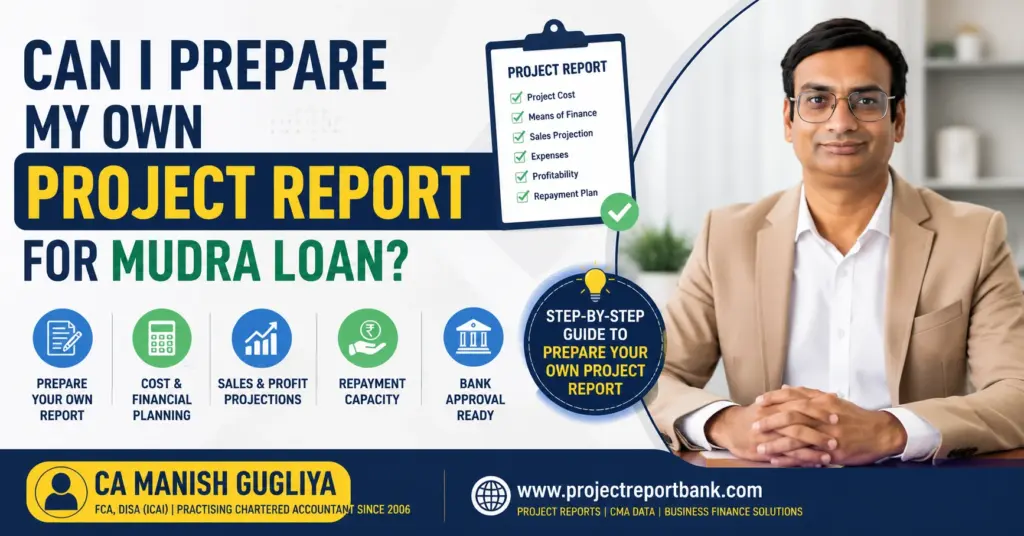
Can I prepare my own project report for Mudra Loan?
Yes, if you understand your business and can create realistic, internally consistent financial projections. Professional assistance from a CA or consultant is helpful for complex proposals but is not universally mandatory.
Does a CA need to prepare or sign a Mudra Loan project report?
Not in all cases. Some banks request CA-certified projections, particularly for larger loan amounts under Tarun category. Others accept project reports prepared by the applicant. Check with your specific lender.
What is the main difference between a project report and a business plan?
The main difference is emphasis. A project report centers on financial viability and repayment capacity for a specific project or loan proposal. A business plan centers on the overall business concept, market strategy, and growth direction. For Mudra Loan purposes, the project report’s financial focus makes it the more relevant document.
Final Conclusion: Project Report vs Business Plan for Mudra Loan
A project report and a business plan serve different primary purposes, even when their content overlaps. For a Mudra Loan, the project report is the document that matters most because it answers the bank’s fundamental question: is this project financially viable, and can the borrower repay?
A business plan adds value for strategic clarity, investor conversations, and long-term planning. But when the bank branch asks for a document to appraise your loan application, they need financial depth: project cost, means of finance, projected sales and expenses, cash flow, and a repayment plan. A project report delivers this. A business plan, unless it contains equivalent financial detail, does not.
If you are applying for a Mudra Loan, prepare a project report that reflects your actual business, uses supportable assumptions, and shows internally consistent numbers from cost to revenue to repayment. Ask your lender what specific documentation they require for your loan amount and category. Build the document around what the bank needs to see, not around what sounds impressive.
For more resources on preparing your Mudra Loan documentation, visit the Mudra Loan project report basics section.
- Mudra Loan Project Report Online – Can It Really Be Done?

- Does a Project Report Guarantee Mudra Loan Approval? (Expert Guide by CA Manish Gugliya)
- Does Mudra Loan Amount Affect Project Report Requirements?
- When Does a Bank Ask for a Project Report for Mudra Loan?

- What Information Do You Need Before Preparing a Mudra Loan Project Report?

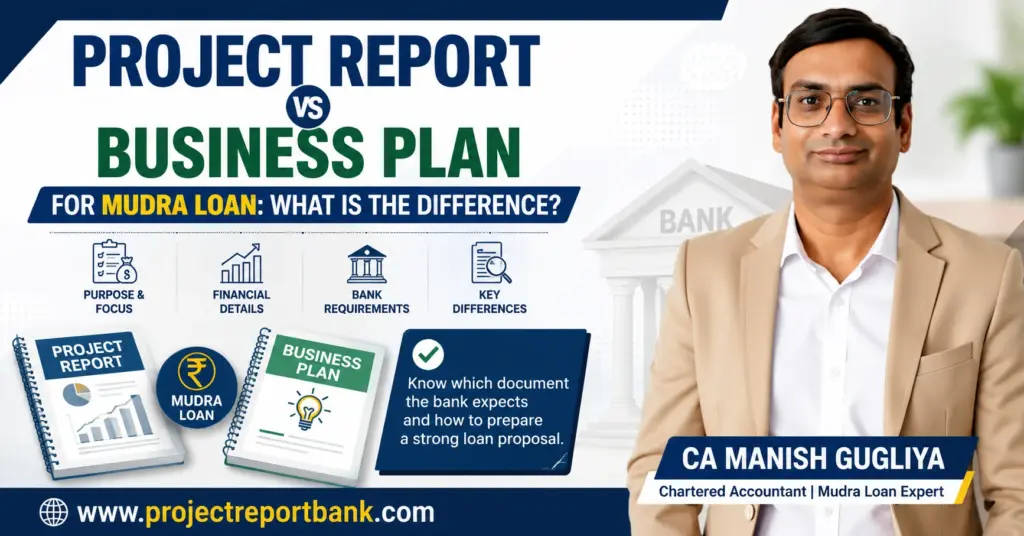
- Project Report vs Business Plan for Mudra Loan: Which Is Better for Your Application?
- Can I Prepare My Own Project Report for Mudra Loan?
- Who Can Prepare a Project Report for Mudra Loan?

- Why Is a Project Report Required for Mudra Loan?