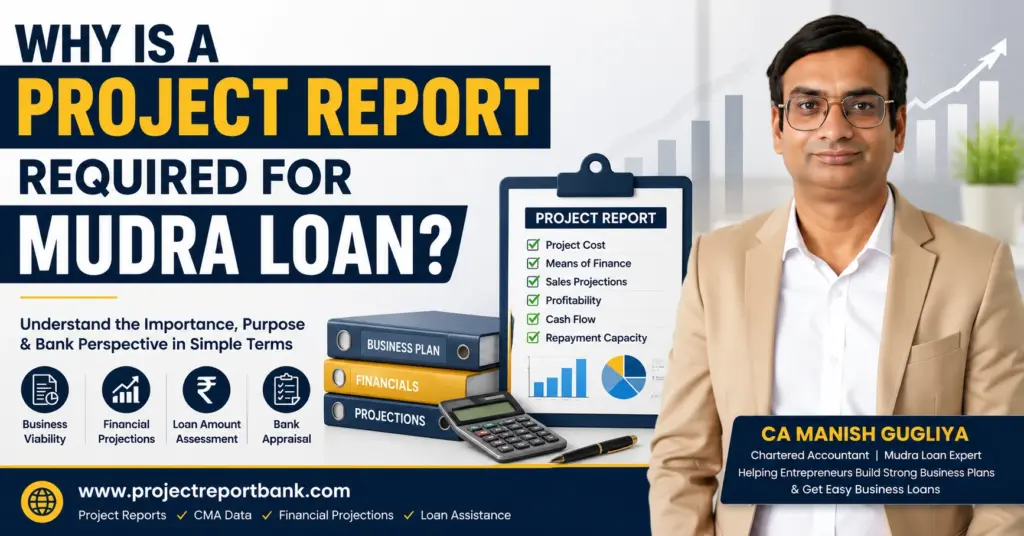
A Mudra Loan project report outlines business plans and financial needs in a structured format that banks use to evaluate whether your proposal is viable and whether you can repay the loan. If you are applying under the Pradhan Mantri Mudra Yojana (PMMY), understanding who can prepare this report is one of the first practical decisions you will face.
The short answer: a Mudra Loan project report can be prepared by the borrower, a Chartered Accountant, an accountant, a financial consultant, or a professional project report preparation service. No specific statutory qualification is required for preparing a project report under the mudra scheme. What banks care about most is the quality, accuracy, and credibility of the information inside the document.
Key Takeaways
A Mudra Loan project report is a structured business and financial proposal submitted alongside your loan application. It covers your business model, project cost, means of finance, financial projections, and repayment plan. Banks use it to assess whether the project is viable and whether you can service the loan from projected cash flows.
- Mudra loans are categorized into three categories-Shishu (up to ₹50,000), Kishore (₹50,001 to ₹5 lakh), and Tarun (₹5,00,001 to ₹10 lakh)-and can provide up to ₹10 lakhs for business funding. A project report is essential for Mudra Loan applications, particularly for Kishore and Tarun categories.
- Under the Pradhan Mantri Mudra Yojana, there is no strict legal mandate for professional certification to draft project reports. Different banks may impose their own documentation requirements, so always confirm with your lender.
- Professional help from an experienced CA or MSME finance expert becomes more useful when the loan amount is higher, projections are complex, or the bank has asked for detailed financial statements and ratio analysis.
- Readers new to the topic can refer to Mudra Loan Project Report Basics and the guide on what a Mudra Loan project report is on ProjectReportBank.com for a broader conceptual understanding.

Who Can Prepare a Mudra Loan Project Report?
Technically, any competent person-including the applicant-can prepare a Mudra Loan project report, unless a specific lender prescribes otherwise. The report is essentially a structured explanation of your business idea, project cost, means of finance, financial projections, and repayment capacity used by the bank to appraise the proposal. Factors influencing the preparation of the report include business understanding and market demand analysis, not just the preparer’s education qualification or professional title.
Banks are primarily concerned with the reliability, internal consistency, and supportability of the information rather than only with the preparer’s designation. A well-reasoned report from the borrower can carry more weight than a formulaic report from a professional with inflated numbers.
The sections below cover your main options: self-prepared report, report prepared by a Chartered Accountant, by an accountant, by a financial or MSME consultant, and by a professional project report service.
The Mudra Loan Applicant or Business Owner
Many borrowers search “can I prepare Mudra Loan project report myself,” and the answer is yes-applicants can prepare their own project report if they understand their business model and costs.
A self-prepared project report for Mudra Loan is reasonable when:
- The business model is simple (trading, retail, basic services)
- You are applying for a smaller Shishu or lower Kishore loan
- You have a clear grip on day-to-day costs, monthly sales, and expected revenue
- Your cost structure is straightforward with no complex machinery or manufacturing processes
You should clearly explain your business overview, proposed location including any space or land requirement, project cost, working capital needs, and a simple year-wise income-expense estimate using realistic assumptions. For smaller Shishu loans, detailed project reports are rarely required-a basic project note often suffices.
The risks? Over-optimistic sales figures, ignoring expenses like rent, salaries of employees working in the unit, GST, and interest, and inconsistent numbers across different pages can all reduce credibility. Unrealistic financial projections can cause report rejection during bank appraisal.
Chartered Accountant
A Mudra Loan project report prepared by CA is common in practice, particularly for Kishore and Tarun category loans or for more detailed term loan and working capital proposals. Hiring Chartered Accountants is common for larger Kishore or Tarun loans because these involve higher amounts and more complex financial analysis.
A CA can help with:
- Accurate project cost estimation including pre-operative expenses
- Structuring means of finance (own contribution vs bank loan)
- Preparing projected Profit & Loss Account, balance sheet, and cash flow statement
- Working capital assessment and depreciation calculations
- Ratio analysis such as DSCR (Debt Service Coverage Ratio), often expected at ≥ 1.25 for Tarun loans
- CMA-style complete financial information where required
An experienced CA can also ensure projections are broadly consistent with existing financial statements, GST returns, and bank statements for existing businesses. However, having a report prepared by a CA does not itself guarantee approval-it simply makes it easier for both borrower and bank to understand viability and repayment capacity.
Accountant
Many small enterprises have in-house or external accountants who handle bookkeeping, GST, and basic financial documents. A capable accountant can usually draft basic financial projections, simple cost sheets, and a business description, especially for micro enterprises and less complex mudra loan project proposals.
The key distinction: routine bookkeeping is different from preparing a detailed, bankable loan project report. An accountant may not always be comfortable with term loan repayment scheduling, interest working, or DSCR calculations if the bank requires them. If you use an accountant, ensure the numbers match past records where applicable, and that assumptions are not simply copied from another business’s report.
Financial or MSME Consultant
Many cities and towns have MSME consultants, finance professionals, and project consultants who offer professional project report for Mudra Loan services. They bring knowledge of different banks’ formats, understanding of mantri mudra yojana PMMY norms, and familiarity with term loan plus working capital structures.
However, titles like “consultant” are not regulated in the same way as “Chartered Accountant.” Before hiring, check actual experience, request sample reports, and verify whether the consultant can explain each number logically. A good Mudra Loan project report consultant will customise the report for your specific business, avoid unrealistic profitability, and help collect supporting financial documents, quotations, and licenses. This is not an exhaustive list of what to check, but it covers the key areas.
Professional Project Report Preparation Service
In recent years, many online project report preparation service for Mudra Loan platforms have emerged. Automated digital platforms can generate bank-ready projected financial reports using template-based or software-driven tools, where reports generated cover standard sections expected by lenders. The borrower provides basic business information, estimated costs, and expected sales; the system generates a structured report with financial projections.
These services save time and offer formats aligned with common bank requirements, but you must ensure all assumptions reflect your real business. Banks increasingly recognise formulaic, copy-paste reports that are not tailored to your product, location, or market analysis.
ProjectReportBank.com specialises in customised Mudra Loan project reports prepared under expert CA supervision, focused on realistic projections and bank-appraisal requirements.
Table of Contents
Can I Prepare a Mudra Loan Project Report Myself?
Yes, you can. But quality and accuracy matter more than the label “self-prepared.”
When self-preparation is usually sufficient:
- Small ticket Shishu loans or simple trading/service businesses like beauty parlors or small retail shops
- You have a good handle on costs, pricing, and monthly sales patterns
- The bank has not specifically insisted on CA-certified projections
When professional assistance may be advisable:
- Higher Tarun category loans approaching ₹10 lakh
- Manufacturing or machinery-intensive projects involving commercial manufacturing processes
- Mixed term loan plus working capital loans facilities
- The banker has specifically asked for detailed financial projections or break even analysis
| Factor | Self-Prepared | Professionally Prepared |
|---|---|---|
| Preparation cost | Nil or minimal | Professional fees apply |
| Depth of financial projections | Basic | Detailed with ratios |
| Time required | Variable, can be slow | Faster with experience |
| Suitability for simple proposals | High | High |
| Suitability for complex proposals | Limited | Strong |
| Ability to defend assumptions before bank | Depends on owner’s knowledge | Professional can guide |
| Financial ratios (DSCR, break even point) | Often missing | Usually included |
Even with a self-prepared report, you can ask a CA or expert to review numbers for internal consistency before submitting to the bank.

Is a CA Required for a Mudra Loan Project Report?
There is generally no blanket rule under the pmmy scheme that makes a CA mandatory for all Mudra Loan projects. This is based on commonly available official PMMY/MUDRA documentation. As ProjectReportBank.com’s FAQ confirms, CA certification is not mandatory under PMMY-there is no RBI circular or ICAI requirement mandating a CA sign every project report.
Important distinctions:
- Report prepared by a CA – the CA drafts the entire document
- Report signed by a CA – the CA puts their stamp and membership number
- Bank asking for CA-certified financial projections – a specific lender norm
These are three different issues. Some banks or branches, such as certain branches of HDFC Bank, ICICI Bank, or Axis Bank, may insist on CA involvement for higher Tarun loans. The specific lending bank may impose its own documentation requirements. Always check the checklist or directly ask your sanctioning branch.
Many borrowers still prefer a CA for larger Mudra Loan project report preparation because it produces better-organised projections and gives the bank comfort. But hiring a CA improves presentation-it does not by itself ensure approval.
Is CA Signature Required on a Mudra Loan Project Report?
In many Mudra Loan cases, banks require a project report but do not mandatorily require a CA signature on it. However, practices vary across different banks, scheme variants, and loan amounts, so applicants must confirm with their own lender.
The applicant’s own declaration and signature is almost always required. A professional signature or certification by a CA is a separate matter. Even where the project report is prepared by a CA, the bank treats you as responsible for the correctness of information-so understand the numbers and do not sign blindly.
If your bank specifically asks for “CA signed” projections in writing, comply to avoid processing delays. Otherwise, there is no need to insist on a signature purely for formality.
Does a Mudra Loan Project Report Need CA Certification?
CA certification is not a universal PMMY rule. It tends to be a bank-specific or case-specific requirement where it exists. Under the Pradhan Mantri Mudra Yojana, there is no strict legal mandate for professional certification to draft project reports.
Clearly distinguish between:
- A report prepared by a CA
- A report reviewed by a CA
- A report signed by a CA
- A report formally certified by a CA
Banks may use these terms differently in their internal formats per their lender norms. Rely on written checklists or sanction conditions from your chosen bank or NBFC rather than assumptions. For larger or borderline cases, a CA-certified set of financial projections can improve confidence but does not override the bank’s own credit appraisal.
Can an Accountant Prepare a Mudra Loan Project Report?
Many banks will accept a project report prepared by an experienced accountant as long as the content is logical, internally consistent, and supported by documents such as quotations and past financials. An accountant should be able to draft profit projections, anticipated expenses, and a simple loan repayment schedule.
For more complex proposals, the accountant and a CA can work together-the accountant preparing basic details information and the CA refining the structure and projections. Avoid relying solely on data-entry skills; test whether the accountant can explain the “why” behind each key assumption if a banker questions it.
Can a Mudra Loan Consultant Prepare the Project Report?
A Mudra Loan project report consultant or MSME finance consultant can certainly prepare the report, provided they understand bank loan appraisal practices and Mudra/PMMY guidelines.
Before hiring, check:
- Years of experience with MSME loans, including pmegp loan and Mudra proposals
- Familiarity with formats across different banks
- Ability to create industry-specific assumptions
- Readiness to revise the report if the bank requests changes
Warn yourself against consultants who focus mainly on promising guaranteed loan approval or unrealistic subsidy claims. Ask for a sample mudra loan project report (with client details masked) to judge quality and customisation. Constructive criticism of your own assumptions by the consultant is actually a good sign.
Who Should Prepare the Project Report for a New Business?
New businesses have no past financial statements, making the project report more dependent on assumptions regarding demand, pricing, capacity utilisation, and expenses. The report should include business description and market analysis based on realistic local conditions, not generic industry averages.
For very small startups-a small retail outlet, beauty parlors, or simple service activities-a self-prepared report with logical numbers may be enough. But for manufacturing units involving commercial manufacturing processes, technology services, or higher Tarun loans, professional assistance is advisable.
Example: A person starting a small food processing or fabrication unit knows approximate machinery prices, selling rates, and potential customers, but may struggle to translate this into year-wise financial projections, working capital cycles, break even point calculation, and DSCR without expert help. This is where a CA or project report expert adds value.
Who Should Prepare the Project Report for an Existing Business?
Existing businesses seeking a Mudra Loan for expansion or working capital top-up have historical data: ITRs, GST returns, financial statements, bank statements, and records of achievements export orders if any. The project report should show how the additional loan will impact turnover, profitability, and cash flow, broadly aligning with past performance while explaining growth assumptions.
A CA-prepared or CA-reviewed report is particularly helpful here to reconcile past and future numbers and answer banker queries on margins, stock levels, and existing borrowings. The report should clearly differentiate between existing assets or loans and new project cost or loan, so the bank sees the incremental impact. Mention the company’s background, project company profile, and any export orders or third party details such as required third party details of key suppliers or customers.
When Is Professional Help Recommended?
Professional preparation may be advisable when:
- The loan amount approaches the upper Tarun limit of ₹10 lakh
- The project involves multiple machines or significant fixed assets
- There is a mix of term loan and working capital requirements
- The bank has raised detailed queries on projections
- The promoter is technically strong but uncomfortable with financial statements or banking industry terminology
- The business involves mutual funds of raw materials, complex project logistics details, or multiple revenue streams
A good professional will not just fill a template-they will discuss assumptions, challenge unrealistic expectations, and help you understand your repayment plan and obligations. While professional fees are an additional cost, a well-constructed loan project report can prevent mis-financing and improve the overall quality of the business plan. This supports the broader goal of financial inclusion under the mudra scheme.
What Should a Professionally Prepared Mudra Loan Project Report Include?
This is a brief overview of contents, not a full “how to prepare” guide. For the detailed structure, refer to Mudra Loan Project Report Basics.
Core sections typically include:
- Promoter profile and project company profile
- Business overview, business administration details, and products or services
- Basic market analysis covering project commercial aspects and advertising strategies
- Detailed project cost, including land requirement and space or land requirement
- Means of finance (own margin vs business loan or bank loan)
- Machinery, equipment, and other fixed assets with project logistics details
- Working capital estimation
A project report typically includes a 5-year profit and loss statement, projected balance sheet, cash flow statement, and loan repayment schedule with interest calculations. Where appropriate, include break even analysis and DSCR. The report must detail how funds will be utilized and repaid. Each set of numbers should be backed by written assumptions on capacity, sales volume, pricing, raw material costs, and expenses related to employees working in the business.
What Does the Bank Actually Look for in the Project Report?
Lenders focus on substance over style. They examine viability, repayment capacity, and consistency with other financial documents. The credibility of the project report is critical for bank approval of loans. Banks require a project report to assess loan viability-and Mudra Loan project reports should be clear and concise.
Key appraisal points include:
- Realistic project cost with adequate promoter contribution
- Logical sales and margin assumptions based on market analysis
- Sufficiency of projected cash to service loan instalments
- Alignment with past performance for existing businesses
- Whether quotations, licenses, and supporting documents match report figures
Banks prefer project reports in a standard format for Mudra loans. An attractive, professionally formatted report with unrealistic numbers may actually harm credibility compared to a modest but honest self-prepared report. For more on this, read about why a project report is required for a Mudra Loan.
Self-Prepared vs CA-Prepared Mudra Loan Project Report
Borrowers often compare a self-prepared project report for Mudra Loan with a CA-prepared project report for Mudra Loan. Here is a practical comparison:
| Factor | Self-Prepared | CA/Professionally Prepared |
|---|---|---|
| Cost | Nil or minimal | Professional fees apply |
| Time to prepare | Longer if unfamiliar with formats | Generally faster |
| Depth of projections | Basic, may miss items | Comprehensive, structured |
| Financial ratios | Usually absent | DSCR, break even, ratio analysis included |
| Handling complex structures | Difficult | Comfortable |
| Addressing banker queries | Owner’s direct knowledge helps | Professional structuring helps |
| Ground-level business understanding | Strong | Depends on briefing quality |
Banks do not universally reject self-prepared project reports. However, for larger or more complex proposals, a professional report often inspires more confidence during credit appraisal and improves approval chances.
Common Mistakes When Choosing Someone to Prepare the Report
Common errors that lead to trouble:
- Selecting someone solely because they promise guaranteed Mudra Loan approval
- Accepting a generic template with only the name and figures changed-similar to using a big bazaar retail format for a small enterprises manufacturing unit
- Relying on extremely optimistic turnover or profit assumptions that even partial fulfilment would not justify
Technical mistakes frequently seen:
- Incorrect project cost (missing pre-operative expenses or working capital)
- Mis-calculated EMIs or repayment schedule
- Inconsistent information in reports results in loan denials
- Ignoring taxes, interest, or depreciation in projections
- Incomplete project reports lead to loan rejections
- Reports not aligned with bank expectations are often rejected
- Lack of clear repayment plans leads to project report rejection
Insist that whoever prepares the report walks you through each major assumption. You should never be caught off guard during bank discussions about your own project work.
Can a Professionally Prepared Project Report Guarantee Mudra Loan Approval?
No. No project report-whether self-prepared, prepared by a CA, or prepared by any expert-can guarantee sanction. Approval depends on the bank’s independent credit appraisal, eligibility norms, documentation, and risk assessment.
A strong, professionally prepared project report helps present the case clearly and can reduce back-and-forth queries, but it is only one part of the overall appraisal that also considers credit history, existing obligations, and conduct of accounts. Treat the report as a planning tool for yourself as well-understanding how much loan you can safely service from projected cash flows.
Practical Example: Small Manufacturing Unit Seeking Mudra Loan
Consider a micro-entrepreneur in 2026 setting up a small plastic components manufacturing unit. The project involves moulds, an injection moulding machine, working capital for raw materials, and an application for a Tarun category Mudra Loan of around ₹8–9 lakh.
The promoter knows: approximate machinery price from vendor quotations, expected selling price per piece, rough monthly production target, and potential customers in the local automobile spare-parts market.
Converting this into a bank ready report requires structuring project cost, identifying promoter’s own margin, estimating working capital cycles, drafting sales and expense projections covering manufacturing processes, and preparing a repayment schedule that results in acceptable DSCR. This is where professional assistance from a CA like CA Manish Gugliya becomes useful-transforming scattered business knowledge into a coherent set of financial projections that both entrepreneur and banker can rely on.
CA Manish Gugliya’s Practical View
In my experience across different banks over nearly two decades of practice as a Chartered Accountant (FCA, DISA from ICAI), the real value of a Mudra Loan project report lies in helping both borrower and lender clearly see project cost, funding structure, profitability, and repayment capacity-rather than just satisfying a paperwork requirement.
A few practical insights I consistently share with entrepreneurs:
- Use conservative yet realistic sales assumptions. If your monthly sales assumption cannot survive even mild constructive criticism, it needs reworking.
- Align projections with actual bank statement trends for existing businesses. Banks will cross-check.
- Avoid “made to fit” numbers that show perfect DSCR but have no basis in your actual capacity or market.
- Understand your own report. Whether a CA, accountant, or consultant prepares it, you must be able to own the business plan before the bank.
Choose whoever prepares your report-self, CA, accountant, or consultant-in such a way that you thoroughly understand the figures. The report is your business story in numbers. If you cannot tell that story, the document alone will not convince anyone.
Conclusion: Who Should Finally Prepare Your Mudra Loan Project Report?
A Mudra Loan project report can be prepared by the borrower, a CA, an accountant, a consultant, or a professional project report service, subject to any specific conditions imposed by the lending institution. Under PMMY, as of 2026, over ₹40.07 lakh crore has been disbursed across crores of accounts-demonstrating the scale of the scheme and the diversity of borrowers it serves, from micro enterprises to small enterprises.
The decisive factors for banks are credibility of information, realistic assumptions, and clear demonstration of repayment capacity-not merely the designation printed on the cover page. Smaller, simple loans for a small business may be supported by a well-thought-out self-prepared report, while larger or more complex proposals involving finance from multiple sources usually benefit from professional preparation.
For a deeper conceptual understanding, read the parent article on Mudra Loan Project Report Basics and the beginner guide on what a Mudra Loan project report is, both available on ProjectReportBank.com.
CA Manish Gugliya, FCA, DISA (ICAI) – Practising Chartered Accountant since 2006, Mudra Loan & Project Report Expert, ProjectReportBank.com.
Frequently Asked Questions
Below are concise answers to common follow-up questions about who can prepare a Mudra Loan project report, beyond what is covered in the main sections above.
Who can prepare a project report for Mudra Loan?
In most cases, the project report can be prepared by the borrower, a Chartered Accountant, an accountant, a finance or MSME consultant, or a professional project report service. No specific statutory qualification is required unless the bank explicitly insists on a particular type of certification. The focus should be on realistic content and supportable assumptions rather than the preparer’s title.
Will my bank reject a self-prepared Mudra Loan project report?
Banks generally do not reject a proposal only because the report is self-prepared. However, they may raise queries or ask for professional certification if projections are unclear, internally inconsistent, or if the loan amount and business complexity are higher. Incomplete project reports and inconsistent information are far more common reasons for rejection than the absence of a professional’s name on the cover.
Is a CA-prepared project report always better for Mudra Loan?
A CA-prepared report is often stronger in terms of structure, detailed financial projections, and ratio analysis, especially for larger or more complex projects. But what truly matters is whether the numbers are realistic and the applicant can explain them. For very simple micro loans, a carefully self-prepared report can also be adequate and accepted by the bank.
Can I change the person preparing my Mudra project report later?
Yes, you can revise or completely re-prepare your project report with another professional if needed. However, inform the bank if the revised report materially changes the project cost, loan requirement, or financial projections already discussed during the appraisal process.
Does using a project report consultant increase my Mudra Loan approval chances?
A competent consultant can improve the quality and clarity of the report, which may help the bank understand and appraise the proposal more easily. But loan sanction still depends on overall eligibility, credit profile, and viability. No project report-regardless of who prepared it-can guarantee Mudra Loan approval.
- Mudra Loan Project Report Online – Can It Really Be Done?

- Does a Project Report Guarantee Mudra Loan Approval? (Expert Guide by CA Manish Gugliya)
- Does Mudra Loan Amount Affect Project Report Requirements?
- When Does a Bank Ask for a Project Report for Mudra Loan?
- What Information Do You Need Before Preparing a Mudra Loan Project Report?
- Project Report vs Business Plan for Mudra Loan: Which Is Better for Your Application?
- Can I Prepare My Own Project Report for Mudra Loan?
- Who Can Prepare a Project Report for Mudra Loan?
- Why Is a Project Report Required for Mudra Loan?