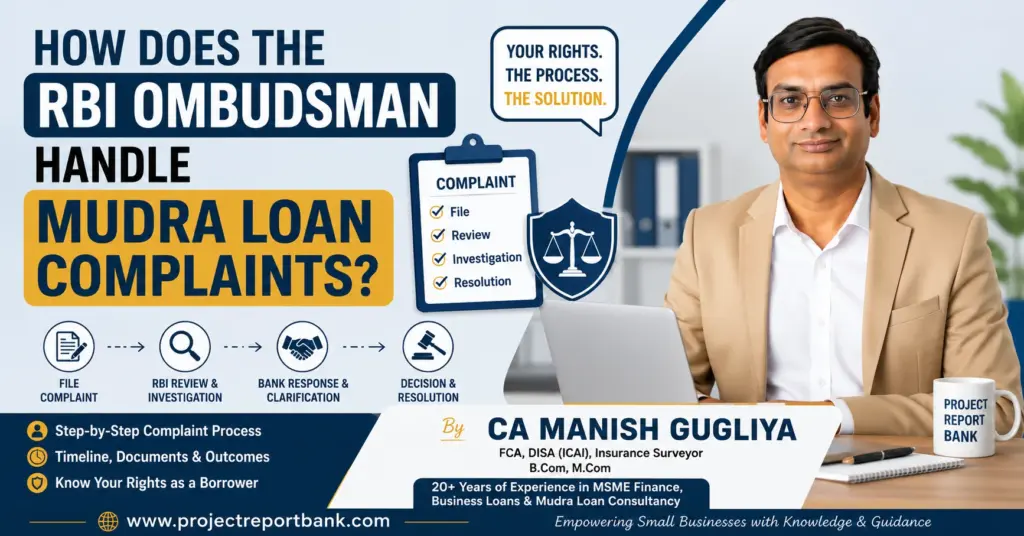
If your Mudra loan application was unfairly rejected, your bank charged hidden fees, or recovery agents harassed you, you have two main options to seek justice in India – the RBI Ombudsman or the Consumer Commission. Both are powerful, but they work very differently. Choosing the wrong one can waste months of your time and effort.
I’m CA Manish Gugliya, and over the past 20+ years of helping MSMEs with project reports, CMA data, and Mudra loan consultancy, I’ve seen hundreds of borrowers struggle with this exact question. Some rush to the consumer court without even writing to their branch manager first. Others file with the banking ombudsman when their case actually needs the broader relief only a Consumer Commission can provide.
Here’s the truth: crucial differences exist between the RBI Ombudsman and the Consumer Commission in terms of procedure and compensation. The RBI Ombudsman is a free, fast, online grievance mechanism run by the Reserve Bank of India for banking service complaints. The Consumer Commission is a quasi-judicial body under the consumer protection act that can award broader damages based on proven losses – including mental agony, financial harm, and litigation expenses.
Both forums are useful. But they serve different purposes. The right choice depends on the nature of your problem, the relief you want, and how much time and money you can invest.
In this article, I’ll explain both options in simple language that anyone can understand. You’ll learn what each authority does, how they compare on speed, cost, and compensation, which Mudra loan problems suit which forum, and exactly how to decide. I’ve also included a decision guide, document checklists, common mistakes to avoid, and answers to 25 frequently asked questions.
The short answer: For most Mudra loan service complaints – processing delays, staff misbehaviour, RBI guideline violations – the RBI Ombudsman is faster, free, and sufficient. But if you’ve suffered significant financial loss, mental harassment, or need compensation beyond ₹30 lakh, the Consumer Commission is the stronger forum. Aggrieved micro-entrepreneurs can approach the RBI Ombudsman for disputes related to Mudra loans, while under consumer law, disputes involving Mudra loans used for livelihood can approach a Consumer Commission.
Table of Contents
What Is RBI Ombudsman?
The RBI Ombudsman is the Reserve Bank of India’s official grievance resolution system for complaints against banks and non banking financial companies (NBFCs). It operates under the RBI Integrated Ombudsman Scheme, 2026, which came into effect on 1 July 2026. This scheme replaced the earlier 2021 version and follows the “One Nation One Ombudsman” approach – meaning there’s no regional jurisdiction anymore. You can file from anywhere in the country.
The banking ombudsman scheme covers all RBI-regulated entities: scheduled commercial banks, regional rural banks, primary cooperative banks (with deposits ≥ ₹50 crore), NBFCs with customer interface or accepting deposits (asset size ≥ ₹100 crore), payment system operators, and credit information companies. Since Mudra loans are disbursed through banks and NBFCs, they fall squarely within this scheme.
What kinds of complaints does it handle?
The ombudsman office accepts complaints about deficiency in banking services, including:
- Delays in loan sanction or disbursement
- Unfair recovery practices or harassment by recovery agents
- Non-observance of RBI’s Fair Practices Code
- Staff misbehaviour at the branch
- Mis-selling of financial products
- Wrong charges or deductions on your account
The Banking Ombudsman Scheme is free for complainants – there is no filing fee whatsoever. Complaints can be filed online through the RBI Complaint Management System (CMS) portal, by email, or by physical letter to the Centralised Receipt and Processing Centre in Chandigarh.
Important rule: Complaints must first be lodged with the bank before approaching the RBI Ombudsman. You must write to your branch manager or the bank’s principal nodal officer. If the bank doesn’t resolve your grievance within 30 days, or gives you an unsatisfactory response, you can then approach the ombudsman within the next 90 days.
For a detailed guide on how this process works specifically for Mudra loans, read our article on RBI Ombudsman for Mudra Loan Complaints.
What Is Consumer Commission?
The Consumer Commission is a quasi-judicial body that handles consumer complaint cases under the Consumer Protection Act, 2019 (CPA 2019). The Consumer Commission operates under the Consumer Protection Act, 2019, which replaced the older 1986 Act and provides much stronger consumer rights.
Under this law, anyone who uses a “service” – including banking services like loans, deposits, and account management – is a “consumer.” When a bank provides deficient service, engages in unfair trade practices, or causes financial harm, you can file a consumer complaint.
Three-tier structure:
The Consumer Commission has three levels, each with different jurisdiction based on the value of goods or services involved:
- District Consumer Disputes Redressal Commission: Claims up to ₹50 lakh
- State Commission: Claims above ₹50 lakh and up to ₹2 crore
- National Commission: Claims above ₹2 crore
For most Mudra loan disputes (Shishu up to ₹50,000, Kishore up to ₹5 lakh, Tarun up to ₹10 lakh), the District Commission will have jurisdiction.
The Consumer Commission handles grievances related to deficiency in service. It can award compensation for financial loss, mental agony, litigation expenses, and interest. The Consumer Commission addresses unfair trade practices and severe negligence – areas where the RBI Ombudsman has limited authority.
Consumer forums can be approached directly within a statutory limitation period of generally 2 years from when the cause of action arose. Consumer Commission provides for judicial recourse that allows formal legal representation, though many consumers do represent themselves.
No court fee is required for complaints under ₹5 lakh. The Consumer Commission requires nominal filing fees for higher claim values, varying by commission level and claim amount.
RBI Ombudsman vs Consumer Commission: How They Compare at a Glance
Before diving into detailed analysis, here’s a quick comparison table that covers the most important factors:
| Feature | RBI Ombudsman | Consumer Commission |
|---|---|---|
| Purpose | Resolve banking service grievances | Resolve consumer disputes, including banking |
| Governing Law | RBI Integrated Ombudsman Scheme, 2026 | Consumer Protection Act, 2019 |
| Compensation Limit | Up to ₹30 lakh (financial loss) + ₹3 lakh (stress/inconvenience) | No fixed cap; based on proven losses and jurisdiction tier |
| Time to Resolve | Generally faster (weeks to a few months) | Months to years depending on backlog |
| Cost | Completely free | Nominal filing fees + possible lawyer costs |
| Lawyer Required? | No | Not mandatory, but recommended for complex cases |
| Types of Complaints | Banking service deficiency, guideline violations | Broader: service deficiency, unfair trade practices, mental harassment, financial loss |
| Appeal | Internal review within RBI; appeal within 30 days | District → State → National Commission → Supreme Court |
| Online Filing | Yes, via CMS portal | Yes, via e-Daakhil portal |
| Best For | Quick resolution of banking service issues | Large compensation claims, proven negligence, complex disputes |
Headline takeaway: RBI Ombudsman is faster, free, and designed for banking service complaints. Consumer Commission offers broader compensation authority and formal legal remedies but requires more time, money, and effort.
Speed and Timeline
Speed matters enormously when you’re a small business owner whose Mudra loan issue is holding up your enterprise. Let’s compare how fast each forum actually works.
RBI Ombudsman timeline:
The process starts with your bank complaint. The bank has 30 days to respond. If unsatisfied, you file with the ombudsman within 90 days. RBI Ombudsman usually resolves complaints faster than the Consumer Commission – the integrated ombudsman scheme promises more expeditious resolution than earlier versions. Most straightforward banking complaints see a resolution within a few weeks to a couple of months after filing.
Consumer Commission timeline:
Consumer forum cases follow formal judicial procedures. After filing, there’s notice to the opposite party, written responses, evidence submission, hearings, and finally an order. Depending on the district and case backlog, this process can stretch from several months to over a year. Appeals in Consumer Commission cases move up the judicial ladder – from District to State to National Commission – which adds more time if either party contests.
| Timeline Factor | RBI Ombudsman | Consumer Commission |
|---|---|---|
| Bank-level complaint | 30 days waiting | Recommended but not strictly mandatory |
| Filing window | Within 90 days of bank reply | Within 2 years of cause of action |
| Acknowledgement | Usually within days | Within weeks |
| Resolution | Weeks to a few months | Months to over a year |
| Appeal timeline | 30 days to file appeal | Varies by commission level |
Winner: RBI Ombudsman – It’s significantly faster for straightforward banking service complaints. The trade-off is that the Consumer Commission, while slower, offers a more thorough judicial process that may be necessary for complex disputes requiring detailed evidence examination.
Compensation and Financial Relief
This is where the two forums differ dramatically.
RBI Ombudsman compensation:
RBI Ombudsman can award up to ₹30 lakhs for financial loss. Additionally, the 2026 scheme allows up to ₹3 lakh for stress, costs, and inconvenience. The ombudsman can also direct the bank to take corrective actions – like reversing wrong charges or updating credit bureau records. However, the ombudsman cannot award punitive damages or relief beyond these fixed limits.
The RBI Ombudsman cannot entertain complaints regarding pure commercial judgments of lenders. So if a bank rejected your Mudra loan for a valid reason based on their credit assessment, the ombudsman won’t override that decision.
Consumer Commission compensation:
The Consumer Commission can award broader damages based on proven losses. There is no fixed cap on compensation – it depends on the claim value, evidence, and the jurisdiction tier you’re filing under. Consumer commissions can award compensation for mental agony, financial loss, interest on delayed payments, litigation expenses, and even exemplary damages in severe cases.
Real-world examples that illustrate the difference:
- A Thrissur Consumer Commission held Central Bank of India liable for losing an original Pattayam (land deed) submitted for an agricultural loan and awarded ₹2.5 lakh compensation.
- A Consumer Commission ordered SBI to pay ₹1 lakh compensation plus refund for wrongfully deducting ₹590 from a closed loan account.
- In a digital fraud case, a Consumer Commission ordered SBI to refund ₹12.93 lakh plus ₹25,000 compensation to a Bengaluru professor.
- Through the RBI Ombudsman, one complainant received ₹25,300 from SBI for incorrect credit bureau reporting – a smaller but swiftly resolved matter.
Winner: Consumer Commission – For significant financial losses, mental harassment claims, and cases needing large compensation, the Consumer Commission has far more power. The trade-off is that the RBI Ombudsman’s ₹30 lakh limit is adequate for most common Mudra loan service complaints, and the process is much simpler.
Cost and Accessibility
For Mudra loan borrowers – many of whom are micro-entrepreneurs, first-time borrowers, or women entrepreneurs running small businesses – cost is a critical consideration.
RBI Ombudsman costs:
- Filing fee: Zero. Completely free.
- Lawyer: Not required. The process is designed for self-representation.
- Documentation: Minimal. Basic complaint form, bank correspondence, and supporting details.
- Travel: None. Everything can be filed online or by post.
- Time investment: Low. No court hearings to attend.
Consumer Commission costs:
- Filing fee: No court fee is required for complaints under ₹5 lakh. For higher amounts, the Consumer Commission requires nominal filing fees.
- Lawyer: Not mandatory, but highly recommended for complex claims. Lawyer fees can range from a few thousand to lakhs depending on the case.
- Documentation: More extensive. You need formal complaint drafting, affidavits, evidence compilation, and supporting documents.
- Travel: You may need to attend hearings at the commission, which could be in another city.
- Time investment: Significant. Multiple hearing dates over months.
For a small business owner who took a Shishu or Kishore Mudra loan, the RBI Ombudsman’s zero-cost, online process is far more accessible than navigating consumer court proceedings.
Winner: RBI Ombudsman – It’s free, doesn’t need a lawyer, and can be filed online from anywhere in India. The trade-off is that for cases requiring larger compensation or formal legal proceedings, investing in a Consumer Commission case may be worthwhile despite the higher costs.
Types of Mudra Loan Problems Each Authority Handles
Not every Mudra loan problem should go to the same forum. Here’s a detailed breakdown of which authority handles what.
Problems suited for the RBI Ombudsman:
- Bank delayed processing your Mudra loan application beyond reasonable time
- Branch manager refused to accept your application without a valid reason
- Bank demanded collateral for a Mudra loan (Mudra loans are collateral-free but not liability-free)
- Staff misbehaviour or rude treatment at the branch
- Bank failed to communicate the reason for loan rejection
- Recovery agents used abusive language or visited your home at odd hours (recovery agents must follow strict Fair Practices Codes)
- Bank charged processing fees not disclosed upfront
- Wrong interest rate applied to your Mudra loan account
- Bank auto-debited your savings account without consent for loan recovery
- No response from the bank’s grievance cell or principal nodal officer
- Bank refused to provide a copy of your loan agreement
- Bank failed to follow RBI or PMMY guidelines during loan processing
- Credit bureau (CIBIL) updated incorrectly due to bank’s error
- Bank refused to provide closure certificate after full repayment
- Delay in releasing security or documents after loan closure
For step-by-step understanding of how these complaints are handled, read How RBI Ombudsman Handles Mudra Loan Complaints.
Problems suited for the Consumer Commission:
- Significant financial loss caused by bank’s negligence in processing your loan
- Mental harassment due to illegal recovery practices
- Bank lost your original documents (title deeds, property papers, security documents)
- Wrongful charges deducted and bank refuses to refund the entire amount
- Business loss due to unreasonable delay in loan disbursement after sanction
- Deficiency in service causing you to miss a business opportunity
- Complaints about unfair loan practices – like unfair trade practices and severe negligence
- Bank misrepresented loan terms, interest rates, or repayment conditions
- Unauthorized deductions from your account for loan recovery
- Bank’s mistake leading to your account being wrongly classified as NPA (a loan becomes an NPA after 90 days of default)
- Proven financial harm where you seek compensation beyond ₹30 lakh
- Bank refusing One-Time Settlement despite eligibility (One-Time Settlement schemes can reduce dues by 30-70%)
- Harassment causing health issues or emotional distress with medical evidence
- Wrongful reporting to credit agencies damaging your business reputation
- Multiple service failures creating a pattern of negligence
When each authority is more appropriate:
Use the RBI Ombudsman as your first step when dealing with standard banking service deficiency – it’s faster and free. Approach the Consumer Commission when your case involves proven financial harm, mental agony, or you need broader relief that goes beyond what the ombudsman can award.
RBI Ombudsman vs Consumer Commission: Which Should You Choose?
Here’s the clear decision framework:
Choose the RBI Ombudsman if:
- Your complaint is about a banking service deficiency (delay, wrong charges, staff behaviour)
- Your claim amount is within ₹30 lakh
- You want a quick, free resolution without lawyers
- The bank violated RBI guidelines or Fair Practices Code
- You’re a first-time borrower or rural entrepreneur who finds court processes intimidating
- Your primary goal is corrective action (reversing wrong entries, getting proper response) rather than large compensation
Choose the Consumer Commission if:
- You’ve suffered significant financial loss that needs larger compensation
- You want to claim damages for mental agony and harassment
- Your case involves unfair trade practices or proven severe negligence
- You need legal notice authority and formal judicial proceedings
- Your claim exceeds ₹30 lakh
- The issue involves lost documents, misrepresentation, or complex legal questions
- You want punitive or exemplary damages that send a message
Can you approach both?
Technically, you could file with the RBI Ombudsman first and then approach the Consumer Commission if dissatisfied. However, pursuing the same grievance in both forums simultaneously is generally not advisable – it risks conflicting orders and the principle of res judicata may apply. If dissatisfied with the RBI Ombudsman, an appeal can be filed within 30 days. If you’re still not satisfied after that process, the Consumer Commission remains an option.
My strongest recommendation: Always start by complaining to the bank’s internal grievance system. If the bank doesn’t resolve your issue within 30 days, approach the RBI Ombudsman for most Mudra loan service complaints. Reserve the Consumer Commission for cases where you need broader relief, larger compensation, or where the ombudsman route hasn’t produced satisfactory results.
Decision Guide for Common Mudra Loan Problems
Here’s a practical decision matrix. Find your situation and see which forum is recommended:
| If Your Problem Is… | Choose… | Why? |
|---|---|---|
| Bank rejected Mudra loan without explanation | RBI Ombudsman | Banks must give valid reason; this is a service deficiency |
| Branch refuses to accept your application | RBI Ombudsman | Violation of RBI guidelines |
| Processing delay beyond 2–3 weeks | RBI Ombudsman | Service deficiency, fast resolution needed |
| Bank demanded collateral for Mudra loan | RBI Ombudsman | Violates PMMY norms |
| Recovery agent came at midnight | RBI Ombudsman | Violation of Fair Practices Code |
| Recovery agents made threats to family | Consumer Commission | Claim mental agony and harassment compensation |
| Bank lost your original property documents | Consumer Commission | Large claim for document loss; see Kerala case (₹2.5 lakh awarded) |
| Hidden charges deducted without notice | RBI Ombudsman | Quick reversal possible |
| Business shut down due to bank delay | Consumer Commission | Claim consequential business loss |
| Wrong interest rate applied | RBI Ombudsman | Straightforward correction |
| Staff misbehaved or humiliated you | RBI Ombudsman first | If seeking large compensation for harassment, then Consumer Commission |
| Bank auto-debited savings for loan EMI | RBI Ombudsman | For reversal; Consumer Commission if seeking compensation |
| CIBIL score wrongly damaged (Mudra defaults severely impact personal CIBIL scores) | RBI Ombudsman | Can direct bank to correct records |
| Bank refuses closure certificate | RBI Ombudsman | Service deficiency |
| Bank charged fees on already closed loan | Consumer Commission | Can claim refund + compensation |
| Loan sanctioned but never disbursed | Consumer Commission | Proven financial harm and missed opportunity |
| Mis-selling of insurance with Mudra loan | Consumer Commission | Unfair trade practice |
| Bank ignored your written complaint for months | RBI Ombudsman | After waiting 30 days, escalate |
| Multiple issues over extended period | Consumer Commission | Complex case needing detailed judicial examination |
| Bouncing post-dated checks led to criminal threats (bouncing post-dated checks can result in criminal charges) | Seek legal counsel | This involves criminal law beyond both forums |
Step-by-Step Decision Flow
Here’s the systematic escalation path every Mudra loan borrower should follow:
Step 1: Complain to Your Bank
Write a formal complaint to your branch manager. Keep a copy. If no response within 7 days, escalate to the bank’s general manager or principal nodal officer. This is always your first step – both forums expect you to exhaust internal bank grievance redressal.
Step 2: Wait 30 Days
Give the bank 30 days to respond. Document everything – save emails, SMS messages, and complaint acknowledgement numbers. If the bank resolves your issue to your satisfaction, no further action is needed.
Step 3: Evaluate the Bank’s Response
- No response at all? → Proceed to Step 4
- Response received but unsatisfactory? → Proceed to Step 4
- Resolved satisfactorily? → Document the settlement and close
Step 4: Choose Your Forum
Ask yourself these questions:
- Is my primary complaint about a banking service deficiency? → RBI Ombudsman
- Do I want compensation for mental agony or large financial loss? → Consumer Commission
- Is my claim under ₹30 lakh and straightforward? → RBI Ombudsman
- Is my case complex, involving unfair trade practices or document loss? → Consumer Commission
Step 5: File Your Complaint
- RBI Ombudsman: File online at the CMS portal. Attach bank correspondence and proof. No fee required. Complaints can be filed online for consumer grievances through the integrated ombudsman scheme as well.
- Consumer Commission: Draft a formal consumer complaint. Attach all evidence. Pay the nominal filing fee. Consider hiring a lawyer for complex cases.
Step 6: Follow Up and Appeal
- If dissatisfied with the RBI Ombudsman, an appeal can be filed within 30 days to the appellate authority.
- If dissatisfied with the Consumer Commission’s District order, appeal to the State Commission, then to the National Commission.
For details on the bank grievance redressal system for Mudra loans, refer to our detailed guide.
Common Mistakes Mudra Borrowers Make
In my 20+ years of MSME finance practice, I’ve seen borrowers repeatedly make these errors. Avoid them:
- Going directly to court without complaining to the bank first. Both the RBI Ombudsman and Consumer Commission expect you to try resolving with the bank first. Skipping this step can get your complaint rejected.
- Not keeping written records. Verbal conversations with the branch manager mean nothing without evidence. Always communicate in writing – email, registered post, or SMS.
- Filing emotional complaints without proof. Saying “the bank harassed me” isn’t enough. You need dates, names, specific incidents, and documentary evidence.
- Missing the time limit. You have 90 days after the bank’s response (or non-response) to approach the RBI Ombudsman. For Consumer Commission, the limitation is 2 years.
- Choosing the wrong forum. Filing a complex financial loss case with the ombudsman, or a simple processing delay with the Consumer Commission, wastes time and energy.
- Not understanding what the RBI Ombudsman cannot do. The RBI Ombudsman cannot entertain complaints regarding pure commercial judgments of lenders – like a legitimate credit-based loan rejection.
- Ignoring complaint acknowledgement numbers. These are your tracking references. Lose them, and you’ll struggle to follow up.
- Not attaching supporting documents. A complaint without evidence is just a story. Attach everything – bank letters, account statements, sanction letters, rejection letters.
- Waiting too long to act. The longer you wait, the weaker your case becomes. Act promptly once you realize the bank isn’t resolving your issue.
- Filing duplicate complaints in multiple forums simultaneously. This creates legal complications and can undermine your credibility. Follow a systematic escalation path.
- Not calculating your actual loss. Before filing, quantify your financial loss clearly. The more specific your claim, the stronger your case.
- Approaching the ombudsman for NPA disputes without understanding the rules. Mudra loans become NPAs after 90 days of overdue payments. RBI’s Prudential Framework guides banks on handling NPAs, and RBI’s guidelines aim to keep banks’ NPA levels low. If you’ve genuinely defaulted, the bank’s NPA classification may be correct. Mudra defaults can lead to civil recovery suits by banks.
Documents Required for Each Authority
Documents for RBI Ombudsman Complaint
- ✅ Complaint form (available online on CMS portal)
- ✅ Copy of your original complaint to the bank
- ✅ Bank’s response (if received)
- ✅ Complaint acknowledgement from bank’s grievance cell
- ✅ Copy of Mudra loan application
- ✅ Sanction letter or rejection letter
- ✅ Relevant bank account statements
- ✅ Email and SMS correspondence with the bank
- ✅ Identity proof (Aadhaar, PAN)
- ✅ Brief description of the issue and relief sought
Documents for Consumer Commission Complaint
- ✅ Formal consumer complaint petition (preferably drafted by a lawyer)
- ✅ Affidavit verifying the complaint
- ✅ Copy of complaint to the bank and bank’s response
- ✅ Mudra loan application and sanction/rejection letter
- ✅ Bank account statements showing disputed transactions
- ✅ Proof of financial loss (bills, receipts, business records)
- ✅ Medical records if claiming mental agony
- ✅ All email, SMS, and written correspondence
- ✅ Identity and address proof
- ✅ Copies of any legal notice sent to the bank
- ✅ Evidence of attempts to resolve with the bank
- ✅ Filing fee receipt
Document preparation tips:
- Make at least 3 photocopies of every document.
- Arrange documents chronologically.
- Highlight key portions in bank correspondence.
- Keep originals safe; submit copies unless specifically asked for originals.
- If the bank is holding your security documents and refuses to return them after loan closure, document this clearly – it strengthens your case in either forum.
Expert Advice from CA Manish Gugliya
Based on my experience working with hundreds of MSME borrowers and clients across India, here are my practical tips for handling Mudra loan disputes:
- Keep every piece of written communication. From the first day you walk into the bank to register your loan application, keep records of everything. This includes application receipts, email confirmations, SMS messages, and even notes of phone calls with dates and names.
- Always complain in writing first. Before escalating anywhere, send a formal written complaint to your branch manager. If no response in 7 days, escalate to the bank’s general manager and principal nodal officer. This systematic approach creates a paper trail.
- Use the RBI Ombudsman for eligible banking service issues. For most Mudra loan service complaints – delays, rude staff, wrong charges, guideline violations – the banking ombudsman is your most efficient path. It’s free and accessible from anywhere in India.
- Consider the Consumer Commission for proven service deficiency where compensation is sought. If you’ve suffered genuine financial loss or mental harassment and have evidence to prove it, the consumer forum can award compensation that the ombudsman cannot.
- Stay professional and evidence-based. Emotional letters get ignored. Factual, well-documented complaints with specific details get resolved. State dates, amounts, names, and reference numbers.
- Understand your rights before escalating. Know the RBI and PMMY complaint guidelines for Mudra loans. Understanding what the bank is supposed to do helps you articulate exactly how they failed. Also check who can file an RBI Ombudsman complaint for Mudra loan to verify your eligibility.
- Don’t ignore NPA classification and settlement options. If you’re struggling to repay, explore the bank’s settlement policies. RBI mandates banks to have board-approved settlement policies. One-Time Settlement schemes can reduce dues by 30-70%, which may be a better resolution than litigation.
- Act within time limits. The 90-day window for the ombudsman and 2-year limitation for Consumer Commission are strict. Don’t let delay weaken your case.
- Seek professional guidance for complex cases. If your dispute involves large amounts, multiple legal issues, or potential criminal implications, consult a lawyer or chartered accountant before filing. The investment in professional advice often saves money in the long run.
- Don’t be afraid to escalate. Many borrowers hesitate to complain against their bank, fearing it will affect their future relationship. The law protects complainants. Both the RBI Ombudsman and Consumer Commission exist specifically to hold banks accountable.
- Verify everything the bank tells you verbally. If a bank officer promises something, ask for it in writing. Verbal assurances have no value in a dispute.
- Understand that Mudra loans are collateral-free but not liability-free. You are still legally obligated to repay the loan. The dispute resolution forums help when the bank has done something wrong – they don’t exempt you from your repayment obligations.
Frequently Asked Questions
Is RBI Ombudsman better than Consumer Commission for Mudra loan disputes?
Neither is universally “better.” The RBI Ombudsman is better for quick resolution of banking service complaints at no cost. The Consumer Commission is better when you need broader compensation for financial loss, mental agony, or unfair trade practices. Your choice depends on the nature of your problem and the relief you seek.
Which is faster – RBI Ombudsman or Consumer Commission?
RBI Ombudsman usually resolves complaints faster than the Consumer Commission. The ombudsman process can take weeks to a few months, while Consumer Commission cases often take several months to over a year due to formal hearing procedures and case backlogs.
Which option gives higher compensation?
The Consumer Commission can award higher compensation because it has no fixed cap – awards depend on proven losses and jurisdiction. The RBI Ombudsman is limited to ₹30 lakh for financial loss and ₹3 lakh for stress and inconvenience.
Can I use both RBI Ombudsman and Consumer Commission?
You can approach the RBI Ombudsman first and then the Consumer Commission if you’re not satisfied. However, pursuing both simultaneously for the same grievance is not advisable as it may create legal complications. A sequential approach works best.
Is a lawyer necessary for filing with the RBI Ombudsman?
No. The entire process is designed for self-representation. You can file your complaint online, by email, or by post. No legal representation is needed.
Is a lawyer needed for Consumer Commission?
Not mandatory – many consumers represent themselves, especially in District Commission cases. However, for complex cases involving large claims, legal representation is strongly recommended. Consumer Commission provides for judicial recourse that allows formal legal representation.
Is the RBI Ombudsman really free?
Yes. The Banking Ombudsman Scheme is free for complainants. There are no filing fees, no hearing charges, and no requirement to hire a lawyer.
Can I complain to the RBI Ombudsman after my Mudra loan is rejected?
Yes, if the rejection was without valid reason, without communication, or if the bank violated RBI or PMMY guidelines. However, the RBI Ombudsman cannot entertain complaints regarding pure commercial judgments of lenders – if the bank had legitimate credit reasons to reject, the ombudsman may not intervene.
What if the bank completely ignores my complaint?
If the bank doesn’t respond within 30 days, you can file with the RBI Ombudsman. The bank’s non-response itself becomes evidence of service deficiency.
Can I file complaints online?
Yes, for both forums. RBI Ombudsman complaints can be filed online through the CMS portal. Consumer complaints can be filed online through the e-Daakhil portal.
Can I seek compensation for mental harassment?
Consumer commissions can award compensation for mental agony – this is one of their key strengths. The RBI Ombudsman can award up to ₹3 lakh for stress and inconvenience, but the Consumer Commission can go much higher based on evidence.
What documents do I need?
At minimum: your loan application copy, bank correspondence, complaint acknowledgement, account statements, and identity proof. For Consumer Commission, you’ll also need affidavits and proof of financial loss. See the detailed checklists in the Documents section above.
How long does the RBI Ombudsman process take?
The initial bank complaint requires a 30-day waiting period. After filing with the ombudsman, resolution generally takes a few weeks to a couple of months, depending on complexity.
How long does the Consumer Commission process take?
Typically several months to over a year at the District level, longer if appealed. Timelines vary significantly based on the commission’s caseload and your location.
Can a small business owner file a consumer complaint?
Yes. Under consumer law, disputes involving Mudra loans used for livelihood can approach a Consumer Commission. Small business owners are consumers when they avail banking services.
What if my complaint is rejected by the RBI Ombudsman?
If dissatisfied with the RBI Ombudsman, an appeal can be filed within 30 days to the appellate authority within RBI. If still unsatisfied, you can approach the Consumer Commission.
What if my Consumer Commission complaint is rejected?
Appeals in Consumer Commission cases move up the judicial ladder. A District Commission order can be appealed to the State Commission, then to the National Commission. In rare cases, the Supreme Court may be approached.
Can I complain about recovery agent harassment?
Yes. Recovery agents must follow strict Fair Practices Codes set by RBI. Complaints about agent misconduct can go to the RBI Ombudsman. If the harassment caused mental agony or physical harm, the Consumer Commission may award additional compensation.
Does filing a complaint affect my CIBIL score?
No. Filing a complaint with the RBI Ombudsman or Consumer Commission does not affect your credit score. However, Mudra defaults severely impact personal CIBIL scores, so address loan repayment issues separately.
Can I complain about wrong charges on my Mudra loan?
Yes. Both forums handle this. For quick reversal, the RBI Ombudsman is generally more effective. For compensation beyond the refund, the Consumer Commission is better.
What happens if I default on my Mudra loan – can I still complain?
Defaulting doesn’t strip your rights as a consumer. If the bank uses illegal recovery methods or violates guidelines, you can still complain. However, Mudra defaults can lead to civil recovery suits by banks, and a loan becomes an NPA after 90 days of default, which is the bank’s legal right to classify.
Is there a fee limit below which Consumer Commission filing is free?
No court fee is required for complaints under ₹5 lakh. For higher claim values, nominal filing fees apply based on the commission and amount.
Can women entrepreneurs file these complaints?
Absolutely. The process is the same for all borrowers regardless of gender. Both forums are accessible to women entrepreneurs – especially the RBI Ombudsman, which can be used online without visiting any office.
Should I send a legal notice to the bank before filing?
It’s not mandatory for either forum, but sending a legal notice before approaching the Consumer Commission shows the bank you’re serious and creates an important record. For RBI Ombudsman, a written complaint to the bank is sufficient.
What is the role of the appellate authority?
The appellate authority reviews decisions if you’re dissatisfied with the initial outcome. For RBI Ombudsman, the appeal goes to a designated authority within RBI. For Consumer Commission, the appeal moves to the next higher tier – District to State, State to National.
Both forums serve important but different purposes in India’s dispute resolution system. The RBI Ombudsman under the integrated ombudsman scheme is generally your best first choice for most Mudra loan banking service complaints – it’s fast, free, and effective. The Consumer Commission under the consumer protection act is the stronger option when you need broader compensation, have suffered significant financial harm, or are dealing with complex disputes requiring formal judicial examination.
The right choice always depends on your specific facts, the relief you’re seeking, and the applicable law. Before pursuing any formal remedy, exhaust the bank grievance redressal system, document everything meticulously, and consider seeking professional guidance.
If you’re facing a Mudra loan dispute and need help with project reports, CMA data, or understanding your options, feel free to reach out to our team at ProjectReportBank.com. Making the right choice at the right time can save you months of effort and help you get the resolution you deserve.
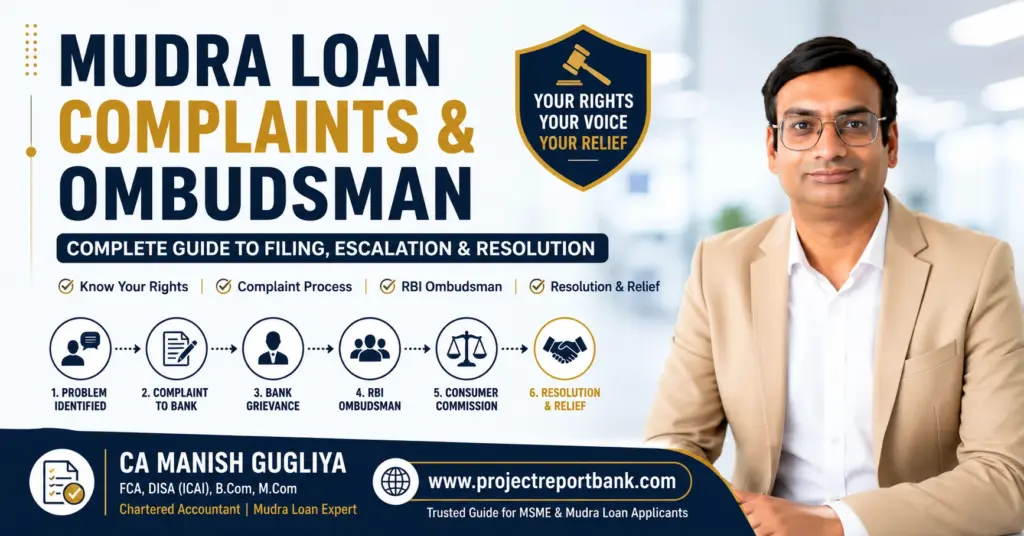
- Mudra Loan Complaints & Ombudsman: Complete Guide to Filing, Escalation & Resolution

- Can a Bank Blacklist You for Filing a Mudra Loan Complaint?
- Can a Mudra Loan Complaint Affect Future Loan Approval?
- Common Mistakes That Lead to Mudra Loan Complaint Failure
- RBI Ombudsman Mudra Loan Relief: Practical Guide for Small Borrowers
- Can the RBI Ombudsman Reject Your Mudra Loan Complaint? Reasons Explained
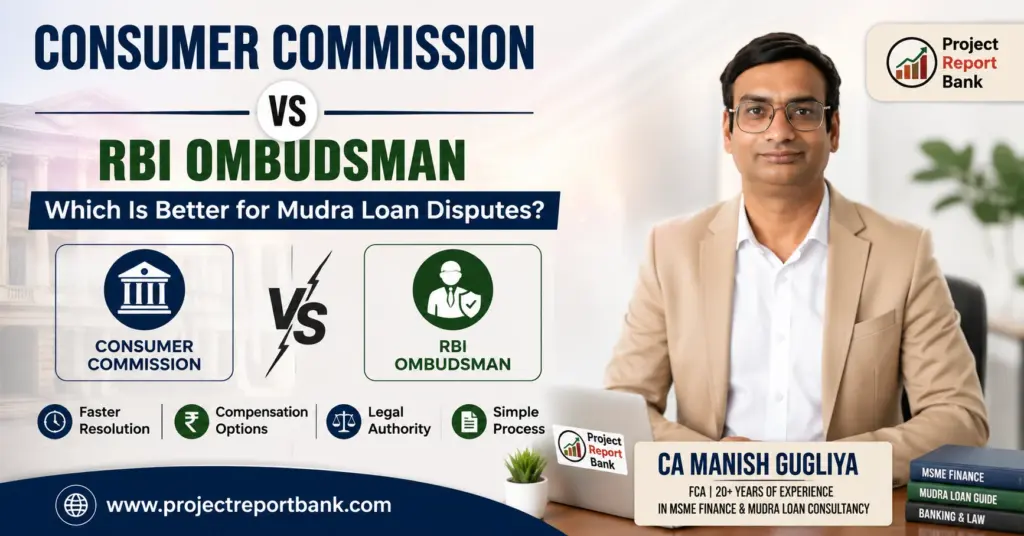
- Consumer Commission vs RBI Ombudsman: Which Is Better for Mudra Loan Disputes?
- Bank Grievance Redressal System for Mudra Loans: Complete Guide
- RBI Ombudsman Mudra Loan Complaint – Detailed Guide by CA Manish Gugliya