Key Takeaways
- The Branch Manager is not always the final authority for Mudra loan approval. His power depends on the loan amount and the bank’s internal sanction limits.
- For small Shishu loans (up to ₹50,000) and some lower Kishore amounts, the Branch Manager can often sanction directly at branch level without sending the file to any higher office.
- For many Kishore category loans (₹50,001 to ₹5 lakh) and almost all Tarun loans (₹5 lakh to ₹10 lakh), the Branch Manager typically recommends the file, and final approval comes from Regional Office, Zonal Office, or a centralized credit hub.
- “Branch Manager recommendation” and “final sanction” are two different things. Regional or Zonal Office can modify the amount, add conditions, or even reject a loan that the Branch Manager recommended positively.
- In this article, you will learn the complete mudra loan approval hierarchy, practical case studies, common myths, and actionable tips to improve your chances of getting your Mudra loan sanctioned.
Introduction: Why There Is Confusion About Branch Manager’s Powers
In my 20+ years as a Chartered Accountant working with MSME finance and business loans, I have seen this scene hundreds of times. A small entrepreneur walks out of the bank smiling, telling his family: “Manager ji ne haan bol diya, loan pakka hai!” Two weeks later, he gets a call from the branch saying Regional Office has raised queries, or worse, the file has been declined. The confusion and frustration are real.
The truth is, in Indian banks, there are different approval levels for every loan, including Mudra loans under Pradhan Mantri Mudra Yojana. Every bank or financial institution has an internal “authority matrix” or “delegation of powers” which decides who can approve up to which loan amount. Some banks allow Branch Managers to approve Mudra loans upto Rs 1 lakh or ₹2 lakh independently. In other banks, the same amount may need joint approval or a recommendation to Regional Office.
This article focuses on real, practical banking practice, explained in language so simple that even a Class 5 student can understand. Let me walk you through everything step by step.
What You Will Learn in This Article
In this article, I will explain step by step:
- Whether the Branch Manager has final authority to approve a Mudra loan, and in which situations branch-level approval is enough.
- When Regional Office, Zonal Office, or a separate Credit Department becomes involved in the mudra loan sanction process, especially for Kishore and Tarun category.
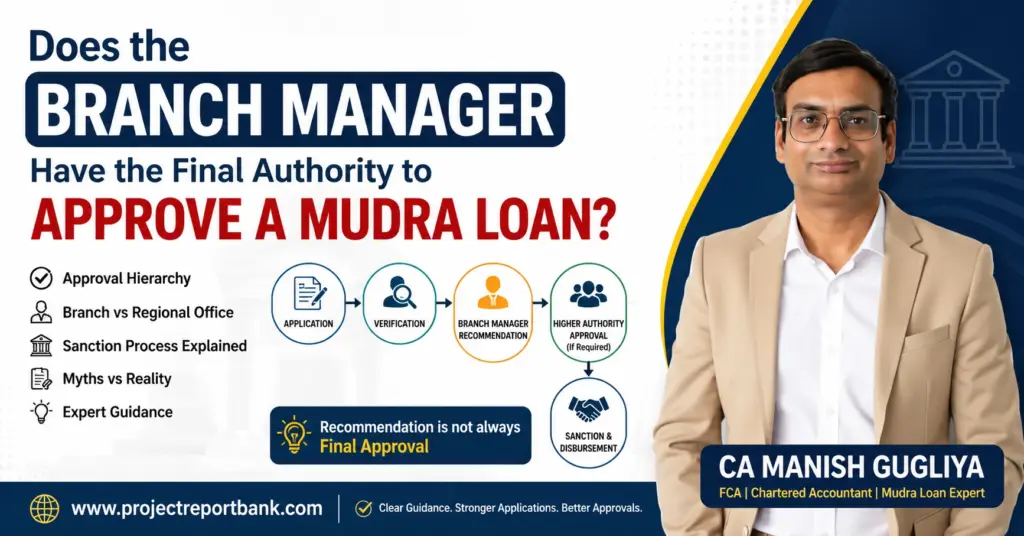
- The complete mudra loan approval hierarchy – who receives the application, who verifies documents, who does credit appraisal, who recommends, and who finally sanctions.
- The difference between “recommended by Branch Manager” and “sanctioned by competent authority” with practical, easy-to-understand examples.
- Practical tips to improve your chances of final sanction under the mudra scheme, and how to follow up if your file is stuck at any stage.
Table of Contents
Understanding Mudra Loan Approval Authority and Stages
“Approval authority” in simple words means: the officer who has legal power inside the bank to say final YES or NO for a particular loan amount. Not every person sitting in the bank has this power. It is given in writing by the bank’s head office.
For any Mudra loan – whether Shishu, Kishore, or Tarun – there are usually these stages:
Stage 1 – Receiving the Application: You walk into the branch or apply online via the JanSamarth portal. The branch staff collects your form, identity proof, business registration documents, and other details. At this point, all you get is a receipt or acknowledgement. Mudra loan applications can be submitted at banks and NBFCs across India.
Stage 2 – Document Verification: A loan officer or clerk checks your KYC, address proof, business proof, rent agreement, and other documents for completeness. They verify whether information in different papers matches.
Stage 3 – Credit Appraisal: This is where the bank checks: can this business honestly pay back EMI on time? The officer pulls your CIBIL report, looks at your bank statement, reads the project report, and assesses your cash flow. The business viability is assessed based on real numbers.
Stage 4 – Branch Manager Review: The Branch Manager reviews the complete proposal. He may visit your shop or unit personally, ask questions, and then either rejects or recommends (or sanctions within his power).
Stage 5 – Higher Authority Review: If the amount is beyond branch powers, the file goes electronically or physically to Regional Office or Credit Hub for final sanction.
Stage 6 – Sanction and Disbursement: Once sanctioned by competent authority, the branch prepares a sanction letter, executes loan documents, and disburses the Mudra loan to your account. Processing time for Mudra loans can be a few days if documents are complete.
For a deeper understanding of each step, you can read the complete Mudra loan processing timeline.
For example, consider a tailoring unit applying for ₹3 lakh working capital. The branch staff takes the application, the loan officer checks KYC and shop papers, the credit officer checks CIBIL and reviews the business plan, the Branch Manager visits the shop and recommends, and then the file goes to Regional Office for final approval since ₹3 lakh may be beyond the Branch Manager’s independent sanction limit.

Is the Branch Manager Always the Final Authority for Mudra Loan?
No, the Branch Manager is not always the final authority to approve a Mudra loan. In many cases, he can only recommend. Final approval rests with Regional or higher authority.
Here is how it typically works:
- For small Shishu loans (up to ₹50,000) and sometimes up to ₹1 lakh or ₹1.60 lakh, the Branch Manager of a public sector bank often has full sanction power. Shishu loans offer up to ₹50,000 for startups and very small enterprises.
- Kishore category loans between ₹50,001 to ₹5,00,000 usually require branch manager approval, but in many banks, the Branch Manager’s independent limit may only cover part of this range. For larger Kishore amounts, the file goes to Regional Office.
- For almost all Tarun loans (₹5 lakh to ₹10 lakh), final approval often lies with Regional Office, Zonal Office, or a specialized credit hub. Tarun loans between ₹5,00,000 to ₹20,00,000 may need regional office approval depending on the bank’s policy.
- Branch managers can approve Mudra loans up to ₹10 lakh only if their bank’s internal delegation allows it. In practice, many Branch Managers have limits well below ₹10 lakh.
Every bank issues a written “delegation of powers” circular internally. Banks must define delegated sanctioning powers for loan approvals as mandated by the RBI’s framework for advances. This defines how much a Branch Manager can sanction alone, when a joint signature is needed, and when the file must go to higher office. Branch managers follow guidelines set by the Department of Financial Services and their own bank’s credit policy.
Consider two examples:
- Bank A: Branch Manager can approve Mudra up to ₹2 lakh. Above that, file goes to Regional Office.
- Bank B: Branch Manager can recommend up to ₹5 lakh, but final sanction above ₹1 lakh is given by Regional Office credit in-charge.
Customers often hear “Manager ne file approve kar di” but in the internal system it is recorded as “recommended” or “forwarded to RO” – which is not the final sanction yet. You can learn more about the powers of a Branch Manager and the Branch Manager approval stage in detail.
How Banks Decide Who Can Approve a Mudra Loan (Delegation of Powers)
“Delegation of powers” is an internal banking concept. The head office of each bank decides how much each officer – Branch Manager, Chief Manager, Regional Manager – can sanction based on rank, experience, and the bank’s risk appetite.
This internal sanction matrix is not printed in public brochures. But every branch staff member uses it daily to decide whether a Mudra loan can be sanctioned at branch level or needs Regional Office approval.
Key factors used to set approval limits include:
- Loan amount category: Shishu (up to ₹50,000), Kishore (₹50,001 to ₹5 lakh), Tarun (₹5 lakh to ₹10 lakh), and the newer Tarun Plus (₹10 lakh to ₹20 lakh). Mudra loans are classified into Shishu, Kishore, Tarun, and Tarun Plus categories.
- Type of borrower: New customer vs. existing customer. Individual borrowers with a satisfactory credit track record often receive faster processing.
- Risk category: Based on CIBIL score, business stability, and whether any security is offered.
- Category of branch: Rural, semi-urban, urban, or metro. A small rural branch may have a Mudra loan sanction limit of ₹1 lakh or ₹2 lakh for the Branch Manager, while a large metro branch Manager may have higher limits – but for risky sectors, even he needs Regional Office approval.
- Grade and experience of the Branch Manager: A senior officer with years of service and low delinquency may have higher delegated limits.
The RBI does not tell individual banks which officer will approve which amount. RBI only issues broad guidelines, and each bank or financial institution designs its own policy and authority structure. So the answer to “who has authority to sanction Mudra loan” depends on the bank’s internal policy on that date, and can change when new circulars are issued.
Mudra Yojana involves processing loans according to each bank’s credit policies and RBI guidelines – there is no single national rule that applies uniformly.
Typical Mudra Loan Approval Hierarchy and Flow
Though each bank has slight variations, the broad Mudra loan approval hierarchy is similar across public sector banks, regional rural banks, small finance banks, commercial banks, and many private banks.
Here is the stage-wise flow:
- Application received by branch staff or online through portal. Basic details are captured and an acknowledgement is given. Mudra loans can be applied online via the JanSamarth portal.
- Document verification done by loan officer or clerk – KYC, address, business proof, income details checked for consistency.
- Credit appraisal by officer using CIBIL report, bank statement, and project report. Viability and repayment capacity checked. The officer evaluates whether the proposed activity can generate enough income to repay.
- Branch Manager reviews the proposal, may visit the business personally, asks questions, and then either rejects, recommends, or sanctions within his power.
- If amount is beyond branch powers, file goes electronically or physically to Regional Office or Credit Hub for final sanction. Larger loans exceeding a branch manager’s limit require escalation to higher authorities.
- Once sanctioned by competent authority, branch prepares sanction letter, executes documents, and finally disburses Mudra loan to the borrower’s account.
In many small Shishu cases, some stages are done very fast by the same officer, so the customer feels that “only Branch Manager did everything.” But the process still exists internally.
If your file seems stuck between stages, understanding why Mudra loan processing gets delayed can help you take the right follow-up steps.
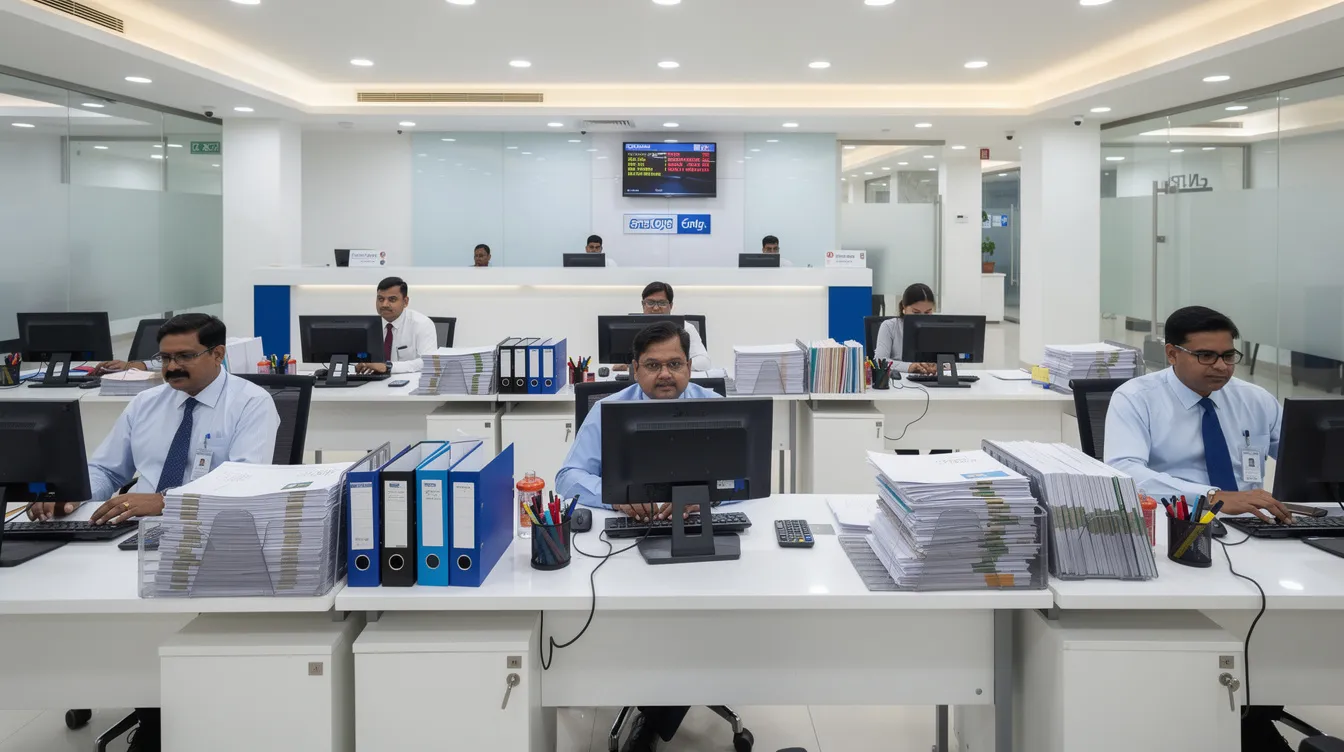
When Can Branch Manager Approve Mudra Loan Directly at Branch Level?
The Branch Manager does have real sanction powers, especially for smaller and low-risk Mudra loans. Many loans are indeed fully approved at branch level within a few days.
Here are typical situations where the Branch Manager can usually approve alone:
- Shishu loans up to ₹50,000 for local street vendors, small shopkeepers, food processing units, or small service providers where risk is low and amount is within his limit. Eligible businesses include vendors, shop owners, and service providers.
- Small Kishore loans (say up to ₹1 lakh or ₹1.5 lakh, depending on bank policy) where the applicant is an existing customer who has successfully repaid previous loans and has a good six-month or one-year banking history.
- Cases with government guarantee – where credit guarantee cover through schemes like CGTMSE is available. Mudra loans are collateral-free for amounts up to ₹10 lakh, and RBI mandates no collateral for micro enterprises under PMMY.
- Where the bank’s current internal circular gives the Branch Manager enough mudra loan sanction authority for that ticket size.
Practical example: A 3-year-old mobile repair shop seeking ₹75,000 for working capital. The Branch Manager visits the shop, checks daily sales in the bank account, sees good account conduct with no cheque bounces, and sanctions directly the same week. In such cases, the Branch Manager is both recommending and giving final sanction as per his delegated powers.
Meeting the Branch Manager personally with full documents and a clear explanation of your business can speed up such small approvals. You can read more about whether meeting the Branch Manager speeds up approval.
When Branch Manager Cannot Approve Mudra Loan Alone
For higher Mudra loan amounts and riskier cases, the Branch Manager is only the first important filter. The final decision is taken by higher authorities.
Common situations where the Branch Manager must send the file upward:
- Kishore loans closer to ₹3–5 lakh and almost all Tarun loans (₹5–10 lakh) and Tarun Plus loans (₹10 lakh to ₹20 lakh) – these create higher risk for the bank. Mudra loans are available up to ₹20 lakh for eligible businesses.
- New businesses with no past banking history, large project cost, or thin equity contribution by the borrower. The verification process for new businesses under Mudra involves deeper scrutiny.
- Weak CIBIL score or multiple existing loans – where risk is high and policy may require approval by a committee or senior officer.
- Agricultural activities are not eligible for Mudra loans, and if the proposed activity falls in a grey area, the Branch Manager will need guidance from higher authority.
In these cases, the Branch Manager’s role is to ensure complete documents and a realistic project report, do local verification, give honest remarks, and then “recommend” or “not recommend” in the system.
The Regional Office or credit hub can then accept the recommendation fully, sanction a lower amount with extra conditions, put the file on hold for additional documents, or reject even if the Branch Manager recommended positively.
If the Branch Manager is transferred during your loan processing, the file does not get cancelled. The new Branch Manager or acting officer takes over, and higher authorities continue the process. Read more about what happens if Branch Manager is transferred.
Recommendation vs Final Sanction: Understanding the Difference
Think of it this way: recommendation is like a school teacher telling the principal – “this student should get a scholarship.” Final sanction is when the principal actually signs and gives the scholarship letter.
Here is what each term means in plain language:
- Recommended = Branch Manager or loan officer believes the loan should be approved and has forwarded it to higher authority with favourable remarks.
- Forwarded / Under process at RO = File is with Regional Office or credit department, still being checked and verified independently.
- Sanctioned = Competent authority has given written approval with the loan amount, interest rate, tenure, and conditions clearly stated in a sanction letter.
- Disbursed = Money is actually credited to your bank account after you sign loan agreement and fulfil all pre-disbursement conditions.
Customers often hear phrases like “file approve ho gayi,” “RO mein hai,” or “sanction ho gaya hai” and confuse these stages, leading to false expectations.
Example 1: A shop owner applies for ₹8 lakh Tarun Mudra loan. The Branch Manager recommends the full amount with positive remarks. But the Regional Office credit team reviews the sales projection, finds it too optimistic, and sanctions only ₹6 lakh.
Example 2: A small enterprise owner with previous loans gets a positive recommendation from Branch Manager. But the RO finds a poor CIBIL score and multiple overdue loans in other banks, and rejects the file entirely.
Never assume that the Branch Manager’s recommendation is equal to final Mudra loan sanction unless you have a written sanction letter from the bank.
What Happens After Branch Manager Recommends the Mudra Loan?
Once the Branch Manager clicks “recommend” or signs the appraisal note, the file starts its journey to the higher approval level (if required by bank policy).
Here is the step-by-step workflow:
- The file goes to Regional Office or Credit Hub electronically or in physical format.
- A credit officer there re-checks documents, CIBIL, income assumptions, project report, and the Branch Manager’s remarks independently.
- If anything is unclear, they raise queries back to the branch – asking for fresh quotations, updated bank statements, GST returns, income proof, or clarification about the business model.
- After satisfaction, the competent authority (Regional Manager or sanctioning officer) records the decision: approve, modify, or reject.
- The decision is communicated back to the branch, which then informs the borrower and prepares the sanction letter if approved.
This back-and-forth can take from a few days to several weeks depending on the queue, staff availability, and quality of documents submitted. Mudra loans are available for non-corporate small businesses, and the government encourages quick processing, but reality depends on completeness.
If the process is taking unusually long, politely ask the branch to share the “current status” of your file. Understanding why Mudra loan processing gets delayed can help you prepare better.
Even after final sanction, disbursement happens only after signing the loan agreement, creating security (if any), and fulfilling all pre-disbursement conditions.
Can Regional Office Reject a Mudra Loan Recommended by Branch Manager?
Yes, Regional Office or higher sanctioning authority can reject or modify a Mudra loan proposal that the Branch Manager has recommended, if they find serious issues.
Key reasons for such rejection or modification:
- Policy mismatch: The proposal is not as per the bank’s latest Mudra loan policy or RBI norms. For example, direct agriculture farming is not an eligible activity under PMMY.
- Very low CIBIL score or serious past defaults that were not properly addressed in the branch note.
- Unrealistic financial projections in the project report – sales numbers that look too high compared to the business type and local market.
- Missing critical documents or doubts in KYC, income, or business proof that create compliance risk.
- High overall exposure – the borrower already has too many loans compared to income, making repayment doubtful.
Sometimes the RO may approve but with conditions – a lower loan amount, more margin money, shorter tenure, or higher security margin. This is not unusual.
Rejection by higher authority is not a personal insult to the Branch Manager. It is part of the risk control system inside banks to protect depositors’ money and maintain financial discipline.
If your file is rejected at higher level, politely request a clear reason from the branch so you can correct issues before re-applying.
Importance of Branch Manager’s Role in Mudra Loan Approval
Although the Branch Manager may not have final authority in all cases, his recommendation carries heavy weight in higher offices. Here is why:
- Local knowledge: The Branch Manager knows the area, market conditions, and reputation of the borrower and guarantors. This knowledge is extremely valuable.
- Field visit report: He personally visits the shop, factory, or service unit and writes frank remarks. A positive, detailed field report builds confidence at Regional Office.
- Banking relationship: He understands the customer’s account conduct – regular cash deposits, cheque returns, trading patterns, and earlier loan extended behaviour.
Consider two similar files going to the Regional Office:
- File A comes with strong positive comments, clear documents, proper project report, and realistic projections. It gets quick approval.
- File B has weak remarks, half-baked papers, and vague comments. It faces multiple queries and eventually gets rejected.
For small borrowers seeking financial assistance under PMMY, having a transparent and trust-based relationship with the Branch Manager improves the comfort level of higher authorities too. The Branch Manager is your biggest advocate inside the system – treat him as a partner, not a gatekeeper.

Key Factors That Influence Final Mudra Loan Approval
Beyond the Branch Manager’s recommendation, here is a practical checklist of what higher authorities evaluate:
- CIBIL score and credit history: Any past defaults, write-offs, or heavy overdue amounts will raise red flags. Eligible borrowers with clean records have a major advantage.
- Business viability and cash flow: Realistic sales, expenses, profit, and EMI affordability shown in the project report. The applicant’s business plan must demonstrate that the enterprise can generate enough to repay.
- Banking behaviour: Regular deposits, low cheque bounce rate, disciplined use of existing limits show financial maturity.
- Experience and necessary skills: Years working in the line of business matter. For example, 5 years as a mechanic before opening a garage shows the educational qualification or practical knowledge needed. Micro enterprises engaged in manufacturing, trading, services, or food processing sectors are all eligible.
- Documentation quality: KYC, licenses, GST or Udyam registration, quotations for capital assets, rent agreement, electricity bill – all should be clear and consistent. Any other legal entity structure (like partnership or proprietorship) must be properly documented.
Even though no collateral is required for Mudra loans up to ₹10 lakh, higher authority still checks whether the business and assets created from the loan will generate sufficient income for EMI repayment.
Honest and consistent information across the application form, project report, and verbal discussion avoids suspicion and speeds up sanction. The verification process for new businesses explains what officers look for during site visits.
Common Myths About Branch Manager’s Power in Mudra Loans
Many borrowers operate on myths and hearsay, which leads to disappointment when the loan is declined. Let me clear up the most common ones:
Myth 1: “Manager ne haan bol diya, ab loan pakka mil gaya.” Reality: Until a sanction letter is issued by the competent authority, the file can still be modified or rejected at any higher level.
Myth 2: “Regional Office always follows Branch Manager’s recommendation blindly.” Reality: The RO has its own responsibility and can overrule the recommendation if risk is high or policy is violated. The refinance agency and guarantee schemes do not override banking risk assessment.
Myth 3: “If one Branch Manager verbally refuses, no other branch of that bank can ever sanction.” Reality: Policy is common across the bank, but assessment can differ. With improved documents, better CIBIL, or a stronger business case, another branch or a later attempt may succeed.
Myth 4: “Using political or personal influence can force Branch Manager to approve the loan.” Reality: Even if local pressure leads to a positive recommendation, the Regional Office can still decline if credit policy is violated. Mudra stands for Micro Units Development and Refinance Agency, but funding decisions are always based on the bank’s risk assessment.
Myth 5: “Mudra loan is a government subsidy, so the bank cannot refuse.” Reality: Mudra is a loan, not a subsidy. The government provides a guarantee framework, but the bank or financial institution makes the final lending decision based on eligibility criteria and repayment capacity.
Rely on written communication and proper documentation, not market rumours.
Practical Case Studies: How Final Mudra Loan Approval Really Works
These are anonymized but realistic cases from my 20+ years of MSME finance experience, showing how branch and higher authorities interact.
Case 1 – Quick Branch-Level Approval: An existing kirana shop owner with a 4-year-old current account applied for ₹1 lakh Shishu/Kishore loan for working capital. The Branch Manager visited the shop, checked daily sales (averaging ₹8,000–10,000), saw consistent deposits, and a clean CIBIL score. The loan was sanctioned directly at branch level within 3 working days. No Regional Office involvement was needed because the amount was within the Branch Manager’s delegated power.
Case 2 – RO Modification: A new mobile accessories shop owner sought ₹8 lakh Tarun Mudra loan. The Branch Manager visited the shop, found it well-located, and recommended the full amount with positive remarks. However, the RO credit team felt the sales projection was too optimistic for a 6-month-old business. They sanctioned ₹5 lakh instead, with advice to apply for enhancement after 12 months of good repayment – the next phase of funding would be considered once the borrower demonstrated performance.
Lesson: Regional Office can reduce amounts even with strong branch recommendation.
Case 3 – RO Rejection: A transport operator with multiple existing vehicle loans (many EMIs delayed by 60+ days) applied for ₹7 lakh Tarun loan. The Branch Manager tried to support the application due to the applicant’s good local reputation but honestly noted the CIBIL issues. The RO rejected the file, citing high risk and recent irregularity in previous loans. The applicant had not availed credit responsibly in the past.
Lesson: Past credit behaviour matters more than local goodwill.
Case 4 – Delay Due to Documents: A tailoring unit applied for ₹3 lakh Kishore loan. The Branch Manager recommended the file. But the RO raised multiple queries: the rent agreement address did not match the Udyam registration address, and the electricity bill was in a different name. The loan was approved only after 1.5 months when all clarifications were submitted with a proper submit of matching papers and proof.
Lesson: Document consistency is non-negotiable. Understanding why processing gets delayed can save you weeks.
Mistakes Borrowers Make About Branch Manager and Mudra Loan Sanction
Many loan rejections or delays happen not because of bad intention by bank staff, but due to avoidable mistakes by applicants.
Common mistakes include:
- Believing verbal assurance as final approval and making big financial commitments (like paying full shop advance or ordering expensive machinery) before receiving a written sanction letter.
- Not submitting all requested documents or giving incomplete, mismatched information – for example, different income figures in the application form and during the verbal discussion.
- Ignoring SMS or calls from branch or RO asking for clarifications, leading to the file being kept pending or closed automatically after a deadline.
- Hiding existing loans or past defaults, which later appear in CIBIL and destroy trust severely. Banks check credit history; they will find out.
- Misunderstanding technical words like “under process,” “forwarded to RO,” or “recommended” – and assuming everything means sanctioned.
Keep a clear checklist, double-check each document for consistency, and ask the branch to explain any term you do not understand. Small enterprises and micro units deserve fair processing, and being well-prepared is your best advantage.
How to Improve Your Chances of Final Mudra Loan Approval
Based on my consultancy experience with hundreds of Mudra and MSME clients, here are actionable tips:
- Prepare a simple but realistic project report showing sales, expenses, and EMI capacity. Avoid over-optimistic numbers. If you claim ₹2 lakh monthly revenue from a small village tailoring shop, nobody will believe you.
- Maintain a clean bank statement for at least 6 months before application. Avoid frequent cheque bounces, large unexplained cash withdrawals, or dormant periods.
- Keep KYC, business registration (GST, Udyam), and shop papers ready and consistent with each other. Every detail like name spelling, address, and enterprise type must match across all documents.
- Be honest about existing loans. Banks will see your CIBIL report anyway. Hiding facts only creates doubt. If you have previous loans with good repayment, highlight them – it shows you are a responsible borrower.
- Respond quickly and politely to any queries from branch or RO. This shows seriousness and improves confidence in your application. Applicants must be aged between 18 to 65 years – make sure your age proof is up to date.
- Get professional help if needed. Guidance from an experienced CA familiar with MSME finance can help you design the correct loan amount, margin money, and repayment schedule, making the file stronger as a reference point for both Branch Manager and Regional Office.
Track the approval stage (branch, RO, or sanction letter issued) instead of only asking “loan kab milega?” You can also apply online through the JanSamarth portal to keep digital records of your submission.
Rights and Reasonable Expectations of Mudra Loan Applicants
Banks must follow RBI guidelines and internal policies, but as a borrower, you also have certain basic rights and can expect fair treatment.
- Right to know status: You can ask whether your file is at branch level, Regional Office, or final decision stage. The bank should provide at least a broad update.
- Right to fair treatment: You must be treated politely and without discrimination, irrespective of loan size, caste, gender, or background. The scheme is meant for non corporate and small enterprise borrowers across India – every eligible applicant deserves equal respect.
- Right to know reasons: If your loan is rejected or sanctioned for a lower amount, you can ask for at least a broad, verbal explanation.
However, borrowers do not have a legal right to force the Branch Manager or RO to approve a loan. Approval is always subject to policy and risk assessment. The interest rate and terms are determined by the bank based on the scheme guidelines.
If the process feels unfair:
- First, talk calmly with the Branch Manager and seek clarity.
- If still dissatisfied, use the bank’s official grievance system or write to Regional Office with your file details.
- Use the Banking Ombudsman or regulator only when there is a clear violation of process – not simply because the loan was declined on genuine risk grounds.
Expert Guidance by CA Manish Gugliya (FCA) on Dealing with Branch Managers and Higher Authorities
As a Chartered Accountant with over 20 years of experience in MSME finance, project reports, CMA data, and Mudra loan consultancy, here is my practical advice:
- Never depend only on verbal words like “ho jayega” or “file clear hai.” Always ask which exact stage your file is in and whether a sanction letter has been issued. Until you hold the sanction letter, nothing is final.
- Focus on the strength of your business proposal – your cash flow projections, margins, market demand – rather than trying to use influence to push the Branch Manager or RO. A strong file speaks louder than any phone call.
- If the Branch Manager gives genuine feedback (for example, “your requested loan amount is too high for your income”), treat it as free consultancy. Adjust your plan instead of arguing. This knowledge is invaluable.
- Prepare alternate strategies. If higher authority finally approves less than requested or rejects, consider applying at a different bank, requesting a smaller amount, or planning a phased expansion. Entrepreneurs who adapt succeed faster.
- Professional help converts weak files into bankable proposals. A well-prepared project report with realistic numbers, proper business plan details, and consistent documents makes both the Branch Manager and the Regional Office comfortable.
See the Branch Manager as a partner who has to balance your need with the bank’s safety – not as an enemy blocking your money. The government of India created the mudra scheme to support micro units and small enterprises, but the lending decision is ultimately a banking decision based on viability and risk.
Conclusion: Does Branch Manager Have Final Authority to Approve Mudra Loan?
The Branch Manager is a key decision-maker and the first gatekeeper for Mudra loans, but he is not always the final authority. For many small Shishu loans and some lower Kishore loans within his delegated powers, the Branch Manager can sanction fully at branch level – sometimes within days.
For larger and riskier Kishore and Tarun loans, final approval usually rests with Regional Office or higher credit authorities, even if the Branch Manager strongly recommends. The loan amount, applicant profile, and bank’s internal delegation matrix determine who gives the final nod.
Understanding the approval stages, keeping your documents ready, and maintaining transparent communication with the branch greatly reduces confusion and delays. Track the real approval stage – branch recommendation, RO review, or sanction letter issued – rather than relying on assumptions based only on what you hear at the counter.
Frequently Asked Questions on Branch Manager’s Authority in Mudra Loans
These FAQs cover practical doubts that many borrowers have beyond what is discussed in the main sections above.
If one Branch Manager rejects my Mudra loan, can I apply at another branch of the same bank?
Technically, yes – you can approach another branch or even another bank. However, internal CIBIL records and the bank’s system will show past rejection reasons. Before re-applying, correct the issues that caused rejection – improve documents, clear outstanding dues, or strengthen your project report. Simply moving to another branch without fixing problems rarely works.
Does meeting the Regional Manager personally help in getting Mudra loan approved?
Personal meetings alone cannot override policy or risk concerns. However, if there are genuine facts about your business that were not clear on paper – like a long track record in trading or manufacturing in the sector – a meeting can help clarify them. For related reading, see whether meeting the Branch Manager can speed up approval.
Will my Mudra loan be automatically cancelled if the Branch Manager is transferred during processing?
No. Transfer of the Branch Manager does not cancel your file. The new Branch Manager or acting officer takes over the pending cases, and higher authorities continue processing based on the file and documents already submitted. You can read more about what happens during a Branch Manager transfer.
Is there any legal time limit within which the bank must decide my Mudra loan application?
While many banks have internal timelines (like 7–14 working days for small shishu loans), the actual time depends on complexity and completeness of documents. There is no strict legal deadline that covers all banks uniformly. If the delay is unusually long, follow up politely with the branch, keep written proof of your submissions, and escalate through the bank’s grievance mechanism if needed.
Can I see which authority (branch or RO) finally sanctioned my Mudra loan?
The sanction letter usually indicates the sanctioning authority and the officer who approved. You can ask the branch staff to clarify who signed the final sanction and what role the Branch Manager played – whether it was direct sanction within his limit or recommendation forwarded to Regional Office. This information helps you understand the process and builds your knowledge for any future loan extended requirements.
- Mudra Loan Branch Manager Issues: Complete Guide to Manager’s Role, Powers & Common Problems


- How Branch Workload Affects Mudra Loan Processing


- Can a Branch Manager Return a Mudra Loan File for Corrections? Complete Practical Guide
- Why Is My Mudra Loan Waiting for the Branch Manager’s Signature?

- Why Does the Branch Manager Ask for Clarification Before Loan Approval?

- Branch Manager Recommendation in Mudra Loan: Full Meaning, Next Steps & Practical Guidance

- Can a Branch Manager Reduce the Requested Mudra Loan Amount?

- Does Branch Manager Have Final Authority to Approve Mudra Loan?
- What Happens If the Branch Manager Is Transferred During Mudra Loan Processing?