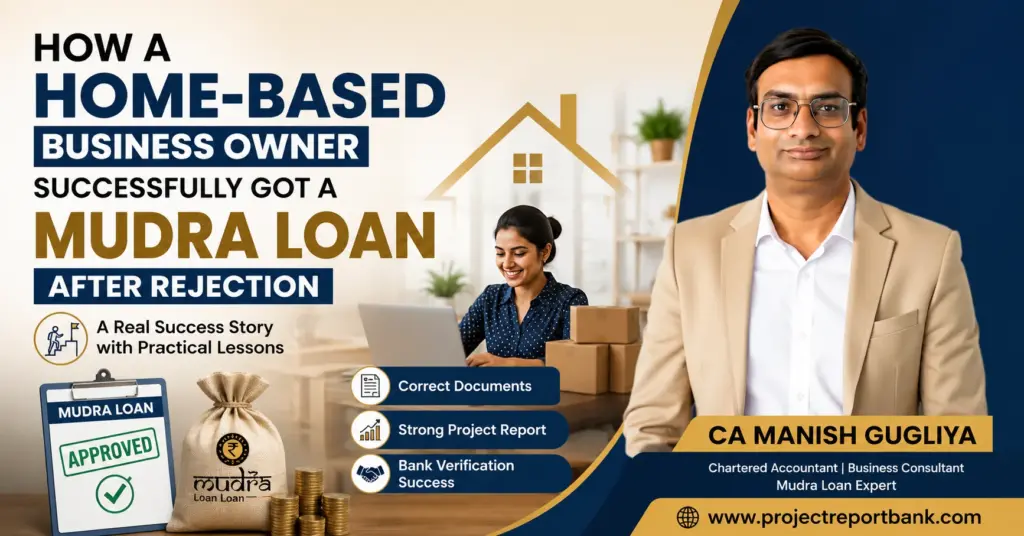
A Mudra loan rejection does not mean the end of the road. In my 20+ years as a practicing Chartered Accountant advising micro and small enterprises, I have seen dozens of home-based entrepreneurs turn a “no” into a confident “yes” simply by fixing what was weak in their first application.
Key Takeaways
Here is what this article covers and why it matters if you run a business from home:
- A home based business Mudra loan under Pradhan Mantri Mudra Yojana is absolutely possible even without a commercial shop, provided your business proof is strong and documentation is clean.
- This case study follows “Anita Sharma,” a Jaipur-based home tiffin and snacks service owner who got a ₹4.5 lakh Kishore Mudra loan approved in early 2025 after an initial rejection in 2024.
- Her first application failed due to weak documentation, cash-only sales that made bank statements look empty, a copy-paste project report, and confusion about whether a residential address qualifies for a business loan.
- Improving banking behaviour, preparing a proper project report for home based business, collecting purchase bills and customer invoices, completing Udyam registration, and cooperating fully during bank verification converted the rejection into approval.
- Any eligible borrower operating a genuine home business can replicate this approach.
Table of Contents
Understanding Mudra Loan for Home-Based Businesses
Pradhan Mantri Mudra Yojana (PMMY) is a scheme of the Government of India launched on 8 April 2015. It provides collateral-free loans through commercial banks, small finance banks, NBFCs, and MFIs to support non corporate, non-farm small and micro enterprises. Mudra Yojana offers collateral-free loans up to ₹20 lakh and loans are processed quickly without collateral. Since launch, over ₹33 lakh crore has been disbursed under the mudra scheme, empowering grassroots entrepreneurs to access funding across India.
The scheme supports small businesses and microenterprises through four categories based on loan amount:
| Loan Category | Loan Amount | Typical Home Business |
|---|---|---|
| Shishu loans | Up to ₹50,000 | Street vendors, small tailoring |
| Kishore | ₹50,001 – ₹5 lakh | Tiffin service, home salon, tuition centre |
| Tarun category | ₹5 lakh – ₹10 lakh | Boutique, bakery, digital services |
| Tarun Plus | ₹10 lakh – ₹20 lakh | Scaling established home units |
The maximum loan amount under Mudra is ₹20 lakh. Mudra loans can be used for working capital and purchasing equipment, and the scheme is aimed at supporting income-generating activities in various sectors. Eligible businesses include shop owners, vendors, and service providers. However, Mudra loans are not available for agriculture-related businesses. You can apply for Mudra loans online or offline through banks, NBFCs, and MFIs. Eligibility requires the applicant to be an Indian citizen with a clean credit history, and applicants must be aged between 18 to 65 years.
A key point: “home based business Mudra loan” is not a separate product. It is a normal PMMY loan where the beneficiary micro unit happens to operate from a residential address instead of a shop. The interest rate varies bank to bank, usually linked to MCLR or RLLR plus a spread, and there is no direct subsidy. Business registration on the Udyam portal is recommended for applicants. GST is not mandatory for very small turnover, but having Udyam and proper proof strongly improves your eligibility criteria.
Real Case Study: Home Tiffin Business Mudra Loan Approved After Rejection
I, CA Manish Gugliya, want to share a case study based on an actual home-based client from Jaipur (name changed for privacy) who obtained a Kishore Mudra loan after first being rejected. This is a mudra loan rejection success story that any home business owner can learn from.
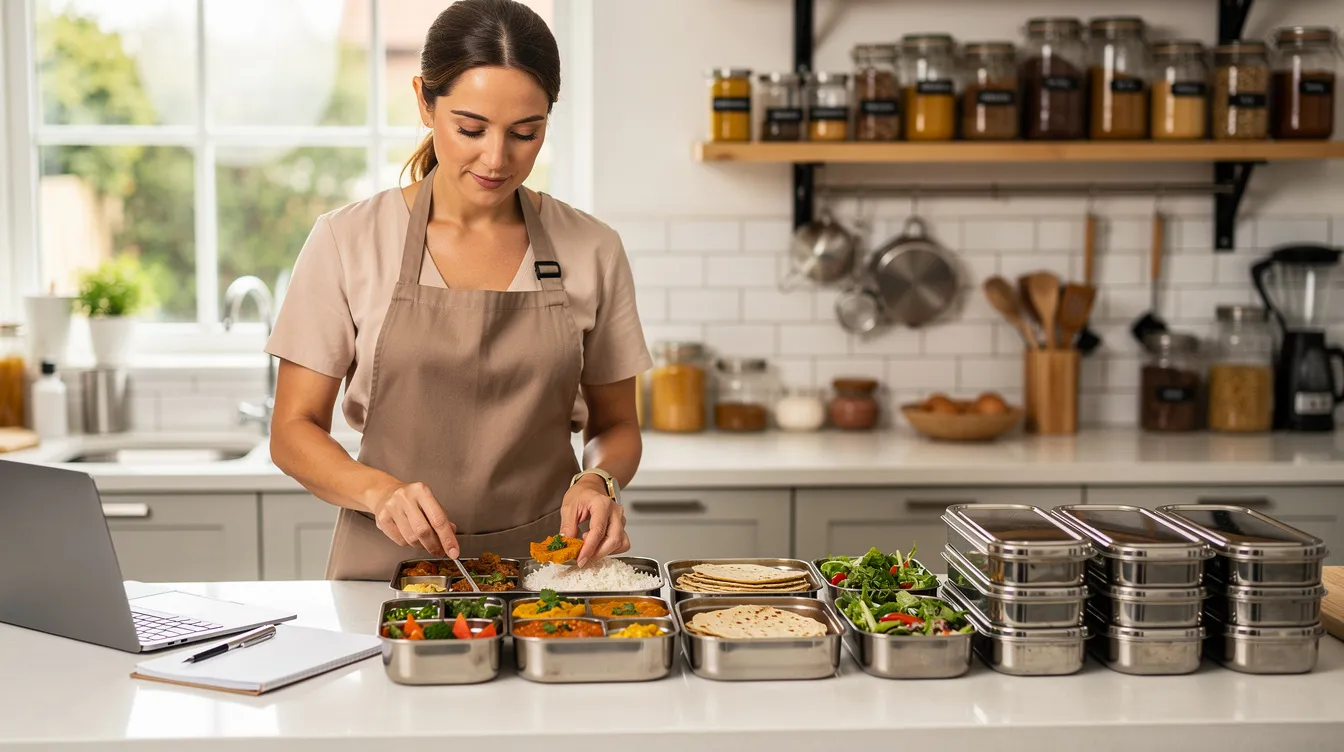
“Anita Sharma,” a 36-year-old homemaker, had been running a home-cooked lunch tiffin and evening snacks service from her 2BHK flat since 2022, serving office-goers and students through WhatsApp orders and Swiggy Genie. In September 2024, she applied for a ₹5 lakh Kishore Mudra loan at a public sector bank branch near Tonk Road. The money was needed for kitchen equipment, bulk raw material purchase, and small marketing expenses.
The bank rejected her application. Reasons included: no Udyam registration, entirely cash-based sales with nothing reflected in her account, a poor project report copied from the internet, no rent agreement, and the credit officer’s concern that a residential flat might face housing-society objections – a business continuity risk.
Anita approached me in October 2024. I reviewed her bank statements, her handwritten daily order register, WhatsApp screenshots, Swiggy chats, and supplier bills. We agreed on a clear improvement plan: open a dedicated business account, route digital payments there, prepare a realistic project report, complete Udyam registration, and build a proper Mudra loan document file.
Between November 2024 and February 2025, she implemented every step. We submitted a revised application for ₹4.5 lakh in March 2025. The same bank sanctioned it in April 2025, disbursed in two tranches linked to equipment purchase. By mid-2025, her daily tiffin capacity grew from 35–40 to about 90–100 meals, and monthly turnover climbed from roughly ₹55,000 to around ₹1.25 lakh with stable repayments.
Why Home-Based Businesses Face Mudra Loan Rejection
In my experience, most rejections of home-based Mudra applications happen not because the scheme rules exclude home businesses, but because the bank cannot clearly see proof of a stable, legal, and profitable business. Many applicants lack awareness of eligibility criteria, and incomplete documentation can lead to immediate rejection. Banks may also discourage applicants due to small loan amounts, and processing delays often occur without status updates.
Here are the typical rejection reasons, each of which applied to Anita’s case:
- No commercial premises: Her business ran from a rented flat with no written permission. The bank worried about eviction or complaints, raising concerns about business continuity.
- Cash-only transactions: Sales were not reflected in her bank statements, making her turnover appear “zero” to the banking system. She looked like a housewife with pocket-money credits, not a serious entrepreneur.
- Poor project report: Anita had submitted a copy-paste project report from the internet with unrealistic sales figures and wrong cost estimates.
- Lack of registrations: No Udyam, no FSSAI licence for food, no proof documents. Documentation errors like these can lead to Mudra loan application rejection.
- Weak bank statement: Low average balance, irregular credits, many cash withdrawals.
- Insufficient own capital: Only ₹40,000 in savings – the bank wanted to see the borrower’s skin in the game.
- Credit score concerns: A CIBIL score below 650 may result in application denial. Anita had no formal credit history at all, which made the bank cautious.
Though Mudra loans are collateral-free with no security required, banks still assess capacity to repay, character, and conditions of the business model before approval.
How We Converted Rejection into Mudra Loan Approval
Most genuine home entrepreneurs can convert a rejection into a home business loan approval by strengthening five areas: business proof, financial records, the project report, banking behaviour, and cooperation during verification. Here is exactly what we did for Anita – and what worked as a mudra loan rejection solution.
Business formalization: We obtained Udyam Registration in November 2024 with the correct activity code, created the trade name “Anita Home Tiffins,” and printed a simple visiting card and menu leaflet. This gave her a formal business identity that the bank could verify.
Documentation clean-up: She started issuing WhatsApp invoices with date, quantity, and amount. We collected purchase bills for atta, rice, gas, and utensils. Documents required for a Mudra loan typically include identity proof and a business plan – we made sure every form and detail was consistent across PAN, Aadhaar, and Udyam.
Banking behaviour: We opened a separate savings account exclusively for business transactions. All regular customers were shifted to UPI/QR payments to that account. Three months of clean bank statements clearly showed business turnover, addressing the earlier address and proof issues.
Capital contribution: Anita deposited ₹80,000 from family savings as the promoter’s capital contribution, clearly explaining the source to the bank. This reduced perceived risk.
Project report & CMA data: I prepared a fresh, customised project report with realistic sales projections based on actual kitchen capacity, correct raw material costs, clear EMI calculation, and monthly cash flow. The DSCR came to approximately 1.44 – comfortably above the 1.25 threshold banks expect. You need to submit a business plan for Tarun loans, but even for Kishore, a strong report makes a decisive difference.
FSSAI compliance: We applied for basic FSSAI registration for her food business and kept the copy ready in the file.
We resized the loan amount from ₹5 lakh to ₹4.5 lakh to better match her demonstrated turnover and own capital, making the proposal look reasonable. I accompanied her to the branch once to clarify doubts about operating from a residential flat and showed photographs of her neat, separate kitchen setup.
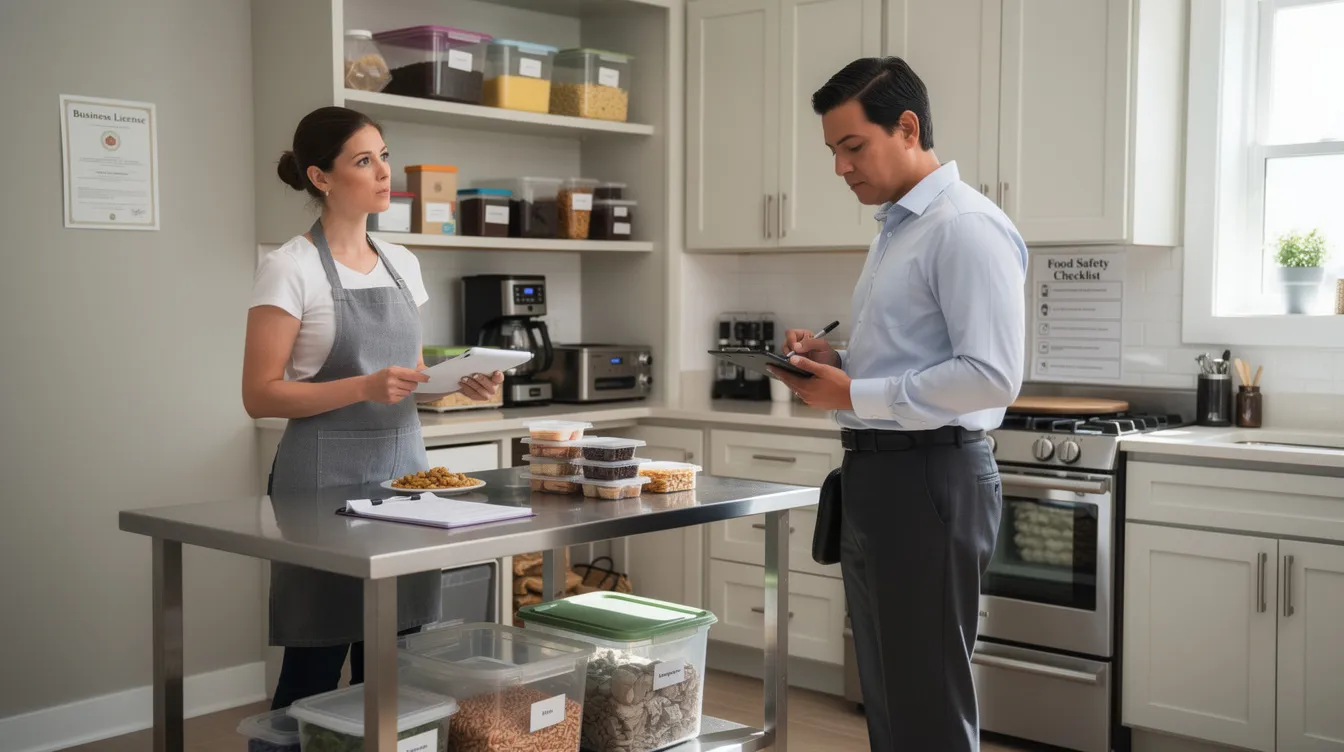
During home based business verification, the credit officer visited the flat, took business photographs, checked stock of raw materials, spoke to one neighbour and one regular customer by phone, and confirmed the business was genuinely running. The same bank sanctioned the Kishore Mudra loan in April 2025 at an interest rate of around 9.75% p.a., repayable in 48 EMIs with a short moratorium for equipment installation.
Role of a Strong Project Report and Practical Approval Tips
In my practical Mudra advisory work, I have seen the project report make the difference between “file kept pending” and “loan sanctioned” – especially for home based business Mudra loan proposals where the bank has no shopfront to look at.
Anita’s first project report failed because it used copied language, inflated monthly sales as if she were running a restaurant, missed working capital calculations, ignored seasonality, and had no connection between expected turnover and actual kitchen capacity.
We corrected it by calculating maximum tiffin capacity based on burner and helper availability, estimated realistic occupancy at 60–70% utilisation, used her present average order size, and aligned raw material, gas, packaging, and delivery expenses accordingly. EMI amount and owner’s drawings were included to show net surplus after repayments.
Every project report for a home based business Mudra loan should cover:
- Business profile: What is sold, to whom, through which channels (WhatsApp, Swiggy, Instagram, offline).
- Promoter profile: Experience, skills, any relevant courses or past work.
- Market analysis: Local demand, competition, advantages of home location such as low rent.
- Cost sheet: Equipment, raw material, branding, working capital margin.
- Financial projections: Monthly and yearly sales, expenses, profit, cash flow, DSCR, and break-even.
- Risk analysis: What if sales drop 20%? How will repayments continue?
Practical tips that improve your mudra loan approval chances: Always maintain one dedicated bank account for business transactions. Route at least 60–70% of turnover through digital payments. Never exaggerate turnover – bankers cross-check with bank statements and ITRs. Keep physical and digital copies of all bills, invoices, and photographs in a neat file before visiting the branch. Prepare yourself for basic questions about customers, prices, margins, and competitors. Where relevant, entrepreneurs can study detailed pre-reapplication checklists to further strengthen their file.
FAQs on Home Based Business Mudra Loan After Rejection
These FAQs address practical doubts of home entrepreneurs whose Mudra loan was rejected or who worry that working from home may reduce approval chances.
Can I get a Mudra loan without a commercial shop if I work from home?
Yes. There is no rule under PM Mudra Yojana that requires a commercial shop. The scheme supports income-generating activities for eligible borrowers regardless of whether you operate from a shop, market stall, or home. What matters is strong business proof, proper documentation, and a viable business plan. Even street vendors qualify under this scheme.
What business proof can I show for a home-based online or WhatsApp business?
Online sellers on Amazon, Meesho, or Instagram can use platform dashboards, payout statements, order screenshots, and delivery receipts as business proof. WhatsApp-based businesses can print order conversations with dates and amounts. Digital payment history through UPI also serves as evidence of trading activity and growth.
If my Mudra loan was rejected once, how long should I wait before applying again?
Reapplication is often most successful after 3–6 months of improved banking behaviour, better documentation, and a revised project report. Use the gap to fill the weaknesses identified in the rejection. The refinance agency and lenders under PMMY do not permanently block reapplications – a past rejection is diagnostic feedback, not a final barrier.
Will the bank always visit my house before sanctioning a home based business Mudra loan?
Home verification is very common for home-based businesses. Keep your business operational during the visit, records handy, workspace clean, and answer honestly. The officer typically checks stock, equipment, and may call one customer reference. Cooperation during this visit significantly improves your approval chances.
How important is CIBIL score for small home business financing under PM Mudra Yojana?
CIBIL score is preferred but not mandatory for Mudra loans. However, a score below 650 raises concerns. If you have no credit history, building one through small financial assistance products or timely bill payments over a few months before applying helps. The government designed this scheme to expand access to funding and financial assistance for micro units, so even first-time applicants with no past credit can qualify with strong business documentation and assets to show for it.
A rejection is not a dead end. Treat it as a checklist of what to fix. Strengthen your business profile, clean up your records, submit a realistic project report, and reapply with confidence.
- Can Bank Reduce Mudra Loan Amount Without Your Consent? Complete Practical Guide (2026)


- What to Do If You Cannot Pay Your Mudra Loan EMI (2026 Guide)

- Can a Bank Refuse a Mudra Loan Because the Target Is Completed? Complete Guide (2026)

- Bank Refused My Mudra Loan Application – What Are My Rights?

- Mudra Loan for Used Vehicles (2026): Eligibility, Documents, Bank Rules & Complete Guide

- Rejected Mudra Loan – What to Do Next? Appeal Process Explained (2026)

- Mudra Loan Project Report Madhya Pradesh – Bank-Ready DPR & CMA Guide

- Project Report for Mudra Loan Maharashtra: Complete Guide for MSMEs, Startups and Small Businesses (2026)

- Mudra Loan Uttar Pradesh: Complete Guide for MSMEs, Startups and Small Businesses (2026)