Key Takeaways
- Banks check FOIR (Fixed Obligation to Income Ratio) and total EMI burden before sanctioning any Mudra Loan under Pradhan Mantri Mudra Yojana (PMMY), whether it is Shishu, Kishore or Tarun category.
- Personal loans, home loans, vehicle loans, credit card dues, BNPL instalments, consumer finance and old business loans all reduce your eligibility for a new Mudra Loan.
- Even a strong business idea or good CIBIL score cannot override a high FOIR – if your monthly income is already heavily committed to existing EMIs, the bank will reject or reduce the loan amount.
- By closing costly loans, reducing credit card outstanding, improving documented business income, and preparing a proper project report and CMA data, applicants can improve FOIR and reapply with better chances.
Introduction – Why Your Mudra Loan Was Rejected Despite a Good Business
Many Mudra Loan applications are rejected not because the business idea is weak, but because the applicant already carries too many EMIs. The scheme was launched on April 8, 2015 under Pradhan Mantri Mudra Yojana to provide collateral free financial assistance to micro enterprises in the non farm sector. Mudra Yojana offers collateral-free loans up to ₹20 lakh across categories – Shishu loans are for amounts up to ₹50,000, Kishore loans range from ₹50,001 to ₹5 lakh, Tarun loans range from ₹5 lakh to ₹10 lakh, and Tarun Plus loans range from ₹10 lakh to ₹20 lakh. Applicants must be aged between 18 to 65 years, and businesses related to agriculture are not eligible for Mudra loans since mudra loans are available for non-farm enterprises only.
Even though loans under Mudra Yojana are approved quickly without collateral, banks still assess repayment capacity. They look at how much money comes in every month versus how much is already going out in EMIs and basic expenses. The main behind-the-scenes calculation that causes rejection due to high existing debt is called FOIR – Fixed Obligation to Income Ratio.
In this article, you will learn what FOIR means, how EMI burden is counted, how banks calculate repayment capacity, why high debt causes rejection, and practical steps to fix your profile before reapplying.

Table of Contents
FOIR Explained in Simple Language – The Real Reason Behind “High Debt” Rejection
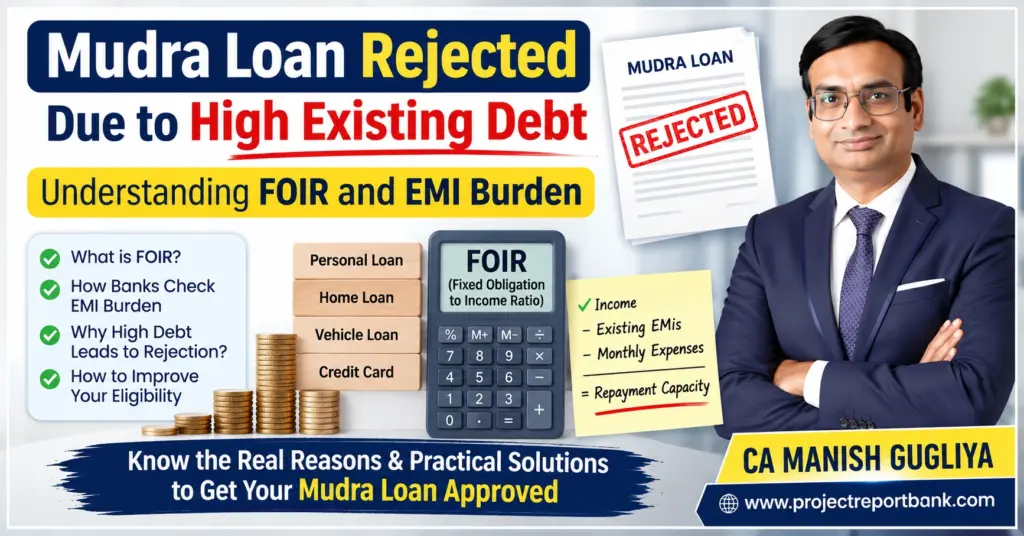
FOIR stands for Fixed Obligation to Income Ratio. It is one of the first numbers the bank calculates for any Mudra Loan application under mantri mudra yojana PMMY. Think of it as a simple percentage: what portion of your monthly income is already blocked in fixed payments like EMIs, credit card minimum dues, and other regular obligations.
Here is why this matters. There is a big difference between income and disposable income. Income is the total money you receive. Disposable income is what remains after your EMIs and necessary family expenses are deducted. Banks care about disposable income because that is the real money available to repay a new loan.
According to a NITI Aayog assessment of PMMY, failure to comply with the FOIR metric – with most banks keeping FOIR around 50% – is among the key reasons for Mudra Loan rejection.
Simple illustration: If your monthly income is ₹40,000 and existing EMIs are ₹18,000, nearly 45% of your income is already blocked. FOIR is high, and approval becomes very difficult.
Now consider two applicants, both earning ₹35,000 per month. One has zero EMIs – their FOIR is very low, and banks happily approve a Kishore category Mudra Loan. The other pays ₹12,000 in personal loan EMIs and ₹3,000 in credit card minimums – their FOIR is already above 40%, leaving almost no room for a fresh EMI. Same income, completely different loan decisions.
Each bank has its own internal FOIR comfort range. There is no single magic percentage that guarantees approval. Some financial institutions accept up to 50-55%, while others, especially for seasonal businesses, keep it tighter at 40-45%.
EMI Burden – What Exactly Counts as “Existing Debt” for a Mudra Loan?
EMI burden is the total of all monthly instalments and fixed repayments you must pay every month before a bank can even think about adding a new Mudra business loan EMI on top.
Here is what banks normally count while checking eligibility:
| Type of Obligation | Counted in FOIR? |
|---|---|
| Personal loan EMIs | Yes |
| Home loan EMIs | Yes |
| Vehicle loan EMIs (car, two-wheeler, commercial vehicle) | Yes |
| Gold loan EMIs | Yes |
| Education loan EMIs | Yes |
| Existing business loan EMIs from any bank or NBFC | Yes |
| Credit card minimum payments | Yes |
| Buy Now Pay Later (BNPL) instalments (Flipkart, Amazon Pay Later etc.) | Yes |
| Consumer durable EMIs (mobile phones, TVs, fridges) | Yes |
| Co-applicant or guarantor obligations | Often yes |
Many borrowers are surprised that BNPL and consumer durable EMIs count. They do. Banks pull your credit report and see every active obligation.
Co-applicant or guarantor obligations can also affect Mudra Loan decisions. If you are co-borrower in your spouse’s or relative’s loan, that EMI may be treated as your fixed obligation too.
Even small EMIs from multiple finance companies together can push FOIR beyond the bank’s limit. Multiple loan applications simultaneously can harm credit scores as well, compounding the problem. The more EMIs you already pay, the larger your FOIR, and the smaller Mudra Loan amount the bank can safely sanction.
For a deeper understanding of how existing EMIs specifically affect Mudra Loan outcomes, that topic is covered in detail separately.
How Banks Actually Calculate Repayment Capacity for Mudra Loans
Banks do not approve Mudra loans only on the basis of turnover or projected profit. They check real monthly cash flow and FOIR to decide a safe EMI for the requested loan amount. Lenders assess repayment capacity carefully – repayment capacity matters more than revenue.
Here is the step-by-step process lenders follow:
- Income recognition: Business income from trading, service receipts, shop income, plus other regular sources like salary of spouse, rent, or pension. Lenders scrutinize bank statements from the last six months for cash flow. They also check GST returns and ITR.
- Subtract existing EMIs: All the obligations listed in the previous section are totalled.
- Subtract living and business expenses: Food, rent, school fees, electricity, staff salaries, stock purchase – these essential expenses are estimated.
- Calculate net monthly surplus: What is left after everything above is deducted.
- Compare surplus with proposed Mudra EMI: If the proposed EMI eats up most of the surplus, the application is rejected or the sanctioned amount is reduced.
Quick illustration: A micro entrepreneur earns about ₹60,000 per month. Family and business expenses are around ₹35,000. Existing EMIs are ₹15,000. Surplus is only ₹10,000. If the requested Mudra Loan EMI works out to ₹8,000, barely ₹2,000 remains as buffer – banks consider this too risky for approval.
Acceptable FOIR ranges are different for different income levels and risk profiles. A borrowers profile with stable salaried co-applicant income gets more flexibility than a seasonal business with irregular cash flow. A low Debt-to-Income ratio indicates limited capacity to repay new loans and will raise red flags.

Why High Existing Debt Leads to Mudra Loan Rejection – Practical Examples
Under the flagship scheme of Pradhan Mantri Mudra Yojana, banks must still follow RBI prudential norms. They cannot approve a new Mudra Loan if your EMI burden already looks risky. High existing debt negatively impacts loan approval chances – this is true whether you apply at public sector banks, private banks, or various financial institutions including NBFCs and MFIs.
Typical high-debt scenarios that trigger rejection:
- Multiple small personal loans from different NBFCs running simultaneously
- Heavy credit card dues converted to EMIs
- An existing business loan plus a recent vehicle loan
- Frequent recent borrowing, top-up loans, or loan restructuring – these signal financial pressure
Case Study: Rejected
| Parameter | Amount |
|---|---|
| Monthly business income | ₹45,000 |
| Total existing EMIs | ₹23,000 |
| Family + business expenses | ₹18,000 |
| Surplus available | ₹4,000 |
| Proposed Mudra EMI | ₹6,500 |
| Result | Rejected – no room for new EMI |
Same Person, Improved Profile: Approved
The same applicant closes one personal loan (₹7,000 EMI) and clears credit card outstanding. Income grows slightly to ₹48,000 through better documented sales.
| Parameter | Amount |
|---|---|
| Monthly income | ₹48,000 |
| Reduced existing EMIs | ₹11,000 |
| Family + business expenses | ₹18,000 |
| Surplus available | ₹19,000 |
| Proposed Mudra EMI (smaller Kishore loan) | ₹5,500 |
| Result | Approved – comfortable surplus |
A smaller loan amount may improve approval chances for applicants with high debt. Sometimes, other rejection reasons like low gross profit margin or incorrect project cost overlap with debt issues – each needs separate attention.
How to Reduce FOIR and Improve Your Chances Before Reapplying
Rejection due to high existing debt is usually temporary. By planning 3–12 months properly, many applicants can qualify for a Mudra Loan in the next attempt. Applicants should consider waiting after settling debt before reapplying.
Practical steps to reduce FOIR:
- List all existing EMIs and credit card/BNPL dues. Calculate your current FOIR roughly on paper.
- Identify which loans carry the highest interest rate – those are the ones to prepay or close first.
- Pay off small high-interest personal loans completely. Reduce credit card balances to zero or at least below 20-30% of your limit.
- Avoid new consumer EMIs. Do not apply for any fresh loans or BNPL before your Mudra application.
- Focus on increasing documented income: route more business receipts through your bank account, file proper GST returns, file ITR consistently. This helps lenders see higher stable income on your records and supports income generation claims.
- Strengthen business documentation. A professionally prepared project report and CMA data can clearly show improved cash flow and realistic EMI capacity to the credit officer. If your earlier CMA data had errors, get it corrected before reapplying.
- Sometimes it is wiser to apply for a slightly smaller Mudra Loan amount with a comfortable EMI rather than insist on maximum sanction and face rejection again.
A credit score below 650 is often insufficient for higher-value Mudra loans, so while fixing FOIR, also work on improving your CIBIL score.
Key Documents to Prove Repayment Capacity & Support Your Mudra Loan Application
Strong documents reduce the bank’s doubt about your income, debt level, and FOIR. This becomes critical if your past application was rejected for high existing debt. Strengthening business documentation can enhance approval chances significantly.
Documents that directly help:
- Last 6–12 months bank statements showing business inflows and all fixed outflows
- Last 1–3 years ITR (proof of income must be submitted when applying for a loan)
- Recent GST returns
- Basic financials – Profit & Loss Account, Balance Sheet, Cash Flow Statement
- Up-to-date statements of existing loans showing outstanding balance and EMI
- Loan closure certificates for loans recently repaid – these directly prove FOIR has improved
- Credit report from CIBIL or other bureaus summarising all active credit, card limits, and repayment history
- Identity proof and address proof as required to apply for a Mudra loan
- A business plan with realistic projections
- Properly prepared project report and CMA data
You can apply for a Mudra loan online or offline. Mudra loans are processed quickly if documents are complete. Clean, consistent documentation often makes the difference between a mudra loan rejected due to high existing debt and a Mudra loan approved with a slightly modified amount and tenure.
Eligible applicants include shop owners and service providers, manufacturers, individuals in trading, and entrepreneurs looking to start or expand small businesses. Mudra Yojana provides loans for various business purposes – from machinery purchase to working capital for product offerings and services.

What To Do After Your Mudra Loan Is Rejected Due to High Existing Debt
Follow this step-by-step action plan:
- Request the specific rejection reason from the bank. Check whether “high FOIR” or “high existing EMIs” or “insufficient repayment capacity” is mentioned. If the bank does not provide a reason, you can find guidance on how to find the actual reason for Mudra Loan rejection. Complaints can be filed with higher authorities if loan rejection is unjustified.
- Obtain your latest credit report. Borrowers should check their credit report for errors that may inflate debt. Look for duplicate entries, accounts marked overdue incorrectly, or settled accounts not updated.
- Do a personal FOIR calculation on paper. List income, list all EMIs, estimate basic expenses, and see how much genuine surplus is left for a Mudra EMI at a typical interest rate and tenure.
- Improve your profile:
- Clear or consolidate smaller loans where possible
- Bring credit cards within 20–30% of limit
- Keep all EMIs fully regular for at least 6–9 months
- Prepare an updated project report and CMA data reflecting the improved position
- Reapply only after your FOIR and EMI burden clearly fit within reasonable bank comfort levels. Otherwise, repeated rejections create multiple inquiry marks in the credit report, further hurting your chances.
The Micro Units Development and Refinance Agency (MUDRA – mudra stands for Micro Units Development and Refinance Agency) was set up under the Ministry of Finance, Government of India to provide easy access to credit for small and micro enterprises. The scheme extended through various financial institutions provides funding to help micro enterprises grow. No collateral is required for loans up to ₹10 lakh, and eligible borrowers must meet specific criteria for Mudra loans. Eligible individuals need to fill the application form, submit the required documents, and meet the bank’s credit needs assessment to avail a Mudra Loan. Whether you are in a start phase or want to expand existing units, the government of india designed this scheme to provide security through collateral free lending so that small businesses can grow without assets as a barrier.
Mudra loans support micro and small enterprises in non farm sectors including manufacturing, trading, and services. The benefits of the scheme extend to non corporate enterprises in the non farm sector, with easy access to credit through banks, NBFCs, and MFIs across India. Visit your nearest lender or apply online through the Jan Samarth portal. Whether you are availed of a previous loan or applying for the first time, proper preparation at every stage is what separates approval from rejection. The categories under PMMY – Shishu, Kishore, Tarun, and Tarun Plus – are designed so that borrowers at different growth stages can access the right loan amount based on their requirements. There is no subsidy component in Mudra Loans, but the interest rate is kept reasonable, and the scheme is among the most important government initiatives for entrepreneurs in India. If you have questions about the process, the letter of rejection, or your rights, visit the relevant ministry’s grievance portal or your nearest branch to get terms clarified in writing.
Frequently Asked Questions (FAQs)
These FAQs address common doubts specifically related to high existing debt, FOIR and Mudra Loan approval. Each answer is kept simple and practical.
Can I get a Mudra Loan if I already have a home loan and a personal loan?
Yes, having existing loans does not automatically disqualify you. The real issue is whether total EMIs – including home and personal loan payments – leave enough monthly surplus for the new Mudra EMI. If, after including the proposed EMI, FOIR becomes too high as per the bank’s internal policy, the loan may be rejected or the amount sharply reduced. If you carry heavy EMIs, consider partial prepayment or tenure extension of existing loans to reduce monthly burden before applying.
Does closing one small loan really improve my FOIR for Mudra Loan approval?
Absolutely. Even closing a single ₹2,000–₹3,000 monthly EMI can meaningfully improve FOIR for low and middle-income borrowers, especially in Shishu and Kishore categories. When that EMI disappears, the same income suddenly supports a larger safe EMI, which can convert a previous rejection into an approval. Keep the loan closure letter and latest statement ready so the bank can clearly verify that the obligation no longer exists.
How long should I wait after rejection due to high existing debt before reapplying?
There is no fixed waiting period, but practically at least 3–6 months are required to close or reduce some loans, bring credit card dues down, and build a clean on-time EMI record. Reapply only after you can show clearly lower EMIs in bank statements and credit report for at least three consecutive months, along with better documented income. Reapplying too quickly, without improving FOIR, often leads to another rejection and more hard inquiries in your credit report.
Is FOIR more important than CIBIL score for Mudra Loan under PMMY?
Both matter but serve different purposes. CIBIL score shows past repayment behaviour – whether you paid EMIs on time. FOIR shows current and future repayment capacity based on income and existing EMIs. Even with a strong CIBIL score, if FOIR is very high due to heavy existing debt, banks may still reject because the future EMI looks unsafe. On the other hand, a moderate CIBIL score with a comfortable FOIR, stable income, and a well-prepared project report can still lead to approval, especially for smaller Shishu or Kishore Mudra loans.
Can adding a co-applicant improve my FOIR for a Mudra Loan?
Adding a co-applicant with stable documented income and low EMIs can improve combined repayment capacity and FOIR, sometimes making a previously rejected application viable. However, if the co-applicant already has heavy EMIs, their liabilities will also be counted, and FOIR may not improve or may even worsen. Choose a co-applicant carefully – ensure their income documents, ITR and bank statements are strong and consistent with the proposed Mudra Loan EMI.
- Can Bank Reduce Mudra Loan Amount Without Your Consent? Complete Practical Guide (2026)


- What to Do If You Cannot Pay Your Mudra Loan EMI (2026 Guide)

- Can a Bank Refuse a Mudra Loan Because the Target Is Completed? Complete Guide (2026)

- Bank Refused My Mudra Loan Application – What Are My Rights?

- Mudra Loan for Used Vehicles (2026): Eligibility, Documents, Bank Rules & Complete Guide

- Rejected Mudra Loan – What to Do Next? Appeal Process Explained (2026)

- Mudra Loan Project Report Madhya Pradesh – Bank-Ready DPR & CMA Guide

- Project Report for Mudra Loan Maharashtra: Complete Guide for MSMEs, Startups and Small Businesses (2026)

- Mudra Loan Uttar Pradesh: Complete Guide for MSMEs, Startups and Small Businesses (2026)

- Mudra Loan Bihar 2026: Eligibility, Documents, Online Application Process & Project Report Guide

- Jan Samarth Mudra Loan 2026: Complete Guide to Online Application, Eligibility, Documents & Approval Process

- MSME Mudra Loan: Complete Guide for Small Businesses, Startups & Manufacturing Units in India (2026)

- Is the Mudra Loan Subsidy Real or Fake? Get the Facts Here

- Mudra Loan Without CIBIL Score: How to Qualify and Apply

- Mudra Loan for Used Machine (2026 Guide) – Eligibility, Documents, Valuation & Approval Tips