Key Takeaways
- A bulk grain handling and logistics terminal is a mechanised facility designed for high-throughput receiving, transfer, temporary storage and dispatch of grain in bulk form, using integrated conveying systems, truck and rail intake, weighbridges and automated controls.
- Commercially scaled grain terminals can handle 0.5 to 5 million tons annually, with typical mid-sized Indian projects targeting 0.3–1.0 million tonnes per year throughput and project cost often ranging from ₹10 crore to ₹25 crore or more, depending on configuration.
- A bankable bulk grain handling terminal project report must address site selection, handling capacity in TPH, automation level, project cost, means of finance, DSCR, IRR, grain temperature and quality protection, and long-term customer contracts.
- Project Report Bank, led by CA Manish Gugliya (FCA, DISA, ICAI), prepares customised DPRs, financial projections, CMA Data and feasibility studies for bulk grain terminals across India.
- This article covers market opportunity, terminal configuration, machinery, financial projections, risk analysis, regulatory aspects and DPR requirements in a structured, investor-focused manner.
Introduction: Role of Bulk Grain Handling Terminals in India
India produces over 300 million tonnes of food grain annually, including wheat, rice, maize and pulses, across states such as Punjab, Haryana, Madhya Pradesh, Chhattisgarh, Telangana and Uttar Pradesh. Moving this grain efficiently from producing regions to mills, consumption centres and export points remains a significant logistics challenge. Grain terminals facilitate efficient grain transport to domestic and foreign markets, and they improve food security by enhancing grain storage capacity and reducing post-harvest losses.
Mechanised bulk grain terminal infrastructure at key nodes – near mandis, railheads, ports and major mills – reduces transit losses, truck waiting time, manual handling and contamination compared with conventional bagged storage and godowns. Grain terminals also reduce economic losses from grain deterioration, create job opportunities in local economies and help regulate grain pricing through better supply management.
This article serves as an industrial-investment planning guide focused on the bulk grain handling terminal project report: technical design, capacity planning, project cost, means of finance, DSCR, IRR and risk analysis. It is authored by CA Manish Gugliya, a Chartered Accountant with 20+ years of experience in project finance advisory. Promoters planning a bulk grain terminal in India can seek professional DPR preparation and project finance advisory support from Project Report Bank.
What Is a Bulk Grain Handling & Logistics Terminal?
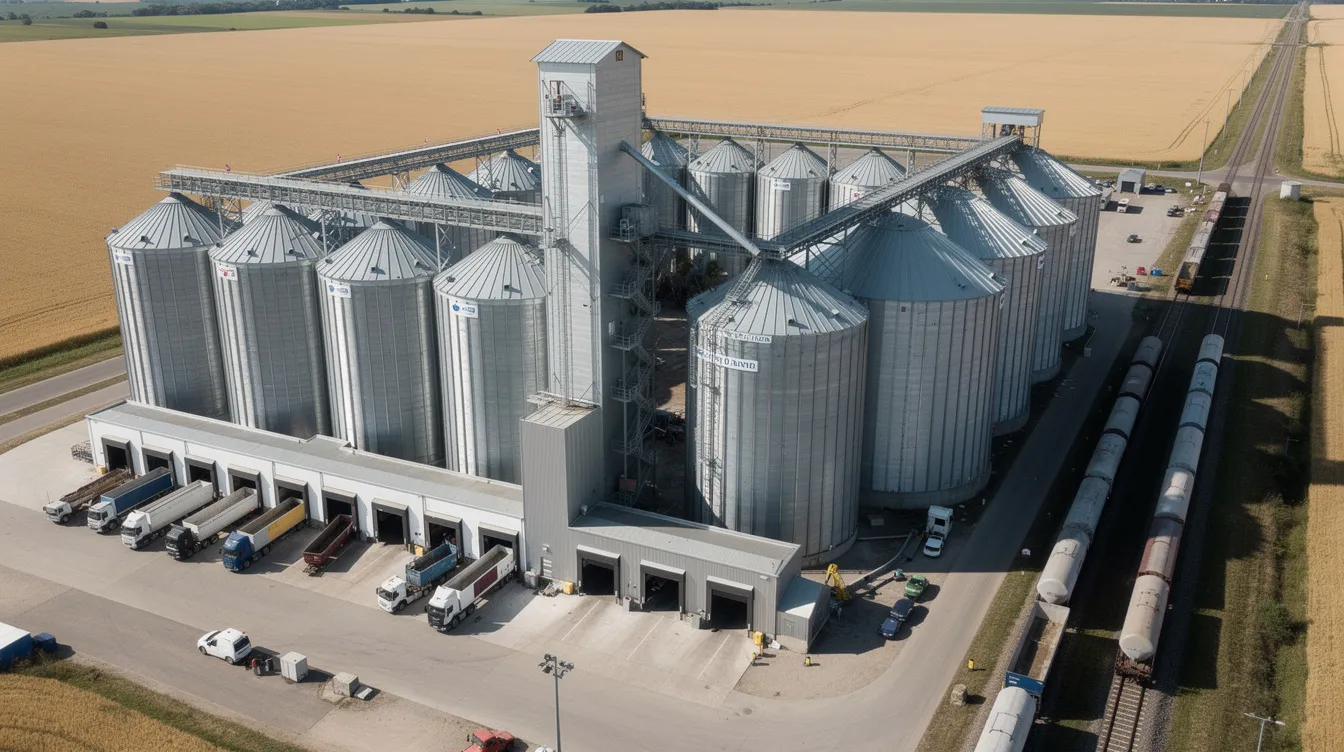
A bulk grain handling and logistics terminal is a mechanised facility that receives, consolidates, cleans where required, temporarily stores and dispatches grain in bulk form. A complete grain storage facility typically includes receiving, cleaning and drying systems connected by conveying systems that link all major parts of the operation. Core functional zones include truck intake pits, truck tipplers, receiving hoppers, grain cleaners, short-term silo storage or bins, truck and rail wagon loading bays, weighbridges and a central control room.
This infrastructure differs from a simple grain storage warehouse or a standalone grain silo installation. The emphasis is on high daily throughput, fast truck turnaround and logistics integration rather than long-duration storage alone. A terminal can be configured primarily for bulk handling with only buffer storage, or as an integrated storage-and-handling hub when combined with larger capacity. For comparison, a modern food grain warehouse project report focuses on conventional warehousing, while grain terminals integrate truck and rail intake systems for rapid movement.
Market Opportunity and Demand Assessment in India
India’s public procurement operations through FCI and state agencies, private grain trading, flour milling, rice milling, poultry-feed manufacturing and starch processing all create demand for efficient grain terminal infrastructure. A bulk grain handling terminal project requires comprehensive market analysis. Grain terminals improve turnover efficiency and reduce docking time for trucks, which is particularly valuable in congested procurement centres.
To estimate annual throughput potential, promoters should map regional grain production within a 150–200 km radius, estimate the proportion likely to use mechanised bulk handling, and account for competing facilities and existing mandis. Seasonality matters critically: grain handling systems must manage surges during harvest seasons, so misjudging peak volumes leads to congestion and lost business.
For example, a proposed terminal near a major wheat cluster around Kota or Bhopal might target 2–3 lakh tonnes per year, based on regional procurement data and mill demand. Network concepts like hub-and-spoke logistics, described in a hub and spoke grain silo project report, can further expand a terminal’s catchment and utilisation.
Business Models and Revenue Streams for Grain Terminals
Core business positioning options include an independent third-party bulk handling terminal, a captive terminal for a large mill or processor, and hybrid terminals combining handling with storage services. A rail-linked grain silo terminal project report addresses rail-integrated models, while a road-fed grain silo storage facility DPR covers road-only configurations.
Key revenue lines include:
- Handling charges per tonne for unloading and loading
- Storage charges based on grain storage duration and tonnage
- Cleaning and grading fees
- Bagging and de-bagging charges
- Logistics coordination fees
DPR financials must focus on service revenue per tonne rather than inflated commodity trading turnover. Long-term contracts – such as minimum guaranteed volume arrangements or take-or-pay structures similar to the Punjab PPP project where fixed service charges were approximately INR 1,100–1,400 per MT – strengthen revenue visibility and bankability.
Terminal Capacity & Throughput Planning
Understanding the difference between installed handling capacity in tonnes per hour, temporary grain storage capacity in tonnes and total annual throughput is essential. Grain terminals globally can handle 0.5 to 5 million tons annually depending on scale. In India, grain handling systems must be properly designed to manage surges during the harvest season while maintaining efficiency during leaner months.
Design parameters include planned daily working hours (16–20 hours during peak), operating days per year, and acceptable truck waiting times. Grain storage facilities often operate around the clock for efficiency during procurement peaks.
| Parameter | 100 TPH System | 200 TPH System | 500 TPH System |
|---|---|---|---|
| Daily Throughput (16 hrs) | 1,600 MT | 3,200 MT | 8,000 MT |
| Annual Throughput (75% utilisation, 280 days) | ~3.4 lakh MT | ~6.7 lakh MT | ~16.8 lakh MT |
| Buffer Storage Needed (5-day) | ~8,000 MT | ~16,000 MT | ~40,000 MT |
Figures are hypothetical planning illustrations only.
Capacity calculations must account for bottlenecks such as cleaner or dryer capacity, not just nameplate conveyor TPH. For integrated processing, refer to the grain cleaning, grading, drying and storage plant DPR.
Land, Location and Site Selection
There is no universal land-size formula. Indicative land needs for a mid-sized road-fed grain terminal range from 2 to 6 acres depending on storage volume, truck parking and rail siding requirements. Site selection is crucial for terminal operational efficiency.
Key location factors include proximity to grain-producing districts, access to national and state highways, potential for railway siding connectivity, distance to major mills, and availability of industrial land-use clearance. Essential site-planning features cover separate entry and exit gates for trucks, internal circulation roads, weighbridge placement, truck unloading and loading pads, and covered areas for sensitive operations. Promoters should reserve land for future expansion of storage blocks, additional grain silo lines or extended loading bays.
Rail-linked projects require coordination with Indian Railways and state industrial development corporations, increasing both land-depth requirement and project implementation timelines.
Machinery, Equipment and Automation Configuration
Selecting robust, maintainable equipment and a well-integrated conveying system is central to both project cost and operating reliability. Terminal efficiency depends on high-speed equipment for loading and unloading grain, while effective dust control measures are mandatory for grain handling terminals. Grain storage facilities integrate multiple equipment types for efficiency, and conveying systems connect all major parts of the operation. Companies like Cimbria design terminals for high throughput and reliability, setting global benchmarks for equipment integration.
| Equipment / System | Function | Key Selection Considerations |
|---|---|---|
| Truck tippler / hydraulic lifter | Unloading grain from trucks | Capacity in TPH, cycle time, suitable for local truck sizes |
| Receiving hoppers | Collecting grain below unloading system | Volume, grate design, cleanout access |
| Belt conveyors | Horizontal and inclined grain transfer | Width (650–1,000 mm), length, power, belt life |
| Bucket elevators | Vertical grain elevation | Capacity, height, chain vs. belt type |
| Pre-cleaners and rotary cleaners | Removing foreign matter | Throughput, screen types, maintenance access |
| Steel silos or bins | Buffer and short-term grain storage | Silo types include corrugated bolted steel and concrete silos |
| Weighbridges | Vehicle and batch weighment | Legal metrology compliance, automation |
| PLC / SCADA panels | Process automation and monitoring | Automation level, expansion ability, reliable supplier support |
| Grain temperature sensors | Quality monitoring in storage | Silo storage systems include temperature monitoring for grain quality |
| Dust extraction systems | Air quality and safety | Safety protocols must address hazards like grain dust explosions |
For detailed silo design aspects, refer to the steel grain silo plant project report. Grain terminals require advanced monitoring systems for efficiency, and automated systems enhance inventory control. Temperature monitoring systems are essential for grain quality management, especially when grain is stored for long periods.
Bulk Grain Handling Process Flow and Operations
The operational sequence follows a structured flow:
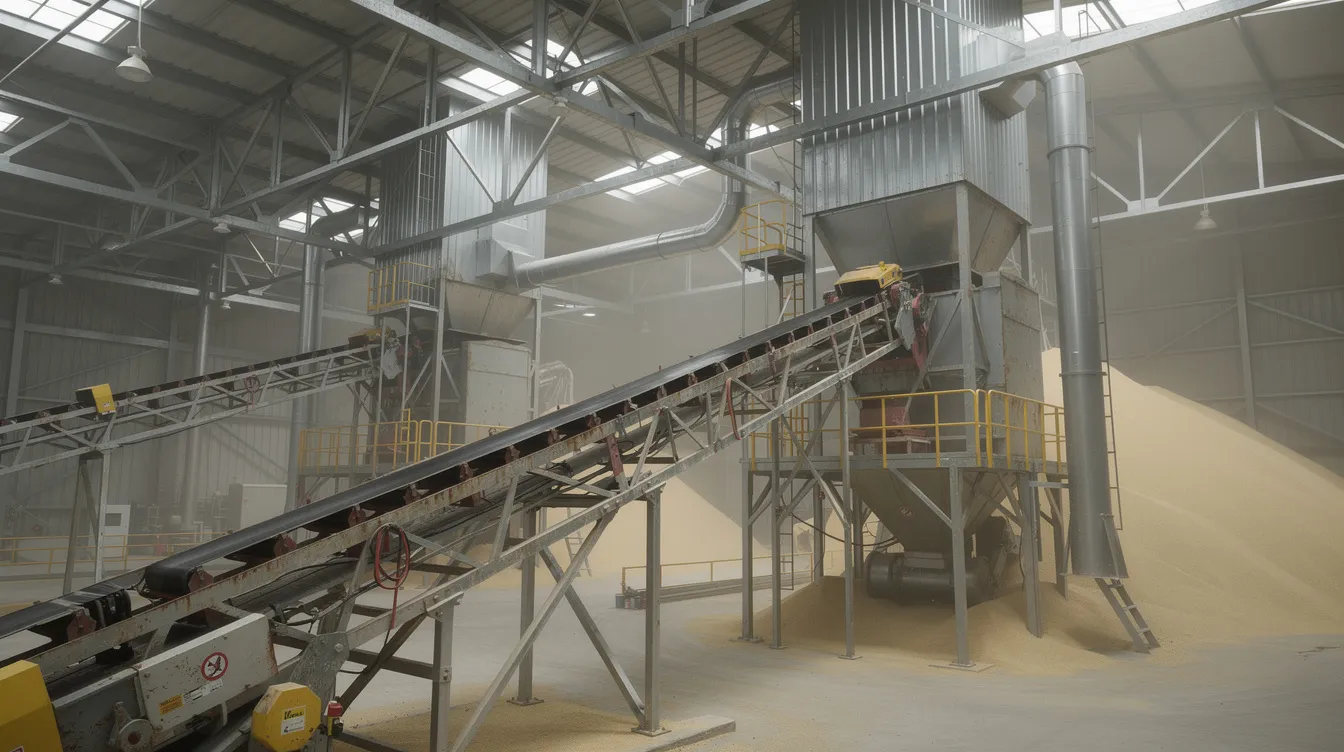
Vehicle Arrival → Weighment → Sampling & Quality Check → Unloading at Receiving Pit → Cleaning (if required) → Conveyor Transfer → Buffer Storage / Silos → Dispatch Planning → Loading → Final Weighment → Transportation
Grain cleaning is crucial before drying and storage processes. Grain quality management is essential throughout storage and dispatch. Grain terminals utilise advanced monitoring systems for real-time tracking of conveyor status, silo levels and equipment health. Operational KPIs include average unloading time per truck, grain loss percentage (mechanised terminals achieve approximately 0.2% loss versus over 10% in conventional godowns), power consumption per tonne and manpower per shift.
Process variations include direct transfer (truck-to-truck), storage-based dispatch and rail wagon loading. Maintenance practices – scheduled shutdown windows, spares inventory and lubrication plans – directly impact uptime and annual throughput.
Project Cost & Capital Investment Structure (Illustrative)
Capital expenditure for terminal construction is substantial and requires careful planning. Actual grain handling terminal project cost depends on land price, civil works, automation level, volume of grain storage provided, rail siding works and power-connection charges.
| Cost Head | Illustrative Amount (₹ Crore) | Remarks |
|---|---|---|
| Land and site development | 1.5–3.0 | Varies greatly by location |
| Civil construction and buildings | 2.0–4.0 | Foundations, buildings, internal roads |
| Handling machinery and conveyors | 3.0–6.0 | Tipplers, belt conveyors, bucket elevators |
| Steel silos / buffer storage | 1.5–4.0 | Depends on storage capacity provided |
| Electrical, automation, dust control | 1.0–2.5 | PLC/SCADA, panels, dust extraction |
| Weighbridges and utilities | 0.5–1.0 | Weighbridges, water, power connection |
| Preliminary, pre-operative, contingency | 0.5–1.5 | Professional fees, interest during construction |
| Working capital margin | 0.5–1.0 | As required by bank norms |
| Total Project Cost | ~10–23 | Hypothetical planning band |
All figures are illustrative assumptions for DPR-structure demonstration and require validation through supplier quotations and detailed engineering.
Adding a 20,000–50,000 tonne long-term grain storage block or complex railway connectivity can significantly increase the total cost beyond these bands. Belt conveyor costs in India range from approximately ₹7,000 to ₹26,000 per metre depending on belt width and capacity, while steel silos of 2,000+ tonnes capacity can cost ₹1.2 to ₹2.5 crore per unit.
Means of Finance, Term Loan Structure and Bank Documentation
Typical means of finance for a commercial-scale grain terminal include promoter equity contribution, bank term loan and margin for working capital. Common debt-equity ratios for infrastructure projects range from 1.5:1 to 2:1, meaning promoter equity of 33–40% of the total cost.
Key term loan parameters include tenure of 7–10 years including moratorium, assumed interest rate, repayment schedule and collateral expectations. Financial models should include revenue projections and operational costs to demonstrate repayment capacity. A bankable DPR together with structured CMA Data preparation for bank loans is generally required for medium and large term-loan proposals. Project Report Bank also provides bank finance DPR and loan proposal assistance and project finance advisory and loan structuring services.
Working Capital Requirements and Operating Cost Structure
A service-based grain terminal’s working capital is driven by operating costs and receivables, not commodity inventory. Major operating costs include staff salaries, electricity for conveyors, bucket elevators and dust collectors, repairs and maintenance, insurance and administrative overheads. Typical receivable cycles from institutional clients run 30–60 days.
Seasonal peaking in grain movement raises short-term working capital utilisation. DPRs should reflect monthly cash-flow variations. Operating efficiency – low power consumption per tonne, controlled maintenance costs, optimal manpower – directly improves EBITDA margin and DSCR.
Financial Projections, Profitability and Scenario Analysis
A 5–7-year grain terminal financial model should project annual throughput, handling and storage charges per tonne, ancillary income, operating expenses, depreciation, interest, tax and net profit. Revenue assumptions should combine contracted volumes, spot business and tariff benchmarks from comparable facilities.
Under-utilisation in the first 2–3 years is common and must be built into capacity utilisation assumptions. No standard profitability benchmark fits all terminals; margins depend on utilisation levels, tariff power, local competition, energy efficiency and financing terms. Professional financial projections and financial modelling services help stress-test the complete project under multiple scenarios.
DSCR, ROI, IRR, Payback and Break-even Analysis
Lenders focus on DSCR over loan tenure, typically preferring minimum DSCR above 1.25–1.30x under base-case assumptions. Promoters evaluate IRR, payback period and ROI. Sensitivity analysis should test lower throughput, delayed ramp-up, lower handling tariff, higher electricity costs, increased project cost and higher interest rates.
Professional DPRs should present base-case, optimistic and downside scenarios rather than a single-point projection. Project Report Bank, under CA Manish Gugliya, performs detailed DSCR and sensitivity analysis for each project but does not guarantee future profitability or loan sanction.
Feasibility, Commercial Viability and Risk Assessment
Project feasibility studies assess the sustainability of investments in terminals across four pillars: technical feasibility of the conveying and storage system, market feasibility based on grain-flow and customer demand, financial viability and regulatory feasibility.
Key risks include:
- Lower-than-expected throughput from competition or policy shifts
- Prolonged breakdown of conveyors or bucket elevators
- Grain quality complaints and contamination
- Dust explosions or fire – safety protocols must address hazards like grain dust explosions
- Grain temperature and aeration system failures where longer storage is provided
Mitigation measures include diversified customer base, binding long-term contracts, preventive maintenance, adequate insurance and contingency margins. Before final investment, promoters should commission a structured project feasibility study and viability assessment. Some proposed projects may need scale reduction, phasing or model alteration to become bankable.
Regulatory Approvals, Compliance and Insurance
Typical approvals include company formation, GST registration, land-use conversion, building plan approvals and environmental clearances. Regulatory approvals often require environmental assessments, and environmental compliance includes managing noise and air quality during operations. Factory licences, fire NOC, electrical safety inspections and legal metrology approvals for weighbridges are generally required.
Rail-linked terminals must separately secure approvals from Indian Railways for private sidings, which can expand project timelines. Promoters should budget for property damage, machinery breakdown, stock and business interruption insurance.
Project Implementation Schedule and Execution Planning
| Phase | Indicative Timeline |
|---|---|
| Concept, feasibility, land shortlisting | Months 0–3 |
| DPR finalisation, loan sanction, approvals | Months 3–8 |
| Civil construction and site development | Months 6–14 |
| Equipment procurement and erection | Months 10–18 |
| Testing, commissioning and trial operations | Months 16–22 |
Timelines are illustrative and vary by land availability, rail siding complexity, supplier delivery and regulatory clearances. Any delay in land or railway approvals can extend the schedule significantly.
Early engagement with machinery suppliers and civil engineers during layout finalisation avoids late-stage design changes. Assigning an experienced project manager to coordinate between contractors, suppliers and utility agencies is advisable.
Why a Professional DPR is Critical for Bulk Grain Terminals
Bulk grain handling terminal projects with investment often above ₹10 crore cannot rely on generic templates or supplier brochures. Banks expect a detailed, customised DPR demonstrating both technical design and commercial viability. Core components include promoter profile, detailed process flow, capacity planning rationale, technical specifications, plant layout, project cost estimate, means of finance, projected financial statements, DSCR and sensitivity analysis.
A professionally prepared DPR addresses bank queries upfront and improves credibility, though it does not guarantee loan sanction. CA Manish Gugliya and Project Report Bank offer end-to-end support for bulk grain terminal DPRs, including structured bank finance documentation and project finance advisory. Serious promoters are encouraged to share basic project details – proposed location, capacity, storage requirement, rail versus road configuration – via WhatsApp for an initial professional discussion.
Conclusion: Summary and Next Steps for Promoters
A successful bulk grain handling and logistics terminal in India depends on correct site selection, realistic throughput estimation, balanced investment in conveying systems and grain storage, reliable power and infrastructure, and long-term customer relationships. The bulk grain handling terminal project report is not merely a compliance document for banks – it is a planning tool to validate capacity, machinery layout, project cost, means of finance, DSCR, ROI and risk profile before committing large capital.
Related configurations such as the PACS and FPO rural grain warehouse project report or modern food grain warehouse project report may also be relevant depending on business model and catchment area. Entrepreneurs and investors seriously evaluating a grain logistics terminal should engage Project Report Bank, under the leadership of CA Manish Gugliya, for customised DPR preparation, financial projections, CMA Data and feasibility analysis – before purchasing land or ordering machinery.
Frequently Asked Questions (FAQ)
What is the basic difference between a grain storage silo project and a bulk grain handling terminal project?
A grain storage project, centred on a grain silo or warehouse, primarily targets long-duration grain storage and grain temperature management over long periods. A bulk grain handling terminal focuses on high-throughput loading, unloading, transfer and short-term storage. The terminal DPR emphasises conveying system design, truck and rail logistics, handling tariffs and throughput-based revenue, whereas a storage DPR focuses on storage days, aeration and monitoring costs. Many commercial projects combine both elements.
Can a small or medium enterprise set up a bulk grain handling terminal?
MSME promoters can set up smaller, road-fed grain terminals focusing on local aggregation and dispatch with lower handling capacity. Such projects still require a structured DPR, term loan planning and working capital assessment. Starting with a modular design and provision for future expansion allows MSME promoters to expand capacity as customer base and throughput increase.
How do banks view projects where the terminal promoter also trades in grain inventory?
Banks typically appraise the term loan for fixed assets and working capital limits for grain trading inventory and receivables as separate components. Trading-related inventory finance may be substantially larger than the terminal’s fixed-asset cost. A comprehensive DPR should distinguish service income from handling and margin income from purchasing and trading, to avoid confusion in profitability analysis and DSCR calculation.
Is it mandatory to install advanced automation and SCADA from Day 1?
Basic automation – interlocked start/stop controls, safety interlocks and overload protection – is essential. The level of sophisticated SCADA, remote monitoring and data analytics can be adapted to project size and budget. Mid-sized terminals in India often start with semi-automated systems and later upgrade. DPRs should factor in both initial automation scope and provision for future upgrades so that cabling, control-room location and panel sizing allow economical expansion.
How early should promoters approach a professional for DPR preparation?
Promoters should engage a DPR and project-finance advisory professional soon after initial concept development and site shortlisting, but before final land purchase or major machinery commitments. Early involvement allows proper capacity analysis, infrastructure optimisation, realistic project cost budgeting and assessment of bankability. Project Report Bank typically starts with a discussion on promoter objectives, catchment analysis and tentative capacity, then develops a detailed, bank-ready bulk grain handling terminal project report and financial model.