Key Takeaways
- A rail-linked grain silo terminal integrates steel grain silos, mechanised conveyors and a private railway siding to handle large-scale grain storage and bulk movement across India, with the main purpose being to minimize post-harvest losses and improve supply-chain efficiency.
- A Rail Linked Grain Silo Terminal Project Report (DPR) must cover technical design, railway siding feasibility, project cost, means of finance, detailed financial projections including DSCR and IRR, and comprehensive risk analysis before capital is committed.
- Location selection near grain-surplus regions, major rail corridors and processing clusters, combined with reliable cargo volumes from counterparties such as the Food Corporation of India, flour mills or traders, is critical for long-term viability.
- Project cost is driven mainly by steel silo structures, mechanised bulk grain handling systems and railway siding construction, and varies widely depending on capacity (25,000 to 100,000 MT) and site-specific conditions.
- Professional DPR preparation and project finance advisory by Project Report Bank can help Indian promoters structure a bankable rail-linked grain storage project with realistic assumptions and a sound funding strategy.
Introduction to Rail-Linked Grain Silo Terminal Projects in India
India is the world’s second-largest producer of rice and wheat. India’s food grain production reached 354 million tonnes in 2024-25, and moving this output from surplus states to consumption centres involves one of the largest bulk commodity logistics operations in the world. Yet a significant share of this grain still moves through conventional godowns and road transport, contributing to avoidable post harvest losses and higher logistics costs.
A rail-linked grain silo terminal integrates storage and railway connectivity to enhance logistics efficiency, enabling bulk food grains to travel long distances by rail at a fraction of the cost and time required by road. Shifting grain transport from trucks to rail lowers long-term transport costs and reduces carbon emissions. Rail connectivity is essential for the operational efficiency of grain silo terminals handling volumes beyond what road transport can economically sustain.
From a project finance perspective, a Rail Linked Grain Silo Terminal Project Report is a specialised DPR that brings together grain storage engineering, bulk handling systems and railway siding economics into a single, bankable investment document. The viability of such a project depends on contracted volumes, rake availability, siding capacity and tariff structures rather than storage capacity alone. This article, prepared from a practising Chartered Accountant’s perspective, examines the technical, commercial and financial considerations that promoters and investors must address before committing large capital to a rail-linked grain storage project in India.
Serious promoters planning such a project should consider a professionally prepared DPR and feasibility assessment before finalising investment decisions.
What Is a Rail-Linked Grain Silo Terminal?
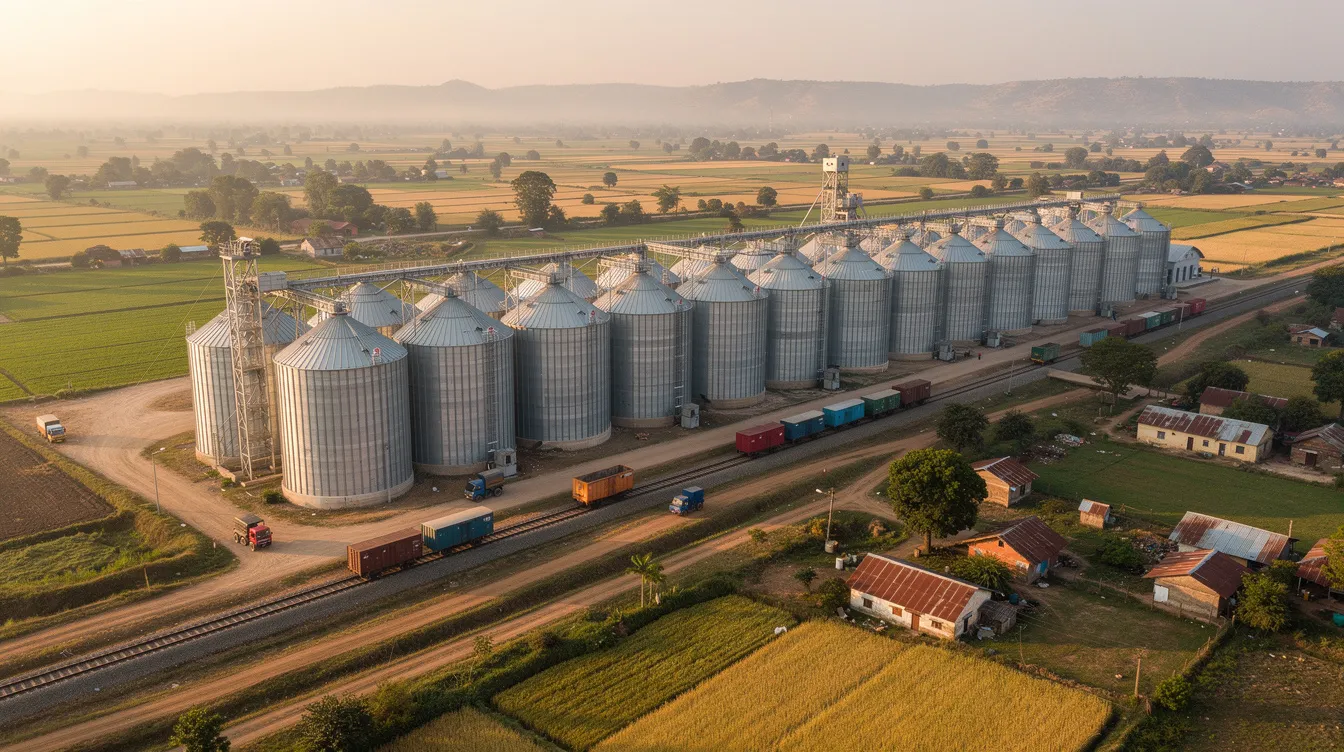
A rail-linked grain silo terminal is an integrated grain terminal combining steel grain silo storage, mechanised grain handling equipment and a dedicated or shared private railway siding for bulk rail dispatch and receipt.
The terminal is organised into several functional zones:
- Truck receipt area with weighbridge, grain sampling and quality laboratory
- Intake and pre-cleaning zone with receiving pits, grids, belt or chain conveyors, bucket elevators and pre-cleaners
- Grain storage zone with multiple flat-bottom or hopper steel silos, aeration and ventilation systems, and temperature and moisture monitoring
- Dispatch zone with silo discharge systems, rail wagon loading spouts, and truck loading provisions
- Supporting systems including dust collection and aspiration, automation through PLC and SCADA for full-process automated management, power distribution, fire detection and fighting systems, and fumigation provisions
Scientific steel silos can reduce grain losses to less than 1%, compared with substantially higher losses in conventional bagged storage. Grain storage technology includes temperature measurement and ventilation systems that preserve quality over extended periods.
Investors new to silo technology can also refer to the Steel Grain Silo Plant Project Report & DPR for detailed understanding of standalone silo infrastructure before evaluating rail-linked configurations.
Comparison: Warehouse vs. Standalone Silo vs. Rail-Linked Terminal
| Feature | Conventional Food Grain Warehouse | Standalone Steel Grain Silo | Rail-Linked Grain Silo Terminal |
|---|---|---|---|
| Storage format | Bagged, manual stacking | Bulk, vertical silos | Bulk, vertical silos |
| Mechanisation level | Low (manual handling) | Moderate to high | High (continuous flow) |
| Typical capacity | 5,000–25,000 MT | 10,000–50,000 MT | 25,000–100,000+ MT |
| Connectivity | Road only | Road only | Road and rail |
| Capital requirement | Lower | Moderate | Higher |
| Operating complexity | Low | Moderate | High |
| Ideal use-case | Local procurement storage | Regional or mill-linked storage | Long-distance bulk grain movement |
For a comparative understanding of conventional godown-based storage, the Modern Food Grain Warehouse & Godown Project Report provides relevant context.
Market Opportunities and Demand for Rail-Linked Grain Storage in India
India’s grain economy requires massive inter-state movement. The Food Corporation of India managed storage of over 917 lakh metric tonnes by mid-2025, while modern silos in India have a capacity of only 27 lakh tonnes, indicating a large gap between requirement and modern storage infrastructure. India also has 8,815 cold storages with over 402 lakh tonnes capacity, but cold storage serves different commodities and does not address bulk grain logistics needs.
Potential demand for rail-linked grain terminals comes from several segments:
- The Food Corporation of India and state procurement agencies requiring scientific storage and bulk dispatch
- Grain traders and aggregators moving wheat and rice across states
- Flour mills, rice processors and food processing units requiring steady inbound grain supply
- Integrated agribusiness and logistics companies seeking rail-based supply chain solutions
The cooperative sector launched the World’s Largest Grain Storage Plan in 2023, while PMKSY approved 1,601 food processing and cold chain projects, and the Agriculture Infrastructure Fund sanctioned over Rs. 73,000 crores. These policy developments signal growing institutional support for modernising grain storage and handling infrastructure.
The FCI’s hub-and-spoke grain silo programme envisions 111.125 LMT of silo capacity at 249 locations under DBFOT and DBFOO PPP arrangements. Private rail-linked terminals can align with or complement these networks where grain flows justify investment.
Any grain silo terminal feasibility study must assess real commodity flows: wheat movement from Punjab, Haryana and Madhya Pradesh to eastern and southern India, and paddy and rice movement from surplus states to deficit regions. Seasonal procurement patterns during Rabi and Kharif windows, commodity mix, and proximity to consumption centres all affect addressable cargo volumes.
A well-planned grain storage terminal can also generate rural employment in terminal operations, creating job opportunities in areas near procurement centres. Before fixing capacity, investors should commission a formal market study covering demand, tariffs and competitor facilities.
Suitable Locations for Setting Up a Rail-Linked Grain Silo Terminal
Site selection must combine grain availability, rail network access and commercial demand. Qualitative assessments of feasibility include grain availability, market demand, and rail connectivity at the proposed location. Cheap land alone does not create a viable grain terminal.
Key location factors include:
- Proximity to grain-surplus mandis and procurement centres
- Road connectivity for inbound truck traffic
- Access to broad-gauge railway lines, junctions or existing freight terminals
- Sufficient contiguous land for silo blocks and railway siding
- Availability of power (11 kV or 33 kV), water and telecom
- Soil bearing capacity suitable for heavy silo foundations
- Flood risk, drainage and environmental conditions
Representative regions where such projects are often evaluated include the wheat belts of Punjab, Haryana and western Uttar Pradesh, and the grain belts of Madhya Pradesh and Rajasthan. However, not every location within these states is automatically viable.
Preliminary technical discussions with the concerned railway division are essential to confirm siding connectivity and assess interface with proposed or existing Gati Shakti Cargo Terminals. Location choice should also consider potential for future expansion from a 25,000 MT terminal to 50,000 MT or 100,000 MT if cargo volumes justify additional investment.
Land Requirement, Railway Siding and Terminal Layout
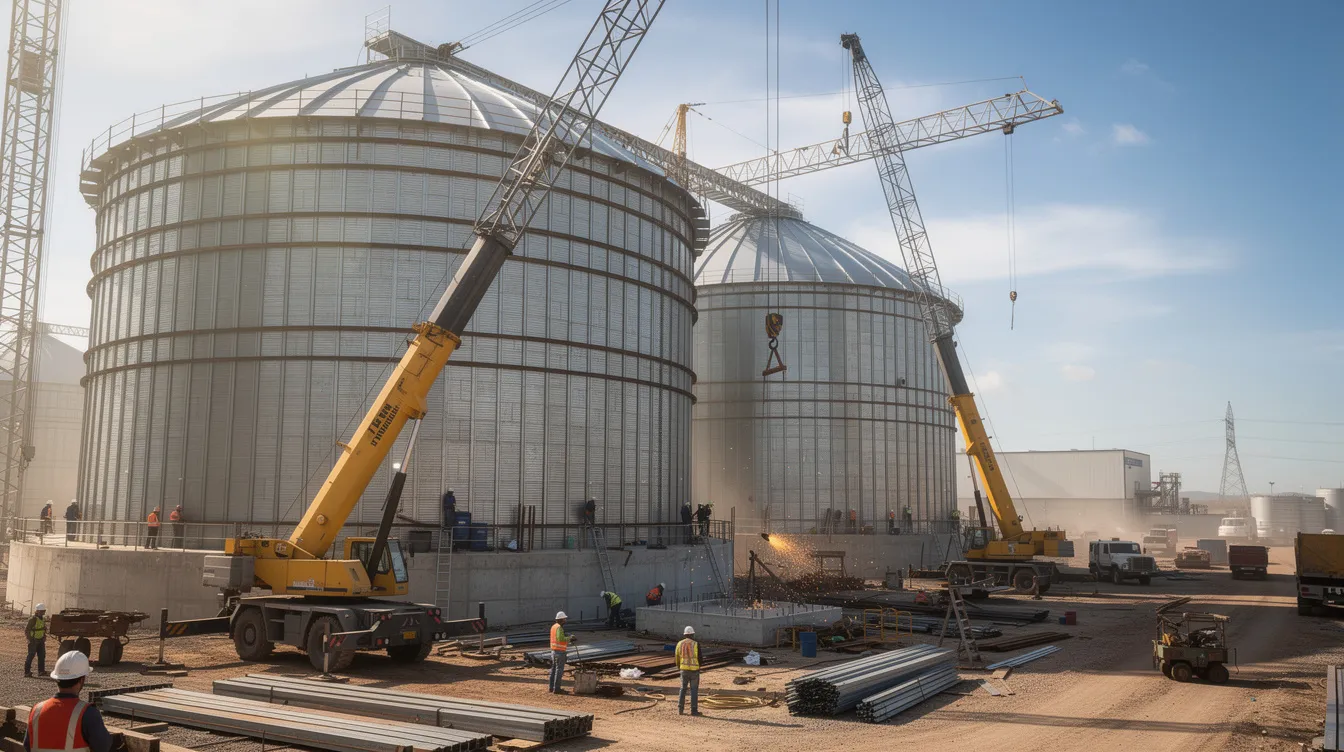
Land planning must separately address grain storage blocks, railway siding alignment and operational circulation. Silo design must accommodate geotechnical conditions and structural requirements to support the load of stored grain, which places specific demands on foundation engineering and site preparation.
A typical rail-linked terminal site includes:
- Silo foundation area with pre-cleaning house and conveyor galleries
- Below-ground intake pits and bucket elevator towers
- Rail wagon loading and unloading platform with approach tracks
- Truck parking, queuing lanes, internal roads and weighbridge complex
- Administration block, quality laboratory, MCC room and transformer yard
- Fire water reservoir, pump house and emergency access roads
A private railway siding for a grain silo terminal typically connects to the nearest Indian Railways mainline station, with reception lines, loading tracks and shunting space. Track geometry, siding length and number of lines depend on rake size, yard constraints and railway division norms.
Many 50,000 MT terminals require several acres more than standalone silos because of railway siding footprints, loading platforms and safety clearances. Final land requirement must be based on detailed engineering in consultation with the relevant railway division.
Illustrative Process-Based Layout Flow:
Truck Entry → Weighbridge → Intake & Pre-cleaning → Silo Block → Rail Loading Spur → Truck Dispatch
Grain Silo Storage Capacity Planning – 25,000 MT, 50,000 MT and 100,000 MT
Static storage capacity refers to the quantity of grain stored at any given time, while annual throughput measures total grain handled through multiple fill-empty cycles. Grain terminals can handle an annual throughput of 0.5 to 5 million tons depending on capacity, turnover cycles and rail evacuation speed. Performance indicators for grain terminals include storage utilization and annual throughput.
Turnover cycles depend on commodity, procurement calendar, contract structure and rail siding capacity. In surplus regions such as Punjab, one can expect 2 to 3 cycles per year; in mixed or deficit regions, perhaps 1 to 1.5 cycles.
| Parameter | 25,000 MT Terminal | 50,000 MT Terminal | 100,000 MT Terminal |
|---|---|---|---|
| Role | Entry-level hub or spoke | Regional hub | Large multi-state dispatch hub |
| Typical silo configuration | 2–4 bins | 4–8 bins (e.g., 12,500 MT each) | 8–16 bins |
| Indicative rakes per month | 1–2 | 2–5 | 5–10+ |
| Staff scale | Smaller team | Moderate | Larger, multi-shift |
| Investment complexity | Lower | Moderate | Higher |
Over-designing capacity without firm cargo commitments can depress utilisation and weaken DSCR. Under-sizing may constrain the business if demand develops. Any Rail Linked Grain Storage Project India DPR should include sensitivity analysis around capacity utilisation and turnover cycles.
Machinery and Equipment Required for a Rail-Linked Grain Silo Terminal
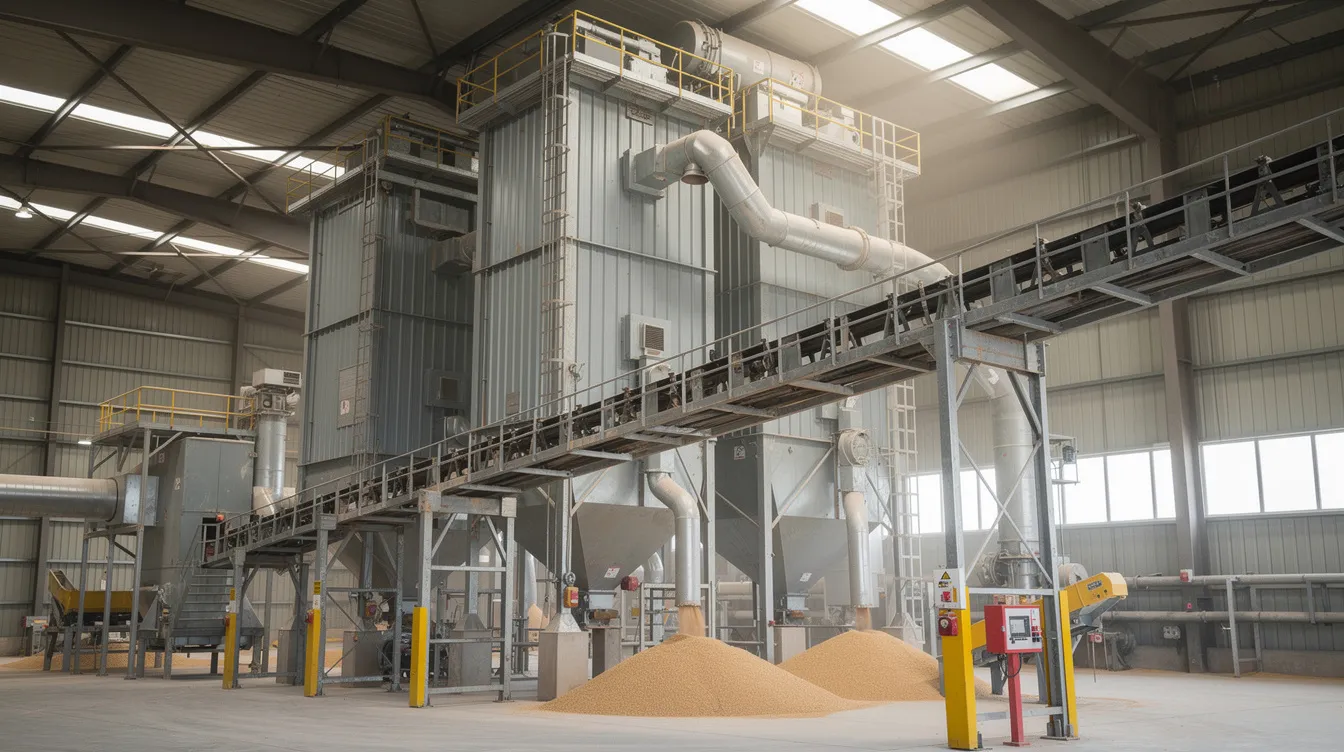
The equipment for a rail-linked terminal builds on the base of a standalone silo facility with additional rail handling systems. Effective grain handling processes reduce storage losses and improve grain quality across the supply chain. Major equipment groups include:
- Steel grain silos – flat-bottom or hopper type, with foundations, stairways, catwalks and corrosion protection
- Receiving systems – truck tipplers or gravity unloading, below-ground intake pits, belt or chain conveyors
- Vertical conveying – bucket elevators with appropriate capacity (tonnes per hour) and overhead distribution conveyors or spouts
- Pre-cleaning and conditioning – pre-cleaners, aspiration systems, dust collectors, aeration fans, roof vents
- Monitoring and protection – temperature and moisture sensors, grain storage technology including ventilation systems, fumigation provisions
- Weighing and sampling – electronic weighbridges, in-line weighing, laboratory instruments for moisture and quality testing
- Railway loading and unloading systems – under-silo discharge, gravity flow to bulk loading spouts, loading platforms with dust control
- Automation – PLC and SCADA systems for monitoring bin levels, flow paths, equipment interlocks and alarms
- Electrical infrastructure – transformers, power distribution, emergency and fire safety systems
Equipment capacity and specification directly influence both capital expenditure and operating efficiency. Grain terminals equipped with modern handling systems improve turnover efficiency and reduce docking time during loading and unloading operations.
Grain Handling and Railway Loading Process
Operational plans for silo terminals include scheduling for grain receipt and dispatch in coordination with rake availability. The process flow typically follows this sequence:
Grain Arrival → Truck Weighment → Sampling & Quality Testing → Truck Unloading at Receiving Pit → Pre-cleaning → Conveying to Silos → Scientific Storage & Monitoring → Retrieval from Silos → Weighment → Rail Wagon Loading → Dispatch
Batch and continuous operations can be planned to synchronise truck arrivals, silo availability and scheduled rake timings. Where the terminal also handles inbound rail receipts, a reverse flow applies: wagon unloading through bottom discharge or tipplers, conveying to silos or truck loading area.
Grain segregation by commodity, quality grade or client requires separate bins or dedicated storage cells. Inventory management systems track lot-wise movement, supporting traceability and accountability.
Coordination with Indian Railways for rake slot booking, full or half-rake planning, and wagon turnaround directly influences the effective utilisation of both the railway siding and silo capacity. The DPR should include expected cycle times for key activities to support realistic manpower and power cost estimates.
Rail-Linked Grain Silo Terminal Project Cost in India
This is one of the most commercially important sections of any Rail Linked Grain Silo Terminal DPR. Capital expenditure (CAPEX) includes costs for civil works, grain-handling equipment, and railway siding, all of which are highly site- and capacity-specific.
| Project Cost Component | Financial Planning Requirement |
|---|---|
| Land acquisition or lease | Location-dependent; based on market rates and zoning |
| Site development | Earthwork, boundary, drainage, internal roads |
| Silo civil foundations | Based on geotechnical survey and structural design |
| Steel silo supply and erection | Vendor quotations; capacity-dependent |
| Grain handling machinery | Conveyors, elevators, intake systems; capacity-rated |
| Railway siding infrastructure | Tracks, points, ballast, civil works; ₹5–10 crore per km indicatively |
| Electrical infrastructure | Transformer, cabling, power distribution |
| Automation and instrumentation | PLC, SCADA, monitoring systems |
| Buildings and utilities | Office, laboratory, gate, stores |
| Environmental and fire-fighting | Dust control, fire water systems |
| Pre-operative expenses | Establishment and commissioning costs |
| Interest during construction | Based on financing and execution schedule |
| Contingencies | Project-specific provision |
| Working capital margin | Based on operating business model |
Railway siding grain silo project cost can form a substantial share of the overall investment. Based on documented project examples, railway siding track costs range from approximately ₹5 crore to ₹10 crore per km for basic ballasted track without major overpasses, with costs increasing for signalling, electrification and multiple lines. FCI’s estimated siding cost at its Sangrur facility was Rs 5.83 crore for the siding component alone.
Cost per MT of storage is not uniform. Smaller terminals face higher per-MT fixed overheads, while larger configurations benefit from economies of scale but require greater absolute capital. The cost must be established through supplier quotations, site engineering and railway feasibility assessment.
Promoters planning a rail-linked grain terminal should engage professional advisory to prepare realistic project cost estimates and a bankable DPR. Project Report Bank provides customised project cost assessment and DPR preparation services for infrastructure and agro-logistics projects.
Means of Finance and Bank Loan Planning
Rail-linked grain terminal projects are capital-intensive and usually financed through a combination of promoter equity and bank term loans, sometimes supplemented by infrastructure-focused investors.
| Source of Finance | Illustrative Range |
|---|---|
| Promoter equity contribution | 25%–35% of project cost |
| Bank term loan | 60%–70% of project cost |
| Working capital finance | Separate cash credit or overdraft facility |
This is illustrative only and not a recommended structure. The appropriate debt-equity ratio depends on project size, cash generation capacity, contract coverage and lender assessment.
Lenders evaluate debt capacity based on projected DSCR, contract coverage such as FCI concession or take-or-pay agreements, project risk allocation and promoter track record. Some projects may be structured under DBFOT or DBFOO concession models, where concession obligations must be factored into free cash flow calculations.
Professional Project Finance Advisory & Loan Structuring Services can help promoters plan the optimal funding structure, repayment profile and financial closing conditions. For bank loan applications, a separate lender-specific DPR along with CMA Data Preparation Services for Bank Loans are generally required.
Revenue Model and Business Opportunities
A rail-linked grain silo terminal earns revenue from services provided, not from trading grain or collecting railway freight. Revenue models vary by project structure:
- Model 1: FCI or government concession – Revenue based on agreed storage charges per MT per month and handling rates per the concession document. FCI tender rates for 0.5 LMT silos in Bihar ranged from approximately ₹1,200 to ₹1,800 per MT per year.
- Model 2: Private commercial terminal – Revenue from contracted or open-market users including traders, flour mills and rice processors.
- Model 3: Integrated logistics terminal – Combines storage, rail loading and unloading, truck handling and value-added services, potentially as part of a Gati Shakti Cargo Terminal.
- Model 4: Captive facility – Benefits measured through avoided logistics costs and faster turnaround rather than third-party revenue.
Revenue categories may include storage fees, handling charges, rake handling charges, contracted terminal service fees and ancillary services. Grain terminals improve turnover efficiency and reduce transport costs when properly utilised, but revenue assumptions in the DPR must be consistent with market rates and realistic utilisation estimates.
Rail-Linked Grain Silo Terminal Financial Projections
Financial projections spanning 5 to 10 years form the backbone of a Rail Linked Grain Silo Terminal DPR. Financial viability models for grain storage terminals typically include analysis of revenue and costs across the projection period.
Key operating assumptions should specify:
- Installed storage capacity and annual throughput based on turnover cycles
- Capacity utilisation ramp-up over years 1 to 3
- Revenue mix between storage and handling services
- Tariff escalation linked to inflation or contract terms
Operational expenditure (OPEX) includes personnel, electricity costs, and equipment maintenance, along with insurance, lease or concession fees, administrative overheads and railway siding O&M costs. The expected throughput capacity of grain terminals influences their financial sustainability directly.
Projections must separate accounting profitability (P&L with depreciation, profit before tax, net profit) from cash-flow analysis (operating cash flows, interest, principal repayment, DSCR). Professional Financial Projections & Financial Modelling Services can help build robust scenario-based models for such projects.
Profitability, ROI, IRR, DSCR and Payback Period
Key financial metrics for investor and lender evaluation include:
- EBITDA margin from storage and handling services
- Project IRR based on pre-financing cash flows
- Equity IRR after debt service
- DSCR – year-wise and average over the loan tenor
- Break-even utilisation in terms of annual throughput or storage occupancy
- Payback period considering ramp-up and debt repayment
High fixed capital cost and operating leverage make throughput and tariff assumptions critical. A small drop in utilisation can materially affect loan repayment capacity. There is no standard ROI for a rail linked grain storage project India; performance depends on contract structure, competition, operating efficiency and capital structure.
Sensitivity analysis should test the effects of ±10–20% changes in throughput, delays in achieving target utilisation, capital cost increases and interest rate changes on IRR and DSCR. A DPR should present conservative, base-case and optimistic scenarios so that promoters and lenders can assess robustness before financial closure.
FCI Hub-and-Spoke Silo Model, PPP and Gati Shakti Cargo Terminals
The FCI hub-and-spoke grain storage model envisions hubs with railway-linked steel silos handling long-distance food grains movement and spokes connected by road for local procurement, implemented under PPP through DBFOT (on FCI land) and DBFOO (on concessionaire or other agency land) structures. First-phase tenders covered 14 locations under DBFOT and 66 locations under DBFOO.
Separately, the Gati Shakti Multi-Modal Cargo Terminal (GCT) policy has enabled 142 commissioned GCTs with estimated handling capacity of 224 MTPA. The policy has mobilised approximately ₹10,000 crore of private investment, and GCTs handled 146 MT of freight in 2025-26. Indian Railways plans to develop 500 GCTs by 2031.
A grain silo terminal can, in some cases, be developed as part of a GCT or co-located with it. However, a GCT approval and an FCI storage concession are separate processes with different eligibility, commercial models and technical permissions. Securing land near a rail line does not automatically translate into FCI contracts or GCT approvals. Each opportunity requires independent evaluation and compliance with current policy.
Promoters interested in PPP models must factor in concession tenure, termination provisions, traffic risk allocation and revenue-sharing obligations when designing their financial model.
Government Approvals and Statutory Requirements
Approval requirements vary by state, project design, concession structure and ownership model. A practical approval framework includes:
- Land-related: Ownership verification, land-use zoning, conversion and development permissions
- Railway-specific: Application for private siding or GCT connectivity, approval of siding alignment and drawings, execution of agreements, payment of charges
- Environmental: Environmental assessments for grain terminals often focus on dust control and noise management, along with consent to establish and operate from the State Pollution Control Board
- Fire and safety: Fire detection and fighting system approvals, fire NOC, hydrant networks
- Food storage: Possible FSSAI registration depending on activity, quality and hygiene standards for stored food grains
- Other: Factory registration where applicable, electrical safety clearances, labour law compliance
A project-specific compliance checklist is essential in every DPR.
Project Implementation Schedule
The construction of a rail-linked grain silo terminal typically spans 18 to 24 months from financial closure, though railway approvals and land acquisition can extend timelines substantially.
Key implementation stages include:
- Concept and preliminary market study
- Site shortlisting and initial railway feasibility
- Topographical and geotechnical investigations
- DPR preparation and financial closure
- Land acquisition or lease finalisation
- Engineering, procurement and construction
- Railway siding works and interface commissioning
- Equipment installation and testing
- Trial and commercial operations
Interest during construction must be computed based on the expected cash flow of expenditure and drawdown of debt across this period. Early ordering of long-lead items such as steel silos, bucket elevators and transformers helps avoid delays.
Risk Assessment and Sensitivity Analysis
Risks affecting grain silo projects include insufficient grain supply and regulatory delays. A comprehensive risk assessment should cover:
- Demand-side risks: Lower-than-expected grain volumes, non-renewal of key contracts, competition from nearby terminals, shifts in procurement policy
- Implementation risks: Land acquisition delays, prolonged railway approvals, cost overruns, supply-chain disruptions for major equipment
- Operational risks: Underutilisation of silos and siding, higher O&M and power costs, grain quality issues, safety incidents
- Financial risks: Higher interest rates, tighter lending conditions, working capital strain from delayed payments
Grain terminals reduce economic losses from grain deterioration when properly operated, but underutilisation or operational failures can quickly erode projected returns.
Rigorous sensitivity analysis on throughput, tariffs, project cost and interest rates helps both promoters and lenders understand the resilience of DSCR and IRR under adverse conditions. A Project Feasibility Study & Project Viability Services engagement can provide independent evaluation before capital is committed.
Importance of a Detailed Project Report for Bank Finance
A detailed project report (DPR) establishes technical feasibility and economic viability of grain silo terminals. For projects involving private railway siding infrastructure, the DPR serves as the primary document for bank term loan appraisal, investor evaluation and internal decision-making.
Key DPR components include:
- Project concept, promoter profile and track record
- Market and demand assessment with grain flow analysis
- Technical configuration: capacity, process, machinery and rail siding layout
- Project cost estimates with engineering-backed assumptions
- Implementation schedule with realistic milestones
- Means of finance and promoter contribution plan
- Detailed financial projections with clearly stated assumptions
- Working capital assessment
- DSCR analysis and loan repayment capacity
- Risk and sensitivity evaluation
Lenders scrutinise assumptions on throughput, tariffs, operating costs, ramp-up, concession terms and contingency provisions before approving finance. A professionally prepared DPR improves the quality and credibility of the project submission but does not substitute for sound business fundamentals.
Bank Finance DPR & Loan Proposal Assistance from Project Report Bank can help promoters prepare structured, bank-compliant documentation for rail-linked grain storage projects.
Frequently Asked Questions
What is a rail-linked grain silo terminal and how is it different from a normal warehouse?
A rail-linked grain silo terminal uses vertical steel grain silos with mechanised intake, conveying and rail wagon loading or unloading via a private siding. A conventional food grain warehouse is typically a godown storing bagged grain, moved by trucks and manual handling.
The terminal is designed for bulk grain storage and high-throughput rail movement, with higher capital cost but significantly better operational efficiency. Grain losses in scientific silos can be reduced to less than 1%, compared with substantially higher losses in conventional bagged storage.
Is a railway siding compulsory for every grain silo project in India?
Many smaller grain silo plants operate with only road connectivity. However, projects specifically conceived as rail-linked terminals, or proposed under FCI hub silo programmes or Gati Shakti Cargo Terminals, normally require a railway siding or equivalent approved rail interface.
The decision depends on cargo volume, distance to markets and Indian Railways’ feasibility assessment. Promoters should evaluate both rail-linked and road-only alternatives during early feasibility.
Can banks in India finance rail-linked grain storage infrastructure?
Indian banks and specialised financial institutions do finance rail-linked grain terminals, subject to detailed appraisal of project viability, promoter strength, contractual arrangements and security structure. Well-prepared DPRs with robust financial projections and CMA data improve the quality of the funding proposal, though they do not guarantee sanction.
What are the major risks in a rail-linked grain terminal investment?
Major risks include insufficient grain volumes, delay in railway siding approvals, cost overruns during construction, underutilisation of installed capacity, and working capital pressure from delayed client payments. Sensitivity analysis on throughput, tariffs and project cost should be a mandatory part of every DPR.
What support can Project Report Bank provide for a rail-linked grain silo terminal project?
Project Report Bank, led by CA Manish Gugliya (FCA, DISA, ICAI), provides customised DPR preparation, project cost assessment, financial projections and modelling, CMA data, project finance advisory and loan structuring tailored to rail-linked grain storage and logistics projects. Serious promoters can visit ProjectReportBank.com to discuss project-specific requirements.
Conclusion – Planning a Bankable Rail-Linked Grain Silo Terminal Project
A successful rail-linked grain silo terminal in India requires alignment of four pillars: strategic location with railway access, reliable grain volumes from credible counterparties, robust silo and handling design, and a financially viable project structure with bankable cash flows.
A Rail Linked Grain Silo Terminal DPR should integrate technical engineering, railway siding design, project cost, means of finance, detailed financial projections, DSCR analysis and risk assessment rather than focusing only on installed storage capacity. The numbers should tell a logical business story, with defensible projections based on reasonable assumptions.
From a Chartered Accountant’s perspective, realistic assumptions, sensitivity testing and clear understanding of contractual obligations are critical for protecting both promoter equity and lender exposure. Investment decisions should be based on integrated technical, commercial and financial feasibility rather than speculative capacity targets.
Entrepreneurs, logistics operators and agribusiness investors planning rail-linked grain storage or hub-and-spoke grain silo projects can connect with Project Report Bank for customised DPR preparation, feasibility studies and project finance advisory. Visit ProjectReportBank.com or reach out via the contact details on the website to discuss your project requirements.
CA Manish Gugliya, FCA, DISA (ICAI) – More than 20 years of professional experience in project reports, financial projections, CMA data, project finance and business advisory.