An integrated grain cleaning, grading, drying and storage plant project report provides a comprehensive blueprint for one of the most capital-intensive segments of agricultural infrastructure in India. This article explains how such a facility works, what a bankable DPR should contain and how promoters can approach capacity planning, machinery selection, financial projections and bank financing for this type of project.
Key Takeaways
An integrated grain cleaning, grading, drying and storage facility is a full agro-infrastructure project – not a simple godown or a standalone grading machine purchase. The DPR for such a project must cover technical design, commercial demand, financial projections, DSCR, ROI, sensitivity analysis and risk assessment together, because banks evaluate the complete investment story, not isolated components.
- These plants typically handle wheat, paddy, rice, maize, pulses and oilseeds. They combine grain cleaning lines, grading machine units, commercial drying systems and scientific storage in warehouses or steel silos, materially reducing post-harvest losses across the food supply chain. Grain cleaning machines reduce post-harvest losses significantly by removing foreign matter before storage.
- The DPR should detail project cost, capacity planning (TPH and MT), machinery specifications, land and building requirements, working capital assessment, profitability analysis, cash flow, DSCR, ROI and risk analysis – all from a banker’s perspective. Financial projections should include capital expenditure, operating costs and profit and loss statements.
- India’s food grain production reached 354 million tonnes in 2024-25, and the Food Corporation of India manages over 917 lakh metric tonnes of storage. India also has 8,815 cold storages with a capacity exceeding 402 lakh metric tonnes. These numbers indicate both the scale of grain handling demand and the infrastructure still required.
- Project Report Bank, led by CA Manish Gugliya, prepares customised DPRs, CMA Data, financial projections and bank loan proposals for integrated grain processing and storage projects across India, including integration with related infrastructure like cold storage facilities where relevant to the business model.
Serious promoters can WhatsApp their proposed capacity, location and approximate budget to Project Report Bank for a customised Grain Cleaning, Grading, Drying & Storage Plant DPR and project finance advisory.
Integrated Grain Cleaning, Grading, Drying & Storage Plant Project Overview
An integrated grain cleaning, grading, drying and storage plant is a single facility where harvested grain is received, cleaned of dust, stones and other impurities, graded by size, weight and quality, dried to safe moisture levels using commercial dryers and then stored scientifically in warehouses or silos until dispatch. The project report should demonstrate technical feasibility, market viability and operational readiness before capital is committed.
This type of facility is distinct from a basic godown. A conventional warehouse stores grain but does not necessarily address moisture risk, quality improvement or grade-wise segregation. An integrated plant adds value at every stage – improving saleable quality, enabling classification by grade, reducing storage and handling losses, and supporting just-in-time supply to millers, processors and institutional buyers. A project report typically includes an executive summary, market analysis and financial projections that together establish whether the investment is justified.
Core functions include:
- Grain cleaning: removal of dust, straw, stones, ferrous particles and other impurities using air suction and vibration-based cleaning machines
- Grain grading: classification of grains by size, weight and colour for uniform quality
- Moisture reduction: commercial grain drying to achieve safe storage moisture levels
- Mechanised handling: bucket elevators, conveyors and distribution systems for efficient internal movement
- Scientific storage: warehouses or silos with aeration, temperature monitoring and quality control systems
- Quality monitoring: moisture testing, sampling, fumigation and pest management
Typical commodities handled include wheat, paddy, rice, maize, soybean, chickpea, tur, urad and other pulses. The DPR must specify which crops and seasonal volumes are targeted, because grain processing projects require an assessment of raw material availability and seasonal trends. Machines can process various grains like wheat and rice, but each commodity has different cleaning, grading and drying requirements.
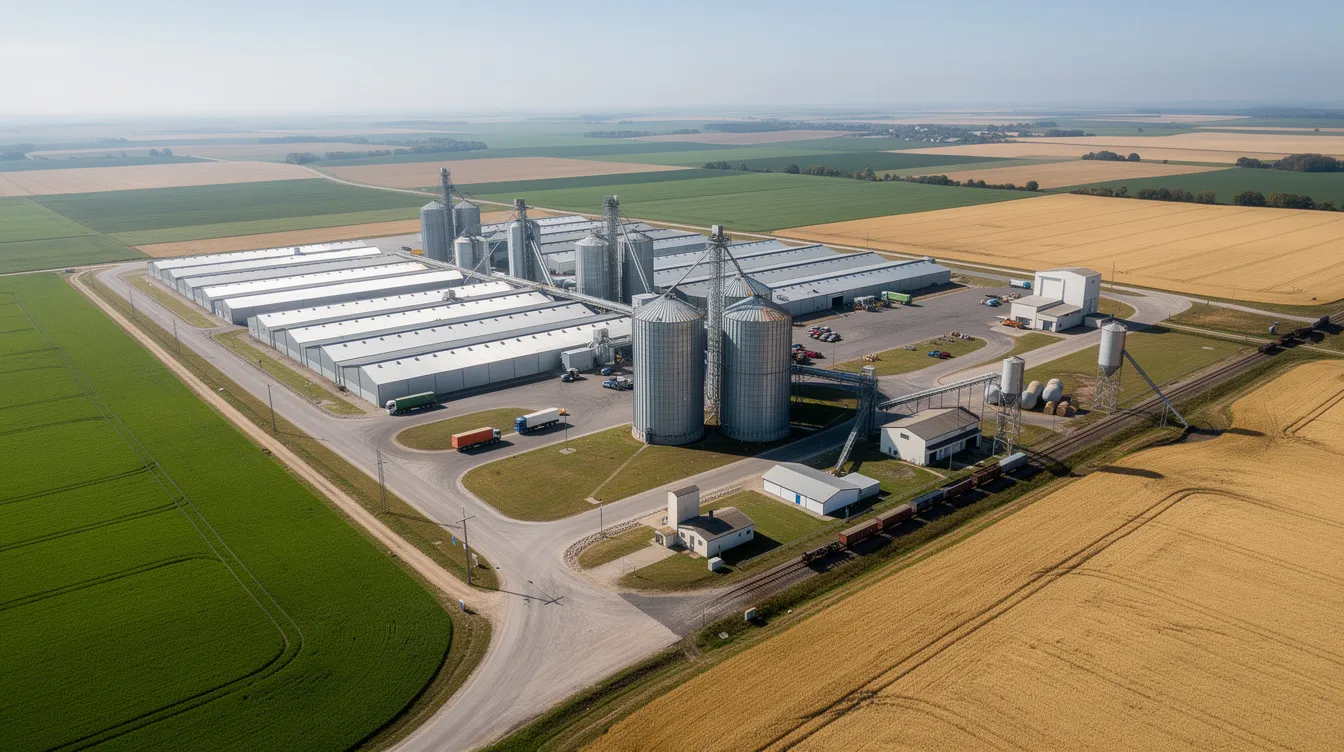
A professionally prepared DPR goes well beyond a vendor’s quotation sheet. It assesses project cost, technical layout, machinery sizing, utilities, manpower, working capital, projected profit and loss, cash flow and DSCR – the complete financial structure that banks and investors need to evaluate.
Readers who already have a location and broad capacity in mind can WhatsApp Project Report Bank with crop mix, desired TPH capacity and MT storage requirement to start their customised Integrated Grain Cleaning, Grading, Drying & Storage Plant DPR.
Market Opportunities and Business Potential in India
India’s record grain output and persistent price volatility have increased demand for integrated grain handling and storage infrastructure. Seasonal arrivals after harvest create a glut at mandis and procurement centres, making timely grain cleaning, grading and drying essential to preserve quality and improve both MSP and open-market realisations. Market analysis involves evaluation of local and regional grain production and potential buyers, which must be project-specific rather than generic.
Key customer segments include:
- Flour mills, rice mills and feed mills requiring cleaned and graded grain
- Grain traders and commission agents needing storage and processing services
- Exporters demanding quality-certified, graded grains with controlled moisture
- Farmer Producer Organisations and primary agricultural credit societies aggregating member produce
- Institutional buyers including government agencies and the public distribution system that supply fair price shops
- Food processing companies, e-commerce grocery platforms and wheat flour mills sourcing specific quality grades
Modern buyers specify maximum moisture, foreign matter limits and grade parameters. Graded grains fetch higher market prices due to uniformity, which means integrated grain cleaning and grading plants near production clusters can charge quality-linked service fees while strengthening the food supply chain.
Regional considerations are critical: plant attractiveness depends on state-level grain surplus, mandi network density, competition from existing silos and warehouses, availability of power, water and approach roads, and proximity to major processing hubs. The DPR should include a brief local market study rather than rely on all-India statistics alone.
Integrated Grain Cleaning, Grading, Drying & Storage Plant Business Models
The same physical plant can support multiple revenue models, and the DPR must clearly identify which model (or combination) the promoter intends to operate. This choice directly affects working capital requirements, inventory risk, banking perception and term-loan structure.
Job-Work and Grain Processing Service Model
In this model, the plant owner does not own grain. Farmers, traders, FPOs and millers bring grain for cleaning, grading and drying on per-MT job-work charges. The model has relatively low inventory and price risk but depends heavily on local throughput volumes and competitive tariff levels. Capacity utilisation analysis becomes the backbone of financial projections, as even modest shortfalls in throughput can affect debt servicing.
Grain Storage and Warehousing Revenue Model
The primary income source is storage rent (₹ per MT per month), loading, unloading, handling and sometimes fumigation services. Clients may be government agencies, large traders, millers, exporters or FPOs who want scientific storage but may or may not use the in-house cleaning line. Promoters comparing a pure storage project with an integrated configuration can study the modern food grain warehouse project report for storage-focused alternatives.
Integrated Grain Procurement and Trading Model
The promoter purchases grain during harvest, processes and stores it, then sells when prices are favourable. This model requires significant working capital for grain inventory and exposes the business to commodity price volatility, carrying costs and quality risk. The DPR must include clear assumptions on purchase prices, expected sale realisations, stock holding period, shrinkage, cleaning losses and interest cost on inventory funding.
Hybrid Processing, Storage and Trading Model
Many practical integrated plants adopt a hybrid model combining assured service income from cleaning, grading and drying with storage rent and selective self-trading. It is advisable for promoters to limit speculative trading in the early years and base trading volumes on realistic working capital limits sanctioned by banks.
| Parameter | Job-Work Service | Storage & Warehousing | Procurement & Trading | Hybrid |
|---|---|---|---|---|
| Primary revenue | Processing fees | Storage rent, handling | Buy-sell margins | Mixed |
| Inventory risk | Low | Low | High | Moderate |
| Working capital intensity | Low-moderate | Low | High | Moderate-high |
| Banking perception | Stable, predictable | Stable | Higher risk | Balanced |
| Suitable for | Small-medium investors | All sizes | Experienced traders | Medium-large investors |
Grain Cleaning, Grading, Drying and Storage Plant Capacity Planning
Capacity planning is central to the integrated grain cleaning grading drying storage plant project report. Three separate capacities must be distinguished:
- Cleaning and grading line throughput in TPH (tonnes per hour) – for screening, sorting and grade-wise separation
- Dryer capacity in TPH at specified inlet and outlet moisture – dependent on crop type and ambient conditions
- Static storage capacity in MT – warehouse or silo space, with turnover cycles per year determining effective annual handling
Illustrative example (indicative only): A notional 200 TPD cleaning and grading plant operating 10 hours per day for 240 days would handle approximately 48,000 MT annually. If paired with 12,000 MT static storage at 60% average occupancy and 2.5 turnover cycles, effective storage movement would be roughly 18,000 MT per year. These figures are hypothetical and must be validated through a site-specific DPR.
Seasonal availability, crop mix and demand determine feasible utilisation levels. Oversizing machinery or storage simply to appear larger on paper can depress DSCR and ROI. The DPR should assume capacity utilisation ramp-up: perhaps 45–50% in year 1, 60–65% in year 2, stabilising at 75–80% by year 3–4. Downtime for maintenance and seasonal gaps must also be factored in.
Modular expansion is advisable – design layouts so that additional grading machines, extra silos or extended godowns can be added later with minimal disruption.
Grain Cleaning, Grading, Drying and Storage Manufacturing Process Flow
The integrated material flow from truck arrival to dispatch generally follows this sequence:
- Grain receipt and sampling – trucks arrive, representative samples are drawn for quality and moisture testing
- Weighment – weighbridge records incoming weight for billing and inventory
- Unloading at intake pit – grain is tipped into receiving hoppers connected to bucket elevators
- Preliminary cleaning – pre-cleaners and aspirators remove dust, straw and light foreign matter; modern machines can clean up to 95% of impurities using multi-deck screens that improve cleaning efficiency and throughput
- Destoning and grading – destoners remove stones; grading machines classify grains by size, weight and colour for uniform lots
- Moisture assessment – portable moisture meters or lab instruments determine whether drying is required
- Grain drying – where moisture exceeds safe storage limits, grain passes through batch or continuous-flow dryers
- Cooling and conditioning – dried grain is cooled before transfer to storage to prevent condensation
- Conveying to storage – bucket elevators, belt conveyors and chain conveyors transport clean grains to designated warehouse bins or silos
- Monitoring – aeration fans, temperature sensors and periodic inspection ensure safe storage conditions
- Dispatch – order-wise loading after final quality inspection, packaging where required and weighment
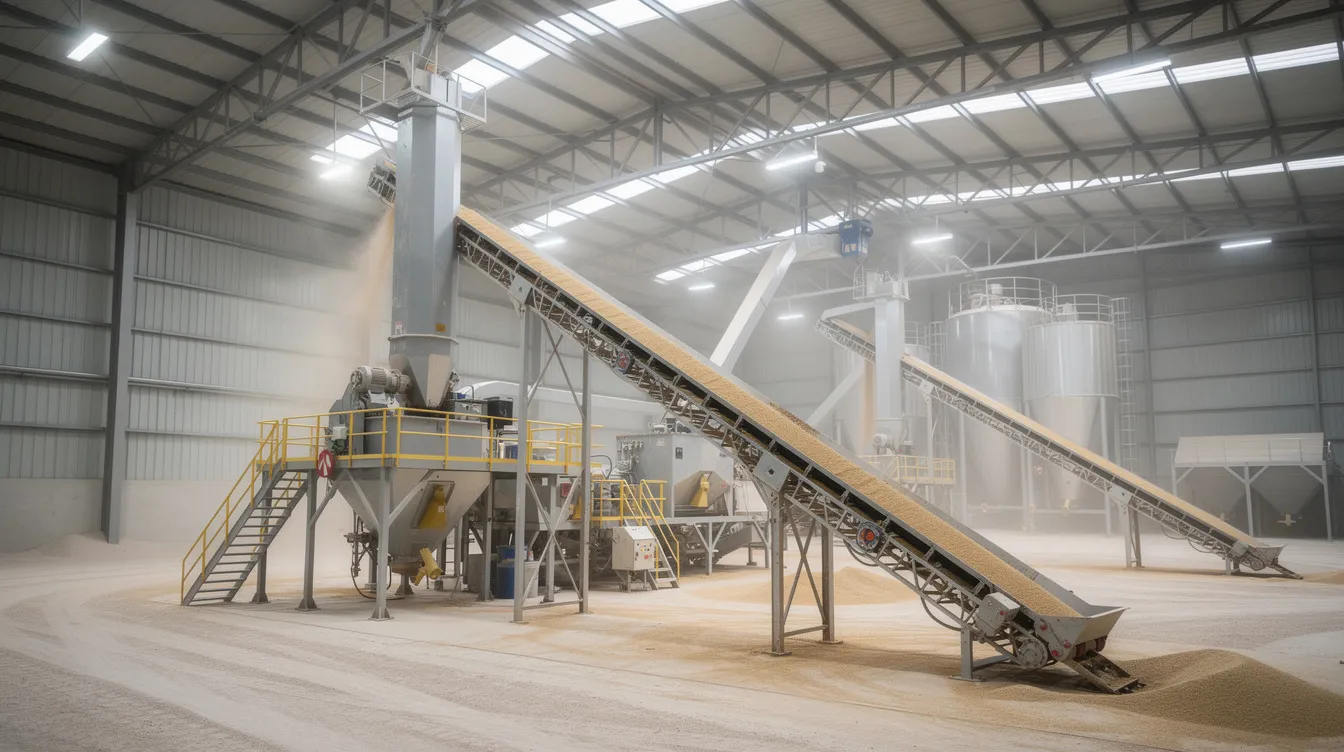
By-products generated during grain cleaning – dust, broken grains, stones, straw – require management strategies. Some by-products (bran, broken grain) have secondary market value as animal feed, while dust and waste require proper disposal. Environmental and safety management measures include dust control systems, waste disposal protocols and fire prevention.
Proper integration of elevators, conveyors and distribution systems reduces manual handling, product damage and spillage, thereby improving commercial recovery. The actual sequence may vary: high-moisture paddy or maize may require drying before grading, while other grains may only need cleaning before dispatch.
Integrated Grain Cleaning Grading Drying Storage Plant Machinery and Equipment
Machinery selection must align with target capacity, commodity mix and business model. Technical specifications in the project report must detail machinery and process flow for grain handling. The DPR should attach a machinery list with specifications, power requirements and supplier quotations.
| Equipment | Principal Function | Key Selection Considerations |
|---|---|---|
| Intake pit and receiving hopper | Grain reception from trucks | Capacity, truck unloading speed, dust containment |
| Vibratory pre-cleaner | Removal of large foreign matter | TPH capacity, screen size adjustability |
| Aspirator and dust separation | Light impurity removal by air suction | Air volume, efficiency, dust collection |
| Destoner | Stone and heavy impurity separation | Grain type compatibility, throughput |
| Grading machine | Size and weight classification | Number of grades, adjustability for multiple grains |
| Gravity separator | Density-based separation | Precision, capacity, maintenance ease |
| Magnetic separator | Ferrous particle removal | Magnetic strength, placement in flow |
| Continuous-flow or batch grain dryer | Moisture reduction | Inlet-outlet moisture range, fuel type, TPH |
| Cooling column | Post-drying grain cooling | Airflow, capacity matching with dryer |
| Bucket elevators | Vertical grain transport | Height, capacity, power, spillage control |
| Belt and chain conveyors | Horizontal grain movement | Length, capacity, grain damage risk |
| Aeration and temperature monitoring | In-storage grain condition management | Sensor accuracy, coverage, computerized monitoring |
| Weighbridge | Incoming and outgoing weight recording | Capacity, digital integration |
| PLC and automation panels | Process control | Level of automation, ease of operation |
| Dust collection and fire safety | Environmental and safety compliance | Cyclone separators, bag filters, fire detection |
Modern steel silos with mechanised bulk handling reduce grain losses significantly compared to traditional godowns. Promoters considering silo-based storage can refer to the steel grain silo plant project report for detailed silo-specific guidance. Automation in grain processing must balance capital expenditure with labour costs – full PLC-based automation increases upfront investment but reduces operating errors and manpower dependency.
Machinery prices must be taken from current supplier quotations. Readers should not rely on generic per-TPH cost assumptions without verification from qualified manufacturers.
Grain Drying Technology, Moisture Control and Quality Preservation
High post-harvest moisture is a primary reason for fungal growth, aflatoxin risk and quantitative losses in stored grains. Storing grains safely involves monitoring moisture levels and maintaining temperature throughout the storage period. Every 1% moisture reduction or approximately 5.5°C drop in grain temperature can roughly double storage life under many Indian conditions.
Safe storage moisture content varies by commodity:
- Wheat, maize, rice: approximately 12–13% for long-term storage
- Soybeans: approximately 9–11%
- Pulses: approximately 13–15% depending on storage duration
Batch dryers suit smaller or seasonal operations, while continuous-flow dryers are more efficient for larger, high-throughput facilities. Common heat sources include rice husk, biomass, coal, diesel and electricity. Fuel choice significantly affects operational costs, regulatory compliance and environmental impact.
Clean grains have a longer storage life and reduced spoilage, but the drying process itself causes weight shrinkage. If grain at 22% moisture is dried to 12%, the weight reduction is approximately 8–9% on a dry-matter basis – this is water removal, not commercial wastage. The DPR should clearly distinguish moisture shrinkage from cleaning losses.
The DPR should show an indicative drying cost per MT based on fuel type and consumption, with all such costing clearly marked as illustrative assumptions requiring validation.
Land, Building and Plant Layout Requirements
Site selection criteria for grain processing facilities include proximity to major grain-producing agricultural belts, mandis, state highways and utilities. Where future expansion may involve larger logistics infrastructure, promoters can evaluate complementary options such as a road-fed grain silo storage facility or a rail-linked grain silo terminal project.
Key layout components include:
- Processing building for cleaning, grading and drying machinery with adequate clear height
- Warehouse or silo block for scientific storage
- Weighbridge with approach road for trucks
- Office, laboratory and staff facilities
- Electrical utility area (transformer, DG set, compressor room)
- Internal roads with separate entry and exit, adequate turning radius and fire tender access
- Future expansion space for additional machinery or storage
Land requirements depend on detailed layout planning rather than a standard fixed ratio. The DPR should include a conceptual material flow description and ensure that land use permissions, zoning compliance and environmental clearances are identified at the planning stage.
Integrated Grain Cleaning, Grading, Drying & Storage Plant Project Cost in India
Project cost estimation is a core section of the DPR and must be itemised based on current quotations and civil estimates. Under recent government norms for PACS-level warehouse construction, cost benchmarks are approximately ₹7,000 per MT in plain areas and ₹8,000 per MT in North-Eastern states – but these cover storage construction only, not the full integrated plant with cleaning, grading and drying machinery.
Typical cost heads include:
- Land purchase or lease premium and site development
- Civil construction (processing shed, warehouse or silos, utility buildings)
- Grain cleaning and grading machinery line
- Grain drying system and fuel infrastructure
- Material handling equipment (elevators, conveyors)
- Electrical installation, automation and PLC systems
- Weighbridge, laboratory and testing equipment
- Fire safety and dust control systems
- Installation, commissioning and trial run expenses
- Preliminary and pre-operative expenses
- Contingency provision (typically 5–10% of fixed assets)
- Margin money for working capital
Storage design (flat warehouse vs RCC vs steel silos), level of automation, grading machine technology and dryer fuel system can significantly change per-tonne project cost. From a banker’s viewpoint, realistic provision for contingencies, interest during construction and initial operating losses is preferable to understated estimates that create funding gaps during implementation.
All cost figures in any sample table are illustrative and subject to detailed, project-specific DPR preparation.
Means of Finance and Bank Loan Structuring
Integrated grain processing and storage facilities are typically financed through promoter equity and bank term loans, along with separate working capital limits. The Agriculture Infrastructure Fund has sanctioned over Rs. 73,000 crores for storage and agricultural infrastructure projects, offering interest subvention of 3% per annum for up to 7 years on eligible loans.
Standard means of finance components:
- Promoter contribution (typically 20–25% or higher)
- Term loan for fixed assets
- Possible support under agriculture infrastructure fund, agricultural marketing infrastructure schemes or NABARD-linked programmes
- Working capital facilities (cash credit, warehouse receipt finance)
Loan structuring should align repayment tenure with asset life, provide an initial moratorium until stabilisation, and plan realistic instalments based on projected DSCR. For project finance advisory and loan structuring, lenders expect integrated financial projections and CMA Data – not only supplier quotations. Promoters seeking structured support can explore bank finance DPR and loan proposal assistance through Project Report Bank.
Promoters can WhatsApp basic details – location, capacity, proposed project cost and bank name – to receive professional support on means of finance planning and bank-ready DPR preparation.
Working Capital Requirements for Grain Processing and Storage Facilities
Even though major investment is in fixed assets, integrated grain plants can require substantial working capital depending on the business model. Under a pure job-work model, the largest components are receivables from customers and operating expenses. In trading models, the dominant item is grain inventory funded by bank cash credit and promoter margin.
Key working capital components include raw grain inventory (for trading), consumables (bags, fumigants), dryer fuel, electricity charges, labour and staff salaries, repairs and maintenance, and administrative expenses. The seasonal nature of grain arrivals means working capital demand can spike significantly during procurement months.
Proper CMA Data preparation is required by banks to assess working capital limits. Professional calculations help avoid under- or over-financing that can create operational stress or unnecessary interest burden.
Revenue Streams and Operating Cost Structure
The DPR should separate revenue streams into service income and trading income for transparent financial modelling:
- Per-MT grain cleaning charges
- Per-MT grading and colour sorting charges
- Per-MT or per-percentage-point moisture removal drying charges
- Storage rental (₹ per MT per month)
- Handling, loading and unloading charges
- Value-added services (lab testing, fumigation, customised packaging)
- Margins on outbound grain trading (where applicable)
Operating costs include power consumption, dryer fuel, labour and supervision, equipment maintenance, spare parts, fumigation, insurance, warehouse upkeep and interest charges. High sales turnover in a trading model alone does not imply high profitability if margins are thin or carrying costs are excessive.
Financial Projections for Integrated Grain Cleaning, Grading, Drying & Storage Plant DPR
From a project finance perspective, banks typically expect 5–7 year projected financial statements for capital-intensive grain infrastructure. Financial feasibility involves break-even analysis, return on investment and cash flow assessments that demonstrate the project can meet its obligations under realistic conditions.
A properly structured projection package should include:
- Capacity utilisation ramp-up assumptions
- Annual grain throughput and processing charge projections
- Average storage occupancy and turnover
- Direct operating expenses and administrative costs
- EBITDA, depreciation, interest and tax calculations
- Cash flow statements showing debt servicing ability
- Projected balance sheets
- Term loan repayment schedule
- DSCR table (bankers typically expect DSCR of at least 1.25–1.5)
- Break-even analysis and scenario testing
Assumptions must be supported by site-specific demand analysis, quotations, pricing research and commercially reasonable projections. For robust spreadsheets that can test different utilisation and pricing scenarios, promoters may consider financial projections and financial modelling services from Project Report Bank.
Grain Cleaning, Grading, Drying & Storage Plant Profitability, ROI, IRR and Payback Period
Profitability and return metrics help promoters and lenders judge whether projected cash flows justify the investment. Key metrics include operating margin, EBITDA margin, net profit margin, Return on Capital Employed, Return on Investment, Internal Rate of Return, payback period and break-even capacity utilisation.
Factors driving profitability include throughput levels, stability of processing tariffs, storage occupancy, control of fuel and power costs, maintenance efficiency, loss control and interest burden. For instance, a 10% reduction in storage occupancy or a 15% increase in dryer fuel cost can materially shift IRR and extend payback period – reinforcing why sensitivity analysis is essential in every DPR.
No article or generic DPR can guarantee specific returns. Actual performance depends on the promoter’s execution capability, market conditions and risk management.
Project Feasibility Study and Sensitivity Analysis
A project feasibility study must assess technical feasibility, commercial viability and financial sustainability before finalising land purchase or committing major capital.
Key feasibility dimensions include adequacy of grain procurement catchment, competition analysis (nearby warehouses, silos, grading plants, cold storage facilities), logistic connectivity, policy environment and availability of skilled manpower.
Variables to stress-test in sensitivity analysis:
- Lower throughput than projected
- Lower service tariffs due to competition
- Higher dryer fuel or electricity costs
- Increase in project cost or delayed commissioning
- Higher interest rates
- Reduced storage occupancy
A robust DPR should show that the project remains viable under reasonable downside scenarios, not only in the base case.
Government Schemes, Agricultural Infrastructure Financing and Regulatory Approvals
Integrated grain processing and storage plants may be eligible for support under several central and state-level schemes, but each project must check the latest guidelines:
- The agriculture infrastructure fund offers interest subvention on eligible loans for warehouses, silos, grading units and related infrastructure. The capital investment subsidy scheme under agricultural marketing infrastructure provides subsidies of approximately 25–33% depending on location, promoter category and project type.
- NABARD-linked refinance and state warehousing incentives may apply in specific locations.
- Regulatory compliance must meet food safety management systems like ISO 22000 or HACCP where applicable to the handling activities.
Promoters operating at the PACS level or through FPOs can explore the PACS and FPO rural grain storage warehouse project for cooperative-focused infrastructure development under the government’s grain storage expansion plan.
Typical regulatory requirements include entity incorporation, land conversion or CLU, building plan and fire NOC, pollution control consent (especially for coal or husk-fired dryers), electrical load sanction, WDRA registration for warehouse components, and relevant food security compliance where grains are handled for human consumption.
Benefits under government schemes are not automatic. Eligibility, conditions and validity must be verified from official sources before inclusion in the DPR.
Documents Required for a Grain Cleaning, Grading, Drying & Storage Plant Bank Loan
Organised documentation improves the quality and speed of bank appraisal. Typical requirements include:
- Promoter documents: KYC, PAN, Aadhaar, experience profile, net worth statement
- Entity documents: partnership deed or incorporation certificate, GST registration, Udyam/MSME registration, board resolutions
- Project documents: detailed DPR, machinery quotations, layout plan, land ownership or lease, project cost and means of finance statement, projected financial statements, DSCR calculation and CMA Data
- Approvals: pollution control NOC, fire NOC, electricity sanction, WDRA registration plan, scheme sanction letters (if applied)
Requirements vary by bank, loan size and borrower type – individual, partnership, company or cooperative.
How CA Manish Gugliya Assists with Integrated Grain Processing and Storage Plant DPR
With over 20 years of experience in project finance, bankable DPR preparation and financial modelling for agro-processing and warehousing projects, I work with promoters to develop investment documentation that banks and investors can evaluate with confidence.
Services offered for integrated grain cleaning, grading, drying and storage projects include:
- Customised Detailed Project Reports with itemised cost estimates
- Project cost estimation and machinery configuration review
- Financial projections, DSCR and repayment analysis
- CMA Data preparation for working capital assessment
- Evaluation of different business models (service vs trading vs hybrid)
- Sensitivity analysis and feasibility assessment
- Guidance on aligning the project with potential government schemes without over-reliance on subsidy
All projections are prepared on reasonable assumptions and are not guarantees of future performance. Actual results depend on execution and market conditions.
Serious promoters, FPOs, PACS, cooperatives and agribusiness investors can WhatsApp brief project details – location, proposed capacity, commodities, approximate budget and bank finance requirement – for a tailored consultation on integrated grain processing and storage DPR preparation.
Frequently Asked Questions
The following FAQs address practical queries that promoters commonly raise when planning an integrated grain cleaning, grading, drying and storage facility.
How long does it typically take to commission an integrated grain cleaning, grading, drying and storage plant?
Timelines vary with project size and statutory approvals. A typical mid-scale facility may take approximately 9–15 months from land finalisation to commercial operations, provided civil works, machinery supply and power connections are efficiently coordinated. Delays in environmental clearances or equipment delivery can extend this timeline.
Can an existing grain godown be upgraded into an integrated grain cleaning and drying facility?
Many promoters convert or augment existing warehouses and godowns by adding a cleaning and grading line, dryer and mechanised handling equipment. However, a detailed layout review, structural assessment and fresh DPR are necessary to confirm feasibility, estimate additional cost and ensure the upgraded plant can operate with the required efficiency.
Should I choose flat warehouse storage or steel silos for my first integrated plant?
Flat warehouses are usually more flexible and simpler for smaller or mixed-commodity projects, while silos suit larger, standardised bulk operations. The choice affects construction cost, handling equipment and operating methodology. Promoters evaluating silo options can refer to the steel grain silo plant project report for detailed guidance.
Is it necessary to combine cold storage facilities with a grain cleaning and storage plant?
Conventional food grains generally do not require cold storage. Perishable items such as fruits, vegetables and meat require temperature-controlled stores, but standard grains need moisture-controlled ambient storage. Integrating cold storage is only relevant if the business also plans to handle perishable commodities or value-added food processing products, in which case separate layout planning and a dedicated DPR are advisable.
Can smaller FPOs and PACS also set up integrated cleaning and grading units?
Smaller FPOs and primary agricultural credit societies can start with modest-capacity cleaning and grading units combined with scientific storage. Several cooperative-focused infrastructure schemes have been launched with reduced margin money requirements and revised subsidy norms to ease development at the PACS level. A right-sized DPR helps align capacity, cost and financing with realistic procurement volumes, ensuring the project is designed for the actual demand rather than aspirational targets.
Conclusion – Planning a Bankable Integrated Grain Processing and Storage Project
A successful integrated grain cleaning, grading, drying and storage project demands careful technical design, realistic capacity planning, appropriate machinery selection, robust financial projections and conservative risk assessment. The facilities play an essential role in ensuring food security by reducing losses, improving grain quality and supporting efficient transportation and distribution through the food supply chain.
The integrated grain cleaning grading drying storage plant project report should clearly define the business model, targeted commodities, throughput, storage strategy, project cost and means of finance so that both promoters and bankers can take informed decisions. From the technical process flow to the financial model, every assumption should be defensible and every projection should tell a logical business story.
Serious entrepreneurs, FPOs, PACS, cooperatives and agribusiness investors are welcome to contact Project Report Bank via WhatsApp or email for customised DPR preparation, financial projections, CMA Data, project feasibility analysis and bank loan proposal assistance.
CA Manish Gugliya FCA, DISA (ICAI) Practising Chartered Accountant | Project Finance & DPR Consultant www.projectreportbank.com