Key Takeaways
Maida and suji are both produced from the same wheat grain through an integrated roller flour mill. The production of maida and suji occurs in a multi-stage milling process that shares early preparation stages but diverges through different grinding, sifting and purification operations.
- The maida and suji manufacturing process begins with common wheat cleaning, conditioning and break roller milling. Product streams separate during plansifting, semolina purification and reduction milling, where maida emerges as fine flour and suji is retained as granular semolina.
- A single flour mill can produce atta, maida, suji and wheat bran together by adjusting roller gaps, sieve sizes and product take-off points within the milling flow-sheet.
- This guide provides separate maida and suji manufacturing process flow charts plus an integrated flow diagram useful for detailed project reports and technical discussions with machinery suppliers.
- The article is written from Project Report Bank’s practical project-advisory perspective by CA Manish Gugliya for entrepreneurs, engineers and project promoters planning wheat milling operations in India.
Introduction to Maida and Suji Manufacturing
Wheat flour production is a complex and evolving industry. When wheat grain enters a properly configured roller flour mill, it can be converted into multiple products – atta maida, suji (semolina or rawa) and wheat bran – through a systematic sequence of grinding, separating, purifying and grading operations. This is an industrial-scale process, distinct from domestic chakki operations, and requires significant machinery configuration and process control.
The maida and suji manufacturing process is largely common up to wheat cleaning, conditioning and initial break milling. The divergence occurs afterward: maida requires extensive reduction milling on smooth rolls to achieve a fine, uniform, low-ash flour, while suji production focuses on retaining purified granular endosperm particles at specific size ranges. Maida and suji are produced from processed wheat, but both products differ significantly in texture and culinary applications.
Maida is commonly used for baking and soft dough products such as naan and pastries, and serves over 55,000 bakery units across India. Over 55,000 units use maida for bakery products, making it a commercially significant output. Suji is primarily used in coarse textured dishes like upma and halwa, and also finds application in vermicelli, breakfast items and certain confectionery preparations.
The wheat grain structure – where the average wheat grain composition is 83% endosperm, with the remainder comprising bran layers (including the seed coat and aleurone layer) and the germ or embryo – determines how commercial roller flour mills separate these product streams. Wheat milling separates bran, germ and endosperm through progressively refined operations. The milling process involves breaking, sifting, purifying and reduction stages that recover each fraction at appropriate quality levels.
This article focuses specifically on the technical manufacturing process, production flow charts and the roller flour mill production process for maida and suji. For project cost, financial feasibility and DPR-related discussions, readers can refer to the dedicated articles on Project Report Bank covering maida manufacturing plant project reports and suji manufacturing plant project reports.
Are Maida and Suji Manufactured Through the Same Process?
The short answer is that they share the same raw material – wheat – and the same early-stage operations, but different treatment of endosperm fractions produces maida (fine flour) and suji (granular semolina). They are not manufactured through two completely isolated lines. Instead, both products emerge from an interconnected wheat milling flow-sheet with repeated grinding and sifting loops.
Break rollers open the wheat grain, creating a mix of coarse grits, middlings and fine flour. These fractions are then classified in plansifters. Coarser, cleaner endosperm granules are sent to semolina purifiers for suji recovery, while finer middlings and purified streams proceed to smooth reduction rolls for maida production. Flour and semolina can be recovered at multiple passages inside the roller flour mill circuit.
A single well-designed flour mill can flexibly change its maida–suji product mix by altering roller settings, sieve selections and product take-off points, which is an important consideration for project design and detailed project report preparation.
| Parameter | Maida | Suji |
|---|---|---|
| Raw material | Wheat grain (common/soft wheat preferred) | Wheat grain (harder varieties or durum preferred) |
| Shared preparation | Cleaning, destoning, conditioning, break milling | Cleaning, destoning, conditioning, break milling |
| Milling approach | Extensive reduction milling on smooth rolls | Minimal reduction; granules retained after purification |
| Purification intensity | Moderate (pre-reduction cleaning) | High (multiple purifier passes for purity) |
| Particle size | Very fine (≥80% through 315 micron sieve) | Granular, coarser (defined size bands) |
| Finished texture | Smooth, powdery white flour | Gritty, sand-like granules |
| Typical ash content | ≤0.70% (dry basis, IS 1009:2023) | ≤1.0% (dry basis, IS 1010) |
| Main applications | Bakery, biscuits, noodles, naan, pastries | Upma, halwa, vermicelli, pasta, breakfast dishes |
Raw Wheat Selection and Preparation for Maida and Suji Production
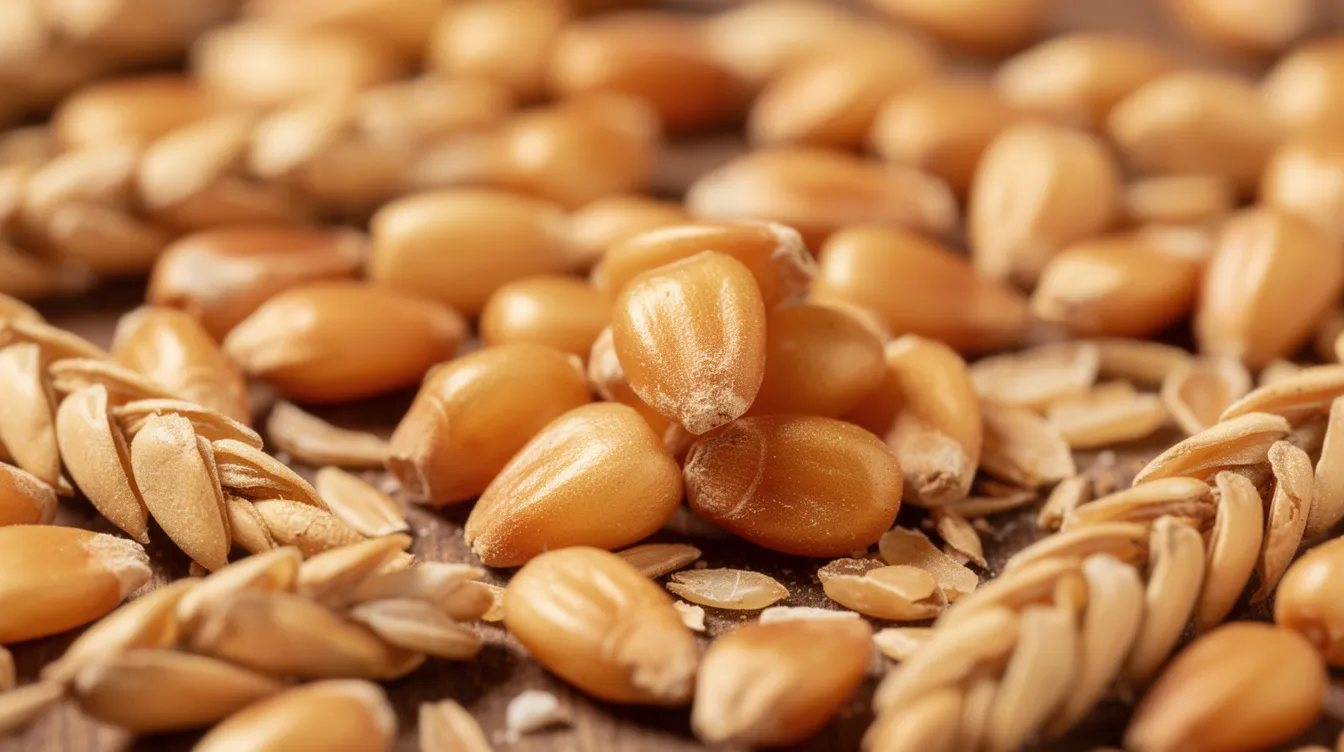
Wheat variety selection is one of the most consequential decisions in both the industrial maida manufacturing process and the suji manufacturing process. Maida is produced from soft or common wheat types (Triticum vulgane or Triticum compactum), giving it distinct properties suited to bakery applications. Suji is typically milled from harder wheat varieties, like durum wheat (Triticum drum), though many Indian flour mills run on blended bread wheat rather than exclusively durum.
Key wheat grain characteristics influencing milling performance include hardness, protein and gluten quality, grain size uniformity, test weight and moisture on arrival (typically 10–13%). Hard wheat tends to produce more granular semolina fractions suitable for suji, while softer wheat yields finer flour more easily. The wheat plant varieties grown across India under widely differing climatic conditions and very different conditions of soil produce grains with varying analytical data in terms of relative proportions of endosperm, bran and germ, and these parts vary by variety.
Wheat consists of many varieties cultivated across regions, and the wheat that commerce bears into the flour mill may belong to different botanical groups – botanical groups Triticum vulgane, Triticum drum and Triticum compactum being the principle wheat types relevant to flour and semolina production. The average composition of these grains, including the pericarp, hyaline layer, aleurone layer representing the outer enveloping skins, endosperm and embryo, determines the yield potential. The pericarp consists of multiple layers that collectively form the wheat bran fraction.
Quality checks at wheat reception include testing for foreign matter, shrivelled or damaged kernels, insect infestation, odour, colour and admixture of other cereals. These factors directly affect maida colour and suji purity in the finished products.
For project planning purposes, expected flour and suji extraction from 100 kg of wheat, along with bran generation estimates, forms a critical assumption in any project report or feasibility analysis. These extraction figures should be developed in consultation with machinery suppliers and experienced millers rather than assumed from generic benchmarks.
Common Manufacturing Process for Maida and Suji
From wheat reception up to purified endosperm fractions, the roller flour mill production process is common for atta, maida and suji production lines. Commercial roller flour mills are employed for efficient production of these products. The following sub-steps describe this shared manufacturing sequence.
Step 1 – Wheat Reception, Inspection and Storage
Raw wheat arrives at the facility by truck or tractor and is weighed on a weighbridge. Samples are drawn from each lot for inspection. Initial tests include moisture content, foreign matter percentage, test weight (hectolitre weight), insect activity and basic visual/smell checks. These results are recorded against batch IDs for traceability in FSSAI-compliant operations.
Accepted wheat is stored in silos or godowns with proper aeration and fumigation schedules. Stack cards and FIFO (first-in-first-out) discipline prevent quality deterioration. The civil supplies department and related procurement channels may supply grain wheat in certain states, but most commercial mills procure directly from mandis and traders based on quality requirements. Storage conditions must prevent moisture gain, insect infestation and mould growth before processing wheat begins.
Step 2 – Wheat Cleaning and Impurity Removal
The cleaning line typically includes a pre-cleaner or vibratory separator (removes oversized and undersized foreign matter), an aspirator or air channel (removes dust and lighter impurities), a destoner (separates stones and heavy particles), magnetic separators (remove metal contaminants) and possibly a scourer for surface cleaning. Aspirators are used to remove impurities from wheat at multiple points. Water washers clean wheat before milling in some configurations, particularly where surface contamination is a concern.
Efficient cleaning is vital for maida and suji quality. Residual stones or dirt increase ash content, reduce product colour and can damage break and reduction rollers. Cleaned wheat grain is often held in clean wheat bins before conditioning, allowing separate handling of different wheat varieties if the mill runs blended grists. Modern automatic maida suji production process lines use aspiration channels and dust collection systems throughout for hygiene and labour safety.
Step 3 – Wheat Conditioning and Tempering
Water is added in a controlled manner using flow meters or dampeners to raise wheat moisture to the level required by the specific milling setup. The target moisture is typically in the low-to-mid teens (percentage), varying by wheat hardness and season. Conditioning toughens the outer bran layer of wheat for easier milling, while softening the endosperm to improve separation during subsequent break and reduction milling.
Tempering time allows moisture to migrate through the grain. Rotating conditioning bins or static tempering bins hold the wheat for several hours, equalising moisture across the wheat grain mass. Different wheat varieties, seasons and target products (higher suji versus higher flour extraction) may call for different moisture targets and tempering durations. Over-conditioning or under-conditioning creates downstream problems including excess fine bran contamination, increased power consumption and reduced extraction efficiency.
Step 4 – Break Roller Milling
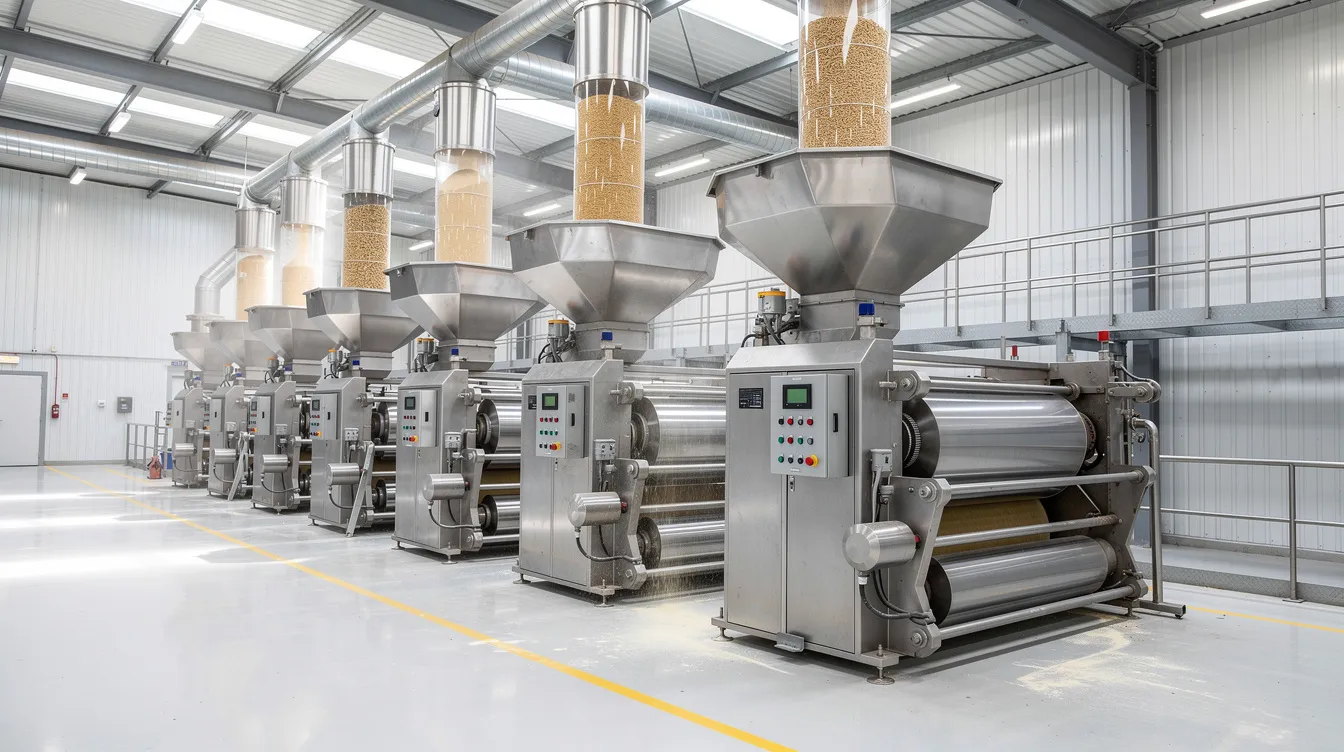
Roller mills are used for breaking and grinding wheat in the milling process. The break system uses corrugated rolls that gradually open the conditioned wheat kernel, separating bran from endosperm without crushing everything into very fine particles at once. The first break passage (B1) produces a mix of relatively large semolina-like grits, middlings, some flour and bran flakes.
Mills typically have multiple break stages (B1, B2, B3, etc.), each with slightly different roll gaps and corrugation patterns. Break rolls are corrugated and purpose-designed for opening kernels and scraping endosperm from bran, as distinct from smooth reduction rolls used later to grind clean endosperm particles into fine flour. Suji fractions can be recovered from several of these break passages, depending on the plant flow-sheet.
Step 5 – Plansifting and Intermediate Product Classification
The plansifter is a large multi-deck screening machine that uses sieves to separate ground stock into fractions based on particle size: fine flour, intermediate middlings, coarse semolina-like particles and oversize material that returns to the next grinding stage. Sieve cloth selection and mesh sizes determine which fractions are sent towards maida reduction passages and which are directed towards suji purification or further break milling.
Modern plansifters operate in closed, hygienic conditions. Correct plansifter adjustment is essential for both maida and suji product separation and ultimately influences extraction efficiency and profitability.
Step 6 – Semolina Purification and Endosperm Separation
Purifiers are used to separate lightweight bran from heavier endosperm particles. Semolina purifiers use vibrating sieves with controlled upward airflow to sort heavier, clean endosperm granules from lighter bran particles and dust.
Purified coarse and medium granules may either be routed as suji (if they meet particle-size and purity criteria) or sent to smooth reduction rolls for further grinding into maida, depending on plant design and desired product mix. Multiple purification stages can be used where high-purity suji or specialised semolina grades are required. Suji is not a by-product or waste of maida manufacturing – it is a deliberately controlled granular product stream with its own commercial value and demand.
Complete Maida Manufacturing Process – Step by Step
The industrial maida manufacturing process takes purified endosperm fractions through multiple smooth reduction roll passages and plansifting until a fine, uniform, low-ash flour is achieved. The feed stock for maida consists of fine middlings and purified semolina fractions from purifiers, free from visible bran, that are directed to reduction rollers.
Reduction milling uses smooth rollers with decreasing gaps across multiple passages (R1, R2, R3, etc.) to progressively reduce particle size and release fine flour. Differential speeds on the two roll surfaces create a shearing action that grinds particles without excessive heat generation. After each reduction passage, material passes through plansifters that remove maida flour fractions, while coarser particles return to later reduction stages. Flour mills use blenders, sieves and reduction rolls to achieve the target fineness.
Flour from different passages is blended in specific ratios to meet target ash content, colour and functional performance. Blending bins and automatic weighing or dosing systems help achieve consistency. Maida undergoes bleaching to achieve a bright white colour in some production methods, though this must comply with FSSAI regulations.
Final sieving ensures the required particle size and removes foreign materials. The finished maida passes through safety sieves, magnets and sometimes colour sorters before quality checks on moisture, ash, fineness and gluten properties. It is then stored in flour silos or packed for sale. The desired maida grade (refined maida for bakery versus general-purpose flour) affects milling flow-sheet complexity and extraction assumptions in a project report.
Maida Manufacturing Process Flow Chart
The following text-based flow chart illustrates the maida production stream within a roller flour mill. Project promoters preparing a detailed project report can adapt this sequence to their specific plant configuration.
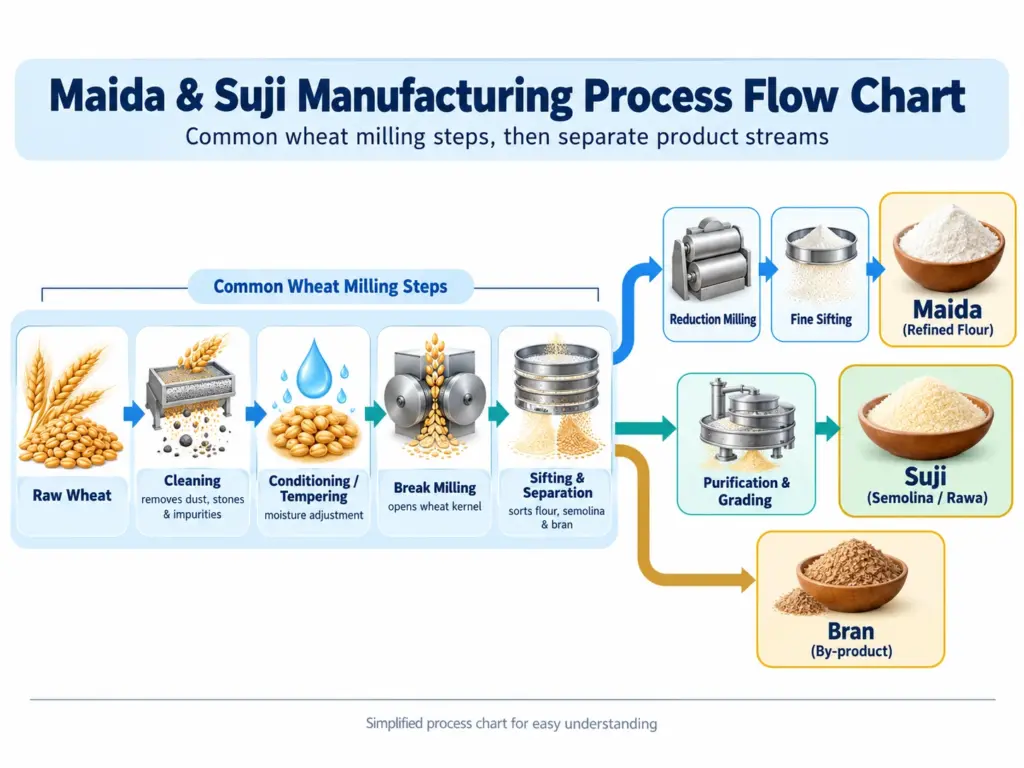
Wheat Reception → Cleaning & Destoning → Conditioning & Tempering → Break Roller Milling (B1–B4) → Plansifter Classification → Semolina / Middlings Purification → Reduction Roller Milling (R1–R6) → Intermediate Sifting (coarse overs return to next reduction stage; bran-rich fractions diverted to bran bins) → Flour Blending → Final Sifting & Metal Detection → Maida Storage Bins → Packing
The preparation stages (reception through conditioning) ensure clean, properly moisture-adjusted wheat enters the milling circuit. The extraction stages (break milling through purification) separate endosperm from bran. The reduction stages progressively grind purified endosperm into fine flour. The finishing stages (blending, final sifting, packing) ensure the product meets commercial specifications. Exact flow-sheets and the number of passages vary by plant capacity, machinery supplier and required product specifications.
Complete Suji (Semolina) Manufacturing Process – Step by Step
Suji or semolina is produced by selectively retaining specific granular endosperm fractions at defined particle-size ranges, rather than grinding all endosperm down to fine flour. Suji is a coarse granular product from intermediate endosperm particles, and suji retains a gritty, sand-like texture and undergoes minimal processing compared to maida.
Granules coming from break passages and purified on semolina purifiers are collected when they fall within the required suji size band. Undersized particles join the maida stream, while oversized particles may be reground in appropriate milling passages. Purified suji is passed over grading sieves to classify into different commercial grades – coarse rawa, medium suji for upma, and fine suji for sweets – with each grade stored in separate bins.
Quality targets for suji include low visible bran specks, bright creamy colour, controlled moisture and uniform granule size. Off-specification fractions (too fine, too coarse or with visible bran) are routed back into appropriate milling passages to improve overall extraction efficiency.
Suji Manufacturing Process Flow Chart
This flow chart shows the dedicated suji path within the overall maida and suji production process.
Wheat Reception & Cleaning → Conditioning → Break Roller Milling (B1–B3) → Plansifting (coarse/medium fractions selected) → Semolina Purification (finer-than-target fraction directed to flour/maida stream; bran-containing rejects to bran bins) → Suji Grading (coarse/medium/fine) → Quality Inspection → Suji Storage Bins → Packaging
The suji stream differs fundamentally from maida in its objective: it preserves granule integrity rather than reducing everything to fine powder. There is slower or limited reduction milling, and stricter control on visible bran specks. Project promoters preparing a suji manufacturing plant DPR can adapt this flow to different capacities with guidance issued by a milling technologist and machinery supplier.
Integrated Maida and Suji Manufacturing Process Flow Chart
Modern roller flour mills are integrated plants where atta, maida, suji and wheat bran are produced together through a single but complex flow-sheet rather than isolated lines. The following integrated flow chart shows common sections and separate product streams.
Wheat Reception → Cleaning & Destoning → Conditioning & Tempering → Break Roller Milling → Main Plansifter → (streams diverge here):
- (A) Coarse purified semolina → Semolina Purifiers → Suji Grading → Suji Bins → Packing
- (B) Fine middlings & purified fractions → Reduction Rolls (R1–R6) → Intermediate Sifting → Flour Blending → Maida Bins → Packing
- (C) Bran-rich fractions from all stages → Bran Silo → Bran Packing or value addition
- (D) Select streams → Atta Blending (if wholemeal flour is part of the product-mix)
A plant can adjust its maida–suji ratio by changing roll gaps, purifier cut-points, sieve cloths and product take-off points, subject to wheat quality and market demand. This integrated flow chart is simplified – actual flour mills have multiple break and reduction passages interconnected through pneumatic conveying and may incorporate online automation.
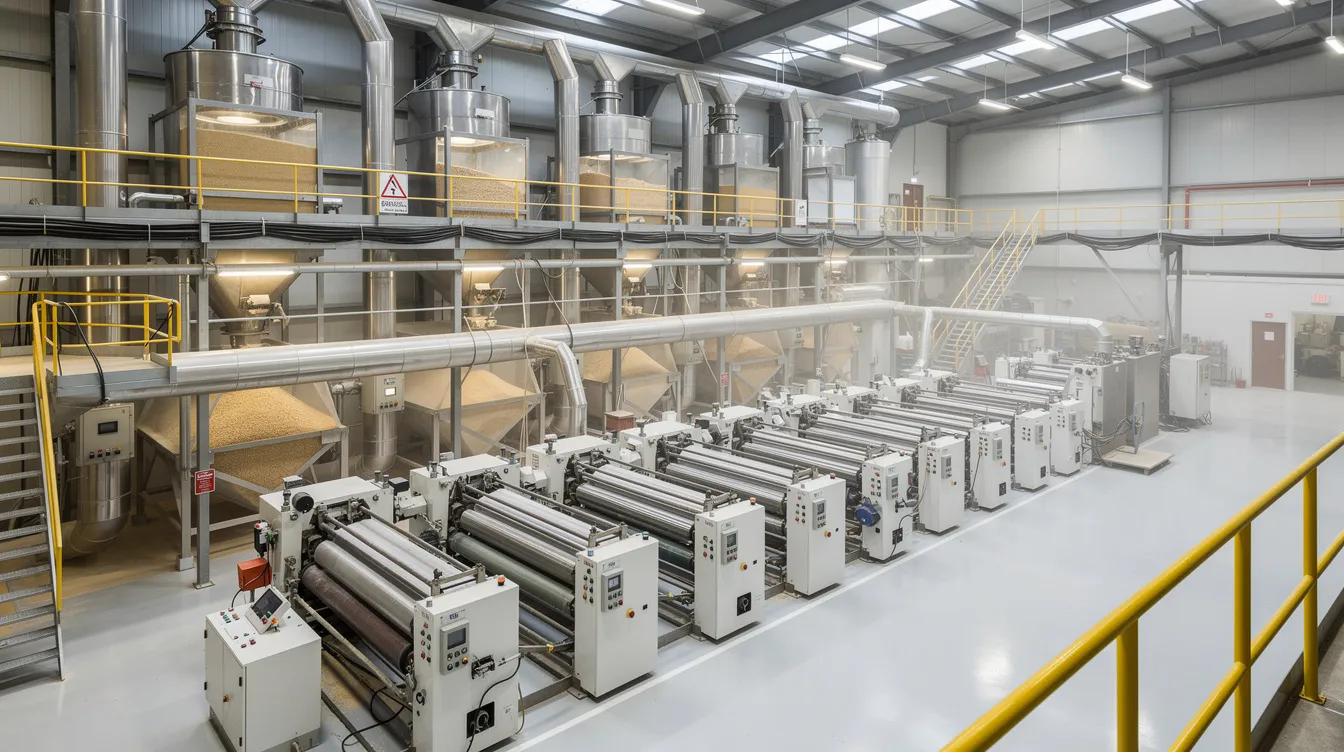
Key Machinery Used in Maida and Suji Manufacturing
This section provides a technical equipment overview. Capital cost details are covered in the maida and suji plant machinery and equipment cost article on Project Report Bank.
| Machinery / Equipment | Stage | Primary Technical Function | Application |
|---|---|---|---|
| Vibratory separator | Cleaning | Removes oversized/undersized impurities | Common |
| Aspirator / Air channel | Cleaning | Removes dust, chaff, light particles | Common |
| Destoner | Cleaning | Separates stones, heavy particles | Common |
| Magnetic separator | Cleaning | Removes metal contaminants | Common |
| Scourer | Cleaning | Surface cleaning of grain | Common |
| Dampener | Conditioning | Controlled water addition | Common |
| Tempering bins | Conditioning | Moisture equalisation and holding | Common |
| Corrugated break rollers | Break milling | Open kernels, separate bran from endosperm | Common |
| Smooth reduction rollers | Reduction milling | Grind purified endosperm into fine flour | Primarily maida |
| Plansifters | Sifting | Size classification of ground stock | Common |
| Semolina purifiers | Purification | Separate bran specks from endosperm granules | Primarily suji |
| Pneumatic conveyors | Material handling | Transport wheat, flour, semolina between stages | Common |
| Cyclones / Bag filters | Dust collection | Capture airborne dust for hygiene and safety | Common |
| Blending bins | Finishing | Combine flour from different passages | Primarily maida |
| Packing machines | Packaging | Automated filling and sealing | Common |
Conveyors transport wheat and flour within the mill at every stage. Corrugated rolls are designed for opening kernels in break passages, while smooth rolls at one end of the reduction system progressively grind clean endosperm into fine maida. Key machinery includes blenders, sieves and reduction rolls that work together to achieve desired product specifications. The shape, corrugation profile and gap settings of rolls directly influence whether the output is granular suji or fine maida.
Maida and Suji Extraction, Yield and Product Mix
Extraction rate in roller flour mills refers to what percentage of clean wheat grain weight is converted into saleable products under given milling conditions. To illustrate with a hypothetical 100-unit wheat input (these numbers are illustrative and vary with wheat quality and flow-sheet configuration):
| Product | Illustrative Recovery (units) |
|---|---|
| Maida (refined flour) | 45–52 |
| Suji (semolina/rawa) | 10–12 |
| Atta (if produced) | 8–10 |
| Wheat bran (including germ) | 20–25 |
| Moisture/process losses | 3–5 |
Factors influencing extraction include wheat variety and hardness, conditioning effectiveness, number of break and reduction passages, purifier efficiency, sieve selection, and how aggressively the miller pursues maximum flour recovery versus maintaining suji quality. Increasing suji production (retaining more coarse granules) may slightly reduce maida extraction and vice versa.
Project feasibility studies assess financial viability before investment, and realistic extraction assumptions are critical inputs into a detailed project report and financial model. These assumptions are usually finalised in consultation with machinery suppliers and experienced millers. The maida and suji manufacturing plant setup cost depends significantly on the target product mix and extraction configuration.
Quality Control in Maida and Suji Manufacturing
Quality control starts from wheat purchase and continues through every processing stage up to finished product packing. Raw wheat tests include moisture, foreign matter, damaged kernels, insect infestation, test weight and occasionally protein or gluten index. In-process checks cover conditioning moisture verification, regular sampling from break and reduction passages, sieve tailings inspection and visual monitoring of semolina purity on purifiers.
Finished maida parameters typically monitored include moisture (max 14.0%), ash content (max 0.70% dry basis), particle size distribution, protein or gluten index (min 9.5% dry basis), colour, specks and microbiological hygiene as specified under IS 1009:2023 and related FSSAI regulations. For suji, key parameters include particle size gradation, absence of visible bran specks, moisture (max 14.5%), ash (max 1.0% dry basis) and gluten content (min 6.0%) under IS 1010.
These limits for sold products must be checked from the latest official FSSAI notifications and BIS standards, as they have been revised in September 2023 with updated contaminant limits including lead, cadmium and aflatoxins. Do not rely on outdated specifications.
Common Technical Problems in Maida and Suji Production
| Problem / Symptom | Likely Technical Causes | Indicative Corrective Actions |
|---|---|---|
| Excessive bran in maida or suji | Poor cleaning, insufficient purifier efficiency, aggressive extraction | Adjust purifier airflow, check sieve meshes, review roll settings |
| Poor semolina purification | Imbalanced air flows, clogged sieve cloths, uneven feed rate | Clean purifier screens, calibrate airflow, stabilise feed |
| Inconsistent flour fineness | Worn smooth rolls, incorrect roll gap, uneven feed | Inspect rolls, adjust gaps, check feed distribution |
| Low extraction yield | Poor wheat quality, improper conditioning, worn rolls | Review wheat procurement, adjust conditioning, re-dress rolls |
| Excess fines in suji | Over-reduction, poor size classification control | Redirect fines to maida stream, adjust plansifter meshes |
| Frequent sieve blockage | Damp feed, excess stock loading, worn sieve cloth | Check conditioning moisture, reduce feed rate, replace cloths |
Scheduled preventive maintenance – including roll re-fluting, sieve cleaning, air-flow balancing – minimises these problems and stabilises product quality. Unresolved chronic issues should be jointly reviewed by plant engineers, the machinery supplier and an experienced milling technologist.
Automation and Process Efficiency in Modern Roller Flour Mills
Automation helps maintain consistent wheat to maida manufacturing process and wheat to suji manufacturing process flows, improving yield, quality and labour safety. Basic automation elements include centralised PLC or microprocessor-based control panels for roller gap settings, feed rates, motor load monitoring and alarm systems.
Automated cleaning and conditioning lines use electronic flow meters, automatic dampeners, moisture sensors and level indicators in bins and silos. Automated data logging for production, energy consumption and extraction ratios can feed into financial modelling and performance tracking for DPRs. Auxiliary systems – pneumatic conveying, dust collection, aspiration and hygiene monitoring – reduce losses and maintain safe working conditions. However, not all automation features are standard in every plant; the level of automation depends on capacity, budget and the methods chosen during project design.
Important Technical Considerations While Designing an Integrated Maida and Suji Plant
Entrepreneurs and investors should address several technical parameters before freezing the roller flour mill flow-sheet with equipment suppliers. Flour mills require significant investment in machinery and infrastructure, and getting the design right at the outset saves unexpected costs and operational difficulties later.
Decisions on target product mix – percentage of maida, suji, atta and wheat bran from the wheat grain input – determine the number and type of break and reduction passages and purifier capacity. Key design parameters include daily grinding capacity (30 TPD, 60 TPD, 120 TPD and above), flexibility for running different wheat varieties grown in various regions, space for future expansion, and layout for hygienic product flows.
Technical provisions for wheat bran handling and value addition should not be overlooked. Final plant and machinery selection, flow diagrams and the detailed project report should be developed jointly by the promoter, a qualified flour milling technologist, a reputable machinery manufacturer and an experienced DPR consultant. The atta manufacturing process and flour mill flow chart article covers the broader atta-focused milling process for readers interested in that product stream.
Frequently Asked Questions
The following questions address practical concerns not fully covered in the main sections above.
Can an existing atta-focused flour mill be modified to produce maida and suji?
Many small chakki or basic atta mills lack the multi-pass roller system, plansifters and purifiers needed for controlled maida and suji production. Upgrades are sometimes possible if space, power and layout permit installing roller mills, sifting and purification equipment. A technical audit of existing machinery, building and utilities is normally required to decide whether conversion is economical or whether a new roller flour mill line is preferable.
How much space is typically needed for an integrated maida–suji plant?
Land and building requirements depend heavily on plant capacity and layout. A compact 30–40 TPD unit needs considerably less space than a 150+ TPD mill. Requirements include adequate height for plansifters and purifiers (often multi-floor layouts), separate hygienic product areas, wheat and bran storage, vehicle movement areas and space for future expansion. A rough range can be assessed during DPR preparation based on the specific machinery configuration.
Is suji the same as dalia in industrial wheat processing?
Suji (semolina or rawa) is a relatively narrow particle-size fraction of purified endosperm, while dalia (cracked wheat) is coarser and usually includes more of the whole kernel, sometimes closer to broken atta in composition. Dalia may be produced on a separate cracking or flaking line and carries different nutritional and functional characteristics. They serve different markets and require different purpose-built production equipment.
How often do roller mills need re-fluting or replacement?
The frequency of corrugated roll re-fluting and smooth roll replacement depends on hours of operation, wheat hardness, maintenance practices and alignment. Mills typically work with machinery suppliers to define inspection intervals rather than using fixed calendar schedules. Worn rolls reduce extraction efficiency, increase bran contamination and may destabilise maida and suji quality. Planned maintenance is part of sound technical and financial project planning.
Do different wheat origins need different conditioning settings?
Wheat from different regions – for instance Madhya Pradesh Sharbati, Rajasthan varieties or imported wheat – can have varied hardness, moisture and vitreousness. These differences affect optimum conditioning moisture and tempering time. Mills should adjust conditioning parameters after small-scale milling trials and moisture tests rather than using a single fixed recipe for all wheat lots. Short fine grains versus larger plump grains also respond differently to water absorption during conditioning.
Conclusion
Maida and suji are both derived from the same wheat grain through an integrated roller flour milling system. They share early processing stages – wheat reception, cleaning, conditioning and break milling – but diverge in their finishing operations. Maida requires extensive reduction milling and flour blending to achieve a fine, low-ash product. Suji demands careful purification, grading and granule preservation to produce a clean, uniform semolina fraction.
Appropriate wheat selection, flow-sheet design, machinery configuration and process control determine the maida–suji product mix, extraction efficiency and consistent quality required by bakery and food manufacturers. Every assumption regarding wheat quality, extraction yield and product specification directly affects the financial projections and viability assessment in a detailed project report.
Entrepreneurs and MSMEs planning a maida, suji or combined flour mill project can benefit from professional support in preparing customised DPRs, financial projections, CMA data and bankable project documentation. Project Report Bank, led by CA Manish Gugliya, provides practical, project-specific advisory for manufacturing ventures. Readers can explore related articles such as the wheat flour mill project report or connect via the WhatsApp option on ProjectReportBank.com for project-specific guidance.