Key Takeaways
- A bakery flour manufacturing plant project report is a specialised DPR that covers the production of controlled-specification flour for bread, biscuit, cake, pizza and other bakery products – a segment distinctly different from ordinary maida or atta production in conventional flour mill plants.
- Promoters can choose between three business models: an integrated automatic flour mill plant that mills wheat into bakery-grade flour, a specialised blending and standardisation unit, or upgrading an existing atta plant or roller flour mill to manufacture bakery-grade products.
- The cost to establish a flour mill ranges from ₹5,00,000 to ₹10,00,00,000 depending on capacity, automation grade and whether the plant is an integrated milling unit or a blending facility. Machinery costs are the largest portion of capital expenditure in most configurations.
- A professionally prepared DPR from Project Report Bank (led by CA Manish Gugliya, FCA) covers project cost, means of finance, working capital assessment, profitability analysis, DSCR, sensitivity analysis and feasibility in depth – all essential for bank loan appraisal and investment decisions.
- This article serves as a detailed guide for entrepreneurs to understand machinery, capacity planning, raw material sourcing, manufacturing process, investment, profitability and bank finance for bakery flour projects in India.
Bakery Flour Manufacturing Plant Project Report – Introduction
Wheat flour is essential for baked goods and pasta, and forms the backbone of the rapidly expanding bakery segment in India. However, not all wheat flour is the same. Industrial bakeries producing bread, buns, biscuits, cookies, pizza bases, cakes, muffins and rusks require flour with tightly controlled protein content, gluten behaviour, ash levels and moisture – characteristics that ordinary maida or atta from a typical mill may not consistently deliver.
This article focuses on the planning, investment and financial feasibility of setting up a dedicated bakery flour manufacturing plant in India. A project report for a bakery flour manufacturing facility requires both technical feasibility and financial planning, and serves as the foundational document for project appraisal, bank loan applications and investor discussions. The bakery flour industry is increasingly influenced by demand for specialised bakery-grade flour and evolving baking trends across organised and institutional channels.
Throughout this article, I will explain the manufacturing process, machinery requirements, business models, project cost, working capital, profitability and bank finance considerations that any serious promoter should evaluate before committing capital. For a broader perspective on wheat processing projects, readers may refer to the wheat flour, atta, maida and suji processing projects section on our website.
What Is Specialised Bakery Flour Manufacturing?
Specialised bakery flour manufacturing involves producing flour grades where protein content, gluten strength, ash content, moisture and granulation are controlled to meet the specific requirements of different bakery products. This is not simply about producing fine flour from wheat grains. It is about delivering flour that performs predictably in industrial dough mixing, proofing, baking and finished-product quality.
Maida is refined wheat flour primarily produced from the endosperm of the wheat kernel. While maida can serve as a base, its protein content typically ranges from 8–10%, and quality consistency varies across batches. Whole wheat flour (atta) includes all parts of the wheat kernel, making it nutritionally different but unsuitable for many bakery applications requiring refined, low-ash flour. Specialty flours also cater to specific dietary needs like gluten-free formulations, though these involve entirely different raw materials.
For a detailed comparison between ordinary refined flour and bakery-specific grades, readers may find the maida manufacturing plant project report useful. Cake flour has lower protein content than bread flour, and the table below summarises the key differences across bakery flour categories:
| Flour Category | Protein (%) | Ash (%) | Key Functional Traits | Production Route | Target Customer |
|---|---|---|---|---|---|
| Bread Flour | 11–14 | ≤0.5 | Strong gluten, high water absorption | Integrated milling or blending | Bread plants, bun manufacturers |
| Biscuit Flour | 9–11 | ~0.5 | Moderate gluten, crisp texture | Milling with controlled extraction | Biscuit factories, cookie makers |
| Cake Flour | 7–10 | Very low | Low absorption, tender crumb | Fine milling, low-protein wheat | Cake chains, pastry kitchens |
| Pizza Flour | 12–14+ | ≤0.5 | Very strong gluten, elasticity | High-gluten wheat milling or blending | QSR chains, pizza outlets |
| Custom Industrial Blends | Variable | Per spec | As per customer formulation | Blending unit | Central kitchens, HORECA |
Wheat quality parameters such as protein and moisture content are essential for flour specifications. Indian industry norms, including IS 7463:2004, specify minimum protein levels of around 11% for bread-industry flour and approximately 9% for biscuit flour, with total ash limited to about 0.5% on a dry basis.
Bakery Flour Manufacturing Business Opportunities in India
The growth of professional bakeries, QSR chains, large-scale biscuit manufacturers, frozen dough producers and modern retail has created increasing demand for consistent, specification-grade bakery flour across India. The processed food sector in India accounted for 23.4% of agri-exports in 2023–24, and the global convenience food market reached USD 511.1 billion in 2024, underlining the expanding scale of the food industry that bakery flour serves.
An effective market assessment identifies target customer segments and competitor pricing strategies. In bakery flour, two distinct channels exist: B2B institutional supply (bulk volumes, consistent specs, long-term contracts with bread plants, biscuit factories, pizza chains and hotel or restaurant businesses) and B2C branded retail packs for home and small-bakery use. The institutional channel typically offers more predictable volumes but longer receivable cycles, while retail branded packs demand higher packaging and marketing investment.
For existing flour mills and atta plant operators, moving into specialised bakery flour represents a clear opportunity to move up the value chain. Generic maida may sell at ₹30–35 per kg wholesale, while bakery-grade flour with certified specifications can command ₹35–45 per kg or higher depending on product range and customer requirements. However, this premium is earned only through consistent output quality, reliable testing and strong sales service.
I would caution promoters against fixing capacity and investment based on assumed market demands alone. Local demand validation, pilot trials with target bakery clients and sample approvals should precede any large capital commitment.
Bakery Flour Manufacturing Business Models
There are three principal models a promoter can evaluate for specialised bakery flour manufacturing:
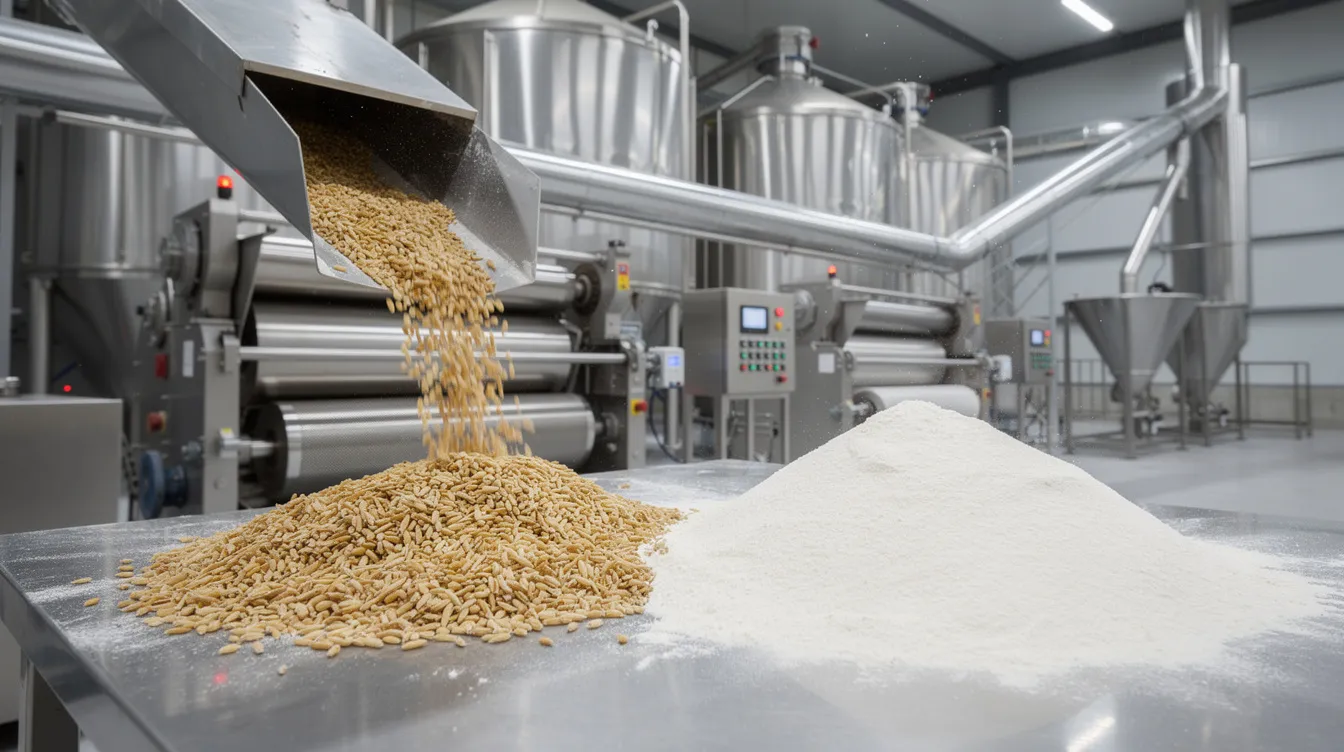
Model A – Integrated Wheat Milling with Bakery Flour Focus: Purchase raw wheat, clean, condition and mill it through roller mills, then produce flour grades with controlled protein, ash and particle size. This is the most capital-intensive model and suits promoters with experience in flour milling or significant investment capacity.
Model B – Specialised Flour Blending and Standardisation Unit: Purchase suitable base flour (maida or semi-refined flour) from other roller flour mills, then create bakery-specific grades using controlled blending, micro-dosing of permitted ingredients and rigorous testing. Lower capex, faster setup, but dependent on supplier quality.
Model C – Existing Roller Flour Mill Diversification: Upgrade an operational flour mill or atta chakki plant by adding blending equipment, storage, quality-control laboratory and packaging systems to produce bakery-grade flour alongside existing products.
For a comprehensive understanding of integrated milling projects, the roller flour mill project report and DPR covers the foundational technical and financial aspects.
| Parameter | Model A: Integrated Mill | Model B: Blending Unit | Model C: Mill Upgrade |
|---|---|---|---|
| Raw material | Raw wheat grains | Base flour from suppliers | Wheat + purchased flour |
| Machinery scope | Full roller mills, cleaners, purifiers, blenders, packing | Blenders, silos, dosing, packing, QC lab | Incremental blending, QC, packing additions |
| Quality-control intensity | High (grain to flour) | Moderate–high (flour to final product) | Moderate–high |
| Working capital | Very high (wheat inventory) | Moderate (flour inventory) | Moderate |
| Investment level | ₹7–45 crore+ | ₹1–5 crore | ₹1–8 crore (incremental) |
| Suitable for | Large/experienced promoters | Small–medium new entrants | Existing mill operators |
An automatic flour mill plant with integrated milling requires higher capex, deeper technical expertise and longer implementation compared to a pure blending unit. Each model demands a different approach to project planning and financial modelling.
Bakery Flour Manufacturing Plant Capacity Planning
Capacity in bakery flour manufacturing is measured in tonnes per day (TPD) of saleable bakery flour output – not raw wheat input. For integrated mills, the distinction matters because wheat-to-refined-flour extraction typically ranges from 68–75%, with the balance comprising bran, germ and milling losses.
Flour milling plants can achieve capacities over 4,000 kg per hour in high-capacity configurations. Typical capacity tiers include:
- 10–20 TPD: Small blending units or upgraded atta chakki plants
- 30–50 TPD: Medium-scale integrated or blending plants
- 60–100 TPD: Upper MSME-scale integrated mills
- 150 TPD and above: Large integrated flour mills
Worked example: A 50 TPD bakery flour plant operating 300 days per year has a gross annual capacity of 15,000 tonnes. With staged capacity utilisation of 60% in Year 1, 70% in Year 2 and 80% in Year 3, saleable output would be approximately 9,000 tonnes, 10,500 tonnes and 12,000 tonnes respectively. If the product mix is 50% bread flour, 30% biscuit flour and 20% cake or pizza flour, revenue and margins will vary by category. For detailed capacity-planning methodology, readers may refer to the roller flour mill capacity planning guide.
Raw Materials Required for Bakery Flour Manufacturing
A comprehensive DPR includes details about raw material sourcing, including seasonal availability and pricing. The primary raw materials differ by business model:
- Model A (Integrated): Raw grains – wheat of specific varieties with known protein characteristics, sourced from wheat-producing regions such as Madhya Pradesh, Uttar Pradesh, Rajasthan, Punjab and Haryana. Cleaned wheat must meet moisture (max 13–14%), foreign-matter and protein specifications before milling.
- Model B (Blending): Base maida or semi-refined flour purchased from established roller flour mills, plus permitted blending ingredients such as vital wheat gluten, malt flour or approved enzymes where legally permissible.
- Model C (Upgrade): A combination of own-milled flour and purchased base flour, depending on the existing mill’s output quality.
Batch-wise lab testing and traceability are non-negotiable in bakery flour production. Every incoming lot of wheat or base flour must be tested for protein, moisture, ash and microbial quality. FSSAI regulations restrict the use of additives in flour, and the regulatory status of each ingredient must be verified before use. Packaging considerations need to address sizes, materials and logistics for distribution – whether 25 kg or 50 kg bags for institutional buyers or 1–5 kg consumer packs for retail.
Bakery Flour Manufacturing Process and Flow
Integrated Wheat Milling Route
The milling process involves cleaning, conditioning and grinding in a systematic sequence. Wheat milling separates bran, germ and endosperm through a series of stages:
Wheat receiving and inspection → Grain cleaning section (pre-cleaner, aspirator, destoner, magnetic separator, scourer) → Conditioning and tempering (conditioning adjusts moisture for different flour types, typically raising moisture to 15–16% for 12–24 hours) → Break system (the break system determines starch degradation in flour; wheat passes through corrugated roller mills that crack open the grain) → Sifting and air purification (sifting categorises flour particles by size after grinding; plansifters separate endosperm from bran) → Reduction system (fine flour grinding occurs in the reduction system, where smooth roller mills gradually reduce grain particles through multiple stages) → Flour collection in bins → Standardisation and blending where needed → Quality testing → Packaging → Finished goods storage → Dispatch.
For a detailed explanation of this process, the roller flour milling process and flow chart article provides comprehensive technical coverage.
Flour Blending and Standardisation Route
Base flour unloading and inspection → Silo or bag storage → Controlled batching and weighing → Industrial blender mixing (ribbon or paddle blenders, with micro-dosing of phase material such as gluten or approved improvers) → Inline sampling → Laboratory testing for protein, ash, moisture and gluten → Packing in bags or bulk containers → Palletisation and dispatch.
Process parameters are fine-tuned depending on the target bakery flour application. For bread flour, blending focuses on achieving the right gluten strength and water absorption. For biscuit flour, the emphasis shifts to controlled protein and crisp texture characteristics.
Bakery Flour Manufacturing Machinery and Equipment
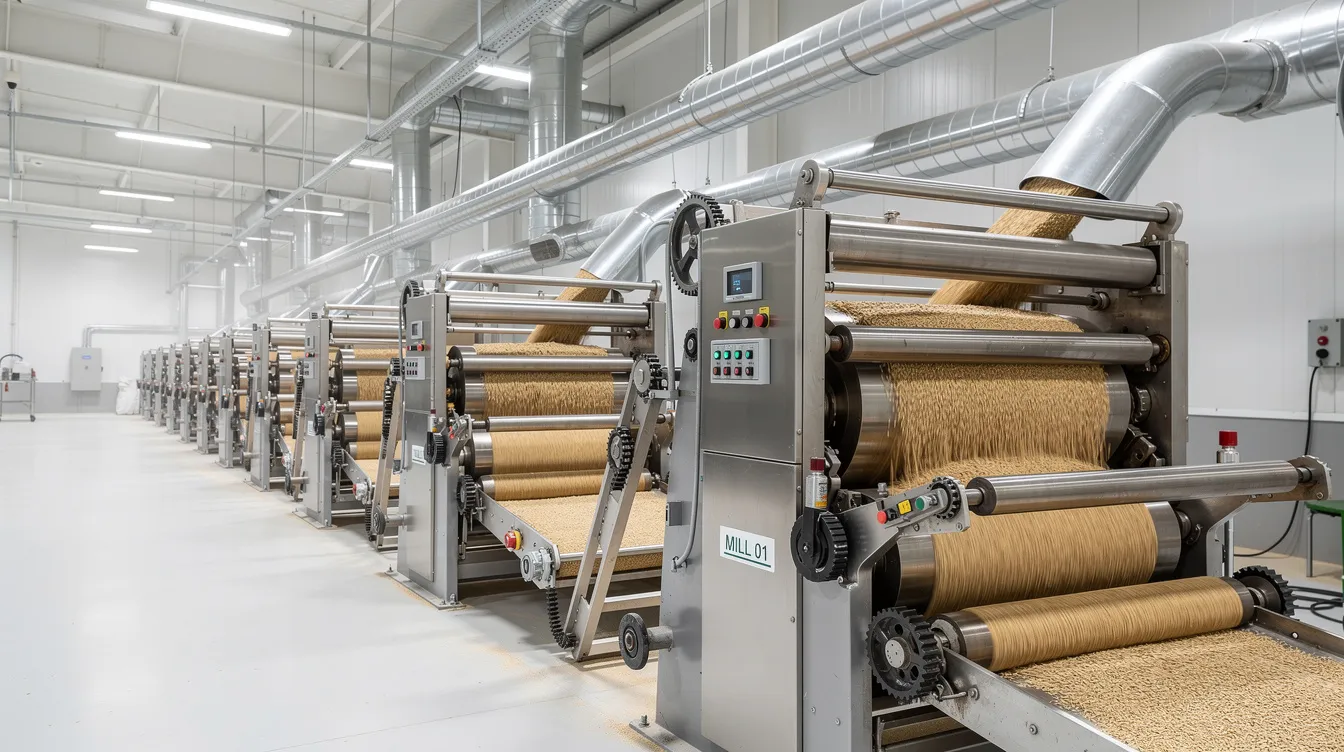
A wheat flour processing plant requires grain cleaning machines, and flour milling requires grain cleaners and roller mills as foundational equipment. Roller mills are essential for milling wheat into flour – they gradually reduce grain through multiple stages of break and reduction. Modern flour mills use automated quality control systems to monitor and maintain consistency. Flour milling machinery includes sifting and air purification systems across both integrated and blending configurations.
| Equipment Category | Integrated Mill (Model A) | Blending Unit (Model B) |
|---|---|---|
| Grain intake and cleaning | Pre-cleaners, destoner, scourer, magnets, aspirators | Not required |
| Conditioning/tempering | Tempering bins with moisture control | Not required |
| Milling | Roller mills, plansifters, purifiers | Not required |
| Flour conveying | Pneumatic systems, elevators | Pneumatic or mechanical |
| Storage | Wheat silos + flour bins | Flour silos/bins only |
| Blending | Industrial blenders, micro-dosing | Core equipment: ribbon/paddle blenders, dosing |
| Quality testing | Lab instruments (moisture, protein, ash, farinograph) | Lab instruments (same scope) |
| Packaging | Automatic bagging, palletiser, metal detector | Automatic bagging, palletiser |
| Dust collection | Dust-collection and filtration system | Dust-collection system |
| Electrical and automation | PLC panels, automation grade as per budget | PLC panels, weighing automation |
Advanced machinery such as inline NIR analysers, fully automatic packaging unit systems and SCADA controls add to cost but improve consistent output and reduce dependence on manual intervention. Flour mill machines from a leading manufacturer in India typically carry mild steel motor power specifications and stainless steel contact surfaces. Key features to evaluate include energy efficiency, low maintenance design, long service life and after-sales service support from machinery suppliers. For equipment cost benchmarks, the roller flour mill machinery and equipment cost article provides useful reference data.
Land, Building and Infrastructure Requirements
Flour mill plants require proper layout for efficient workflow, and can be installed on steel frames or concrete buildings depending on the milling flow design and local construction norms.
Integrated Mill (50–100 TPD): Typically requires 1,500–3,000 sq. metres of covered area across a multi-storey mill house (for gravity-based milling flow), raw wheat yard or unloading bay, grain silos, blending area, packing hall, finished goods warehouse, QC laboratory, utility block (DG set, compressor, transformer), admin office and parking with truck-turning radius.
Blending Unit (20–30 TPD): A single-floor layout of 500–1,200 sq. metres may suffice, covering flour unloading bay, storage, the grinding section or blending hall, packing area, warehouse and lab.
Infrastructure requirements include adequate electricity connection (power load matching motor power requirements of all flour mill machines), water supply for conditioning and cleaning, proper drainage, ventilation, dust-control systems, fire safety measures and road access for heavy vehicle movement. Building height in integrated mills is important for multi-storey construction that facilitates gravity-assisted material flow. Exact area and civil cost depend on location, construction type (mild steel number structures vs RCC) and whether the promoter owns or leases the land.
Bakery Flour Manufacturing Plant Setup Cost in India
Establishing a flour mill costs between ₹5,00,000 to ₹10,00,00,000 depending on the scale and model. A 500 kg flour mill typically costs between ₹3,00,000 to ₹5,00,000, while medium-sized mills require ₹20,00,000 to ₹1,00,00,000 to establish. For dedicated bakery flour plants, the investment is substantially higher due to quality-control, blending and advanced packaging requirements.
Machinery costs are the largest portion of capital expenditure, typically forming 45–55% of total project cost in a new integrated mill. Below are illustrative cost structures for three configurations. All figures are planning-level estimates, not verified vendor quotations:
Scenario 1: 20–30 TPD Blending Unit (Illustrative)
| Cost Head | Approx. Range (₹ Lakh) |
|---|---|
| Land and site development | 15–40 |
| Building and civil works | 25–50 |
| Blending and packaging machinery | 40–80 |
| Electrical and utilities | 10–20 |
| Lab and office equipment | 5–10 |
| Pre-operative and contingency | 10–20 |
| Margin for working capital | 30–60 |
| Total | 135–280 |
Scenario 2: 50 TPD Integrated Bakery Flour Mill (Illustrative)
| Cost Head | Approx. Range (₹ Crore) |
|---|---|
| Land and site development | 0.8–1.5 |
| Building and civil works | 1.5–2.5 |
| Plant and machinery (roller mills, cleaners, blending, packing) | 2.5–4.0 |
| Electrical, utilities, DG set | 0.5–1.0 |
| Lab, office, miscellaneous | 0.3–0.5 |
| Pre-operative and contingency | 0.4–0.8 |
| Margin for working capital | 2.0–3.0 |
| Total | 8.0–13.3 |
Scenario 3: 100+ TPD Large Integrated Plant (Illustrative)
Total capital investment for a fully integrated plant at this scale typically ranges from ₹12–18 crore or higher, depending on automation grade, land cost, and the product range offered.
These figures will vary based on geography, machinery brand (imported vs indigenous), level of automation and local construction costs. Promoters should obtain fresh quotations from machinery suppliers before finalising the investment plan. For a comparative baseline, the roller flour mill setup cost in India article provides detailed cost benchmarks across multiple capacity tiers.
If you are planning a specialised bakery flour manufacturing plant, I would recommend getting a project-specific DPR prepared based on your proposed capacity, product mix, location and financing needs. A customised project report provides far more reliable cost estimates than generic benchmarks. You can reach us through www.projectreportbank.com to discuss your business requirements.
Project Cost and Means of Finance Structure
Total project cost is compiled by aggregating fixed assets (land, building, plant and machinery, electrical, utilities, furniture), preliminary and pre-operative expenses, contingency and margin for working capital.
Illustrative Example (50 TPD Integrated Plant):
| Component | Amount (₹ Crore) |
|---|---|
| Fixed assets (land, building, P&M, electrical, utilities, lab) | 6.5 |
| Pre-operative expenses and contingency | 0.7 |
| Margin for working capital | 2.3 |
| Total Project Cost | 9.5 |
Possible means of finance:
| Source | Amount (₹ Crore) |
|---|---|
| Promoter’s equity contribution | 2.85 (30%) |
| Term loan from bank | 5.45 (57%) |
| Working capital finance (CC/OD) | 1.20 (13%) |
| Total | 9.5 |
The debt-equity structure should not be fixed merely by attempting to minimise the promoter’s contribution. Higher borrowing increases interest and repayment obligations. Banks typically expect minimum promoter contribution of 20–30% depending on project size and sector. For structuring the means of finance and repayment schedule, the project finance advisory and loan structuring services page explains our professional approach.
Working Capital Requirements for Bakery Flour Manufacturing
Working capital in a bakery flour plant is driven by the operating cycle: purchase of wheat or base flour, storage and conditioning, processing, finished goods holding, sales to institutional or retail customers, credit period extended to buyers, and collection of dues.
Typical inventory and credit norms:
- Wheat or base flour stock: 15–30 days of consumption
- Packing material and consumables: 15 days
- Finished goods: 5–10 days
- Debtors (institutional supply): 30–45 days
- Creditors (supplier credit): 15–30 days
Illustrative Calculation (50 TPD plant at 70% utilisation):
Monthly raw material consumption might be approximately ₹2.0–2.5 crore. With 30 days of raw material inventory, 7 days of finished goods and 30 days of receivables, gross working capital could range from ₹2.5–3.5 crore, partially offset by supplier credit. The net working capital requirement and bank CC limit are derived from this assessment.
The difference in working capital between bulk institutional supply (higher receivables, lower marketing cost) and branded retail packs (lower receivable days but higher inventory and marketing spend) can be significant. For deeper coverage, the roller flour mill financial projections and working capital article provides a structured framework.
Bakery Flour Manufacturing Cost Per Kg and Profitability
Major operating cost heads include wheat or base flour cost (typically 60–70% of total cost), blending ingredients, power and fuel, direct labour and supervision, packing material, repairs and maintenance, lab testing, factory overheads, administration and selling expenses. Operating costs for a flour mill increase significantly by year five due to inflationary pressures on raw material, power tariffs and labour.
Illustrative Cost-Per-Kg Calculation (50 TPD Integrated Plant at 70% Utilisation):
| Cost Element | ₹ Per Kg (Approx.) |
|---|---|
| Wheat cost (at ~₹25/kg input, 72% extraction) | 34.70 |
| Less: By-product realisation (bran, germ) | (3.50) |
| Net raw material cost | 31.20 |
| Processing (power, labour, maintenance) | 2.50 |
| Packing material | 1.00 |
| Overheads, admin, selling | 1.30 |
| Total production cost | 36.00 |
| Average selling price (blended product mix) | 40.00 |
| Contribution margin per kg | 4.00 |
From contribution, the plant must cover interest, depreciation and tax to arrive at net profit. EBITDA margin in bakery flour manufacturing typically ranges from 8–14% depending on product mix, capacity utilisation, customer pricing and wheat market volatility. The actual bakery flour manufacturing profit margin varies and should not be confused with EBITDA.
Financial Projections and Viability Analysis
Financial projections typically span 5 to 10 years and cover production, sales volume and costs. The project report should demonstrate financial viability through profitability analysis and funding plans. A five-to-seven-year model is standard for bank appraisal of a bakery flour plant DPR.
Illustrative 3-Year Snapshot (50 TPD Integrated Plant):
| Parameter | Year 1 | Year 2 | Year 3 |
|---|---|---|---|
| Capacity utilisation | 60% | 70% | 80% |
| Annual sales (₹ crore) | 36.0 | 42.0 | 48.0 |
| EBITDA (₹ crore) | 3.2 | 4.5 | 5.8 |
| Interest (₹ crore) | 0.9 | 0.8 | 0.7 |
| PAT (₹ crore) | 0.8 | 1.8 | 2.9 |
| DSCR (approx.) | 1.30 | 1.55 | 1.85 |
Assumptions: wheat cost ₹25/kg, average selling price ₹40/kg, 300 operating days, term loan interest 10.5%, extraction 72%, by-product realisation included.
Projections must reflect realistic market conditions, not optimistic or arbitrary growth figures. For customised, bank-ready financial models, the financial projections and financial modelling services page explains our approach.
DSCR, Break-Even, ROI and Sensitivity Analysis
DSCR (Debt Service Coverage Ratio) measures the cash accruals available for debt servicing divided by term-loan repayment obligations including interest. Banks generally expect an average DSCR of 1.25–1.5 or higher across the projection period. Project viability analysis covers capital and operating cost estimates, including fixed and variable costs.
Break-even in a bakery flour plant context typically falls at 40–55% capacity utilisation for medium-scale integrated mills – the point at which revenue covers all fixed and variable costs. ROI, IRR and payback period are derived from projected cash flows rather than accounting profit alone.
Sensitivity analysis is crucial to evaluate the impact of fluctuations in wheat prices and production capacity. A professionally prepared DPR should test scenarios such as:
- Wheat price increase of 10–15%
- Selling price decline of 5–10%
- Capacity utilisation dropping to 50%
- Receivable days extending from 30 to 60 days
A project that remains viable under moderate stress is inherently stronger than one where a small adverse change creates a debt-servicing problem. For detailed feasibility methodology, the project feasibility study and viability services page outlines our professional framework.
Licences, FSSAI Compliance and Quality Standards
Statutory compliance includes obtaining food safety and environmental approvals relevant to the plant’s location, capacity and product composition. Key requirements include:
- FSSAI registration or licence (Central licence for larger units with turnover above ₹12 crore; State licence otherwise)
- Factory licence under the Factories Act
- Pollution control consents (consent to establish and operate) where applicable
- Fire NOC and building approvals
- GST registration
- Labelling compliance under FSSAI regulations: ingredient list, best-before date, nutritional information, allergen declaration (including gluten) and manufacturer details
Applicable food safety practices include HACCP plans, Good Manufacturing Practices, pest control and sanitation protocols. BIS standards such as IS 7463:2004 specify quality parameters for wheat flour used in bakery applications, though promoters should verify current standards from official sources as these may be updated periodically. The exact compliance checklist depends on state-level regulations, plant capacity, use of additives and waste-management requirements.
Bakery Flour Manufacturing Plant DPR for Bank Loan
A detailed project report should include an executive summary, market analysis and financial projections. The project implementation schedule outlines key milestones from land acquisition to commercial production. A bankable DPR for a bakery flour manufacturing plant covers:
- Promoter background and experience
- Project concept and technical configuration
- Capacity, location and market overview
- Manufacturing process and machinery list
- Project cost with supporting quotations
- Means of finance and promoter contribution
- Working capital assessment
- Projected profit and loss, cash flow and balance sheet
- Break-even analysis, DSCR calculations and sensitivity scenarios
CMA Data, as required by Indian banks, summarises past and projected financials for credit appraisal and must align with the DPR projections. This is prepared for bank submission, not certified as a guarantee of future performance. The bank finance DPR and loan proposal assistance and CMA Data preparation services pages explain how we assist promoters with complete bankable documentation.
If you are preparing for a bank loan or investor discussion for a bakery flour plant, I would recommend having a customised DPR and CMA Data prepared that reflects your specific project assumptions. Generic reports do not serve the purpose of a serious credit appraisal. Contact us through www.projectreportbank.com to discuss your project.
Key Risks in Specialised Bakery Flour Manufacturing
- Wheat price volatility: Raw material is the dominant cost. Even a 10% wheat price increase can compress margins significantly if selling prices are locked in contracts.
- Quality inconsistency: Inability to meet strict bakery flour specifications leads to customer rejections and damaged credibility. Inadequate lab and quality-control systems are a common cause.
- Customer concentration: Dependence on one or two large bakery clients creates revenue risk if contracts are lost or volumes reduced.
- Slow receivables: Institutional customers often take 30–45 days or longer to pay, straining cash flow despite accounting profitability.
- Underutilised capacity: Fixed costs in an integrated mill are significant. Consistently operating below 60% utilisation erodes profitability rapidly.
Mitigation approaches include long-term sourcing arrangements for wheat, robust quality systems with trained lab personnel, diversified customer base, conservative financial projections and AMCs for key flour mill machines. Operational aspects such as staffing and training programs are vital for efficient plant management and consistent quality. These risk assessments are an integral part of a professional feasibility study and DPR.
When Should an Entrepreneur Invest in a Bakery Flour Manufacturing Plant?
An entrepreneur should consider this investment when:
- Confirmed or high-probability demand exists from local bakeries, bread plants, biscuit factories or institutional food processors
- A suitable site with adequate infrastructure (power, water, road access) is available
- The promoter has reasonable understanding of flour and bakery markets, or access to an experienced technical and commercial team
- Adequate promoter contribution and access to bank finance or investor funding are realistic
For first-time promoters with limited capital, starting with a smaller blending unit using purchased fine flour may be more appropriate than constructing a full integrated mill. This reduces risk while building customer relationships and market understanding.
Existing flour mills, commercial atta chakki machine owners or atta plant operators can often upgrade into bakery flour production by adding blending equipment, storage, quality-control laboratory and improved packaging systems – a significantly lower investment than a greenfield plant.
I would strongly recommend pilot trials and sample approvals from target bakery clients before committing to large dedicated bakery flour capacities. The DPR, financial model and risk analysis should serve as decision-making tools, not merely loan documents.
Professional DPR, CMA Data and Project Finance Assistance
At Project Report Bank, led by CA Manish Gugliya, we prepare customised DPRs for bakery flour manufacturing plants across different capacities and business models. Our scope includes technical understanding of flour mills and atta plant configurations, financial projections, DSCR analysis, working capital assessment and realistic profitability estimates.
We also assist with CMA Data preparation, projected balance sheets and discussion notes commonly requested by Indian banks and financial institutions. The objective is to help promoters present a credible, internally consistent financial proposal – not to produce impressive-looking numbers that cannot withstand scrutiny.
Professional advisory reduces the risk of underestimating project cost or overestimating revenue. For esteemed customers planning serious projects, this professional support often makes the difference between a well-structured proposal and one that raises unnecessary questions during bank appraisal.
Frequently Asked Questions – Bakery Flour Manufacturing Plant Project
The following FAQs address common practical queries from promoters evaluating bakery flour manufacturing projects.
What is the typical cost of starting a bakery flour manufacturing plant in India?
The cost depends heavily on the chosen business model and capacity. A small blending unit of 20–30 TPD may require ₹1.5–3 crore, while a 50 TPD integrated bakery flour mill plant may need ₹8–13 crore. Larger integrated plants of 100+ TPD can require ₹12–18 crore or more. Machinery costs form the largest share of total capital investment, and automation grade significantly influences the final figure.
Is bakery flour manufacturing profitable?
Bakery flour manufacturing can be profitable when the plant operates at adequate capacity utilisation (typically above 60%), maintains consistent product quality and serves a diversified customer base. EBITDA margins of 8–14% are achievable depending on product mix and market conditions. However, profitability is not guaranteed – it depends on wheat prices, selling price discipline and operational efficiency.
What is the difference between bakery flour and ordinary maida?
Ordinary maida typically has protein content of 8–10% and variable ash and gluten characteristics. Bakery flour is manufactured to meet specific functional requirements: bread flour needs 11–14% protein with strong gluten, biscuit flour needs moderate protein for crisp texture, and cake flour requires low protein for tender crumb. The final product must meet industry standards that generic maida may not consistently achieve.
Can an existing roller flour mill or commercial atta chakki be upgraded for bakery flour?
Yes. An existing mill can often be upgraded by adding blending equipment, quality-control laboratory instruments, improved flour storage, dedicated packing lines and automation for consistent batching. The incremental investment is typically much lower than a greenfield plant. However, the existing mill’s grinding units and roller mills must be capable of producing the base flour quality needed for bakery applications.
What machinery is essential for a bakery flour manufacturing plant?
For an integrated plant: grain cleaning equipment, destoner, conditioning bins, roller mills, plansifters, purifiers, pneumatic conveying, flour blenders, packaging machines and dust-collection systems. For a blending unit: flour silos, industrial blenders, micro-dosing systems, weighing and batching equipment, sieving, packaging machinery and QC laboratory instruments. Mild steel and stainless steel construction is standard for contact surfaces. The chakki size and configuration differ entirely from what is used in a commercial atta chakki machine setup.
How is a bakery flour plant DPR prepared for a bank loan?
A bankable DPR is prepared by analysing the proposed capacity, machinery configuration, project cost, means of finance, working capital, financial projections and sensitivity scenarios. It includes projected P&L, cash flow, balance sheet, DSCR calculations and break-even analysis. CMA Data is prepared separately for bank submission. The financial analysis must be based on defensible, project-specific assumptions – not generic industry averages.
Conclusion
Specialised bakery flour manufacturing is a higher-value, more technically demanding segment than generic atta or maida production in conventional flour mills or atta chakki plants. The choice between an integrated milling plant, a blending unit or upgrading an existing mill fundamentally shapes the project’s investment, complexity and risk profile.
A well-prepared bakery flour manufacturing plant project report helps the promoter, the banker and the investor evaluate viability before funds are committed. Accurate project costing, realistic financial projections, robust quality systems and market-validated demand are prerequisites – not optional extras. In India, where the food industry continues to expand and professional bakeries increasingly demand consistent, specification-grade flour, this segment offers genuine commercial opportunity for the well-prepared promoter.
If you are an entrepreneur, MSME owner or existing flour mill operator planning a bakery flour manufacturing project, I invite you to discuss your specific requirements with us. A customised DPR, financial model and bank finance documentation prepared with project-specific assumptions will serve you far better than generic estimates. Please reach out through www.projectreportbank.com to begin a professional consultation.
About the Author – CA Manish Gugliya
CA Manish Gugliya, FCA, DISA (ICAI), is a practising Chartered Accountant with over 20 years of professional experience. His advisory work includes Detailed Project Reports, CMA Data preparation, financial projections, project feasibility studies, MSME consulting and bank finance assistance for manufacturing and industrial projects across India.
Website: www.projectreportbank.com