
A puffed rice manufacturing plant looks straightforward on paper – rice goes in, puffed rice comes out, and the margin looks attractive. But too many promoters commit capital based on rough monthly profit estimates without examining project viability through a structured financial lens. This article presents an analytical framework for evaluating a puffed rice project on the metrics that actually matter to entrepreneurs, bankers and investors in India.
Key Takeaways
- A puffed rice plant feasibility study must evaluate project cost, cash flow, ROI, IRR, NPV, payback period, DSCR and break-even utilisation – not just estimated profit.
- ROI and IRR of a puffed rice manufacturing project depend heavily on plant capacity, capacity utilisation, raw material price, selling price and working-capital cycle.
- Sensitivity analysis for changes in paddy price, selling price, power cost, utilisation and interest rate is essential before committing capital.
- Banks increasingly demand structured sensitivity scenarios in a detailed project report before sanctioning term loans for food-processing units.
- Project Report Bank, led by CA Manish Gugliya, prepares bankable puffed rice plant project reports with financial projections, DSCR, NPV, IRR and scenario analysis.
Why Feasibility, ROI, IRR and Payback Matter for a Puffed Rice Plant
Many puffed rice (murmura) projects in India are evaluated only on “expected monthly profit.” This approach is dangerously incomplete. A proper puffed rice plant feasibility study must cover project cost, operating assumptions, cash flows, ROI, IRR, NPV, payback period, DSCR and break-even utilisation for at least 7–10 years.
Banks, investors and CAs look beyond profit-and-loss. They focus on debt-servicing capacity, working capital adequacy, and sensitivity to adverse movements in raw materials and selling prices. For a typical MSME-scale puffed rice manufacturing business producing 2 to 10 tonnes per day, viability depends on realistic assumptions about paddy cost, fuel, labour, packaging and market price. The minimum investment for a small-scale unit starts at around ₹10 lakhs, covering land, building, machinery, and working capital – but the real question is whether that investment generates adequate, resilient returns.
What Is a Puffed Rice Plant Feasibility Study?
A puffed rice plant feasibility study is a structured evaluation of whether a proposed manufacturing plant is technically, commercially and financially viable. This assessment is typically captured in a detailed project report used for internal decision-making and bank finance.
The study covers several dimensions:
- Technical feasibility: Assesses the puffed rice manufacturing process, machinery selection, plant layout, utilities and manpower. Puffed rice is made by heating rice kernels until they pop – traditionally using sand-roasting methods, while the modern method uses machines to puff rice under heat at approximately 250–270°C. The main machinery includes a husker, dryer, cleaning and destoning machines, and packaging unit.
- Market and commercial feasibility: Evaluates demand for murmura across regional markets, competition from industry players, buyer segments and pricing trends. Puffed rice is a popular snack food in India and a popular street food used in preparations like bhel puri. Demand drivers include local consumption patterns and festival demand spikes.
- Financial feasibility: Covers capital investment, operating cost, revenue projections, profitability, cash accrual, ROI, IRR, NPV, payback, DSCR and break-even analysis. This should be backed by structured puffed rice plant financial projections prepared on realistic assumptions.
- Operational feasibility: Availability of labour, consistent power and fuel, logistics for incoming paddy and outgoing finished goods. Location proximity to supply chains reduces raw material transportation costs.
- Funding feasibility: Realistic mix of term loan and equity, working-capital limits, ability to meet bank norms on DSCR and promoter contribution.
Conducting a feasibility study requires evaluating technical, financial, and market factors together. A bankable report typically covers 7–10 years of projections, aligned with the expected term of bank loans.
Key Drivers of Puffed Rice Plant Financial Feasibility
The financial viability of a puffed rice manufacturing project is highly sensitive to a few core assumptions. If these are wrong, ROI and IRR can change drastically.
- Installed production capacity: A small-scale unit can achieve a production capacity of 2 tonnes per day. For capacity planning at larger scales, capacity ranges from 200 kg/hr to over 1,000 kg/hr depending on automation.
- Capacity utilisation ramp-up: Year 1 utilisation is often 50–60%, rising to 70–75% in Year 2 and stabilising at 80% from Year 3. Low utilisation keeps fixed cost per kg high.
- Raw materials and procurement cost: The main raw material for puffed rice is rice. India produces over 100 million tonnes of rice annually, yet only 10% is processed into value-added products like puffed rice. Paddy or parboiled rice accounts for 50–70% of total production cost. Puffed rice requires specific paddy varieties that expand well upon heating, and raw material quality affects the expansion ratio and crispiness of the puffed product. Other ingredients include salt, sugar, and spices. Detailed raw material planning should factor in seasonal price variation, transport, mandi fees and cleaning losses.
- Conversion yield: Typical recovery is 60–70% of input rice. A 5% improvement in yield can noticeably improve margins over time.
- Selling price and product mix: Loose murmura in gunny bags fetches lower per-kg realisation than branded retail packs, but retail involves higher packaging and marketing expenses.
- Energy consumption: Fuel type (LPG, coal, biomass) and electricity for blowers, conveyors and packing are significant cost components. See power and utility requirements for detailed planning.
- Labour and supervision: Low automation reduces initial investment but increases labor costs. Costs vary based on production scale and machinery type.
- Packaging: Packaging for puffed rice must prevent moisture pickup to maintain texture. Retail packs can add 6–15% to sales value in cost terms.
- Working capital: Stock of paddy, finished puffed rice, packaging inventory and debtor days – these impact cash flow more than many entrepreneurs anticipate.
A 5% rise in paddy cost, when raw material represents 65% of total cost, adds roughly 3.25% to total cost per kg – enough to compress EBITDA margins by several percentage points.
Project Cost as the Starting Point of ROI Analysis
ROI and IRR can be trusted only if total project cost is realistically estimated. Fixed capital investment includes costs for land, building, and machinery. Capital expenditure should include both initial investments and ongoing operating costs.
Key components for a typical plant:
- Land cost or lease deposit for an industrial area plot
- Building and civil construction for godown, production hall and office
- Plant and machinery – puffing machine, roaster, conveyors, grading units, packaging machines (see puffed rice plant machinery cost for detailed breakdowns)
- Electrical installation, boiler, compressor, fuel tanks
- Installation, erection and commissioning expenses
- Preliminary and pre-operative expenses including DPR preparation, interest during construction, necessary licenses and approvals
- Contingency margin (5–10% of machinery and civil cost)
- Margin money for working capital
Process technology can vary from traditional methods to modern automated machines. The project cost and means of finance section of a DPR should detail how the cost will be funded through term loan, promoter equity and possible subsidy. Underestimation leads to cash stress and weak DSCR from Year 1.
Revenue Model and Sales Assumptions
Annual revenue is calculated as: installed capacity × capacity utilisation × net realisation per kg.
Major revenue streams include bulk sales to wholesalers and mandis, supply to snack manufacturers as an ingredient, contract or private-label manufacturing for established brands, and own-brand retail packs for supermarkets and kirana stores. Market analysis includes identifying local retailers and wholesale grain merchants. The puffed rice market is expected to grow significantly, driven partly by growing demand for puffed rice as a low-calorie snack option and the increasing recognition of its various health benefits.
Using overly high selling prices in projections artificially inflates ROI, IRR and NPV. Banks routinely flag unrealistic revenue assumptions. For a detailed discussion, refer to the puffed rice revenue model and market strategy.
Profitability, Break-Even and Cash Accrual
Key profit metrics for a puffed rice plant include gross profit (sales minus raw material and packing cost), EBITDA (gross profit minus wages, power, fuel and overheads), EBIT (EBITDA minus depreciation), and profit after tax. Cost-benefit projections analyze break-even points and profit margins at different utilisation levels.
A separate but crucial metric is cash accrual (PAT + depreciation), which reflects cash available for loan repayment and reinvestment. A project can experience cash-flow problems despite annual profitability – especially when loan repayments, stock build-up or high debtor days consume cash faster than profit generates it.
Break-even capacity utilisation for many MSME puffed rice plants falls between 55–70%. A plant operating at only 55–60% utilisation may barely cover fixed costs, while crossing 75–80% often leads to healthy margins. See the detailed puffed rice plant profitability and break-even analysis for worked examples.
ROI, IRR, NPV and Payback Period for a Puffed Rice Project
For serious puffed rice project financial analysis, entrepreneurs should understand these four metrics beyond headline profit.
ROI: ROI = (Annual return ÷ Total investment) × 100. The “annual return” can be defined as PAT, cash accrual, or average cash profit – the basis should always be disclosed. For example, if total project cost is ₹150 lakh and annual cash accrual is ₹30 lakh, the illustrative ROI is 20%. These are hypothetical figures, not industry norms.
IRR: The internal rate of return is the discount rate at which the present value of future cash inflows equals the initial investment. Project IRR (based on total investment) and equity IRR (based on promoter’s equity) differ significantly – higher leverage pushes equity IRR up but increases financial risk. For MSME food-processing projects, project IRR in the range of 15–25% is considered acceptable under base-case assumptions.
NPV: Net present value is the sum of discounted future cash flows minus initial investment. A positive NPV at the weighted average cost of capital (say 12%) indicates the project creates value. At a higher discount rate (say 18%), only stronger projects sustain positive NPV.
Payback Period: Simple payback is the time for cumulative cash accrual to recover project cost – typically 3–5 years for well-planned puffed rice plants. Discounted payback adjusts for time value of money and will be longer. Payback should not be the sole criterion; a project with slightly longer payback but strong long-term cash flows and positive NPV can still be attractive.
Cash Flow, DSCR and Bank Loan Repayment Capacity
Even a profitable puffed rice plant can face cash crunch if working capital and loan repayments are poorly planned. Cash inflows from sales are often delayed by credit terms, while outflows for rice or paddy, fuel, electricity, wages and packing material occur on quicker cycles. Seasonal build-up of paddy inventory adds further strain.
Working capital planning should account for inventory days (raw paddy, finished puffed rice), debtor days from wholesalers and institutional buyers, and creditor days from rice mills and packaging suppliers. The working capital requirement for a puffed rice plant is typically underestimated in early-stage planning.
DSCR (Debt Service Coverage Ratio) = Cash available for debt service ÷ (Interest + Loan instalments due in the year). Banks in India typically look for minimum DSCR of 1.25–1.30 and average DSCR above 1.50. The repayment structure – moratorium period, step-up or level instalments – directly affects DSCR. A one-year dip in capacity utilisation can reduce DSCR below 1.0 if term-loan instalments are high, underlining the importance of conservative planning. Detailed analysis is covered in our resource on DSCR and loan repayment capacity of a puffed rice project.
Sensitivity Analysis for a Puffed Rice Plant
A puffed rice plant sensitivity analysis checks how ROI, IRR, DSCR and profit change when adverse events occur. Sensitivity analysis should be a part of financial feasibility to assess risks – base-case projections alone are insufficient.
Key sensitivity tests include:
- Increase in raw material price: A 10% rise in paddy cost, where raw material is 65% of total cost, adds approximately 6.5% to total cost – compressing EBITDA and potentially pushing DSCR below comfort levels.
- Reduction in selling price: Competition and buyer pressure in the domestic market can force price cuts. Even a 5% drop in average realisation sharply reduces contribution per kg.
- Lower capacity utilisation: Comparing base-case (80%) with stress case (60–65%) shows that per-unit fixed cost absorption deteriorates significantly.
- Increase in fuel and power cost: Energy-intensive puffing operations are vulnerable to fuel price volatility.
- Increase in interest rate: A 1–2% rise in borrowing cost reduces PAT, weakens DSCR and lowers equity IRR.
Combined stress scenarios are where the real risk lies. When raw material cost rises by 8%, selling price drops by 5%, and capacity utilisation falls to 65% simultaneously, the impact on ROI and IRR is far more severe than each factor alone:
| Scenario | Capacity Utilisation | Selling Price Change | RM Cost Change | EBITDA Margin | DSCR | Illustrative ROI | Illustrative IRR |
|---|---|---|---|---|---|---|---|
| Base Case | 80% | – | – | 15–18% | 1.55 | 20% | 22% |
| Conservative | 70% | -3% | +5% | 10–12% | 1.25 | 13% | 16% |
| Stress | 65% | -5% | +8% | 5–7% | 0.95 | 6% | 10% |
All figures are illustrative only and not industry benchmarks.
Banks and professional investors increasingly expect such scenarios in a bankable puffed rice plant project report before sanctioning finance.
Plant Layout, Process Efficiency and Their Impact on Returns
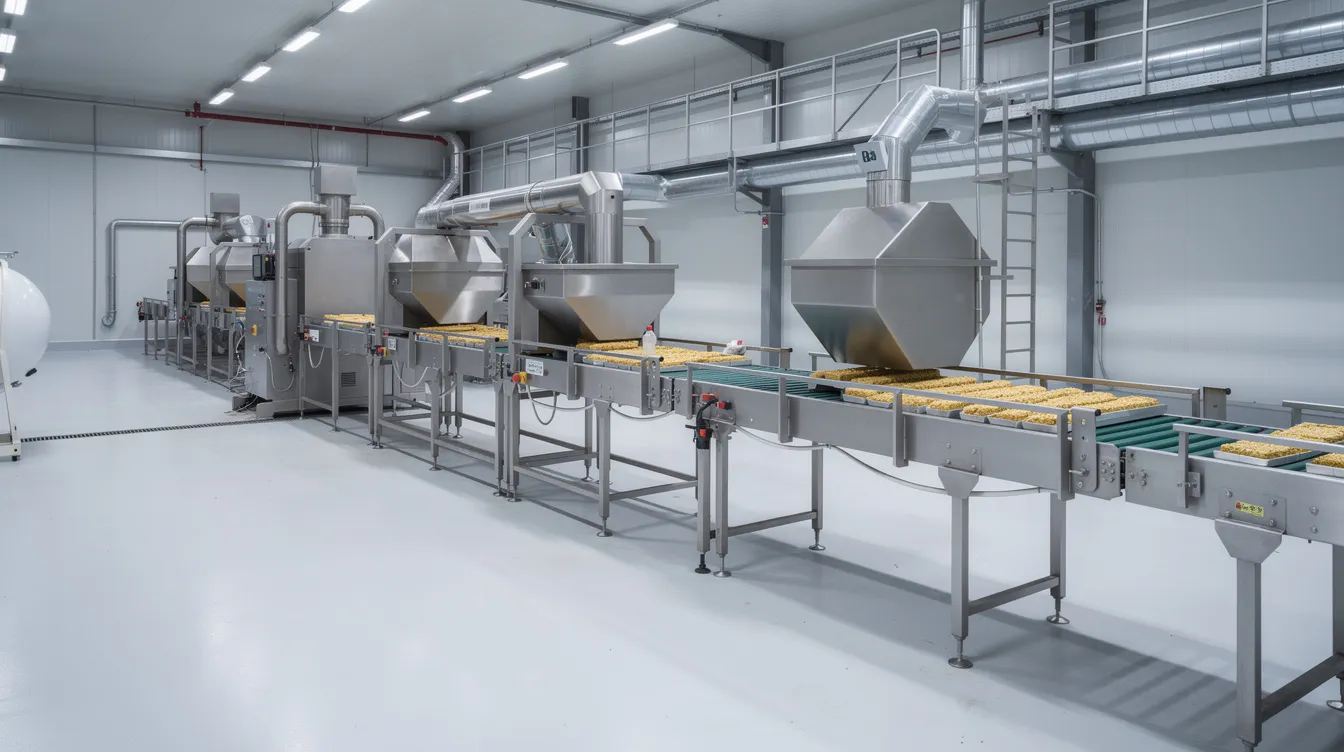
Beyond financial projections, actual puffed rice plant ROI depends on process efficiency and technology choice. A well-designed plant layout minimises material handling distance, reduces spillage and contamination, and improves supervision across shifts. Standard operating procedures should be established for hygiene and quality control.
Selection of energy-efficient machinery and adherence to a standardised manufacturing process can improve yield uniformity, reduce fuel consumption per kg, lower labour requirement per tonne and reduce downtime. Even a 1–2% improvement in yield translates into a noticeable improvement in puffed rice plant profit margin and IRR over 8–10 years. Waste management must comply with local pollution control norms.
How to Improve ROI and IRR in a Puffed Rice Manufacturing Business
While some factors like global commodity prices are uncontrollable, several operational levers are available:
- Efficient raw material procurement – seasonal bulk purchase, direct sourcing from mills, quality checks to minimise impurities
- Higher, stable capacity utilisation through multi-shift operation, steady order booking and preventive maintenance
- Energy-efficient equipment – improved puffing technology, insulation and heat recovery systems
- Product mix optimisation – moving part of volume from low-margin loose murmura toward branded or private-label packs
- FSSAI compliance and consistent quality to reduce rejections and command better pricing
- Working-capital discipline – controlled credit terms, faster debtor collection, realistic inventory norms
- Balanced debt-equity structure to keep DSCR healthy
- Market development through tie-ups with snack manufacturers and regional distributors in the export market and domestic channels
Professional financial modelling can quantify how each action affects projected IRR, NPV and payback of the puffed rice plant.
Bank Finance, Project Viability and Role of a Bankable DPR
Banks appraise a puffed rice plant loan proposal on total project cost and means of finance, promoter profile and creditworthiness, financial projections for 7–10 years, DSCR trend, break-even utilisation, margin of safety, and sensitivity of ROI to changes in key variables. Regulatory approvals including necessary local and national clearances – you must obtain a food license from the FSSAI, register your business with the Registrar of Companies, and secure factory and pollution control approvals before commercial production.
A properly structured DPR with puffed rice plant financial projections and sensitivity scenarios significantly improves appraisal outcomes, though it does not guarantee sanction. For details on financing options and MSME schemes, see our resource on bank loan and project finance for a puffed rice plant.
Illustrative Financial Feasibility Snapshot (Indicative Only)
The following table presents a hypothetical snapshot for a mid-sized puffed rice manufacturing unit – for understanding the structure of analysis only:
| Parameter | Illustrative Value |
|---|---|
| Total Project Cost | ₹45–60 lakh |
| Promoter’s Equity | 25–30% of project cost |
| Term Loan | 60–70% of project cost |
| Annual Sales (stabilised) | ₹80–120 lakh |
| EBITDA Margin | 12–18% |
| Cash Accrual (annual) | ₹12–22 lakh |
| Break-Even Utilisation | 58–68% |
| Average DSCR | 1.40–1.60 |
| Project IRR | 18–24% |
| Simple Payback | 3–5 years |
These figures are illustrative only. Actual results depend on plant capacity, technology, raw-material cost, selling price and financing terms. Entrepreneurs should rely on a customised puffed rice plant feasibility report, not generic internet examples.
When Is a Puffed Rice Plant Financially Feasible?
There is no universal threshold of ROI or IRR that suits every entrepreneur. A project should demonstrate stable operating margins under both base and conservative scenarios, break-even utilisation that is not unreasonably high, average DSCR above lender comfort levels, positive NPV at a realistic discount rate, and project IRR greater than cost of capital by a reasonable margin.
Beyond numbers, practical considerations – promoter capability, location near rice-growing clusters, access to skilled labour, and ability to secure reliable buyers – also influence feasibility. A puffed rice plant feasibility study should always stress test the project, not merely present an optimistic picture.
Importance of a Detailed, Bankable Puffed Rice Plant Project Report
For any serious investment decision, a comprehensive, bankable puffed rice plant project report is essential. It should include an executive summary, technical section covering the puffed rice manufacturing process and machinery, project cost and means of finance, production and sales projections, operating cost build-up, year-wise profitability statements, cash-flow statements, balance sheets, ROI, IRR, payback, NPV, DSCR and sensitivity analysis. Set up your manufacturing facility with the necessary equipment, source rice kernels from reliable suppliers, and package and label puffed rice before selling.
Project Report Bank prepares such bankable reports in line with bank expectations. While professional DPRs improve decision-making quality and support appraisal, they cannot guarantee specific profitability or loan sanction.
Professional Note from CA Manish Gugliya
In my two decades of preparing project reports, I have consistently seen that the puffed rice plants which succeed are those where promoters evaluated the project under both expected and stressed conditions before committing capital. Seemingly small changes in paddy price, fuel cost or selling price can materially affect ROI, IRR, DSCR and payback period.
Through Project Report Bank, I assist entrepreneurs, MSME units, CAs and consultants with customised feasibility studies, detailed project reports, financial projections, CMA data and bank-finance documentation for puffed rice and other food-processing projects. I do not certify or guarantee future profits, ROI, IRR or loan approvals – my role is to help promoters take informed, data-backed business decisions and present a professional, bankable case to lenders.
FAQ – Puffed Rice Plant Feasibility, Returns and Risk
What minimum capacity is advisable for a commercially viable puffed rice plant in India?
A production capacity of at least 2 tonnes per day is generally considered the threshold for commercial viability. Below this, fixed overheads per kg remain high and it becomes difficult to achieve acceptable ROI and payback. Puffed rice can be produced at a rate of 2 tonnes per day with relatively modest machinery investment. However, scaling to 3–5 TPD improves cost efficiency and market share potential considerably.
How do government subsidies impact the IRR and NPV of a puffed rice project?
Schemes like PMFME, PMEGP and Mudra can cover 25–35% of capital cost. This effectively reduces the promoter’s net investment, improving both equity IRR and payback period. A subsidy does not change operating margins but significantly improves the financial feasibility of smaller projects. The puffed rice industry benefits from government focus on food processing growth.
Which licences are required before starting commercial production?
Key regulatory approvals include FSSAI food license, GST registration, factory licence, shop and establishment licence, and pollution control clearance – especially for emissions from roasting and puffing operations involving sand, heat and steam. Delays in obtaining necessary licenses can postpone commissioning, increasing interest during construction and pre-operative expenses, which directly weakens early-year DSCR.
Can an existing rice mill diversify into puffed rice manufacturing more easily?
Yes. An existing rice mill or rice trader already has established grain procurement channels, storage infrastructure and market relationships. This reduces raw material landed cost, provides better quality control over rice kernels, and shortens the working-capital cycle. These advantages can improve project feasibility compared to a greenfield setup by a new entrant.
How often should financial projections be revised after operations start?
Projections should be reviewed at least annually – or whenever there is a significant change in paddy price, selling price, capacity utilisation or interest rates. Early-warning indicators include DSCR falling below 1.25, capacity utilisation consistently below projections, rising debtor days, and raw material cost exceeding budgeted levels by more than 5%. Timely revision allows promoters to take corrective action before financial stress becomes severe.