
A puffed rice plant earns money only when it sells, not when it produces. This article breaks down the puffed rice and murmura revenue model, product mix decisions, and market strategy that determine whether a murmura manufacturing plant in India actually generates profit or merely consumes capital.
Key Takeaways
- A puffed rice plant in India becomes profitable when installed capacity, product mix (loose bulk, packaged retail, value-added SKUs), and distribution strategy are aligned with real market demand and working capital capability. Misalignment between any of these causes revenue shortfall regardless of production volume.
- The core puffed rice and murmura revenue model is: saleable quantity multiplied by average realisation per kg. Both sides of this equation depend on product mix, pricing discipline, packaging format, and channel strategy.
- Banks scrutinise realistic capacity utilisation ramp-ups, product-wise sales projections, and contribution margins before sanctioning term loan and working capital limits for any murmura manufacturing industry project.
- A balanced mix of bulk murmura, branded packaged products, B2B supply, and value-added items provides revenue stability; dependence on one stream introduces concentration risk.
- All numbers and examples in this article are indicative only. Actual puffed rice plant profitability depends on local raw material prices, plant scale, product quality, packaging, distribution reach, and promoter capability.
Why Revenue Model & Product Mix Decide Puffed Rice Plant Profitability
India produces 89 million tonnes of rice annually, yet only 10% of that rice is converted to value-added products. This gap represents opportunity for puffed rice manufacturing, but opportunity alone does not create profit. Puffed rice is made by heating rice kernels under high pressure, and while the production process is well understood, many plants fail financially because promoters overestimate saleable output and underestimate the effort required to build distribution.
The real challenge is designing a bankable puffed rice business model before purchasing machinery. Entrepreneurs must decide early: will they sell loose murmura to mandi traders, packaged products through retail, B2B supply to namkeen and snack manufacturers, or a combination? Each product line has a different cost structure, margin, demand cycle, and working capital requirement.
These decisions directly influence turnover, contribution margin, DSCR, IRR, and overall puffed rice plant profitability from a DPR and project finance perspective. This article is written for MSME promoters, first-generation entrepreneurs, and investors planning a rice manufacturing business or food processing business in India.
Understanding the Puffed Rice & Murmura Revenue Model
Annual Revenue = Saleable Production Quantity x Average Realisation per Kg.
Saleable quantity is derived from:
- Installed Puffed Rice Plant Capacity Planning & Production Capacity (e.g., tonnes per day)
- Operating days per year (typically 300 after maintenance and holidays)
- Capacity utilisation (often 50-60% in Year 1, ramping to 80-85%)
- Process loss: breakage, moisture, rejects; yield from paddy to finished puffed rice is below 100%
Average realisation per kg depends on whether the plant sells bulk loose murmura at lower prices or packaged retail products at higher prices, whether customers are B2B processors or B2C retail buyers, and whether value-added flavoured variants are part of the product range. Revenue generation in this business relies on transforming low-cost inputs into high-volume consumer goods, so puffed rice businesses operate on high-volume, low-cost mechanics. Promoters should avoid assuming 100% utilisation from Day 1.
Major Revenue Streams in a Puffed Rice Plant
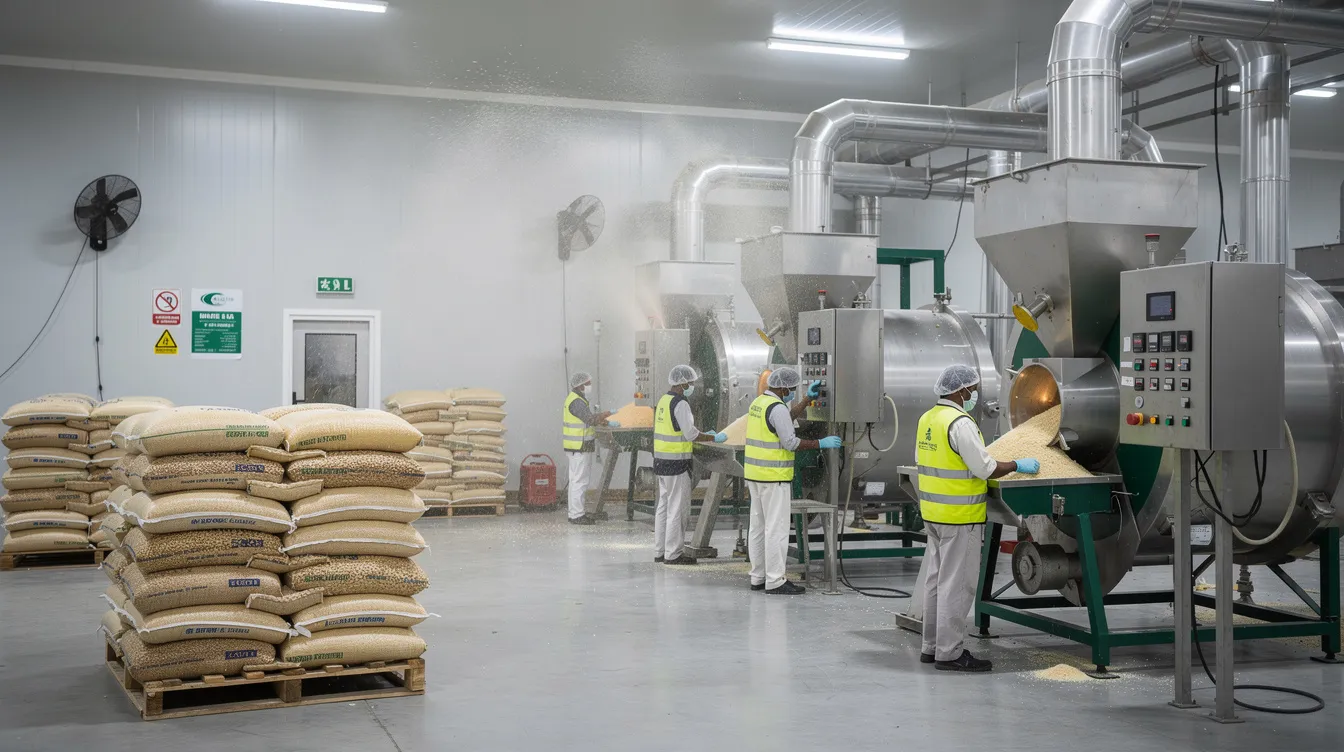
A modern puffed rice making business should diversify across multiple channels. Revenue models include bulk sales and retail packaging of puffed rice products.
- Bulk / Loose Murmura: Supply to wholesale markets, mandi traders, distributors, and namkeen manufacturers. B2B bulk wholesale is a primary income source for most plants. Margins are tight, but turnover is fast and packaging cost is minimal.
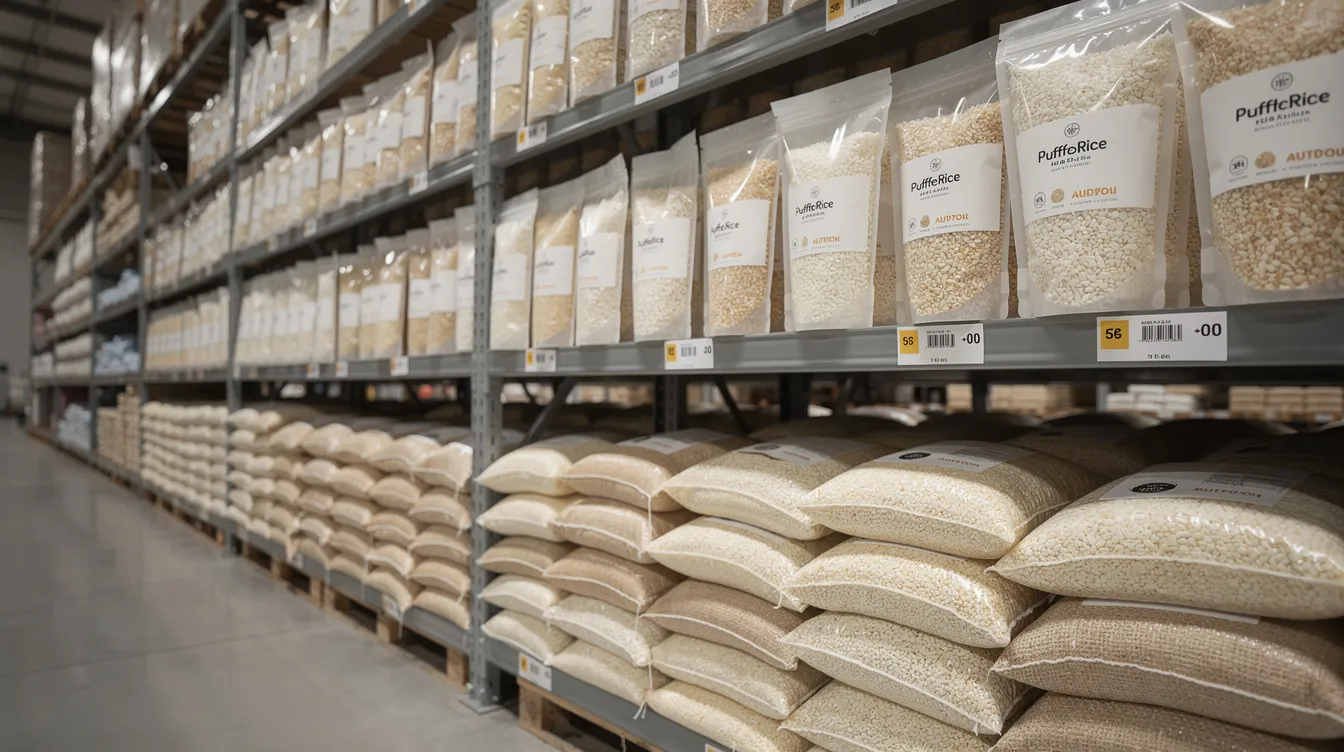
- Packaged Retail Murmura: Own-brand or private-label pouches (100g, 200g, 500g, 1kg). Retail packaging increases profit margins through attractive branding and clean sorting. Branding and attractive packaging can command premium pricing.
- B2B Supply: Standard-grade puffed rice for chivda, snack mixtures, and bhel manufacturers. B2B supply to street food vendors ensures steady volume. B2B contract packaging provides steady production contracts for manufacturers. Key customers for puffed rice include local vendors and snack stalls.
- Value-Added Products: Masala murmura, flavoured bhel mixes, diet murmura, roasted puffed rice mixes. Value addition through flavoured variants boosts profit margins; one project report platform estimates flavoured variants at 50-70% gross margin versus 30-50% for plain murmura. Puffed rice is a popular ingredient in healthy snacks like Bhel Puri, a widely consumed street food across India. Health trends are driving demand for lower-calorie snack options like puffed rice. Puffed rice is low in calories compared to regular rice, is a reliable source of fiber, and contains gamma-oryzanol, which lowers cholesterol levels; these various health benefits position it well as a nutritious street food and a popular low-cost breakfast cereal worldwide. Flavoured puffed rice variants target health-conscious urban consumers seeking a healthy snack food.
- Institutional / HoReCa: Caterers, temples, canteens, hostel messes. Larger bulk sacks; price negotiation is strong.
- Export / Ethnic Markets: Attractive but demands superior packaging, traceability, and compliance with importing-country food safety norms.
Product Mix Planning for a Puffed Rice & Murmura Plant
Product mix refers to the proportion of total production allocated to bulk puffed rice, packaged murmura, value-added products, B2B supply, and private-label manufacturing. An optimal puffed rice product mix maximises contribution margin while controlling demand risk and working capital requirements.
Illustrative product mix (indicative only, for a 5-6 TPD plant):
| Product Line | Share of Output | Target Channel |
|---|---|---|
| Bulk loose murmura | 50% | Wholesale, mandis |
| Own-brand packaged murmura | 25% | Retail, kirana, modern trade |
| B2B to namkeen/snack units | 15% | Industrial processors |
| Value-added/flavoured SKUs | 10% | Retail, online, premium |
The optimal mix varies: a plant near rice belts (West Bengal, Odisha) may lean toward bulk supply, while one near metro cities can allocate more to branded retail. In a puffed rice plant project report, financial projections should be built product-wise rather than using a single average selling price.
Loose Murmura vs Packaged Murmura Business Model
Most puffed rice plants in India start with bulk loose supplies, then gradually add packaged and branded murmura as they build market confidence.
| Parameter | Loose Murmura | Packaged Murmura |
|---|---|---|
| Selling price per kg | Lower (indicative ₹30-40/kg) | Higher (indicative ₹55-70/kg) |
| Packaging cost | Minimal (sacks) | Material: laminates, pouches, labels |
| Branding spend | Negligible | Required for shelf appeal |
| Distributor/retailer margin | Lower | Higher |
| Working capital intensity | Lower | Higher (packaging stock, receivables) |
| Margin per kg | Tighter | Better if distribution is adequate |
| Volume potential | Higher, faster rotation | Slower build, but brand equity grows |
Both models can coexist within one plant. Allocate part of capacity to each based on demand and seasonality. Market demand for puffed rice is heightened during festivals and cultural events, and seasonal and festival demand can spike revenue for either model.
Pricing Strategy & Cost-Based Decisions
A structured puffed rice pricing strategy must cover all cost components and leave adequate contribution. Simply undercutting competitor prices damages long-term viability.
Key cost components to consider: paddy or rice cost (the basic raw material), fuel and power for heating rice, labour, packaging material, freight, QC and rejections, distributor and retailer margins, admin and selling overheads. Raw material costs and packaging quality directly influence income in the puffed rice market. Raw paddy price and availability directly affect profit margins in the industry.
Raw material grade, moisture level, and expansion ratio affect both cost per kg and achievable selling price. Better expansion from quality rice grains reduces finished-product cost; details on sourcing are covered in Raw Material Planning for Puffed Rice & Murmura Manufacturing. Operating costs such as boiler fuel, electricity, and manpower are detailed in Puffed Rice Plant Utilities, Power & Manpower Requirements.
Contribution margin (selling price minus variable cost per kg) determines what each unit contributes toward fixed costs, interest, depreciation, and promoter remuneration.
Revenue Assumptions for DPR, Financial Projections & Illustrative Calculation
When structuring revenue assumptions for a bankable puffed rice manufacturing project report, follow this sequence: define installed capacity, set operating days, apply a capacity utilisation ramp-up, subtract process loss, allocate output by product mix, and assign selling prices per product line.
| Year | Indicative Utilisation |
|---|---|
| Year 1 | 50-60% |
| Year 2 | 70-80% |
| Year 3 onward | 80-90% |
Illustrative revenue model (hypothetical 3 TPD plant):
- 3,000 kg/day x 300 days = 900,000 kg/year installed output
- At 60% utilisation: 540,000 kg gross output
- After 10% process loss: 486,000 kg saleable
- Bulk (60%): 291,600 kg x ₹35/kg = ₹1.02 crore
- Packaged (30%): 145,800 kg x ₹60/kg = ₹0.87 crore
- Value-added (10%): 48,600 kg x ₹100/kg = ₹0.49 crore
- Total indicative revenue: ~₹2.38 crore/year
This is for understanding the puffed rice revenue model only. Actual figures must reflect your plant capacity, local prices, product quality, and market. For expected output at each Puffed Rice Manufacturing Process & Process Flow Chart stage, process loss assumptions should be validated against your technology and rice variety.
From Revenue to Profitability: Gross Margin, Contribution & Cash Accrual
Turnover alone does not reflect bankability. A North Karnataka economic study found net return per quintal of paddy processed into murmura at approximately ₹1,355 against total cost of ₹2,499 and gross return of ₹4,073.
- Turnover: Total sales revenue
- COGS: Raw material, fuel, labour, packaging, process loss
- Gross Profit: Turnover minus COGS
- Contribution: Turnover minus all variable costs; this covers fixed costs
- EBITDA: Earnings before interest, tax, depreciation
- Cash Accrual: Net profit plus depreciation; the actual cash left after all outflows
Value-added products may show higher gross margin but also carry higher marketing, packaging, and inventory costs. If a plant projects only high-margin SKUs without the distribution capability to sell them, the DPR becomes unrealistic for bankers.
CA Manish Gugliya’s Practical View: Projecting revenue from flavoured or premium SKUs is acceptable only when the promoter can demonstrate a credible distribution plan. Banks will discount projections that assume immediate high-margin sales without evidence of channel readiness.
Market Segmentation, Geographic Focus & Distribution Strategy
| Customer Segment | Typical Pack | Credit Terms | Margin Sensitivity |
|---|---|---|---|
| Wholesale / Mandis | Bulk sacks (25-30 kg) | 7-15 days | High |
| Kirana retail | 200g, 500g, 1kg pouches | Cash to 15 days | Medium |
| Modern retail / Supermarkets | Branded pouches | 30-45 days | Medium-High |
| Namkeen / Snack manufacturers | Bulk bags | 15-30 days | High |
| Institutional (caterers, temples) | Bulk sacks | 15-30 days | High |
| Private label / Contract | As specified | Per contract | Varies |
| Online / D2C | Premium packs | Prepaid / COD | Lower |
E-commerce and modern retail are growing distribution channels for puffed rice, especially for branded and flavoured products.
Geographic strategy should start local (district/taluka), then expand to state-level and adjoining states. Puffed rice is bulky but lightweight; freight cost per kg becomes material over long distances. Plant location relative to both raw material sources and markets matters; for layout considerations, refer to Puffed Rice Plant Land, Building & Plant Layout Requirements. Excessive credit to distributors increases working capital pressure and receivable risk.
Branding, Packaging & Raw Material Strategy
Quality control and compliance with food safety norms (FSSAI) enhance brand value and enable premium pricing. A branded puffed rice or packaged murmura product line requires a clear brand name, consistent quality promise, and clean labelling. Regional positioning in Tier-2 and Tier-3 cities can build strong repeat purchase before competing with national brands.
Murmura loses crispness quickly when exposed to humidity, making barrier-quality packaging material essential for shelf life. Common packaging formats range from bulk sacks for institutional supply to premium laminated pouches for modern retail.
Raw material strategy directly affects expansion ratio, lighter and crispness characteristics, colour, breakage, and selling price. Choice between parboiled and raw rice, moisture levels, and kernel consistency all influence the puffed rice profit margin. Stable procurement is a pillar of the revenue model; refer to Raw Material Planning for Puffed Rice & Murmura Manufacturing for detailed guidance.
CA Manish Gugliya’s Practical View: Compromising on raw material quality to save ₹1-2 per kg on procurement often reduces expansion ratio and product appearance, lowering realisable selling price by ₹3-5 per kg. The net effect is negative.
Machinery, Project Cost Alignment, Capacity Utilisation & Working Capital
Modern continuous puffed rice processing plants offer better uniformity and lower breakage than traditional sand filled oven methods. Automation in production can reduce labor overhead and increase output consistency. Choose machinery matched to planned capacity and product mix; details on equipment are covered in Puffed Rice & Murmura Plant Machinery Cost. The minimum investment for a small-scale puffed rice unit starts at approximately ₹10 lakhs, scaling up with capacity and automation.
Over-investing in machinery capacity beyond realistic market demand raises depreciation and interest burden, increasing the break-even point. Project cost must align with revenue potential; refer to Puffed Rice & Murmura Plant Project Cost & Means of Finance for debt-equity structuring. A Karnataka study observed average capacity utilisation of about 55.8% among murmura units, underscoring why DPR projections should assume gradual ramp-up.
Working capital cycle spans rice or paddy procurement, packaging material stock, finished goods inventory (especially for packaged SKUs), and trade receivables from distributors and B2B buyers. Byproduct monetization, such as selling broken rice or husk, reduces operational waste and improves cash flow.
CA Manish Gugliya’s Practical View: High-margin, slow-moving value-added products can strain working capital more than basic bulk murmura. A ₹5 lakh finished-goods inventory of flavoured SKUs sitting unsold for 45 days costs more in locked capital than ₹5 lakh of bulk murmura rotating every 10 days.
Risk Assessment & Strategies to Improve Revenue and Profitability
A sound puffed rice business model must recognise and address risks openly.
| Risk | Mitigation Strategy |
|---|---|
| Paddy/rice price volatility | Forward contracts; multiple suppliers; buffer storage |
| Price competition in bulk murmura | Diversify product mix; improve quality |
| Quality inconsistency | SOPs for moisture, grading; test batches |
| Low capacity utilisation | Advance buyer tie-ups; phased capacity investment |
| Dependence on few B2B buyers | Expand customer base across segments |
| Delayed payments | Strict credit policies; prefer shorter terms |
| Rising packaging/freight costs | Bulk sourcing; locate plant near markets |
| Product spoilage and breakage | Better packaging barrier; handling training |
Practical steps to improve puffed rice plant profitability: increase utilisation, reduce wastage, optimise raw material procurement, improve product mix toward higher-contribution items, expand distribution reach, and monitor overheads.
Market Entry Strategy for New Entrepreneurs & Bank Finance Perspective
A phased approach reduces risk for a new puff rice manufacturing business:
- Phase 1: Local bulk sales and B2B buyers; stabilise production, procurement, and cash flows
- Phase 2: Expand distributors into neighbouring districts and state-level wholesale
- Phase 3: Launch branded packaged murmura in selected retail channels
- Phase 4: Introduce value-added products (masala murmura, flavoured mixes, snack foods served as savoury snack originating from Indian tradition) once base distribution is stable
Each phase increases marketing spend and working capital intensity. Move forward only after stabilising the previous phase.
From a bank finance perspective, lenders look for realistic capacity, clear product mix, conservative utilisation ramp-up, sensible selling prices, and a credible distribution plan. Bankers test puffed rice financial projections under sensitivity scenarios: what if sales are 20% lower, or raw material costs rise 15%? The project must still service term loans. Refer to Puffed Rice & Murmura Plant Project Cost & Means of Finance for structuring finance.

CA Manish Gugliya’s Practical Insights (Consolidated Box)
1. Do not overestimate turnover. Projecting high sales in Year 1 without confirmed orders or an established distribution network reduces your DPR’s credibility. Banks expect conservative assumptions with clear justification.
2. Use product-wise revenue analysis, not a blended average. A single average selling price across all output masks the true economics of each product line. Product-wise projections reveal which segments contribute and which consume margin.
3. Control distributor credit to protect cash flow. Offering 30-45 day credit to distributors without monitoring collections can create a working capital trap. Set credit limits and enforce them from the start.
4. Match capacity to market reach before buying machinery. A 10 TPD machine makes no financial sense if your distribution supports only 3 TPD of actual sales. Over-capacity inflates depreciation and interest without generating corresponding revenue.
5. Realistic ramp-up improves DPR credibility. Showing 50-60% utilisation in Year 1 and 80-85% by Year 3 signals maturity and honesty. Banks respond better to conservative projections backed by a credible market plan.
FAQ: Puffed Rice & Murmura Revenue Model, Product Mix & Market Strategy
These questions address common concerns raised by entrepreneurs preparing a puffed rice business plan in India.
How does a puffed rice manufacturing plant actually earn revenue in India?
Puffed rice plant revenue comes from selling bulk loose murmura to wholesalers and mandi traders, packaged retail products through distributors and kirana stores, B2B supply to namkeen and snack manufacturers, institutional contracts, and occasionally export sales. Each stream is priced per kg or per pack based on product type and channel.
What capacity utilisation should be assumed for initial years in projections?
There is no universal standard. Utilisation assumptions should reflect plant size, promoter experience, confirmed orders, and market plan. A gradual ramp-up (50-60% in Year 1, 70-80% in Year 2, stabilising at 80-90%) is typical in bankable DPRs. Projecting immediate full utilisation without justification weakens credibility with lenders.
Is packaged murmura always more profitable than loose puffed rice?
Not necessarily. Packaged murmura may offer higher realisation per kg but also requires higher packaging cost, promotion expenses, retailer margins, and working capital. The net murmura profit margin must be evaluated after all costs. Many plants combine both models to balance cash flow and margin.
What factors affect the selling price of murmura?
Selling price depends on raw material grade, process efficiency, product quality (expansion ratio, colour, breakage), packaging format, brand strength, geographic market, distributor margins, and competitor pricing. The puffed rice market in India varies by region; prices in metro retail differ from rural wholesale rates.
How can a puffed rice manufacturer increase profitability?
Focus on increasing capacity utilisation, reducing process loss and breakage, improving raw material procurement, shifting product mix toward higher-contribution items, expanding distribution to new territories, controlling credit terms, and maintaining consistent quality. The growing puffed market attributed to health trends and the expanding Indian processed food industry, snacks industry, and food manufacturing industry also creates tailwinds for well-positioned manufacturers in this profitable food processing business and agro based profitable projects space, whether producing puffed food, flaked rice, puffed wheat, or processed food products across the Asia Pacific region, with equal sized servings and hot air popping or heating wheat grains methods creating lighter textures and fewer calories per serving.
Conclusion
Long-term success of a puffed rice manufacturing business in India depends on a well-designed murmura revenue model, a carefully chosen product mix, realistic capacity utilisation, disciplined pricing, and a distribution strategy matched to working capital capability. The puffed food market and rice production sector offer real opportunity, but profitability requires connecting technical capacity with market demand in one integrated financial picture.
A bankable puffed rice plant project report should link machinery selection, raw material strategy, rice processing capacity, market segmentation, and product-wise revenue assumptions into projections that withstand bank-level scrutiny. Whether your project involves puffed rice processing, rice making, food processing projects, beverage industry projects, or a start food processing industry venture, the fundamentals of revenue planning remain the same.
Entrepreneurs planning a new puffed rice, murmura, poha, rice processing plant, or other food production business may obtain professional assistance for preparation of a detailed project report, financial projections, CMA data, feasibility analysis, and bank finance documentation from CA Manish Gugliya through ProjectReportBank.com. No guarantee of projected financial results or bank finance approval is implied.
Author
CA Manish Gugliya Chartered Accountant | Project Report, DPR, CMA Data & Project Finance Consultant ProjectReportBank.com