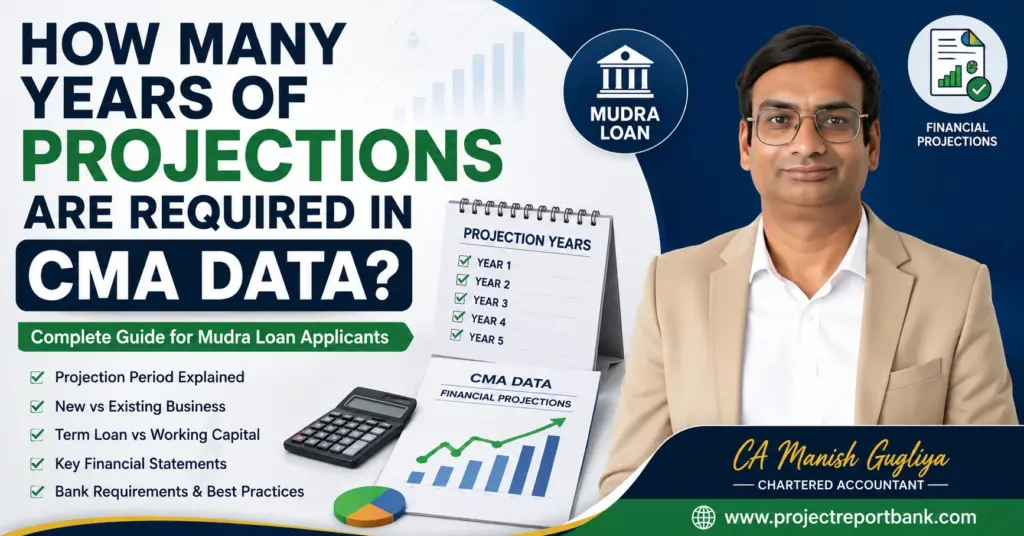
When preparing cma data for a mudra loan application, one of the first questions entrepreneurs ask is: how many years of financial projections should I include? The short answer is that most banks expect 3 to 5 years of future projections, but there is no single universal rule. The appropriate projection period depends on the loan type, loan amount, repayment tenure, and the specific bank’s appraisal requirements. In this article, I explain exactly how to determine the right projection period for your CMA data, what financial statements need to be projected, and how to avoid the mistakes that lead to delays or rejections.
Key Takeaways
- For mudra loan CMA data, many indian banks commonly ask for 3 to 5 years of financial projections. CMA data packages typically cover past financials and future projections of 3 to 5 years. However, no single rule applies to every lender or every file.
- Term loan projections are usually aligned with the full loan repayment period (often 4–5 years), while working capital projections may focus on the next 2–3 operating years.
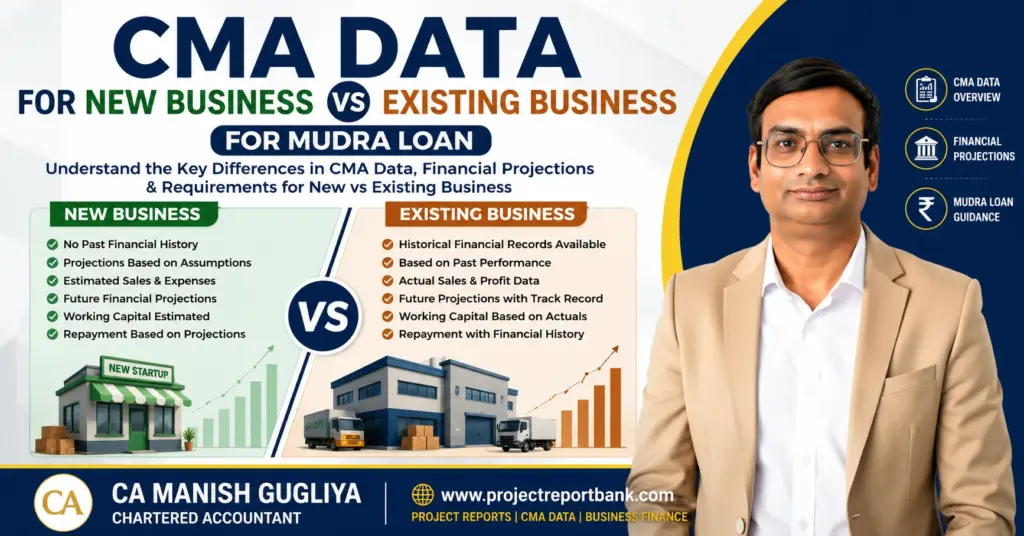
- A new business relies entirely on future projections since historical financials are unavailable. An existing business must combine past financial data with projected financial statements.
- CMA data validates business viability for collateral-free loans up to ₹10 lakh under PMMY, and CMA data is necessary for msme loan applications, government scheme loans including pmegp loan and stand up india, and credit limit enhancements.
- CMA data helps marginalized segments prove creditworthiness to banks and financial institutions. As of March 2026, PMMY disbursed about ₹40.07 lakh crore across more than 57 crore accounts.
- The safest approach: follow the specific instructions given by your bank and be prepared to revise or extend the CMA data projection years if the lender requests it.
What Is the Projection Period in CMA Data?
The projection period in CMA data refers to the number of future financial years for which you prepare forward-looking financial statements as part of your business loan application. CMA stands for credit monitoring arrangement, and credit monitoring arrangement data is a structured financial report used by banks to appraise the creditworthiness of loan applicants. If you are new to this subject, the complete beginner guide on CMA data for Mudra Loan explains the basics in detail.
CMA data includes historical financials and projections used to evaluate loan applicants’ viability. The projection period is distinct from:
- Historical actual figures – for example, audited financial statements for FY 2022–23 and FY 2023–24, drawn from your books of account, ITR filings or bank statements.
- Current year estimated figures – for example, FY 2024–25 provisional results based on actual performance so far and reasonable estimates for the remaining months.
- Future projections – for example, FY 2025–26 through FY 2029–30, showing expected turnover, profitability, working capital, and repayment capacity.
CMA data refers to structured financial projection reports used to appraise credit risk. CMA reports focus on credit appraisal for banks, helping the banker look beyond the current year to assess whether your business idea will generate enough cash accruals to service the proposed term loan and working capital borrowings over the coming years.
How Many Years of Projections Are Usually Prepared for a Mudra Loan?
There is no fixed regulatory mandate from RBI, MUDRA or PMMY stating that every mudra loan CMA data file must contain exactly a specific number of projection years. In practice, how many years of projections for mudra loan CMA data you prepare depends on the loan type, the amount, and your bank’s expectations. CMA data projections assist in determining loan amounts micro-enterprises are eligible for, and CMA data projections dictate how loans get sanctioned at the branch level.
In many practical cases – particularly for mudra loan amounts under Kishore (₹50,001 to ₹5 lakh) and Tarun (₹5 lakh to ₹10 lakh) categories – professionals prepare 3 to 5 years of future projections. For very small Shishu category loans (up to ₹50,000), some banks accept shorter projection periods of 2–3 years or even simplified formats. Most banks and cooperative banks require cma reports for loans above ₹10–25 lakh, though many branches ask for them at lower thresholds for mudra loan project applications.

| Situation | Possible Projection Approach | Why It May Be Relevant |
|---|---|---|
| Small working capital mudra loan (Shishu/Kishore, short cycle) | 2–3 years of projections | Operating cycle is short; annual review covers ongoing needs |
| Term loan for machinery under Tarun category, 5-year repayment | Projections covering the full 5-year repayment tenure | Shows debt servicing capacity across the entire repayment schedule |
| Composite facility (term loan + cash credit limit) | 4–5 years covering both term loan repayment and stabilised working capital cycle | Allows assessment of both instalment coverage and operational liquidity |
| Bank specifically asks for 3 years or 7 years | Follow the bank’s specific instruction | Matches the lender’s internal appraisal format and credit teams’ requirements |
This table is illustrative only – it is not an official RBI or MUDRA rule. The final CMA data projection period for mudra loan should follow your sanctioning bank’s written or verbal guidance.
Is 5-Year Projection Mandatory in CMA Data for Mudra Loan?
No, a 5-year projection is not universally mandatory for all mudra loan CMA data. It is a common convention adopted in many project reports and by professional preparation services, but it is not a legal requirement for every file. CMA data helps demonstrate financial viability for msme loan schemes, and positive CMA data projections enable banks to approve larger loans without collateral – but the number of years is flexible.
Five-year financial projections for mudra loan are commonly prepared when:
- The proposed term loan or composite loan has a repayment period of 4–5 years.
- The bank’s credit policy or appraisal checklist specifically requests 5 years of projected financial statements.
- The business model has a longer stabilisation period, such as a small manufacturing unit installing new machinery that takes time to reach break even.
Shorter projection periods (2–3 years) may be acceptable when:
- The mudra loan is for a very small limit under Shishu or small Kishore facilities for trading or service businesses with short operating cycles.
- The bank uses a simplified appraisal format for smaller loan applications.
Practical tip: Avoid insisting that “5 years is compulsory” or “3 years is enough.” Instead, ask your branch or credit officer what CMA data projection period they expect for your specific proposal. Longer projections can help demonstrate sustainability, but only if the projected financials are realistic, consistent, and supported by logical financial assumptions.
Table of Contents
Projection Period for a New Business
When a new business applies for a mudra loan, there are no historical financial statements to draw upon. The CMA data projections for mudra loan are built entirely on estimated and projected financial statements. For readers interested in the specific differences in cma preparation, the article on CMA data preparation for new business versus existing business for Mudra Loan covers this in detail.
For a new business, the projection period is usually aligned with:
- The proposed term of the loan (for the term loan component).
- At least the first 3–5 years of operations, showing ramp-up in turnover and profitability from the initial business idea to a stabilised operating level.
The key elements to project year-wise include:
- Projected turnover and sales projections, including monthly sales patterns where the format requires it.
- Capacity utilisation assumptions (for manufacturing units) and expected growth pattern.
- Projected profitability – gross profit, operating profit and net profit after interest and tax.
- Working capital requirement in terms of inventory, receivables and creditors.
- Cash accruals and expected income sufficient to cover term loan instalments.
The projected profit and loss account, projected balance sheet and projected cash flows must align with the project cost and means of finance described in your mudra loan project report.
Projection Period for an Existing Business
An existing enterprise applying for a mudra loan – whether for expansion, additional machinery or a higher working capital limit – should combine historical financial data with future projections.
Historical data typically included:
- Past 2–3 years’ turnover and profitability from audited financial statements or ITR data.
- Existing balance sheet position: fixed assets, current assets, current liabilities, and existing bank loans.
- Historical working capital cycle: average inventory days, receivable days and creditor days.
CMA data projection years for an existing business usually cover:
- One estimated current year (for example, FY 2024–25 provisional estimates).
- 2–4 further projected years beyond the current year, depending on loan type and lender requirement.
Past performance acts as the base for future financial projections. Projected growth in turnover should connect logically with historical trends and the impact of the new investment funded by the mudra loan. Projected profitability and cash accruals should reflect expected cost savings or higher margins from the funded project.
Consistency between historical financials and future figures is critical. Unexplained jumps in projected turnover or profit reduce banker confidence and can lead to queries or delays from credit teams.
Projection Period for Term Loan vs Working Capital
The CMA data projection period for mudra loan may differ depending on whether the main facility is a term loan, a working capital limit like cash credit, or a composite loan combining both. Term loan projections are usually assessed over the entire loan repayment period, while working capital projections focus on the next 2–3 financial years. For composite mudra loans, the projection period should cover both the repayment schedule of the term loan and the stabilised working capital cycle.
Term Loan Projections
For term loan components under Mudra – especially Kishore and Tarun categories – projections usually extend over the entire loan repayment period, typically 4–5 years. Banks require CMA data to assess repayment capacity for term loans, and term loans for machinery purchases need cma reports.
Key elements to cover in term loan projections:
- Aligning the projected profit and loss account with yearly instalments and interest.
- Showing depreciation on new machinery or equipment funded by the term loan.
- Highlighting projected cash accruals each year and comparing them with term loan EMIs. CMA projections indicate the borrower’s operational surplus for loan repayment capability. Lenders compute health indicators like the debt service coverage ratio and current ratio from CMA projections. CMA projections assess debt service coverage ratio to ensure cash inflows meet loan obligations.
- Ensuring the projected balance sheet each year shows the correct outstanding loan balance after scheduled repayments.
The banker uses these future projections to judge debt servicing capacity over the full repayment plan, not just in the first year. CMA projections are used to assess repayment capability and liquidity for micro-entrepreneurs.
Working Capital Projections
Working capital projections in CMA data focus on the next 1–3 years of operations because cc limit and overdraft facilities are reviewed annually. CMA data is essential for working capital loan applications, and CMA data must be submitted annually for working capital limit renewals. For practical guidance on structuring this section, see the article on detailed working capital requirement presentation for Mudra project reports.
Key elements for working capital assessment:
- Projected turnover and how it translates into monthly sales patterns.
- Projected levels of inventory, receivables and creditors based on realistic holding periods from the working capital cycle.
- Calculation of working capital requirement and working capital gap for each projected year.
- Proposed bank finance (such as cash credit limit or overdraft) to bridge the gap, while keeping sufficient own margin in current assets.
The maximum permissible bank finance is calculated through CMA data for businesses requesting loans. MPBF is calculated using Tandon or Nayak methods. The Tandon Method requires 25% of the working capital gap from the borrower, while the Nayak Method calculates MPBF as 25% of projected annual turnover. MPBF determines the maximum working capital loan a bank can sanction, and the MPBF calculation is critical for determining working capital limits. It is worth noting that RBI withdrew mandatory MPBF norms in April 1997, but many banks continue to use these methods as internal appraisal tools.
Projected working capital levels must reconcile with projected sales and cost of goods sold, otherwise the CMA data may look inconsistent.
Which Financial Statements Should Be Projected?
CMA data projections for mudra loan are built from a complete set of projected financial statements, not just rough sales estimates. CMA reports typically contain up to seven interlinked financial statements – and CMA reports include up to seven interlinked financial statements that must work together as a coherent financial report.
The main projected financial statements required in most bank loan appraisal formats:
- Projected profit and loss account (also called the operating statement) – showing sales, purchases, expenses, interest, depreciation and net profit.
- Projected balance sheet – showing fixed assets, current assets, current liabilities, term loans, cash credit limit and capital.
- Projected cash flow or fund flow statement – CMA data maps out cash flows to confirm timing of cash inflows and outflows for business operations. Cash flow statements show how cash is generated and used, including loan disbursement and repayment.
- Loan repayment schedule – year-wise or month-wise instalments and interest.
These projected statements must:
- Reconcile with each other – profit should tie to reserves and cash accruals, closing balances should become next year’s opening figures.
- Reflect consistent sales projections and working capital projections.
- Incorporate the proposed bank loan, promoter contribution, project cost and means of finance used in the loan project report.
Some banks may ask for additional analytical schedules such as ratio analysis, DSCR working, or fund flow for each year, but these are extensions of the same underlying projected financials. Completeness and internal consistency are more important than merely filling in a standard cma format template.
How Should Sales Be Projected for CMA Data?
Projected turnover is the starting point for most CMA data projection years. Careless sales projections can make the entire mudra loan CMA data unbelievable, and will undermine projected profitability, working capital, and repayment capacity downstream. CMA data evaluates projected sales growth and direct costs to validate revenue assumptions, and CMA projections evaluate profitability and sales trajectory benchmarks against local standards.
Key factors for preparing sales projections:
- Installed capacity and realistic capacity utilisation (for manufacturing units) over the projection period.
- Expected selling price per unit or service rate, considering competition, target market conditions and market analysis.
- Expected volume growth year by year, consistent with marketing efforts and industry norms.
- Seasonality or off-season months where sales may be lower.
Important principles:
- Sales should not simply be increased by the same arbitrary percentage every year without linking it to capacity, market or resources.
- For existing businesses, historical sales trend from GST returns or financial statements must be the base.
- For a new business, sales should be linked to realistic ramp-up from trial production or initial months of operation.
For detailed guidance on structuring this correctly, see the article on sales and revenue projections for Mudra project reports. Errors in sales projections will distort the entire set of projected financial statements – profitability, cash accruals, working capital requirement and DSCR are all downstream effects.
Relationship Between Project Cost, Means of Finance and CMA Projections
CMA data projections for mudra loan must be consistent with the project cost and means of finance described in the loan project report. Bankers quickly spot mismatches between these documents, and inconsistencies raise doubts about the entire proposal.
Key linkages to maintain:
- Items included in project cost (machinery, furniture, pre-operative expenses, initial working capital margin) should appear appropriately in the projected balance sheet’s fixed assets and current assets.
- The proposed mudra term loan or working capital loan must match the borrowings shown under liabilities and in the repayment schedule.
- Promoter contribution should reflect in capital or unsecured loans from promoters and must tie with the means of finance statement.
- Interest expense in the projected profit and loss account should be broadly consistent with projected outstanding bank loan balances and cc limit utilisation.
- Depreciation in projected P&L should be logically linked to the value and nature of fixed assets capitalised.
For specific formatting guidance, refer to articles on presenting project cost in a Mudra Loan project report and showing means of finance in a Mudra Loan project report. When these linkages are consistent, the CMA data looks professional and credible, helping the credit officer understand the whole project finance structure at a glance.
What Information Is Needed Before Preparing Multi-Year CMA Projections?
Reliable CMA data projections depend on collecting correct business details and financial inputs before starting calculations. CMA report preparation usually takes 5–8 working days after document collection, so gathering inputs early saves time. For a complete information checklist for CMA data preparation for Mudra loans, see the dedicated guide.
Practical checklist of information required:
- Basic business details: constitution, line of activity, location, promoters’ experience, business plan.
- Historical financial statements (if available): audited P&L and balance sheet, or ITR data for last 2–3 years.
- Current year provisional results and major changes (new customers, price changes, cost variations).
- Proposed project cost and item-wise breakup (machinery, furniture, other fixed assets, margin for working capital).
- Means of finance: proposed mudra loan amount, other bank loans, promoter capital, unsecured loans.
- Sales assumptions: expected turnover, price per unit, capacity utilisation, customer profile.
- Operating expenses: power, wages, rent, administrative expenses, selling expenses and other recurring costs.
- Working capital cycle assumptions: inventory days, debtor days, creditor days.
- Existing loans, EMIs and proposed repayment schedule for new loans.
- Applicable tax rates, expected depreciation method and interest rates used for projections.
The more accurate and well-documented these inputs are, the more robust the CMA data projection years will be during bank loan appraisal. Chartered accountants and experienced consultants who prepare bank ready project reports can help convert raw inputs into structured projections.
CMA Data vs Project Report: Do Both Use the Same Projection Period?
CMA data and the mudra loan project report are related but not identical documents. Banks may use them at different stages of business loan appraisal. The key differences between CMA Data and project reports for Mudra Loan are explained in a separate guide.
- A project report is narrative plus financial – covering business model, market analysis, technical feasibility, project cost, means of finance and high-level financial projections. Project reports include industry analysis and financial viability assessment. DPRs are detailed project reports prepared for larger financing needs.
- CMA data is primarily financial, restating historical data and future projections in the bank’s analytical format, especially for working capital assessment, CC limit proposals, and maximum permissible bank finance calculations.
In professional preparation practice, the underlying projection period is kept consistent between the project report and CMA data, but presentation formats may differ. If a bank initially asks only for a detailed project report or a sample report for a small mudra loan, the same future projections can later be adapted into CMA format if the branch requests CMA data during appraisal or loan renewal.
Can the Applicant Prepare CMA Projections?
In my experience, many small entrepreneurs can provide the basic figures and assumptions themselves, but may benefit from professional help to convert them into structured CMA data for mudra loan. CMA data helps formalize business proposals for micro-entrepreneurs lacking formal accounting backgrounds. There is no universal legal rule that only chartered accountants can prepare CMA data – the applicant or an in-house accountant can prepare estimated financial statements if they understand the link between sales, costs, working capital and repayment capacity.
Professional assistance from a CA or experienced consultant is particularly useful when:
- The proposal involves both term loan and cash credit with multiple projection years.
- The bank’s CMA format is detailed and requires fund flow, MPBF and ratio analysis.
- There are multiple existing loans or complex working capital cycles, and you need a full report covering sensitivity analysis.
Preparing CMA data does not mean a CA is “certifying” the future projections. Projections remain estimates based on agreed assumptions, not audited historical results. CMA projections should not be confused with actual loan portfolio performance post-disbursal.
Can a Bank Ask for a Different Projection Period?
Yes, banks can and often do ask for a different CMA data projection period for mudra loan than what the borrower initially prepared. Banks require CMA data for credit limit enhancements and loan renewal, and different branches – even of the same bank – may follow different internal appraisal requirements. The article on when banks may ask for CMA data for Mudra Loan covers this in more detail.
Common scenarios where the bank asks for changes:
- The bank requests an additional 1–2 years of projections to match their internal appraisal model.
- The branch suggests that projections should cover the full term of the proposed mudra term loan.
- The credit department asks for revised projections if original assumptions appear too aggressive or conservative.
What to do when the bank asks for a different projection period:
- Rework the projected financial statements using the same logical assumptions (or revised ones if necessary).
- Ensure extended projections continue to reconcile across P&L, balance sheet and cash flow.
- Submit a short note explaining key assumptions and changes from the earlier version.
Being flexible and prompt in providing revised CMA data helps avoid unnecessary delays in mudra loan sanction or loan renewal processes. CMA data is often required for working capital loans, and cma data mandatory submissions are common for annual working capital limit renewals.
Common Mistakes in Multi-Year CMA Projections
Even when the correct number of CMA data projection years is chosen, many loan applications suffer because of unrealistic or inconsistent financial projections. Unrealistic CMA projections may lead to reduced loan amounts or declines in loan applications, and realistic CMA projections help prevent small business owners from over-leveraging.
Unrealistic assumptions:
- Projecting turnover with steep, unjustified growth – for example, from ₹10 lakh in the base year to ₹60 lakh the next year without clear basis.
- Applying the same percentage growth rate every year without linking it to capacity, market or resources.
- Projecting margins far higher than industry norms with no supporting explanation.
Technical errors:
- Missing or incorrect loan instalments in projected cash flows and projected balance sheet.
- Interest expense not matching projected outstanding bank loans and cc limits.
- Mismatch between project cost and fixed assets capitalised in projections.
- Insufficient working capital leading to negative cash balances or unrealistic creditor levels.
Structural inconsistencies:
- Opening balances of one year not matching the previous year’s closing figures.
- Projected balance sheet not tallying (assets ≠ liabilities + capital).
- Copying assumptions from another business loan project report without adjusting for the applicant’s specific business model.
Banks prefer realistic, internally consistent projections over flashy numbers, especially for small mudra loan applications where bankers know local market conditions.

Practical Example of CMA Projection Period (Illustrative Only)
This is an illustrative example only. It is not a compulsory bank format. The exact number of years, instalment structure and level of detail will depend on your bank’s requirements.
Hypothetical case: A micro manufacturing unit in Jaipur plans to buy a small machine costing ₹6 lakh in FY 2025–26. The total project cost is ₹8 lakh including machinery and initial working capital. The means of finance: ₹2 lakh promoter contribution and ₹6 lakh mudra term loan under the Kishore category, repayable over 4 years.
How projections might be structured:
- Use FY 2023–24 and FY 2024–25 as historical or estimated base (if the business already exists).
- Prepare projections for FY 2025–26 to FY 2028–29 (4 projection years) to cover the 4-year term loan repayment period.
- Show gradual increase in capacity utilisation from 50% to 80% over the projection period, with corresponding sales projections.
What the CMA data would reflect:
- Yearly projected profit and loss showing revenue, expenses, interest on mudra loan and depreciation on machinery.
- Projected cash accruals and comparison with annual instalments to show comfortable repayment capacity.
- Projected balance sheet with declining term loan balance and gradually improving net worth.
In real life, the bank may ask for an additional year or require you to show expected income after the loan is fully repaid. But this example helps readers visualise how projection periods practically align with loan repayment and business stabilisation.

Expert View: CA Manish Gugliya
From my experience preparing CMA data and project reports for entrepreneurs across government schemes including mudra loan, msme loan, and project finance proposals, I have found that the focus should not be on mechanically choosing 3 or 5 years. The right projection period is one that fully covers the loan repayment period for term loans and gives a clear picture of working capital requirements and profitability for at least the near future.
What matters far more than the exact count of projection years is whether the projections are realistic, whether the sales-to-profit-to-cash accrual-to-repayment chain holds together logically, and whether the numbers are defensible when the bank asks questions. At ProjectReportBank.com, our approach is to understand the entrepreneur’s business model first and then decide the appropriate CMA data projection period in consultation with the banker wherever possible.
- Choose the projection horizon based on your financing proposal and the lender’s expectation.
- Ensure that projected figures remain explainable to both the entrepreneur and the banker.
- Treat projections as planning tools and decision-support, not guaranteed future results.
Frequently Asked Questions
Below are quick answers to common doubts about CMA data projection period for mudra loan. For a deeper understanding, refer to the relevant sections above.
How many years of projections are required in CMA Data for Mudra Loan?
There is no single fixed rule. Many mudra loan CMA data sets use 3–5 years of projections. The safest approach is to follow the projection period suggested by your bank and ensure that it sufficiently covers the loan repayment and initial stabilisation years. CMA data projections dictate how loans get sanctioned at the branch level.
Is 5-year projection compulsory for CMA Data?
Five-year projections are not universally compulsory. They are a common professional practice, especially when the loan tenure is 4–5 years. Individual banks – including financial institutions and cooperative banks – may accept shorter or longer projection periods depending on internal policy and the nature of the proposal.
Can CMA Data contain only 3 years of projections for a small Mudra Loan?
Yes. For smaller mudra limits, especially short-tenure working capital or micro term loans, some banks accept 3-year projections if the repayment schedule is fully covered and the business performance can be properly assessed within that period, subject to their appraisal norms.
Should CMA projections cover the entire loan repayment period?
For term loans, it is generally advisable that CMA projections span the entire loan repayment period so the bank can see year-wise repayment capacity. For pure working capital facilities, projections typically focus on the next 2–3 operating years and are revisited at loan renewal.
Are CMA projections treated as guaranteed financial results by banks?
No. Banks understand CMA projections are estimates based on stated assumptions. They use them to judge viability and risk, but they do not treat them as guaranteed performance or audited results. This is why transparent assumptions and realistic numbers are essential. CMA projections should not be confused with actual loan portfolio performance post-disbursal.
Final Conclusion
There is no one-size-fits-all answer to how many years of CMA data projections for mudra loan are required. Typical practice ranges from 3 to 5 years, adjusted for loan type, repayment period and bank policy.
- Term loan projections should normally align with the full loan repayment tenure.
- Working capital projections should cover the near-term operating cycle, often 2–3 years, with annual CMA submissions needed for working capital limit renewals.
- Consistent, realistic and well-explained projections carry more weight in bank appraisal than the mere number of projected years.
Always check the specific CMA data projection period required by your bank and be prepared to revise or extend projections if requested during appraisal or loan renewal. If you are just starting to understand CMA data, the beginner guide on CMA data for Mudra Loan is a practical place to begin.
The objective is not to produce impressive-looking numbers. It is to present financial projections that honestly reflect your business’s expected performance, demonstrate repayment capacity, and give both you and your banker confidence in the financing proposal.
- CMA Data for Mudra Loan: Complete Guide


- CMA Data for Mudra Loan Online – Can It Really Be Prepared from Anywhere?

- How to Make Realistic Assumptions in CMA Data for Mudra Loan

- How Banks Analyse CMA Data for Mudra Loan Applications

- How Many Years of Projections Are Required in CMA Data?
- CMA Data for New Business vs Existing Business for Mudra Loan
- Information Required for CMA Data for Mudra Loan – Practical Guide by CA Manish Gugliya

- Who Can Prepare CMA Data for Mudra Loan? Is a CA Required?

- CMA Data vs Project Report for Mudra Loan: Key Differences