Key Takeaways
- CMA data for a new business mudra loan is largely assumption-based because no historical operating financials exist. CMA data for an existing business mudra loan builds on the business’s past performance, current financial position and available records.
- Lenders may or may not ask for cma data depending on the bank, loan amount, type of facility and the complexity of the proposal. It is not universally mandatory for every mudra loan application.
- New businesses rely on projected sales, expenses and working capital based on practical assumptions such as capacity utilisation, pricing and market conditions. Existing businesses use historical turnover, profits, bank statements and GST data as the starting point for future projections.
- Well-prepared financial projections for mudra loans should be realistic, internally consistent and aligned with the nature and stage of the business. CMA data serves as a forward-looking blueprint of a new business’s economics while also acting as a reconciliation tool for existing businesses.
- At ProjectReportBank.com, CA Manish Gugliya and team can assist entrepreneurs with practical cma data preparation and financial projections for both new and existing business loan applications.

What Is CMA Data for a Mudra Loan?
CMA stands for credit monitoring arrangement. A credit monitoring arrangement report is a structured financial presentation that banks may request while appraising a mudra loan or other bank loans. It helps the lender evaluate whether the proposed business activity can generate enough cash to service the loan’s EMI and sustain itself over time.
CMA data for a mudra loan generally includes a projected profit and loss account (P&L), projected balance sheet, fund flow or cash flow statement, working capital assessment and key ratios such as current ratio and Debt Service Coverage Ratio (DSCR). CMA reports typically contain up to seven interlinked financial statements that together present a complete financial picture.
For mudra loans-especially smaller Shishu-category facilities-some banks may use a simplified appraisal process and may not insist on a full cma report. However, for Kishore and Tarun categories, banks often require structured financial packages. CMA data is required for loans above ₹10 lakhs as a general banking practice.
CMA data is a support tool for the banker’s credit decision, not a guarantee of sanction. Each lender may follow its own internal process. If you need the fundamentals, I recommend reading the article on what CMA Data means for a Mudra Loan. This article focuses specifically on how cma data differs between new and existing businesses.
Is CMA Data Different for a New and Existing Business?
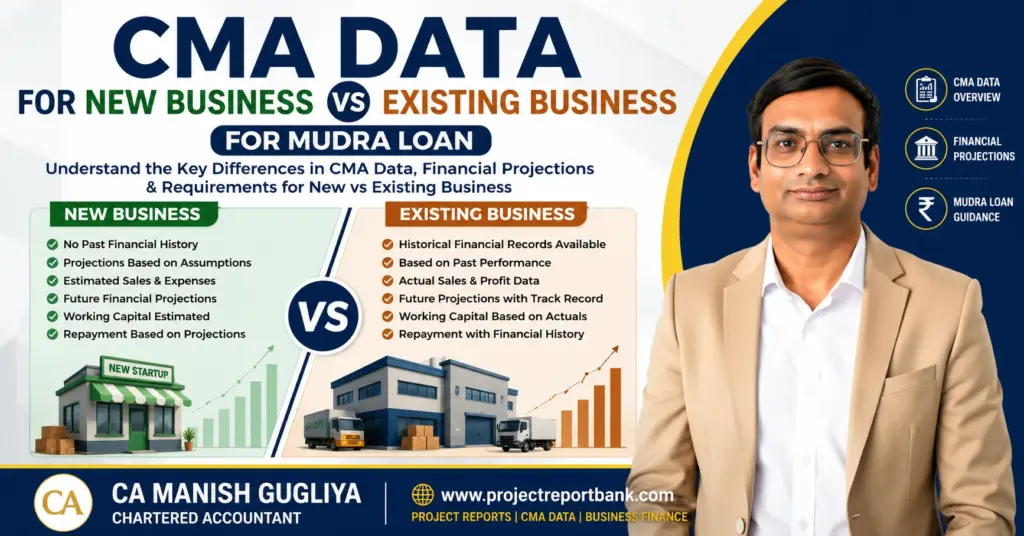
The standard cma format for a mudra loan often looks similar for both new and existing businesses-both will contain projected financial statements, working capital forms and ratio analysis. However, the underlying inputs and reliability of numbers differ significantly.
For a new business, cma data is fully projection-based. There is no past operating history, no actual turnover, and no verified expense patterns. Every number-from expected income to inventory holding days-rests on assumptions about capacity, pricing, market demand and cost structure. For new businesses, CMA is a forward-looking credit proposal rather than just an accounting statement.
For an existing business, CMA data is anchored in actual historical sales, profitability, assets, liabilities and working capital patterns. Banks can cross-verify projections against GST returns, bank statements and audited financials. The focus shifts from “Can this work?” to “Is the proposed growth realistic given past performance?”
| Particular | New Business | Existing Business |
|---|---|---|
| Operating history | None available | 1–3 years typically available |
| Turnover basis | Estimated from assumptions | Past actual turnover and current run-rate |
| Profitability | Estimated margins from industry norms | Historical gross and net margins |
| Existing assets | Only proposed fixed assets | Actual machinery, stock, debtors on books |
| Existing liabilities | Mostly the proposed loan | Creditors, existing loans, payables |
| Working capital pattern | Modelled from expected cycle | Derived from actual stock and debtor behaviour |
| Basis of projections | Market survey, capacity, quotations | Past trends + planned expansion |
| Risk factors | Higher-no track record | Moderate if past performance is stable |
Regardless of category, cma data must tell one coherent financial story that matches the business model being financed. Banks use cma data to assess repayment capacity for loans, and inconsistencies raise questions in both scenarios.
CMA Data for a New Business Mudra Loan
CMA data for a new business mudra loan is prepared entirely without historical financials. The quality of assumptions about sales, costs and working capital becomes the single most important factor. CMA data requires detailed financial projections for new business loans.
A good starting point is a clear description of the proposed business activity. For instance, consider an entrepreneur planning a readymade garment showroom in Jaipur starting April 2027-the cma data should describe the location, target customers, competitive positioning and basic business plan.
Project cost should be broken down clearly: machinery or equipment, furniture and fixtures, computers, shop interiors, initial stock, licensing expenses and a margin for working capital. Supplier quotations and rent agreements help support these figures. Total project cost must match the means of finance-promoter’s capital contribution plus the proposed mudra loan amount plus any other sources.
Sales and capacity assumptions are where most scrutiny falls. A standard CMA package outlines financial performance over typically 3 to 5 years. The operating statement details expected revenues and expenses year by year. Assumptions should cover expected monthly billing, number of customers per day, average bill size, seasonal patterns and a realistic annual sales build-up. Banks generally expect Year 1 capacity utilisation at 40–60%, not 100% from month one.
Expense projections should include purchase cost or raw material as a percentage of sales, salaries and wages, rent, electricity, marketing, travelling, maintenance, administrative overheads, depreciation and interest on the proposed loan. These feed into projected cash flows and the projected balance sheet over the projection period.
Working capital assumptions-inventory holding period, credit to customers, credit from suppliers and expected cash balance-flow directly into the CMA working capital forms, including Form IV and related schedules.
The projected profit and loss account, projected balance sheet and projected cash flows are all built from these assumptions. The proposed loan repayment schedule and interest calculations must demonstrate that the business generates sufficient cash surplus. CMA data assists in determining loan sizing and working capital needs for the banker.
Inflating sales or underestimating expenses merely to justify a larger loan amount is counterproductive. Projections must remain commercially sensible for the specific business, location and line of activity.
Table of Contents
How Are Financial Projections Prepared When There Is No Past Business Data?
First-time entrepreneurs often wonder how they can present financial projections without any business track record. The answer is that reasonable assumptions can still be built using external information and practical judgment.
Practical data sources include:
- Supplier quotations for machinery, equipment and raw materials-these pin down capital expenditure and cost of goods
- Rental listings and lease offers for the proposed area, providing actual rent figures
- Local market surveys and competitor benchmarking-visiting businesses in the same line, checking their pricing, average footfall and seasonal patterns
- Machine specifications-units per hour, working days per month, realistic utilisation ramp-up from Year 1 to Year 3
Industry norms for gross margin, salary ranges, electricity consumption and operating-cycle days can be used where direct data is unavailable. Cash flow statements track cash inflows and outflows for operations, while funds flow statements detail sources and applications of long-term funds. Together, they help verify whether projected cash generation can service the mudra loan EMI.
Break-even analysis is useful for demonstrating that projected sales are sufficient to cover fixed and variable costs. Good financial projections help build confidence with lenders regarding market understanding.
Every major assumption should be documented. For example: “Rent based on actual offer letter dated May 2026; salary based on prevailing wages in Jaipur; average debtor period 15 days based on trade practice.” This makes the cma report more credible during appraisal.
Projections are estimates, not guarantees. Banks understand this but still expect assumptions to be explainable and internally consistent.
CMA Data for an Existing Business Mudra Loan
CMA data for an existing business mudra loan starts from what the business has actually achieved. The existing business’s past performance, current financial position and available records provide the foundation for future projections.
Historical information typically used includes at least the last one or two years’ profit and loss accounts, balance sheets, GST turnover data where applicable, and bank statements reflecting sales deposits and expense payments. These audited financials or provisional statements act as a reality check on any growth assumptions.
Existing assets-machinery, furniture, stock, debtors-and liabilities-creditors, existing term loan balances, cash credit limit utilisations, unsecured loans-are carried as opening balances into the CMA projected balance sheet. If a business has an existing sanctioned limit or cash credit facility, its impact on working capital must be reflected.
Past turnover and gross profit margins serve as the base for future sales and profitability projections, adjusted for planned changes such as adding new machinery, extending business hours or introducing additional product lines. Current year estimates-for example, FY 2025–26 actuals up to December 2025-are annualised or adjusted within CMA forms to bridge the gap between historical and projected periods.
CMA data must reconcile with GST and income-tax turnover. A mismatch with GST or ITR can lead to CMA data rejection. Banks cross-verify, so consistency is non-negotiable.
Future projections should factor in the new mudra loan: incremental interest cost, new EMI outflows and any expected increase in sales from the fresh investment. CMA reports include historical financials and future projections working together.
Historical Financials vs Projected Financials
Historical financials are actual audited or provisional results from past years. Projected financial statements are forward-looking estimates prepared for credit appraisal. Both are essential components of cma data for mudra loans, but their availability and role differ between new and existing businesses.
New businesses generally do not have historical business financials, although promoters may have personal income-tax returns or past employment income. Existing businesses may provide at least one to three years of financial statements covering turnover, profit, assets and liabilities.
Historical figures guide the reasonableness check on projections-whether turnover growth, margin stability, expense ratios and working capital behaviour align with observable past trends. Balance sheet projections show projected assets and liabilities for long-term solvency, and CMA data must reconcile projected liabilities with assets for each year.
| Particular | New Business | Existing Business |
|---|---|---|
| Historical sales | Generally unavailable | May be available from past records |
| Historical profit | Generally unavailable | Available from audited P&L |
| Existing fixed assets | Only proposed/planned | Actual assets on books |
| Existing liabilities | Limited to proposed loan | Creditors, existing loans, payables |
| Working capital pattern | Estimated from assumptions | Actual trends from stock and debtor data |
| Base for growth rate | Business assumptions and market survey | Past turnover trends and current run-rate |
| Nature of projections | Entirely assumption-driven | Historical performance + future assumptions |
While projections are essential in both cases, their reliability is judged differently when a meaningful track record is available. CMA data is used in loan applications to assess repayment capacity and risk levels across both scenarios.
Information Required for Preparing CMA Data
The information list for cma preparation depends on whether the applicant is a new or existing business and on the complexity of the mudra loan proposal. CMA data preparation typically takes 3 to 5 working days, but organising inputs beforehand can significantly reduce turnaround. For the complete document checklist, refer to the guide on information required to prepare CMA Data for a Mudra Loan. Below is a summary of the main categories.
Information for a New Business
For a first-time entrepreneur, the typical inputs include:
- Aadhaar and PAN, basic KYC documents and Udyam registration details
- A note describing the proposed business activity, location and target market
- Estimated project cost breakup with quotations for machinery, furniture, interior work and initial stock
- Promoter’s own capital availability and proposed mudra loan amount
- Realistic assumptions for monthly sales quantity, selling prices, raw material cost percentages, salary structure, rent agreements and utility bills
- A simple working capital plan covering expected inventory days, debtor days and creditor days
- Business details that feed into sales, expense and fund flow projections
Information for an Existing Business
For an existing business, the inputs include:
- Audited or provisional financial statements for recent years, GST returns and income-tax returns
- Bank statements for the main current account and any existing cash credit or overdraft accounts
- Details of existing loans: sanction letters, EMI schedules, outstanding balances
- Latest stock statement, debtors and creditors ageing, and fixed-asset register or depreciation schedule
- Management inputs on planned expansion-for example, adding a second machine in April 2027 or opening a new outlet
Entrepreneurs should organise these documents before approaching a CA or preparer to provide a full report efficiently and avoid repeated revisions.
Working Capital Assessment: New vs Existing Business
Working capital assessment is central to cma data for mudra loans, especially where the facility includes a working capital limit rather than only a small term loan. CMA data helps banks determine maximum permissible bank finance, which determines the maximum working capital loan a bank can sanction.
For a new business, current assets (inventory and debtors) and current liabilities (creditors and payables) are estimated from industry practice and the proposed business model. Typical assumptions might include 30 days of stock holding, 15 days of receivables and 10 days of supplier credit. The working capital cycle is modelled rather than measured.
For an existing business, actual past patterns from stock statements, debtor ageing and creditor lists can be used to fine-tune working capital assumptions, making them more grounded.
The working capital gap-current assets minus current liabilities excluding bank borrowing-determines the bank finance required. The Tandon Committee proposed three methods for MPBF calculation. Method II requires 25% of total current assets as the borrower’s margin. The Nayak Committee method calculates MPBF as 25% of projected annual turnover. Most banks continue to use MPBF logic for working capital assessment despite RBI’s withdrawal of formal MPBF norms.
For a detailed discussion, refer to the guide on working capital requirement in a Mudra Loan project report.
Sales Projections for New vs Existing Businesses
Sales projections heavily influence cma data for mudra loans because they directly affect profitability, DSCR and working capital needs.
For a new business, sales projections should be built from the ground up: production or service capacity, realistic utilisation ramp-up (40–60% in Year 1, improving to 80% by Year 3), number of working days, average billing rate and seasonal variations over 3–5 years.
For existing businesses, past turnover trends-say FY 2023–24 and FY 2024–25-and current run-rate provide the base. Projections should show a justifiable growth path. Projecting 3–4 times current turnover in the very next year without explaining capacity additions or confirmed orders is a common red flag that bankers quickly notice. Unrealistic sales projections are a common CMA mistake across both categories.
CMA projections help banks verify operational needs against submitted loan requests. For a deeper exploration of this topic, read the article on sales and revenue projections for a Mudra Loan project report.
Project Cost and Means of Finance
Project cost and means of finance are crucial parts of cma data for both new and expansion proposals under mudra loans. Mudra loans vary by tier: Shishu up to ₹50,000, Kishore ₹50,000 to ₹5 lakh, and Tarun ₹5 lakh to ₹10 lakh-and the project finance structure must fit the category.
Typical components of project cost for a micro-unit include land lease or deposit, building renovation or interiors, plant and machinery, tools, computers, pre-operative expenses and margin for working capital.
The means of finance should logically match project cost: promoter’s capital, proposed mudra loan (term loan and/or working capital), any other sources. Total sources must equal total uses in the CMA forms. CMA data must align with RBI guidelines for bank ready reports and ensure regulatory compliance.
For a new business, the entire project cost is new. For an existing business, project cost may relate only to an addition-for example, an additional machine costing ₹7 lakh while the remaining setup is already in place.
These concepts are explained further in the guides on project cost in a Mudra Loan project report and means of finance in a Mudra Loan project report.
CMA Data vs Project Report for a New or Existing Business
While cma data and a project report are related documents, they serve different functions in a mudra loan project context. A detailed project report typically narrates the business idea, technical feasibility, market study, promoter profile and financial feasibility. CMA data focuses on structured financial statements and ratios for credit appraisal-profitability analysis, repayment capacity and working capital adequacy.
For example, a new manufacturing unit may submit a descriptive project report plus CMA forms for term loan and working capital. An existing trader seeking a working capital enhancement may rely primarily on cma data with a short business note. Neither document should be assumed to automatically substitute the other-even a sample project report or sample report template should be checked for relevance to the specific case. Banks may specify which formats they prefer.
For a detailed comparison, refer to the article on CMA Data vs project report for a Mudra Loan.
Is CMA Data Mandatory for Both New and Existing Mudra Loan Applicants?
Whether cma data is mandatory for mudra loan applications depends on the lender’s internal policies, loan amount, type of facility and whether it is primarily for working capital or a term loan. Banks may not require extensive CMA data for smaller Shishu loans, where simpler application and scoring formats often suffice.
For higher Kishore and Tarun loans-closer to ₹5–10 lakh-some branches may ask for structured projections in standard cma format, especially where a term loan component is involved. Indian banks, cooperative banks, NBFCs and financial institutions each have their own thresholds. Banks require CMA data for working capital limit renewals annually, and cma data must be submitted for loan renewal reviews.
Both new and existing businesses should be prepared to share clear financial projections and basic working capital calculations even if a full cma report is not explicitly requested. Requirements differ across banks and sometimes even across branches under government loan schemes and other government schemes, so entrepreneurs should confirm with their lender what exactly is expected. CMA data is required for loans above ₹10 lakhs as a common practice when sanctioning loans.
For a focused discussion on whether it is compulsory, read the article on whether CMA Data is required for a Mudra Loan.
Can a CA Prepare CMA Data for New and Existing Businesses?
Many entrepreneurs, especially those without a finance background, seek help from chartered accountants or tax consultants to prepare cma data and financial projections for mudra loan applications.
A CA can assist in understanding the business model, structuring project cost and means of finance, estimating working capital requirement and preparing CMA forms-projected P&L, balance sheet, fund flow and key ratios-based on information and assumptions agreed with the client. This cma report preparation is professional assistance, not a guarantee. Lenders use CMA data to evaluate repayment capacity based on projected cash flows, but the figures remain management’s estimates subject to actual future performance.
In practice, some banks may ask for CA-prepared or CA-supported statements, but this does not mean CA certification is universally compulsory for every mudra loan file. Preparation is distinct from assurance. An online tool or assisted service may also help generate preliminary projections, but complex proposals generally benefit from professional input.
For more on this, see the guide on who can prepare CMA Data for a Mudra Loan.
Common Mistakes in CMA Data for New Businesses
From my experience working with first-time entrepreneurs, certain mistakes in cma data for new business mudra loans appear repeatedly:
- Unrealistically high first-year sales without explaining how customers will be acquired or what marketing effort is planned
- Assuming 100% capacity utilisation from month one-banks expect conservative ramp-up, typically 40–60% in Year 1
- Ignoring realistic seasonality or ramp-up delays that every new business faces
- Underestimating expenses such as salaries, rent, electricity, repairs and marketing, leading to overstated profits and unrealistic DSCR
- Weak cash flow analysis that does not map monthly EMI outflows against actual expected cash generation
- Working capital gaps: assuming zero debtors in industries where credit is normal, or negligible stock despite promising fast delivery
- Project cost not matching means of finance: promoter contribution too small or loan amount not reconciling with total uses
- Copy-pasting figures from another project or a sample report template without verification against actual business details
Treat cma data as a planning tool for your own business understanding-not merely a bank document to be filled with optimistic numbers. The best project report or CMA submission is one that the entrepreneur genuinely understands.
Common Mistakes in CMA Data for Existing Businesses
Existing businesses, despite having data, often face CMA issues because historical figures, current performance and projections are not properly aligned:
- Ignoring last year’s turnover decline while suddenly projecting aggressive growth without additional capacity or investment
- Unrealistic margin improvement not supported by any change in input costs, pricing or efficiency
- Incorrect opening balances: mismatch between the last audited balance sheet and opening figures in CMA, unrecorded unsecured loans or missing statutory liabilities
- Not factoring existing EMI obligations or cash credit interest into future cash flows, which weakens perceived repayment capacity. The Debt Service Coverage Ratio ideally should be above 1.25 according to lender guidelines
- Inconsistency with GST returns and bank statements: projecting high cash sales despite historically low levels, or turnover mismatches across documents. Such mismatch with GST or ITR can lead to CMA data rejection
- Incorrect working capital calculations that ignore actual debtor ageing or creditor patterns available from existing records
Use cma preparation as an opportunity to reconcile books, returns and projections into one consistent financial narrative.
Practical Example: New Business vs Existing Business
Consider two hypothetical applicants for a mudra loan in FY 2026–27:
Applicant A – New Mobile Accessories Retail Shop
- No past sales history; entirely new venture
- Project cost: ₹6 lakh (interiors ₹1.5 lakh, initial stock ₹3 lakh, furniture and fixtures ₹1 lakh, pre-operative expenses ₹0.5 lakh)
- Means of finance: Promoter’s capital ₹2 lakh + Mudra loan ₹4 lakh
- Sales projections based on assumed footfall of 15–20 customers/day, average bill size ₹400, building up from lower levels in initial months
- Expenses estimated from local rent quotations, salary surveys and industry margins
- Working capital modelled on 30-day stock, 7-day receivables, 15-day creditor credit
Applicant B – Existing Mobile Shop Adding Second Outlet
- Existing sales: ₹18 lakh in FY 2024–25; provisional FY 2025–26 sales of ₹22 lakh
- Profit margins based on two years of historical data and current year estimates
- Expansion project cost: ₹5 lakh for second outlet (funded by ₹3.5 lakh Mudra loan + ₹1.5 lakh own funds)
- Future projections build on actual sales history plus reasonable uplift from the new location
- Working capital derived from existing stock turnover and debtor patterns

| Aspect | Applicant A (New) | Applicant B (Existing) |
|---|---|---|
| Sales basis | Footfall assumptions, market survey | Actual past turnover + expansion estimate |
| Expense basis | Quotations, industry norms | Historical cost structure + incremental costs |
| Working capital | Estimated from trade practice | Actual stock/debtor patterns extended |
| Perceived risk | Higher-no track record | Moderate-verifiable performance exists |
Neither example implies a guaranteed loan approval outcome. The difference lies in how the cma data is constructed and verified.
Which CMA Data Is More Difficult to Prepare?
Neither new-business nor existing-business cma data for mudra loans is automatically easier. Each presents distinct challenges.
New business cma preparation requires building assumptions from scratch-understanding the market, estimating capacity utilisation, pricing expenses and ensuring the projected story is commercially realistic. Sensitivity analysis and ratio analysis calculating metrics like current ratio and DSCR must all be constructed without reference data.
Existing business cma data can be challenging due to data reconciliation: aligning audited accounts, GST returns, bank statements and management explanations into a single set of figures, especially where records are incomplete or informal.
In practice, the difficulty level also depends on business complexity-manufacturing versus simple trading-the number of products and whether both term loan and working capital are involved in the mudra loan project. Careful preparation and open discussion between entrepreneur and preparer matter far more than whether the business is new or existing.
Frequently Asked Questions
Below are additional practical points that often arise when entrepreneurs begin working on cma data for new and existing business mudra loans.
How early should I start preparing CMA data before applying for a Mudra Loan?
Start at least 2–4 weeks before approaching the bank. This allows time to collect business details, refine assumptions, gather quotations and review projections with your CA. For existing businesses, additional time may be needed to reconcile historical records.
Can I update CMA data if my business plan or figures change later?
Yes, CMA projections can usually be revised and resubmitted before sanction if major assumptions change. Clearly explain the reasons to the banker so the revision appears transparent, not arbitrary.
Do I need separate CMA data for term loan and working capital under Mudra?
In many small mudra cases, a single integrated set of projections covering both components may be sufficient. However, where both term loan and working capital limit are significant, the cma data should clearly show the term loan repayment schedule and separate working capital assessment.
What if my existing business has weak historical profits-can projections still justify a Mudra Loan?
Projections can reflect improvements through cost control, better pricing or new product additions. However, they should not simply ignore past weaknesses. The cma report should realistically explain how the situation will improve rather than just showing higher profit numbers without justification.
Is CMA data needed if I am applying through a digital Mudra Loan platform?
Some digital platforms use simplified online forms or an online tool instead of full CMA formats. However, lenders may still ask for basic projections or additional financial details in CMA style if the loan project requires closer appraisal, particularly for msme loans in higher categories.
Expert View of CA Manish Gugliya
In my practice of preparing cma data and project reports for mudra loan applicants across various sectors, one principle consistently holds: projections should reflect the ground reality of the business, not what the entrepreneur thinks the banker wants to see.
For a new business, the strength of CMA data lies entirely in the logic and consistency of assumptions. Sales volume, pricing, expenses and working capital must fit the actual conditions of the business location and line of activity. A bank ready pdf or formal cma submission is only as good as the assumptions behind it. For an existing business, cma data should be examined in the context of actual past and current financial performance. Projections that completely ignore history often raise questions during appraisal.
Well-prepared cma data helps both entrepreneur and banker understand how the business will service the mudra loan-but it does not by itself guarantee loan approval. I encourage entrepreneurs to remain closely involved in the assumptions used, even when seeking professional assistance through an assisted service or CA engagement. Understanding your own numbers is the foundation of a confident loan application.
Conclusion
CMA data for a new business mudra loan is primarily assumption-driven-every number, from projected sales to working capital, is built from the business plan, market understanding and practical estimates. CMA data for an existing business mudra loan combines historical performance with future projections, offering lenders verifiable reference points alongside forward-looking estimates.
In both cases, projections must be internally consistent, commercially reasonable and aligned with the proposed business model and loan amount. The cma report should reconcile logically across all forms-operating statement, balance sheet, cash flow and ratio analysis.
Lender requirements for cma data vary across loan schemes, so applicants should confirm expectations with their specific bank. Use cma preparation as an opportunity to understand your own financial story-not just as a compliance formality. Entrepreneurs who genuinely understand the numbers behind their CMA data are better equipped to run their business and to interact confidently with bankers during the appraisal process.
- CMA Data for Mudra Loan: Complete Guide


- CMA Data for Mudra Loan Online – Can It Really Be Prepared from Anywhere?

- How to Make Realistic Assumptions in CMA Data for Mudra Loan

- How Banks Analyse CMA Data for Mudra Loan Applications

- How Many Years of Projections Are Required in CMA Data?
- CMA Data for New Business vs Existing Business for Mudra Loan
- Information Required for CMA Data for Mudra Loan – Practical Guide by CA Manish Gugliya

- Who Can Prepare CMA Data for Mudra Loan? Is a CA Required?

- CMA Data vs Project Report for Mudra Loan: Key Differences