Entrepreneurs applying for a Mudra loan frequently encounter two terms – “project report” and “CMA Data.” Because both documents contain financial projections, many applicants assume they are interchangeable. They are not. A project report is a comprehensive document that presents the overall business proposal – the idea, the promoter, the market, the machinery, and the expected financial outcomes. CMA Data (Credit Monitoring Arrangement Data) is a structured financial presentation designed specifically for credit assessment by banks and financial institutions.
Understanding this distinction matters because submitting the wrong document – or submitting both with conflicting numbers – is among the most common reasons Mudra loan applications face delays or rejection.
The short answer: A project report explains what your business is and why it is viable. CMA Data shows how the financial numbers support the lending decision. Depending on the loan amount, the nature of your business, and your lender’s appraisal process, you may need one, the other, or both. The exact documentation required should always be confirmed with your concerned bank or financial institution.
What Is a Project Report for Mudra Loan?
A project report – sometimes called a detailed project report (DPR) or bank project report – is a comprehensive narrative and technical blueprint of a business. It combines business information, project information, and financial projections into a single document that tells the lender: here is my business idea, here is how I plan to execute it, and here is why it should work.
For Mudra Loan project report basics, the typical structure covers approximately 14 sections:
- Executive summary – a concise overview of the entire proposal
- Promoter profile – education, experience, background, and KYC details
- Business description – nature of the business, products or services, the business model, and USP
- Market analysis – target customers, competition, demand trends, and market assumptions
- Technical details – machinery, manufacturing process, production aspects, location, and supplier information
- Project cost – capital expenditure on machinery, premises, pre-operative expenses, and working capital
- Means of finance – promoter contribution, bank loan requirement, and any subsidy
- Sales and revenue projections – capacity, pricing, and turnover estimates
- Profitability projections – projected profit and loss statements for 3–5 years
- Balance sheet projections – projected financial position across the projection period
- Cash flow statements – expected cash flow over the projection period
- Loan repayment schedule – how and when the loan will be repaid
- SWOT analysis and risk assessment – strengths, weaknesses, opportunities, and threats
- Annexures – vendor quotations, licenses, GST registration, Udyam Registration, and past financial statements if available
Project reports are essential for new businesses seeking term loans. They are also required for all loan categories under Mudra loans, though the depth expected varies significantly. A Shishu loan (up to ₹50,000) may only require a brief business overview and basic cost estimates. A Tarun loan (₹5,00,001–₹10 lakh) or the newer Tarun Plus category (up to ₹20 lakh for repeat borrowers, introduced in October 2024) demands a far more detailed, bankable project report with realistic assumptions.
A well-prepared project report can combine narrative and financial projections effectively, helping the lender see both the qualitative story and the quantitative feasibility of a particular project.
What Is CMA Data for Mudra Loan?
CMA Data is a standardized financial statement required by banks to analyze a borrower’s financial health. The abbreviation stands for Credit Monitoring Arrangement – a structured framework prescribed by RBI/IBA in the 1980s to bring consistency to how banks and financial institutions assess working capital and credit risk.
Where a project report tells the story of a business, CMA Data translates that story into structured financial analysis. It includes historical and projected financial information structurally designed for banks, organized into typically seven standardized statements:
- Existing credit facilities – details of all current working capital limits, term loans, cash credit facilities, utilization, and overdues
- Operating statements – historical profit and loss statements (last 2–3 years if available) plus projected profit and loss accounts
- Balance sheet – historical and projected balance sheets showing the company’s financial position
- Current assets and current liabilities – detailed breakdown of raw material inventory, work-in-progress, finished goods, debtors, creditors, and statutory dues
- Maximum permissible bank finance (MPBF) – computation using the Tandon Committee Method (typically Method II) or, for smaller proposals, the Nayak/Turnover method
- Fund flow statement – sources and uses of funds, both historical and projected
- Ratio analysis – financial ratios including current ratio, debt-equity ratio, turnover ratios, gross margin, net margin, and return on capital
Additionally, CMA Data provides a structured financial picture for analyzing repayment capacity through the debt service coverage ratio (DSCR). Banks generally expect a DSCR of ≥1.25 for Kishor and Tarun category loans, while Tarun Plus may demand ≥1.50. CMA Data focuses heavily on past audited numbers and future projections using a strict RBI format.
For a more detailed introduction, you can read what is CMA Data for Mudra Loan.
CMA reports are mandatory for loans exceeding ₹10 Lacs in India, though certain lenders may request them for smaller amounts depending on their internal appraisal process. CMA reports require historical and projected financial data – typically covering 2–3 years of historical financials and projected financials for up to 5 years.
CMA Data vs Project Report: How They Compare at a Glance
| Basis | Project Report | CMA Data |
|---|---|---|
| Primary purpose | Explains the overall business proposal and its feasibility | Provides structured financial analysis for credit assessment |
| Main focus | Business + project + financial viability | Primarily quantitative financial data and ratios |
| Business profile depth | Detailed – promoter, market, operations, technical feasibility | Limited – focuses on financial data, not business narrative |
| Financial detail level | Financial projections within broader business context | Deep – structured financial statements, ratio analysis, MPBF, DSCR |
| Working capital assessment | Can be included, often at a summary level | More structured and detailed, using standard banking methods |
| Preparation complexity | Requires market research, vendor quotations, business planning | Requires financial analysis, accounting expertise, knowledge of banking formats |
| Typical use case | New business applying for a term loan or comprehensive business loan | Existing businesses with historical performance, working capital loan assessment |
| Bank appraisal role | Explains the overall proposal to the lender | Supports the financial and credit appraisal decision |
The key takeaway: a project report tells the bank what you plan to do and why it should work, while CMA Data tells the bank whether the financial numbers support the lending decision.
Table of Contents
Primary Purpose and Focus
This is the most decisive factor when understanding the difference between CMA Data and a project report. If you grasp the purpose of each document, the rest of the comparison follows naturally.
Purpose of a Project Report
A project report exists to present and justify a business idea. Its main objective is to demonstrate that a particular project is feasible – technically, commercially, and financially. It answers the lender’s fundamental questions:
- Who is the promoter, and what is their capability?
- What is the proposed business activity?
- Is there market demand for this product or service?
- What machinery, equipment, and resources are needed?
- What is the total project cost, and how will it be funded?
- What are the expected sales, expenses, and profitability?
- Can the business repay the loan?
Project reports assess the feasibility of a specific project. They are essential for new businesses seeking term loans, where the lender has no historical performance to evaluate.
Purpose of CMA Data
CMA Data exists to serve the lender’s credit appraisal process. It is a lender-focused document that organizes the borrower’s financial data into a bank ready format. Its purpose is to:
- Present the company’s financial position – both historical and projected
- Assess working capital requirements using structured methods
- Calculate maximum permissible bank finance
- Analyze financial viability through ratios and statements
- Evaluate repayment capacity through DSCR
- Determine the borrowing capacity of the enterprise
CMA Data is used to assess working capital requirements and overall financial health. CMA data evaluates a company’s financial eligibility for loans by analyzing cash flow, profit and loss, and balance sheets.
Both documents serve different but complementary purposes. A project report without financial substance lacks credibility. CMA Data without business context lacks narrative. In many Mudra loan applications – especially for larger amounts – both are needed.
Depth of Financial Information
While both documents contain financial projections, the depth and structure of financial information differ significantly.
A project report typically includes projected profit and loss statements, a projected balance sheet, and a cash flow statement. These projections support the narrative – they show that the business described in the report can generate revenue, cover costs, and repay loans. However, financial projections in a project report are generally submitted as part of a broader document. The emphasis is on demonstrating financial viability alongside business feasibility.
CMA Data goes deeper into financial analysis. It doesn’t just present financial statements – it dissects them. Current assets are broken down by category: raw material inventory holding, work-in-progress, finished goods, debtors (with specific holding-day assumptions). Current liabilities are similarly detailed: trade creditors, statutory dues, advances received. These granular inputs feed directly into the working capital assessment and MPBF computation.
CMA reports analyze historical and projected cash flows, fund flows, and balance sheets with a level of precision that a typical project report does not attempt. Ratio analysis in CMA Data evaluates current ratio, debt-equity ratio, profitability ratios, and turnover ratios – metrics that banks use directly in their credit monitoring arrangement process.
CMA Data is mainly used for larger loan amounts where detailed financial assessment is necessary. When a bank needs to determine exactly how much working capital to finance, or whether the projected financials support the requested bank loan amount, CMA Data provides the structured framework for that decision.
CMA Data wins for financial depth and structured analysis. A project report provides financial context; CMA Data provides the financial blueprint that banks use for credit decisions.
Information Coverage and Scope
In terms of breadth, a project report covers considerably more ground.
A project report includes promoter details and operational plans as part of the loan application. It describes the business, market analysis, and socio-economic feasibility. It addresses technical feasibility – the manufacturing process, production aspects, machinery specifications, and operational workflow. It includes market analysis examining demand, competition, pricing, and customer segments. It discusses the implementation timeline and project progress expectations.
CMA Data, by contrast, is focused almost entirely on financial data. It does not describe the promoter’s background. It does not analyze the market. It does not explain the technical aspects of the business. It does not include vendor quotations, machinery specifications, or production capacity details.
Consider a small manufacturing unit applying for a Tarun category Mudra loan of ₹8 lakh. The project report would explain what the unit produces, where raw material is sourced, what machines are needed and their specifications, who the target customers are, what the competitive landscape looks like, and why the promoter is capable of running this business. CMA Data would take the projected sales, costs, and investment figures from that proposal and present them in structured financial statements – computing working capital needs, MPBF, DSCR, and financial ratios.
Project report wins for comprehensive business information. It gives the lender a complete picture of what the business is and why it should succeed, covering both qualitative and quantitative domains.
Preparation Requirements and Complexity
The skills required to prepare each document differ meaningfully.
A project report requires the business owner to articulate their business model, gather market data, obtain vendor quotations for machinery and equipment, estimate capacity utilization, describe the manufacturing process or service delivery model, and compile promoter background information. While financial projections are included, much of the work is descriptive and research-oriented. A business owner with reasonable knowledge of their trade can contribute substantially to this document, often working with a consultant or chartered accountant to refine the financial sections.
CMA Data requires deeper financial modelling skills. Preparing accurate CMA Data means understanding working capital cycles, holding-day assumptions for inventory and receivables, the Tandon Committee or Nayak method for MPBF computation, fund flow construction, and ratio analysis. For existing businesses, it requires organizing past financial statements – audited profit and loss accounts, balance sheets – and then building credible projected financials on that historical foundation. CMA reports require 2–3 years of historical financial data, which makes preparation harder for startups with no past performance to reference.
Most business loans at higher amounts involve CMA Data prepared by or reviewed by chartered accountants or experienced financial consultants who understand bank specific formats and the structured financial presentation that lenders expect.
Project report wins for accessibility to business owners. While professional help is valuable for both documents, a business owner can meaningfully contribute to and understand their own project report. CMA Data preparation generally requires stronger financial and accounting expertise.
What Is the Main Difference Between CMA Data and a Project Report?
To state it simply:
Project Report = Story and structure of the business proposal + financial feasibility
CMA Data = Structured financial presentation and analysis of the proposal/business
This is a conceptual distinction rather than a rigid rule that every bank applies identically. But it captures the fundamental difference.
Consider a practical example. Suppose a business owner wants to start a food processing unit with ₹7 lakh in Mudra loan finance:
- The project report would explain: What food products will be manufactured? What machines are needed? Where is the unit located? Who are the target buyers? What is the estimated production capacity? What is the total project cost, and how will it be funded (promoter contribution + bank loan)? What are the expected sales, operating expenses, and profits over the next 3–5 years? Can the business repay the loan?
- The CMA Data would take those same financial numbers and present them in a structured format: projected operating statements (profit and loss), projected balance sheets, current assets and current liabilities breakdowns with holding-day assumptions, working capital assessment using standard banking methods, MPBF computation, fund flow, DSCR calculation, and financial ratio analysis.
The numbers must be identical across both documents. The presentation and purpose differ.
Difference in Information Covered
A section-by-section comparison reveals how different the two documents are in what they actually contain.
Business and promoter information: A project report includes detailed sections on the promoter’s background, education, experience, and capability. It describes the business idea – products, services, the value proposition. CMA Data contains none of this. It assumes the reader already knows what the business is.
Market analysis and technical feasibility: A project report includes market analysis and technical details – competition, demand assessment, machinery specifications, supplier information, production capacity. A Project Report describes the business, market analysis, and socio-economic feasibility. CMA Data does not address market conditions, competitive dynamics, or production aspects.
Financial projections: Both documents contain financial projections, but CMA Data presents them in a more detailed and structured manner. CMA Data includes historical and projected financial information – operating statements, balance sheets, fund flows – organized in a format that feeds directly into the bank’s credit appraisal. A project report presents projections as supporting evidence for the business case.
Working capital and credit analysis: CMA Data typically provides a much more detailed working capital assessment – breaking down current assets and non-current assets, computing MPBF, and calculating capital assessment ratios. A project report may address working capital requirements, but usually at a higher level.
Ratios and repayment capacity: CMA Data generally includes formal ratio analysis and DSCR computation. While a project report may touch on repayment ability, CMA Data provides the structured quantitative basis for the bank’s assessment.
Difference in Financial Projections
Financial projections appear in both documents, but their treatment differs.
In a project report, financial projections serve to demonstrate that the proposed business can generate sufficient revenue, cover operating costs, service the debt, and provide a reasonable return. The projections are embedded within the broader narrative – after explaining the market, the capacity, the pricing, and the cost structure, the report shows expected future projections in the form of projected profit and loss statements, cash flow statements, and balance sheets.
In CMA Data, financial projections are the core content. CMA data focuses on historical and projected financial statements presented in a bank ready report format. The projections are not just summarized – they are broken down line by line. Revenue is linked to capacity and utilization. Cost of goods sold reflects raw material consumption based on holding-day assumptions. Operating expenses, depreciation, interest, and tax are individually detailed. The resulting profitability feeds into projected balance sheets, which in turn feed into working capital analysis and ratio analysis.
Common mistakes include unrealistic revenue projections and outdated data – problems that surface more visibly in CMA Data because the structured format makes inconsistencies easier for banks to spot.
When both documents are prepared, the underlying assumptions – sales figures, growth rates, expense ratios, capital expenditure, and loan amounts – must be identical. Conflicting financial projections across a project report and CMA Data is one of the top reasons Mudra loan applications face scrutiny.
Project Cost and Means of Finance: How They Fit Into Both Documents
Project cost in a Mudra Loan project report is a foundational element. It details the total investment required – machinery, equipment, building or premises, pre-operative expenses, and working capital margin. This cost structure determines how much bank loan the applicant needs.
Means of finance in a Mudra Loan project report shows how that total project cost will be funded – typically through a combination of promoter contribution (own funds) and bank finance (term loan, working capital loan, or both). MUDRA provides loans up to ₹20 lakh for income-generating micro-enterprises, and the means of finance must reconcile with both the project cost and the Mudra category being applied for.
In CMA Data, project cost and means of finance are reflected through the balance sheet projections and fund flow statements. The machinery appears as a fixed asset. The promoter’s contribution appears as capital. The bank finance appears as a term loan liability. Working capital appears in the current assets and current liabilities structure.
The critical point: these figures must match across both documents. If the project report states a total project cost of ₹9 lakh with ₹2 lakh promoter contribution and ₹7 lakh bank finance, the CMA Data’s balance sheet must reflect exactly these numbers. Any discrepancy undermines credibility and can stall loan approval.
Working Capital: Why CMA Data Can Go Deeper
Working capital is where CMA Data demonstrates its greatest depth advantage over a typical project report.
A project report may state: “Working capital requirement is estimated at ₹2.5 lakh.” CMA Data breaks this down:
- Raw material inventory – value based on consumption and holding days (e.g., 30 days of RM stock)
- Work-in-progress – value based on production cycle length
- Finished goods – based on storage duration before dispatch
- Debtors – based on credit period offered to customers
- Cash and other current assets – operating cash needs
- Less: Creditors – credit period received from suppliers
- Less: Other current liabilities – advances, statutory dues
From this, the working capital gap is computed. Then, using the Tandon Committee Method II or the Nayak/Turnover method, the maximum permissible bank finance is calculated. Under Tandon Method II, the promoter must contribute a minimum of 25% of total working capital requirements. Under the Nayak method (often used for smaller proposals), total working capital is estimated at 25% of projected annual turnover, with the bank financing 20% and the promoter contributing 5%.
Unrealistic holding-day assumptions – overstating debtor days or understating creditor days – lead to inflated MPBF requests. Bankers scrutinize these assumptions closely.
For more detail, see the working capital requirement in a Mudra Loan project report.
Sales & Revenue Projections in CMA Data vs Project Report
Sales projections drive everything – profitability, cash flow, working capital needs, and repayment capacity. Both documents must reflect the same sales assumptions, but they present them differently.
In a project report, sales and revenue projections for a Mudra Loan project report are typically presented with context: installed capacity, expected capacity utilization (often starting at 60–70% in year one and rising gradually), product-wise quantity and selling price, and growth assumptions justified by market analysis.
In CMA Data, sales figures are presented within the operating statement (projected P&L) and linked directly to the cost structure – raw material consumption as a percentage of sales, gross margins, operating expenses, and net profitability. The structured format makes it easy for the bank’s credit officer to test assumptions. If you claim 20% annual growth but your capacity utilization is already at 95%, the numbers won’t hold up.
A common mistake is using one set of sales projections in the project report and a different set in the CMA Data. Even small differences – a few lakhs here or there – create doubt about the reliability of the entire application. Monitoring outcomes at the bank level involves comparing actual performance against these initial projections, so credibility at the application stage matters.
Is CMA Data Required for Every Mudra Loan?
This question deserves a careful answer. CMA Data is not universally mandatory for every Mudra loan application. The documentation requirements depend on several factors:
- Loan amount – CMA reports are mandatory for loans exceeding ₹10 Lacs in India. For Shishu loans (up to ₹50,000), CMA Data is rarely requested. For Kishor (₹50,001–₹5 lakh), it may or may not be required depending on the bank.
- Nature of facility – A working capital loan or cash credit facility is more likely to require CMA Data than a simple term loan.
- New vs existing business – Existing businesses with historical financials are more likely to be asked for CMA Data. New businesses without past performance may submit projections within their project report instead.
- Bank’s internal requirements – Public sector banks, cooperative banks, and private banks may each have different documentation expectations. Even different branches of the same bank may vary. Some banks, such as Punjab National Bank, may have specific internal formats.
- Complexity of the proposal – A straightforward trading business may face lighter documentation requirements than a manufacturing project with multiple revenue streams.
The safest approach: confirm the exact documentation required with the bank branch where you are applying.
Can a Bank Ask for Both CMA Data and a Project Report?
Yes, and it happens regularly – especially for Kishor, Tarun, and Tarun Plus category loans.
The reason is straightforward: the two documents serve different but complementary purposes.
Project Report → explains the business proposal – who the promoter is, what the business does, what the market looks like, what machinery is needed, and why the project should work.
CMA Data → presents the financial implications – how much working capital is needed, what the projected financial position looks like, whether the business can service debt, and what the key financial ratios indicate.
For example, a small service business applying for a ₹6 lakh Tarun Mudra loan may be asked to submit a detailed project report covering the business plan, promoter profile, and project cost – along with CMA Data containing projected operating statements, balance sheets, working capital assessment, and DSCR computation. The project report tells the bank why the loan should be sanctioned. The CMA Data tells the bank whether the numbers support that decision.
Many professional service providers now prepare reports combining both the project report and CMA Data into integrated packages, typically following a 14-section format that satisfies both requirements in a single bank ready report.
Can a Project Report Replace CMA Data?
A detailed project report may already contain many of the projected financial statements found in CMA Data – profit and loss accounts, balance sheets, and cash flow statements. In that sense, there is overlap.
However, a project report does not typically include the structured working capital assessment (with holding-day breakdowns and MPBF computation), fund flow statements in the CMA format, or the formal ratio analysis that banks use in credit monitoring arrangement processes. It may not present financials in the specific bank specific formats that the lender’s appraisal system requires.
If a bank has specifically asked for CMA Data or a CMA report, submitting only a project report – even a detailed one – may not satisfy the requirement. The applicant should clarify with the lender whether their project report’s financial sections are sufficient or whether a separate CMA Data document in the prescribed format is needed.
Avoid assuming that one document automatically substitutes for the other.
Can CMA Data Replace a Project Report?
Generally, no. CMA Data is a financial report. It does not provide the business narrative, promoter background, market analysis, technical feasibility assessment, machinery details, or operational plan that a project report contains.
A bank reviewing only CMA Data would know the projected financial statements and ratios, but would not understand:
- What business activity generates those numbers
- Who the promoter is and their relevant experience
- Whether there is genuine market demand for the product or service
- What production aspects or operational model underpin the projections
- How the project cost is structured and what assets are being acquired
For most business loans – especially term loan applications for new ventures – the bank needs this contextual information to evaluate the business idea itself, not just the numbers. CMA Data should not automatically be treated as a substitute for a complete project report.
Example: Same Mudra Loan Proposal Presented in Both Documents
Consider a hypothetical food processing unit:
Proposal: An entrepreneur wants to start a small papad and snacks manufacturing unit. Total project cost: ₹8 lakh (₹5 lakh for machinery, ₹1 lakh for pre-operative expenses, ₹2 lakh for working capital). Promoter contribution: ₹2 lakh. Mudra loan requirement: ₹6 lakh (term loan of ₹4.5 lakh + working capital of ₹1.5 lakh). Projected first-year sales: ₹18 lakh.
How the Project Report presents this:
- Promoter profile – experience in food industry, relevant training
- Business description – papad and snack manufacturing, product range, USP
- Market analysis – local demand, competition, distribution channels
- Technical details – machinery specifications, manufacturing process, capacity (e.g., 50 kg/day)
- Project cost breakdown – machine-wise costs with vendor quotations
- Means of finance – ₹2 lakh own funds + ₹6 lakh Mudra loan
- Financial projections – P&L, balance sheet, cash flow for 5 years
- Repayment schedule – monthly/quarterly EMI plan
How CMA Data presents this:
- Operating statement – Year 1 sales ₹18 lakh, raw material cost ₹10.8 lakh, operating expenses ₹3.2 lakh, depreciation ₹0.75 lakh, interest ₹0.54 lakh, net profit ₹2.71 lakh
- Balance sheet – fixed assets ₹5 lakh (less depreciation), current assets detailed by category, capital ₹2 lakh + retained earnings, term loan outstanding
- Current assets and liabilities – RM inventory (15 days holding = ₹0.45 lakh), finished goods (10 days), debtors (30 days), creditors (15 days)
- MPBF computation – total current assets minus promoter margin, resulting bank finance for working capital
- DSCR – (Net profit + depreciation + interest) ÷ (loan installment + interest) = should be ≥ 1.25
- Ratio analysis – current ratio, debt-equity, profitability margins
Every number must reconcile. The ₹18 lakh sales in the project report must match the ₹18 lakh in the CMA operating statement. The ₹6 lakh loan amount must appear consistently in both.
Common Mistakes When Preparing CMA Data and Project Report Together
When both documents are submitted, inconsistencies between them are among the top rejection reasons. Based on professional experience, these are the mistakes I see most frequently:
- Different projected sales – the project report assumes ₹20 lakh first-year revenue while CMA Data shows ₹15 lakh
- Loan amount mismatch – the project report requests ₹7 lakh but CMA Data reflects ₹8 lakh in borrowings
- Project cost not matching – machinery cost differs between project cost statement and CMA balance sheet
- Means of finance not reconciling – promoter contribution stated in the project report doesn’t match capital shown in CMA
- Working capital figures inconsistent – the project report estimates ₹2 lakh working capital need, while CMA computes ₹3.5 lakh
- Machinery figures mismatched – vendor quotations in the project report don’t align with fixed asset values in CMA Data
- Profit projections unsupported – high profitability claimed without supporting sales or cost assumptions
- Unrealistic growth assumptions – full capacity utilization from year one in the project report, but CMA Data reflects gradual ramp-up
- Balance sheet inconsistencies – closing balances in one year don’t match opening balances in the next
- Copying generic CMA templates – using industry-average numbers instead of figures specific to the actual business
Each of these discrepancies signals to the bank that the applicant hasn’t carefully thought through the proposal, which directly undermines confidence in the financial analysis and repayment ability.
Important Consistency Checks Before Submission
Before submitting both documents, verify that the following items match exactly across the project report and CMA Data:
- [ ] Total loan amount requested
- [ ] Project cost – total and component-wise
- [ ] Means of finance – promoter contribution and bank finance
- [ ] Machinery and equipment cost
- [ ] Working capital requirement
- [ ] Projected sales – year by year
- [ ] Cost of raw material and direct expenses
- [ ] Gross profit and net profit
- [ ] Depreciation rates and amounts
- [ ] Interest computation (rate and amount)
- [ ] Loan repayment schedule – annual installments
- [ ] Closing balances in balance sheet across projection years
- [ ] Opening balances in each year matching prior year’s closing
- [ ] Capital account reflecting promoter contribution accurately
- [ ] Current assets and current liabilities aligning with working capital computation
This reconciliation exercise takes time but is essential. A project report and CMA Data that tell the same consistent financial story significantly improve the application’s credibility.
CMA Data vs Project Report: Which Should You Choose?
The answer depends on your specific situation:
Only a Project Report Is Requested
This is common for Shishu and smaller Kishor category applications, or when the lender’s primary concern is understanding the business idea and its viability. Focus on creating a clear, honest, and well-structured project report with credible financial projections, realistic market assumptions, and complete cost documentation.
CMA Data Is Specifically Requested
This typically occurs for larger loan amounts, working capital facilities, or when the bank’s credit appraisal process requires a specific financial report format. Prepare CMA Data carefully – ensure historical financials (if available) are accurately presented, projections are realistic, holding-day assumptions are industry-appropriate, and the DSCR exceeds the expected threshold (generally ≥1.25 for Kishor and Tarun categories).
Both Are Requested
When both documents are required – common for Tarun and Tarun Plus loans – prepare them from the same set of underlying assumptions. The project report should explain the business and its feasibility. The CMA Data should translate that same proposal into structured financial analysis. Both must reconcile completely.
If you are unsure which documents are needed, ask the bank branch where you intend to apply. Different banks, different branches, and different loan amounts can trigger different documentation requirements.
Expert View: CA Manish Gugliya
From my professional experience preparing project reports and CMA Data for MSME clients, I have observed that entrepreneurs often focus on whether a particular document is “mandatory.” While that question matters, a more useful approach is to understand what financial information the lender needs to assess your proposal – and then present it clearly, accurately, and consistently.
A project report and CMA Data should not tell two different financial stories. When both are prepared, the project cost, funding structure, sales projections, profitability assumptions, working capital requirements, and repayment schedule must be internally consistent. If your project report shows ₹15 lakh in projected first-year sales, your CMA operating statement must show ₹15 lakh. If your means of finance shows ₹2 lakh promoter contribution, your CMA balance sheet’s capital account must reflect ₹2 lakh.
I also want to emphasize that neither document guarantees loan approval. What these documents do is present your proposal in a format that enables the bank to make an informed lending decision. A bank ready report – whether it’s a project report, CMA Data, or both – demonstrates that you have thought through your business carefully and can articulate its financial position credibly.
My practical advice: do not copy generic templates. Every business is different. The holding-day assumptions for a grocery store are different from those of a garment manufacturer. The capacity utilization curve for a new restaurant is different from an established printing press. Tailor every number to your actual business, and ensure your projections are defensible if the bank asks questions.
Frequently Asked Questions
Is CMA Data the same as a project report?
No. CMA Data is a structured financial presentation – it contains financial statements, working capital assessment, ratio analysis, and credit-related computations. A project report is a comprehensive document covering the business proposal, promoter details, market analysis, technical feasibility, project cost, means of finance, and financial projections. They serve different purposes and contain different types of information, though both may include financial projections.
What is the difference between CMA Data and a project report?
The core difference: a project report explains the business idea and its feasibility, while CMA Data provides structured financial data for the bank’s credit assessment. A project report is narrative + financials. CMA Data is primarily quantitative – historical financials, projected financials, ratios, working capital analysis, and MPBF computation.
Is CMA Data compulsory for a Mudra Loan?
Not universally. CMA reports are mandatory for loans exceeding ₹10 Lacs in India, but smaller Mudra loan categories (Shishu, smaller Kishor amounts) may not require formal CMA Data. Requirements vary by bank, branch, loan amount, and the nature of the proposal. Always confirm with your specific lender.
Is a project report compulsory for every Mudra Loan?
Project reports are required for all loan categories under Mudra loans, though the level of detail expected varies considerably. A Shishu application may require only a brief business overview, while a Tarun or Tarun Plus application demands a detailed project report with realistic assumptions, financial projections, and supporting documentation.
Can a bank ask for CMA Data and a project report together?
Yes. Since the two documents serve complementary purposes – one explains the business, the other structures its financial analysis – many lenders request both, particularly for larger loan amounts. When both are submitted, all financial figures must be consistent across documents.
Can a project report replace CMA Data?
Not automatically. While a detailed project report contains financial projections, it may not include the structured working capital assessment, MPBF computation, fund flow statements, or formal ratio analysis that CMA Data provides. If a bank specifically requests CMA Data, clarify whether your project report’s financial sections satisfy that requirement or whether a separate CMA document is needed.
Can CMA Data replace a project report?
Generally no. CMA Data does not cover the promoter’s background, market analysis, technical details, machinery specifications, or operational plan. For most business loan applications – especially for new businesses seeking term loans – the bank needs this qualitative business information alongside the financial analysis.
Which contains more financial details: CMA Data or a project report?
CMA Data. It is specifically designed for financial and credit analysis – containing detailed breakdowns of current assets and current liabilities, MPBF computation, fund flow statements, DSCR calculation, and comprehensive ratio analysis. A project report contains financial projections but presents them as part of a broader business proposal rather than as standalone financial analysis.
Should financial projections be the same in CMA Data and the project report?
Absolutely. When both documents are prepared for the same Mudra loan application, the projected sales, expenses, profitability, balance sheet figures, and loan amounts must match exactly. Inconsistent projections across documents are a common reason for delays or additional scrutiny during the bank’s appraisal process.
Conclusion
A Mudra Loan project report presents the complete business proposal – the idea, the promoter, the market, the technical plan, the project cost, and the financial feasibility. It is a comprehensive document that tells the bank what the business is and why it should succeed.
CMA Data provides a structured financial presentation – historical and projected financial statements, working capital assessment, MPBF computation, ratio analysis, and DSCR – designed specifically for credit assessment by banks and financial institutions.
Neither document should be described as universally mandatory or universally interchangeable for every Mudra loan application. The documentation required depends on the loan amount, nature of the business, type of facility, and the specific lender’s appraisal process.
When both are required, they should be prepared using consistent underlying assumptions. Every financial figure – from project cost to projected sales to promoter contribution – must reconcile across documents. A project report and CMA Data that tell the same coherent financial story significantly strengthen a Mudra loan application.
Before preparing either document, confirm the exact documentation and format required by your concerned bank or financial institution.
- CMA Data for Mudra Loan: Complete Guide


- CMA Data for Mudra Loan Online – Can It Really Be Prepared from Anywhere?

- How to Make Realistic Assumptions in CMA Data for Mudra Loan

- How Banks Analyse CMA Data for Mudra Loan Applications

- How Many Years of Projections Are Required in CMA Data?
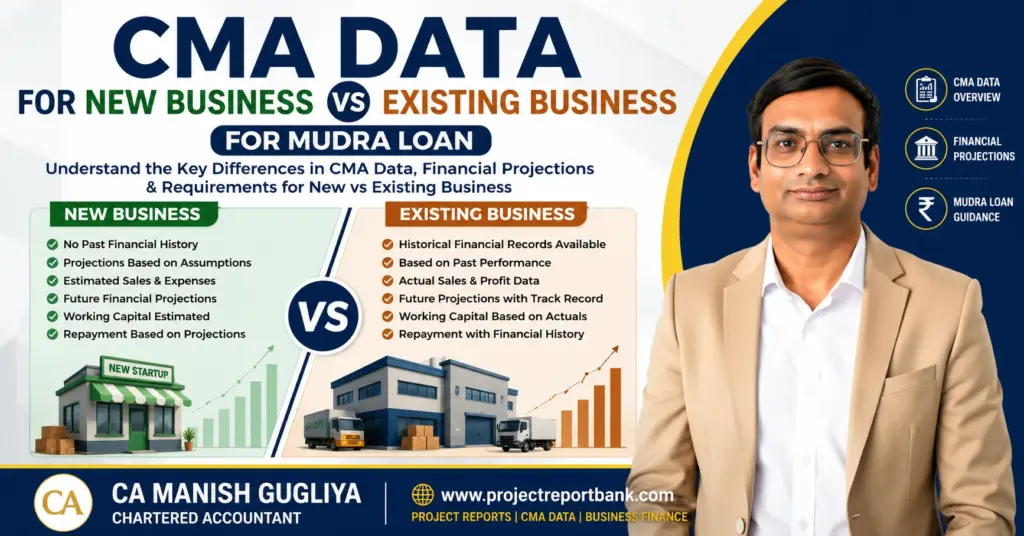
- CMA Data for New Business vs Existing Business for Mudra Loan
- Information Required for CMA Data for Mudra Loan – Practical Guide by CA Manish Gugliya

- Who Can Prepare CMA Data for Mudra Loan? Is a CA Required?

- CMA Data vs Project Report for Mudra Loan: Key Differences