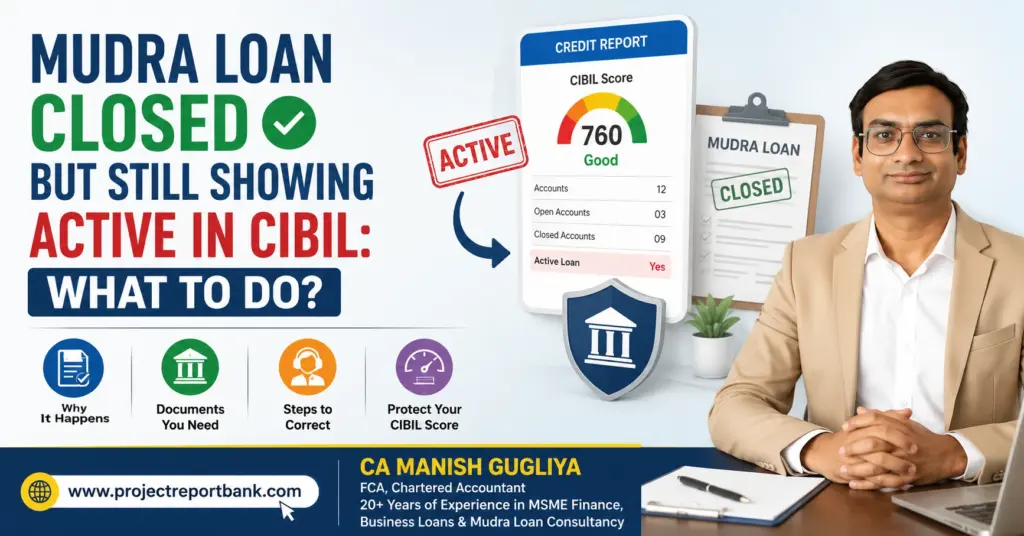
You repaid every last rupee of your Mudra Loan, the bank confirmed it verbally, and you moved on. Then you pulled your credit report for a new loan application and discovered the old Mudra Loan is still showing as “Active” with an outstanding balance. This step by step guide explains exactly why this happens, how to fix it, and what to watch out for along the way.
Key Takeaways
- A Mudra Loan can be fully repaid at the bank yet still appear “Active” in the CIBIL report because loan closure at the lender and the credit bureau update are separate processes handled on different timelines.
- If the Mudra Loan was closed very recently (within the last 30–60 days), an “Active” status may simply reflect a normal reporting lag. Anything beyond that period should be actively investigated and corrected.
- The borrower must first confirm actual loan closure with the lending bank, collect loan closure documents (NOC/No Dues Certificate, closure letter, final statement), and then check the latest CIBIL report entry for discrepancies.
- The practical solution follows a clear sequence: verify closure with the bank → get written proof → contact the bank for correction → if needed, raise a formal dispute with TransUnion CIBIL and track the resolution until the report shows “Closed.”
- One wrongly active Mudra account does not automatically destroy your CIBIL score, but it can affect future Mudra Loan or business loan applications if left uncorrected.
Table of Contents
Understanding the Problem: Mudra Loan Closed but Showing Active in CIBIL
Imagine a small business owner who fully repaid a Mudra Loan in March 2026. Four months later, while preparing a fresh loan application, she downloads her CIBIL report and finds the old Mudra Loan still listed as “Active/Open” with Rs 12,000 outstanding. The bank says the loan is done, yet the credit bureau tells a different story.
This happens because “loan closure” is a formal event inside the bank’s core system, while the “CIBIL status update” depends on periodic data that the bank shares with credit information companies like TransUnion CIBIL. A CIBIL report reflects your credit history and score based entirely on information supplied by financial institutions-it does not generate its own data. A closed Mudra Loan remaining visible in your credit history is perfectly normal as long as the status reads “Closed” with zero outstanding balances. The problem is specifically when it still appears “Active” or carries an incorrect balance.
This article is written from the perspective of CA Manish Gugliya (FCA), with over 20 years of practical experience in MSME finance, project reports, CMA data, and Mudra Loan consultancy, aiming to give practical guidance. While the focus here is on Mudra Loans under PMMY (which can be up to Rs 10 lakh for micro enterprises and small businesses), the principles broadly apply to other loans-home loan, vehicle loan, or business loan-when closure is not correctly reflected in the credit report.

Why Is My Closed Mudra Loan Still Showing Active in CIBIL?
The first thing to understand is the difference between a normal time lag and a genuine error. Not every “Active” status after repayment means something went wrong.
Legitimate reasons (normal lag):
- The loan was closed very recently and the bank’s next reporting cycle has not yet occurred.
- Most banks and NBFCs send data to credit bureaus only once a month; some follow specific reference dates (9th, 16th, 23rd, and month-end) under RBI’s Credit Information Reporting Directions, 2025.
- Technical glitches or data synchronisation delays between the bank’s system and the bureau’s database.
Error-type reasons:
- The bank has not actually marked the Mudra account as “Closed” in its core banking system, even though you made the final payment.
- A small residual amount-interest, penalty, processing fee, insurance premium, or GST-is still outstanding, and pending dues can prevent an account from being marked as closed.
- Wrong account status or closure flag sent by the bank due to administrative errors.
- Clerical mismatches in personal identifiers (PAN, name spelling, customer ID) can affect credit report accuracy and cause incorrect CIBIL ownership or loan status.
- Administrative omission at the lender’s end can lead to failure in data updates to credit bureaus altogether.
A Mudra Loan closed but showing active in CIBIL almost always means the lender’s reporting or the bureau’s update cycle has not caught up, or the bank has sent wrong loan closure information. Discrepancies can arise from incorrect documentation or lender delays, and lenders report loan status updates during regular cycles-not in real time.
First Confirm Whether Your Mudra Loan Is Actually Closed
Many borrowers assume that paying the last EMI automatically means formal loan closure. This is not always correct. Banks often require a separate closure request or foreclosure entry before marking the account as done.
Before raising any dispute, you should:
- Obtain the latest Mudra Loan account statement and verify that principal outstanding is zero.
- Look for entries related to interest, charges, or penal interest to ensure nothing is left unpaid.
- Check for a formal “loan closure” or “foreclosure” entry and date in the bank statement or loan account.
Visit or contact your lending branch-whether SBI, HDFC Bank, Bank of Baroda, a small finance banks branch, or a local cooperative bank-and ask staff to confirm in the system that the account status is “Closed” and not “Active” or “Settled.” If any amount is still outstanding (even a few hundred rupees of overdue interest or charges), the loan will remain active in lender records and therefore in the CIBIL report.
A No Dues Certificate is necessary for verifying loan closure formally. Before raising disputes, first check your Mudra Loan outstanding balance to be absolutely certain that nothing remains.
Did You Foreclose or Pre-Close the Mudra Loan?
Foreclosure or pre-closure means paying the entire outstanding Mudra Loan before the scheduled end of the original Mudra Loan repayment period. In such cases, an extra set of steps is typically involved:
- The bank generates a foreclosure statement with the exact payoff amount.
- The borrower makes a final lump-sum payment as per that statement.
- The bank posts closure entries and may charge foreclosure fees based on its policy and loan terms.
If any step is incomplete-for example, the foreclosure statement was issued but the final payment fell slightly short, or some charge was not collected-the account may remain “Active” in the system even though EMIs have stopped. Borrowers who have foreclosed should double-check that the date and amount of last payment match the foreclosure statement, and that the bank has issued a closure acknowledgement or objection certificate. For a detailed walkthrough, refer to the Mudra Loan foreclosure process.
How Long Does It Normally Take for a Closed Mudra Loan to Update in CIBIL?
There is no single fixed legal number of days that applies to every bank, but industry practice is fairly consistent.
- Loan closure updates typically take 30 to 45 days to reflect in CIBIL. This was also confirmed in a parliamentary reply in the Lok Sabha regarding credit information timelines.
- Lenders report loan closure to CIBIL within 30-60 days, depending on internal reporting cycles.
- If a dispute is required, CIBIL takes up to 30 days to resolve disputes once the bank furnishes its response.
If the Mudra Loan was closed less than 30 days ago, it can be reasonable to wait for the next reporting cycle. But if a loan closed more than 60 days ago still shows as “Active” or carries an incorrect amount, it is time to start the formal correction process.
One important clarification: “Closed” in CIBIL does not delete the account. The loan typically remains in your credit history for several years as part of your repayment record, which is normal and often positive for your credit profile.
Documents You Should Collect Before Asking for CIBIL Correction
Solid loan closure documentation makes banks and credit bureaus take a correction request more seriously and speeds up the dispute resolution process. Gather loan closure documents before contacting your lender.
Checklist of required documents:
- Mudra Loan account number and bank/branch details
- Latest loan account statement showing nil outstanding
- Loan closure letter or written email confirmation from the bank
- NOC / No Dues Certificate or Mudra Loan closure certificate
- Proof of final payment (RTGS/NEFT slip, UPI screenshot, demand draft receipt, or stamped cash receipt)
- Bank statement (savings or current account) showing debit of final payment
- Latest CIBIL report page where the Mudra Loan still appears “Active” or with wrong figures
- Any earlier emails or complaint numbers related to loan closure
Keep soft copies (PDF or clear photos) of all the necessary documents in a dedicated folder. Ensure that your identity details-name, PAN, date of birth, mobile, email-are consistent across bank records and CIBIL account to minimise confusion during verification. For joint Mudra Loans or loans with guarantors, collect the same documentation for all persons whose names appear in the CIBIL entry.
Step-by-Step: What to Do If Mudra Loan Is Closed but CIBIL Still Shows Active
This is the core action section. Follow these numbered steps in order.
Step 1 – Reconfirm closure with your bank. Visit or contact the lending branch. Ask staff to verify on their system that the loan status is “Closed” and the outstanding balance is zero. If the bank’s own records are not updated, resolve this first.
Step 2 – Obtain written closure proof. Request a formal loan closure letter and, wherever available, a NOC/No Dues Certificate showing account number, borrower name, closure date, and bank seal or signature.
Step 3 – Download your latest CIBIL report. Check your CIBIL report to confirm loan status discrepancies. Verify the specific Mudra Loan entry: account status, sanctioned loan amount, current balance, last payment date, and “date reported.” Check your CIBIL report for errors before applying for any new loans.
Step 4 – Contact the bank for CIBIL correction. Contact your lender if your loan status is not updated. Lodge a written complaint or email to the bank requesting correction of data reported to all credit bureaus. Attach copies of closure documents and the incorrect report page.
Step 5 – Raise a CIBIL dispute if required. An online dispute can be raised on the CIBIL Dispute Portal. Select the specific loan account, choose the fields in dispute (account status, current balance, date closed), and upload supporting documents. Dispute resolution requires submitting supporting documents to CIBIL clearly showing the Mudra Loan is fully repaid.
Step 6 – Track complaint and dispute IDs. Maintain a record of bank complaint numbers, CIBIL dispute ID, names of officials spoken to, and copies of all correspondence. This is essential for escalation if needed.
Step 7 – Recheck your credit report after response. CIBIL takes up to 30 days to resolve disputes. After that period, pull an updated transunion cibil report and verify that the status is now “Closed,” the current balance is zero, and no new negative entry has been introduced mistakenly.
CIBIL will usually update only after the bank confirms the correction through its verification process, so following up with the bank remains crucial until the report is accurate.
Should You Contact the Bank or CIBIL First?
Many borrowers are unsure whether to approach the bank, CIBIL, or both when a closed loan still shows active. Here is how the responsibilities break down.
The bank/lender:
- It is the original source of the data (sanction, EMIs, closure, payment details).
- It decides whether the CIBIL account is marked “Active,” “Closed,” “Settled,” or “Written-off.”
- CIBIL cannot override the bank’s data without its confirmation.
The credit bureau (CIBIL):
- It maintains and displays the credit report based on lender data.
- It provides a dispute resolution process if the consumer believes the reported data is inaccurate.
- It forwards disputes back to the lender for verification and acts on the response.
Practical guidance: If the bank’s own records still show the loan as active, resolve the issue there first. If the bank confirms the loan is closed but the CIBIL report is still wrong, pursue both channels: written request to the bank to report correction and formal dispute with CIBIL. Raising a CIBIL dispute alone will not help if the lender refuses to acknowledge closure or insists some amount is still due. In such cases, resolving the underlying account issue with the bank is essential.
What If the Bank Has Not Updated the Mudra Loan Closure Properly?
Sometimes the bank itself may be slow or reluctant to correct its reporting, causing prolonged Mudra Loan CIBIL status not updated issues. Here is a practical escalation ladder:
- Meet the branch manager or credit officer, share documents, and request written confirmation that they will send updated data to all credit bureaus.
- Submit a written complaint to the bank’s customer care or grievance cell with all supporting documents and request a written response.
- If not resolved, escalate to the bank’s nodal officer or head office grievance redressal team, quoting earlier complaint numbers.
Always insist on an acknowledgement (stamped copy or email reply) when submitting documents so there is a traceable record. If the issue remains unresolved even after the bank’s internal grievance timelines, borrowers can consider approaching the RBI’s Integrated Ombudsman as per current frameworks. Throughout this process, remain factual, polite, and organised with your documentation.
Can an Incorrectly Active Mudra Loan Affect Your CIBIL Score and Future Loans?
The word “Active” by itself does not necessarily reduce the CIBIL score-a three digit number that lenders use to assess loan repayment capability. Many active loans in good standing are part of a healthy credit profile. Timely payments boost your CIBIL score significantly, and repaying existing loans on time improves your credit profile over time.
The problem arises when a closed account is wrongly shown as:
- Having an outstanding balance, increasing the perceived debt to income ratio and credit utilisation ratio
- Showing “overdue” or DPD entries that no longer apply
- Displaying EMI obligations every month, reducing apparent repayment capacity
A good CIBIL score can lead to lower interest rates on future borrowing. Conversely, a low cibil score or an incomplete CIBIL profile can hinder future loan approvals or lead to higher interest rates. A CIBIL score above 650 is advisable for better loan terms on most products. Correcting inaccuracies in your CIBIL report can enhance your score and prevent loan rejections.
Lenders generally review existing facilities, similar to how they assess credit card payments and credit card utilisation. Learn more about whether banks check existing loans before Mudra Loan approval for context on how a wrongly active entry can create confusion about your current liabilities and reduce your eligible loan amount or result in a lower score assessment.
Correcting wrong active entries is about ensuring an accurate credit report and transparent credit profile-not about chasing a “magic” score.
Closed vs Active vs Settled – Understanding Status Terms in Your CIBIL Report
Misunderstanding these labels can lead to serious long-term credit issues. Even among complex financial topics in banking, these definitions matter greatly:
| Status | Meaning | Credit Impact |
|---|---|---|
| Active/Open | Loan currently running; EMIs still due; closure not recorded | Neutral if repayment is on time |
| Closed | Full contractual dues paid; account formally closed with zero outstanding | Generally positive |
| Settled | Lender accepted lower amount than originally due; some portion waived | Usually negative for creditworthiness |
| Written-off | Lender classified account as loss/bad debt | Indicates serious default history |
Never confuse “Settled” with “Closed.” A borrower who has honestly repaid their Mudra Loan in full should ensure the bank reports it as “Closed,” not “Settled.” A legitimately closed loan may remain visible in the report for several years as a record of financial discipline and responsible repayment-borrowers should not expect it to disappear. If the report shows a status you disagree with, the same bank-plus-CIBIL dispute process applies, supported by strong documentation.
What If Your Old Mudra Loan Had Late EMIs or Defaults?
Many small businesses face temporary cash-flow issues, leading to delayed EMIs during the Mudra Loan tenure. Changing the status from “Active” to “Closed” will not erase genuine historical late-payment or default data if it was accurately reported earlier.
Credit history generally works like this: the timeline of EMIs (on-time, late, or missed) remains in the report for several years. Even after closure, past delays can still be visible, although their impact may reduce over time with consistent future financial discipline and timely credit card payments or loan repayment on other facilities.
Borrowers should not expect a CIBIL dispute to remove accurate historical late-EMI records. Disputes are meant for errors or mismatches, not for removing true negative history. To understand eligibility implications in more depth, refer to how late EMI payments can affect Mudra Loan eligibility.
Mistakes to Avoid When Correcting a Wrong Mudra Loan Status in CIBIL
Borrowers often unintentionally slow down their own resolution process by skipping key steps or relying only on verbal assurances.
Common mistakes:
- Raising a dispute with CIBIL before checking whether the bank has formally closed the loan in its system
- Not collecting or misplacing essential documents like the NOC, closure letter, or final statement
- Ignoring small residual amounts (for example, Rs 150 of interest or late fee) that keep the account technically active
- Submitting inconsistent details (different PAN, spelling variations, mismatched dates) across different forms
Additional pitfalls:
- Believing that paying the last EMI is enough and never asking the bank for written closure confirmation
- Raising multiple disputes without adding fresh documentary evidence, leading to repetitive rejections
- Not tracking complaint numbers, making proper escalation difficult later
- Assuming the issue is fixed without downloading the updated report to verify
Always keep copies of anything you upload or submit. Patience plus organised follow-up usually works far better than aggressive, unfocused complaints with no supporting documents.
Hypothetical Practical Example: From Wrong “Active” Status to Correct “Closed” Status
This is a hypothetical case based on typical client situations and not a real person’s story.
The scenario: A small trader in Jaipur takes a Rs 3 lakh Mudra Loan in April 2022. She completes all EMIs and makes the final payment on 15 February 2026. The bank confirms verbally that the loan is over, but no written closure letter is collected.
The problem: In June 2026, she applies for a new business loan seeking financial assistance to expand her shop. The new bank’s credit appraisal shows her CIBIL report where the old Mudra Loan is still “Active” with Rs 15,000 outstanding. The new lender reduces her eligible amount, citing higher existing liabilities.
The corrective steps:
- She visits her original bank and obtains the final Mudra Loan account statement and a closure letter with NOC.
- She downloads her latest cibil report, highlights the wrong Mudra Loan entry, and writes an email to the bank’s grievance cell attaching all proofs.
- She simultaneously raises an online CIBIL dispute, selecting “Current Balance” and “Account Status” as fields in dispute, and attaching the NOC as supporting documents.
The resolution: Within about 30 days, the bank updates its data. On her next CIBIL report, the Mudra Loan status is “Closed” with zero balance. She shares the updated report with the new lender, which reconsiders her correct debt position while re-evaluating the loan application. The cibil updates resolve the confusion entirely.

CA Manish Gugliya’s Practical Advice on Managing Loan Closure and Credit Reports
In my 20+ years of advising MSME borrowers, I have seen many Mudra borrowers lose key benefits simply because they do not maintain a proper digital file of their loan documents after closure. The details matter.
I always advise clients to maintain a permanent folder (physical plus cloud storage) containing:
- Sanction letter and key loan terms
- Periodic loan statements and repayment schedules
- Foreclosure statement, if the loan was pre-closed
- Final payment proof (NEFT/RTGS slip, cheque copy, or UPI confirmation)
- NOC / No Dues Certificate and closure letter
- At least one updated CIBIL report showing the loan as “Closed”
This documentation not only helps in resolving CIBIL issues but becomes extremely useful when preparing project reports, CMA data, or applying for the next Mudra Loan or business loan through platforms like ProjectReportBank.com. While credit reports may look technical, a disciplined approach with documents and timely follow-up usually leads to successful correction of wrong entries. The income and repayment records you preserve today become evidence of your repay track record tomorrow.
Frequently Asked Questions
How long after Mudra Loan closure should I wait before worrying about the CIBIL status?
In many cases, it is reasonable to wait for one or two full reporting cycles-around 30 to 60 days-after confirmed closure at the bank. If after this period the Mudra Loan still shows as “Active” or the balance is not zero, follow the correction process outlined above. If a new loan application is urgent, you can share closure documents directly with the new lender while the correction is in progress, though approval remains the lender’s discretion.
Will raising a CIBIL dispute for a wrong active Mudra Loan reduce my credit score?
Simply raising a legitimate dispute through the official CIBIL dispute resolution process does not, by itself, lower the credit score. The score is influenced by underlying data such as repayment history, outstanding amounts, and utilisation-not by the act of filing a dispute. Correcting an inaccurate “Active” status can, over time, help the report more accurately reflect your true credit behaviour, which is beneficial when applying for a home loan, business loan, or any other facility where a good cibil score plays a key role.
What if the bank insists my Mudra Loan is closed but refuses to give a NOC or closure letter?
Politely insist on at least some written proof-this could be an email from the branch, a stamped account statement showing nil outstanding, or a system-generated closure confirmation. Escalate to the branch manager or customer care if front-desk staff is uncooperative, and keep a record of all interactions. Even a detailed account statement plus official email can serve as the required documents when raising disputes or explaining the situation to a prospective new lender seeking to verify your repayment capacity.
Can I apply for a new Mudra Loan if the old one still shows active in CIBIL?
Lenders will likely treat the old active Mudra Loan as an existing liability, which may reduce eligible amount or trigger extra scrutiny. Although a cibil score required for Mudra Loans under PMMY is generally more flexible-CIBIL score is not required for Mudra Loan applications as a formal cutoff in many cases-lenders still review existing credit facilities. Applicants must be between 18 and 65 years old, only Indian citizens can apply for a Mudra Loan, and applicants must not have any past loan defaults. Where possible, complete the CIBIL correction before submitting a fresh application to avoid confusion about your obligations.
Should my closed Mudra Loan disappear completely from the CIBIL report?
No. A closed account is generally not deleted; it remains in your credit history with its status changed to “Closed” and balance updated to zero. This can actually be positive, as it shows a track record of borrowing and successful repayment. Many lenders view responsible closure of previous facilities favourably when evaluating new applications that might offer you lower interest rates. The main goal is correct status and accurate figures, not erasing the loan from the report altogether.
Conclusion
If your Mudra Loan is closed but still showing active in CIBIL, the resolution follows a clear path: confirm actual loan closure with the bank, obtain loan closure documents, download and verify the latest credit report, contact the lender for correction, raise a formal dispute with CIBIL if needed, and track the correction until the report accurately shows “Closed.”
This is a solvable issue in most cases, provided the borrower is proactive, organised with documentation, and patient with reporting timelines. Maintaining a clean and accurate credit report-along with carefully preserved loan closure documents-is essential preparation for any future Mudra Loan, home loan, or business finance application.
At ProjectReportBank.com, CA Manish Gugliya’s consistent advice to every MSME borrower remains the same: accurate credit information and strong documentation are the foundation for smooth financing and professional project-report preparation. Take the time to get it right once, and every future loan application becomes easier.
- Mudra Loan Closure Process: How to Properly Close a Mudra Loan After Full Repayment


- Mudra Loan NOC After Closure: Step-by-Step Guide by CA Manish Gugliya

- Mudra Loan Closed but Still Showing Active in CIBIL: What to Do?
- Can a Bank Refuse to Renew a Mudra Loan? Reasons, Rules & Next Steps

- What Documents Are Required for Mudra Loan Renewal? (Practical Guide by CA Manish Gugliya)

- Can a Mudra Loan Be Renewed? Eligibility, Process & Practical Guide (By CA Manish Gugliya)

- How to Check Mudra Loan Outstanding Balance? (Practical Guide for Borrowers)

- Can You Foreclose a Mudra Loan? Process, Charges & Rules (Expert Guide by CA Manish Gugliya)

- Can Mudra Loan Repayment Period Be Extended? (Practical Guide by CA Manish Gugliya)