
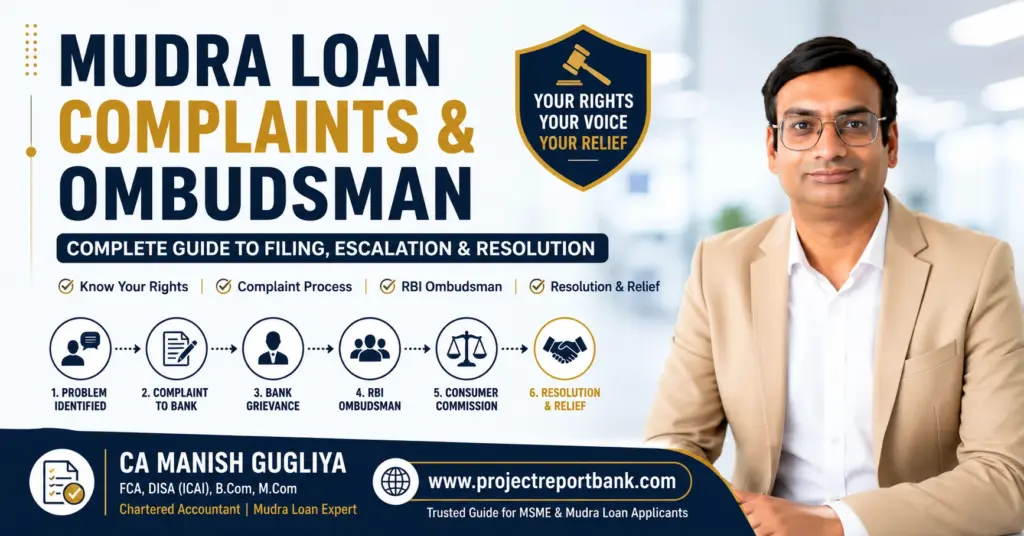
Applying for a Mudra Loan is an important step for many entrepreneurs, small business owners, startups, shopkeepers, professionals, and self-employed individuals. While many applications are processed smoothly, some borrowers face unnecessary delays, unfair treatment, unexpected charges, poor communication, or even wrongful rejection. When such situations arise, knowing how to file a Mudra Loan complaint becomes essential.
Fortunately, borrowers are not left without support. Banks in India are required to follow established grievance redressal procedures, and if a complaint is not resolved satisfactorily, applicants have the right to escalate the matter through higher authorities, including the RBI Integrated Ombudsman Scheme and, in appropriate cases, the Consumer Commission. Understanding these options helps borrowers protect their rights and seek a fair resolution.
Why Do Borrowers File Mudra Loan Complaints?
Borrowers generally file complaints when they believe the bank has not acted fairly or has failed to follow proper procedures. A complaint is not about creating conflict with the bank—it is about requesting a transparent, timely, and lawful resolution to a genuine problem.
Some complaints arise because of excessive processing delays, while others involve poor customer service, lack of communication, incorrect information, or disputes over documentation. In many cases, borrowers simply want the bank to explain its decision or resolve an issue that has remained pending for weeks or even months.
Common Banking Problems Faced by Mudra Loan Applicants
Although every case is different, several issues are commonly reported by Mudra Loan applicants, including:
Unreasonable delays in processing the application.
Repeated requests for the same documents.
Lack of updates on application status.
Unsatisfactory behaviour by bank officials.
Confusion regarding eligibility or documentation.
Disputes related to processing charges or other banking practices.
Rejection without a clear explanation.
Delay in loan disbursement even after approval.
Understanding whether these issues are procedural delays or actual service deficiencies is the first step toward selecting the correct complaint process.
Will Filing a Complaint Affect Your Future Loan?
One of the biggest concerns among borrowers is whether filing a complaint against a bank could negatively impact future loan applications. This fear often prevents applicants from raising legitimate grievances.
In practice, filing a genuine complaint through the proper grievance redressal system does not automatically affect your eligibility for future loans. Banks are expected to evaluate future loan applications based on financial eligibility, repayment capacity, credit history, and applicable lending policies—not because a borrower exercised the right to file a complaint.
However, complaints should always be supported by accurate facts, proper documentation, and respectful communication to ensure the matter is handled professionally.
Understanding the Bank Grievance Redressal Mechanism
Every bank has an internal grievance redressal system designed to resolve customer complaints before they need to be escalated externally.
Typically, borrowers should first approach the concerned branch and submit a written complaint. If the issue remains unresolved within the prescribed timeframe or the response is unsatisfactory, the complaint can usually be escalated to higher authorities within the bank, such as the Regional Office or Nodal Officer.
Maintaining written records, acknowledgements, emails, and complaint reference numbers can significantly strengthen your case if escalation becomes necessary.
Role of the RBI Integrated Ombudsman Scheme
If a bank does not resolve a complaint satisfactorily after the required waiting period, eligible borrowers may approach the RBI Integrated Ombudsman Scheme.
The Ombudsman provides an independent mechanism for examining complaints against regulated entities in specified circumstances. It offers borrowers an opportunity to seek impartial review without the complexity of traditional court proceedings. However, complaints must satisfy the prescribed eligibility conditions and procedural requirements before they can be considered.
Understanding when and how to approach the Ombudsman can save considerable time and improve the chances of an effective resolution.
When Can the Consumer Commission Help?
Certain disputes may also fall within the jurisdiction of the Consumer Commission, particularly where a borrower believes there has been a deficiency in service. Depending on the facts of the case, the Consumer Commission may provide an additional legal remedy beyond the banking grievance process.
Since the Ombudsman and Consumer Commission serve different purposes, choosing the appropriate forum is important. The nature of the dispute, the relief sought, and applicable legal provisions all influence the correct course of action.
What You’ll Learn in This Complete Guide
This comprehensive guide is designed to help Mudra Loan applicants understand the complete complaint resolution process from start to finish. Throughout this guide, you will learn:
How the Mudra Loan complaint process works.
When to use the bank’s grievance redressal system.
How and when to approach the RBI Integrated Ombudsman.
The difference between the Ombudsman and the Consumer Commission.
Common mistakes that lead to unsuccessful complaints.
Whether complaints can affect future loan applications.
Best practices for preparing documents and evidence.
Practical steps to improve the chances of a successful complaint resolution.
Whether your application is delayed, rejected, or facing another banking issue, understanding the available grievance mechanisms will help you make informed decisions and pursue the most appropriate resolution in a structured and professional manner.
Find the Right Mudra Loan Complaint Guide
Select the situation that best matches your problem and read the relevant guide for detailed information and practical steps.
Can Bank Blacklist You After a Complaint?
Read Complete Guide →Future Loan Approval After a Complaint
Read Complete Guide →Common Mudra Loan Complaint Mistakes
Read Complete Guide →RBI Ombudsman Relief for Mudra Loan Complaints
Read Complete Guide →RBI Ombudsman Complaint Rejection
Read Complete Guide →Consumer Commission vs RBI Ombudsman
Read Complete Comparison →Bank Grievance Redressal and Complaint Escalation
Read Complete Guide →How RBI Ombudsman Handles Mudra Loan Complaints
Read Complete Guide →Who Can File an RBI Ombudsman Complaint?
Check Eligibility →RBI Ombudsman Guide for Mudra Loan Complaints
Read Complete Guide →Everything You Need to Know Before Filing a Mudra Loan Complaint
This comprehensive guide explains the complete complaint process, your legal rights, available grievance mechanisms, and practical steps to resolve Mudra Loan-related banking issues effectively.
When to File a Complaint
Understand the situations where filing a complaint is appropriate and justified.
Whom to Complain To
Know the correct authority to approach at each stage of the complaint process.
Complaint Hierarchy
Learn the proper escalation path from the bank branch to higher authorities.
Bank Grievance Process
Understand how banks handle complaints through their internal grievance system.
RBI Integrated Ombudsman Scheme
Know when and how to approach the RBI Ombudsman for unresolved complaints.
Consumer Commission
Understand when the Consumer Commission may be the appropriate legal remedy.
Future Loan Impact
Learn whether filing a complaint can affect your future Mudra Loan applications.
Common Complaint Mistakes
Avoid mistakes that can delay or weaken your complaint and reduce its effectiveness.
Rights of Applicants
Know your rights as a Mudra Loan applicant throughout the complaint process.
Understanding Mudra Loan Complaints
A Mudra Loan is designed to support small businesses, entrepreneurs, startups, shopkeepers, manufacturers, service providers, and self-employed individuals by providing access to business finance. While many borrowers receive timely assistance, others may face issues during the application, sanction, or disbursement process. When these issues are not resolved through normal communication with the bank, borrowers may consider filing a formal complaint.
It is important to understand that not every inconvenience amounts to a valid grievance. Some delays may occur due to document verification or regulatory checks, while others may arise because of genuine operational reasons. However, when a borrower believes that a bank has failed to follow fair procedures, provided deficient service, or acted contrary to applicable guidelines, raising a complaint becomes an important step toward seeking resolution.
Why Do Mudra Loan Complaints Arise?
Complaints generally arise when borrowers experience problems that remain unresolved despite repeated communication with the bank. Many applicants expect transparency, timely updates, and professional service throughout the loan process. When these expectations are not met, dissatisfaction often leads to formal complaints.
Common reasons include poor communication, lack of clarity regarding loan status, repeated document requests, unexpected delays, disagreements over charges, or concerns about how the application has been handled. In many situations, borrowers simply seek a clear explanation and fair treatment rather than confrontation with the bank.
Filing a complaint is therefore a structured way of requesting the bank to review and resolve an issue through its grievance redressal mechanism.
Delays in Loan Processing
One of the most common reasons for Mudra Loan complaints is excessive delay in processing applications. Every loan application goes through several stages, including document verification, eligibility assessment, credit evaluation, internal approvals, and final sanction.
Reasonable processing time may vary depending on the complexity of the application. However, when an application remains pending for an unusually long period without any communication or explanation, borrowers often become concerned.
While some delays may occur due to incomplete documentation or additional verification, prolonged silence from the bank can create uncertainty for entrepreneurs who depend on timely funding for their businesses. In such situations, borrowers should first seek clarification before considering further escalation.
Illegal or Unexplained Charges
Another common source of complaints involves charges that borrowers do not clearly understand. Applicants occasionally question processing fees, service charges, documentation expenses, or other deductions made during the loan process.
Banks are expected to communicate applicable charges transparently. If a borrower believes that an amount has been charged incorrectly or without proper explanation, they have the right to request clarification and supporting details.
Maintaining receipts, bank statements, sanction letters, and written communications helps borrowers understand whether the charges are consistent with the terms communicated by the bank.
Issues Related to Insurance
Insurance-related concerns also generate complaints in some Mudra Loan cases. Borrowers sometimes feel uncertain about whether an insurance product is optional or mandatory, how premiums are calculated, or why insurance has been included with the loan.
Before accepting any insurance product, borrowers should carefully review the policy details, understand its purpose, and ask questions whenever something is unclear. Proper disclosure and informed consent help reduce misunderstandings and improve transparency during the loan process.
When borrowers believe that adequate information was not provided or that insurance-related issues remain unresolved, they may choose to raise their concerns through the appropriate grievance mechanism.
Documentation Problems
Documentation plays a significant role in the Mudra Loan approval process. Missing documents, incorrect information, mismatched records, or repeated requests for the same documents can cause frustration and unnecessary delays.
Applicants should ensure that all required documents are complete, accurate, and submitted in the prescribed format. Similarly, banks should communicate clearly if additional documents are genuinely required for processing the application.
Maintaining copies of every submitted document, acknowledgement receipt, email, and communication can help borrowers resolve future disputes more effectively.
Unprofessional Behaviour or Poor Customer Service
Borrowers also file complaints regarding the conduct of bank officials. Professional communication, respectful behaviour, and timely guidance are essential parts of quality customer service.
If applicants experience repeated non-responsiveness, inappropriate behaviour, refusal to provide information, or unnecessary inconvenience, they may consider raising the matter with higher authorities within the bank.
At the same time, borrowers should communicate respectfully, maintain written records wherever possible, and avoid emotional or confrontational interactions, as professional communication often contributes to faster and more effective resolution.
Concerns About Wrongful Rejection
Loan rejection can be disappointing, particularly when borrowers believe they satisfy the eligibility criteria. Sometimes applicants feel that sufficient reasons were not provided or that their application was not evaluated fairly.
However, it is important to understand that every rejection does not automatically indicate an error by the bank. Lending decisions are based on several factors, including eligibility, business viability, repayment capacity, documentation, internal credit assessment, and applicable banking policies.
If borrowers believe that procedural fairness has not been followed or important information has been overlooked, they may seek clarification and, where appropriate, use the available grievance redressal process.
Delay in Loan Disbursement After Approval
Receiving loan approval does not always mean that funds are immediately credited. In some cases, borrowers experience delays between sanction and actual disbursement.
Such delays may occur because of pending documentation, execution of loan agreements, verification requirements, or other internal banking procedures. However, when disbursement remains pending without reasonable explanation, borrowers may seek clarification from the bank and request an expected timeline.
For business owners waiting to purchase machinery, stock inventory, or working capital, prolonged disbursement delays can significantly affect business operations.
Understanding the Philosophy Behind Complaint Resolution
The purpose of a complaint is not to create conflict between borrowers and banks but to encourage fair, transparent, and accountable banking practices. An effective grievance redressal system benefits both borrowers and financial institutions by providing an opportunity to identify problems, clarify misunderstandings, and resolve disputes in a structured manner.
Borrowers should approach the complaint process with complete documentation, factual information, and realistic expectations. Likewise, banks are expected to examine complaints objectively, communicate their decisions clearly, and resolve genuine grievances within the prescribed framework.
A well-prepared complaint supported by evidence, proper communication, and the correct escalation process is more likely to achieve a satisfactory outcome than one based solely on assumptions or emotions. Understanding the complaint resolution process empowers Mudra Loan applicants to protect their rights while maintaining a professional and constructive relationship with the bank.
Complaint Resolution Journey (Infographic)
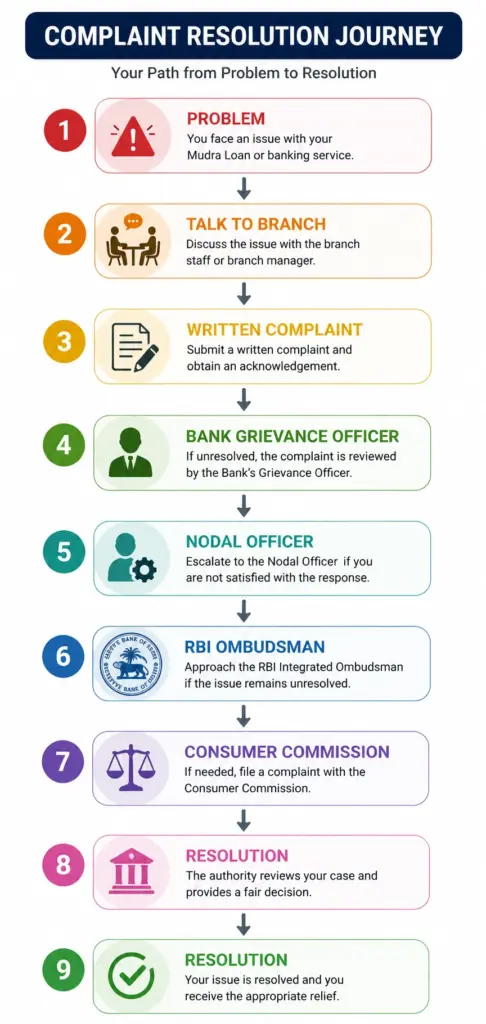
Problem
Every complaint begins when a borrower experiences an issue during the Mudra Loan process. Common problems include excessive processing delays, lack of communication, unexplained charges, insurance-related concerns, document disputes, poor customer service, wrongful rejection, or delays in loan disbursement. Before taking any action, clearly identify the exact issue and collect relevant documents, emails, SMS messages, acknowledgement receipts, or other evidence that supports your concern.
Talk to the Branch
The first step is always to discuss the issue with the concerned bank branch. Many problems are resolved quickly through direct communication with the branch official or Branch Manager. Explain your concern politely, request clarification, and ask for a reasonable timeline for resolution. Maintaining professional communication often helps resolve misunderstandings without requiring formal escalation.
Submit a Written Complaint
If the issue remains unresolved after discussing it with the branch, submit a written complaint to the bank. Clearly describe the problem, include relevant dates, attach supporting documents, and request a written acknowledgement. A formal complaint creates an official record and helps the bank investigate your grievance systematically. Always keep a copy of the complaint and the acknowledgement for future reference.
Bank Grievance Officer
When the branch is unable to resolve your complaint satisfactorily, the matter can usually be escalated to the bank’s Grievance Redressal Officer. This officer reviews the complaint independently and examines whether the bank has followed its internal procedures correctly. Borrowers should cooperate by providing any additional information requested during the review process while keeping copies of all correspondence.
Nodal Officer
If the grievance remains unresolved after the previous level, borrowers may escalate the complaint to the bank’s Nodal Officer. The Nodal Officer is responsible for handling higher-level customer complaints and ensuring that the bank’s grievance redressal mechanism functions effectively. This stage provides another opportunity for the bank to resolve the issue before external authorities become involved.
RBI Integrated Ombudsman
If the bank does not resolve the complaint satisfactorily within the applicable timeframe, eligible borrowers may approach the RBI Integrated Ombudsman Scheme. The Ombudsman provides an independent platform for examining complaints against regulated entities in accordance with the scheme’s provisions. Before filing a complaint, borrowers should ensure they meet the eligibility requirements and have completed the necessary internal grievance process.
Consumer Commission
In certain cases involving an alleged deficiency in banking service, borrowers may also have the option to approach the Consumer Commission. Depending on the nature of the dispute and the applicable legal provisions, the Consumer Commission may examine claims relating to service quality and provide appropriate relief. The suitability of this option depends on the specific facts of each case.
Resolution
The final objective of the complaint process is to achieve a fair, transparent, and lawful resolution. Depending on the circumstances, the complaint may result in clarification, correction of an error, improved communication, compensation where applicable, or another appropriate remedy. Borrowers should maintain realistic expectations, cooperate throughout the process, and preserve all records until the matter is fully resolved.
Which Mudra Loan Complaint Guide Should You Read?
Find the situation that best matches your concern and open the most relevant detailed guide.
| Your Situation | Recommended Article |
|---|---|
| The bank threatened to blacklist you after filing a complaint | Can a Bank Blacklist You After a Mudra Loan Complaint? |
| Your RBI Ombudsman complaint was rejected | Why the RBI Ombudsman May Reject a Mudra Loan Complaint |
| You want to approach the RBI Ombudsman | RBI Ombudsman for Mudra Loan Complaints: Complete Guide |
| You are considering the Consumer Commission | Consumer Commission vs RBI Ombudsman for Mudra Loan Disputes |
| You are worried that the complaint may affect future loan approval | Can a Mudra Loan Complaint Affect Future Loan Approval? |
| Your complaint failed or did not produce the expected result | Common Mistakes That Cause Mudra Loan Complaints to Fail |
| The bank is not responding to your complaint | Bank Grievance Redressal System for Mudra Loans |
| You do not know whether you are eligible to file with the Ombudsman | Who Can File an RBI Ombudsman Complaint for a Mudra Loan? |
Complete Complaint Library
Can Bank Blacklist You After a Mudra Loan Complaint?
Many borrowers worry that filing a complaint against a bank may result in being blacklisted. This guide explains the facts, legal position, and common misconceptions surrounding this concern. Understanding your rights can help you raise genuine grievances without unnecessary fear.
👉 Read Complete Guide: Can Bank Blacklist You After a Mudra Loan Complaint?
Can a Mudra Loan Complaint Affect Future Loan Approval?
Many applicants hesitate to complain because they believe it could reduce their chances of getting future business loans. This article explains how banks assess future loan applications and whether a genuine complaint has any impact on your eligibility.
👉 Read Complete Guide: Can a Mudra Loan Complaint Affect Future Loan Approval?
Common Mistakes That Cause Mudra Loan Complaints to Fail
A complaint supported by proper documents and the correct procedure has a much better chance of success. Learn the most common mistakes borrowers make and practical ways to avoid them before submitting your complaint.
👉 Read Complete Guide: Common Mistakes That Cause Mudra Loan Complaints to Fail
RBI Ombudsman Relief for Mudra Loan Complaints
The RBI Integrated Ombudsman can provide relief in eligible banking complaints after the bank’s grievance process has been completed. This guide explains the types of relief available and what borrowers can realistically expect.
👉 Read Complete Guide: RBI Ombudsman Relief for Mudra Loan Complaints
Why the RBI Ombudsman May Reject a Mudra Loan Complaint
Not every complaint is accepted by the RBI Ombudsman. This article explains the common reasons for rejection, eligibility requirements, and how borrowers can prepare a stronger complaint before filing.
👉 Read Complete Guide: Why the RBI Ombudsman May Reject a Mudra Loan Complaint
Consumer Commission vs RBI Ombudsman for Mudra Loan Disputes
Choosing the right authority is important for resolving banking disputes efficiently. This comparison explains the differences between the Consumer Commission and the RBI Ombudsman so borrowers can decide the most suitable option.
👉 Read Complete Guide: Consumer Commission vs RBI Ombudsman for Mudra Loan Disputes
Bank Grievance Redressal System for Mudra Loans
Before approaching external authorities, borrowers should generally use the bank’s internal grievance redressal system. This guide explains the complaint hierarchy, escalation process, and best practices for resolving issues within the bank.
👉 Read Complete Guide: Bank Grievance Redressal System for Mudra Loans
How the RBI Ombudsman Handles Mudra Loan Complaints
Wondering what happens after your complaint reaches the RBI Ombudsman? This guide explains the complaint review process, investigation, communication with the bank, and how final decisions are made.
👉 Read Complete Guide: How the RBI Ombudsman Handles Mudra Loan Complaints
Who Can File an RBI Ombudsman Complaint for a Mudra Loan?
Not every borrower automatically qualifies to file an Ombudsman complaint. This article explains eligibility conditions, who can file, and the situations where the RBI Ombudsman can examine a grievance.
👉 Read Complete Guide: Who Can File an RBI Ombudsman Complaint for a Mudra Loan?
Complete Guide to RBI Ombudsman for Mudra Loan Complaints
If you want a complete understanding of the RBI Integrated Ombudsman Scheme, this guide covers eligibility, filing procedure, documentation, timelines, complaint tracking, and practical tips for borrowers seeking resolution.
👉 Read Complete Guide: Complete Guide to RBI Ombudsman for Mudra Loan Complaints
Mudra Loan Complaint Escalation Matrix
Use this table to understand the usual escalation path for different types of Mudra Loan and banking complaints. The exact authority may vary depending on the facts of the case and the bank's grievance policy.
| Problem | First Level | Second Level | Third Level | Final Level |
|---|---|---|---|---|
| Delay in Processing or Disbursement | Bank Branch | Branch Manager | Nodal Officer | RBI Ombudsman |
| Illegal or Unexplained Charges | Bank Branch | Regional Office | Nodal Officer | RBI Ombudsman |
| Misbehaviour or Poor Customer Service | Branch Manager | Regional Office | RBI Ombudsman | Consumer Commission |
| Compensation for Service Deficiency | Bank Grievance Officer | RBI Ombudsman | Consumer Commission | Appropriate Court |
RBI Ombudsman vs Consumer Commission
Both forums can help resolve banking grievances, but their eligibility, procedure, cost, powers, and suitable use cases are different. Use this comparison to understand which option may be appropriate for your Mudra Loan complaint.
| Comparison Point | RBI Ombudsman | Consumer Commission |
|---|---|---|
| Eligibility | A customer of a bank or other regulated entity covered under the RBI Ombudsman Scheme may complain about an eligible deficiency in service. The customer must ordinarily complain to the bank first. | A person qualifying as a consumer may file a complaint regarding deficiency in service or an unfair practice. In business-related cases, consumer eligibility may depend on whether the service was obtained exclusively for earning a livelihood through self-employment. |
| Time and Procedure | The complaint may generally be filed after the bank rejects the grievance, provides an unsatisfactory response, or fails to reply within the applicable period. The process is designed to be comparatively simple and non-adversarial. | Proceedings may take longer because they follow a more formal adjudication process involving filing, notice, evidence, replies, hearings, and a final order. Actual time depends on the case and the Commission's workload. |
| Cost | Filing and resolution under the RBI Ombudsman Scheme are free. Borrowers should not pay an agent merely to submit a complaint. | A prescribed filing fee may apply depending on the value of the claim. Additional expenses may arise for documentation, professional advice, representation, or other legal requirements. |
| Compensation | The Ombudsman may direct corrective action and award compensation within the limits prescribed under the applicable RBI scheme, provided deficiency in service and loss or inconvenience are established. | The Commission may order refund, correction of service deficiency, compensation for proven loss or injury, litigation costs, or another appropriate remedy permitted under consumer law. |
| Is a Lawyer Required? | No lawyer is normally required. A complainant may file personally or through an authorised representative, subject to the rules of the applicable Ombudsman Scheme. | A lawyer is not legally compulsory, and consumers may represent themselves. However, professional assistance may be useful in complicated matters involving substantial claims or detailed legal and documentary issues. |
| Documentation | Usually requires the complaint made to the bank, acknowledgement or reference number, the bank's response, loan details, relevant correspondence, supporting evidence, details of loss, and the relief requested. | Generally requires a properly drafted consumer complaint, supporting documents, evidence of the transaction or service, correspondence, proof of deficiency, calculation of loss, applicable fee, and the relief claimed. |
| Suitable For | Suitable for eligible complaints involving deficiency in banking service, such as unresolved charges, poor grievance handling, procedural lapses, or failure to provide a required banking service. | Suitable where the complainant qualifies as a consumer and seeks formal adjudication, broader relief, or compensation for an alleged deficiency in service or unfair practice. |
| Final Outcome | The matter may end through settlement, corrective action, an Award, compensation within prescribed limits, or rejection or closure with reasons. Appeal rights depend on the nature of the decision. | The Commission may pass an enforceable order granting or rejecting the relief claimed. An aggrieved party may appeal before the appropriate higher Consumer Commission, subject to applicable law and timelines. |
Which Option Should You Choose?
The RBI Ombudsman is generally the simpler first external remedy for an eligible unresolved banking-service complaint after approaching the bank. The Consumer Commission may be considered where consumer eligibility exists and the dispute requires formal adjudication or broader compensation. The correct option depends on the facts, documents, relief required, and applicable legal provisions.
Mudra Loan Complaint Timeline
This timeline explains the usual path from submitting a complaint to your bank through approaching the RBI Ombudsman and, where legally appropriate, the Consumer Commission.
Identify the Problem and Collect Evidence
Clearly identify your Mudra Loan issue and collect relevant documents, such as the loan application, acknowledgement, correspondence, bank statements, receipts, sanction letter, emails, SMS messages, and details of previous discussions with bank officials.
Submit a Written Complaint to the Bank Branch
Submit a clear written complaint to the concerned bank branch or Branch Manager. Mention the problem, important dates, supporting facts, and the resolution you expect. Obtain an acknowledgement or complaint reference number and retain a copy for your records.
Allow the Bank Up to 30 Days to Respond
Give the bank a reasonable opportunity to investigate and resolve your grievance. During this period, cooperate with requests for relevant information and maintain copies of every communication, acknowledgement, reply, and supporting document.
Review the Bank’s Reply or Lack of Response
Further escalation may be considered when the bank rejects the complaint, gives an unsatisfactory response, or does not respond within 30 days. Before escalating, confirm that your complaint is supported by evidence and falls within the relevant grievance rules.
Approach the RBI Ombudsman
An eligible complaint may be submitted under the applicable RBI Integrated Ombudsman framework after completing the bank’s internal grievance process. Attach the original complaint, acknowledgement, bank response, loan details, supporting evidence, and the relief requested.
Complaint Review, Settlement or Decision
The complaint may be examined through communication with the borrower and the bank. Depending on the facts, it may result in settlement, corrective action, an award or other relief within the applicable framework, or rejection or closure with reasons.
Consider the Consumer Commission Where Applicable
Where the complainant qualifies as a consumer and the dispute involves an alleged deficiency in service or unfair practice, the Consumer Commission may be considered. The suitability of this remedy depends on consumer eligibility, the facts of the case, the relief sought, and applicable legal provisions.
Common Mistakes While Filing Mudra Loan Complaints
Many genuine complaints fail because borrowers unknowingly make simple procedural mistakes. Avoiding these common errors can significantly improve the chances of a fair and timely resolution.
No Written Complaint
Many borrowers only discuss their issue verbally with bank officials and never submit a written complaint. Without a written record, proving that the grievance was reported becomes difficult. Always submit a written complaint and obtain an acknowledgement or complaint reference number.
Missing Evidence
A complaint without supporting documents is often difficult to verify. Keep copies of the loan application, acknowledgement, emails, SMS, bank letters, account statements, and other relevant records. Proper documentation helps authorities understand your grievance and review it more effectively.
Approaching the Wrong Authority
Some borrowers directly approach external authorities without first using the bank's grievance redressal system. Following the proper escalation process is important because many complaints must first be considered by the bank before external remedies become available.
No Complaint Reference Number
Failing to obtain a complaint acknowledgement or reference number can make future follow-up difficult. Always request written confirmation that your complaint has been received. This reference becomes useful if you later need to escalate the matter.
Using Emotional or Aggressive Language
Complaints should present facts rather than emotions. Avoid personal allegations, threats, or offensive language. A clear, respectful, and evidence-based complaint is easier for the bank or grievance authority to understand and investigate objectively.
Delay in Escalation
Waiting too long after receiving an unsatisfactory response may affect the complaint process. If the bank fails to resolve your grievance within the applicable timeframe, review the available grievance options and escalate the matter without unnecessary delay.
Documents Required Before Filing a Mudra Loan Complaint
Keeping the right documents ready helps the bank, RBI Ombudsman, or other grievance authorities understand your complaint quickly and improves the chances of a faster resolution.
| Document | Why It Is Required |
|---|---|
| Loan Application | Serves as proof of your Mudra Loan application and the details originally submitted to the bank. |
| Application Acknowledgement | Confirms when the application or complaint was received and helps establish the processing timeline. |
| SMS Messages | Provides evidence of communication, status updates, OTPs, or other messages received from the bank. |
| Email Correspondence | Supports your complaint by showing written communication, requests, replies, or follow-up discussions with bank officials. |
| Bank Letters | Acts as official evidence of sanction, rejection, clarification, notices, or other communications issued by the bank. |
| Bank Statement | Helps verify deductions, charges, loan transactions, or disbursement details where relevant. |
| Copy of Complaint | Demonstrates that the grievance was formally submitted before escalating it to higher authorities. |
| Bank Reply | Shows the bank's response or decision and is often required while approaching the RBI Ombudsman or another grievance authority. |
Applicant Rights During a Mudra Loan Complaint
Every Mudra Loan applicant deserves fair treatment throughout the complaint process. Understanding these rights helps borrowers communicate confidently and pursue grievance redressal through the appropriate channels.
| Applicant Right | Available? | Explanation |
|---|---|---|
| Written Acknowledgement | ✔ Yes | You have the right to receive an acknowledgement or complaint reference number after submitting a written complaint to the bank. |
| Timely Response | ✔ Yes | The bank should examine your complaint and provide a response within the applicable grievance redressal timeline. |
| Fair Hearing | ✔ Yes | Your complaint should be reviewed objectively based on facts, documents, and applicable banking procedures without bias. |
| Escalation of Complaint | ✔ Yes | If your grievance remains unresolved, you may escalate it through the bank's grievance redressal hierarchy before approaching external authorities where applicable. |
| Approach the RBI Ombudsman | ✔ Yes | Eligible borrowers may approach the RBI Integrated Ombudsman after following the bank's internal grievance process and satisfying the applicable conditions. |
| Approach the Consumer Commission | ✔ Yes | Where legally applicable and the borrower qualifies as a consumer, the Consumer Commission may be approached for deficiency in service or other consumer disputes. |
Expert Guidance from CA Manish Gugliya
With over 20 years of practical experience as a Chartered Accountant, I have worked with entrepreneurs, MSMEs, startups, traders, manufacturers, and self-employed professionals seeking business finance. One lesson I have learned is that many Mudra Loan complaints remain unresolved not because borrowers lack genuine concerns, but because they do not follow the correct complaint process or maintain proper documentation.
A complaint should never be viewed as a conflict with the bank. Instead, it is a professional way to seek a fair, transparent, and timely resolution. When borrowers understand the grievance process and present their concerns with facts and evidence, they are far more likely to receive a satisfactory outcome.
Don’t Be Afraid to File a Genuine Complaint
Many borrowers avoid filing complaints because they worry it could affect future banking relationships or loan approvals. In reality, if your grievance is genuine and supported by facts, you should not hesitate to use the available grievance redressal mechanism. A professionally filed complaint demonstrates that you are seeking a fair resolution—not creating unnecessary disputes.
Maintain Proper Documentation
Documentation is one of the most important factors in a successful complaint. Always preserve copies of your loan application, acknowledgement receipts, emails, SMS messages, bank letters, account statements, complaint copies, and responses received from the bank. Well-organised records make it easier for both the bank and grievance authorities to understand your case.
Escalate Professionally
Do not rush directly to higher authorities. Begin by discussing the issue with the concerned branch and then follow the prescribed grievance hierarchy if the matter remains unresolved. Professional communication, supported by facts and documents, is far more effective than making unsupported allegations or emotional accusations.
Avoid Threatening the Bank on Social Media
Many borrowers believe that posting complaints on social media will force the bank to act quickly. In practice, official grievance channels are usually much more effective. Rather than publishing emotional posts or making public allegations, focus on submitting a written complaint and following the proper escalation process.
Preserve Every Piece of Evidence
Small pieces of evidence can become extremely valuable during complaint resolution. Preserve complaint reference numbers, acknowledgement receipts, emails, SMS alerts, bank letters, courier receipts, meeting notes, and written replies. Even seemingly minor documents may help establish the sequence of events if the matter is escalated.
Understand the RBI Complaint Process
The RBI Integrated Ombudsman is designed to examine eligible complaints after borrowers have given the bank an opportunity to resolve the issue. Understanding when and how to approach the Ombudsman helps borrowers avoid procedural mistakes and improves the likelihood of their complaint being considered.
Use the Consumer Commission Wisely
The Consumer Commission is an important legal remedy in appropriate cases, but it should be approached only after understanding whether it is the correct forum for your dispute. The choice between the bank’s grievance mechanism, the RBI Ombudsman, and the Consumer Commission depends on the nature of the complaint and the relief being sought.
Protect Your Future Banking Relationship
Filing a complaint does not mean ending your relationship with the bank. Continue communicating politely, provide requested documents promptly, and cooperate throughout the grievance process. Professional behaviour often helps maintain a positive relationship while ensuring that your concerns are properly addressed.
A Practical Example
Suppose your Mudra Loan application has remained pending for several weeks without any meaningful update. Instead of repeatedly visiting the branch or expressing frustration online, submit a written complaint, obtain an acknowledgement, preserve all communication, wait for the prescribed response period, and then escalate the matter through the appropriate grievance channels if necessary. This systematic approach usually produces better results than informal follow-ups alone.
Practical Tips from My Experience
Based on years of advising business owners and loan applicants, I recommend maintaining a dedicated file for all loan documents, requesting written acknowledgements whenever possible, carefully reading every communication from the bank, keeping records in chronological order, and avoiding verbal discussions without written follow-up. These simple habits make complaint resolution much easier.
Common Banking Mistakes Borrowers Should Avoid
Borrowers often weaken their own complaints by failing to submit supporting evidence, approaching the wrong authority, delaying escalation unnecessarily, relying only on verbal discussions, or using emotional language instead of presenting facts. Avoiding these common mistakes can significantly improve the quality and effectiveness of your complaint.
Final Recommendations
A successful Mudra Loan complaint is built on three principles—proper documentation, professional communication, and the correct escalation process. Always focus on facts rather than assumptions, preserve every important document, follow the grievance hierarchy patiently, and choose the appropriate authority for your complaint. A well-prepared complaint supported by clear evidence is far more likely to achieve a fair and satisfactory resolution.
Frequently Asked Questions (FAQs)
Can a bank reject my Mudra Loan because I filed a complaint?
Banks are expected to evaluate loan applications based on eligibility, repayment capacity, documentation, and applicable lending policies. Filing a genuine complaint alone should not be the reason for rejecting a loan application.
Will filing a complaint affect my CIBIL score?
No. Filing a complaint does not directly affect your CIBIL score. Your credit score is generally influenced by repayment behaviour, outstanding loans, credit utilisation, and other credit-related factors rather than the complaint itself.
Can I file a complaint directly with the RBI Ombudsman?
Generally, borrowers should first submit their complaint to the concerned bank and allow the bank an opportunity to resolve it. If the complaint remains unresolved or the response is unsatisfactory, eligible borrowers may approach the RBI Ombudsman.
Can the RBI Ombudsman order compensation?
In eligible cases, the RBI Ombudsman may direct appropriate relief, including compensation within the limits and conditions prescribed under the applicable RBI Ombudsman framework.
Is the Consumer Commission better than the RBI Ombudsman?
Neither forum is universally better. The appropriate authority depends on the nature of the dispute, the relief sought, consumer eligibility, and the applicable legal provisions.
How long does the complaint process usually take?
The timeline varies depending on the complexity of the complaint and the authority handling it. Banks should generally respond within the prescribed grievance period before borrowers consider further escalation.
Can the bank close my account because I filed a complaint?
Filing a genuine complaint does not automatically give the bank the right to close your account. Any action by the bank must comply with applicable laws, regulations, and account terms.
Can I complain after my Mudra Loan application is rejected?
Yes. If you believe there has been a deficiency in service or procedural unfairness, you may seek clarification and use the appropriate grievance redressal process.
Can my complaint help future applicants?
Yes. Genuine complaints often help banks identify operational issues, improve customer service, and strengthen grievance handling processes, benefiting future borrowers.
Can I file a Mudra Loan complaint online?
Yes. Many banks provide online grievance portals, and eligible complaints under the RBI Ombudsman framework can also be submitted through the prescribed online channels.
Can complaints against NBFCs also go to the RBI Ombudsman?
Certain NBFCs regulated by the RBI are covered under the RBI Integrated Ombudsman framework. Eligibility depends on whether the concerned entity falls within the scope of the applicable scheme.
Is a lawyer required to file a complaint?
No. Most borrowers can submit complaints themselves. Professional assistance may be helpful in complicated cases but is generally not mandatory for filing a grievance.
Can I withdraw my complaint later?
Yes. If your issue has been resolved satisfactorily or you no longer wish to continue, you may generally request withdrawal of your complaint according to the applicable procedure.
Can I file multiple complaints for the same issue?
Filing repeated complaints before different authorities simultaneously may create procedural complications. It is usually better to follow the prescribed grievance hierarchy.
Can I file an anonymous complaint?
Anonymous complaints are generally less effective because grievance authorities may require your identity and supporting information to investigate the matter properly.
What evidence should I keep before filing a complaint?
Keep your loan application, acknowledgement receipt, emails, SMS messages, bank letters, account statements, complaint copies, bank replies, and any other documents supporting your grievance.
Is there any fee for filing a complaint?
Banks generally do not charge a fee for accepting customer complaints. The RBI Ombudsman process is also intended to be free for eligible complainants.
What should I do if the bank never replies?
If the bank fails to respond within the applicable grievance period, eligible borrowers may consider escalating the matter through the next level of the grievance redressal process.
Can a complaint become time-barred?
Yes. Certain complaint mechanisms have limitation periods. Borrowers should avoid unnecessary delay and file complaints within the applicable timelines.
How can I track the status of my complaint?
Use the complaint reference number or acknowledgement provided by the bank or grievance authority. Many institutions also provide online complaint tracking facilities.
Can I claim compensation for my loss?
Depending on the facts of the case and the applicable legal provisions, compensation may be available through the appropriate grievance mechanism or legal forum.
Can I appeal against an RBI Ombudsman decision?
The availability of an appeal depends on the nature of the decision and the applicable RBI Ombudsman provisions. Borrowers should review the relevant rules before taking further action.
What if I lose some of my loan documents?
Try to obtain duplicate copies from the bank, retrieve emails or SMS records, and preserve any available correspondence. Maintaining complete records from the beginning is always advisable.
Can a guarantor file a complaint?
If the guarantor has a legitimate grievance relating to the loan or banking service and is otherwise eligible, they may be able to raise the matter through the appropriate grievance mechanism.
Which authority should I approach first?
In most cases, the first step should be the concerned bank branch or its internal grievance redressal system. If the issue remains unresolved, borrowers may escalate it to higher authorities, the RBI Ombudsman, or the Consumer Commission where legally appropriate.
Conclusion
Understanding the Mudra Loan complaint process is just as important as understanding the loan application process itself. While most banks strive to provide efficient customer service, borrowers may occasionally face issues such as processing delays, poor communication, unexplained charges, documentation disputes, or other banking concerns. When these situations arise, filing a genuine complaint is a legal right available to every eligible borrower and should be used responsibly whenever necessary.
The key to a successful complaint is following the correct escalation process. In most cases, borrowers should first approach the concerned bank branch and allow the bank an opportunity to resolve the issue through its internal grievance redressal mechanism. If the complaint remains unresolved or the response is unsatisfactory, eligible borrowers may consider approaching the RBI Integrated Ombudsman or, where legally appropriate, the Consumer Commission. Choosing the correct authority at the right stage can save both time and unnecessary effort.
Another important factor is proper documentation. Preserve your loan application, acknowledgement receipts, complaint copies, emails, SMS messages, bank letters, account statements, and every written communication related to your case. Well-organised records strengthen your complaint, help establish the facts, and make it easier for grievance authorities to review your case objectively.
It is equally important to maintain professional communication throughout the process. Present your concerns clearly, support them with evidence, avoid emotional allegations, and follow the prescribed grievance hierarchy patiently. A complaint based on facts and proper documentation is far more likely to receive a fair and timely resolution than one based solely on assumptions or frustration.
Every complaint is unique, and the most appropriate course of action depends on the nature of the issue, the evidence available, and the authority responsible for resolving it. Before taking any major step, take time to understand your rights, the available grievance mechanisms, and the correct escalation procedure.
Explore the Complete Complaint Library
This cluster page provides an overview of the entire Mudra Loan complaint ecosystem, but each situation deserves a detailed explanation. Whether you want to understand the RBI Ombudsman process, compare it with the Consumer Commission, learn who is eligible to file a complaint, avoid common mistakes, or understand how complaints may affect future loan applications, explore the Complete Complaint Library above. Each guide explains a specific topic in depth, helping you make informed decisions and pursue the most appropriate grievance resolution process with confidence.