Key Takeaways
- Filing a formal complaint about a Mudra loan does not inherently harm your creditworthiness or future loan approvals, provided you continue repaying on time and submit genuine documents.
- Complaint history is not part of your CIBIL report. Credit bureaus like TransUnion CIBIL, Equifax, Experian, and CRIF High Mark record only repayment behaviour, defaults, overdues, and outstanding balances.
- Under Reserve Bank of India rules and the Integrated Ombudsman Scheme 2021, banks cannot legally reject your future loan simply because you approached the banking ombudsman or the principal nodal officer.
- Borrowers who filed Mudra complaints but maintained strong CIBIL scores and healthy turnover have received Kishore-category enhancements and fresh term loans from the same branch within 12 months of complaint resolution.
Introduction: Why This Question Worries So Many Mudra Borrowers
Picture a garment shop owner in a semi-urban town. She took a Shishu-category Mudra loan of ₹40,000 for working capital. The branch charged her a processing fee the sanction letter never mentioned. She wants to complain, but her neighbour warned her: “If you go against the bank, they will blacklist you. No more loans, ever.”
This fear is common across India. Crores of micro and small businesses depend on Mudra loans (Shishu up to ₹50,000, Kishore up to ₹5 lakh, Tarun up to ₹10 lakh) for daily operations. Most borrowers carry a set of myths:
- “The branch manager will remember my name and reject my next application.”
- “RBI will mark me negative in some central system.”
- “My CIBIL score will drop if I file a grievance.”
These fears are essentially baseless. This article answers four questions: Can a Mudra loan complaint affect future loan approval? Does a complaint reach CIBIL? What does the ombudsman scheme actually say? And how can you complain safely?
As CA Manish Gugliya (FCA), with 20+ years of hands-on experience in MSME finance, Mudra loan consultancy, and banking grievance redressal, I am writing from real case files, not textbook theory.

Table of Contents
Why Borrowers Fear Filing Mudra Loan Complaints
Fear is natural when your business depends on one branch located in your town. Here is what drives it:
- Retaliation worry. Borrowers think the credit officer will “take revenge” by delaying the next Mudra or cash credit request.
- Relationship dependency. Many micro units feel they must keep the branch staff satisfied because they may need an overdraft enhancement or an emergency ad-hoc limit later.
- Social myths. Neighbours, agents, and sometimes bank staff themselves say, “Never visit the banking ombudsman; you will be blacklisted.”
- Lack of awareness. Most borrowers do not know that formal channels like nodal officers, the principal nodal officer, and the Integrated Ombudsman Scheme 2021 exist to protect them.
I have seen a Kishore borrower in Delhi delay his written complaint for ten months because of these fears. During that delay, wrong interest charges accumulated, and his stress multiplied. The issue was resolved within 30 days once he finally used the proper escalation path.
Does Filing a Mudra Loan Complaint Affect Future Loan Approval?
Short answer: Filing a complaint about service quality should not negatively affect future loan eligibility. Genuine Mudra loan complaints filed through proper channels with correct facts generally do not affect future loan approval at any bank.
A complaint is about service failure or non adherence to RBI or Mudra guidelines. A credit issue is about not paying EMIs, cheque bounces, or fraud. These two categories are treated separately by every lender.
The Reserve Bank and its complaint management system encourage customers to raise issues when a bank fails to follow rules. RBI never asks banks to punish a customer for using the grievance redressal system.
Lenders evaluate applications based on your creditworthiness and repayment history: income, turnover, cash flow, CIBIL score, existing EMI burden, and internal lending policies. Whether you previously approached the banking ombudsman is not a factor in credit underwriting.
Problems arise only when the borrower behaves wrongly (threats, fake documents) or carries a poor repayment track record.
Does a Mudra Loan Complaint Affect Your CIBIL Score or Credit History?
A procedural complaint against a bank does not harm your credit record. Complaint details are never sent to CIBIL, Experian, CRIF, or Equifax. These bureaus receive only loan accounts, limits, EMI payment dates, days past due, write-offs, and settlement tags.
Credit Bureau Reporting indicates missed EMIs lower your credit score. A “Settled” tag indicates that the borrower did not repay the full amount, and that tag stays on your report for years, affecting future interest rates and approvals.
Approaching the branch nodal officer, emailing the principal nodal officer, or registering a case under RBI’s complaint management system does not generate any entry in your credit file. Multiple hard enquiries (many loan applications in a short period) can reduce your score slightly, but that is unrelated to complaints.
After resolving a dispute like wrong default reporting, ask the bank to correct CIBIL data. If the bank fails to act, you can escalate to the RBI ombudsman for rectification.
| Complaint History | Credit History | |
|---|---|---|
| Stored by | Bank internal records | Credit bureau (CIBIL, Equifax, etc.) |
| Used for | Service improvement | Loan underwriting |
| Visible to other banks? | No | Yes |
| Affects CIBIL score? | No | Yes |
| Contains repayment data? | No | Yes |
Can Banks Reject Future Loans Because You Complained? (Legal and Practical View)
Under RBI’s fair practices code and the 2021 Integrated Ombudsman Scheme, banks must base lending decisions on objective criteria, not on emotional reactions to complaints. Lenders are legally prohibited from blacklisting you for exercising your consumer rights under the consumer protection act.
Every scheduled commercial bank must designate nodal officers and a principal nodal officer who report to head office management and RBI on complaint handling, not on punishing complainants.
Core factors that decide your next Mudra or MSME loan: business vintage, turnover, profitability, GST returns, bank statement conduct, existing EMIs, CIBIL score, and security or collateral if applicable.
If a bank rejects after a past complaint, it must record a proper credit reason (low score, poor cash flow, overdue loans). “Customer approached banking ombudsman” is not an acceptable rejection code. If you suspect pure retaliation, seek the written reason and, if needed, again approach the bank’s grievance redressal system or the RBI portal.
Situations That Can Actually Hurt Your Future Loan Approval
Banks and NBFCs care about credit risk and conduct risk. These are the real reasons most Mudra or MSME loan applications get rejected:
- Defaults and irregular EMIs. Repeated bouncing of Mudra EMIs, long overdue periods, and settlement instead of full payment are shared with credit bureaus. The underlying payment default will severely hurt your credit history and future approvals. An unresolved repayment dispute can lead to stricter future loan approvals across all lenders.
- High leverage. Too many existing loans, large credit card dues, and a high fixed obligation to income ratio cause genuine rejections, even when no complaint was ever filed.
- Fraud and misrepresentation. Fake ITRs, forged GST returns, inflated bank statements, or false declarations can lead to FIRs, internal caution lists, and long-term damage.
- Non-cooperation. Not providing documents for renewal, avoiding calls, or using abusive language spoils the relationship and internal perception.
These risk factors are entirely different from a genuine grievance about non adherence to RBI or Mudra guidelines, which by itself does not mark you as a responsible risk.
Genuine vs Frivolous Complaints: Why Your Approach Matters
A genuine, well-documented complaint is your right. Repeated frivolous or exaggerated complaints can spoil professional relationships, even though they do not appear in CIBIL. A complaint can impact your creditworthiness assessment indirectly if it is built on false claims that eventually unravel.
| Genuine Complaint | Frivolous Complaint |
|---|---|
| Backed by documents and dates | No supporting proof |
| Clear ask (waive wrong charge, issue sanction letter) | Vague or shifting demands |
| Single escalation path followed step by step | Multiple repeated submissions across forums |
| Respectful, factual tone | Abusive or threatening language |
| References specific RBI circular or Mudra guideline | General accusations without detail |
Stick to facts, amounts, and dates so that even if the case goes up to the banking ombudsman, your image remains that of a credible complainant.

Rights of Mudra Borrowers and Safe Use of the Grievance System
RBI’s customer protection framework, including bank-level grievance redressal and the Integrated Ombudsman Scheme 2021, exists so that customers can raise issues without fear. Banks must acknowledge grievances within five days of receipt.
Key rights you hold:
- Right to a time-bound reply (generally within a reasonable period of 30 days).
- Right to clear, written reasons for loan rejection.
- Right to escalate to regional nodal officers and the principal nodal officer.
- Complaints unresolved for 30 days can escalate to the Ombudsman. You can approach the Integrated Ombudsman after one month of dissatisfaction with the bank’s reply.
The Banking Ombudsman resolves customer complaints against banks. It is a quasi-judicial authority set up by the RBI. The Ombudsman addresses issues like unfair charges and service delays. Customers can escalate unresolved complaints to the Banking Ombudsman when the bank does not provide a satisfactory response.
Complaints must be filed within 13 months of the incident at the bank level. Banks that discriminate against customers for using legitimate channels violate RBI directions on transparency and fair treatment. For a step-by-step guide on who can file an RBI ombudsman complaint for Mudra loan, read our detailed article.
How to File a Mudra Loan Complaint Without Harming Future Eligibility
The safest way to protect your future finance options is to remain financially disciplined while using the formal, polite grievance route laid down by RBI and your bank.
Checklist:
✓ Pay EMIs on or before the due date. Avoid cheque bounces. Keep your saving or current account balance healthy during the complaint period.
✓ Prepare documents: sanction letter, account statement, EMI schedule, emails and SMS from the bank, and any written communication from branch staff showing non adherence. Documentation is important to prove an account rectification to future lenders.
✓ Follow the escalation ladder: (1) Lodge a written complaint with the branch manager. Complaints can be lodged via the bank’s website or in branch. (2) Escalate to the bank’s regional nodal officer. You can escalate unresolved complaints to Regional Nodal Officers. (3) Write to the principal nodal officer at the bank’s head office address. (4) If still not resolved, submit your case on the RBI CMS portal and the banking ombudsman. A unique Grievance ID is generated after complaint submission; save your complaint reference numbers.
✓ Use respectful language. Clearly state what resolution you want (waiver of wrong charge, correction of CIBIL reporting, issuance of sanction letter). Avoid threats.
✓ If the relationship breaks down, you can approach another bank for fresh Mudra or MSME loans. Other lenders do not have access to your complaint trail; they see only your credit history.
Common Mistakes That Really Can Damage Future Loan Chances
Complaints are usually not the issue. The danger comes from the borrower’s behaviour during and after the dispute:
- Stopping EMIs as a pressure tactic. This immediately creates overdue tags in CIBIL and gives the bank a valid credit reason to refuse any fresh loan. Complaints can delay loan processing times if combined with payment defaults.
- Giving false statements. If the bank proves misrepresentation or forgery in your complaint to the banking ombudsman, it justifies internal cautioning and stricter dealing in the future.
- Using agents who file poorly drafted, duplicate complaints in your name without your full understanding, creating confusion with nodal officers and authorities.
- Filing the same matter repeatedly across bank, ombudsman, consumer court without disclosure. Authorities view this negatively; it delays genuine resolution. Read about common mistakes that lead to Mudra loan complaint failure to avoid these traps.
Practical tip: if you feel emotionally charged, draft your complaint, review it the next day, and mail or submit it only after the language is factual and calm.
Real-Life Style Scenarios: Complaint vs Future Mudra Loan Approval
Practical examples show how complaints and future loans interact in day-to-day banking.
Scenario 1: A Shishu-category borrower in New Delhi complained in writing to the bank’s principal nodal officer about a six-week delay in releasing sanctioned Mudra funds. The complaint was resolved. The account ran cleanly for 12 months. In 2025, the same branch approved a Kishore-category loan because turnover had grown and CIBIL was above 750. The earlier complaint played no role in the credit committee’s decision.
Scenario 2: A borrower filed a correct complaint about wrong penal interest but then began skipping EMIs. When she applied for another Mudra loan, it was rejected due to poor CIBIL (days past due of 90+), not the old complaint. She wrongly blamed the grievance. Lesson: never stop payment while a complaint is open.
Scenario 3: A trader filed repeated, partly false complaints to multiple forums without observed facts or proof. The bank could not refuse solely on that basis, but the credit committee asked for extra documents and finally declined based on cash flow stress and large unpaid GST dues. Lesson: keep feedback factual, and keep your accounts clean.
FAQ: Mudra Loan Complaints and Future Loan Approval
Can other banks see that I complained to RBI or the banking ombudsman?
No. There is no public database of complaints like CIBIL. Other banks see only your credit history and account conduct. Your complaint details stay within the bank’s internal records and RBI’s complaint management system. Unresolved complaints may lead to loan application denials only if they involve actual payment disputes, not service grievances.
Should I withdraw my complaint before applying for a top-up or enhancement?
Withdrawal is not required. Keep your repayment regular, register a clean and well-documented fresh application, and let the credit committee evaluate you on merit. The complaint and the loan application are handled by different teams in most banks.
Will complaining delay my existing Mudra loan renewal?
Usually, renewals follow normal policy. In some cases, the bank may first close the open issue before signing off on the renewal file. Any delay comes only if your documents or repayment are not in order, not from the complaint itself.
Does the banking ombudsman ever order banks to stop lending to a person?
Such directions are issued only in cases of extreme fraud, money laundering, or serious regulatory violations. Ordinary service complaints under the ombudsman scheme do not trigger any lending restrictions. Complaints must be filed within one year of the bank’s reply to remain eligible for ombudsman review.
What if my bank wrongly reported a default to CIBIL during the complaint period?
Visit your branch with proof of payment (receipts, bank statements). Submit a written request for correction. If the bank does not act within a reasonable period, escalate to the principal nodal officer and then to the RBI ombudsman. The purpose of these channels is to resolve exactly this type of issue.
- Mudra Loan Complaints & Ombudsman: Complete Guide to Filing, Escalation & Resolution
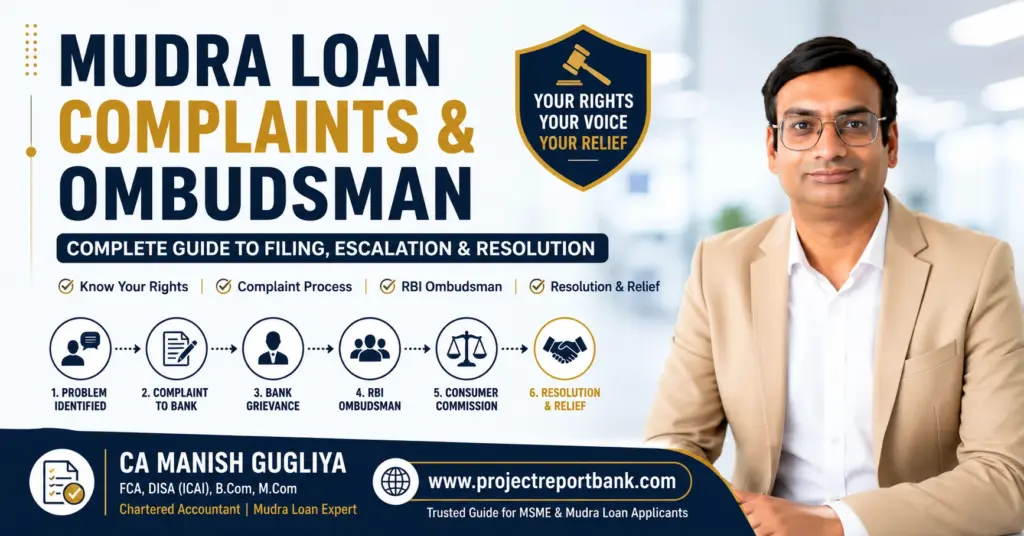

- Can a Bank Blacklist You for Filing a Mudra Loan Complaint?
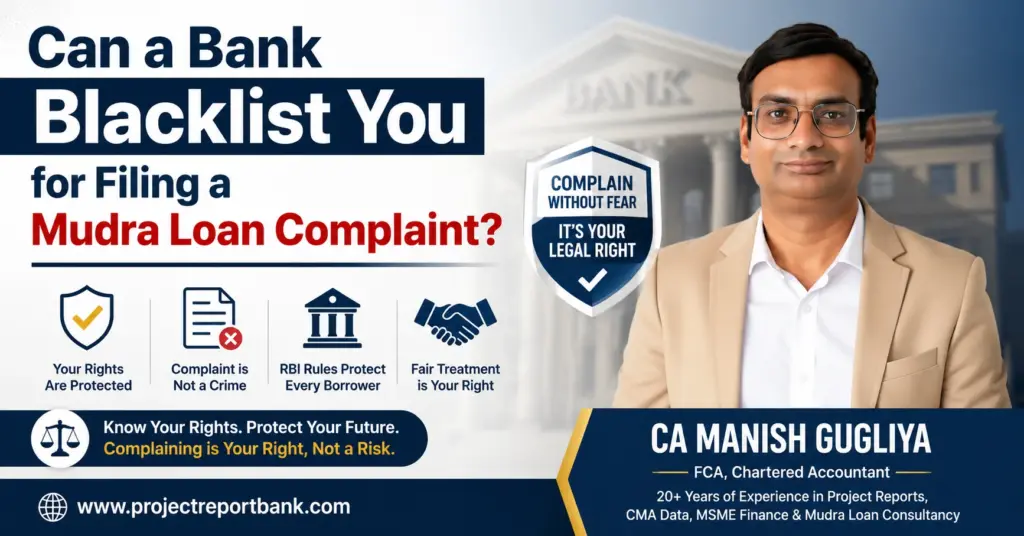
- Can a Mudra Loan Complaint Affect Future Loan Approval?
- Common Mistakes That Lead to Mudra Loan Complaint Failure
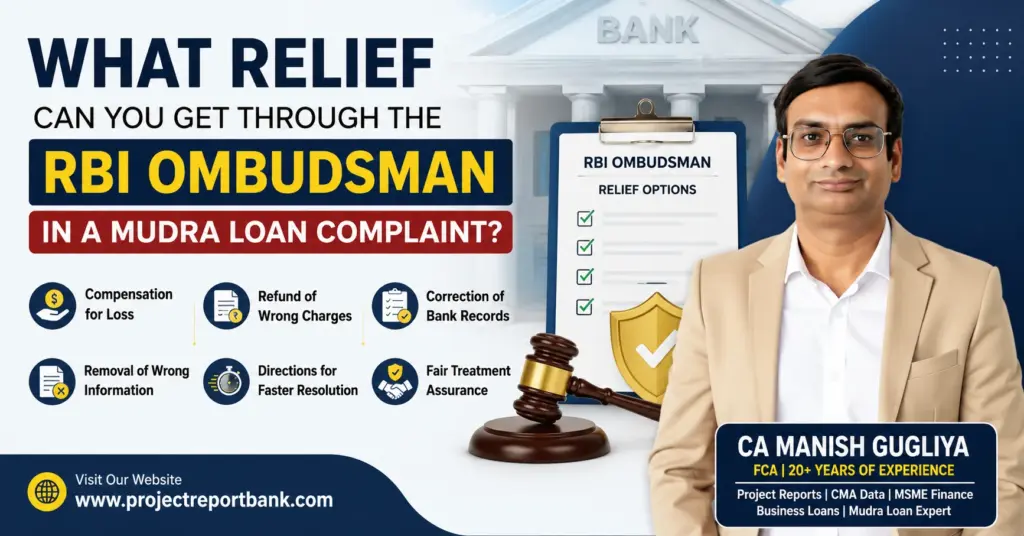
- RBI Ombudsman Mudra Loan Relief: Practical Guide for Small Borrowers
- Can the RBI Ombudsman Reject Your Mudra Loan Complaint? Reasons Explained
- Consumer Commission vs RBI Ombudsman: Which Is Better for Mudra Loan Disputes?
- Bank Grievance Redressal System for Mudra Loans: Complete Guide

- RBI Ombudsman Mudra Loan Complaint – Detailed Guide by CA Manish Gugliya