
Introduction
When applying for a Mudra Loan, many applicants believe that the Branch Manager alone has complete control over loan approval or rejection. This misunderstanding often leads to confusion, unnecessary stress, and unrealistic expectations during the loan process. In reality, the Branch Manager is one of the most important officials involved in evaluating your application, but their authority is governed by the bank’s internal policies, RBI regulations, and PMMY guidelines. Understanding the Branch Manager’s actual role can help you communicate effectively, avoid common mistakes, and improve your overall loan application experience.
Why the Branch Manager Plays an Important Role
The Branch Manager is usually the first senior banking official responsible for reviewing your Mudra Loan application. They supervise document verification, assess the business proposal, evaluate the applicant’s financial profile, and ensure that the application complies with the bank’s lending policies. Depending on the loan amount and the bank’s internal delegation of powers, the Branch Manager may recommend approval, seek additional information, or forward the application to higher authorities for final sanction.
Because the Branch Manager oversees multiple stages of the loan process, many applicants interact with them directly for clarifications, status updates, and document submissions.
Why Many Applicants Misunderstand the Branch Manager’s Authority
A common misconception is that the Branch Manager can approve or reject every Mudra Loan application independently. In reality, the manager’s authority varies based on several factors, including the loan amount, the bank’s internal approval hierarchy, credit policies, and delegated financial powers.
For example, while the Branch Manager may recommend approval after completing the branch-level assessment, the final decision for certain cases may rest with a higher credit authority, regional office, or another designated sanctioning officer. Similarly, the manager cannot ignore mandatory banking guidelines or approve an application that does not meet eligibility requirements.
Understanding these limitations helps applicants set realistic expectations and reduces unnecessary frustration during processing.
What Decisions Can and Cannot Be Made by the Branch Manager?
The Branch Manager can perform several important functions during the Mudra Loan process. They can verify documents, request additional information or clarifications, evaluate the business proposal, recommend approval, return incomplete applications for correction, and guide applicants regarding procedural requirements.
However, there are also important limitations. A Branch Manager cannot override RBI or PMMY guidelines, sanction loans beyond their delegated financial authority, ignore mandatory credit assessment procedures, or guarantee loan approval simply because the applicant has met them personally. Every application must pass through the bank’s prescribed verification and approval process.
Knowing the difference between the manager’s responsibilities and limitations helps applicants understand why certain decisions may take longer than expected.
Common Reasons for Branch Manager-Related Delays
Not every delay is caused by negligence or intentional inaction. In many cases, delays occur because the Branch Manager is handling multiple responsibilities simultaneously. High application volumes, incomplete documentation, pending clarifications, workload during financial year-end, staff shortages, transfers, internal approvals, and signature requirements can all extend processing time.
Applicants may also experience delays when additional business verification or financial assessment is required before the application can move to the next stage. Recognizing these practical reasons helps applicants follow up professionally instead of making assumptions about the status of their application.
What This Complete Guide Covers
This cluster page serves as a one-stop resource for every major issue related to the Branch Manager’s role in Mudra Loan processing. Whether your application is waiting for the manager’s signature, returned for corrections, delayed due to workload, affected by a branch manager transfer, or you want to understand the manager’s approval powers and recommendations, you’ll find a dedicated guide for each situation.
Each section provides a brief overview of the issue along with a link to a detailed article that explains the topic in depth. By identifying your specific situation and following the appropriate guide, you can better understand the loan process, avoid common mistakes, and take the right next steps with confidence.
Explore 10 detailed guides covering the Branch Manager’s role, powers, approval authority, file processing issues, delays, recommendations, transfers and practical solutions for Mudra Loan applicants.
What You Will Learn
This complete guide will help you understand how the Branch Manager’s role can affect different stages of Mudra Loan processing. You will learn:
Role of the Branch Manager
Understand how the Branch Manager reviews, supervises, and supports the processing of a Mudra Loan application.Processing Responsibilities
Learn which branch-level activities may be handled or monitored by the Branch Manager, including document review, business assessment, clarification, and forwarding of the application.Approval Powers
Know whether the Branch Manager can approve the loan independently or whether the application must be sent to a higher sanctioning authority.Signature Delays
Understand why a Mudra Loan application may remain pending for the manager’s signature and what steps the applicant can take.File Corrections
Learn why the Branch Manager may return a loan file for correction, additional documents, or clarification.Loan Amount Reduction
Understand why the requested loan amount may be reduced based on business requirements, repayment capacity, risk assessment, or bank policy.Branch Manager Recommendations
Learn what a positive or negative recommendation means and whether it guarantees approval or rejection.Impact of a Manager’s Transfer
Know what can happen when the Branch Manager is transferred while your Mudra Loan application is still under process.Meeting the Branch Manager
Understand when meeting the Branch Manager may be useful, how to prepare for the discussion, and what applicants should avoid.Workload-Related Delays
Learn how staff shortages, high application volume, inspections, audits, and other branch responsibilities can affect processing time.Escalation Options
Understand when and how to escalate the matter to the regional office, nodal officer, grievance department, or other appropriate authority.
Find the Right Guide for Your Branch Manager Issue
Select the situation that matches your Mudra Loan application and open the detailed guide for explanations, applicant rights, and practical solutions.
How Branch Workload Affects Mudra Loan Processing
Read Complete Guide →Can a Branch Manager Return a Mudra Loan File?
Read Complete Guide →Mudra Loan Waiting for Manager Signature
Read Complete Guide →Branch Manager Loan Clarification
Read Complete Guide →Branch Manager Recommendation for Mudra Loan
Read Complete Guide →Can a Branch Manager Reduce the Mudra Loan Amount?
Read Complete Guide →Does the Branch Manager Have Final Approval Authority?
Read Complete Guide →What Happens After a Branch Manager Transfer?
Read Complete Guide →Can Meeting the Manager Speed Up a Mudra Loan?
Read Complete Guide →Powers of a Branch Manager in Mudra Loan Approval
Read Complete Guide →Understanding the Branch Manager’s Role
The Branch Manager plays a central role in the branch-level processing of a Mudra Loan application. From the time an application is submitted until it moves to the next stage of approval, the Branch Manager supervises several important activities to ensure that the proposal complies with the bank’s lending policies, RBI regulations, and PMMY guidelines. Although applicants often assume that the Branch Manager has complete authority over loan approval, the actual role is broader and operates within the bank’s delegated powers.
Below are the key responsibilities performed by a Branch Manager during Mudra Loan processing.
First-Level Decision Maker
The Branch Manager is generally the first senior official to review the overall quality of a Mudra Loan application. They examine whether the proposal appears complete, practical, and suitable for further processing. At this stage, the manager may identify missing information, request corrections, or forward the application for detailed credit evaluation.
Loan Assessment
Before recommending any application, the Branch Manager reviews the applicant’s business proposal, project report, financial requirements, repayment capacity, and supporting documents. This assessment helps determine whether the proposed business appears commercially viable and whether the requested loan amount is justified.
Risk Evaluation
Every loan involves financial risk. The Branch Manager performs an initial assessment of various risk factors, including business feasibility, borrower profile, repayment capacity, existing liabilities, banking behaviour, and document authenticity. This evaluation assists the bank in making informed lending decisions.
Documentation Verification
One of the Branch Manager’s important responsibilities is ensuring that the loan file contains all required documents. If any mandatory document is missing, incomplete, or inconsistent, the manager may return the application for correction or request additional information before processing continues.
Understanding the Business Proposal
The Branch Manager evaluates whether the applicant clearly understands the proposed business and whether the project appears realistic. In some cases, they may seek clarification regarding business operations, investment plans, projected income, or market potential before making a recommendation.
Recommendation Authority
After completing the branch-level review, the Branch Manager may recommend approval, recommend modifications, or identify concerns that require further examination. However, a recommendation should not be confused with final approval, as many applications require additional scrutiny or sanction from higher authorities depending on the bank’s internal approval hierarchy.
Customer Interaction and Guidance
The Branch Manager also serves as the primary point of contact for many applicants. They explain document requirements, clarify procedural queries, communicate deficiencies in the application, and guide applicants throughout the processing journey. Professional communication between the applicant and the Branch Manager often helps avoid unnecessary delays.
| ✅ Branch Manager Can | ❌ Branch Manager Cannot |
|---|---|
| Verify loan documents and supporting records. | Change or override RBI regulations. |
| Recommend approval based on the branch-level assessment. | Ignore PMMY guidelines or bank policies. |
| Seek clarification or request additional documents. | Approve loans beyond delegated financial authority. |
| Return incomplete or incorrect loan files for correction. | Guarantee loan sanction before the complete approval process. |
| Evaluate the business proposal and repayment capacity. | Approve applications that do not satisfy mandatory eligibility criteria. |
| Guide applicants regarding documentation and procedural requirements. | Waive mandatory verification or compliance procedures. |
| Forward eligible applications to higher authorities when required. | Bypass the bank's internal credit appraisal process. |
This comparison clearly shows that while the Branch Manager performs several important branch-level responsibilities, their authority is exercised within the framework of the bank’s internal policies and applicable RBI and PMMY guidelines. Understanding these boundaries helps applicants develop realistic expectations and interact with the bank more effectively during Mudra Loan processing.
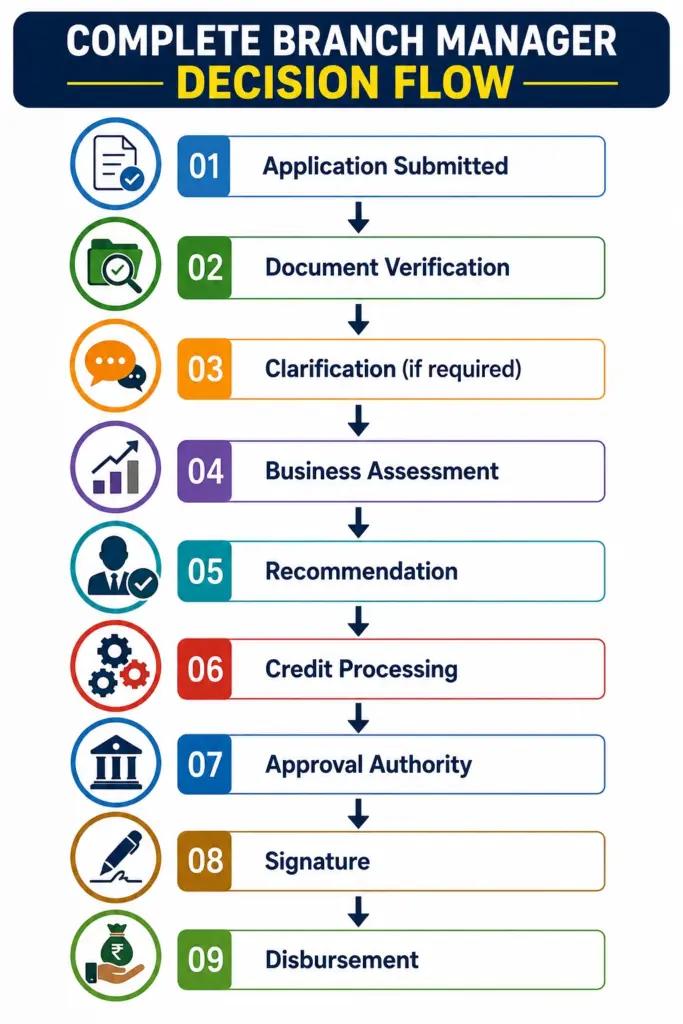
Complete Branch Manager Decision Flow
1. Application Submitted
The Mudra Loan journey begins when the applicant submits the completed application form along with the required documents to the bank branch. At this stage, the branch acknowledges receipt of the application and performs a preliminary review to ensure the file is complete. Providing accurate information and all supporting documents from the beginning helps reduce unnecessary delays in later stages of processing.
2. Document Verification
Once the application is received, the Branch Manager or the designated bank official verifies all submitted documents for completeness, authenticity, and consistency. Identity proof, address proof, business documents, bank statements, project report, and other supporting records are carefully reviewed. If any mandatory document is missing or contains discrepancies, the applicant may be asked to provide corrections before the application proceeds further.
3. Clarification (If Required)
If the bank needs additional information or finds inconsistencies in the application, the Branch Manager may contact the applicant for clarification. This may involve explaining the business model, updating financial information, or submitting additional documents. Promptly responding to clarification requests helps prevent unnecessary processing delays and allows the application to move smoothly to the next stage.
4. Business Assessment
During this stage, the Branch Manager evaluates the overall viability of the proposed business. The assessment considers factors such as business experience, market demand, investment requirements, projected income, repayment capacity, and the purpose of the loan. The objective is to determine whether the business appears financially feasible and capable of repaying the sanctioned loan within the agreed terms.
5. Recommendation
After reviewing the documents and assessing the business proposal, the Branch Manager records a recommendation based on the branch-level evaluation. The recommendation may support approval, approval with certain conditions, or highlight concerns that require further review. It is important to remember that a recommendation is only one step in the process and does not automatically guarantee loan approval.
6. Credit Processing
Following the Branch Manager’s recommendation, the application moves to the bank’s credit processing stage. Depending on the bank’s internal procedures, this may include credit appraisal, financial analysis, CIBIL verification, income assessment, internal risk evaluation, and other compliance checks. These assessments help the bank determine whether the loan proposal satisfies its lending and risk management standards.
7. Approval Authority
Once the credit evaluation is completed, the application reaches the appropriate approval authority. Depending on the loan amount and the bank’s delegation of powers, the final decision may be taken by the Branch Manager, a regional office, or another authorized sanctioning authority. The application is approved only after all required evaluations and internal procedures have been completed.
8. Signature
After the loan receives approval, the necessary sanction letters and loan documents are signed by the authorized bank official. The applicant may also need to sign various loan agreements and declarations before the loan is released. Completing all documentation accurately ensures that the disbursement process can proceed without further delays.
9. Disbursement
The final stage is the disbursement of the sanctioned loan amount. After all formalities, documentation, and approvals have been completed, the bank releases the funds according to the approved terms and conditions. Depending on the loan purpose, the amount may be credited directly to the applicant’s account or disbursed as per the bank’s applicable procedures.
Common Branch Manager Issues During Mudra Loan Processing
Although the Branch Manager plays a significant role in processing a Mudra Loan application, applicants often face situations that create confusion or delay. Some issues are related to documentation, while others arise because of branch workload, internal approval procedures, managerial transfers, or misunderstandings about the Branch Manager’s authority. This section briefly explains the most common Branch Manager-related issues and directs you to detailed guides where you can learn about the causes, practical solutions, applicant rights, and the appropriate next steps.
1. Branch Workload Causing Processing Delay
Every Branch Manager is responsible for multiple banking activities in addition to processing Mudra Loan applications. During busy periods such as financial year-end, audits, inspections, or staff shortages, loan processing may slow down. Such delays are generally operational rather than personal and do not automatically indicate that your application will be rejected. Following up professionally and understanding the branch’s workload can help manage expectations.
Read the complete guide: How Branch Workload Affects Mudra Loan Processing
Link: https://projectreportbank.com/how-branch-workload-affects-mudra-loan-processing/
2. Branch Manager Returned Your Loan File
Sometimes the Branch Manager may return your Mudra Loan application because documents are incomplete, incorrect, or additional information is required. A returned file is usually an opportunity to rectify deficiencies rather than a rejection. Understanding the reasons behind file returns helps applicants make corrections quickly and continue the processing without unnecessary delays.
Read the complete guide: Can a Branch Manager Return a Mudra Loan File?
Link: https://projectreportbank.com/branch-manager-return-mudra-loan-file/
3. Waiting for Branch Manager Signature
Many applicants notice that their Mudra Loan application remains pending because it is awaiting the Branch Manager’s signature. This may happen due to internal approvals, pending verification, workload, or administrative procedures. Knowing why signatures are delayed helps applicants understand the process and decide when it is appropriate to follow up with the bank.
Read the complete guide: Mudra Loan Waiting for Manager Signature
Link: https://projectreportbank.com/mudra-loan-waiting-manager-signature/
4. Branch Manager Asking for Clarification
During the assessment process, the Branch Manager may request clarification regarding your business proposal, project report, investment requirements, financial estimates, or supporting documents. Such requests are a normal part of evaluating the loan application. Providing accurate and timely responses can help the application move smoothly to the next stage.
Read the complete guide: Why Is the Branch Manager Asking for Loan Clarification?
Link: https://projectreportbank.com/branch-manager-loan-clarification/
5. Branch Manager Recommendation
After reviewing your application, the Branch Manager may provide a recommendation based on the business assessment and document verification. Many applicants assume that a recommendation guarantees approval, but it is only one stage of the overall loan evaluation process. Understanding what a recommendation means helps set realistic expectations.
Read the complete guide: What Does a Branch Manager Recommendation Mean?
Link: https://projectreportbank.com/branch-manager-recommendation-mudra-loan/
6. Loan Amount Reduced by Branch Manager
In some cases, the sanctioned loan amount may be lower than the amount originally requested. This can happen because of business viability, repayment capacity, project cost assessment, or the bank’s internal lending policies. Understanding why the requested amount may be reduced helps applicants prepare for discussions with the bank.
Read the complete guide: Can a Branch Manager Reduce the Requested Mudra Loan Amount?
Link: https://projectreportbank.com/branch-manager-reduce-mudra-loan-amount/
7. Final Approval Authority
Many borrowers believe that the Branch Manager alone has the authority to approve every Mudra Loan application. In reality, approval depends on delegated powers, loan amount, bank policy, and internal approval hierarchy. Knowing who has the final authority helps applicants better understand the decision-making process.
Read the complete guide: Does the Branch Manager Have Final Authority to Approve a Mudra Loan?
Link: https://projectreportbank.com/branch-manager-final-authority-mudra-loan/
8. Branch Manager Transfer During Processing
A Branch Manager may be transferred while your Mudra Loan application is still under process. Although this can sometimes delay the application temporarily, the file usually continues under the supervision of the new Branch Manager. Understanding how transfers affect processing helps applicants plan their follow-up appropriately.
Read the complete guide: What Happens If the Branch Manager Is Transferred During Processing?
Link: https://projectreportbank.com/mudra-loan-branch-manager-transfer/
9. Meeting the Branch Manager
Many applicants believe that meeting the Branch Manager personally will speed up loan approval. While a professional discussion can help clarify doubts or provide additional information, it cannot bypass verification procedures or guarantee approval. Knowing the right way to communicate with the Branch Manager can improve your overall experience.
Read the complete guide: Can Meeting the Branch Manager Speed Up Your Mudra Loan?
Link: https://projectreportbank.com/meet-branch-manager-speed-up-mudra-loan/
10. Powers of the Branch Manager
The Branch Manager performs several important responsibilities, including document verification, business assessment, seeking clarifications, and recommending applications. However, these powers are exercised within the bank’s delegated authority and applicable RBI and PMMY guidelines. Understanding these responsibilities helps applicants avoid misconceptions about the manager’s role.
Read the complete guide: What Are the Powers of a Branch Manager in Mudra Loan Approval?
Link: https://projectreportbank.com/branch-manager-powers-mudra-loan-approval/
Which Guide Should You Read?
Match your current Mudra Loan situation with the most relevant detailed guide. Click the recommended article to understand the issue, possible reasons, and practical next steps.
| Your Situation | Recommended Guide |
|---|---|
| Branch Manager returned your loan file | Can a Branch Manager Return a Mudra Loan File? |
| Application is waiting for the manager’s signature | Mudra Loan Waiting for Manager Signature |
| Branch Manager asked for an explanation or clarification | Why Is the Branch Manager Asking for Loan Clarification? |
| Branch Manager was transferred during processing | What Happens If the Branch Manager Is Transferred? |
| The requested loan amount was reduced | Can a Branch Manager Reduce the Mudra Loan Amount? |
| Processing is delayed due to branch workload | How Branch Workload Affects Mudra Loan Processing |
| You want to understand the Branch Manager’s powers | Powers of a Branch Manager in Mudra Loan Approval |
| You are unsure who has final approval authority | Does the Branch Manager Have Final Approval Authority? |
| You want to understand the manager’s recommendation | What Does a Branch Manager Recommendation Mean? |
| You are considering meeting the Branch Manager | Can Meeting the Branch Manager Speed Up Your Mudra Loan? |
Applicant Rights While Dealing With the Branch Manager
During the Mudra Loan application process, the Branch Manager serves as the primary point of contact for many applicants. While the Branch Manager is responsible for assessing the loan proposal and ensuring compliance with the bank’s lending policies, applicants also have certain rights that promote transparency, fairness, and effective communication. Understanding these rights helps borrowers interact confidently with the bank while maintaining a professional relationship throughout the loan processing journey.
Right to Fair Treatment
Every Mudra Loan applicant has the right to be treated fairly, respectfully, and without discrimination. The Branch Manager should evaluate every application based on eligibility, documentation, business viability, and applicable banking guidelines rather than personal opinions or external influences. Applicants should expect courteous communication and an unbiased assessment of their loan proposal.
Right to Ask About the Application Status
Applicants have the right to request updates regarding the current stage of their Mudra Loan application. The Branch Manager or designated bank official should provide reasonable information about whether the application is under verification, pending clarification, under credit appraisal, awaiting approval, or ready for disbursement. Regular but polite follow-up helps applicants stay informed without creating unnecessary pressure on the branch.
Right to Know the Deficiencies in the Application
If the Branch Manager finds that documents are incomplete, inconsistent, or require correction, the applicant has the right to know the specific deficiencies. Understanding exactly what information or document is missing enables applicants to rectify the issue quickly instead of making repeated visits to the branch without clear guidance.
Right to Submit Clarification
Applicants also have the right to explain their business proposal, respond to clarification requests, and submit additional documents whenever required. If the Branch Manager raises concerns about turnover, investment, business experience, or project viability, applicants should be given a reasonable opportunity to provide supporting evidence before any decision is taken.
Right to Escalate the Matter
If an applicant experiences unreasonable delays, lack of communication, or procedural issues that cannot be resolved at the branch level, they have the right to escalate the matter through the bank’s established grievance redressal mechanism. Escalation should always be made professionally and only after allowing reasonable time for the branch to complete the normal processing procedure.
Right to File a Complaint Against Unfair Treatment
If an applicant believes that they have been treated unfairly, subjected to inappropriate behaviour, or that the prescribed banking procedures have not been followed, they have the right to submit a formal complaint through the bank’s complaint system. Complaints should always be supported by relevant facts, documents, acknowledgements, or communication records to facilitate proper investigation.
Applicant Rights vs Branch Responsibilities
| Applicant Rights | Branch Responsibilities |
|---|---|
| Receive fair, respectful, and unbiased treatment. | Process every application objectively according to bank policies and applicable guidelines. |
| Ask about the current status of the loan application. | Provide reasonable updates on the application's processing stage. |
| Know if any document or information is missing. | Clearly communicate deficiencies requiring correction or additional documents. |
| Submit clarification or additional supporting documents. | Review the clarification fairly before proceeding with the application. |
| Escalate unresolved issues through the grievance process. | Guide applicants regarding the appropriate escalation channel when required. |
| File a complaint if unfair treatment or procedural irregularities occur. | Handle complaints professionally and follow the bank's grievance redressal process. |
| Receive transparent communication during processing. | Maintain clear, timely, and professional communication with applicants. |
Knowing your rights does not mean challenging the Branch Manager at every stage. Instead, it helps you communicate professionally, provide complete information, seek timely updates, and use the appropriate grievance mechanism whenever necessary. A cooperative approach from both the applicant and the Branch Manager generally results in smoother Mudra Loan processing.
Common Mistakes Applicants Make
Many Mudra Loan applications are delayed not because of eligibility issues, but because applicants make avoidable mistakes while interacting with the Branch Manager. Avoiding these common errors can help ensure smoother loan processing and better communication with the bank.
Visiting the Branch Every Day
Frequent unnecessary visits rarely speed up processing and may create inconvenience for both you and the branch staff.
Arguing with the Branch Manager
Always communicate politely and professionally. Constructive discussion is more effective than confrontation.
Ignoring Clarification Requests
Delaying responses to clarification or additional document requests can significantly increase processing time.
Submitting Incomplete Documents
Missing documents often result in the loan file being returned for correction, causing avoidable delays.
Not Maintaining Communication
Stay in touch with the branch at reasonable intervals to receive important updates and respond promptly.
Having Wrong Expectations
Do not assume that meeting the Branch Manager or receiving a recommendation guarantees loan approval.
Depending Only on Verbal Assurances
Wherever possible, rely on written communication, acknowledgements, and official updates instead of verbal commitments.
Not Tracking Your Application
Keep copies of documents, acknowledgement receipts, and regularly check the application's progress through appropriate channels.
Expert Guidance by CA Manish Gugliya
Successfully obtaining a Mudra Loan is not only about meeting the eligibility criteria but also about managing the application process professionally. Based on my practical experience in MSME finance, project reports, CMA data, and business loan consultancy, the following recommendations can help applicants communicate effectively with the Branch Manager, avoid common mistakes, and improve the overall loan processing experience.
Submit a Complete Loan Application
Before submitting your Mudra Loan application, ensure that every required document is complete, properly signed, and free from errors. A complete application reduces the chances of your loan file being returned for corrections and speeds up the verification process.
Respond Quickly to Clarification Requests
If the Branch Manager requests additional documents or clarification, respond as early as possible. Prompt replies demonstrate seriousness and prevent unnecessary delays in processing your application.
Prepare a Professional Project Report
A realistic and well-prepared project report helps the Branch Manager understand your business proposal more effectively. Proper financial projections and business planning significantly improve the quality of your loan application.
Keep Financial Records Ready
Maintain updated bank statements, quotations, licences, GST records (where applicable), financial statements, and other supporting documents. Being prepared allows you to respond quickly whenever additional information is requested.
Understand the Branch Manager’s Authority
Many applicants believe the Branch Manager has complete control over loan approval. In reality, their authority depends on the bank’s delegated powers and internal approval process. Understanding these limits helps avoid unrealistic expectations.
Stay Patient During High Workload Periods
Processing may take longer during financial year-end, audits, inspections, or periods of heavy application volume. Professional patience and reasonable follow-up are usually more effective than repeated branch visits.
Follow Up Professionally
Maintain polite and professional communication with the Branch Manager. Follow up at reasonable intervals, ask for updates respectfully, and cooperate whenever additional information is requested.
Maintain Written Communication
Whenever possible, submit clarifications, additional documents, or important requests in writing. Written communication creates a proper record that can be useful if any issue arises later.
Preserve All Acknowledgements
Always keep copies of acknowledgement receipts, application forms, emails, SMS updates, and document submission records. These documents become valuable if you need to track your application or raise a grievance.
Escalate Only After a Reasonable Waiting Period
If your application remains pending without a valid reason, first discuss the matter with the Branch Manager. Escalate to higher authorities only after giving the branch sufficient time to complete the normal processing procedure.
Be Honest and Transparent
Provide accurate information about your business, investment, turnover, and financial position. Honest disclosure builds credibility and allows the Branch Manager to evaluate your application fairly.
Focus on Building a Strong Business Proposal
Rather than concentrating only on loan approval, focus on presenting a viable business idea supported by realistic financial projections and proper documentation. A strong business proposal improves both approval chances and long-term business success.
Complete Branch Manager Issues Library
Explore every Branch Manager-related issue that may arise during your Mudra Loan journey. Each guide explains the problem, why it happens, practical solutions, and the next steps applicants should take.
How Branch Workload Affects Mudra Loan Processing
Who Should Read
Applicants whose Mudra Loan application is delayed because of heavy branch workload, staff shortages, audits, or financial year-end activities.
Problem Solved
Understand why workload-related delays occur and how to follow up professionally without creating unnecessary pressure.
Can a Branch Manager Return a Mudra Loan File?
Who Should Read
Applicants whose loan application has been returned for corrections or additional documents.
Problem Solved
Learn the common reasons why a Branch Manager returns a loan file and how to resolve the deficiencies quickly.
Mudra Loan Waiting for Manager Signature
Who Should Read
Applicants whose application is pending because it is awaiting the Branch Manager's signature.
Problem Solved
Understand why signature delays happen and when you should follow up with the branch.
Why Is the Branch Manager Asking for Loan Clarification?
Who Should Read
Applicants who have received clarification requests regarding their business or loan proposal.
Problem Solved
Learn how to respond properly and avoid unnecessary delays during loan assessment.
What Does a Branch Manager Recommendation Mean?
Who Should Read
Applicants who want to understand the importance of the Branch Manager's recommendation.
Problem Solved
Know whether a recommendation guarantees approval and how it affects loan processing.
Can a Branch Manager Reduce the Requested Mudra Loan Amount?
Who Should Read
Applicants who receive approval for an amount lower than the amount requested.
Problem Solved
Understand why loan amounts are reduced and the factors considered during assessment.
Does the Branch Manager Have Final Authority?
Who Should Read
Applicants who are unsure who makes the final Mudra Loan approval decision.
Problem Solved
Learn the difference between Branch Manager recommendations and final approval authority.
What Happens If the Branch Manager Is Transferred?
Who Should Read
Applicants whose loan application is affected by a Branch Manager transfer.
Problem Solved
Understand how transfers affect pending applications and how to continue the process smoothly.
Can Meeting the Branch Manager Speed Up Your Mudra Loan?
Who Should Read
Applicants planning to meet the Branch Manager to discuss their loan application.
Problem Solved
Learn when a meeting is helpful and how to communicate professionally with the Branch Manager.
Powers of a Branch Manager in Mudra Loan Approval
Who Should Read
Applicants who want to understand the actual powers and limitations of a Branch Manager.
Problem Solved
Learn what the Branch Manager can and cannot do during Mudra Loan processing.
Frequently Asked Questions (FAQs)
1. What is the role of a Branch Manager in Mudra Loan approval?
The Branch Manager reviews your loan application, verifies documents, evaluates your business proposal, seeks clarification if required, and may recommend the application for approval. Depending on the bank’s internal delegation of powers, the Branch Manager may or may not have the authority to sanction the loan.
2. Can a Branch Manager reject my Mudra Loan?
Yes, the Branch Manager may reject or recommend rejection if the application does not meet the bank’s lending criteria, contains incomplete information, or fails during assessment. However, every rejection should be based on legitimate banking reasons rather than personal discretion.
3. Can the Branch Manager reduce the sanctioned loan amount?
Yes. After evaluating the business requirement, repayment capacity, and project viability, the bank may approve an amount lower than the one requested if it considers that amount more appropriate.
4. Why is my Mudra Loan waiting for the Branch Manager’s signature?
Your application may be waiting because certain internal approvals, document verification, or administrative formalities have not yet been completed. High workload or the Branch Manager’s absence can also contribute to signature delays.
5. Can the Branch Manager return my loan file?
Yes. If mandatory documents are missing, incorrect, or require clarification, the Branch Manager may return the application for correction before processing continues.
6. Can I meet the Branch Manager directly?
Yes. Applicants can request a meeting to discuss their application, clarify doubts, or submit additional information. However, a meeting does not guarantee faster approval.
7. What happens if the Branch Manager is transferred during processing?
Your application normally remains valid and is transferred to the new Branch Manager or another authorised officer. Although processing may be delayed temporarily, it usually continues after the handover.
8. Can I complain against a Branch Manager?
Yes. If you experience unfair treatment, unreasonable delays, or procedural issues, you may submit a complaint through the bank’s official grievance redressal mechanism.
9. Does the Branch Manager have final approval authority?
Not always. Final approval depends on the loan amount, delegated powers, and the bank’s internal approval hierarchy. Some applications require approval from higher authorities.
10. Can branch workload delay Mudra Loan processing?
Yes. Heavy application volume, staff shortages, audits, and financial year-end activities may increase the overall processing time.
11. How long should I wait before following up?
A polite follow-up after a reasonable interval is appropriate. If the bank has requested clarification or additional documents, submit them promptly before seeking further updates.
12. Can the Branch Manager ask for additional documents?
Yes. If further verification is necessary, the Branch Manager may request additional documents or supporting information before processing your application.
13. Is a Branch Manager’s recommendation equal to loan approval?
No. A recommendation is only one stage of the assessment process. The application may still require credit appraisal or approval from another authorised officer.
14. Can the Regional Office overrule the Branch Manager?
Yes. Depending on the bank’s internal approval process, higher authorities may review, modify, approve, or decline recommendations made by the Branch Manager.
15. What should I do if the Branch Manager does not respond?
Maintain professional communication, visit the branch if necessary, and request an update. If there is an unreasonable delay without valid reasons, consider using the bank’s grievance redressal system.
16. What if the Branch Manager refuses to meet me?
You may request an appointment, speak with another authorised officer, or communicate through written correspondence. If necessary, escalate the matter through official channels.
17. Can I request another officer to process my application?
In certain situations, another authorised bank official may assist you, especially if the Branch Manager is unavailable. However, processing responsibilities depend on the bank’s internal procedures.
18. Can the bank change the processing officer?
Yes. The bank may assign another officer due to workload, leave, transfers, or internal administrative requirements without affecting the validity of your application.
19. What documents should I keep during discussions with the Branch Manager?
Carry copies of your application, acknowledgement receipt, identity proof, project report, financial records, quotations, and any correspondence exchanged with the bank.
20. How can I improve my Mudra Loan approval chances?
Submit complete documentation, prepare a realistic project report, maintain accurate financial information, respond promptly to clarification requests, and communicate professionally with the Branch Manager throughout the application process.
21. Does meeting the Branch Manager guarantee faster approval?
No. While a meeting can help clarify doubts and resolve documentation issues, approval still depends on verification, business assessment, and the bank’s internal approval process.
22. Can the Branch Manager ignore RBI or PMMY guidelines?
No. Every Branch Manager must process Mudra Loan applications according to the applicable RBI regulations, PMMY guidelines, and the bank’s internal lending policies.
23. What should I do if my application is delayed for several weeks?
First, confirm the current processing stage with the branch and ask whether any action is required from your side. If the delay continues without a reasonable explanation, you may escalate the matter through the bank’s grievance mechanism.
24. Can incomplete documentation delay my Mudra Loan?
Yes. Missing documents are one of the most common reasons for delays. Submitting a complete and accurate application at the beginning significantly improves processing efficiency.
25. How can I avoid common Branch Manager-related issues?
Prepare a complete application, maintain regular but professional communication, respond quickly to clarification requests, keep acknowledgement receipts safely, and understand the Branch Manager’s role and limitations before expecting a final decision.
Conclusion
The Branch Manager plays an important role throughout the Mudra Loan journey by reviewing applications, verifying documents, assessing business proposals, seeking clarifications, and recommending eligible cases for further approval. However, it is equally important to understand that the Branch Manager works within the bank’s internal policies, delegated authority, and applicable RBI and PMMY guidelines. Not every decision is made solely at the branch level, and many applications require additional verification or approval before the loan is sanctioned.
Applicants should also remember that many delays are procedural rather than personal. Factors such as document verification, clarification requests, branch workload, internal approvals, staff transfers, and administrative processes can all affect the processing timeline. Remaining patient, maintaining professional communication, and responding promptly to the bank’s requirements can significantly improve the overall experience.
If you are facing any Branch Manager-related issue, first identify your exact situation using the guides provided on this page. Whether your application is delayed because of workload, waiting for a signature, returned for corrections, affected by a transfer, or you simply want to understand the Branch Manager’s authority, each detailed guide explains the issue, possible reasons, practical solutions, and the appropriate next steps.
Finally, escalate the matter only after allowing the branch reasonable time to complete the normal processing procedure and after making genuine efforts to resolve the issue through regular communication. By understanding the Branch Manager’s responsibilities and following the appropriate guidance, applicants can navigate the Mudra Loan process more confidently and avoid many common misunderstandings.
Continue exploring the detailed articles in this Branch Manager Issues Library to find issue-specific guidance, practical recommendations, and step-by-step solutions for your particular Mudra Loan situation.
Mudra Loan Branch Manager Issues: Complete Guide to Manager’s Role, Powers & Common Problems
Introduction When applying for a Mudra Loan, many applicants believe that the Branch Manager alone has complete control over loan approval or rejection. This misunderstanding often leads to confusion, unnecessary stress, and unrealistic expectations during the loan process. In reality, the Branch Manager is one of the most important officials involved in evaluating your application, […]

How Branch Workload Affects Mudra Loan Processing
Key Takeaways Before you dive into the full article, here are the most important points you should remember about how branch workload affects mudra loan processing. Introduction: Why Branch Workload Matters in Mudra Loan Processing Imagine this. A shopkeeper in a small town applies for a ₹2 lakh Kishore Mudra loan in June 2025. He […]
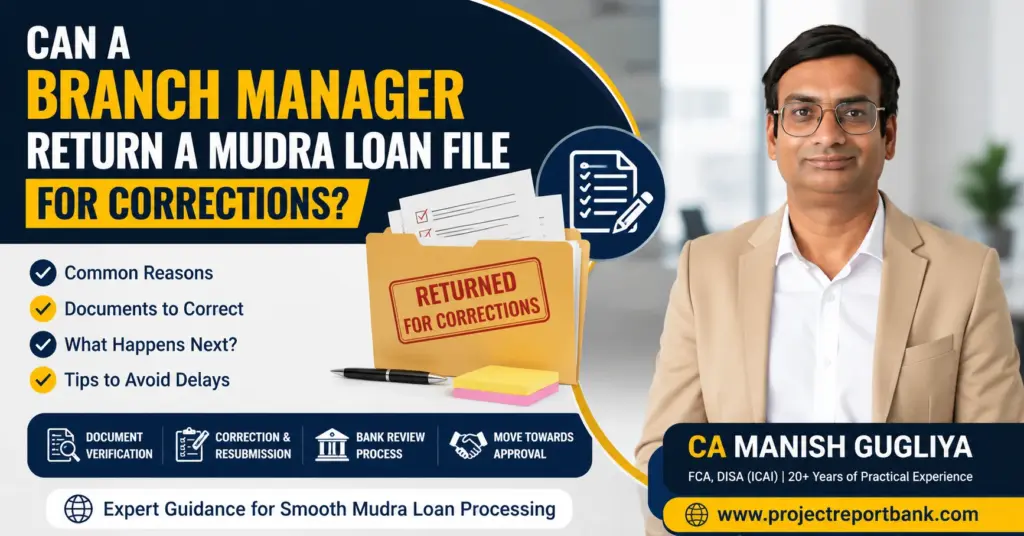
Can a Branch Manager Return a Mudra Loan File for Corrections? Complete Practical Guide
Many applicants panic when their Mudra loan file comes back from the branch. They assume their application is finished. That is almost never true. Returning a file for corrections is a routine step in loan processing, not a rejection. This guide explains exactly why it happens, what to fix, and how to get back on […]
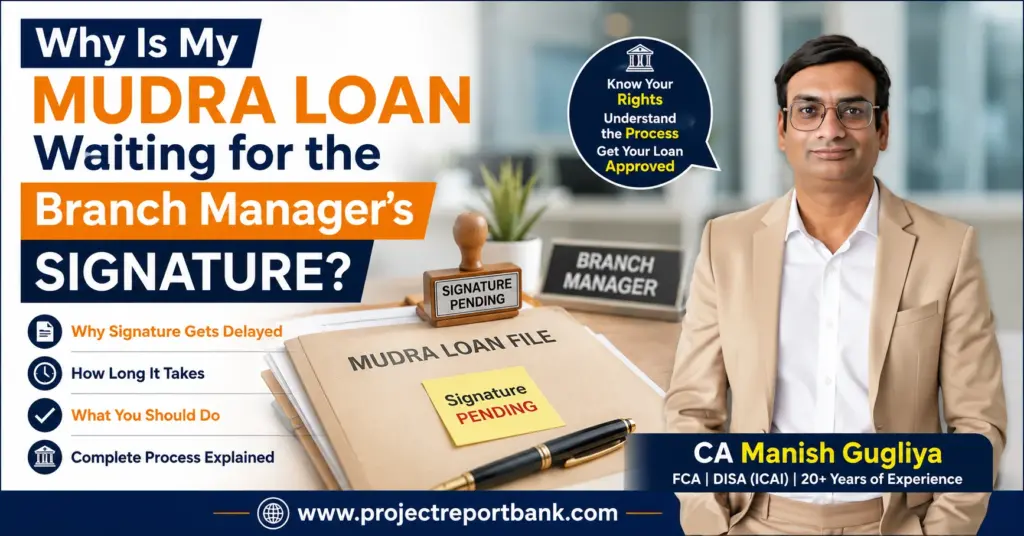
Why Is My Mudra Loan Waiting for the Branch Manager’s Signature?
Key Takeaways Introduction: Why Applicants Panic When the Signature Is Pending Imagine this: Ramesh, a shopkeeper in a small town, applied for a Kishore loan of ₹2 lakh in June 2026. He submitted every document the bank asked for. Five days later, the loan officer told him, “Your file is with the branch manager for […]

Why Does the Branch Manager Ask for Clarification Before Loan Approval?
Key Takeaways As a practising Chartered Accountant (CA Manish Gugliya, FCA) with over 20 years of experience in project reports, CMA data, and MSME finance, I regularly handle clarification letters from banks and help borrowers convert a status of “loan approval pending clarification” into final sanction. This article covers why banks ask clarifications, how to […]

Branch Manager Recommendation in Mudra Loan: Full Meaning, Next Steps & Practical Guidance
Key Takeaways Introduction: Why “Branch Manager Recommendation” Confuses Mudra Loan Applicants Picture this: a first-time entrepreneur in 2026 applies for a Mudra loan of ₹7 lakh to set up a small trading business. He checks his application status online and reads: “File recommended by Branch Manager.” He immediately calls his supplier and says, “Money will […]

Can a Branch Manager Reduce the Requested Mudra Loan Amount?
You applied for a Mudra loan of ₹5 lakh. The bank sanctioned ₹3.5 lakh. Now you are wondering – did the branch manager cut my loan amount on purpose? Was it personal? Can they even do that? This is one of the most common frustrations I hear from MSME applicants across India. In this guide, […]
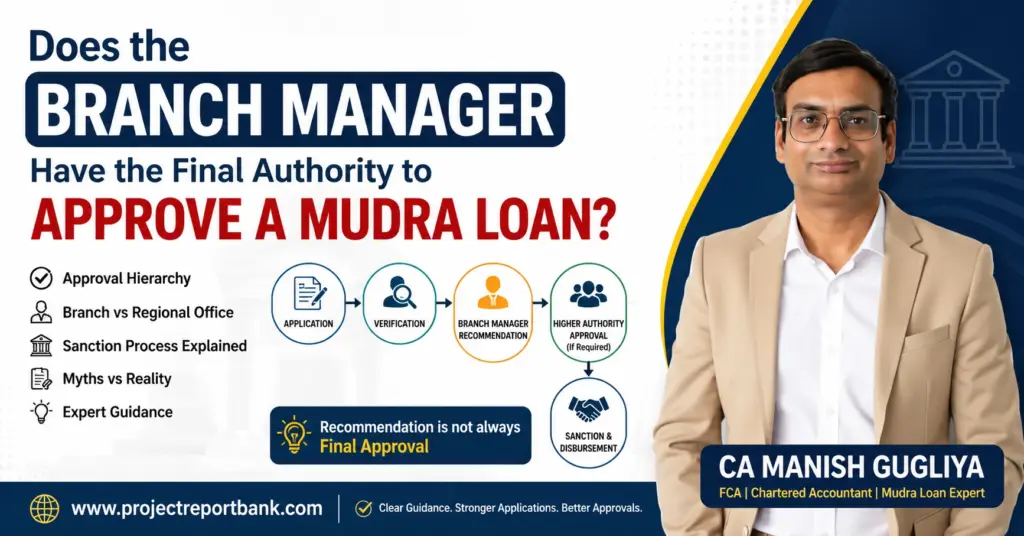
Does Branch Manager Have Final Authority to Approve Mudra Loan?
Key Takeaways Introduction: Why There Is Confusion About Branch Manager’s Powers In my 20+ years as a Chartered Accountant working with MSME finance and business loans, I have seen this scene hundreds of times. A small entrepreneur walks out of the bank smiling, telling his family: “Manager ji ne haan bol diya, loan pakka hai!” […]

What Happens If the Branch Manager Is Transferred During Mudra Loan Processing?
Your mudra loan verification is complete, documents are submitted, and suddenly you learn that the Branch Manager has been transferred. Does your application start from zero? Will another manager reject it? Will processing stop? These are among the most common concerns applicants have. Let me answer them directly: a Branch Manager’s transfer during mudra loan […]