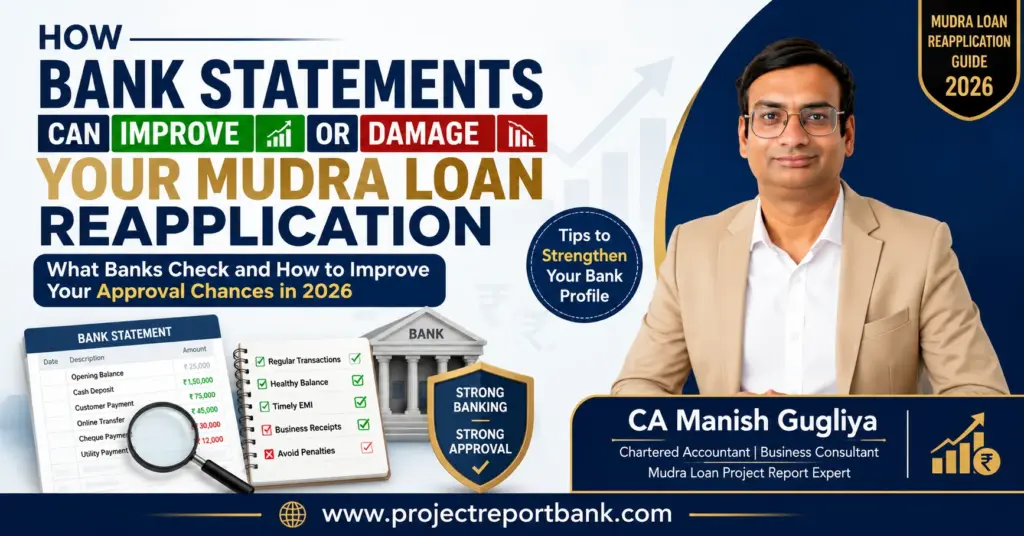
Key Takeaways
If you are a busy Mudra Loan applicant reapplying after rejection, here is what matters most:
- During Mudra Loan reapplication under Pradhan Mantri Mudra Yojana (PMMY), bank managers trust your last 6–12 months bank statement more than any verbal promise or printed project report you bring.
- Regular business credits, limited cash withdrawals, no cheque bounce, and timely EMI payments strongly improve approval chances-even for shishu loans upto rs 50,000.
- Negative habits like frequent penalty charges, sudden heavy cash deposits, or salary-like transfers without proof can make banks doubt your turnover and repayment capacity.
- You should “repair” your banking behaviour for at least 3–6 months before reapplying. Professional help from a Chartered Accountant can align bank statements, GST, ITR, and project report properly.
Introduction: Why Your Bank Statement Decides Your Mudra Loan Fate
In my practice as a Chartered Accountant since 2006, I have sat across bank managers during hundreds of Mudra Loan reappraisal meetings. One thing is always the same-the manager keeps the bank statement on the table and silently reads your banking behaviour line by line before asking a single question.
For mudra loans-Shishu loans provide up to Rs.50,000 for startups, Kishore loans range from Rs.50,000 to Rs.5 lakh for expansion, and Tarun loans offer Rs.5 lakh to Rs.10 lakh for established businesses-actual entries in your bank account carry more weight than your spoken explanation or even a nicely printed project report.
Mudra loans are available to individuals and MSMEs, including eligible entities like sole proprietorships and partnership firms. The minimum age requirement for applicants is 18 years and the maximum age limit is 65 years. No collateral is required for loans up to ₹10 lakh, and interest rates for Mudra loans start at 9.05% per annum with a repayment tenure of up to 5 years.
Even if you satisfy basic eligibility criteria like age, business activity, and acceptable CIBIL score, a weak or suspicious bank statement can still lead to rejection or reduction of the sanction amount.
Here is a common misconception: many applicants think “low balance is fine for small loans” or “cash business doesn’t need to go through bank.” This thinking directly hurts Mudra Loan reapplication. Interest rates and repayment tenures differ from bank or financial institution, but almost every lender follows similar internal checks on credit turnover, debit patterns, and bounce history before approving repeat mudra finance.
Table of Contents
Why Bank Statements Matter So Much in Mudra Loan Reapplication
After the first rejection, the reapplying borrower must understand that the bank statement is actually a “mini balance sheet plus cash flow statement” for the bank. Bank statements serve as a crucial indicator of a business’s financial health.
Here is what statements reveal to a credit officer:
- Actual business performance: Monthly turnover, seasonality, and growth trend. An increase from Rs 80,000 per month to Rs 1.5 lakh per month over 6 months builds confidence in your enterprise.
- Cash flow patterns: Customer credits, supplier payments, EMI deductions-all visible. The bank judges whether you can comfortably pay a new EMI of, say, Rs 2,500 or Rs 5,000 per month on top of existing obligations.
- Business continuity: Regular transactions prove the beneficiary micro unit is active. A dormant account for 3–4 months before reapplication makes banks doubt whether the business is operational at all.
- Financial discipline: Absence of cheque return charges, limited use of unarranged overdraft, and no frequent Rs 10 or Rs 50 penalty debits for failed auto-debits and ECS-banks treat these as early signs of stress.
According to recent data from 2025-2026, about 80% of Mudra rejections for self-employed applicants stem from issues visible in bank statements: irregular deposits, name mismatches, weak transaction history, or insufficient credits.
What Exactly Banks Check in Your Bank Statements
This is the core practical section. Normally, lenders require bank statements for the last six months for Mudra Loan reapplication, though for larger Kishore or Tarun amounts, 12 months is safer. Income documentation includes a bank statement from the last 12 months. Banks go line by line-not just looking at closing balance.
The statements must show regular consistent business turnover including incoming and outgoing payments. Submitting bank statements in PDF format is preferred by lenders, and typed bank statements should ideally be downloaded digitally for authenticity.
Balance and Liquidity
Lenders evaluate average monthly balances to assess liquid cash availability. Banks prefer that balance does not remain near zero or negative every day. For example, maintaining at least Rs 5,000–Rs 10,000 cushion when applying for Rs 2–3 lakh shows readiness.
Transaction Types Examined
| Transaction Type | What Bank Looks For |
|---|---|
| Cash deposits/withdrawals | Frequency, size, whether cash dominates over digital |
| UPI / NEFT / RTGS / IMPS | Digital trail proving real customer activity |
| Cheque clearing | Whether cheques issued by you bounce |
| Business receipts | Regular customer credits matching your claimed trading or service activity |
| Vendor payments | Payments to fixed suppliers, GST-registered parties |
Obligation and Penalty Checks
- Existing EMI deductions: The statements should reflect timely repayments of previous loans without defaults. Even one or two EMIs bouncing in last 6 months can heavily damage confidence.
- Overdraft usage, bounce charges, returned cheques, ECS failures, penal charges: All actively tabulated by credit appraisal officers.
- Transaction frequency: 60–80 entries per month look more realistic for a retailer than only 4–5 big entries.
Details of the bank account including the account holder’s name and number must match application details across all documents. Common reasons for loan application rejection include insufficient account activity and low turnover.
Positive Banking Habits That Improve Mudra Loan Reapproval Chances
These are practical habits I advise clients to follow for at least 3–6 months before submitting a fresh Mudra Loan file:
- Regular business transactions: Daily or weekly credits from customers and proper vendor payments. Show live business-not a sleeping account used only when the loan is needed.
- Stable monthly turnover: Broadly matching GST returns and ITR. For example, a Kirana shop moving steadily from Rs 1 lakh to Rs 1.4 lakh monthly credits before reapplying for Kishore category.
- Timely EMI payments and no cheque bounce: Set your auto-debit date just after main customer payments land, so EMIs never fail. If an applicant has successfully repaid previous loans, this builds a satisfactory credit track record.
- More digital transactions: UPI, QR code, POS, NEFT instead of pure cash. This makes your sales visible, especially for loans above rs 50,000 under Kishore and Tarun brackets. It is advisable to maintain a healthy average monthly balance for loan eligibility.
- Route maximum business income through the bank. Keep business and personal accounts separate. Maintain simple bookkeeping so entries in bank statement, sales register, GST returns, and project report all support each other.

Banking Habits and Red Flags That Damage Mudra Loan Reapplication
In many Mudra Loan rejection cases I handle, the main reason is not a weak business idea but poor banking behaviour visible in the statement.
High-Risk Patterns Banks Flag Immediately
- Frequent cheque bounces, ECS returns, EMI defaults: Even for small EMIs like Rs 1,000–Rs 2,000. Banks see these as clear proof that the borrower gives low priority to loan obligations.
- Irregular deposits: Big deposit just before month-end followed by full withdrawal, or sudden heavy cash credits without invoices or GST trail. Banks suspect circular transactions or arranged statements.
- Personal expenses and speculative transactions in business account: Online gaming, intraday trading, school fees, groceries-all mixed into business current account signal poor discipline.
- Frequent transfers between personal savings accounts: Artificially inflating turnover by moving money between family accounts.
Other Red Flags
- Negative balance or continuous penalty entries
- Dormant account revived just one month before applying
- Heavy cash withdrawals immediately after cash deposits
- Multiple loan enquiries reflecting financial stress
- Sharp fall in turnover without explanation
- Large unexplained credits suggesting fake business activity
If such issues exist in your last 2–3 months, it is often better to first clean the pattern for a few months before reapplying. Rushing and facing another rejection will also show in bank records and hurt future chances.
How to Improve Your Bank Statement Before Reapplying for Mudra Loan
Think of this as a step-by-step action plan for 3–6 months to convert a weak bank statement into a bank-friendly one. This is the next phase of your preparation before reapplication.
- Route all or most sales through bank: Use UPI, QR code, or bank transfers. Target at least 60–70% of monthly sales reflecting in the bank account for individual borrowers and small traders.
- Reduce unnecessary cash withdrawals: Maintain a minimum average balance-keep not less than Rs 5,000–Rs 10,000 if applying for Shishu or Kishore, and somewhat higher cushions for larger Tarun loans.
- Strictly avoid cheque bounce: Keep a separate “EMI safety buffer” in the account 2–3 days before EMI date. Clear any overdue EMIs of previous loans to show discipline before fresh Mudra finance is assessed based on your updated profile.
- Separate business and personal accounts: Personal spends like school fees, groceries, and movie tickets should not flow from business current account used for Mudra Loan.
- Maintain basic records: Cash book, bank book, sales and purchase registers. When a CA prepares the project report and CMA data, it should fully match bank turnover. This helps you build a strong business profile before reapplying.

Supporting Documents That Strengthen Bank Statement Analysis
A clean bank statement becomes even more powerful when supported by consistent other documents. Here is what matters:
- GST Returns (GSTR-1 and GSTR-3B): Turnover broadly matching bank credits proves real sales, especially for Kishore and Tarun Mudra Loan categories. Mismatch between GST turnover and bank credits is a common trigger for rejection.
- Income Tax Returns and Profit & Loss Account / Balance Sheet: Even for small micro enterprises, a simple P&L prepared by a CA shows profits, capital assets, and repayment capacity aligned with bank statement flow.
- Project Report and CMA Report: Tailored to the specific loan amount-from small Shishu tickets like rs 50,000 to higher Tarun limits upto rs 10 lakh-and matching the actual banking pattern of the applicant. You should update your project report before reapplying so assumptions align with recent bank data.
- KYC Documents: PAN card, Aadhaar card, and voter ID along with identity proof and address proof matching across all documents. Mudra loan requires a completed application form with photographs.
- Other useful documents: Udyam Registration, sales and purchase registers, stock summary, utility bills, bank reconciliation statements, and passport-size photos.
- Category proof: Proof of eligibility for SC/ST/OBC categories may be required. Additional documents may be requested by the bank or financial institution during application.
Consulting a professional to coordinate these documents ensures there is no mismatch that might trigger doubts about fake turnover or manipulated statements.
Real-Life Style Examples, Common Mistakes, and Expert Tips
These are anonymised cases from my practice showing how banking behaviour changed Mudra Loan results.
Example 1: A small mobile repair shop with regular digital receipts and no cheque bounce got quick sanction of Rs 1.5 lakh Kishore loan, despite modest profits on paper. The bank trusted consistent banking patterns over 5 months of steady UPI collections averaging Rs 70,000–Rs 90,000 monthly.
Example 2: A transport operator’s reapplication was rejected due to repeated EMI defaults and cheque returns in last 9 months. Despite high turnover, the bank treated this as a clear sign of poor repayment culture. The loan extended to him earlier had not been managed responsibly.
Example 3: A seasonal business like a school-uniform trader improved banking by routing all season sales through current account for 4 months, maintaining balance off-season, and received a higher Tarun limit the following year.
Example 4: A trader earlier rejected for weak banking, who after 6 months of corrected behaviour-steady deposits, fewer cash withdrawals, no penalties-and an updated project report, got Mudra Loan approved at the same bank. The minimum loan amount under Mudra is ₹30,000, and even small funding amounts demand clean statements.
Expert Tips from CA Manish Gugliya
- Plan reapplication timing: wait at least 3–6 months after cleaning your banking pattern.
- Never experiment with artificial routing or circular transactions-banks spot these quickly.
- Keep statements simple and honest. Match bank turnover with project report assumptions and expected EMI load.
- Your proposed activity and knowledge of necessary skills in your sector matter, but the bank statement serves as the reference point for everything you claim about your enterprise.
- Banks look at whether micro units development is genuinely supported by your income history and nature of business before providing financial assistance.
- Mudra loans provide up to ₹20 lakh for micro enterprises through Tarun Plus loans, which extend from Rs.10 lakh to Rs.20 lakh-but only for eligible borrowers with proven track records. The mudra scheme, run as a refinance agency through commercial banks, small finance banks, and other financial institutions, uses your banking data as the maximum loan determinant.
Frequently Asked Questions
For Mudra Loan reapplication, how many months of bank statement should I give?
Most banks ask for 6–12 months. For larger Kishore and Tarun amounts, 12 months is safer. Statements older than 12 months are rarely useful unless used for historical trend comparison. Under the government guidelines, lenders evaluate recent behaviour most closely.
Can I get a Mudra Loan if my account mostly remains near zero balance?
Technically possible, but near-zero balance and irregular credits give a weak impression. Banks assess whether your income supports new EMI obligations. Build a healthier pattern-maintain even Rs 5,000–Rs 10,000 average balance-for a few months before reapplying.
Is cash-only business acceptable for Mudra Loan?
Pure cash business without bank trail is extremely difficult to justify. Banks prefer to see at least majority of sales routed through the account. Under the mudra scheme, micro enterprises engaged in non corporate, non-farm activities are eligible-but without banking proof, even an eligible applicant faces rejection. A processing fee may still apply even if your application is eventually declined.
Will small Rs 10 or Rs 20 penalty charges affect my Mudra Loan?
One or two small charges rarely matter alone. But repeated penalty entries-combined with bounces or low balances-create a cumulative negative impression. The bank uses these as one data point among many when evaluating the borrower’s discipline. The educational qualification of the applicant does not matter under the scheme, but banking discipline absolutely does.
Should I change my bank before reapplying for Mudra?
Simply changing bank without improving banking behaviour usually does not help. What matters is whether the new account shows clean, consistent behaviour. Better to correct your pattern first, then if needed explore whether to reapply at the same bank or another with a professionally prepared file. Many applicants who have availed guidance from a CA can successfully undertake this transition and expand their business with proper funding from commercial banks.
How long should I wait before reapplying after rejection?
I recommend waiting at least 6 months after rejection while maintaining clean banking behaviour. This gives the bank enough fresh data to see improvement. Rushing to reapply within weeks usually results in the same outcome, as the statement still shows old negatives.
Does the processing fee get refunded if my loan is rejected?
No. The processing fee charged by the bank or financial institution is generally non-refundable, regardless of whether your application is approved or rejected. This is one more reason to prepare thoroughly-including your bank statement and all covering loans documentation-before you submit your file.
Conclusion and Call to Action
Under Pradhan Mantri Mudra Yojana, whether you seek Shishu (up to Rs 50,000), Kishore, or Tarun loans, your bank statement acts like a daily progress report of your financial discipline and business stability. Every stage of assessment-from initial screening to final sanction-relies heavily on what your banking data reveals.
Positive habits-regular digital receipts, clear business payments, no cheque bounces, and timely EMIs-improve your chances more than any verbal assurance given during a bank interview. The ownership of your financial profile lies with you.
Consciously improve your banking pattern for at least 3–6 months before reapplying. Align bank statements with GST, ITR, and a realistic project report that supports the requested Mudra Loan amount and interest rates.
Need professional help? Reach out to CA Manish Gugliya, Chartered Accountant, Business Valuation Expert, and Mudra Loan Project Report Specialist, for preparing a banker-friendly Project Report, CMA Report, and complete Mudra Loan documentation file. Proper guidance saves time, reduces rejection risk, and helps you build a long-term relationship with the bank-instead of facing repeated refusals.
- Can Bank Reduce Mudra Loan Amount Without Your Consent? Complete Practical Guide (2026)


- What to Do If You Cannot Pay Your Mudra Loan EMI (2026 Guide)

- Can a Bank Refuse a Mudra Loan Because the Target Is Completed? Complete Guide (2026)

- Bank Refused My Mudra Loan Application – What Are My Rights?

- Mudra Loan for Used Vehicles (2026): Eligibility, Documents, Bank Rules & Complete Guide

- Rejected Mudra Loan – What to Do Next? Appeal Process Explained (2026)

- Mudra Loan Project Report Madhya Pradesh – Bank-Ready DPR & CMA Guide

- Project Report for Mudra Loan Maharashtra: Complete Guide for MSMEs, Startups and Small Businesses (2026)

- Mudra Loan Uttar Pradesh: Complete Guide for MSMEs, Startups and Small Businesses (2026)