If a bank officer has already visited your business once for a Mudra loan and now you have received another call for a “second visit,” you are probably wondering what went wrong. Take a deep breath. In most cases, nothing has gone wrong at all. Mudra loan re-verification is a routine banking step, and this article will explain exactly why it happens, what the officer checks, and how you should prepare so your loan moves smoothly toward approval.
Key Takeaways
Many Mudra loan applicants panic the moment they hear the words “second verification.” Here is what you need to know right away:
- Mudra loan re-verification (a second site visit or repeat inspection) is a normal part of the loan approval process and does not automatically mean your loan will be rejected.
- Re-verification is usually ordered by the branch manager or credit department of the bank or financial institution when they need extra confirmation before sanction-especially for higher loan amounts in the Kishore or Tarun category.
- You should keep your business open, documents ready (Aadhaar, PAN, business proof, bills, bank statements, project report, and other documents), and answer every question honestly during the repeat inspection.
- If your business is genuine, your information matches your documents, and you have successfully repaid previous loans (if any), re-verification can actually increase your approval chances rather than decrease them.
- A satisfactory credit track record, visible business activity, and consistent answers are the three strongest things working in your favour during any second visit.
Understanding Mudra Loan Re-Verification
Let me share something I see regularly in my practice as a Chartered Accountant.
A small shop owner in Indore applied for a ₹5 lakh Kishore Mudra loan. The bank sent a field officer who visited the shop, clicked photos, spoke to a neighbour, and left. The applicant assumed the verification was done. Two weeks later, he got a call: “Sir, we need to visit your shop again for re-verification.” He immediately called me, worried that his loan was about to be rejected.
It was not. The branch simply needed a few extra details because his rent agreement showed a slightly different address from his Udyam registration. The second visit took fifteen minutes, and the loan was sanctioned within a week.

Table of Contents
What exactly is Mudra loan re-verification?
In simple words, it is a second (or repeat) check by bank staff or their appointed field investigation agency to confirm your business operations, address, documents, or the purpose of the loan before final approval. Re-verifying a Mudra loan involves a formal review of business performance and the accuracy of everything submitted earlier.
How is it different from first verification?
The first verification (or initial business verification) is a broad check-the officer visits your business or residence, takes photographs, confirms your identity, checks your signboard, and maybe talks to a neighbour. It covers the basics.
Re-verification is more focused. It is ordered after someone at the bank has already reviewed your application, documents, credit bureau report, and the first field report. If specific doubts or gaps remain-say, a document mismatch, a photo that was unclear, or a question about your actual business activity-the bank orders a targeted second visit to clarify those exact points.
Who orders re-verification?
Typically, the instruction comes from the branch manager, the credit officer at the regional office, or the risk and audit team. For higher Mudra loan amounts-upper Kishore (near ₹5 lakh) or Tarun (₹5 lakh to ₹10 lakh)-many banks have an internal policy that requires additional physical verification before sanction. Departments involved can include the branch credit desk, a field investigation agency hired by the bank, a centralized processing cell, or sometimes a concurrent auditor conducting random quality checks.
Note that procedures may differ between public sector banks, private banks, small finance banks, and NBFCs, but the basic purpose-reducing risk and ensuring accuracy-remains the same across every financial institution.
Quick background on the Mudra scheme
Pradhan Mantri Mudra Yojana (PMMY) was launched on April 8, 2015, to provide financial assistance to income generating micro enterprises across the country. Under this scheme, loans are provided by various financial institutions including banks and MFIs, covering loans upto rs 20 lakhs for micro enterprises in the non-farm sector and activities allied to agriculture (but not direct agriculture or khadi activity funded under separate schemes).
Mudra loans are classified into four categories:
| Category | Loan Amount | Typical Borrower |
|---|---|---|
| Shishu | Upto Rs 50,000 | Very small or new micro units |
| Kishore | Rs 50,000 to Rs 5 lakhs | Growing small business enterprises |
| Tarun | Rs 5 lakhs to Rs 10 lakhs | Established enterprise seeking expansion |
| Tarun Plus | Upto Rs 20 lakhs | Repeat borrowers who have availed and repaid a Tarun loan |
Eligible borrowers include individual borrowers, a partnership firm, a proprietary concern, and even a private or public company-as long as the entity is a non corporate or non-farm micro or small enterprise. Interest rates are determined by Member Lending Institutions based on their own guidelines, with the current RLLR at 9.05% per annum for mudra loans. Most banks have waived upfront fees for shishu loans, and processing fees for other categories are assessed based on each bank’s service charge guidelines. No prepayment charges are applicable on any Mudra loan.
Applicants must not be defaulters to any bank. Educational qualification requirements depend on the nature of the proposed activity, and individuals may need necessary skills or relevant knowledge for the business they plan to undertake. The application can be submitted online (where generating an OTP and receiving an application number is part of the process) or at lending institutions directly, with documents attached during the submission stage.
Main Reasons Why Banks Do Mudra Loan Re-Verification
From my 20+ years of experience handling hundreds of Mudra cases, most re-verifications happen for routine, practical reasons-not because the loan is already rejected. Let me walk you through the most common triggers.
1. Incomplete first visit
The officer could not meet the owner, the shop was closed (maybe it was a Sunday or a festival), or important photos-signboard, machinery, stock-were missed. The bank simply requests another physical verification to fill in the gaps. If your business was not operational during the first visit, this is one of the most common reasons for a second one.
2. Missing or unclear documents
After reviewing your KYC, business proof, or financial papers, the bank or financial institution finds gaps. Maybe the rent agreement was not signed, the bank statement did not cover the last six months, or a photocopy was too faded to read. They send someone again to cross-check on-site.
3. Business or address mismatch
Your GST registration, Udyam certificate, or shop licence shows one address, but your actual unit is at another place. This is common with rented premises or home-based setups. Re-verification is done to confirm the correct location and the nature of the business at that address.
4. New doubts after internal scrutiny
The credit officer or branch manager notices something unusual-very high projected sales relative to the shop size, a big stock value that seems inconsistent with the space, or a business activity different from what was written in the application (say, the application mentions trading but the premises look like a service workshop). A second field verification is ordered to re-confirm facts.
5. High loan amount within Mudra
For Kishore and Tarun category loans (₹4–₹10 lakh), or when the applicant has multiple existing facilities, many banks have an internal policy requiring additional verification. Businesses seeking higher loan categories must submit detailed project reports, and the bank wants to ensure those projections match reality.
6. Quality audit or random checks
Sometimes the regional office or head office selects a few Mudra files every month for surprise re-verification. This is a quality control measure to ensure that field investigation reports submitted by officers are genuine and the loan approval process is being followed correctly. It is not personal-it is a system-level check.
7. GPS or location issues
Earlier photographs did not capture proper GPS coordinates, or geo-tagging was missing or incorrect. The bank asks for a fresh visit with clear, location-stamped photos as proof that the business premises actually exist where claimed.
8. Multiple loans or same address
Where several applicants apply from the same shop, house, or shared office space, or where a borrower has availed and repaid previous loans and now applied for a Tarun or Tarun Plus loan, the bank may re-verify to confirm the actual scale of the business. Re-verification is also required for annual loan renewal or monitoring, especially when a lending institution initiates review of a working capital loan that needs its annual assessment.
9. Customer complaint or internal red flag
Rarely, a complaint, neighbour input, or inconsistency in CIBIL or KYC data may trigger a targeted re-verification to rule out fraud or misuse of funding sought under the Mudra scheme.
Important: None of these reasons, on their own, signify automatic rejection. They only mean the bank wants extra comfort before making a final decision on your loan.
Where Re-Verification Is Common and What Officers Check
Some types of businesses and premises naturally attract more Mudra loan re-verifications because it is harder for the bank to judge operations in a single visit.
Home-based businesses like tailoring, tiffin services, tuition centres, or handmade product enterprises often face repeat inspections because physical evidence of business activity is less visible from outside. Officers come again to confirm that actual income-generating activity is happening inside the residence and not only on paper. Verification of home-based Mudra loan businesses typically involves checking ownership or rent agreement, electricity bill in the applicant’s name, and neighbour feedback.
Rented premises create their own challenges. The bank needs to see a valid rent agreement, landlord NOC, and confirm that the lease address matches all application forms and the shop licence. If the tenancy is informal or the agreement is old, expect a second visit. You can read more about how banks handle Mudra loan verification for rented business premises.
Manufacturing and service units-a small fabrication workshop, printing press, beauty parlour, mechanic shop-invite re-verification focused on machinery, power connection, basic safety, number of workers, and whether the scale matches the requested loan amount. For these sectors, site inspection of manufacturing units may be more thorough than a retail shop visit.
Mobile, seasonal, and online businesses are the trickiest. A stall owner who operates at weekly markets, or an Amazon seller running from a small room, may need to provide extra evidence such as delivery receipts, invoicing or sales records, platform dashboards, or stock photos to prove continuity.
What officers actually check during the second visit
During a Mudra loan re-verification, the officer typically looks at:
- Whether the business is actually open during normal hours
- Presence of the owner or an active manager who can answer questions
- Visible stock, tools, or machinery relevant to the business type
- Signboard displaying the business name
- Basic documents: GST certificate, Udyam registration, shop licence, rent agreement, electricity bill
- A few recent purchase bills and sales bills
- Basic customer flow or work-in-progress samples
- Fresh photographs of premises, machinery, and the applicant
Officers may also re-confirm details you gave earlier during phone verification-business start date, average monthly sales, number of employees, planned use of the Mudra loan amount, and your repayment capacity given existing EMIs.
Sometimes they talk casually to neighbours to verify that the business has been running continuously and is not a temporary setup created just for the verification visit.
If your business was closed during an earlier visit (festival, medical emergency, travel), explain this politely to the branch and make sure operations are fully visible during the next phase of re-verification.
Documents to Keep Ready and How to Prepare for Re-Verification
In many Mudra loan files I have handled, the field investigation report was positive but the bank delayed approval simply because documents were scattered or not shown properly during the visit. Preparation makes a real difference. Here is a practical reference point for what to keep ready.
Document checklist for re-verification
| Document | Why the Bank Asks | What to Show During Re-Verification |
|---|---|---|
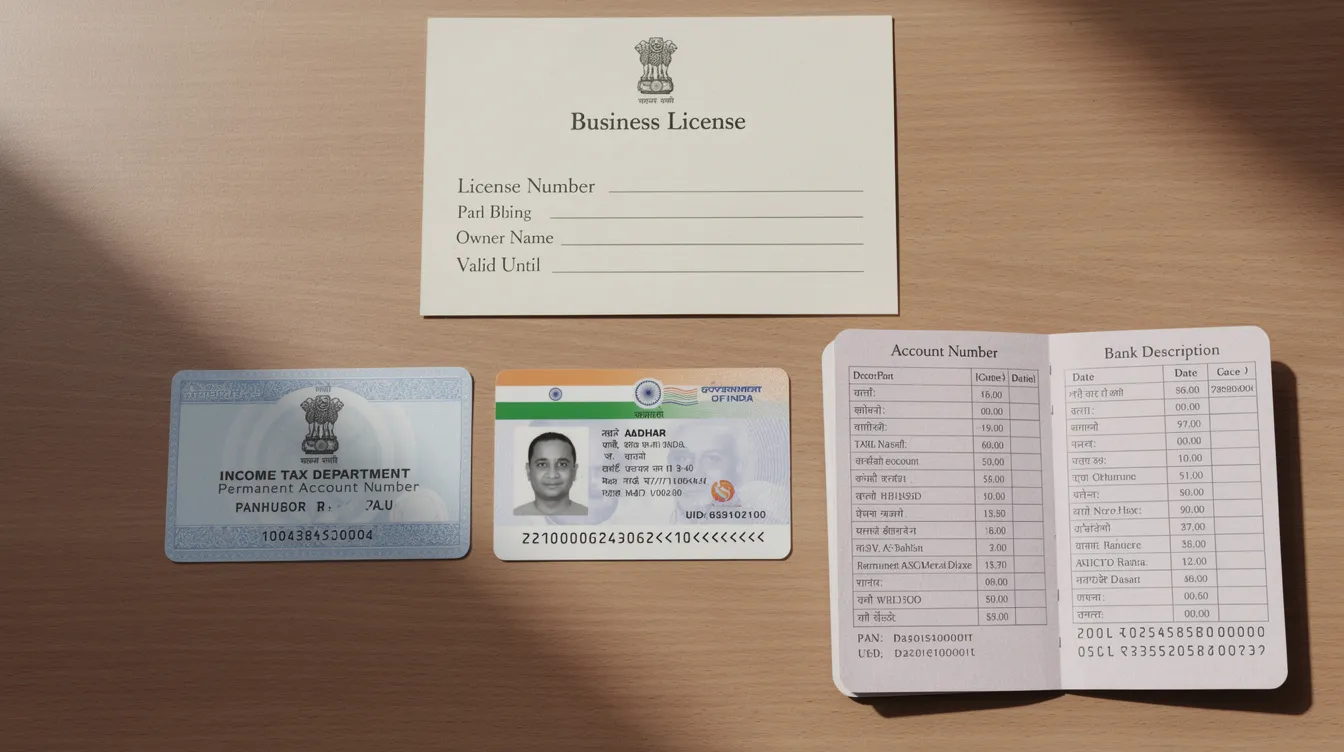
| Aadhaar Card | Identity and address proof; eKYC verification | Original + clear photocopy; ensure name and address match other documents |
| PAN Card | Identity; mandatory for Kishore/Tarun loans | Original + photocopy |
| Passport / Voter ID | Additional identity proof if sought by the bank | Original + photocopy (if available) |
| Latest Electricity Bill | Address and residence verification; proves premises are active | Bill from last 2-3 months in applicant’s or business name |
| Rent Agreement + Landlord NOC | Confirms legal right to use rented premises for business | Signed, stamped, with matching address; landlord’s Aadhaar copy if possible |
| GST Registration | Business proof; validates trading or manufacturing or services activity | Printout showing active status and correct address |
| Udyam Registration | MSME identity; links to beneficiary micro unit details | Printout from Udyam portal |
| Shop & Establishment Licence | Legal business proof; confirms ownership or registration | Current licence with valid date |
| Bank Statement (last 6-12 months) | Shows cash flow, turnover pattern, regular transactions | Statement from main business accounts; highlight regular credits |
| ITR / Financial Statement | For Kishore and Tarun category; income and tax proof | Last 1-2 years filed returns |
| Existing Loan Statements | Shows current EMI burden and repayment discipline | Statements showing all previous loans and current status |
| Purchase & Sales Bills | Proves actual business operations and turnover | 10-15 recent bills arranged by date |
| Machinery Quotations / Bills | For term loan or equipment purchase component | Original bills or quotations matching project report |
| Project Report / CMA Data | Justifies loan amount, use of funds, projected revenue | Keep aligned with actual setup; avoid unrealistic projections |
| Business Photographs | Visual proof of enterprise operations | Recent photos of shop interior, stock, machinery, signboard |
Physical preparation checklist
Before the officer arrives:
✔ Keep business open and reasonably clean during expected visit hours ✔ Display signboard properly-visible from outside ✔ Ensure at least minimal stock, tools, or work-in-progress is present ✔ Inform family members or staff that a bank officer may come; they should guide the officer politely ✔ Keep all documents in one labelled file at the business premises-photocopies on top, originals behind ✔ Confirm the officer’s name and approximate visit timing through the branch or official call ✔ Keep your phone switched on; do not ignore calls from unknown numbers during the processing period ✔ Make sure answers given over phone and in person are consistent-do not fill in different details at different stages

Does Re-Verification Mean Rejection? Outcomes, Problems, and Expert Tips
Let me be direct: Mudra loan re-verification is generally a positive sign. It means your file is still active-not closed. Many of my clients finally got sanction only after a second visit clarified small doubts that the branch had.
What happens after successful re-verification?
The officer submits an updated field or business verification report. The branch manager or credit desk reviews it along with your CIBIL report, eligibility criteria, project report, and cash flow projections. If everything checks out, the file moves to sanction, then documentation, then disbursement. Based on my experience, this typically takes 3 to 15 working days depending on the bank’s workload and internal processing queue.
Minor problems found during re-verification
If the officer finds that the shop was closed on one occasion, stock was low on the visit day, there is a minor address mismatch, or one or two documents are missing-these are not fatal. The bank usually asks for clarification or additional documents. There may be a slight delay, but the loan can still be sanctioned once issues are resolved. The lender may also reduce the loan amount slightly rather than reject outright.
Serious problems that can lead to rejection
The lender may decline the application if:
- Fake bills or borrowed machinery were shown only for the visit
- The business is totally different from what was written in the application
- The applicant gave wrong information about previous loans or current liabilities
- The business is not operational at all-no stock, no customers, no activity
- Documentation requirements are clearly not met despite multiple chances
In extreme cases, the bank may flag the case for fraud investigation.
Expert tips from CA Manish Gugliya
Based on two decades of working with Mudra loan applicants, here are my strongest recommendations:
- Always run a genuine, income-generating activity before you apply-do not create a setup only for the verification
- Never submit fake quotations or borrowed documents; the risk of permanent blacklisting is not worth it
- Keep projections in your project report realistic and aligned with your actual setup; if you possess a small shop, do not project turnover of a wholesale enterprise
- Disclose all existing EMIs and liabilities honestly-the bank will check your CIBIL report anyway
- Maintain at least basic written records of daily sales and purchase transactions
- Avoid giving exaggerated answers during the visit; if monthly sales are ₹40,000, say ₹40,000-not ₹1,00,000
- If you have availed Mudra loans before, make sure those accounts show a clean, satisfactory credit track record
- Applicants must not be defaulters to any bank-clear old dues before applying for the next phase
- Stay in regular touch with the branch so any clarification can be handled quickly without needing yet another visit
- If you believe your loan was unfairly delayed or rejected even after a positive re-verification, meet the branch manager first, then write to the bank’s regional office or nodal officer with facts and supporting references
According to government data, digital credit underwriting through the Jan Samarth portal sanctioned over 3.96 lakh MSME loan applications (amounting to over ₹52,300 crore) between April and December 2025. While digital models are reducing manual verification layers for small ticket funding, physical re-verification remains standard for higher amounts and new borrowers in the Kishore, Tarun, and Tarun Plus categories-so being prepared is covered under every scenario.
FAQs on Mudra Loan Re-Verification
Here are quick answers to the most common doubts I hear from Mudra loan applicants after a second visit is scheduled.
Why did the bank ask for Mudra loan re-verification after already visiting once?
It is usually because of pending documents, an address or business mismatch, internal policy for higher loan amounts, or the need for extra comfort before sanction. Your file is still under active consideration-it has not been rejected. Sometimes it is simply a random quality audit by the regional office and has nothing to do with your specific case.
Can my Mudra loan be rejected after re-verification?
Yes, it can be rejected if serious issues are found-fake information, a non-operational business, poor credit behaviour, or if the borrower is a defaulter. However, genuine applicants who cooperate, meet the eligibility criteria, and provide accurate documents generally get a fair decision. Minor issues like a low stock day or one missing document usually lead to a request for clarification, not outright rejection.
How should I behave with the officer during re-verification?
Be polite and calm. Answer questions in simple and consistent language. Do not guess numbers-if you do not remember your exact monthly sales, say so and offer to show your accounts or bank statement. Show documents without being asked twice. Tell the truth even if sales are currently low or the business is recently started. Officers appreciate honesty far more than inflated claims.
What if I am not at the shop when the officer comes again?
Inform the bank in advance if you are going out of station. Request a reschedule through the branch. Ensure a responsible family member or staff person is present who can answer basic questions and show documents. Never ignore calls from unknown numbers during the processing period-it could be the verification officer trying to schedule the visit.
Does having successfully repaid previous loans help during re-verification?
Absolutely. A clean repayment track record and a good CIBIL score create a strong positive impression. They support the credit officer’s decision in favour of sanction, provided your current business facts-visible operations, realistic turnover, and proper documents-also support the Mudra loan proposal. This is especially important for applicants moving from the Tarun to the Tarun Plus stage, where the bank specifically checks whether the earlier loan was repaid responsibly before extending higher funding through Mudra Ltd.
- Can Bank Reduce Mudra Loan Amount Without Your Consent? Complete Practical Guide (2026)


- What to Do If You Cannot Pay Your Mudra Loan EMI (2026 Guide)

- Can a Bank Refuse a Mudra Loan Because the Target Is Completed? Complete Guide (2026)

- Bank Refused My Mudra Loan Application – What Are My Rights?

- Mudra Loan for Used Vehicles (2026): Eligibility, Documents, Bank Rules & Complete Guide

- Rejected Mudra Loan – What to Do Next? Appeal Process Explained (2026)

- Mudra Loan Project Report Madhya Pradesh – Bank-Ready DPR & CMA Guide

- Project Report for Mudra Loan Maharashtra: Complete Guide for MSMEs, Startups and Small Businesses (2026)

- Mudra Loan Uttar Pradesh: Complete Guide for MSMEs, Startups and Small Businesses (2026)

- Mudra Loan Bihar 2026: Eligibility, Documents, Online Application Process & Project Report Guide

- Jan Samarth Mudra Loan 2026: Complete Guide to Online Application, Eligibility, Documents & Approval Process

- MSME Mudra Loan: Complete Guide for Small Businesses, Startups & Manufacturing Units in India (2026)

- Is the Mudra Loan Subsidy Real or Fake? Get the Facts Here

- Mudra Loan Without CIBIL Score: How to Qualify and Apply

- Mudra Loan for Used Machine (2026 Guide) – Eligibility, Documents, Valuation & Approval Tips