Key Takeaways
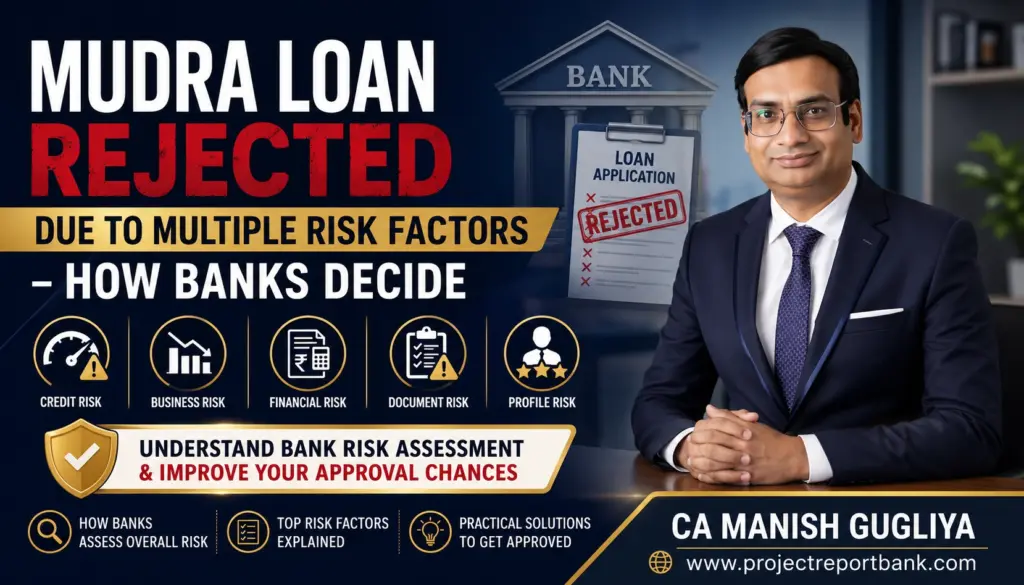
Many Mudra loan applications under Pradhan Mantri Mudra Yojana (PMMY) are rejected not because of one major problem but because several small risk factors add up together during credit appraisal.
- Even if the applicant is eligible on paper, banks can still reject a mudra loan after reviewing combined business, financial, and repayment risks across the full profile.
- A ₹5 lakh Kishore Mudra loan application from a new shop owner with irregular bank statements, no savings, and a weak project report may be rejected due to overall risk-even though no single issue alone was fatal.
- Mudra loans are collateral free and aimed at small enterprises, with four categories: Shishu loans offer up to ₹50,000 for startups, Kishore loans range from ₹50,001 to ₹5 lakh, Tarun loans provide ₹5 lakh to ₹10 lakh for established businesses, and Tarun Plus loans offer ₹10 lakh to ₹20 lakh for expanding businesses.
- Improving each part of the application-business plan, project report, bank statements, own contribution, and documents-can significantly improve chances of approval.
Table of Contents
Introduction – Why Your Mudra Loan Was Rejected Even Though You Were “Eligible”
You applied for a ₹5 lakh Mudra loan. You submitted your Aadhaar, PAN, photographs, and other documents. You met the age requirement. Your business is real. And yet the bank said: “Application not recommended after credit appraisal.” No clear explanation.
This is frustratingly common. The core issue behind a mudra loan rejected due to multiple risk factors is simple: banks look at your overall risk profile, not just one eligibility checkbox. Pradhan Mantri Mudra Yojana is a flagship scheme for financial assistance to micro enterprises-shopkeepers, street vendors, traders, manufacturers, and service providers. It is a collateral free business loan scheme meant to support non corporate small business growth across India.
As a practising Chartered Accountant, I have seen dozens of cases where no single weakness was serious enough to cause rejection. But 5–6 moderate issues together made the bank uncomfortable. In this guide, you will understand exactly how bank risk assessment for Mudra loans works, see practical case studies, and get a checklist to improve your Mudra loan approval chances before you apply.

How Banks Actually Assess Risk in Mudra Loans – The Big Picture
Mudra loans are disbursed by banks, NBFCs, and MFIs-not directly by the Micro Units Development and Refinance Agency. Every lender must follow its own credit policy plus RBI norms before sanctioning any business loan.
Credit appraisal for a Mudra loan means checking your business model, project report, applicant profile, repayment capacity, bank statements, and overall business risk. There is usually no publicly disclosed fixed “score card.” Credit officers use a mix of internal guidelines, experience, and risk parameters. Applicants must be aged between 18 to 65 years, and businesses must be non-farm to qualify for Mudra loans.
The critical insight: banks do not only ask “Is there one big problem?” They ask, “Is this loan reasonably safe when we look at everything together?”
A small tailoring unit with stable cash flow and clean banking may get approved even with limited experience. The same loan amount for a seasonal business with weak documentation may be declined. The difference is the combined weight of risk factors, which falls into three groups: (1) business and project risks, (2) financial and repayment risks, and (3) behavioural and documentation risks.
Business & Project Risks That Quietly Push Your Mudra Application Toward Rejection
Banks want to see a viable, practical business plan-not just any idea. “Business risk” means the chance that the business cannot generate enough cash flow to repay EMI regularly.
Key business-side risk factors that individually may be mild but together become serious:
- No or very low business experience in the chosen activity. A lack of a clear business plan can lead to loan rejection on its own. Applying without business experience adds further weight.
- Unrealistic sales projections or wrong estimation of working capital needs.
- Highly seasonal business without a backup plan for off-season income.
- Risky business location-low footfall, no rent agreement, informal premises.
- Unregistered businesses are more likely to face loan rejection. Business registration on the Udyam portal is recommended, and formalizing your business through registrations increases credibility with lenders.
Eligible businesses include shop owners, vendors, and service providers across trading, manufacturing, and services. A weak business proposal can result in loan rejection even for these eligible borrowers.
Lenders require a detailed project report for Kishor and Tarun loans to assess viability. A poorly prepared project report-copy-paste templates, no cost breakup, missing month-wise cash flow, contradictions between the loan application form and project report-is a common cause of rejection. According to the NITI Aayog PMMY Assessment, “lack of documentation” and “low viability of business project” are among the primary rejection causes.
Financial & Repayment Risks – When Your Numbers Don’t Fully Convince the Bank
Even if the business idea looks good, the bank will decline a Mudra loan if it feels EMI may not come on time every month.
Repayment capacity means whether your actual income after business expenses is sufficient to pay EMI for the requested loan amount without stress. A high debt-to-income ratio leads to rejected loan applications.
Typical financial risk factors:
- Low declared income in ITRs, thin or irregular bank statements, very small average balance.
- Many cash withdrawals immediately after each deposit, or frequent cheque bounces.
- Existing EMIs already consuming a high share of income.
- Limited own contribution. Asking for the full loan amount with almost zero personal investment signals higher risk because the borrower has little “skin in the game.”
CIBIL score is preferred but not mandatory for Mudra loans. However, a poor credit score below 650–700 is a primary reason for loan rejection, and a CIBIL score below 650 can result in outright rejection when combined with other weaknesses. Using a guarantor can reduce perceived risk for the lender in borderline situations.
Maintaining a healthy banking history can improve loan approval chances. Maintaining a dedicated business current account for at least six months is advisable. Applying for a smaller loan amount can also improve chances of approval when your income profile is modest.
Quick EMI example: A ₹5 lakh Mudra loan over 5 years at ~12% interest rate gives an EMI of roughly ₹11,100 per month. If your monthly surplus after all expenses is only ₹13,000–₹14,000, and you have another existing EMI, the bank sees this margin as dangerously thin.
Documentation, Behaviour, and Compliance Risks That Signal “Caution” to the Bank
Many applicants focus only on collecting documents but miss how banks judge behaviour, seriousness, and compliance discipline during the Mudra loan approval process.
Documentation-related risk factors:
- Incomplete or incorrect documentation leads to immediate rejection. Discrepancies between Aadhaar, PAN, and business address proof can lead to rejection.
- Missing licences, utility bills, or rental agreement where required.
- Applying as an individual instead of a business entity causes confusion about the loan’s commercial purpose.
- Gaps between declared turnover and actual bills or proof.
- Common reasons for loan rejection include incomplete paperwork and poor credit history appearing together.
Compliance issues like non-filing of ITR when income appears taxable, or avoiding GST registration despite turnover in the liable range, add further doubt. Repeated corrections or overwriting on the form reduce confidence in accuracy.
Behavioural red flags during field verification-not being available at the business address, neighbours giving conflicting information, or vague answers about operations-can tilt the decision toward rejection when business and financial risk are already moderate.
Keep organised files, be transparent in replies, and ensure your business premises are ready for inspection. You can review the full list of documents required for Mudra loans to avoid gaps.

How Multiple Moderate Risk Factors Combine to Cause Rejection – Practical Case Studies
Banks look at the full picture. Four or five medium-level issues together can look like one big risk. Mudra loan applications face high rejection rates, sometimes over 99% on certain digital portals according to recent government data.
Case 1 – Rejected: Applicant A (26, Bhopal) applies for ₹4 lakh Kishore loan for a mobile shop. Good CIBIL score, but no savings, no prior business experience, irregular salary credits, copy-paste project report, and inflated sales projections. No single issue is fatal-but together, the bank sees an applicant who may not sustain the business. Rejected.
Case 2 – Approved: Applicant B (35, Surat) applies for ₹7 lakh Tarun loan for garment manufacturing. Average CIBIL (~700), but ₹2 lakh own contribution, regular bank statements for 12 months, realistic project report, and existing orders in hand. Despite only an average credit score, the combined profile signals safety. Approved.
Case 3 – Rejected: Seasonal ice-cream cart in Lucknow, ₹1.5 lakh Shishu/Kishore loan. Only 4–5 months of income, no alternate off-season plan, no banking records for previous season, no business registration. Seasonal risk plus thin documentation leads to decline.
Case 4 – Turnaround: Beauty parlour in Nagpur, initially rejected for invalid quotations, no rent agreement, and Aadhaar-PAN mismatch. Applicant corrects all documents, provides fresh quotations, revised realistic project report. Reapplied after 4 months-sanctioned. Being rejected despite eligibility is not permanent if you fix the weak spots.
Lesson: Strengthen as many aspects as possible because you usually do not know which 2–3 points weigh most in your particular bank’s internal risk model under the Mudra scheme.
Checklist to Reduce Risk Before Applying for a Mudra Loan
Before visiting the bank, run through this pre-application checklist. It applies whether you are seeking a Shishu, Kishore, Tarun, or Tarun+ loan under the Mudra Yojana.
- Eligibility basics: Confirm you are running or starting a non-farm small business, aged 18–65.
- Loan amount and purpose: Decide a clear, realistic loan amount and specify the exact purpose-stock, machinery, renovation, or working capital. You can also apply online through portals like Jan Samarth.
- Bank statements: Maintain 6–12 months of clean statements. Reduce unnecessary cash withdrawals, avoid cheque bounces.
- Own contribution: Build at least 10–25% of total project cost as savings or own investment before applying.
- Project report: Prepare a simple but realistic report-business description, local market study, cost estimate, revenue forecast, and EMI planning. Get professional help with your project report if numbers are not your strength.
- Document readiness: Aadhaar, PAN, photographs, Udyam registration, rent agreement or property ownership papers, quotations for machinery, past ITR/GST returns if available, and existing loan account statements.
- Self-review: Look at your profile from a banker’s eyes. Check each risk factor discussed above and correct as many weaknesses as possible before you submit your Mudra loan application.
FAQs – Mudra Loan Rejection Due to Multiple Risk Factors
These FAQs address practical doubts around Mudra loan risk assessment beyond basic scheme details.
Can my Mudra loan be rejected even if I meet all official eligibility criteria under PMMY?
Yes. Eligibility is only the first filter. Final sanction depends on full credit appraisal, your borrower risk profile, and the bank’s internal lending policy. Meeting the basic criteria does not guarantee approval under any government scheme.
Is there any way to know exactly which risk factors caused my Mudra loan rejection?
Banks are not always required to share detailed internal scoring. However, you should request a written explanation for loan rejection from lenders, as they are obligated to provide one. Use the rejection reasons as feedback to improve.
How long should I wait before re-applying after a Mudra loan rejection?
First correct the highlighted issues-for example, build 3–6 months of better bank statements, update your project report, or clear existing dues. Then apply either at the same bank or approach another lender with improved details and documents.
Does a rejected Mudra loan badly affect my CIBIL score?
Enquiries and rejections can appear in your credit history, but one or two rejections alone usually do not reduce your score significantly. Defaults and late payments on existing loans are far more harmful to your credit profile.
Can a consultant or CA really improve my Mudra loan approval chances?
No genuine professional can guarantee approval. But experienced advisors can help prepare realistic project reports, organise documents, verify eligibility, and reduce common risk factors-which often leads to better outcomes and stronger applications for eligible borrowers seeking funding and financing for their business growth.
Conclusion & About the Author
A mudra loan rejected due to multiple risk factors is usually not about one single mistake. It is about the total picture-business viability, financial discipline, documentation quality, and behavioural signals-that the bank sees during credit appraisal and processing. Each moderate weakness adds weight, and together they cross the lender’s comfort threshold.
Focus on strengthening every part of your profile before applying or reapplying. Do not get discouraged by one rejection. Treat it as feedback, correct weaknesses over the next few months, and approach the bank again with a stronger overall profile. The money and subsidy support under this government of India initiative is real-your job is to make your application worthy of it.
About the Author
CA Manish Gugliya (FCA, DISA ICAI) is a Chartered Accountant with over 20 years of experience in MSME finance, Mudra loan consulting, CMA data, project reports, business valuation, and business planning. Through Project Report Bank, he has helped entrepreneurs across India understand bank expectations, verify their eligibility, fill application forms correctly, and prepare stronger loan applications for identity-verified, growth-oriented small enterprises.
- Integrated Value-Added Rice Products Processing Plant Project Report & DPR
- Integrated Rice Plant Bank Loan, Feasibility, ROI, IRR, Payback & Sensitivity Analysis


- Integrated Rice Processing Plant Financial Projections, Working Capital & DSCR

- Integrated Rice Products Revenue Model, Market Strategy & Profitability

- Integrated Value-Added Rice Plant Project Cost & Means of Finance

- Raw Material Procurement & Inventory Planning for Integrated Value-Added Rice Plant

- Common Utilities, Warehousing, Packaging & Material Handling for Integrated Rice Plant

- Integrated Rice Processing Plant Land, Building & Multi-Line Plant Layout – A Practical Guide for DPR & Bank Finance

- Integrated Rice Processing Plant Capacity Planning & Product Mix

- Integrated Value-Added Rice Plant Machinery & Equipment Cost – A Practical DPR-Oriented Guide

- Integrated Poha, Puffed Rice & Rice Snacks Manufacturing Process & Line Integration

- Instant Poha Manufacturing Plant Project Report & DPR – Bankable Guide by Project Report Bank

- Ready-to-Cook Rice Breakfast Mixes Manufacturing: Products, Process & Plant Setup

- Cup Poha Manufacturing, Packaging & Business Model – A Practical Guide for Entrepreneurs in India

- Instant Poha Market Potential, Pricing, Branding, Sales Channels & Distribution Strategy