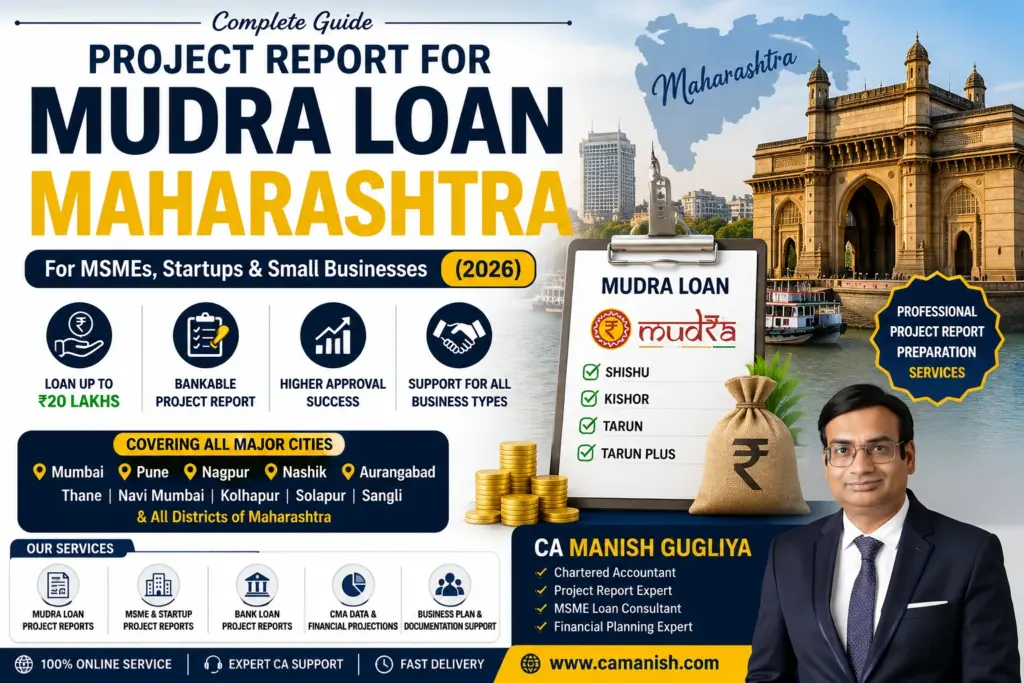
Key Takeaways
- A strong, bankable project report is now the deciding factor for Mudra Loan approval in Maharashtra in 2026 – simply filling a loan application form is no longer enough for most banks.
- Mudra Loans in Maharashtra cover loans upto rs 10 lakh under standard categories (and up to ₹20 lakh where banks operate Tarun Plus), with a typical repayment period of 3–5 years for manufacturing, trading and services sectors.
- Eligible borrowers include proprietorship and partnership firms, LLPs, private limited companies and other legal entity types operating in food processing, retail, logistics, tourism, e-commerce and more.
- A professional project report must cover promoter profile, detailed cost of project, realistic sales projections, cash flow statements, DSCR and break-even analysis, and loan repayment capacity – all aligned with bank expectations.
- Project Report Bank, run by experienced Chartered Accountants, prepares fully online, customized Mudra Loan project reports for entrepreneurs across every district of Maharashtra.
Table of Contents
Introduction
Maharashtra in 2026 stands as India’s leading industrial and MSME state. From Mumbai’s trading floors to Pune’s engineering clusters, Nagpur’s agro-processing belts to Kolhapur’s small manufacturing units, the state promotes livelihood creation at a scale few others match. Micro enterprises engaged in manufacturing, services and trading form the economic backbone, contributing significantly to employment and state GDP.
In practice, a Mudra Loan in Maharashtra means financial assistance of up to ₹10 lakh (and up to ₹20 lakh under the newer Tarun Plus category) for non-farm, non corporate micro enterprises under Pradhan Mantri Mudra Yojana (PMMY). The scheme was launched on April 8, 2015, specifically to provide funding to income generating micro enterprises that were previously excluded from formal banking.
Banks now insist on a clear, bankable project report for Mudra Loan in Maharashtra, especially for amounts above ₹2–3 lakh. From a Chartered Accountant’s perspective, entrepreneurs who invest time in preparing a detailed business plan, financial projections and CMA-style data before approaching any bank or financial institution stand a significantly better chance of timely approval.

What is Mudra Loan?
Pradhan Mantri Mudra Yojana (PMMY) is a central government scheme designed to finance non-farm, non corporate micro units through commercial banks, Regional Rural Banks, MFIs and NBFCs. The Micro Units Development and Refinance Agency Ltd. (MUDRA) functions as a refinance agency – it refinances participating lenders but does not lend directly to individual borrowers or the beneficiary micro unit entrepreneur.
In Maharashtra, borrowers access Mudra Loans through public sector banks like Bank of Maharashtra, SBI and PNB, as well as private banks, small finance banks and cooperative banks. The loan extended under the mudra loans scheme can be applied for directly at bank branches or online through portals like JanSamarth. For a detailed walkthrough of the online process, refer to this guide on Jan Samarth Mudra Loan.
Overview of Pradhan Mantri Mudra Yojana (PMMY)
PMMY was designed with clear objectives: financial inclusion, promoting self-employment, formalizing small businesses, and reducing dependence on informal moneylenders. The mudra scheme offers collateral-free loans covering loans for working capital and term loan needs across manufacturing, trading, food processing, repair shops, service providers and small transport units.
No collateral is required for loans up to Rs. 10 lakh. The credit guarantee fund for Micro Units (CGFMU) provides guarantee coverage, enabling banks to lend without physical security. Interest rates are not fixed centrally – each bank or financial institution sets rates based on internal policies, risk profile and borrower creditworthiness. Banks are advised to charge reasonable interest rates for Mudra loans, and rates in 2026 typically range from around 9% to 15% depending on category and borrower profile.
Categories of Mudra Loans (Shishu, Kishor, Tarun, Tarun Plus)
Mudra loans are classified into four categories that signify the stage of growth development and funding needs of the beneficiary micro unit:
| Category | Loan Limit (₹) | Typical Use |
|---|---|---|
| Shishu | Up to 50,000 | Startup micro units, street vendors, artisans |
| Kishor | 50,001 to 5,00,000 | Expansion, equipment upgrade, stock purchase |
| Tarun | 5,00,001 to 10,00,000 | Established units needing larger capital assets |
| Tarun Plus | 10,00,001 to 20,00,000 | Borrowers who have successfully repaid previous loans under Tarun |
Shishu loans offer up to Rs. 50,000 with minimal documentation and usually no formal project report. Kishore loans range from Rs. 50,001 to Rs. 5 lakhs and require basic financials. Tarun loans range from Rs. 5 lakhs to Rs. 10 lakhs with full project report expectation. Tarun Plus loans offer between Rs. 10 lakhs and Rs. 20 lakhs, introduced in Budget 2024-25 for entrepreneurs with a satisfactory credit track record.
As of June 2025, banks had sanctioned approximately ₹4,930 crore across 34,697 accounts nationally under Tarun Plus, with Maharashtra among the leading states.
Banks in Maharashtra typically treat Shishu as ticket-size loans with minimal paperwork. From Kishor onwards, expect increasingly detailed project reports. For example, a Mumbai DTP centre might qualify under Shishu, a Pune mobile repair shop under Kishor, and a Nagpur food processing unit under Tarun or Tarun Plus.
Category selection should depend on your actual stage of growth development – startup versus expansion – and realistic fund requirement, not on stretching to the specified maximum limit.
Loan Limits, Interest Rate and Repayment Period
The maximum loan under standard categories is ₹10 lakh (Tarun), while Tarun Plus extends the specified limit to ₹20 lakh for qualifying repeat borrowers. Mudra loans provide up to Rs. 20 lakh for micro enterprises across various financial institutions.
Interest rates in 2026 start around 8.15%–10.50% p.a. for strong profiles and can go higher. The current RLLR for Mudra loans at Bank of Maharashtra is 9.05% p.a., with effective rates reaching approximately 11.80% after adding spread and BSS for loans upto rs 10 lakh. Mudra loan interest rates range from 9% to 15% across various lenders.
The maximum repayment tenure of Mudra loans is 5 years, with working capital limits (overdraft loan, CC) reviewed annually and term loans structured in monthly EMIs. The repayment period is aligned with projected cash flows and DSCR in your project report. Prepayment charges for Mudra loans are currently nil, giving borrowers flexibility to close early.
Mudra loans have a margin requirement of 25% – meaning the bank finances 75% and the promoter must bring in 25% as own contribution, as per Bank of Maharashtra’s PMMY terms.
Who Can Apply for Mudra Loan in Maharashtra?
Eligible borrowers include proprietary concern operators, partnership firm owners, LLPs, private limited companies, small public company micro units, SHGs, and even a joint liability group. Individual borrowers starting non-farm income generating micro enterprises can also apply.
Maharashtra-specific examples:
- Pune IT repair shop (proprietorship)
- Kolhapur engineering job work (partnership firm)
- Navi Mumbai logistics startup (LLP)
- Nashik food processing unit (private limited company)
Enterprises must be non corporate, non-farm micro units. Core agricultural activities like crop loans and land improvement are excluded, while allied activities – dairy, poultry, cold storage, aggregation agro industries, agribusiness centres and agri-processing – may be covered under the sector covered by PMMY. Any person with necessary skills or interest in the proposed activity and who meets eligibility criteria prescribed by the lending bank can apply. There is no educational qualification barrier.
New startups without business vintage can apply, especially for startup-focused Mudra Loans, but they need a strong project report and visible own contribution.
Why Maharashtra Entrepreneurs Prefer Mudra Loans
Mudra Loan is often the first formal bank loan for small businesses in Maharashtra due to its collateral-free nature, flexible loan size and relatively simple eligibility criteria. The credit requirement of a small manufacturer in Chakan differs vastly from a kirana shop owner in Solapur – yet both can access the mudra scheme through the same framework.
Women entrepreneurs, SC/ST and OBC borrowers, including disabled persons, are increasingly using Mudra for formalization and GST registration. Many banks also link Mudra accounts with pmjdy accounts for direct benefit transfer.
Manufacturing and Food Processing Units
Small manufacturing units in MIDC areas – Chakan near Pune, Waluj at Chhatrapati Sambhajinagar, Satpur at Nashik – regularly use Mudra for machinery purchase and working capital. Papad and snack manufacturing in Kolhapur, turmeric processing in Sangli, and agro-processing in Jalgaon are common examples of investment proposed under Tarun category. Technical feasibility is crucial for manufacturing or processing units, and project reports must include machinery quotations, power requirements, raw material sourcing and seasonal sales patterns. Local market context should highlight proximity to industrial hubs in Maharashtra.
Trading, Retail and Service Industry
Retail kirana shops in Thane, medical stores in Solapur, hardware traders in Ahmednagar and salon services in Navi Mumbai use Mudra for stock purchase and renovation. These businesses – often proprietorships and partnership firms – have minimal fixed assets, so project reports must focus on inventory cycle, cash-flow management and realistic sales turnover projections. Banks look closely at banking conduct and GST filings rather than heavy collateral.
Logistics, Tourism and E-commerce Startups
Small transporters in Nagpur, logistics startups in the Bhiwandi warehousing belt, and tempo owners in Mumbai use Mudra for vehicle purchase. Tourism opportunities include homestays in Ratnagiri, travel agencies in Nashik and eco-tourism services supporting areas around Mahabaleshwar. E-commerce sellers from Mumbai, Pune and Thane finance initial inventory, packaging and digital marketing using Mudra. Franchise-based businesses in food and retail also fall within Mudra ticket sizes.

What is a Project Report for Mudra Loan?
A project report is a structured document presenting the business model, project cost, means of finance, profitability, cash flows and repayment plan. Banks use it to evaluate whether the loan application is viable and the borrower can service the debt.
For Mudra Loan Maharashtra, most banks insist on at least a basic project report from ₹2 lakh upwards and a detailed bankable project report for amounts above ₹5 lakh. A standard project report should demonstrate viability – showing not just what you plan to do, but how you will repay. It should include an executive summary outlining business details and loan amount requested.
The difference between a professionally prepared report (with realistic assumptions, DSCR, scenario analysis) and a generic downloaded format is often the difference between approval and rejection. Project Report Bank prepares Mudra Loan project reports specifically aligned with bank credit appraisal needs across Maharashtra, including formats suitable for PSU banks and cooperative banks.
Key Components of a Bankable Project Report
Each component below reflects bank loan project report standards and should link with CMA data elements where relevant.
Promoter Profile
Cover personal background, education, technical experience, past business or employment history and credit history. A CNC operator from Pune starting his own job work unit or an experienced chef from Mumbai launching a cloud kitchen – banks give weightage to stability of income, CIBIL score and existing banking relationship. The promoter profile assessed based on these factors directly influences sanction probability.
Business Overview
Describe business type (manufacturing, trading, services sectors), legal form (proprietorship, partnership firm, LLP, private limited company or other legal entity), location and target market. Include shop size, rental terms, key licenses (Shop Act, FSSAI, Udyam Registration, GST). Banks prefer clarity on whether the unit is new or existing, and the purpose: startup, expansion or diversification.
Product and Service Details
Detail main products or services, pricing, unique selling proposition and seasonal demand. Maharashtra examples include Maharashtrian snacks, engineering components, agri-inputs, digital marketing packages. Mention procurement sources and basic costing per product group. The presently defined product mix determines revenue projections.
Market Analysis
Analyze local demand in your specific city or taluka. Identify target customers (B2B, B2C), competition and realistic demand drivers. Use approximate numbers – daily footfall, ticket size, competitor count – rather than generic macro data. Analysis differs significantly by state; for comparison, see how project reports differ for Uttar Pradesh.
Cost of Project
Break down fixed assets (machinery, furniture, computers, vehicles, renovation), preliminary expenses, working capital margin and contingencies. For Mudra limits, total project cost often ranges between ₹3 lakh and ₹15 lakh. Assets created through the loan must be clearly listed. Include realistic 2026 pricing backed by vendor quotations from Maharashtra.
Means of Finance
Show how the project cost is financed: promoter’s capital contribution, Mudra term loan, working capital limit (overdraft loan amount if applicable), and any other funding. For credibility, own contribution should be visible in bank statements. Example: 25% margin and 75% Mudra Loan for a ₹10 lakh project. This structure demonstrates the needs of the beneficiary clearly.
Sales Projections
Present 3–5 year projections, keeping year one conservative. Relate projections to market analysis: estimated daily customers, average bill size, capacity utilization (40% in year 1, gradually increasing). Projected financials should cover balance sheets and profit/loss for 3-5 years. Align with GST thresholds and realistic seasonality – Ganesh Chaturthi, Diwali, monsoon impact on logistics.
Profitability Statement
Show projected Profit & Loss capturing revenue, COGS, gross profit, operating expenses, interest, depreciation and net profit. Gross and net profit margins should be comparable with industry norms for similar Maharashtra businesses. Unrealistic high margins raise banker suspicion instantly.
Cash Flow Projections
Cash flow determines ability to pay EMIs regardless of book profit. Show monthly inflows and outflows – loan EMI, rent, salaries, raw materials, utilities, tax – for at least the first 12 months. Projected financials must include cash flow statements and break-even analysis. Banks look for stable positive cash surplus after EMI and household drawings.
Projected Balance Sheet
Include a projected balance sheet for 3–5 years showing capital, loan outstanding, fixed assets, current assets (stock, receivables, cash) and current liabilities. Inconsistencies between balance sheet and cost of project are a common reason for credit officer queries.
DSCR and Break-Even Analysis
Debt Service Coverage Ratio equals cash available for debt service divided by annual EMI obligations. Target average DSCR of at least 1.3–1.5 in your project report. Break-even analysis shows at what sales volume the business covers all fixed costs – essential for banks to judge loan repayment capacity and resilience to dips in sales.
Loan Repayment Capacity and Sensitivity Analysis
Demonstrate that you can service Mudra EMIs even if sales fall 10%–15% below projections. Show alternate income sources, spouse income or past business surplus wherever available. Fine-tuned projections help avoid EMI stress and loan restructuring.
Eligibility Criteria for Mudra Loan in Maharashtra
Eligibility criteria for Mudra Loan in Maharashtra follow national PMMY rules, though banks can impose additional branch-level conditions. Only non-farm, non corporate micro enterprises engaged in income-generating activities qualify. MSME registration is necessary for businesses in Maharashtra applying under Kishore, Tarun or Tarun Plus.
Types of Eligible Business Entities
- Proprietorships: Retail shops, small manufacturers, freelancers, e-commerce sellers – the most common form across Maharashtra cities. Each proprietary concern with a valid Udyam certificate qualifies.
- Partnership firms and LLPs: Manufacturing units, transport contractors, agencies and workshops. Partnership deed or LLP agreement is mandatory.
- Companies: Private limited companies and small public company entities can seek Mudra where they qualify as micro enterprises with proper incorporation documents and board resolutions.
- Others: SHGs, joint liability group formations, and cooperative societies in rural Maharashtra also qualify.
Very small units may apply even without GST registration, subject to bank policy and turnover levels.
Activity-Based Eligibility Conditions
Eligible activities include manufacturing, processing, trading, repair shops, service centres, food services, transport, logistics, tourism services and allied agricultural activities. Pure crop loans, land purchase and land improvement projects are outside Mudra scope, though dairy, poultry, fisheries and agri-processing are covered. The proposed activity must be revenue-generating – charitable or personal consumption loans are not eligible.
Other Common Eligibility Criteria
Common requirements include age 18–65, acceptable CIBIL score, no major loan defaults, minimum own contribution and clear KYC. Existing units should have 6–12 months of satisfactory bank statements. Startups must compensate with stronger project reports and visible margin funds. For broader MSME eligibility overlap, see this MSME Mudra Loan Guide.
Documents Required for Mudra Loan
Although Mudra Loans are collateral-free, documentation in 2026 remains rigorous. Missing documents are a leading cause of delay and rejection. Prepare a complete file before visiting any bank.
Typical Documentation Checklist
| Category | Documents |
|---|---|
| Personal KYC | Aadhaar, PAN, Passport or Voter ID for all promoters/partners/directors |
| Address Proof | Electricity bill, rent agreement, property tax receipt (residence + business) |
| Business Proof | Udyam Registration, Shop & Establishment License, GST certificate, partnership deed, MOA/AOA |
| Quotations | Pro-forma invoices for machinery, furniture, vehicles, interior work, computers |
| Financial Documents | Last 1–3 years ITRs, provisional financials, CMA-style data for larger Mudra loans |
| Project Report | Detailed project report for Mudra Loan Maharashtra – mandatory for higher amounts |
| Bank Statements | Last 6–12 months of main operative account plus any existing loan statements |
For special category applicants, additional disability or community certificates may be required. Refer to Mudra Loan for Disabled Persons for specifics.
How to Prepare a Professional Mudra Loan Project Report
A banker-friendly project report follows a logical, numbers-driven process. Even if you hire a CA or use Project Report Bank, understanding these steps helps. Similar state-specific approaches are used in the Bihar project report process as a useful reference point.
Step 1: Collect Business and Promoter Information
Gather promoter KYC, educational qualifications, work experience, existing business details and previous financial statements. Capture exact location, shop/plant size, rental terms, licenses and bank account details across Maharashtra.
Step 2: Conduct Market and Competitor Research
Visit competitors, understand local demand, talk to potential customers and suppliers within your city or taluka. Collect data points: daily footfall, average spend, peak season and off-season trends. These feed directly into your sales projections.
Step 3: Estimate Cost of Project and Working Capital
Prepare a cost sheet with quotations from vendors, machinery suppliers and vehicle dealers in Maharashtra. Calculate minimum stock requirement, receivables cycle and cash buffer to arrive at the working capital margin needed.
Step 4: Prepare Revenue and Expense Projections
Convert market findings into monthly sales projections – normal case and conservative case. Key expense heads include purchases, wages, rent, utilities, marketing, transport and taxes. Keep projections aligned with typical industry ratios.
Step 5: Compile CMA-Style Financial Data
Structure data similar to CMA forms: projected P&L, balance sheet, fund flow and working capital assessment for 3–5 years. Although formal CMA data is not mandatory for all Mudra Loans, banks in Maharashtra increasingly expect CMA-like detail for the overdraft loan and term loans above ₹5 lakh.
Step 6: Draft the Narrative and Risk Mitigation
Include a concise business narrative, SWOT analysis and risk factors – competition, regulatory changes, supply disruptions and demand slowdowns. Specify mitigation plans: multiple suppliers, digital marketing, product diversification, insurance.
Step 7: Finalize Report and Submit with Loan Application
Review all calculations, ensure consistency between cost of project and means of finance, attach project report with filled loan application form, KYC and supporting documents. Meet branch officials for discussion. Project Report Bank can prepare and refine reports digitally, coordinating with borrowers to match bank requirements.

Common Reasons Why Mudra Loan Applications Get Rejected
Many rejections in Maharashtra are not due to scheme limitations but weak project reports, incomplete documentation or poor financial discipline.
Weak or Generic Project Reports
Copy-paste reports downloaded from the internet, with no local data or realistic numbers, are easily identified by credit officers. Lack of DSCR calculation, missing break-even analysis and inconsistent figures across sections raise doubts about proposal seriousness.
Unrealistic Projections and Assumptions
Examples include sudden jumps from zero to very high monthly sales, or extremely low expense ratios that don’t match Maharashtra ground realities. Modest, defendable projections with clear logic secure approval more reliably than inflated numbers at a higher maximum loan request.
Incomplete Documentation and Poor Banking Conduct
Missing KYC, no proof of business existence, incomplete quotations and discrepancies between declared income and bank statements are common. Frequent cheque bounces, overdue credit card bills and irregular bank balances over the last 6–12 months directly hurt approval chances.
Inadequate Planning and Wrong Loan Structuring
Using term loan instead of working capital or underestimating the credit requirement often leads to cash flow stress. A good project report should align facility type and repayment period with actual cash cycle.
Incorrect Financial Assumptions and Lack of Margin
Ignoring GST, underestimating expenses, or not showing own contribution in bank accounts undermines credibility. Banks look for promoter skin in the game, especially for new startups. Mudra loans are available for micro enterprises only – structuring the loan correctly from the start matters.
Business Opportunities Suitable for Mudra Loan in Maharashtra
Here are practical business ideas that fit within the ₹1–10 lakh Mudra limit and show strong demand in Maharashtra in 2026.
Food Processing Units, Restaurants and Cloud Kitchens
Snack units in Kolhapur, pickle and papad units in Nagpur, spice grinding in Sangli, packaged food in Nashik. Low-investment cloud kitchens in Pune, Thane and Navi Mumbai using Mudra for kitchen equipment and marketing. Small food franchise outlets also fit well.
Repair Shops, Automobile Workshops and Mobile Services
Mobile repair shops, computer service centres and small garages across cities and talukas using Mudra for tools, diagnostic equipment and rent deposits. These businesses depend heavily on local repeat customers.
Digital Marketing, IT and E-commerce Businesses
Digital marketing agencies, web design firms and freelancing teams in Mumbai, Pune and Nagpur using Mudra to fund laptops, software and office setup. E-commerce sellers funding initial inventory and ad budgets through Mudra as a proprietary concern.
Logistics, Trading and Packaging Units
Small transport vehicles, courier franchises, last-mile delivery services and godown-based traders in Bhiwandi, Navi Mumbai and Pimpri-Chinchwad. Packaging material units supplying boxes and labels to manufacturers across Maharashtra.
Manufacturing and Franchise Businesses
Light manufacturing – electrical components, fabrication, readymade garments, handicrafts – in semi-urban and rural Maharashtra. The services supporting these sectors (maintenance, calibration, quality testing) also qualify for Mudra.
Online Project Report Preparation Services Across Maharashtra
Project Report Bank is a specialized online platform run by Chartered Accountants, preparing customized project reports for Mudra, MSME and startup loans.
We do not maintain physical offices throughout Maharashtra. Our services are provided completely online through digital consultation, document collection, report preparation, review, and online delivery. Entrepreneurs can avail our services from any district, city, town, or village in Maharashtra.
Major cities served: Mumbai, Pune, Nagpur, Nashik, Thane, Navi Mumbai, Chhatrapati Sambhajinagar (Aurangabad), Kolhapur, Solapur, Sangli, Jalgaon, Ahmednagar, Amravati, Akola, Nanded, Latur, Satara, Ratnagiri, Chandrapur, Yavatmal – and all other districts.
Services include:
- Mudra Loan Project Reports
- MSME and Startup Project Reports
- Detailed Project Reports (DPR)
- CMA Data and Financial Projections
- Business Plans and Loan Documentation Support
Visit www.projectreportbank.com to get started.
Why Entrepreneurs Choose Project Report Bank
Project Report Bank is led by Chartered Accountants with hands-on exposure to MSME financing, CMA data preparation and loan documentation across multiple banks in Maharashtra and nationally.
Chartered Accountant Expertise and Customized Reports
Every report is prepared or reviewed by experienced CAs who tailor assumptions, costing and projections based on specific sector and city. Whether it is a food processing unit in Kolhapur or a digital agency in Pune, the reports reflect real local economics.
Practical Banking Knowledge and Loan-Oriented Analysis
Report formats are aligned with how credit officers in PSU banks, private banks and cooperative banks actually read and evaluate project proposals. DSCR, break-even, sensitivity analysis and cash flow coverage are presented in banker-friendly format.
Fast Delivery, Digital Support and Revisions
Standard Mudra Loan project reports are delivered within 2–4 working days. Revisions after bank discussion are possible, allowing entrepreneurs to incorporate branch feedback without rewriting their entire report.
Related Funding Options for Maharashtra Businesses
Professional project reports prepared for Mudra can often be adapted for related MSME and startup funding schemes.
Jan Samarth Loans and Online Portals
Many Mudra Loans and government-linked schemes can be applied through the JanSamarth portal with project report upload features. For a detailed guide, see Jan Samarth Mudra Loan.
CGTMSE Loans and Collateral-Free MSME Finance
CGTMSE covers MSME loans beyond Mudra limits – often used in Maharashtra for ticket sizes above ₹10 lakh. Explore CGTMSE Loan Without Collateral for details on larger collateral-free funding.
MSME Loans, Startup Funding and Working Capital Finance
Standard MSME term loans, working capital limits, overdraft facilities and startup funding lines are accessible to growing Maharashtra businesses. Refer to the MSME Mudra Loan Guide for broader options.
Practical Tips to Improve Mudra Loan Approval Chances
- Maintain clean bank statements for at least 6 months before applying
- Keep existing EMI obligations moderate relative to income
- Avoid cheque bounces and overdue payments in the months before application
- Finalize realistic project cost with genuine vendor quotations
- Ensure own contribution (25% margin) is visible in your bank account
- Prepare a professional project report – not a generic internet download
- Choose the right bank and branch based on your location and business type
- Be fully transparent in all disclosures, especially about existing loans or previous loans
- Align requested loan amount with demonstrated repayment capacity
- Keep personal KYC, Udyam Registration and GST updated and matching across all documents
- Maintain basic accounting records from day one
- Respond to bank queries within 24–48 hours
- Stay open to suggestions on loan structuring – term loan vs working capital split
- If applying for Tarun Plus, ensure you have a record of loans that were successfully repaid
- Consider engaging a CA-run service like Project Report Bank for complex proposals
Following these steps can significantly shorten processing time and improve chances of full sanction.
Frequently Asked Questions
What is the typical processing time for a Mudra Loan in Maharashtra?
Processing usually takes 7 to 21 working days after submission of complete documents and a clear project report, depending on bank and branch workload. Delays typically stem from incomplete documentation, unresolved queries or pending site visits. Proper preparation shortens timelines considerably.
Can I get a Mudra Loan without ITR or existing business proof
First-time entrepreneurs can obtain shishu loans and lower Kishor-range Mudra Loans without ITR, provided they submit a strong project report, complete KYC and visible margin money. For amounts above ₹3–5 lakh, most banks prefer at least one year of ITR or some business track record. Agricultural activities in the strict sense remain outside scope – loans up to Rs. 10 lakh are available under Mudra scheme only for non-farm micro units.
Is collateral or guarantor ever needed for Mudra Loan in Maharashtra?
Mudra Loans up to ₹10 lakh are officially collateral-free under PMMY, backed by the credit guarantee fund. No collateral is required for loans up to Rs. 10 lakh. Some banks may request a simple personal guarantee or co-obligant as internal risk policy, which is different from property-based security.
How important is GST registration for Mudra Loan approval?
Very small businesses with turnover below threshold may get Mudra without GST, but for trading and manufacturing units with higher projected turnover, GST registration strengthens credibility. Banks in Maharashtra increasingly validate sales projections against GST returns for existing units.
Can women and special category entrepreneurs get additional benefits?
Many banks in Maharashtra run special Mudra variants or interest concessions for women, SC/ST, OBC and differently-abled entrepreneurs. Loan extended under these categories may carry slightly lower interest rates or relaxed documentation norms, subject to individual bank guidelines.
Conclusion
Mudra Loan Maharashtra remains one of the best entry-level funding options for micro and small businesses in manufacturing, trading and services – a scheme launched to drive grassroots entrepreneurship. Loans up to Rs. 10 lakh are available under Mudra scheme with no collateral, and the newer Tarun Plus extends to ₹20 lakh for proven borrowers.
Success depends on preparation. A well-designed, bankable project report, realistic financial projections, clean documentation and disciplined banking behaviour are what separate approved applications from rejected ones. Banks treat the project report as your primary reference point for evaluating whether your business can service the debt.
If you are an entrepreneur, startup founder or MSME owner anywhere in Maharashtra, get a professionally prepared project report for Mudra Loan Maharashtra from Project Report Bank at www.projectreportbank.com before approaching your bank. It is the single most impactful step you can take toward timely loan approval.
About the Author
CA Manish Gugliya is a practicing Chartered Accountant specializing in project report preparation, MSME financing, startup advisory, business valuation, financial projections, CMA data preparation and bank loan documentation. Through Project Report Bank, he assists entrepreneurs, startups, manufacturers, traders and service providers across India – including all regions of Maharashtra – in preparing bankable project reports for Mudra Loans, MSME loans, startup funding, CGTMSE loans and other business financing requirements.
- Can Bank Reduce Mudra Loan Amount Without Your Consent? Complete Practical Guide (2026)


- What to Do If You Cannot Pay Your Mudra Loan EMI (2026 Guide)

- Can a Bank Refuse a Mudra Loan Because the Target Is Completed? Complete Guide (2026)

- Bank Refused My Mudra Loan Application – What Are My Rights?

- Mudra Loan for Used Vehicles (2026): Eligibility, Documents, Bank Rules & Complete Guide

- Rejected Mudra Loan – What to Do Next? Appeal Process Explained (2026)

- Mudra Loan Project Report Madhya Pradesh – Bank-Ready DPR & CMA Guide

- Project Report for Mudra Loan Maharashtra: Complete Guide for MSMEs, Startups and Small Businesses (2026)
- Mudra Loan Uttar Pradesh: Complete Guide for MSMEs, Startups and Small Businesses (2026)
- Mudra Loan Bihar 2026: Eligibility, Documents, Online Application Process & Project Report Guide

- Jan Samarth Mudra Loan 2026: Complete Guide to Online Application, Eligibility, Documents & Approval Process

- MSME Mudra Loan: Complete Guide for Small Businesses, Startups & Manufacturing Units in India (2026)

- Is the Mudra Loan Subsidy Real or Fake? Get the Facts Here

- Mudra Loan Without CIBIL Score: How to Qualify and Apply

- Mudra Loan for Used Machine (2026 Guide) – Eligibility, Documents, Valuation & Approval Tips