Key Takeaways
- Total grain silo machinery cost in India – covering steel silo structure, conveyors, bucket elevators, aeration, cleaning and basic automation – typically falls in a broad range of ₹7,00,000 to ₹18,00,000+ per MT of storage capacity for commercial projects, depending on silo type (flat bottom vs hopper bottom), steel specification, mechanisation level and project scale.
- Grain silo machinery and storage systems in India vary widely based on capacity and materials. Economies of scale apply heavily: larger setups reduce per-ton costs, while smaller farm-level silos have a higher cost per MT.
- Civil works, land, taxes, statutory approvals and working capital are separate from pure machinery cost and must be budgeted additionally in the DPR.
- Selecting the right combination of grain storage silos and grain handling equipment – elevators, conveyors, cleaners, dryers, aeration – directly impacts operating cost, grain quality, DSCR and overall project viability.
- Accurate machinery costing requires current supplier quotations. Project Report Bank can help entrepreneurs and FPOs convert these into a bankable DPR and CMA Data for loan applications.
Introduction – Grain Silo Machinery Cost in India
Modern grain storage silos are steadily replacing traditional storage methods across India. For wheat, rice, maize, pulses and other grains, scientific silo-based storage reduces post harvest losses, protects against moisture pests and contamination, and enables organised bulk storage that improves inventory management efficiency. Grain silos are designed for long-term storage of various grains and are now an important part of modern agriculture and agricultural supply chains.
Understanding the grain silo machinery cost in India is the starting point for any serious investment decision. This article focuses specifically on plant and machinery – not land or civil cost – covering the equipment required from intake to dispatch: bucket elevators, belt and chain conveyors, intake pits, grain cleaning and drying systems, aeration, temperature sensors and automation. Machinery cost varies sharply with storage capacity (a 5,000 MT facility versus a 50,000 MT complex), type of silo (flat bottom vs hopper bottom silo), steel thickness, galvanisation and degree of automation.
Typical investment scenarios include FCI and state agency projects, private agro-logistics terminals, integrated rice mills, flour mills, oilseed processors, and FPOs or PACS developing storage solutions near mandis. In each case, proper storage infrastructure requires careful machinery planning.
At Project Report Bank, led by CA Manish Gugliya, FCA, DISA (ICAI), machinery cost is treated as an integrated decision alongside project cost, means of finance, DSCR and IRR – not as an isolated procurement exercise.
Complete Grain Silo Machinery and Equipment List
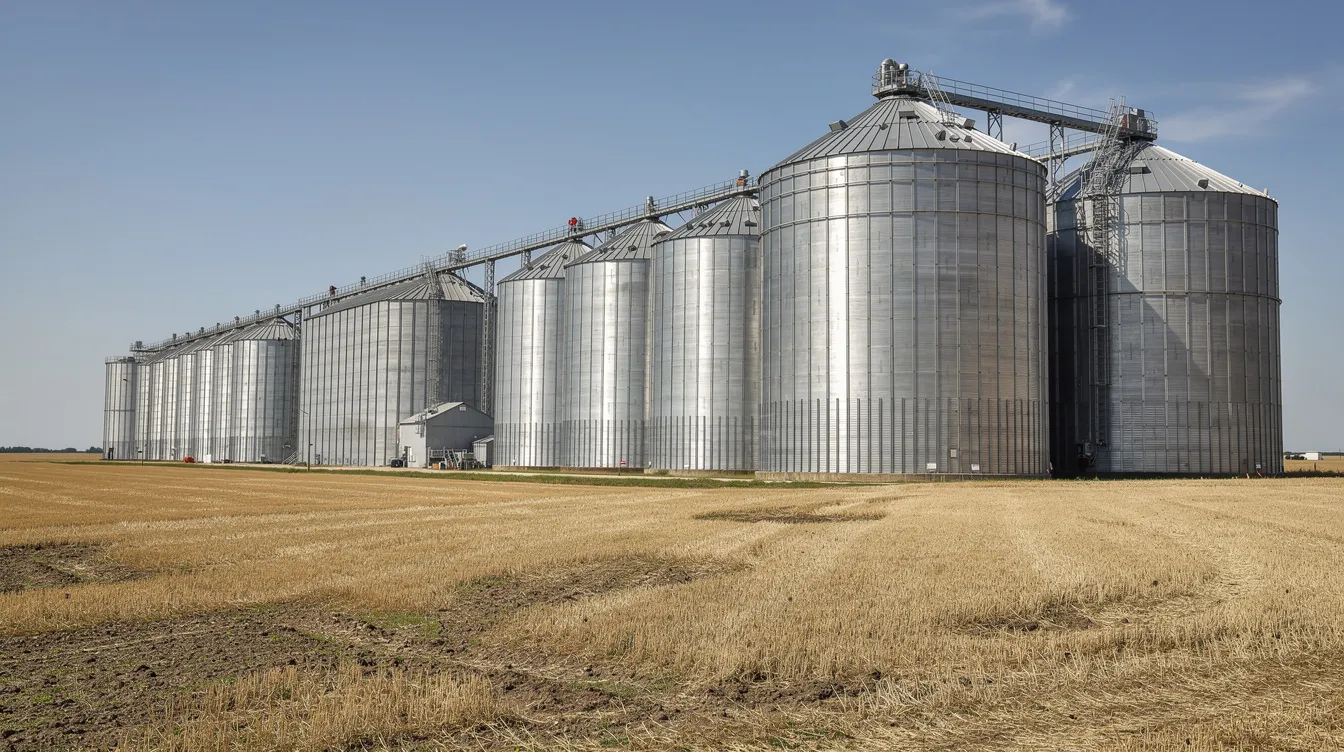
A modern grain storage facility combines grain silos, grain handling systems and grain conditioning equipment into a complete operational complex. Below is a structured overview of major machinery groups.
Silo Structure and Accessories
The galvanised steel silo structure forms the largest single cost component. This includes corrugated wall panels, vertical stiffeners, roof assemblies, manholes, ladders, catwalks, aeration floors and discharge systems. Flat bottom silos are suited for long-duration grain storage in large quantities, while hopper bottom silos offer gravity-based self-emptying suitable for smaller capacities. Flat bottom silos require specialised sweep augers or mechanical systems to empty completely. Compartmental silos are engineered for different shapes and sizes to suit specific project requirements.
Grain Handling Systems
Complete grain-handling systems include storage silos, conveyors and cleaning equipment working in sequence. Key items include:
- Bucket elevators (typical capacities 60–200 TPH, varying heights)
- Belt conveyors for horizontal and gentle-incline grain movement
- Drag chain conveyors for tunnels and under-silo discharge
- Screw conveyors for short-distance transfer under hopper bottom silos
- Grain intake pits and receiving hoppers
- Conveyor galleries, transfer towers and chutes
Grain Conditioning and Protection Equipment
- Pre-cleaners and aspirators at intake
- Vibratory screens and grading equipment
- Destoners (particularly for flour mills and seed processing)
- Grain dryers (batch or continuous, various fuel sources)
- Dust extraction and collection systems (cyclones, bag filters)
Monitoring, Control and Automation
Modern silos include automated systems for temperature control. Integrated machinery like automated temperature detection cables and sweep augers add to silo costs but are essential for maintaining grain quality. Key systems include:
- Aeration fans and ducting
- Temperature-monitoring cables and sensors
- Grain level measurement (rotary paddles, radar, ultrasonic)
- Moisture meters (handheld and in-line)
- PLC/SCADA automation panels
- Electrical control panels, MCCs and VFDs
- Safety interlocks and alarm systems
Core vs Optional Equipment
Core equipment required for almost every facility: silos, elevators, conveyors, intake/discharge, aeration and basic temperature monitoring. Optional or project-specific systems include full PLC-SCADA, high-capacity grain dryers, advanced dust control, rail loading arrangements and remote monitoring.
Access and safety features – platforms, walkways, sampling points, safety cages, lightning protection interfaces – should also be included in the machinery schedule.
Grain Silo Equipment Price and Machinery Cost in India
Quoting one standard grain silo machinery cost in India is difficult because prices change with the steel market, exchange rates for imported components and project scope. All cost references in this section are broad, illustrative Indian-market ranges and should be confirmed through current supplier quotations before preparing a DPR.
How to Structure a Machinery Cost Comparison
A useful framework includes: machinery/equipment name, capacity or specification, indicative cost band in ₹, main cost factors (steel thickness, galvanisation, TPH, height, automation), and explicit cost inclusions/exclusions (foundations, GST, freight, erection, electricals).
Indicative Price Ranges for Key Equipment
Material and construction quality significantly influence grain silo prices. Project pricing for grain silos scales with whether the purchase includes only the shell or a complete system. Pricing varies based on silo types such as flat-bottom and hopper-bottom configurations.
| Equipment | Indicative Price Range (₹) | Notes |
|---|---|---|
| Farm storage silos | From ₹1,00,000 each | Basic, small-capacity units |
| Compartmental silo bins | ₹5,00,000 each | Mid-range, modular |
| Industrial storage silos | ₹6,05,000 each | Medium-capacity industrial facilities |
| Flat bottom grain storage silos | ₹80,00,000 each | Large-capacity, long-term bulk storage |
| Hopper bottom silos | ₹10,00,000 each | Self-emptying, up to 1,500 MT |
| Grain storage silos (typical) | Around ₹12,00,000 each | Mid-to-large commercial units |
| Bucket elevators (3–5 TPH) | ₹2,00,000–₹3,50,000 per unit | Varies by height, material, capacity |
| Small-scale silo units | ₹30,000 to ₹6,00,000 | Very small farm or village-level |
Larger storage capacities require thicker high-grade steel sheets and greater structural height, increasing per-unit cost. Economies of scale apply heavily in silo pricing – larger setups reduce per-ton costs significantly.
Civil works (silo foundations, tunnels, intake pits, RCC retaining walls, buildings), electrical power distribution and statutory approvals are typically quoted separately from silo machinery packages. GST treatment, import duties, packing and forwarding, and erection and commissioning costs must be specified clearly in quotations, because banks and investors will examine inclusive vs exclusive pricing during DPR appraisal.
For a comprehensive understanding of how machinery cost fits within total project investment, refer to the separate guide on grain silo and warehouse setup cost in India.
Grain Silo Machinery Cost by Storage Capacity
Storage capacity refers to the total MT of grain that silos can hold at one time, while grain handling capacity refers to the TPH throughput of conveyors and elevators. Confusing these two is a common planning error.
| Storage Capacity | Typical Configuration | Handling (TPH) | Automation | Machinery Investment Notes |
|---|---|---|---|---|
| 5,000 MT | 2–4 flat bottom or multiple hopper bottom silos | 50–100 TPH | Basic to medium | Higher cost per MT due to fixed elements (intake pits, elevators, panels) |
| 10,000 MT | 2–4 large flat bottom silos | 100–150 TPH | Medium | Better economies; moderate conveyor lengths |
| 25,000 MT | 4–8 flat bottom silos | 150–250 TPH | Medium to high | Scale benefits evident; multiple elevators and redundancy needed |
| 50,000 MT | 8–16+ flat bottom silos | 200–400 TPH | High | Lowest per-MT cost; high absolute capex; extensive conveying and automation |
Smaller projects (around 5,000 MT) carry a higher machinery cost per MT because fixed elements like intake pits, elevators and control panels are spread over lower capacity. Larger complexes benefit from economies of scale but require higher absolute capital expenditure.
Grain type also influences cost: paddy typically requires more drying infrastructure, while wheat may need more aeration. Coastal sites require higher corrosion protection than dry inland locations. Whether the plant is road-fed or rail-linked significantly affects equipment selection. Expansion planning – leaving space for additional silos – should be considered during initial machinery planning to avoid expensive redesign later.
Galvanised Steel Grain Silo Structure – Specifications and Cost Factors
Steel grain silos in India are typically constructed from galvanised corrugated sheets bolted together in rings, with vertical stiffeners, a roof assembly, manholes, ladders and catwalks. Hot-dip galvanised steel is the industry standard for weather resistance and longevity. Galvanised steel is commonly used in modern agricultural silos due to its corrosion resistance, and silos can be constructed from galvanised steel for durability across various industries.
Key specifications affecting cost include steel grade (high-tensile galvanised), sheet thickness (heavier at lower rings, lighter at top), galvanisation level (g/m²), silo diameter, height and roof design. Design loads are calculated based on grain bulk density, wind load, seismic zone classification, temperature variations and material flow pressures – all of which affect steel tonnage and price.
Flat Bottom vs Hopper Bottom
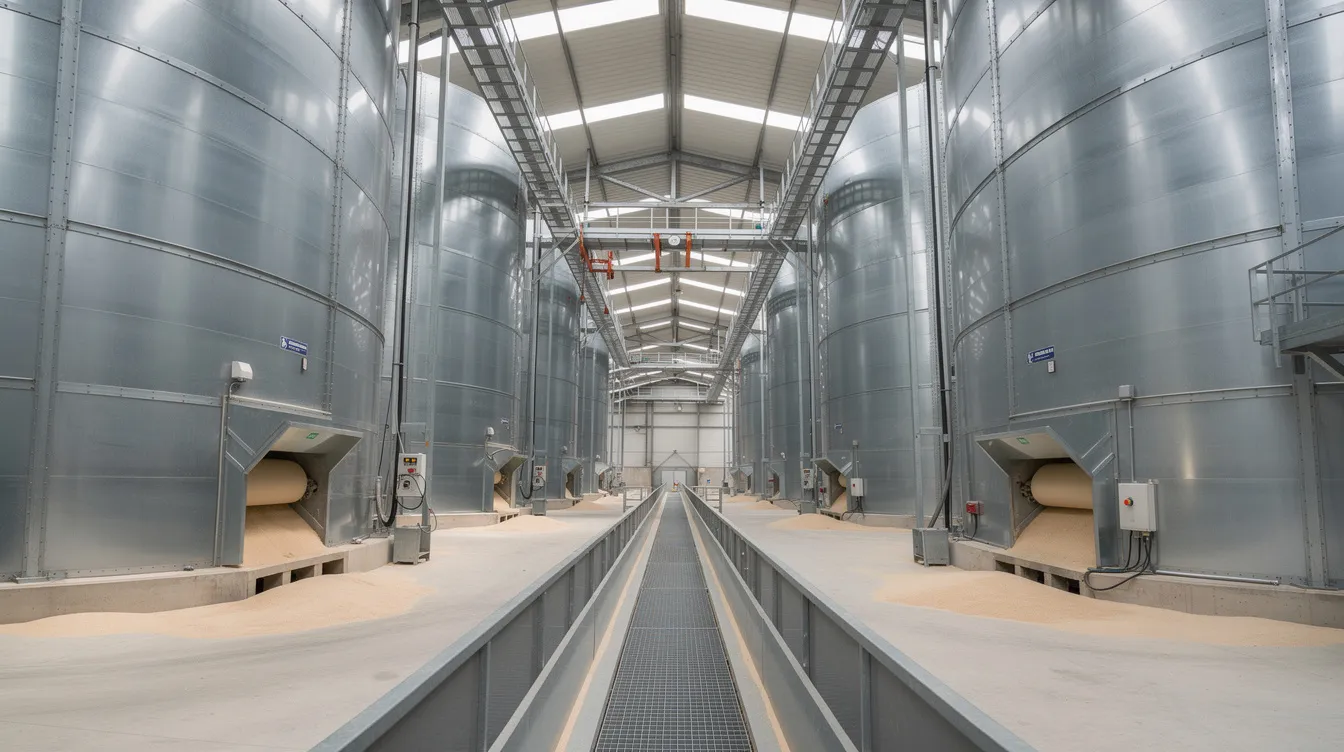
Flat bottom silos are designed for long-duration grain storage and store large quantities economically, but require concrete foundations and sweep augers for emptying. Hopper bottom silos can store up to 1,500 tons of grain and offer self-emptying convenience, making them popular as grain storage hopper applications for smaller capacities and grain processing units. However, the hopper bottom silo design uses substantially more steel per MT, roughly doubling the structural cost compared to flat bottom configurations.
Features that must be budgeted include aeration floors or ducts, roof vents, access doors, level sensors, sampling points and catwalks between silos.
Choosing the lowest-price supplier with thinner steel or poor galvanisation may reduce upfront cost but can raise life-cycle cost through higher maintenance, reduced structural strength and risk of grain spoilage. For a detailed understanding of how structural design choices affect financing and depreciation, see the Steel Grain Silo Plant Project Report & DPR.
Grain Handling Equipment – Conveyors, Elevators and Loading Systems
Grain handling systems connect the entire complex – from truck or rail intake to storage silos and back to dispatch. Their capacity in TPH must be matched to expected peak and average throughput to avoid bottlenecks.
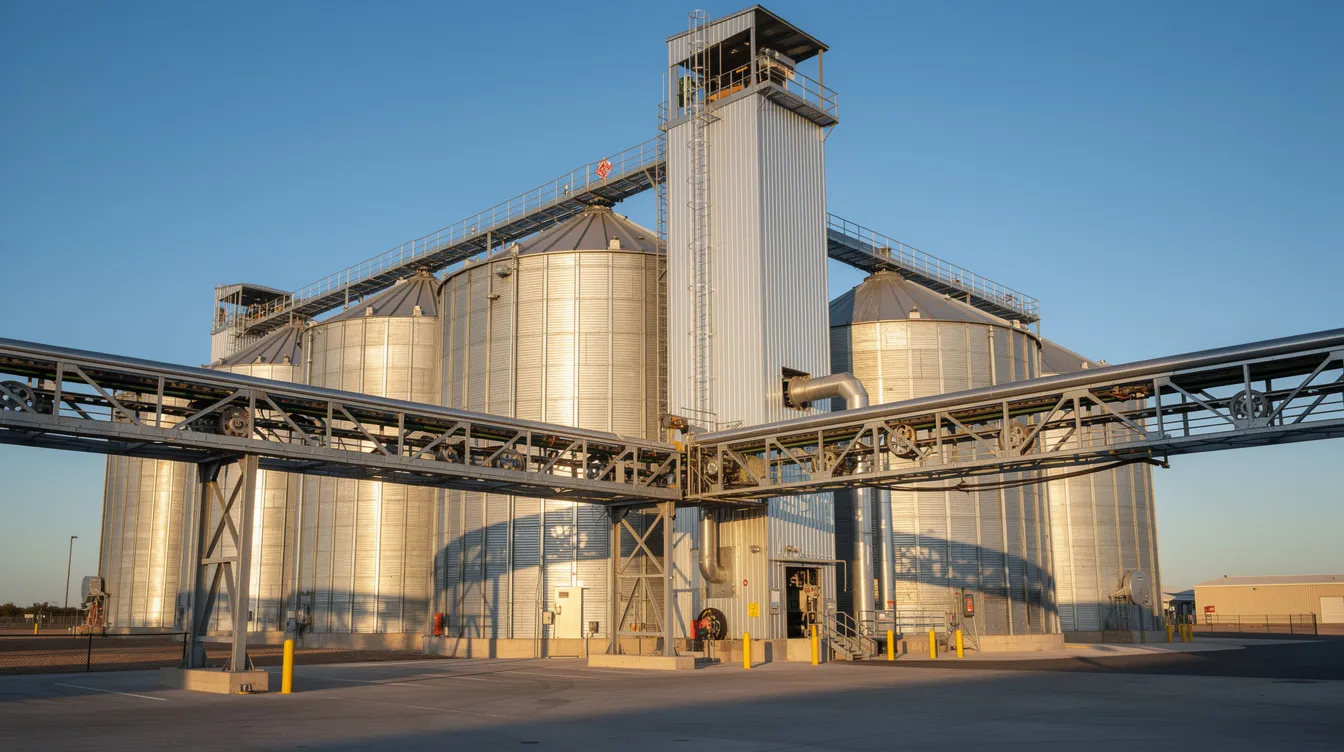
Bucket elevators are the primary vertical conveyors, typically rated at 60–200 TPH in Indian projects. Key cost drivers include height (lift), belt vs chain design, motor size and energy consumption. Current market prices for smaller bucket elevators (3–5 TPH) range from approximately ₹2,00,000 to ₹3,50,000, while larger units cost proportionally more.
Belt conveyors are preferred for longer, gentler grain handling with less grain breakage, while drag chain conveyors are used for horizontal or inclined conveying inside tunnels. Screw conveyors serve short-distance transfer under hopper bottom silos but are limited for long runs due to power consumption. Long-term storage facilities often require mechanical systems to facilitate grain unloading efficiently.
Loading and unloading systems – truck tippers, intake hoppers, feeding arrangements, dispatch spouts and rail loading systems – directly impact turnaround time and manpower. A Bulk Grain Handling & Logistics Terminal DPR or a Rail-Linked Grain Silo Terminal DPR will define TPH and layout requirements before finalising conveyor and elevator sizes.
Grain handling equipment cost includes not only the conveyor or elevator itself but also supporting structures, galleries, chutes, transitions, skirting, aspiration points and drives – all of which should appear as line items in the machinery schedule.
Grain Cleaning, Grading and Drying Equipment
Scientific grain storage requires grains to be within a safe moisture range and reasonably clean before entering storage silos. Silos are utilised for storing grains like wheat, rice and pulses, and reducing foreign matter, broken grains and dust prevents spoilage and hot spots.
Pre-cleaners, aspirators and vibratory screens are placed at intake to improve grain quality but add to machinery cost and power load. Destoners and magnetic separators are relevant particularly for flour mills and seed processing units – not all bulk storage projects will require them.
Grain dryers reduce moisture to safe storage levels. Batch vs continuous dryers, heat sources (biomass, diesel, gas, steam) and inlet/outlet moisture targets all affect energy cost per tonne dried. Dust extraction systems around cleaners and dryers – fans, cyclones, bag filters – are often under-budgeted but are important for reducing fire risk and improving the working environment.
Handheld and in-line grain moisture meters are relatively modest in cost but critical for quality control. For projects combining cleaning, drying and storage, the Integrated Grain Cleaning, Grading, Drying & Storage Plant Project Report shows how integrated plants generate additional processing revenue streams.
Grain Silo Aeration, Temperature Monitoring and Automation
Aeration fans and moisture monitoring systems are essential for long-term grain storage, particularly where grain may remain in silos for 6–12 months. Grain storage silos protect against moisture and pests when properly aerated. Galvanised steel silos are used for storing various grains, and aeration design mistakes – too little or uneven airflow – can lead to spoilage even in new facilities.
Temperature-sensing cables installed vertically through the grain connect to monitoring panels or SCADA systems. Sensor spacing influences both detection accuracy and cost. Level sensors (rotary paddles, radar, ultrasonic) and pressure switches provide over-fill protection and automate conveyor sequencing.
PLCs and automation panels sequence grain handling equipment, interlock motors for safe operation, record temperature and level data, and enable alarms for abnormal conditions. Full SCADA and remote monitoring are optional upgrades. While automated systems increase initial grain silo machinery cost, they reduce manual intervention, improve grain quality management and simplify record-keeping for lenders and auditors. Silos provide controlled environments that maintain grain quality for longer durations when these systems are properly implemented.
Grain Silo Machinery Power Requirements and Operating Costs
Banks and investors look beyond machinery purchase price to understand energy consumption, operating cost and their impact on DSCR and project feasibility.
To assess power requirements, list all motor loads across grain handling, cleaning, drying, aeration and auxiliary systems. Sum their kW/HP ratings for total connected load, then estimate average operating load based on diversity factors (not all motors run simultaneously).
Illustrative formula:
Annual Energy Consumption (kWh) = Average Operating Load (kW) × Operating Hours per Day × Operating Days per Year
For example, 120 kW average load × 12 hours × 330 days = 4,75,200 kWh per year. This is illustrative only – actual consumption depends on project-specific operating patterns.
Energy-efficient motors, VFDs on conveyors and bucket elevators, shorter conveying paths and proper aeration design can meaningfully reduce recurring electricity costs. Annual maintenance – replacement of elevator belts, conveyor idlers, chain wear, bearings, lubricants and dust-collection filters – must also be budgeted as operating expenses.
In DPRs prepared by Project Report Bank, energy cost, repairs and maintenance and labour cost are built into profitability projections, break-even analysis and DSCR calculations.
Grain Silo Machinery Installation, Commissioning and Site Requirements
Even well-selected machinery can underperform if site layout, foundations and erection are not properly planned. Civil foundation construction and local installation costs substantially affect total project budget.
Site requirements include adequate land for silo layout, internal roads, truck movement space, safe distances between silos for maintenance access, provision for future expansion and utilities. The interface between machinery and civil works – silo foundations, annular beams, tunnels for chain conveyors, intake pits, cable trenches – requires careful coordination between civil and mechanical drawings.
Installation involves unloading silo panels, erecting steel silos, aligning bucket elevators and conveyors, electrical cabling and earthing, dry and wet trial runs, calibrating weighbridges and instruments. When comparing grain silo equipment price quotations, promoters must verify what is included: only supply, or also freight, unloading, foundations, erection, commissioning, training and initial spares. Written performance guarantees for handling capacity (TPH), silo tightness and aeration airflow should be obtained, subject to agreed operating conditions.
Grain Silo Machinery Manufacturers and Suppliers in India
India now has multiple experienced manufacturers of grain storage silos, hopper bottom silos, conveyors and grain handling systems. Several company focuses on turnkey delivery while others supply equipment for EPC contractors to install. Silo configurations can be customised for specialised industrial storage needs.
Supplier Evaluation Checklist:
- Years of experience and completed grain storage project references
- Range of storage capacity handled and in-house design capability
- Quality of galvanised steel, fabrication standards and third-party certifications
- After-sales service, local presence, breakdown response time
- Stock of critical spare parts (elevator buckets, belts, chains, gearboxes)
- Technical datasheets, GA drawings and power consumption details included with quotations
Promoters may choose between sourcing only the silo structure from a leading manufacturer versus awarding a complete EPC contract covering civil, mechanical, electrical and automation. Each approach has cost and risk implications. This article does not endorse any particular brand; instead, it encourages structured comparison using a supplier selection matrix for investments involving large quantities of equipment.
Grain Silo Machinery Cost for Bank Loan and DPR Preparation
From a banker’s perspective, clarity and realism of the plant and machinery schedule is central to approving a grain silo project. Project feasibility studies are essential before investment in new grain storage projects.
In a Detailed Project Report, machinery costs are consolidated as individual line items with supplier quotations attached as annexures, including packing, freight, insurance, erection, commissioning and an appropriate contingency percentage. Plant and machinery (steel silos, conveyors, bucket elevators, cleaners, dryers, aeration, electrical panels) must be distinguished from other fixed assets: civil works, land, buildings, vehicles and pre-operative expenses.
Total project cost is built from plant and machinery, other fixed assets, preliminary expenses, margin for working capital, contingencies and interest during construction. Means of finance include promoter contribution (equity), term loan, and possibly subsidies subject to eligibility under schemes from MOFPI and other agencies.
For bank loan proposals, Project Report Bank also prepares CMA Data and financial projections, ensuring consistency between machinery cost, depreciation and funding structure. Promoters with preliminary quotations and site details can connect with Project Report Bank for preparation of a bankable DPR tailored to their specific grain storage project.
Financial Feasibility of Grain Silo Machinery Investment
Machinery selection is not only a technical decision but a financial one, affecting capital cost per MT of storage capacity, operating margins and loan serviceability. Modern silos improve inventory management, allow for organised bulk storage and maintain superior quality of grain for longer durations – all of which contribute to the revenue model.
Investors typically evaluate capital expenditure per MT (machinery cost divided by total storage) alongside expected annual throughput (how many cycles per year) and storage and handling charges.
Illustrative Financial Framework (not a quotation):
- Assumed storage occupancy: 70–80% of capacity
- Average storage tariff: per MT per month (market-dependent)
- Handling charges: per MT at intake and dispatch
- Annual revenue: occupancy × capacity × tariff × months, plus handling income
- Less operating costs: power, manpower, repairs, insurance, administrative overheads
- EBITDA derived; break-even checked against fixed costs including interest and depreciation
- DSCR verified over loan tenure based on repayment schedule
IRR and payback period depend on tariffs, occupancy, operational efficiency and financing terms. Sensitivity analysis – showing how changes in occupancy, grain storage tariffs, electricity rates or interest cost alter viability – is something Project Report Bank includes in professional feasibility studies.
Choosing the Right Grain Silo Machinery for Different Projects
Machinery configuration for a standalone rural silo will differ significantly from a rail-linked bulk terminal or an integrated cleaning and drying complex, even at similar storage capacities. The growing demand for grain storage solutions means various industries and project types require tailored approaches.
- Standalone steel silo projects near mandis or food processing plants: moderate handling capacity, basic automation, flat bottom silos common.
- Road-fed grain storage facilities serving regional markets: emphasis on truck turnaround time and intake speed.
- Rail-linked grain terminals: high-capacity conveying, rake loading, redundancy in bucket elevators and conveyors. More articles on this are available via the Hub & Spoke Grain Silo Project Report.
- PACS and FPO grain storage projects: focus on simple, robust silos with basic grain handling and aeration. Farmers prefer smaller silos for local storage and processing needs. A PACS & FPO Rural Grain Warehouse DPR addresses these agricultural requirements specifically.
- Integrated rice mills and food processing companies: silos serve as part of a larger processing line for food processing industries and food processing plants, requiring coordinated handling and conditioning.
Promoters should first define their business model – trading, storage as a service, captive use for their own processing, or government-linked contracts – and then finalise machinery with technical and financial alignment to overall project requirements.
Common Mistakes When Purchasing Grain Silo Machinery
Grain silo investments are long-term, and mistakes at machinery selection stage can raise operating costs or create capacity constraints for 15–20 years.
Capacity-related errors: Confusing storage capacity (MT) with handling capacity (TPH), under-sizing bucket elevators leading to long truck unloading times, or over-sizing equipment that increases power costs unnecessarily.
Technical oversights: Inadequate aeration design, absence of temperature monitoring, ignoring dust control and fire safety, poor layout creating bottlenecks, and insufficient access for maintenance. These can reduce grain spoilage prevention effectiveness and compromise safe storage conditions – precisely the external environmental conditions that silos are meant to manage.
Commercial errors: Comparing quotations only on per-MT price without matching steel thickness, galvanisation and scope. Ignoring exclusions like foundations, electricals and automation. The minimum order quantity or scope differences between suppliers can make apparently similar offers fundamentally different.
Financial planning gaps: Not budgeting realistic allowances for erection, commissioning, contingency and pre-operative expenses. Underestimating working capital needs. Assuming overly optimistic tariffs and occupancy. These gaps directly weaken DSCR and project viability.
Technical due diligence, structured supplier comparisons and professional financial modelling – including sensitivity analysis – can substantially reduce the risk of these mistakes.
Frequently Asked Questions – Grain Silo Machinery Cost in India
The following questions address practical concerns commonly raised by Indian entrepreneurs and investors planning grain storage projects. Answers provide indicative guidance, not binding quotations or guaranteed financial outcomes.
What factors most strongly influence grain silo machinery cost in India?
Storage capacity, type of silo (flat bottom vs hopper bottom), steel specification and galvanisation quality, level of mechanisation (basic handling vs fully automated silo systems), need for grain drying and cleaning equipment, and site conditions (civil interfaces, rail connectivity) are usually the biggest cost drivers. Freight distance from manufacturer to site and choice between locally manufactured and imported components also affect final equipment price and delivery time. A type hopper or type flat or type conical configuration each carries different material and fabrication costs.
How long does it typically take to install and commission a grain silo machinery package?
For mid-size projects (5,000–10,000 MT) in India, a realistic timeline from foundation readiness to commissioning is approximately 4–8 months, depending on project complexity. This includes civil completion, silo erection, mechanical installation of conveyors and elevators, electrical works and trial runs. Actual duration varies with project size, monsoon conditions, site readiness and supplier resource deployment. DPR schedules should always include adequate buffer.
Can existing godowns be integrated with new grain storage silos and handling equipment?
Integration is often feasible by adding bucket elevators, belt or chain conveyors and intake systems that connect existing flat warehouses with new silos into a single handling system. However, structural assessment of old godowns, layout constraints and incremental power requirements must be evaluated. A Modern Food Grain Warehouse & Godown Project Report can help assess such hybrid storage solutions and their feasibility.
Are government subsidies available for grain silo machinery and storage capacity creation?
Various central and state-level schemes for agriculture infrastructure, warehousing and rural storage periodically support investment in grain storage silos, but eligibility criteria, subsidy rates and terms change over time. Promoters should check current scheme guidelines directly. Project Report Bank can factor applicable schemes into project cost and means of finance planning within the DPR, without guaranteeing sanction or subsidy approval.
At what stage should I involve a DPR and financial advisory firm for a grain silo project?
Engaging a professional advisor is most useful once a preliminary concept is defined – proposed storage capacity, broad location, target grain types (wheat rice maize or pulses), intended users – but before finalising machinery orders or bank loan applications. This allows proper alignment of technical scope, machinery cost, project cost, loan structuring, DSCR expectations and sensitivity analysis, improving the quality of discussions with banks and investors. It is suitable for both new projects and expansion of existing farms or industrial facilities.
Conclusion – Planning Grain Silo Machinery Investment
Successful grain storage projects in India require correct sizing of grain storage silos, proper specification of grain handling and conditioning equipment, realistic estimation of machinery cost and disciplined financial planning. Silos reduce post-harvest losses significantly and reduce grain spoilage when properly designed, but achieving these outcomes demands more than simply purchasing equipment at the lowest price.
Focusing only on the lowest upfront grain silo equipment price can compromise grain quality, energy efficiency and long-term reliability. A balanced approach considers life-cycle cost, maintainability, scalability and the features that matter for the stored grain – whether it is wheat, rice, maize or other grains used by food processing companies and various industries.
The need is for integrated planning that covers machinery selection, storage capacity, operating cost estimation, project feasibility, DSCR and bank loan structuring – rather than treating each decision in isolation. This is what separates a bankable project from a collection of quotations.
Planning a Grain Silo Storage Project in India?
CA Manish Gugliya, FCA, DISA (ICAI), brings over 20 years of professional experience in project reports, financial feasibility, CMA Data and bank finance advisory. Entrepreneurs, FPOs, agro-processors and infrastructure developers planning new grain storage silos – or upgrading existing godowns – can seek professional assistance with Detailed Project Reports, financial projections, project cost assessment and loan proposal preparation.
Website: www.projectreportbank.com
Preferred enquiry method: WhatsApp