
Understanding the complete project cost of a maida suji manufacturing plant before approaching a bank or placing machinery orders is not optional-it is fundamental. This article provides a structured, investment-oriented overview for promoters planning an integrated wheat roller flour mill in India.
Key Takeaways
- A commercial maida suji manufacturing plant setup cost in India typically starts from around ₹4–6 crore for a 25–50 TPD integrated roller flour mill and can exceed ₹30–45 crore for 200 TPD+ fully automatic plants, excluding land in metro areas. These are 2025–2026 planning estimates, not vendor quotations.
- Maida and suji are co-products of an integrated wheat roller flour mill. The production of maida and suji involves multiple milling and purification stages, so total project cost depends on wheat input capacity (TPD), automation level, building design, storage arrangements and working capital tied up in wheat inventory.
- A machinery quotation alone is not the project cost. A bankable project requires budgeting for land, building, plant and machinery, electricals, utilities, preoperative expenses and working capital margin. A comprehensive detailed project report is essential for setting up a flour mill.
- Project Report Bank, led by CA Manish Gugliya (FCA, DISA), prepares customised DPRs, CMA Data and bank finance documentation for maida suji and other flour mill projects. Promoters should not finalise investment without a project-specific feasibility study.
Maida & Suji Manufacturing Plant Setup Cost in India – Overview
A maida and suji manufacturing plant is an integrated wheat roller flour mill that can produce maida (refined wheat flour), suji (semolina), atta and bran in one continuous manufacturing process. Maida is refined wheat flour commonly produced in roller flour mills, where the starchy endosperm of wheat grains is separated, ground and purified. Suji, also known as semolina, is produced alongside maida in roller flour mills through granulation and grading. These plants also produce atta, bran and sometimes besan or specialty flour, depending on configuration.
For context, flour mill setup costs range from ₹10 lakh to ₹2 crore for basic units. A small flour mill of 5–10 TPD costs ₹10 lakh to ₹25 lakh, a medium-scale flour mill of 20–40 TPD costs around ₹35 lakh to ₹80 lakh, and an 80–120 TPD flour mill may require ₹1 crore to ₹2 crore for machinery alone. Similarly, a small 10–20 TPD atta plant costs ₹15 lakh to ₹30 lakh, while a 20–40 TPD atta-maida-suji plant costs between ₹45 lakh to ₹90 lakh. Large 80+ TPD units cost around ₹1 crore to ₹2.5 crore in machinery investment. However, an integrated maida suji plant for serious commercial purpose-serving bakeries, bread manufacturers, pasta producers, food companies and institutional buyers-requires substantially more when building, electricals, utilities and working capital are included.
Current industry trends favour higher automation and improved dust control in flour mills, which increases initial investment but improves efficiency and compliance. Few Indian major players like Ambuja Flour Mills Ltd, Anirudh Foods Ltd and Ankit India Ltd operate large-scale roller flour mills that shape the competitive profile of this industry across the country. A promoter planning to establish a new unit must conduct thorough market research and a feasibility study before finalising capacity.
From a project finance perspective, banks and investors focus on DSCR, break-even and realistic financial projections-not only the quoted machinery value. Proper project planning includes assessing capital requirements, utility needs and land for milling operations.
Capacity-Wise Maida & Suji Manufacturing Plant Investment
Capacity for a flour mill plant is measured in wheat input tonnes per day (TPD), typically operating 20–22 hours per day. Production capacity significantly influences flour mill project costs, and established benchmarks for roller flour mill project costs vary based on scale, machinery and location. Plants producing maida and suji range from small units of 10–20 TPD to large units exceeding 50 TPD and beyond. Land purchase cost is excluded from the table below for comparability.
| Parameter | 25 TPD | 50 TPD | 100 TPD | 150 TPD | 200 TPD |
|---|---|---|---|---|---|
| Plant & Machinery (₹ Cr) | 1.5–2.5 | 3.0–4.5 | 5.5–7.5 | 8.0–12.0 | 14.0–20.0 |
| Building & Infrastructure (₹ Cr) | 1.0–1.5 | 1.5–2.5 | 3.0–4.5 | 5.0–7.0 | 6.0–9.0 |
| Other Fixed Assets & Project Expenses (₹ Cr) | 0.5–0.8 | 0.8–1.2 | 1.5–2.0 | 2.0–3.0 | 2.5–4.0 |
| Total Fixed Capital (₹ Cr) | 3.0–4.5 | 5.0–7.5 | 9.0–13.0 | 15.0–22.0 | 22.0–32.0 |
| Working Capital Margin (₹ Cr) | 0.8–1.5 | 1.5–2.5 | 2.5–4.0 | 4.0–7.0 | 7.0–11.0 |
| Indicative Project Cost (₹ Cr) | 4.0–6.0 | 7.0–10.0 | 12.0–17.0 | 20.0–30.0 | 30.0–45.0 |
| Total Working Capital Requirement (₹ Cr) | 2.0–3.5 | 4.0–6.0 | 8.0–12.0 | 12.0–18.0 | 18.0–28.0 |
For a 100 TPD maida suji plant, total fixed capital may be approximately ₹11–13 crore, margin for working capital ₹2–3 crore and indicative project cost ₹13–16 crore, while total working capital requirement (funded partly by cash credit) might be ₹8–10 crore. The working capital margin is the promoter’s or term-loan-funded portion included in project cost; the total working capital requirement is the larger number funded through CC/OD facilities based on drawing power. A customised detailed project report is needed to refine these figures for a specific location, product mix and business plan.
Detailed Project Cost Breakup for a Maida & Suji Plant
A professional DPR breaks investment into logical cost heads. Civil construction and electrical setup contribute significantly to project costs, and cost heads must meet banking formats used in CMA Data and term loan appraisals.
Land Purchase and Site Development
Typical land requirements range from 0.5–1 acre for 25–50 TPD to 3+ acres for 150–200 TPD. Infrastructure requirements for a flour mill typically include a minimum area of 3,000 to 5,000 sq. ft. even for smaller units. Industrial land in tier-3 locations may cost ₹60–₹150 lakh per acre, while land near major cities commands several crores. Site development includes levelling, internal roads, boundary wall, borewell and external electrification. Promoters using leased land or existing family plots should account for notional rent in their feasibility study.
Factory Building and Civil Construction
Key civil components include the main multi-storey mill building (RCC or steel structure), wheat godown, finished goods warehouse, utility block, laboratory and administrative office. Built-up areas typically range from 15,000–20,000 sq. ft. for 50 TPD to 30,000–40,000 sq. ft. for 100 TPD. At current rates of ₹1,500–₹2,500 per sq. ft. for industrial RCC/PEB construction, building cost forms a substantial part of fixed capital. Food-industry compliance with FSSAI and hygiene norms adds to construction cost.
Maida & Suji Processing Machinery Cost
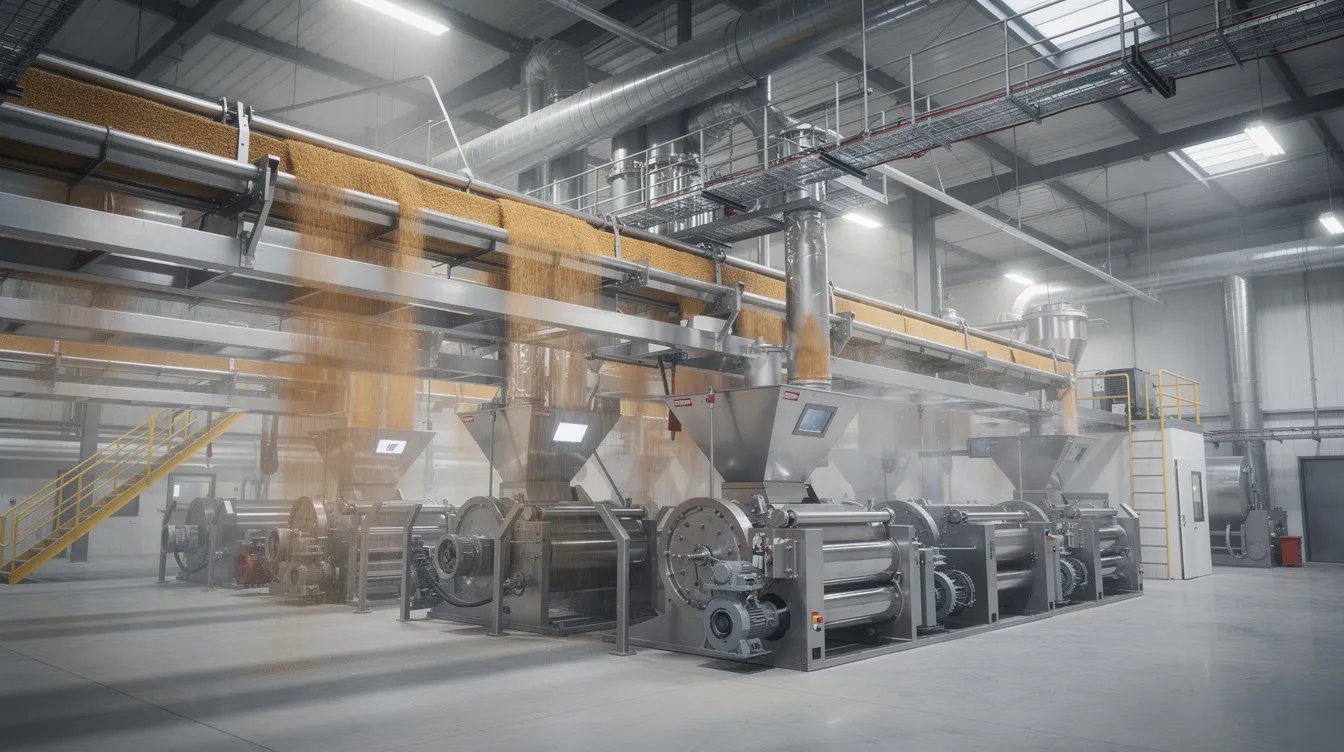
A roller flour mill requires precise grinding and purification equipment to produce maida and suji. Flour milling involves machine types including cleaners, roller mills, plansifters and purifiers for separating flour. Milling equipment configurations typically include multiple machinery types to handle distinct processes in flour production. Core groups include wheat receiving and pre-cleaning, tempering tanks, roller mills (break and reduction), plansifters and purifiers, bran finishers, pneumatic conveying with dust control, and packing machines.
For reference, a standard roller flour mill costs around ₹6,00,000 per piece, an automatic flour mill plant with 1 ton capacity costs ₹7,50,000, and a roller flour mill plant with 50–250 TPD capacity can cost ₹1,50,00,000 or more. Fully automatic flour mill plants cost between ₹50 lakh to ₹2 crore, and more advanced integrated lines range from ₹50,00,000 to ₹2,00,00,000 depending on automation. Machinery type affects the overall investment in flour mills, constituting roughly 45–60% of total fixed capital. Quoted machinery prices are usually ex-works and exclude GST, freight, erection and commissioning-all of which must be added in the DPR.
Electrical Installation, Utilities and Other Costs
Electrical infrastructure-transformers, HT/LT panels, MCC, cabling, VFDs, PLC controls and lighting-can form 8–12% of fixed capital. Electricity consumption in milling operations varies based on production capacity and machinery used, with connected loads ranging from 150–250 kW for 25 TPD to 600+ kW for 200 TPD. Many entrepreneurs underestimate this cost.
Supporting utilities include air compressors, dust extraction systems, material handling equipment, weighing systems, laboratory equipment and fire safety infrastructure. Together these can form 5–10% of project cost. Erection and commissioning typically add 8–15% over basic machinery value. Preliminary expenses cover DPR consultancy, statutory approvals (FSSAI, Pollution Control Board, factory licence), interest during construction, trial runs and contingencies-all essential for a bankable project. Regulatory compliance for flour mills includes obtaining necessary permits and registrations as per local laws.
Maida & Suji Manufacturing Plant Machinery Investment
Machinery selection determines not only cost but also extraction efficiency, power consumption and product quality. High automation in flour mills typically leads to increased capital investment but can reduce labour costs substantially. Indian major players and machinery suppliers offer equipment with improving quality, though import content still matters for certain components. Promoters should evaluate supplier warranty terms, spares availability and after-sales service. A promoter must seek quotations from at least two machinery suppliers-one Indian, one imported-for an informed comparison. Machinery origin, automation level and the number of purifiers directly shape total investment.
How Product Mix Affects Maida & Suji Plant Investment
An integrated plant can be configured as maida-dominant (for bakeries and bread manufacturers), suji-dominant (for pasta and vermicelli producers) or balanced across maida, suji and atta. A typical extraction ratio for a flour mill is around 60–65% maida, with remaining fractions for suji and bran. From 100 TPD wheat input, illustrative recovery might be: 45% maida, 20% suji, 7% atta, 25–27% bran and pollard, and 1–3% process losses. These numbers depend on wheat quality, mill configuration and the number of purifiers installed. Processing wheat with higher endosperm content generally yields better maida recovery. Changing the target ratio can alter machinery cost by 10–20% and shift revenue assumptions and project economics substantially.
Working Capital Requirements for a Maida & Suji Manufacturing Plant
Working capital is critical in wheat-based flour mills because of high raw materials value, wheat price volatility, seasonal stocking needs and credit terms to buyers. Grain procurement for flour mills involves significant working capital, especially during peak harvest seasons. Operational costs for a medium-scale mill can range widely depending on the scale and automation.
For a 100 TPD plant operating 26 days per month at an illustrative wheat price of ₹28,000 per MT, monthly wheat consumption is approximately 2,600 MT worth ₹7.3 crore. With 20–30 days of wheat inventory, packing materials, finished goods and 15–30 days of trade receivables, total working capital can easily reach ₹8–12 crore. Increasing wheat inventory from 20 to 45 days or extending debtor collection periods directly raises this requirement. The working capital margin (funded by promoter or term loan) must be distinguished from total working capital funded through bank CC/OD facilities.
Means of Finance – Bank Loan and Promoter Contribution
A maida suji plant project cost is typically financed through promoter equity, term loan and separate working capital limits. For an illustrative 100 TPD plant with ₹15 crore project cost:
| Source | Amount (₹ Cr) | Percentage |
|---|---|---|
| Promoter Contribution | 4.0–5.0 | ~27–33% |
| Term Loan | 10.0–11.0 | ~67–73% |
| Total Project Cost | ~15.0 | 100% |
Banks typically require minimum 25–30% promoter contribution, proper CMA Data, projected financial statements and cash flow analysis. From a professional perspective, repayment capacity and DSCR matter far more than maximising the term loan amount. Business plans for flour mill setups require detailed financial projections and viability analysis.
Manufacturing Cost and Operating Expenses
Wheat purchase cost is the largest component of maida suji manufacturing cost per MT. Flour mill operational expenses include labour, utilities, maintenance and raw material costs. For 1 MT of wheat input at ₹28,000, conversion cost (power, labour, packaging, overheads) may add ₹2,000–₹3,500 per MT, bringing total cost to approximately ₹30,000–₹31,500 per MT of wheat milled. Revenue must then be computed from selling prices of all products-maida, suji, atta and bran-to arrive at contribution per MT and break-even. Input wheat cost per MT and finished product cost per MT are distinct figures that must be treated separately in any DPR.
Financial Feasibility and Investment Planning
Before investing in a maida suji manufacturing plant, promoters should examine projected revenues by product, EBITDA, cash accruals, break-even capacity, DSCR over loan tenure, ROI, IRR and payback period. Banks typically want DSCR comfortably above 1.3–1.4 and reasonable break-even capacity utilisation. Profitability depends heavily on extraction efficiency, wheat-to-selling-price spread, plant utilisation ramp-up (often 50–60% in year 1) and control over operating costs. Investment opportunities in this sector remain strong, but financial projections must be tested through sensitivity analysis. Project Report Bank builds robust financial models and tests multiple scenarios for promoters seeking bank finance.
Sensitivity Analysis – What Can Increase the Project Cost?
Initial cost estimates are sensitive to several decisions. Choosing imported machinery or advanced PLC automation over semi-automatic lines can increase machinery and infrastructure cost by 25–40%. Opting for steel grain silos instead of conventional godowns, purchasing expensive land, designing consumer-packaging lines for multiple SKUs, or increasing wheat inventory coverage from 20 to 60 days-all raise investment significantly. Inflation in steel, cement and labour between planning and execution phases is another risk. If a promoter upgrades from semi-automatic to fully automatic, long-term labour and wastage savings may improve margins, but the upfront capital requirement rises substantially.
A good DPR includes sensitivity analysis on wheat price, selling price and capacity utilisation changes. This helps promoters understand risk and helps banks assess DSCR resilience. Promoters across the country looking to produce white flour, suji or atta at scale should commission a customised feasibility study so that their planned investment is tested against realistic scenarios. Whether the unit is meant for domestic supply or to convert the promoter into an exporter, the survey of financial viability must precede machinery orders.
FAQ – Maida & Suji Manufacturing Plant Setup Cost in India
Below are practical questions entrepreneurs commonly ask during early-stage project planning.
What is the minimum viable capacity for a commercial maida & suji plant?
While very small flour mills exist, a serious integrated maida suji unit for B2B supply generally starts from 25–50 TPD wheat input. A small 10–20 TPD atta plant costs between ₹15,00,000 to ₹30,00,000, but integrated maida suji plants with purifiers and grading equipment require higher investment. The right capacity depends on target market, wheat availability and promoter capital. Project Report Bank helps evaluate multiple capacity options in a structured business plan.
How long does it take to set up a maida & suji plant?
Approximately 9–15 months from land acquisition to commercial production for a 50–100 TPD plant, covering DPR and finance sanction, civil construction, machinery manufacturing, erection, commissioning and trial runs.
Can an existing flour mill be upgraded to add suji or increase maida capacity?
Yes. Many existing atta or roller flour mills can be upgraded by adding purifiers, extra plansifters, improved cleaning sections and new packing lines. Such expansion projects still need a structured feasibility study and updated DPR for bank finance.
Are there government schemes for maida & suji plants?
Eligibility depends on state policies and whether the project qualifies as MSME. Incentives may include capital subsidies, interest subsidies or electricity duty concessions. However, project viability should never depend entirely on subsidies. Contact the local industry department or a professional advisor for current scheme details.
Why invest in a customised DPR instead of a generic template?
Banks increasingly scrutinise assumptions, DSCR and risk factors. Generic templates rarely match actual site conditions, machinery configuration or working capital cycle. A customised DPR integrates realistic costs, means of finance, CMA Data and sensitivity analysis. Project Report Bank, led by CA Manish Gugliya (FCA, DISA, with over 20 years of professional experience), specialises in such professionally prepared reports for flour mill and maida suji manufacturing plant projects across India. Fully automatic flour mill plants cost between ₹50 lakh to ₹2 crore in machinery alone-but the total project number is always higher, and only a project-specific DPR can establish the real funding requirement.