
Key Takeaways
- Profitable mozzarella cheese manufacturing depends on reliable milk procurement, controlled process parameters, uninterrupted cold chain, and confirmed B2B and retail buyers.
- There is no single “standard” mozzarella cheese plant cost – project investment varies with capacity, automation level, refrigeration intensity, packaging formats and location-specific construction standards.
- Operating costs for cheese plants are typically 70–80% raw materials, making milk price and cheese yield the two parameters that most directly determine margins.
- Before approaching banks, a customised mozzarella cheese manufacturing plant project report with realistic technical and financial projections is essential for appraisal.
- As a practising Chartered Accountant, I (CA Manish Gugliya, FCA, DISA) assist promoters in preparing customised DPRs, CMA Data and financial projections for mozzarella cheese manufacturing units and other dairy projects.
Introduction: Why Focus on a Mozzarella Cheese Manufacturing Plant?
Mozzarella is one of the most commercially significant cheese varieties in the world today. The global cheese market was valued at USD 98.0 billion in 2025 and is expected to reach USD 153.08 billion by 2034, with mozzarella accounting for a substantial share of that demand driven by the pizza and food-service industry.
In India, the expansion of pizza chains, cloud kitchens, frozen-food brands and modern retail has created strong and growing cheese demand for industrial mozzarella production. Yet mozzarella is not a simple dairy product to manufacture. It is a pasta filata cheese requiring precise control over milk quality, curd acidity, stretching conditions, moisture, melt performance and browning behaviour – all within an unbroken cold chain from production to the final product reaching the consumer.
This article covers the entire process of planning a mozzarella cheese manufacturing plant – from understanding the product and its market, through capacity selection, raw materials, manufacturing process, machinery, utilities, quality control, regulatory compliance, project cost, financing, profitability and risk analysis. I write from the perspective of CA Manish Gugliya (FCA, DISA, ICAI), with experience since 2006 in preparing project reports, CMA Data and financial projections for manufacturing and MSME projects across India.
Understanding a Mozzarella Cheese Manufacturing Plant
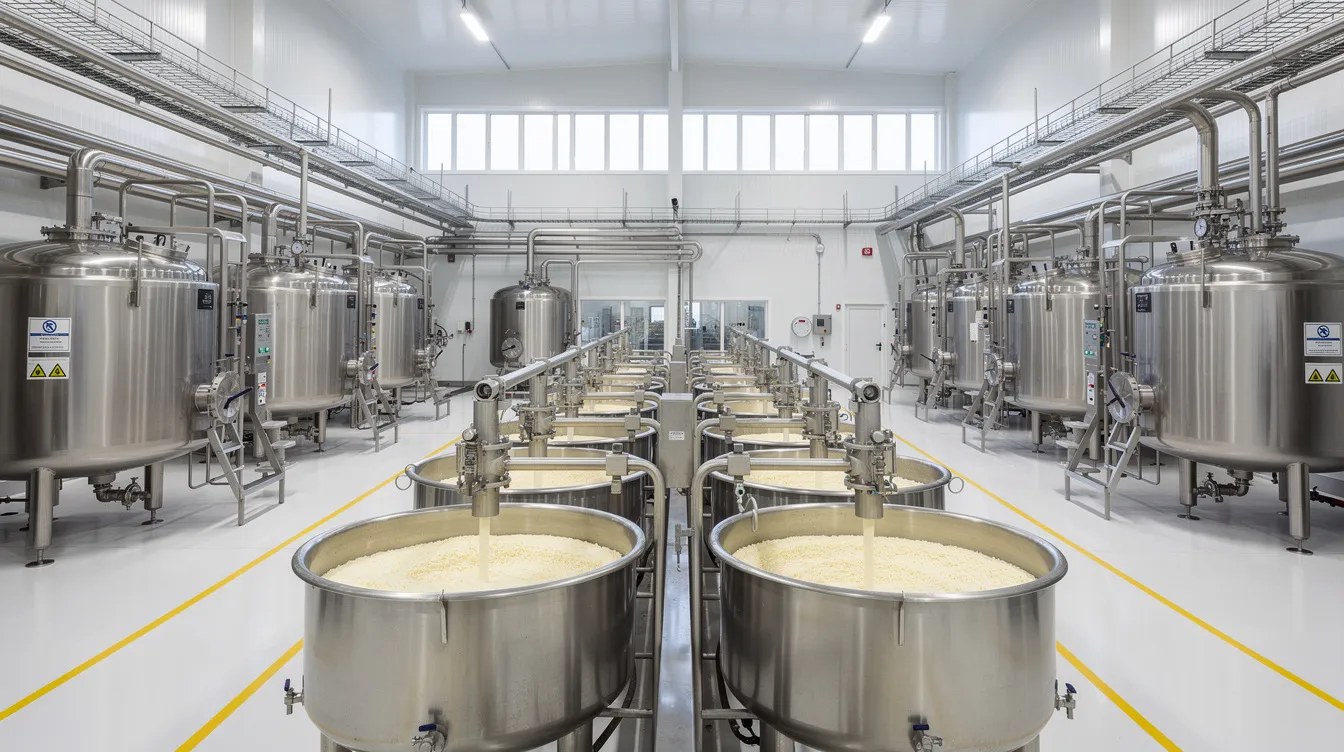
Mozzarella is classified as pasta filata cheese – a stretched-curd cheese made from cow milk, buffalo milk or their blend. The pasta filata process begins with curd formation in a cheese vat, followed by acidification, stretching and kneading of the curd in hot water, moulding into the desired shape and cooling. This stretching process gives mozzarella its characteristic elastic texture, melt and pull – the properties that make it essential for pizza applications.
Major commercial forms include:
- Fresh mozzarella – soft, high-moisture (50–60% moisture content), short shelf life, packed as balls or ovolines in brine, suited for fresh consumption and premium retail.
- Low-moisture mozzarella – firmer, 45–52% moisture, longer shelf life, preferred by pizza chains and food processors for consistent browning and melt.
- Block mozzarella – pressed into large quantities for slicing or industrial melting.
- Shredded and diced mozzarella – convenience formats for food-service, bakeries and frozen pizza.
- String cheese – a snack format with a characteristic rubbery cheese texture, popular in retail.
It is important to distinguish natural dairy mozzarella from analogue mozzarella or analogue pizza cheese, which uses vegetable fat, rennet casein and stabilisers instead of whole milk. Analogue products are cheaper but differ in taste, melt and regulatory classification. Recombined mozzarella, made from milk powders rather than fresh milk, is yet another distinct category. Similarly, mozzarella cheese powder is a dehydrated ingredient used in seasonings and processed cheese applications – not a substitute for fresh or block mozzarella on pizzas.
Market Opportunity and Demand in India
The rapid growth of pizza chains, quick-service restaurants, cloud kitchens and frozen-food brands since 2010 has driven strong industrial mozzarella cheese demand across India. Britannia’s recent ₹220-crore investment in a cheese plant at Ranjangaon – targeting approximately 10,000 tonnes of processed cheese and 6,000 tonnes of natural cheese annually – illustrates the scale of opportunity.
Key demand segments include:
- QSR pizza chains and cloud kitchens
- Hotels, restaurants and cafés (HORECA)
- Frozen pizza and snack manufacturers
- Bakery and ready-to-eat food producers
- Institutional caterers (offices, universities, railways)
- Modern retail and e-commerce
- Private-label manufacturing for other dairy brands
- Export to Middle East and neighbouring markets, subject to importing-country standards
Regional dairy companies and cooperatives are increasingly adding mozzarella to their cheese manufacturing portfolio to capture growing market reach in metros and Tier-II cities. Promoters should conduct location-specific surveys, mapping pizza outlets, HORECA clusters and food-processing plants within a 300–500 km radius before finalising plant capacity.
Selecting the Right Plant Capacity
Capacity planning for a mozzarella cheese production plant requires distinguishing milk-handling capacity (litres per day) from mozzarella output (kg or tonnes per day). Mozzarella yield from milk depends on composition, process efficiency and the cow-buffalo blend used.
Illustrative industrial scale bands in India:
| Configuration | Milk Input (L/day) | Assumed Yield | Mozzarella Output | Approx. Built-up Area |
|---|---|---|---|---|
| Small commercial | 50,000 | ~15% | ~7.5 MT/day | 2,000–3,000 sq m |
| Medium | 2,00,000 | ~17% | ~34 MT/day | 7,000–10,000 sq m |
| Large | 5,00,000 | ~18% | ~90 MT/day | 15,000–20,000 sq m |
These figures are purely illustrative. Actual capacity must be matched with milk supply, confirmed sales, cold-room capacity and working-capital strength. Annual production capacity for organised cheese plants typically falls in the 5,000–10,000 MT range. The competitive landscape demands that promoters avoid selecting capacity solely from machinery quotations – a DPR must validate capacity against demand, logistics and financial sustainability.
Milk Requirement and Other Raw Materials
Milk quality is critical for consistent mozzarella production. The key parameters are fat, SNF, protein (especially casein), microbiological load, absence of antibiotics and freshness at reception.
Buffalo milk has nearly twice the fat content of cow’s milk. Standardized buffalo milk is typically adjusted to around 4% fat for mozzarella manufacturing. Buffalo milk mozzarella has superior stretch compared to cow’s milk mozzarella and a higher yield – producing 1 kg of mozzarella requires approximately 5 kg of buffalo milk, while cow’s milk requires about 8 kg for the same output. Indian studies on buffalo-cow blends confirm yields of 17–18% from buffalo-dominant mixes.
Procurement options include direct farmers, cooperative societies, chilling centres and bulk milk coolers. For a detailed discussion, refer to dairy plant milk collection and procurement infrastructure.
Other essential raw materials include starter cultures (such as Streptococcus thermophilus), rennet or microbial coagulant, calcium chloride for proper coagulation and calcium balance, salt and brine solution, packaging materials, cleaning and sanitation chemicals. Even a small change in yield percentage across a 10 MT/day plant translates into significant rupee impact on cost of production.
Mozzarella Cheese Manufacturing Process
The mozzarella cheese manufacturing process begins with milk reception and follows a controlled sequence through to refrigerated dispatch. Temperature and pH control are critical for mozzarella’s stretchability and melt performance at every stage.
The entire process in sequence:
- Milk reception and quality testing – fat, SNF, acidity, microbial load, antibiotic residues
- Filtration, clarification and standardisation – milk is standardized for fat-to-protein ratio before cheese making
- Pasteurisation – HTST pasteurization occurs at 72°C for 15 seconds to eliminate harmful pathogens and ensure consistent quality
- Cooling – to inoculation temperature (~32–35°C)
- Starter and rennet addition – lactic acid bacteria are added to ferment lactose into lactic acid; rennet is added to coagulate the milk into a solid gel
- Coagulation – curd firmness develops over a set period
- Curd cutting – curd is cut into 10–15 mm pieces to facilitate whey drainage
- Cooking and stirring – curds are gently heated to expel more liquid and control moisture content
- Whey drainage – liquid whey is drained away, leaving solid cheese curds
- Curd acidification – curds undergo acidification to reach the critical pH of 5.1–5.3 before stretching; curd maturation can be automated for efficiency and space optimization
- Stretching and kneading – curds are kneaded and stretched in hot water or steam at 75–85°C to become elastic, forming the characteristic spun paste fibre structure of pasta filata cheeses
- Moulding and portioning – into blocks, balls or loaves of the desired shape
- Brining – shaped mozzarella cheese is immersed in brine (typically 18–23% NaCl) to add flavor and shelf life; brining typically lasts 30 minutes to 2 hours for fresh mozzarella
- Chilling – rapid cooling in chilled water or blast chillers
- Format preparation – block-cutting, shredding or dicing as required
- Packaging – vacuum, shrink or modified-atmosphere packaging
- Cold storage and refrigerated dispatch – maintaining ≤4°C continuously
The stretching process is the heart of mozzarella manufacturing. If pH is too high, the curd will not stretch properly and produces a crumbly texture; if too low, fibres break. Browning behaviour and oiling-off during baking depend on moisture, salt and the quality of fibre formation during stretching. This entire sequence, including flavour development through lactic acid activity and new flavors from brining, should be documented in any mozzarella cheese project report.
Machinery and Equipment Required
Mozzarella cheese plant machinery ranges from semi-automatic small unit configurations to fully automated production lines. Machinery selection must match capacity, product mix and budget.
Principal process equipment:
- Milk reception and storage tanks, milk testing laboratory
- Clarifier and cream separator, standardisation system
- Pasteuriser (HTST or equivalent)
- Cheese vat (can hold 1,000 to 18,000 liters of milk depending on scale)
- Curd-cutting and agitation system – curd cutters can slice 10–16 kg blocks for stretching
- Whey-draining conveyors or tables
- Curd maturation equipment
- Mozzarella cooker-stretcher – steam cooker-stretchers can produce 80 to 3,000 kg of cheese per hour
- Moulding and portioning machines
- Brining tanks and brine systems management
- Chilling systems, block-cutting, shredding and dicing machines
- Vacuum or MAP packaging machines
Utility and hygiene systems:
- CIP system, boiler/steam generator, refrigeration plant
- Air compressor, water-treatment plant, ETP
- Quality-control laboratory instruments
Cost factors depend on automation level, stainless-steel grade, imported versus domestic equipment, PLC/SCADA controls and packaging sophistication. For broader context on equipment pricing, readers can refer to cheese plant machinery and equipment cost, noting that mozzarella lines require additional pasta filata-specific machines.
Land, Building and Plant Layout
Hygienic zoning and unidirectional product flow are non-negotiable for any cheese manufacturing unit. A facility layout should enforce clean-to-dirty separation to prevent cross-contamination, with distinct zones for raw-milk handling, processing, stretching, brining, chilling, packaging, cold storage, dispatch, laboratory, utilities, CIP, ETP and staff amenities.
Walls and floors must have washable, food-grade finishes with adequate drainage slopes. Provision for future expansion – an additional cheese vat or second mozzarella production line – should be incorporated in civil design. An engineer or dairy technologist should coordinate with architect and financial consultant for integrating layout with the project-cost structure in the DPR.
Utility Requirements and Cold-Chain Infrastructure
Utilities represent substantial CapEx and operating cost in industrial mozzarella production:
- Electricity – major load from refrigeration compressors, motors, packaging lines; backup power is essential
- Steam/hot water – for pasteurisation, curd cooking, cooker-stretcher operation
- Refrigeration and chilled water – milk pre-cooling, cheese chilling, cold storage rooms
- Process water – food-grade quality for cleaning, cooling and brine preparation
- Compressed air – pneumatic controls, valves, packaging machines
- Effluent treatment – waste management is essential due to the high-strength wastewater generated in cheese manufacturing
Uninterrupted cold chain from plant cold storage through reefer transport to distributor is critical for mozzarella shelf life. Promoters should review dairy plant power, water, steam, refrigeration and ETP requirements when designing utilities. Energy-efficiency measures – insulation, heat recovery, VFDs and optimised brine systems – directly reduce long-term utility costs and improve plant profitability.
Quality Control and Product Testing
Large buyers – QSR chains, food processors and modern retailers – specify strict standards and will audit the mozzarella cheese manufacturing business regularly.
- Incoming milk: testing for fat and protein content, acidity, microbial load, antibiotic residues, temperature
- In-process controls: pH tracking at coagulation and stretching, moisture and salt content, curd firmness, whey fat losses
- Finished product: microbiological counts, stretchability and meltability tests, oiling-off and browning evaluation, texture, packaging integrity and shelf-life studies
Quality control in mozzarella production includes testing milk for fat and protein content at every reception. The quality plan should be customised per customer segment – a pizza cheese manufacturing plant supplying major QSRs will face tighter functional and microbiological specifications than general retail supply.
Licences and Regulatory Approvals in India
Dairy processing involves navigating various compliance fronts for public health. In India, compliance with FSSAI guidelines is mandatory for dairy processing units. Mozzarella production is also subject to food safety regulations such as HACCP.
Key approvals typically include:
- Business registration, Udyam Registration (MSME), FSSAI licence, GST registration
- State Pollution Control Board consent – environmental clearances are required for effluent discharge in dairy processing
- Factory licence, fire-safety NOC, boiler and electrical approvals
- Legal Metrology registration, labour-law compliances, trademark registration
- Import Export Code (IEC) for exports
Regulatory compliance requirements vary with state, plant size and constitution. A well-prepared DPR should map likely statutory requirements, but final confirmation must come from the respective authorities.
Mozzarella Cheese Plant Project Cost and Investment Structure
Total mozzarella cheese plant investment consists of fixed capital plus margin for working capital. Cheese manufacturing plant setup costs vary significantly by region, capacity and technology.
Major capital-cost components:
- Land and site development
- Factory building and civil works (food-grade finishes, insulation)
- Plant and machinery (including cooker-stretcher, cheese vat, packaging)
- Refrigeration and cold storage systems
- Utilities (boiler, water treatment, air compressor)
- Laboratory, ETP, electrical installations
- Office equipment, vehicles (including refrigerated vans)
- Preliminary and pre-operative expenses, interest during construction, contingencies
As reference: Milky Mist Dairy invested approximately ₹450 crore for a large integrated cheese complex in Tamil Nadu, while Himalya International set up a 150,000 L/day mozzarella plant in Himachal Pradesh at USD 2.5 million in 2006. These benchmarks illustrate the wide range. Readers exploring broader costing can refer to cheese manufacturing plant setup cost in India, noting that a dedicated mozzarella plant requires additional pasta filata equipment and higher cold-storage intensity.
Working Capital Requirement for a Mozzarella Cheese Manufacturing Unit
Working capital covers funds blocked in milk procurement, consumables, wages, utilities, inventory and receivables. Key items include daily milk purchases, starter cultures and rennet, salt and packaging materials, electricity and refrigeration expenses, salaries, transport and cold-chain costs, and minimum operating cash.
B2B supply to pizza chains or institutional customers typically involves 30–60 day credit periods, extending the receivables cycle significantly. The DPR should estimate working capital based on days of raw-material inventory, finished-goods stock and average collection period. Banks sanction working-capital limits based on projected turnover, holding norms and financial ratios.
Revenue Model and Mozzarella Plant Profitability Drivers
Mozzarella cheese plant profitability is project-specific and must be established through detailed financial analysis, not generic margin figures. Typical gross profit margins for cheese plants range from 30–40%, but actual margins depend entirely on local conditions.
Revenue streams may include bulk blocks, shredded and diced mozzarella, retail packs, private-label production, and whey utilisation (beverages, ricotta cheese, animal feed). Operating costs for cheese plants are typically 70–80% raw materials – making milk procurement price and composition the dominant cost drivers.
Other profitability drivers include capacity utilisation, product mix, selling price realisations, energy and refrigeration costs, packaging cost, labour productivity and cold-chain efficiency. A mozzarella cheese project report should include sensitivity analysis showing the impact of ±5–10% changes in milk price or selling price on cash flows and DSCR.
Financial Projections and Bank Appraisal
In my practice as a Chartered Accountant, I prepare detailed financial projections for mozzarella and other dairy industry projects. Core statements required include projected P&L, balance sheet, cash-flow and fund-flow statements, cost-of-production calculation, working-capital assessment and term-loan repayment schedule.
Analytical indicators must include DSCR, break-even point, IRR, payback period and sensitivity analysis. Lenders evaluate reasonableness of assumptions, promoter contribution and experience, proposed security, implementation schedule and confirmed buyers. The framework used for dairy processing plant financial projections can be adapted to a mozzarella cheese manufacturing plant.
Means of Finance and Bank-Loan Options
The means of finance should balance promoter contribution (typically 25–40%), term loans, working-capital limits and any eligible government incentives. Eligibility for subsidies depends on current notifications, unit size, location and promoter profile – promoters must check latest guidelines from official sources. For guidance on structuring funds for dairy projects, refer to dairy plant project cost and means of finance. For specifics on dairy processing plant bank loan and project finance, a customised DPR with credible assumptions is essential. No consultant can guarantee loan approval.
Feasibility and Risk Analysis for Mozzarella Cheese Manufacturing Business
Beyond machinery and milk supply, promoters must evaluate technical, market, financial and operational risks:
| Risk | Mitigation |
|---|---|
| Milk price volatility and seasonal shortages | Long-term procurement contracts, multiple sourcing channels |
| Inconsistent milk quality | Strong QC lab, supplier audits, rejection protocols |
| Process-control failures (culture, pH, stretching) | Trained dairy technologist, documented SOPs |
| Refrigeration/power breakdown | Backup generators, redundant refrigeration |
| Dependence on few large buyers | Diversified customer base, retail + institutional mix |
| Whey and effluent management | ETP design, whey utilisation (feed, powder, beverages) |
A feasibility study should test scenarios at 60%, 80% and 100% capacity utilisation to evaluate whether the business remains sustainable under stress. The broader principles of dairy processing plant feasibility and project viability apply equally to dedicated mozzarella projects.
Implementation Roadmap for Setting Up a Mozzarella Cheese Production Plant
A typical implementation sequence from idea to commercial production spans several months:
- Preliminary market study and product positioning
- Capacity and product-mix finalisation
- Milk procurement strategy
- Site selection and land acquisition
- Engagement of dairy technologist and consultant
- Preparation of customised DPR
- Bank-loan proposal submission
- Statutory approvals initiation
- Machinery ordering (mozzarella cheese plant machinery lead times vary)
- Civil construction and utilities development
- Installation, commissioning and trial production
- Product validation, buyer trials and approvals
- Ramp-up to commercial production
Integrated plants adding other dairy lines can benefit from a broader integrated dairy processing plant project report. Early coordination between banker, equipment supplier, architect and financial consultant helps avoid delays and total cost overruns.
Why a Customised DPR Is Essential for a Mozzarella Cheese Manufacturing Plant
Generic downloadable mozzarella cheese project reports use average assumptions that rarely match a specific promoter’s capacity, location or financing pattern. A customised DPR should capture actual chosen capacity, local milk prices and supply, proposed product mix, actual machinery quotations, site-specific civil costs, promoter profile and realistic working-capital cycle.
I assist project promoters in preparing customised mozzarella cheese manufacturing plant project reports, CMA Data and financial projections for submission to banks and investors – but I do not guarantee loan sanction. Promoters should review and understand every assumption before presenting to lenders.

Frequently Asked Questions
Is it better to locate a mozzarella cheese plant near milk producers or near the market?
Locating near milk-producing areas reduces raw-milk logistics and chilling costs and may secure better quality and pricing. Locating near consumption centres reduces finished-goods transport and cold-chain risk. Many successful projects choose a balanced location within feasible distance of both reliable milk supply and major buyers. The optimal choice depends on state infrastructure, road connectivity and cold-chain availability.
Can a dairy mozzarella plant and an analogue pizza-cheese line operate in the same factory?
Both can technically co-exist with separate equipment and clear segregation, but labelling, formulations and FSSAI definitions must be strictly followed. Contracts with buyers must clearly specify whether they are purchasing natural mozzarella cheese or analogue mozzarella, since performance, cost and legal classification differ significantly.
How long does it typically take to commission an industrial mozzarella cheese manufacturing unit?
Timelines vary from several months to over a year from DPR and loan sanction to trial production, depending on land readiness, statutory approvals, machinery lead time and civil-construction complexity. Promoters should build a realistic buffer for unforeseen delays when planning cash-flow and interest during construction.
Is it necessary to have an in-house dairy technologist for a mozzarella cheese project?
For industrial mozzarella production, an experienced dairy technologist – whether on payroll or as a retained consultant – is strongly recommended. While machinery suppliers provide commissioning support, long-term product consistency, process optimisation and troubleshooting require dedicated technical leadership. Process control, particularly maintaining the stretching process within the correct pH and temperature window, demands ongoing expertise.
Can a mozzarella cheese manufacturing plant be expanded later into a full dairy-processing complex?
If land, layout and utilities are planned with future expansion in mind, a standalone mozzarella unit can later add lines for cheddar, paneer, butter, yoghurt or UHT milk. Such integrated expansion should be analysed through updated DPRs and financial projections to ensure new investments align with market opportunity and financing capacity.
A mozzarella cheese manufacturing plant can be commercially attractive when supported by dependable milk procurement, suitable technology, controlled manufacturing, established buyers, cold-chain infrastructure and realistic financial planning. The difference between a successful project and a struggling one often comes down to the quality of pre-investment analysis and the credibility of the DPR.
If you are planning a mozzarella cheese manufacturing business or any dairy processing project, I invite you to reach out through www.projectreportbank.com for assistance with customised project reports, CMA Data, financial projections, bank-loan proposals and project feasibility analysis. Every project is unique – and the documentation supporting it should reflect that.
CA Manish Gugliya, FCA, DISA (ICAI) Practising Chartered Accountant | Project Reports & DPR Consultant