Most entrepreneurs walk into a bank, hear the sanctioned loan amount and the monthly EMI, and feel relieved. The funding is approved, the business can start. But here is the part that catches people off guard – the amount you actually end up paying to the bank is often significantly more than the amount you borrowed. And the difference is not just about interest. It includes processing charges, documentation costs, insurance premiums, penalties, and several other line items that quietly add up over the life of your loan.
I am CA Manish Gugliya, and after helping hundreds of Mudra Loan applicants across India over the past two decades, I can tell you this with certainty: the borrowers who understand the total cost of a Mudra loan before signing make far better financial decisions than those who don’t. This article will break down every rupee you might pay, with real-world examples, comparison tables, and practical tips to reduce your overall borrowing cost.

Key Takeaways
- The total cost of a Mudra loan is not just the loan amount – it includes all interest paid over the tenure, processing fees (where applicable), documentation charges, insurance premiums, penalties, and other bank-specific charges. A ₹5 lakh Mudra loan can cost you anywhere from ₹5.8 lakh to ₹7 lakh or more in total repayment depending on your interest rate, tenure, and add-on costs.
- There are no government-fixed interest rates for Mudra loans. Each bank or financial institution sets its own rate based on your credit profile, business risk, and internal benchmarks. Comparing offers from multiple lenders is not optional – it is essential.
- Many so-called “hidden costs” are actually mentioned in your sanction letter and the bank’s schedule of charges. The problem is that most borrowers never read those documents carefully. Always ask the bank to explain every charge before you sign.
- Choosing a longer tenure reduces your monthly EMI, but it increases the total interest you pay over the life of the loan – sometimes by tens of thousands of rupees.
- This article will show you, with practical examples and comparison tables, how to calculate and reduce the total cost of your Mudra loan, so your business funding becomes a genuine support for growth rather than a quiet financial drain.
Table of Contents
What Does “Total Cost of a Mudra Loan” Really Mean?
In my experience as a Chartered Accountant helping MSME entrepreneurs, I have seen that most first-time borrowers focus on two numbers – the sanctioned loan amount and the monthly EMI. They rarely think about what the loan will actually cost them by the time the last EMI is paid. That is a mistake.
The total cost of a Mudra loan is the entire amount you will finally pay to the bank from the day you receive the money to the day your loan account is closed. This includes your principal amount and interest charges, plus every fee, premium, and penalty that applies during the loan tenure.
The Major Cost Components
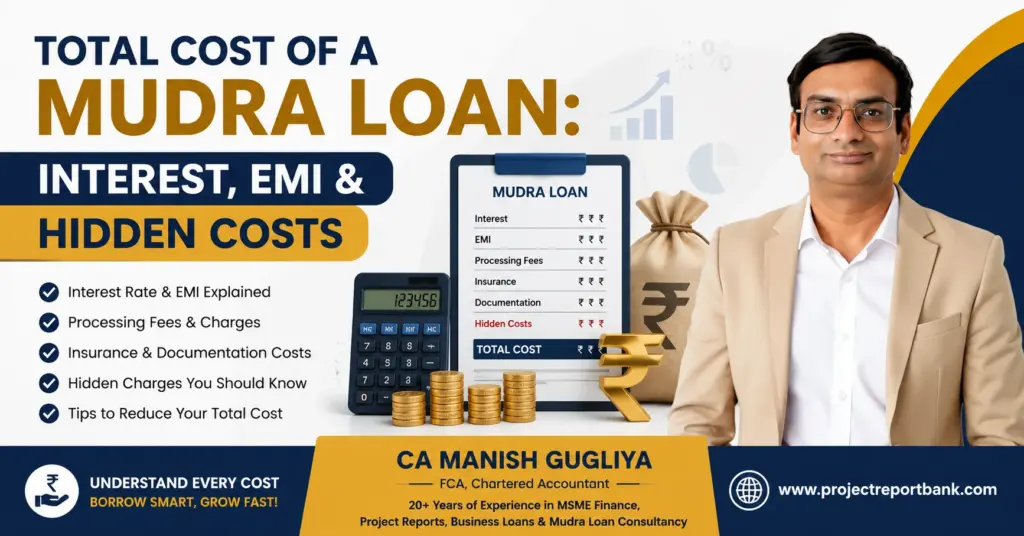
Here is what can go into your total borrowing cost:
- Principal repayment – the original loan amount you borrowed.
- Interest payable over the tenure – the biggest cost driver, calculated on the outstanding balance each month.
- Processing charges – a one-time upfront fee charged by some banks (often nil for smaller Mudra categories).
- Documentation fees – charges for preparing, verifying, and registering loan documents.
- Insurance premiums – credit life insurance or asset insurance, sometimes mandatory, sometimes optional.
- Guarantee fees – under CGTMSE or CGFMU schemes, where applicable (especially for Tarun Plus category).
- Prepayment or foreclosure charges – fees for closing your loan before the scheduled tenure (many banks waive this for Mudra loans).
- Late payment penalties (penal interest) – extra interest charged when you miss or delay an EMI.
- Cheque/ECS bounce charges – a fixed penalty each time your EMI payment bounces.
- Inspection and legal charges – periodic or one-time charges for account supervision, site visits, or legal verification.
A Quick Example to Set the Context
Consider a ₹5 lakh Mudra loan at around 10% p.a. for 5 years. Your total repayment on interest alone comes to approximately ₹1.4 lakh. That means you pay the bank roughly ₹6.4 lakh in total – and this is before adding any processing fee, insurance, or other charges. The actual amount leaving your pocket could be even higher.
Under the Pradhan Mantri Mudra Yojana (PMMY), which was set up by the government of India through MUDRA – a refinance agency under the Ministry of Finance – there is no interest subsidy on standard Mudra loans. Interest rates are deregulated and vary based on individual cases. Banks are free to set their own reasonable rates within their internal policies.
Mudra loans have three categories: Shishu, Kishore, and Tarun. The Shishu category offers loans up to Rs.50,000, the Kishore category provides loans from Rs.50,001 to Rs.5 lakh, and the Tarun category offers loans from Rs.5 lakh to Rs.10 lakh. Additionally, the Tarun+ category provides loans from Rs.10 lakh to Rs.20 lakh for borrowers who have successfully repaid a previous Tarun loan.
Not every bank charges every type of fee. Some public sector banks offer nil processing fees on Shishu loans or working capital loans up to ₹5 lakh. The actual mix of charges always depends on your lending institution, your category, and the loan amount. That is exactly why understanding the full cost breakdown matters.
Components of Total Mudra Loan Cost & Impact of Interest and EMI
To understand the total cost of a Mudra loan, you need to separate each component, see how much it costs individually, and then understand how they combine over the full repayment period. Let me walk you through each one.
Cost Component Breakdown
| Cost Component | Is It Mandatory? | Does It Vary by Bank? | How It Affects Total Cost |
|---|---|---|---|
| Interest charges over tenure | Yes | Yes – linked to bank’s benchmark rate and your profile | Largest cost driver; even a 1% difference in rate can mean thousands more over the tenure |
| Processing fee | Often mandatory for Kishore/Tarun; often nil for Shishu | Yes | One-time upfront cost; can range from nil to 1% of loan amount |
| Documentation charges | Usually yes | Yes | Fixed cost, sometimes bundled with processing fee, sometimes separate |
| Insurance (credit life / asset) | Sometimes mandatory, sometimes optional | Yes | Adds a lump sum or recurring cost; can be a few thousand rupees |
| Guarantee fee (CGTMSE/CGFMU) | Mandatory where scheme requires it | Policy varies | Small percentage of loan; applicable especially for Tarun Plus |
| Penal interest (late payment) | Only if you default or delay | Yes | Extra interest on overdue amount; compounds over time |
| Cheque/ECS bounce charges | Only if your payment bounces | Yes | Fixed penalty per occurrence; adds up with repeated bounces |
| Inspection/supervision charges | Depends on bank policy and loan size | Yes | Periodic small charge; cumulative over years |
| Prepayment/foreclosure charges | Depends; many banks waive for Mudra | Yes | If charged, adds cost to early closure; if nil, prepayment saves money |
| Legal/valuation fees | Where required by bank | Yes | Charged “at actuals”; can be a few hundred to a few thousand rupees |

How Interest Works on Mudra Loans
Interest rates for Mudra loans typically range from 8% to 24% per annum, depending on the lender type (public bank vs NBFC), your business category, and your risk profile. Public sector banks generally offer the lowest interest rates on Mudra loans, while NBFCs may charge significantly higher rates for faster processing or higher-risk borrowers.
Many Mudra loans are linked to internal bank benchmarks such as MCLR (Marginal Cost of Funds Based Lending Rate), EBLR (External Benchmark Lending Rate), or RLLR (Repo Linked Lending Rate). This means your rate may fluctuate over the tenure if it is a floating rate loan. Interest rates can be revised by banks without notice when underlying benchmarks change.
Your applicant credit history influences the interest rate offered on Mudra loans. A clean repayment track record, stable business income, and a good CIBIL score will get you a lower rate. Weak financials or poor credit history will push the rate higher.
Mudra loan interest rates vary by bank and borrower profile. For reference, UCO Bank offers Mudra loans starting at 8.85% p.a., while some NBFCs may go up to 24% for the same loan category. To understand how banks arrive at your specific rate, I recommend reading this detailed guide on Mudra loan interest rate calculation.
Many lenders use the reducing balance method to calculate interest for Mudra loans. This means interest is calculated on the outstanding principal each month, not on the original loan amount. As you keep paying EMIs and the principal reduces, the interest portion in each EMI also decreases gradually.
How EMI Affects Your Total Repayment
EMI stands for Equated Monthly Instalment – a fixed amount you pay every month that includes both a principal portion and an interest portion. In the early months of your loan, a larger share of your EMI goes toward interest. Over time, as the outstanding principal reduces, more of your EMI goes toward paying off the actual loan.
The repayment tenure for Mudra loans can extend up to 5 to 7 years. The relationship between tenure and total cost is straightforward but often misunderstood:
- Shorter tenure = higher monthly EMI, but you pay significantly less total interest over the life of the loan.
- Longer tenure = lower monthly EMI (feels more affordable), but the total interest paid is much higher.
A Quick Numeric Example
Take a ₹2 lakh Mudra loan at 11% p.a.:
| Parameter | 3-Year Tenure | 5-Year Tenure |
|---|---|---|
| Monthly EMI (approx.) | ₹6,567 | ₹4,396 |
| Total amount repaid | ₹2,36,412 | ₹2,63,760 |
| Total interest paid | ₹36,412 | ₹63,760 |
By choosing the 5-year tenure, your EMI drops by about ₹2,170 per month – which feels comfortable. But you end up paying approximately ₹27,350 more in total interest. That is real money.
The total repayment cost is calculated by multiplying monthly EMI by the total number of months, and then adding any one-time or recurring charges on top. For a step-by-step guide on computing your EMI before applying, check out this resource on how to calculate Mudra loan EMI before applying.
Loans up to Rs.10 lakh do not require collateral security under PMMY, which is a significant benefit for micro enterprises and small businesses that may not have assets to pledge.
Practical Cost Examples, Hidden Charges & Ways to Reduce Your Mudra Loan Cost
Real-life examples are the best way to understand the true borrowing cost of Mudra loans. The figures below are indicative illustrations based on typical bank policies and publicly available rate information – not exact bank quotations. Your actual numbers will depend on your specific lender, category, and credit profile.
Example 1: ₹2 Lakh Mudra Loan – Short Tenure vs Long Tenure
Loan amount: Rs 2,00,000 | Interest rate: 10.5% p.a.
| Parameter | 3-Year Tenure | 5-Year Tenure |
|---|---|---|
| Monthly EMI (approx.) | ₹6,510 | ₹4,310 |
| Total repayment | ₹2,34,360 | ₹2,58,600 |
| Total interest paid | ₹34,360 | ₹58,600 |
| Processing fee | Nil (Shishu/Kishore at many PSBs) | Nil |
| Effective total cost | ~₹2,34,360 | ~₹2,58,600 |
The longer tenure saves you ₹2,200 per month but costs you ₹24,240 extra in interest over the life of the loan.
Example 2: ₹5 Lakh Mudra Loan – Two Different Banks
Loan amount: Rs 5,00,000 | Interest rate: 9.75% p.a. | Tenure: 5 years
| Parameter | Bank A (PSB, lean charges) | Bank B (Private/NBFC, more charges) |
|---|---|---|
| Monthly EMI (approx.) | ₹10,570 | ₹10,570 |
| Total repayment (EMI × 60) | ₹6,34,200 | ₹6,34,200 |
| Total interest paid | ₹1,34,200 | ₹1,34,200 |
| Processing fee | Nil | 1% = ₹5,000 |
| Documentation charges | Nil | ₹1,500 |
| Credit life insurance | Not required | ₹2,500 |
| GST on fees (18%) | Nil | ~₹1,620 |
| Effective total cost | ~₹6,34,200 | ~₹6,44,820 |
Same interest rate, same EMI – but Bank B costs you about ₹10,600 more because of processing fees, insurance, documentation, and GST. This is why you must compare the full cost, not just the interest rate.
Tip: Bank of Baroda, for instance, offers nil processing fees and nil prepayment charges on their regular Mudra loan products. Bank of Maharashtra waives processing fees for working capital loans up to ₹5 lakh but charges about 1% on term loans between ₹5-20 lakh.
How to Read a Loan Cost Breakdown
When you receive a loan offer, here is how to calculate your actual total cost step by step:
- Note the sanctioned loan amount.
- Check the interest rate and confirm whether it is fixed or floating.
- Find the EMI amount and multiply it by the total number of months in your tenure.
- Add one-time charges: processing fee, documentation fee, legal/valuation charges.
- Add insurance premium (if applicable or mandatory).
- Add guarantee fee (if applicable, especially for Tarun Plus).
- Add GST on any service fees charged.
- The sum of all the above is your actual total cost of borrowing.
For a detailed walkthrough with worked-out examples, see this guide on Mudra loan interest calculation explained with examples.

Hidden Costs Borrowers Frequently Overlook
Let me be clear – most of these costs are not truly “hidden.” They are mentioned in your sanction letter, the bank’s schedule of charges, or the Key Facts Statement (KFS) that banks are now mandated to provide. The problem is that borrowers do not read these details carefully. Here are the charges that catch people off guard:
- Credit life insurance: Some banks push this aggressively, even when it is not mandatory for your loan category. It can add ₹1,000 to ₹5,000 to your upfront cost. Always ask: “Is this compulsory as per your written policy, or optional?”
- Asset insurance: If your Mudra loan is used to buy machinery, equipment, or a vehicle, the bank may require you to insure the asset with a “bank clause.” This is often genuinely mandatory for hypothecated assets, so you cannot avoid it, but you can choose a competitive insurer.
- GST on fees: Processing fees, documentation charges, and guarantee fees attract 18% GST. A ₹5,000 processing fee becomes ₹5,900 after GST. Borrowers rarely account for this.
- Cheque/ECS bounce charges: Each time your EMI payment bounces, the bank charges a fixed penalty – typically ₹250 to ₹750 per occurrence. Two or three bounces a year can quietly add ₹1,500 to ₹2,250 to your cost.
- Penal interest for late payments: If you miss an EMI or pay it late, banks levy penal interest on the overdue amount. This is often 2% to 4% above your normal rate and can snowball if you are consistently late.
- Inspection and supervision charges: Some banks levy quarterly or annual inspection charges, especially for loans above ₹2 lakh. For example, Federal Bank charges ₹100 per quarter for inspection on Mudra loans above ₹2 lakh, plus CERSAI registration fees of ₹75 to ₹150 depending on loan size.
- CERSAI and CIBIL charges: Small fixed fees for charge creation, credit bureau search, and registration. Individually small, but they add to upfront cost.
Does Every Bank Charge Processing Fees?
No. Processing fees for Mudra loans are often waived for the Shishu category across most public sector banks. For Kishore and Tarun categories, policies differ:
- Many PSBs charge nil to 0.50% for smaller amounts.
- Private banks and Regional Rural Banks may charge 0.50% to 1%.
- NBFCs and Small Finance Banks sometimes charge 1% to 2%, especially for higher-risk profiles.
Always confirm the exact fee before your loan is sanctioned. You can find information on which banks offer the most competitive terms in this comparison of banks offering the lowest interest rate on Mudra loans.
Is Insurance Mandatory?
This is one of the most common questions I get. The short answer:
- Credit life insurance: Not universally mandatory for all Mudra loans. Many banks offer it as optional. However, some bank branches push it as if it is compulsory. If the bank insists, ask them to show you the written policy or circular that mandates it for your specific category.
- Asset insurance: If you are buying a vehicle, machinery, or equipment with the Mudra loan and the bank holds a hypothecation charge over the asset, insurance is usually genuinely mandatory. This is standard banking practice to protect both the lender and the borrower in case of damage or loss.
- Guarantee cover premium (CGTMSE/CGFMU): For the Tarun Plus category, borrowers are required to bear the guarantee premium. This is non-negotiable under the scheme.
Always check whether insurance is adding real value for your situation or whether it is simply inflating your borrowing cost.
Common Myths About Mudra Loan Costs
| Myth | Reality |
|---|---|
| Mudra loans are interest-free | No. The government does not subsidise or waive interest on standard PMMY Mudra loans. |
| Every bank has the same interest rate | Rates differ widely – from about 8% in PSBs to 24% in some NBFCs. |
| There are zero hidden charges | Most charges are disclosed, but borrowers don’t always read the fine print. |
| Longer tenure always saves money | Longer tenure reduces EMI but increases total interest, often by a large margin. |
| Insurance is compulsory in every case | It depends on the loan category, the asset, and the bank’s specific policy. |
Mistakes That Increase Your Loan Cost
These are the errors I see most frequently among Mudra loan applicants:
- Borrowing more than needed. If your project requires ₹3 lakh, don’t take ₹5 lakh “just in case.” You pay interest on every extra rupee. Read this guide on how much Mudra loan you should apply for to size your requirement correctly.
- Choosing the longest possible tenure without considering total interest impact.
- Missing EMI payments – even once or twice – which triggers penal interest and damages your credit score.
- Ignoring the sanction letter terms and not questioning charges you don’t understand.
- Accepting unnecessary add-on products like premium insurance packages or account protection plans that the bank branch executive recommends for their own targets.
Actionable Tips to Reduce Your Total Mudra Loan Cost
- Borrow only what your project report justifies. Your project report should clearly show the exact funding requirement. Over-borrowing directly increases your total cost.
- Compare offers from at least 2-3 banks. Don’t settle for the first bank that says yes. Carry your financial documents to multiple lenders and compare interest rates, processing fees, and other charges.
- Prefer a slightly shorter tenure if your business cash flow allows it. The monthly EMI will be higher, but you will save significantly on total interest.
- Avoid unnecessary insurance products. If insurance is not mandatory for your category, decline it politely.
- Maintain a strong credit history. Pay all existing obligations on time. A good CIBIL score gets you better rates.
- Never miss an EMI. Set up auto-debit and ensure sufficient balance in your account. Even one bounce means a penalty charged to your account.
- Read the sanction letter line by line. If any clause is confusing – interest reset dates, penal interest rates, inspection fees – ask the bank to explain it. If needed, consult a Chartered Accountant or finance consultant before signing.
- Consider prepayment. If your business generates surplus cash, paying off part of the loan early can save substantial interest. Many banks charge nil foreclosure fees for Mudra loans, but always confirm this from your sanction letter.
Expert Advice from CA Manish Gugliya
After working with Mudra Loan applicants for over 20 years, my single biggest piece of advice is this: never evaluate a loan offer by EMI alone. The lowest EMI is almost always the longest tenure – and the longest tenure is almost always the most expensive loan.
Before you accept any offer, sit down with a calculator (or an online EMI calculator), plug in the numbers, add up all the charges, and arrive at your total repayment figure. Then do the same for one or two competing offers. The difference will surprise you.
Mudra loans are a powerful tool for micro enterprises and small businesses across India. The scheme, managed through MUDRA as a micro units development and refinance agency under the ministry of finance, has enabled millions of entrepreneurs to access formal funding. But the benefit of the scheme only works in your favour when you understand every rupee you are paying. The goal is to protect your business margins, not erode them through avoidable costs.

Frequently Asked Questions on Total Cost of Mudra Loan
Here are the faqs I get most frequently from Mudra Loan applicants. These address specific doubts not fully covered in the sections above.
Are Mudra Loans Ever Interest-Free or Subsidised?
No. Standard Mudra loans under the Pradhan Mantri Mudra Yojana are not interest-free. The government does not provide any interest subsidy on these loans. Each bank or financial institution decides its own rate. However, some state governments run separate schemes that may offer interest subsidies or capital subsidies for specific sectors or categories (like women entrepreneurs or SC/ST borrowers). These are independent of PMMY. Always check your state’s MSME ministry website or the bank’s page for any such additional benefits available in your region, and verify the details directly before assuming any subsidy applies.
How Can I Roughly Estimate the Total Repayment Before Applying?
Follow these steps:
- Use an online Mudra loan EMI calculator – enter the loan amount, expected interest rate (check the bank’s current rate on their website or by visiting the branch), and your preferred tenure.
- The calculator will give you the monthly EMI. Multiply the EMI by the number of months to get the base total repayment.
- Add one-time charges: processing fee (if any), documentation fee, legal/valuation charges, guarantee fee.
- Add insurance premium if applicable.
- Add GST (18%) on all service fees.
- The total of all the above is your estimated total cost.
This gives you a realistic picture before you even submit your application. You can find more details on the calculation approach in this guide on Mudra loan interest calculation.
Can Prepayment or Early Closure Reduce the Total Cost?
Yes – significantly. When you prepay, you reduce the outstanding principal, which means less interest accrues in subsequent months. If you can make partial prepayments or close the loan early, you can save a substantial amount in interest. The good news is that many public sector banks charge nil foreclosure or prepayment fees for Mudra loans. However, some lenders – especially for larger Tarun or Tarun Plus loans – may charge a small prepayment penalty. Always confirm the prepayment terms in your sanction letter before planning early closure.
What Happens to the Total Cost If I Miss an EMI?
Missing even one EMI triggers two additional costs. First, the bank will levy penal interest on the overdue amount – this is typically 2% to 4% above your regular interest rate. Second, if your auto-debit or cheque bounces, you will be charged a bounce penalty (usually ₹250 to ₹750 per instance). Beyond the immediate financial cost, missed payments are reported to credit bureaus and lower your CIBIL score. A poor score can lead to higher interest rates on future loans or even rejection. Over time, repeated defaults can add thousands of rupees to your total borrowing cost through compounding penal interest alone. The best security against this is to maintain adequate account balance and set up payment reminders.
Do All Banks Have Identical Processing and Documentation Charges?
Not at all. Each bank publishes its own schedule of service charges, and these vary widely. For instance, Bank of Maharashtra charges nil processing fees on working capital Mudra loans up to ₹5 lakh but charges approximately 1% on term loans between ₹5 lakh and ₹20 lakh. Indian Overseas Bank charges documentation fees of 0.25% with a minimum of ₹500. Some banks bundle documentation and processing fees together, while others list them separately. As an entrepreneur, you should not compare just interest rates – compare the entire cost structure. Ask each bank for their complete schedule of charges for the Mudra loan product you are applying for, and make your decision based on the total picture.
The bottom line is this: the lowest EMI is not the cheapest loan. Before you sign, add up every cost – interest over the full tenure, processing charges, insurance, documentation fees, and potential penalties. Compare at least two or three offers. Read your sanction letter carefully. And if any clause feels confusing, consult a professional before committing. Your Mudra loan should fuel your business growth, not quietly drain your profits.
- Prepayment of Mudra Loan: Rules, Benefits & Practical Advice (2026 Guide)


- Total Cost of a Mudra Loan: Interest, EMI & Hidden Charges
- Mudra Loan Interest Calculation Explained with Examples

- How Much Mudra Loan Should You Apply for Your Business?

- Minimum Mudra Loan Amount: Is There Any Lower Limit?

- How Banks Decide Your Mudra Loan Amount
- Which Bank Offers the Lowest Interest Rate on Mudra Loan? A CA’s Expert Comparison

- How to Calculate Mudra Loan EMI Before Applying

- Mudra Loan Interest Rate Explained: How Banks Calculate It