Key Takeaways
- The RBI Ombudsman under the integrated ombudsman scheme can order banks and NBFCs to correct service mistakes, refund wrong charges, update records, and pay compensation in genuine cases.
- The ombudsman cannot force a bank to sanction a Mudra loan, cancel a genuine loan liability, or rewrite bank lending policies.
- Many cases close within 30–60 days when documents are clear and the complaint is factual.
- Relief depends on written evidence of service deficiency, not emotions alone.
- If relief is not satisfactory, the borrower can appeal to the appellate authority within RBI or approach a consumer commission.
Introduction: Why Mudra Borrowers Go to the RBI Ombudsman
Since 2016, I have seen many Pradhan Mantri Mudra Yojana borrowers struggle with banks. Common problems include repeated branch visits without progress, delay in sanction without explanation, wrong processing fees, insurance forced without consent, rude conduct, rejection without a written letter, and wrong credit bureau reporting despite timely repayment.
The RBI Ombudsman is an independent grievance redressal authority set up by the Reserve Bank of India under the banking ombudsman scheme to handle customer complaints involving deficiency in service by banks, NBFCs, and other regulated entities.
When borrowers search for “RBI Ombudsman Mudra loan relief,” they usually expect loan approval, EMI waiver, refund of excess charges, or compensation for harassment. Some of these are realistic. Others are not.
This article covers what relief actually means, what types the banking ombudsman can grant in Mudra loan matters, what it cannot do, documents needed, tips, common mistakes, and what to do if the outcome is not satisfactory.

Table of Contents
What Does “Relief” Mean Under the RBI Ombudsman Scheme?
Under the RBI integrated ombudsman scheme, relief means specific directions given by the ombudsman to the bank or NBFC to correct a genuine banking service deficiency.
Service deficiency includes situations like not following RBI guidelines, not giving payment receipts, miscalculating interest, not replying to a written complaint within 30 days, or misreporting to credit bureaus like CIBIL. The ombudsman office reviews documents submitted by both sides and applies Reserve Bank circulars to decide whether the regulated entity failed in its duties.
Relief falls into four broad types:
- Corrective directions – process a pending request, issue sanction letter, update records
- Refund – return wrongly charged fees or excess interest
- Compensation for financial loss – subject to scheme limits
- Compensation for mental agony and harassment – within financial caps
Relief can also be non-monetary: correction in credit report, issuance of pending documents, or an explanation for delay. The complainant must understand that relief always connects to a specific rule or service failure, not verbal arguments.
Types of Relief Available Through the RBI Ombudsman (Mudra Loan Focus)
Below are the specific types of relief broken down with practical Mudra loan situations. These arise from the RBI Integrated Ombudsman Scheme 2021 and related RBI circulars on customer protection.
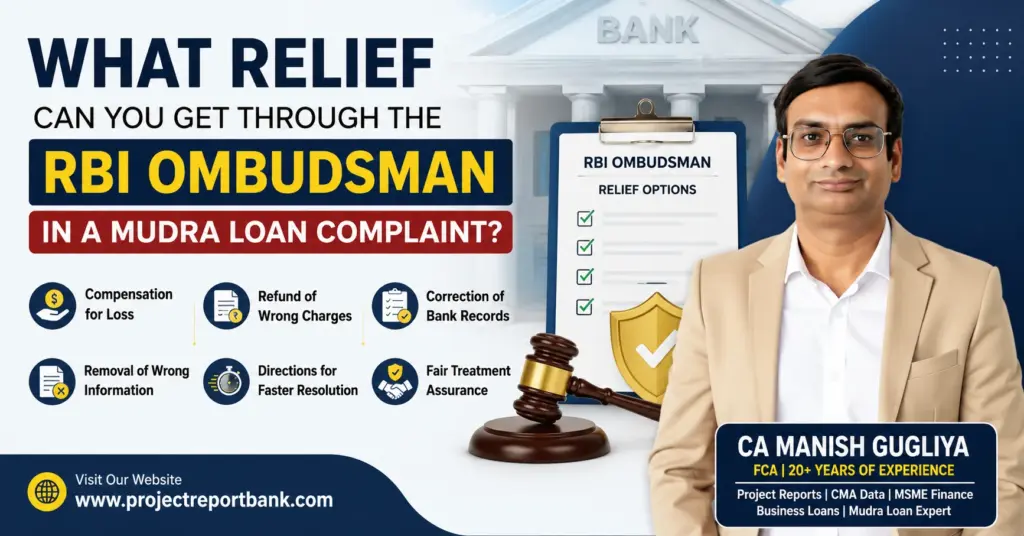
Direction to Resolve the Complaint
The most common relief is a written direction ordering the bank to look into the complaint and resolve it within a fixed period. For example, if a Kishore loan enhancement request has been pending for three months without any response, the ombudsman can direct the bank to decide and communicate reasons in writing within 15–30 days.
This does not guarantee a “yes” from the bank. It forces fair conduct, recorded reasons, and proper communication.
Correction of Bank Records
The ombudsman can direct correction of internal records – outstanding balance, interest rate, repayment schedule, or security details. Common Mudra issues include EMI posted twice on the same date, wrong overdue marking despite full payment, or a missing record of a cash deposit where the borrower has the receipt.
Proper records prevent wrongful NPA classification and protect future borrowing capacity.
Refund of Wrongly Charged Fees
If a bank charges processing fees, inspection charges, or insurance premium in violation of declared Mudra policy or RBI rules, the ombudsman can order a refund. Example: a Tarun loan borrower charged ₹5,000 processing fee when the bank’s website displayed ₹2,500. With the sanction letter and bank statement as proof, the ombudsman directed a full refund plus interest.
Compensation for Financial Loss (Where Applicable)
The ombudsman can direct compensation for actual, provable financial loss caused directly by the bank’s deficiency. Under the 2021 scheme, this is capped at ₹20 lakh; under the 2026 scheme, the limit rose to ₹30 lakh.
Example: a borrower lost a confirmed ₹50,000 business order because the bank delayed Mudra disbursement for three months after sanction. With purchase orders, emails, and bank statements showing the delay, compensation becomes realistic.
Compensation for Mental Agony and Harassment
In cases of rude, high-handed, or repeatedly negligent behaviour, the ombudsman may award a limited amount for mental agony and inconvenience – up to ₹1 lakh under the 2021 scheme and ₹3 lakh under the 2026 scheme.
Mudra examples: insulting behaviour towards women entrepreneurs, blocking an account without valid reason affecting daily business, or repeated branch visits with zero acknowledgement. This compensation is a token, not a large civil court claim, and requires some written evidence beyond emotional statements.
Removal of Wrong Information Caused by Bank Error
Banks sometimes wrongly report Mudra accounts as overdue or written-off to credit information companies like CIBIL, Experian, or Equifax. The ombudsman can direct the bank to correct or delete wrong entries when the borrower shows proof of regular payments.
The impact for a small borrower is huge – a corrected credit score reopens access to housing loans, vehicle finance, and further working capital.
Faster Resolution of Pending Banking Service Issues
Many complaints are simply about delay – no movement on a loan application, no response to a balance certificate query, or slow closure after full payment. Once a complaint is registered with the ombudsman, banks take notices seriously. Many matters get resolved during the process itself, even before a formal award. This indirect pressure often leads to quick issuance of NOC, closure letter, or pending disbursement.
What Relief Cannot Be Granted by the RBI Ombudsman?
Understanding limits is as important as knowing rights. The ombudsman usually cannot:
- Force a bank to sanction or enhance a Mudra loan if the credit decision follows policy with no service deficiency
- Change or rewrite Reserve Bank of India lending policies, interest rates, or collateral norms decided by the bank’s credit committee
- Grant unlimited or speculative compensation without clear documents
- Cancel genuine loan liabilities – principal or interest due under a valid agreement
- Decide civil disputes unrelated to banking service failure (landlord-tenant, partnership, or private fraud matters)
Commercial judgment by the bank, where no deficiency exists, falls outside the ombudsman’s jurisdiction.
Examples of Relief in Mudra Loan Complaints (With Comparison Table)
Here are real-life style examples showing how Mudra loan problems translate into specific relief through the RBI Ombudsman complaint process:
| Problem (Mudra Loan) | Possible Relief | Short Example |
|---|---|---|
| Wrong processing fee on ₹2 lakh Kishore loan | Refund of excess amount with interest | Bank charged ₹4,000 vs declared ₹2,000; refund directed |
| Delay in sanction without reason | Corrective direction to decide within fixed period | Application pending 4 months; bank ordered to respond in 15 days |
| Rude behaviour and poor service | Compensation for harassment | Woman entrepreneur faced repeated insults; ₹5,000 token awarded |
| Wrong CIBIL reporting | Correction of credit bureau record | Fully paid Tarun loan still showing overdue; bank directed to update |
| Unfair pre-closure handling | Direction to process closure and issue NOC | Bank refused NOC for 2 months after full payment; resolved in 3 weeks |

When Compensation May Be Awarded in Mudra Loan Cases
Compensation is not automatic. The ombudsman checks whether the bank broke any RBI or internal rule, whether the borrower suffered actual financial loss, whether documents support the claim, and whether the requested amount fits within scheme limits.
A borrower should never exaggerate loss. Instead, quantify it with invoices, GST returns, or simple cash book summaries. The ombudsman may also consider the bank’s attitude – whether it accepted the mistake quickly or kept denying. Compensation for mental agony is usually smaller and may be clubbed with financial loss in the final award.
How the RBI Ombudsman Decides Relief (Process Overview)
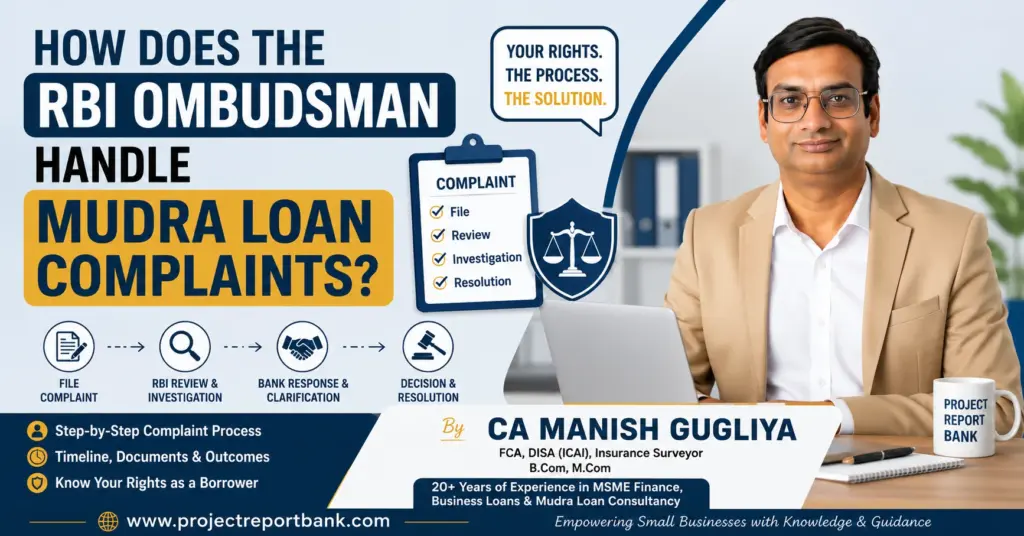
The procedure works step by step:
- Complain to the bank first – in writing to the branch, then the bank’s grievance redressal system, including the principal nodal officer or general manager level. Wait 30 days.
- File with RBI Ombudsman – complaints can be filed online on the CMS portal, by email, or in physical mode. You need your mobile number, account details, and a clear description. Complaints can also be submitted in regional languages.
- Processing – the centralised receipt and processing centre sends notice to the bank. The bank submits its reply. The complainant gets a chance to respond.
- Resolution – many cases are resolved through conciliation. If that fails, the ombudsman passes a speaking order or award. The regulated entity is generally bound to comply.
Approximate timeline: 30 days at bank + 30–60 days at ombudsman for straightforward cases. Complex matters may extend beyond this period.
Documents That Strengthen Your RBI Ombudsman Mudra Loan Claim
| Document Type | Why It Helps |
|---|---|
| Written complaint to bank (with date) | Proves you followed the procedure |
| Bank’s reply or email trail | Shows whether the bank addressed the issue |
| Mudra application form and sanction/rejection letter | Establishes the terms and bank’s commitment |
| Account statements showing disputed entries | Demonstrates the deficiency with numbers |
| Fee/charge receipts | Proves overcharging or wrong deductions |
| CIBIL/credit report snapshot | Shows wrong reporting by the bank |
| Supplier penalty invoices / purchase orders | Links financial loss to bank’s delay |
| SMS/email screenshots | Captures communication trail |
Keep a one-page timeline of events with dates – application, sanction, first complaint, follow-up, and so on. It helps the ombudsman see the full picture quickly.
Tips to Improve Your Chances of Getting Relief
- Always complain to the bank first and keep proof of every request and feedback received.
- Write a calm, factual complaint with dates and amounts – skip emotional language.
- Attach only relevant supporting documents, properly labelled (one PDF per category).
- Cite specific RBI circulars or bank policy extracts where available.
- Download the full loan account statement before and after the dispute period to show the difference clearly.
- Be truthful – disclose all facts including your own mistakes. Hiding previous defaults damages credibility.
- Check who can file an RBI Ombudsman complaint to confirm eligibility before filing.
- Use clear PDFs, not blurry photos, when uploading on the portal.
- Keep your contact details updated so the ombudsman office can reach you.
- Follow up politely if you have not received any communication within the expected period.
Expert Tip: Before filing, visit the bank’s website and screenshot their published schedule of charges. If their self-declared fee differs from what they charged you, that single screenshot can decide your case.
Common Mistakes That Reduce the Chances of Relief
Many genuine Mudra borrowers lose relief not because they are wrong, but because of avoidable mistakes.
- Filing without giving the bank 30 days to reply – complaint gets rejected as non-maintainable
- Sending only emotional narrative without a single document
- Demanding loan sanction as a “right” – this is outside the ombudsman’s sector of authority
- Hiding facts like previous defaults or bounced cheques, which the bank can easily reveal from its record
- Wrong selection of bank or regulated entity on the CMS portal, or uploading unreadable images
- Submitting after the filing window expires – under the 2026 scheme, complaints filed beyond 90 days of the bank’s last response get rejected regardless of merit
Important Note: Do not copy-paste long legal templates from the internet without understanding them. Inconsistent statements confuse the ombudsman and weaken your case. Re-check all dates, amounts, and account numbers before final submission.
Frequently Asked Questions on RBI Ombudsman Mudra Loan Relief
Can the RBI Ombudsman force my bank to approve a Mudra loan?
No. The ombudsman cannot force a bank to sanction a Mudra loan just because you want it. It can only check whether the bank followed fair practices, gave reasons for rejection, and dealt with your application as per RBI and internal policy. If no service deficiency exists, the bank’s commercial credit decision stands.
How long does it usually take to get relief from the RBI Ombudsman?
After the bank’s 30-day response period, many complaints before the ombudsman are resolved within roughly 30–60 days. Complex matters involving detailed evidence or multiple issues can take longer. In FY 2024-25, RBI received approximately 1.33 million ombudsman complaints, so volume also affects speed.
Is there any fee for filing an RBI Ombudsman complaint for a Mudra loan?
Filing is completely free. The Consumer Education and Protection Department of the reserve bank runs this scheme at no cost to the customer. You only spend on preparing documents and internet or printing.
What can I do if I am not satisfied with the RBI Ombudsman’s decision?
The scheme allows an appeal to the appellate authority within RBI, generally within 30 days from the date of the order. The authority may grant up to 30 additional days if there is sufficient cause. Independently, you can also consider approaching a consumer commission or civil court after taking professional advice.
Can I file both a consumer court case and an RBI Ombudsman complaint for the same Mudra issue?
The ombudsman generally will not proceed if the matter is already before a court or consumer forum on the same grounds. Decide your main remedy route carefully before filing.

Conclusion: Using RBI Ombudsman Wisely for Mudra Loan Problems
Meaningful RBI Ombudsman Mudra loan relief is possible when there is clear banking service deficiency supported by documents – wrong charges, unexplained delay, or incorrect credit bureau reporting by a regulated entity covered under the Reserve Bank of India ombudsman scheme.
The ombudsman is not a replacement for the bank’s credit committee. It cannot approve loans or waive genuine dues. But it is a strong remedy to enforce fairness, transparency, and correction of mistakes. If the bank has acted against its own policy or RBI guidelines, the ombudsman has the authority to direct resolution and award compensation as it may deem fit within the scheme’s limits.
Maintain proper records from day one: application copies, sanction letter, repayment track, and complaint submissions. Study related guides – how RBI Ombudsman handles Mudra loan complaints or when complaints may be rejected – so you plan your approach well and are satisfied with the process.
I am CA Manish Gugliya (FCA), with over 20 years of experience in MSME finance, project reports, CMA data, and Mudra loan consultancy across India. If you are a small entrepreneur, woman borrower, or startup facing unfair treatment from your bank, know that with calm planning, correct procedure, and honest documentation, the system can provide fair resolution. Do not hesitate to use the online portal or post your query – the process exists to protect you.
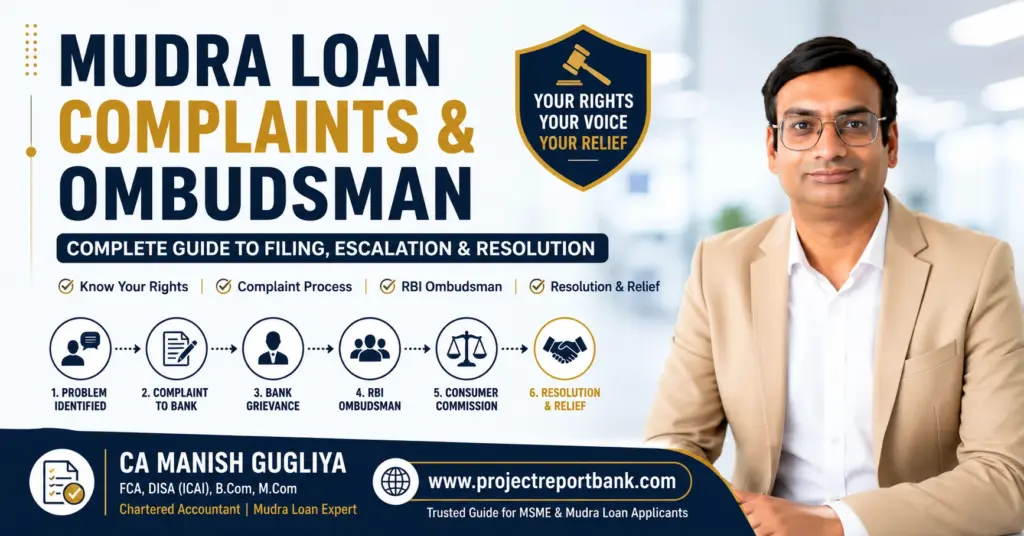
- Mudra Loan Complaints & Ombudsman: Complete Guide to Filing, Escalation & Resolution

- Can a Bank Blacklist You for Filing a Mudra Loan Complaint?
- Can a Mudra Loan Complaint Affect Future Loan Approval?
- Common Mistakes That Lead to Mudra Loan Complaint Failure
- RBI Ombudsman Mudra Loan Relief: Practical Guide for Small Borrowers
- Can the RBI Ombudsman Reject Your Mudra Loan Complaint? Reasons Explained
- Consumer Commission vs RBI Ombudsman: Which Is Better for Mudra Loan Disputes?
- Bank Grievance Redressal System for Mudra Loans: Complete Guide
- RBI Ombudsman Mudra Loan Complaint – Detailed Guide by CA Manish Gugliya