Key Takeaways
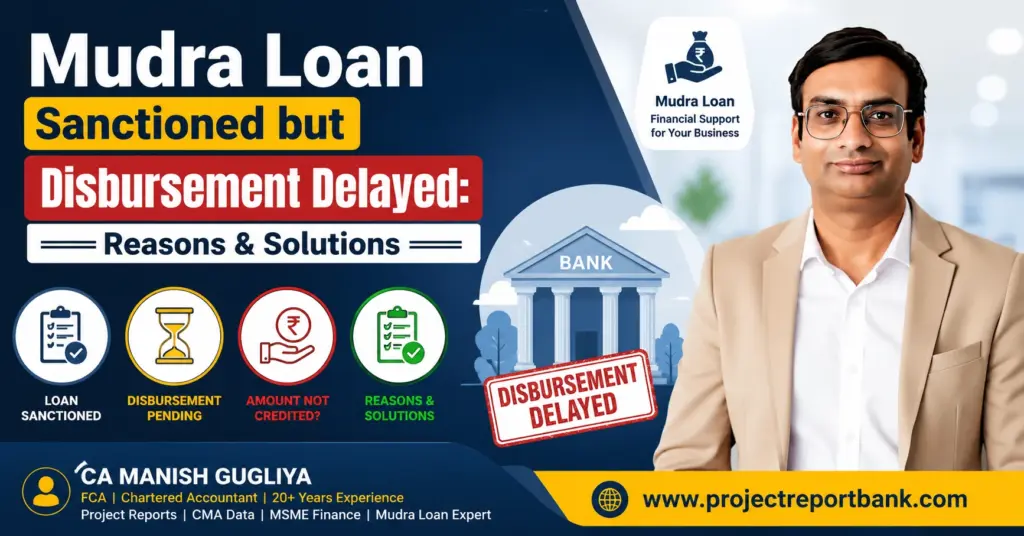
- “Mudra loan sanctioned” means the bank has approved your loan in principle, but the money will be credited only after a few more formal steps like signing agreements, ECS/NACH registration, and final verification are completed.
- In most genuine cases of Mudra loan disbursement delay, the problem is small: a missing document, an unsigned agreement, a pending ECS mandate, or an internal bank processing lag.
- A clear action plan works: talk to your branch, ask for written reasons, complete pending formalities, and escalate to Regional Office, bank grievance cell, or RBI Ombudsman if needed.
- In a clean case, disbursement usually happens within 3–10 working days after full documentation. If it drags on for months, you have rights as a borrower.
Introduction: Sanctioned but Money Not Credited – What Is Really Happening?
Imagine this: Ramesh, a shopkeeper in Jaipur, receives a Mudra loan sanction letter for ₹4,00,000 on 12 June 2026. By 25 June, the loan amount is still not credited to his account. He panics and assumes the bank has cheated him.
This situation is far more common than you think. “Loan sanctioned” in banking language means the bank has agreed to give you the Mudra loan subject to certain conditions. It is not the same as disbursement or actual payment into your account.
Many borrowers believe that the moment they receive a sanction SMS or letter, the money should arrive the same day. When it does not, worry sets in.
In this guide, written from my 20+ years of practical experience in MSME finance and Mudra loan consultancy, I will cover:
- What sanction actually means vs. disbursement
- Every step that happens after sanction
- Common reasons for Mudra loan disbursement delay
- Realistic timelines for different categories
- What to do if the bank is delaying, and when escalation is justified
One reassuring note: in most genuine Mudra loans for business, if your documents are correct and you follow the process, disbursement does happen. The key is understanding the system and following up the right way.
Table of Contents
What Does “Mudra Loan Sanctioned” Actually Mean?
Under the Pradhan Mantri Mudra Yojana (PMMY), launched in April 2015, banks give Mudra loans in three main categories: Shishu (loans upto rs 50,000), Kishore (₹50,001 to ₹5,00,000), and Tarun (₹5,00,001 to ₹10,00,000). With the addition of Tarun Plus in October 2024, Mudra loans can be up to ₹20 lakh. In all categories, “sanction” and “disbursement” are two separate stages.
The sanction letter is a written document from the bank or financial institution mentioning the sanctioned loan amount, interest rate (starting at 9.05% per annum for many banks), tenure (repayment of up to 5 years), EMI schedule, and special conditions. It also shows a validity period-often 30 to 90 days.
No collateral is required for Mudra loans, which makes them attractive for micro enterprises. The scheme covers manufacturing, trading, and services sectors, supporting income generation and employment creation across india.
But sanction is a conditional promise. You must complete documentation, sign the loan agreement, provide ECS/NACH mandate, and satisfy KYC checks before the bank will release the funds.
| Aspect | Sanction | Disbursement |
|---|---|---|
| Definition | Bank’s formal approval of your Mudra loan | Actual credit of money to your account |
| Document received | Sanction letter with terms | Disbursement advice / credit confirmation |
| Money credited? | No | Yes |
| Main checks done | Credit appraisal, eligibility criteria | Final document verification, NACH, account validation |
| Risk to borrower | Sanction can lapse if conditions unmet | Funds available; EMI obligation begins |
| What you must do | Read terms, prepare remaining documents | Start using funds for stated business purposes |
What Happens After Mudra Loan Sanction? (Step-by-Step Flow)
After your Mudra loan is sanctioned, the bank still has to complete a specific sequence before money can be disbursed. If any step gets stuck, the “Mudra loan sanctioned but disbursement delayed” situation appears.
Here is the post-sanction workflow:
- Sanction letter issued → 2. Documentation call from branch → 3. Borrower signs loan application set and loan agreement → 4. KYC and business documents re-verified → 5. Stamping and execution of agreements → 6. ECS/NACH mandate registration for EMI → 7. Bank account and PAN validation → 8. Loan account number created → 9. Final authorization by branch manager → 10. Disbursement entry → 11. Credit to your savings/current account

Some banks require you to open a current account before disbursement. If KYC for this new account is incomplete, the next phase of processing stalls. For Shishu loans, the number of forms may be fewer, but basic documentation and KYC still apply.
If you want to understand what happens before sanction, guides on topics like Mudra loan under credit appraisal and branch manager approval explain those earlier stages. Final verification by the bank may be conducted after loan sanction-this is normal, not a red flag.
Why Is My Mudra Loan Sanctioned but Still Not Disbursed?
Common patterns: you have a sanction SMS but no call for documentation. Or documents are signed but Mudra loan amount not credited. Or ECS mandate given but bank says “system issue” for days. There are many factors behind this.
Pending Documentation – Incomplete or incorrect documentation can cause delays in loan disbursement. The branch may still be waiting for your GST registration copy, Udyam registration, shop license, or KYC of a co-applicant. Sometimes the applicant forgets a simple form like a recent photograph or an updated address proof.
Loan Agreement Not Signed – If you have not visited the branch to sign the agreement and hypothecation documents, the lender cannot proceed. Delays can occur if the sanction letter conditions are not fully met.
ECS/NACH Mandate Pending – Registering your NACH mandate for EMI deduction can take 2–7 working days. A small manufacturing unit in Indore signed loan papers on 5 March 2026, but ECS mandate was sent to their bank only on 9 March and approved on 14 March-disbursement happened on 16 March, an 11-day gap.
Bank Account Issues – Providing incorrect bank details can delay the loan disbursement process. Mismatched PAN, wrong account number, or an inactive account can all stall the credit.
Internal Compliance / Regional Office Approval – Pending verification may be required for large loan transactions. Some banks send Mudra files above ₹2–5 lakh to their Regional Office for second-level approval, adding 3–7 working days. Read more about Mudra loan file sent to regional office for details.
Government Subsidy Mapping – If your Mudra loan is linked with a credit guarantee scheme (like CGTMSE), mapping and fee processing can add time.
Technical / System Error – Bank technical issues can lead to delays in loan disbursement. Software glitches, core banking reconciliation errors, or portal downtime are real problems.
Holiday or Year-End Closing – Disbursement delays can occur due to bank holidays or weekends. The last week of March is especially slow, as banks handle closing, NPA reporting, and audits. Disbursement timelines can be affected by the bank’s internal audit procedures.
In rare cases, if the bank discovers adverse information-like a defaulter tag, major cheque returns, or suspected fraud-they may put the disbursement on hold and start re-verification even after sanction.
How Long Does Mudra Loan Disbursement Usually Take?
There is no single RBI rule stating “disbursement must happen in X days” after sanction. The actual time taken depends on factors like bank type, Mudra category, quantum of the loan amount, and whether documents were completed in one visit or multiple visits.
| Situation | Expected Time After Sanction |
|---|---|
| Shishu (documents ready, digital path, existing customer) | 1–3 working days |
| Kishore (complete documents, hybrid processing) | 3–7 working days |
| Tarun (higher scrutiny, site visit, regional office) | 7–15 working days |
| Missing documents pending | Add 3–10 days |
| ECS/NACH registration in progress | 2–7 days |
| Internal compliance escalation | 1–7 additional days |
| Public holidays / year-end period | Variable, may add 3–5 days |
| Ideal clean case (all conditions met, no holidays) | 3–10 working days |
If you see “Mudra loan disbursement pending” for more than 30 days without a proper written reason, start structured follow-up. Guides on how long can a bank keep Mudra loan application pending and RBI guidelines on Mudra loan processing delay are useful as a reference point.
Documents Required Before Final Disbursement
Even though you submitted documents at application stage, many banks ask for updated copies at the disbursement stage to complete the final loan set.
| Document | Purpose | Mandatory? |
|---|---|---|
| Aadhaar Card | KYC, identity verification | Yes |
| PAN Card | Tax identification, account validation | Yes |
| Recent Photograph | Loan file record | Yes |
| Bank Statements (6–12 months) | Income and cash flow assessment | Usually yes |
| Udyam Registration | MSME identity | Yes (for most categories) |
| Shop License / GST Certificate | Business proof, eligible activity confirmation | Yes |
| Rent Agreement / Ownership Proof | Business place verification | Yes |
| Quotations / Invoices for Machinery | For term loan or purchase of assets created with loan | If applicable |
| Partnership Deed / MOA / AOA | For firm or company applicants | If applicable |
| Signed Loan Agreement | Legal contract with the lender | Yes |
| ECS/NACH Mandate Form | EMI auto-debit setup | Yes |
| Processing fee receipt | Fee payment confirmation | Yes |
For a partnership firm or small company, KYC of all partners or directors is also required. If the bank keeps asking for unnecessary documents, read about your rights in such situations.
Signs That Your Mudra Loan Will Be Disbursed Soon
Many borrowers keep guessing what is happening inside the bank. Here are clear signs that your Mudra loan disbursement is close:
- All forms and agreements have been signed and stamped
- The bank has generated a loan account number in your name
- ECS/NACH mandate status shows “registered” on your SMS or net banking
- You receive an SMS like “your loan has been approved and will be disbursed shortly”
- The branch gives you a specific date for batch processing
- You have received a printed disbursement advice or EMI schedule with dates
In many public sector banks, once the loan entry is made in the “Loans & Advances” system with a disbursement voucher prepared, the actual credit to your account often happens the same day or next working day.
What Should You Do If Mudra Loan Disbursement Is Delayed?
A calm, step-by-step approach works better than shouting at branch staff. The goal is to remove the practical reason for delay and create a written record.
Step 1 – Visit or call the branch and ask specifically: “What is pending for my disbursement?”
Step 2 – Request a written note or email stating the reason for delay and the expected date.
Step 3 – Immediately provide any pending document or signature. Take a receipt.
Step 4 – Send a polite follow-up email summarising your visit and the bank’s commitment.
Step 5 – If no progress in 7–10 working days, meet the Branch Manager with all papers.
Step 6 – If still no clarity, start formal escalation (next section).
Quick checklist: Keep copies of all documents submitted. Note dates of visits and names of officials. Save every SMS and email from the bank. Never pay cash to anyone claiming to speed up disbursement.
Example: A tailoring unit owner in Surat sent an email summary on 10 August 2026 to the branch. She approached the Branch Manager on 17 August when there was no update. Disbursement happened on 19 August after the ECS mandate was finally processed. Related guides like when to follow up on your Mudra loan application provide more detail.
When and How to Escalate Mudra Loan Disbursement Delay
Escalation is for situations where the bank is not giving a clear reason, is sitting on the file for weeks, or is ignoring government guidelines-not for a routine 1–2 day delay.
The escalation ladder:
- Branch Staff → 2. Branch Manager → 3. Regional / Zonal Office → 4. Bank’s Nodal Officer / Grievance Cell → 5. RBI Integrated Ombudsman
Before approaching the RBI Ombudsman, you must have first complained to the bank and waited usually 30 days (or received an unsatisfactory reply). Guides on how to complain about Mudra loan delay and escalating processing delays walk you through each stage.

Real example: A trader in Lucknow had his Mudra loan sanctioned but disbursement delayed for over 45 days. The branch had simply not processed the disbursement voucher. After he escalated to the Regional Office with a written complaint, the matter was resolved within one week.
Can the Bank Cancel the Mudra Loan Sanction After Approval?
Sanction does not create an absolute right to disbursement. The bank can cancel if serious problems surface, though this should not happen casually.
Legitimate reasons for cancellation:
- Detected fraud or fake documents
- Major difference between declared and actual business plan or revenue
- Negative CIBIL report discovered after sanction
- Material change in the borrower’s financial position
- Borrower not completing documentation within validity period
- Sanction validity expired (e.g., sanction dated 1 April 2026, valid for 60 days, but documentation not completed by 30 May 2026)
Common myth: Banks cannot cancel a sanction just because you politely asked questions or wanted to understand the terms. If you feel such pressure, document everything and consider a complaint under RBI/PMMY guidelines.
If sanction is cancelled, always ask for the reason in writing.
Common Mistakes Borrowers Make After Mudra Loan Sanction
These avoidable errors directly lead to “Mudra loan payment not received” situations:
- Delaying your visit to the branch after sanction
- Not reading the sanction letter carefully, including its terms and validity
- Forgetting required KYC and business documents on the day of signing
- Giving incomplete or mismatched signatures
- Ignoring SMS or emails from the bank asking for clarification
- Changing the loan purpose mid-way (e.g., from machinery purchase to personal use)
- Not disclosing existing loans, cash credit facilities, or EMIs honestly
- Assuming the branch will “manage everything” without your involvement
- Making big investment commitments (paying full advance for equipment) before funds are actually credited
Do’s after sanction: Keep your phone reachable. Check SMS daily. Maintain a polite relationship with branch staff. Keep all documents in one file for quick availability.
Expert Tips from CA Manish Gugliya to Avoid and Handle Disbursement Delays
From 20+ years of working with MSME funding, business loan applications, and Mudra loans, here are actionable tips:
- Always ask for a copy of the sanction letter and read the validity period carefully.
- Submit all remaining documents within 2–3 days of sanction-do not wait.
- Keep a written list of pending points as told by the bank at each stage.
- Ask clearly for the expected disbursement date and get it in writing.
- Open and complete KYC of the required current account early to avoid delays.
- Never change the loan purpose mid-way; it can lead to cancellation.
- Be transparent about existing EMIs, whether from a term loan, cash credit, or any other availed credit facility.
- Never agree to pay unofficial “speed money” to any person-it is illegal and not a requirement.
- Use written communication: send follow-up emails instead of relying only on phone calls.
- Keep scanned copies of every signed document for your own security.
- For Kishore/Tarun loans, a professionally prepared project report and CMA data (through ProjectReportBank, for example) reduces back-and-forth and speeds up both sanction and disbursement.
- Do not plan your shop opening or big purchase exactly on the assumed disbursement date-keep buffer days for practical banking processing.
- Remember that Mudra loans support income generating activities across sectors including manufacturing, services, trading, agriculture, transport vehicles, and shopkeepers-make sure your business plan matches the eligible purposes under the scheme.
- If you are availing extended credit under Tarun Plus, expect additional verification since the demand for documentation at higher amounts is naturally greater.
Frequently Asked Questions on Mudra Loan Sanction vs Disbursement
These FAQs cover the most common doubts from first-time borrowers and small business owners, including traders, micro units, and enterprises across social and economic categories.
My Mudra loan is sanctioned but money is not credited – what should I do first?
Visit or call your branch immediately and ask what specific document, signature, or formality is still pending. Get the answer in writing. In most cases, a small requirement is holding up the process.
Does sanction always guarantee disbursement?
No. Sanction is a conditional approval. If you do not meet the conditions, provide wrong information, or if the bank finds you are a defaulter on other loans, disbursement may not happen. However, genuine applicants with correct documents almost always receive their funds.
Can I apply at another bank while this sanctioned Mudra loan is not disbursed?
Technically you can, but it is not advisable. Multiple parallel applications show on your CIBIL record and may raise red flags. It is better to resolve the issue at your current bank first.
What if the bank keeps delaying even after I completed all formalities?
If more than 30 days have passed and you have no written reason for the delay, escalate to the Branch Manager, then Regional Office, and if needed, file a complaint with the RBI Integrated Ombudsman. You have the right to demand a clear answer. Guides on Mudra loan delayed for months and your rights provide a useful reference point in hindi and English.
Can the sanction letter expire?
Yes. Most sanction letters have a validity of 30–90 days. If you do not complete formalities within this period, the bank may treat the sanction as lapsed. You would then need to request revalidation or go through fresh processing, which is an avoidable delay.
Conclusion and Call to Action
“Mudra loan sanctioned but disbursement delayed” is usually a process or communication gap-not a rejection. By understanding the post-sanction steps, keeping documents ready, and following up with written communication, most borrowers get their Mudra loan disbursed within a reasonable time.
Remember: sanction is not money in hand. Documentation and ECS/NACH are critical. Written records protect your rights. And escalation options exist if the bank is not responding fairly. Mudra loans support income generation for millions of micro enterprises in India-do not let a short delay discourage you from building your business on better terms.
If you want professionally prepared project reports, CMA data, or expert Mudra loan guidance to make your business loan application strong, explore the resources at ProjectReportBank.com.
About the Author
CA Manish Gugliya (FCA) is a Chartered Accountant with over 20 years of hands-on experience in project reports, CMA data, MSME finance, business loans, and Mudra loan consulting across banks and financial institutions. Through ProjectReportBank.com, he has helped thousands of micro and small entrepreneurs across India prepare strong loan documentation and understand practical banking procedures. His mission is to explain complicated RBI and PMMY rules in simple language so that even first-generation entrepreneurs from small towns can confidently deal with any bank or financial institution. Explore more detailed guides on Mudra loan appraisal, branch manager approval, regional office processing, and handling long delays at ProjectReportBank.
- Mudra Loan Delay in Processing: Complete Guide to Every Stage, Reason & Solution

- Mudra Loan Processing Time: Stage-Wise Timeline from Application to Disbursement


- Can Festivals, Holidays or Financial Year-End Delay Mudra Loan Processing?

- Mudra Loan Pending Due to Internal Bank Approval: What Should You Do?
- Mudra Loan Sanctioned but Disbursement Delayed: Reasons & Solutions (By CA Manish Gugliya)
- Why Is My Mudra Loan Still Under Credit Appraisal?

- Mudra Loan Pending After Site Inspection: What It Really Means (From a Banker’s Desk)

- Mudra Loan File Sent to Regional Office: What Happens Next?

- Why Is My Mudra Loan Stuck at Branch Manager Approval?