Key Takeaways
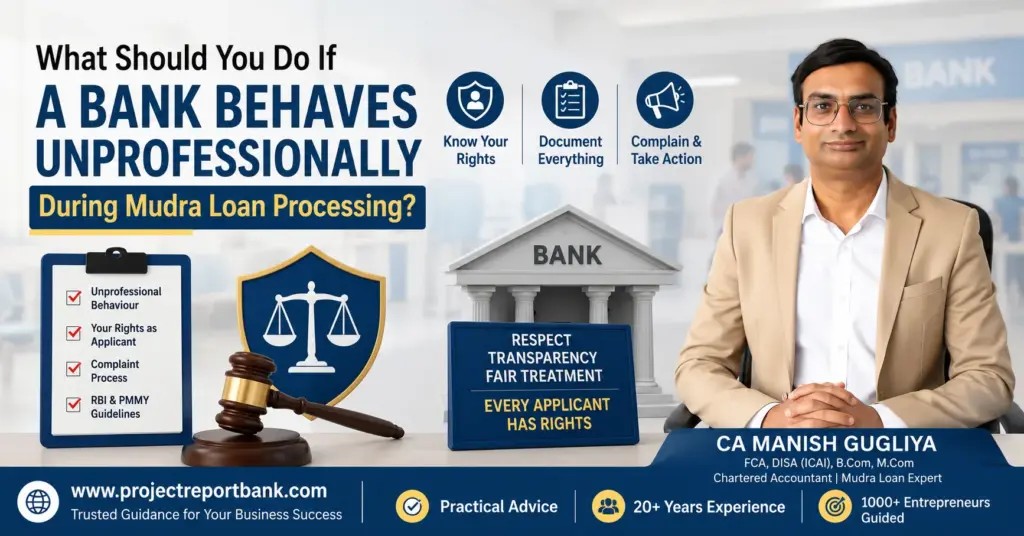
- Mudra loan bank misconduct includes rude language, false statements like “the scheme is closed,” forced insurance purchases, and deliberate delay in processing mudra loan applications.
- As an applicant, you have rights under RBI and PMMY guidelines: respectful treatment, written acknowledgement of your mudra loan application, and a reasoned written reply if your application is refused.
- The correct escalation path is: Branch Manager → Regional Office → Nodal Officer / Head Office Grievance Cell → RBI Integrated Ombudsman.
- In my practical experience as CA Manish Gugliya, solid documentation (project report, CMA data, e mail trail) and calm written complaints work far better than arguments at the branch.
- Avoid common mistakes like signing blank forms, paying unofficial cash charges, or waiting months without a single written follow-up.
Introduction: Mudra Loan Bank Misconduct and Why It Matters
Mudra loan bank misconduct is something a growing number of small business owners, micro entrepreneurs, shopkeepers, and startups face every year across India. It can range from a bank manager refusing to accept your application without reason, to staff humiliating you publicly, to being forced to buy insurance before your loan file moves forward.
However, not every rejection or delay is misconduct. Banks have a legitimate duty to verify eligibility, check your credit history, and evaluate repayment capacity. The problem starts when staff cross the line – violating RBI customer service norms, PMMY guidelines, or basic dignity.
I am CA Manish Gugliya (FCA), and with over 20 years of hands-on experience in MSME finance, project reports, CMA data, and Mudra loan consultancy, I have seen both sides. This article gives you step-by-step, practical guidance on what counts as misconduct, what your rights are, how to lodge complaint properly, and when to approach the banking ombudsman – without emotional advice or guesswork.

Table of Contents
What Counts as Unprofessional Behaviour by a Bank in Mudra Loan Processing?
Unprofessional behaviour in Mudra loans means conduct that breaks RBI customer service norms, PMMY guidelines, or basic dignity – even if no money is stolen. Misconduct related to Mudra loans includes fraudulent practices by both borrowers and bank officials, but lighter forms of misbehaviour are far more common.
Here are concrete examples based on real scenarios from 2018–2026:
- A bank manager shouting at an applicant or humiliating them in front of other customers.
- Staff refusing to accept a properly filled mudra application form without giving any written reason.
- Telling the applicant “Mudra loan scheme is closed” or “we don’t provide direct loans under Mudra in this branch” while still offering other MSME products.
- Bank staff conditioning mudra loan approval on the purchase of unrelated financial products like expensive insurance, credit cards, or demat accounts.
- Asking the applicant to visit 5–6 times for signatures or “clarifications” without actually moving the file.
- Comments based on caste, religion, or gender, or refusing to speak with women entrepreneurs unless a male relative is present – this is discriminatory and serious misconduct.
Consider this: a Kirana shop owner in Jaipur walks into a bank branch with a complete set of documents for a Kishore loan. The officer glances at his clothes, does not open the file, and verbally says “your business is too small.” No written rejection. No document check. The applicant walks away believing the scheme is not for him.
This is exactly the kind of behaviour that violates RBI and PMMY norms on fair treatment. Written proof is crucial for any further complaint. Some individuals even act as facilitators for Mudra loans despite clear instructions against middleman involvement, adding another layer of risk for many applicants.
Professional vs Unprofessional: Comparison Table for Mudra Loan Behaviour
Many applicants feel harassed but are unsure whether it is genuine bank process or actual misconduct. This table should help you tell the difference.
| Professional Behaviour | Unprofessional Behaviour |
|---|---|
| Gives written acknowledgement of mudra loan application on the same day with date and seal | Refuses to give any receipt; keeps the form on the table for weeks |
| Asks for missing documents with a clear printed checklist | Verbally tells you to “bring more papers” without specifying what is needed |
| Explains rejection reasons in writing within 15–30 days | Gives only a verbal rejection without checking CIBIL or reviewing documents |
| Guides applicant to open a current account only when genuinely required (Kishore/Tarun) | Demands you open a demat account and buy insurance before even looking at your mudra loan application |
| Processes application within the bank’s stated timeline | Deliberately keeps file “under process” for months with no update and no written communication |
| Treats all applicants equally regardless of background | Makes remarks about caste, gender, or profession; ignores applicants from small villages |
Some institutions may levy undisclosed additional charges for documentation or processing on Mudra loans. Documentation requirements for Shishu loans are sometimes made excessively high despite the simple form requirements under the government backed scheme. If you notice any of these, it is a red flag.
Your Rights as a Mudra Loan Applicant Under RBI and PMMY Guidelines
PMMY (Pradhan Mantri Mudra Yojana) is a government backed scheme launched in 2015. Banks, regional rural banks, NBFCs, and MFIs are intermediaries – they do not own the scheme. You, as an applicant, have certain minimum rights.
- Right to apply: You can submit a mudra loan application at any eligible bank branch, including the branch where your current account or savings account is maintained. Mudra loans can be applied for up to ₹20 lakh and are categorized into three types: Shishu (up to ₹50,000), Kishore (₹50,001 to ₹5 lakh), and Tarun (up to ₹10 lakh). A current account is required for Kishore and Tarun loans.
- Right to respect: Polite, fair treatment irrespective of caste, religion, gender, language, or profession.
- Right to acknowledgement: Written acknowledgement with date and a complaint reference number for your application. This receipt helps later if you need to lodge a complaint or prove submission.
- Right to clarity: Banks must tell you exactly which documents are needed and check them in a single sitting where possible. Documentation must include a business plan for Tarun loans.
- Right to timely decision: Mudra loan disbursement should occur within 7–10 working days. Banks must provide written reasons for any rejection.
- Right to freedom from pressure: You cannot be forced to buy insurance or other products as a condition for processing.
Only one active Mudra loan is allowed per PAN number. These rights flow from the PMMY operational guidelines and the RBI’s Charter of Customer Rights.

Immediate Steps to Take When You Face Bank Misconduct
If misconduct happens, act the same day or within the same week. Stay calm and follow these steps:
- Stay calm. Do not argue or raise your voice. Note the exact words used by the bank officer or branch manager.
- Record details. Write down the date, time, branch name, and the full name and designation of the staff involved.
- Preserve proofs. Save all SMS alerts, WhatsApp messages, e mail replies, and the stamped copy of your mudra loan application.
- Send a polite e mail. Mail the branch’s official ID summarising what happened and asking for clarification or the status of your mudra loan.
- Follow up in 3–5 working days. If no proper reply comes, request a meeting with the Branch Manager in writing.
- Ask for written reasons. If they say “scheme is closed” or “we are not accepting mudra applications,” ask them to confirm in writing. Make it clear you are ready with all documents.
- Note witnesses. If behaviour was rude or discriminatory, note the presence of any witnesses – other customers or staff – who saw the incident.
- Never sign blank forms or pay cash. Avoid signing any blank form or paying any unofficial “charges” without a printed receipt mentioning Mudra loan / PMMY. Get a stamped acknowledgment receipt after submitting your application.
These steps build a strong base for future escalation to the bank’s grievance cell or the banking ombudsman if needed.
Gathering Evidence Before You Lodge a Complaint
In my practical experience, many genuine mudra loan grievances fail because applicants have no proof beyond “he said, she said.” Evidence wins cases. Emotions do not.
Here is what helps:
| Type of Evidence | How It Helps in Complaint / Ombudsman Case |
|---|---|
| Copy or photo of filled mudra loan application form | Proves you applied with complete details |
| Acknowledgement slip with branch seal and date | Establishes timeline; forces bank to respond |
| E mail trail to branch, regional office, nodal officer | Shows you followed up in writing |
| SMS or WhatsApp messages from bank staff | Digital proof of communication or promises |
| Call records (date, time, duration) | Supports your version; recorded calls help where legally allowed |
| Diary with visit dates, officer names, and what was said | Creates a consistent factual story |
| Receipts of forced insurance or add-on products | Proves forced bundling linked to the mudra loan |
About CCTV: You usually cannot access branch CCTV yourself, but mention the exact date and time in your complaint so higher authorities can pull the footage if needed.
Do not fabricate or exaggerate. Inconsistent stories weaken genuine mudra loan grievances. Many applicants are unaware of the proper application process, making them vulnerable to fraud. Loan applicants may even create non-existent business entities to secure funds – banks watch for this, and false claims from your side will destroy credibility.
How and When to Escalate: From Branch Manager to RBI Integrated Ombudsman
Every bank has a fixed escalation ladder. Jumping directly to the RBI Ombudsman without first complaining to the bank usually causes delays and rejection of your complaint.
Level 1 – Branch: Meet the branch manager with your written application and evidence. Ask for a written reply within 7–10 working days. Many issues resolve here if you are calm and documented.
Level 2 – Regional / Zonal Office: Use the bank website or the printed display inside the branch to find contact details of the Regional Manager or General Manager at zonal offices. Send a detailed e mail or letter attaching copies of your mudra loan application and complaint.
Level 3 – Bank Nodal Officer / Head Office Grievance Cell: Public Sector Banks have designated Mudra Nodal Officers for handling scheme-related issues. The nodal officer’s address and contact are usually displayed in the branch or on the bank’s website. Customers receive a complaint acknowledgment within three days, and a unique Grievance ID is generated for tracking.
Level 4 – Bank’s Internal Ombudsman: Some complaints are internally reviewed before you can approach the Reserve Bank. Most banks with 10+ branches are required to have one.
Level 5 – RBI Integrated Ombudsman Scheme: You can approach the RBI Integrated Ombudsman only after 30 days from your first written complaint, or if the bank gives an unsatisfactory final reply. Complaints should be resolved within 30 days of receipt. Customers can escalate unresolved complaints to the RBI Ombudsman. The rbi ombudsman scheme is free of cost.
Every escalation letter should include: dates, branch name, people met, brief facts, evidence list, and a clear request – for example, “process my mudra loan application as per PMMY guidelines” or “give written reasons for rejection.”
Filing a Formal Mudra Loan Bank Complaint (Online and Offline)
A formal complaint means a written or online grievance with a unique reference number – not just verbal arguments at the counter.
Key channels:
- Branch complaint: Write and submit at the branch. Insist on stamped acknowledgement and a complaint number.
- Online portal: Most banks have a grievance portal linked from their website. Choose category “Mudra / PMMY Loan” or “Retail MSME.” Complaints can be lodged via bank websites or in person.
- E mail to nodal officer: Send a clear mail describing the misconduct, attaching evidence. Keep the language respectful and factual.
- Speed post to head office: Physical letter to regional office or head office via speed post with tracking. This creates a paper trail banks cannot deny.
Borrowers facing misconduct can file complaints through the lender’s internal system. Borrowers can also register complaints with a bank’s Regional Manager or the RBI Ombudsman if a loan is unreasonably rejected. Not every disagreement qualifies as misconduct. Fair rejection due to poor CIBIL, weak business plan, or missing documents is not automatically illegal. Banks should not be able to ignore RBI PMMY guidelines, but they retain the right to evaluate credit risk.
Banks usually acknowledge complaints in 3 days and aim to resolve within 30 days. Track your mudra loan status on the UdyamiMitra portal using your application reference number. Status updates may lag by 3–5 business days. Call the bank branch if status shows “under process” for 10 days.
Common Mistakes Applicants Make While Dealing with Bank Misconduct
From my experience, many mudra loan applicants unintentionally weaken their own case through avoidable mistakes.
- Losing temper in the branch and using harsh language, which the bank later highlights in their defence.
- Not taking any written acknowledgement of the mudra loan application or complaint.
- Relying on verbal promises from bank staff about “sure mudra loan approved” without any e mail or sanction letter.
- Submitting incomplete or incorrect documentation, which leads to immediate rejection – then blaming the bank for delay.
- Paying money to unofficial “agents” or even to staff members for faster processing without asking for official receipts. Some institutions may levy unauthorized fees on Mudra loans.
- Waiting silently for several months without a single written follow-up, then complaining that “bank is not responding.”
- Signing blank forms or blank cheques at the request of staff.
- Applying for Mudra loans from multiple banks simultaneously – borrowers may do this to misrepresent their liabilities, leading to CIBIL issues and rejection everywhere.
- Borrowers sometimes divert Mudra loan funds for personal consumption rather than intended income-generating activities – this creates repayment problems and future loan denials.
| Wrong Action | Better Alternative |
|---|---|
| Arguing emotionally at the counter | Write a calm factual e mail the same day |
| No acknowledgement taken | Insist on stamped receipt before leaving |
| Paying cash “processing fee” | Ask for printed official receipt or refuse |
| Waiting months without follow-up | Send written follow-up every 7–10 days |
Avoiding these mistakes often resolves 50–60% of mudra loan issues before any formal complaint is needed.
Situations That Are NOT Mudra Loan Bank Misconduct
Misunderstanding genuine lending norms as “harassment” is common. This section helps you avoid unnecessary fights with banks.
The bank is usually right when:
- Refusing a mudra loan because your CIBIL score is below 650 with multiple recent defaults. Low CIBIL scores below 650 can result in rejection.
- Asking for proper business proof like GST registration, Udyam certificate, rent agreement, or current account statements before sanction. Applying without business registration increases rejection chances.
- Taking 2–3 extra days for additional verification if address, PAN, or KYC details appear suspicious.
- Reducing the requested loan amount after checking actual business turnover and repayment capacity.
- Rejecting an application when the proposed business clearly lacks viability on paper – for example, unrealistic sales projections without a market study. Lack of a clear business plan can lead to loan denial.
Not every delay or rejection signals misconduct; banks must verify eligibility and evaluate repayment capacity before approving loans. Non-Performing Assets (NPAs) can increase due to bank staff failing to verify applicants’ business existence, so lenders are naturally cautious.
“Strict but professional” means: the officer asks for additional documents politely and explains why. “Rude or discriminatory” means: the officer refuses to look at your file and says your business type doesn’t deserve a loan. Focus complaints on behaviour and procedural violations – not on the bank’s right to do credit appraisal. You can read more about whether a bank must explain Mudra loan rejection.
Expert Advice by CA Manish Gugliya: 10 Practical Tips to Protect Yourself
In my practical experience as a Chartered Accountant helping hundreds of entrepreneurs with Mudra loans, I have found that preparation prevents most problems. Here are 10 tips aimed at small business owners and women entrepreneurs:
- Prepare a simple but solid project report and basic CMA data. A strong file reduces both rejections and poor treatment at the branch.
- Always communicate key points in writing – especially application submission and follow-up. Use e mail or registered post.
- Never sign blank forms or give blank cheques. Insist that every column related to your mudra loan is filled before you sign.
- Do not pay any “service charge” or “file opening fee” in cash. Mudra loans under PMMY have no unofficial charges. Deal only with authorised bank staff.
- Maintain a neat physical and digital folder with all documents, bank statements, and correspondence.
- Use your existing current account or savings account branch first. A good banking track record there often helps with quick mudra loan approval and satisfaction from both sides.
- If one bank behaves unprofessionally, explore other eligible lenders – other banks, NBFCs, or regional rural banks – instead of wasting 6–8 months fighting at one place. Mudra loans are available through banks, NBFCs, and MFIs.
- Escalate only with sufficient evidence and a clear factual story. Avoid long emotional narratives.
- Take professional guidance for documentation, but never believe any guarantee of loan approval from agents or consultants. Borrowers often face rejection or harassment by bank officials despite government directives to lend – but guarantees from middlemen are always false.
- If you plan to approach the banking ombudsman scheme, first ensure you have completed the full internal escalation ladder correctly. The Reserve Bank of India enforces expectations around fair recovery practices and grievance handling.

Action Checklist: What To Do If You Face Mudra Loan Bank Misconduct
This is your print-and-use checklist. Especially useful for first-time mudra loan applicants who feel nervous dealing with branch managers.
Before Applying:
- Prepare project report, CMA data, and business plan
- Collect KYC, Udyam registration, and business proofs
- Open or regularise your current account
- Keep scanned copies of every document
At the Branch:
- Ask for the mudra loan form and fill it completely
- Demand written acknowledgement with date and seal
- Note the officer’s name and designation
- Verify the scheme category – Shishu, Kishore, or Tarun
If Misconduct Happens:
- Stay calm and do not argue
- Record date, time, branch, officer name, and exact words
- Preserve SMS, WhatsApp, and e mail evidence
- Send a polite written summary within 24 hours
For Complaints:
- File written complaint at the branch with stamped receipt
- Escalate to regional office, then to nodal officer or head office
- Contact the bank’s customer day desk if available
- Approach RBI Integrated Ombudsman if unresolved after 30 days
- Register your feedback and track status using the Grievance ID
Conclusion: Handle Mudra Loan Bank Misconduct Calmly and Systematically
Professional behaviour is expected from both sides – the bank and the applicant. But banks carry higher responsibility under the mandatory RBI and PMMY guidelines because they are the service providers in a government backed scheme serving small businesses and entrepreneurs looking for business growth.
Genuine mudra loan bank misconduct relates to behaviour: rudeness, discrimination, forced products, refusal to accept applications, verbal lies about scheme closure, or deliberate delay. It does not cover every negative credit decision by a lender doing its job.
Documentation, written communication, and proper use of grievance mechanisms – from the branch to the banking ombudsman – give far better results than confrontation. If you are satisfied with a bank’s response, move forward. If not, escalate with evidence and patience.
Explore related guides on Mudra loan processing charges, whether banks can delay processing legally, and extra documents banks may ask for on this website to strengthen your position further.
FAQs on Mudra Loan Bank Misconduct and Complaints
These FAQs cover practical questions not fully addressed in the main sections above, written in simple language.
Can a bank officer shout at a Mudra loan applicant or ask them to leave the branch?
No. Under RBI’s Charter of Customer Rights, every customer has the right to respectful treatment. Shouting, humiliating, or asking you to leave without reason violates these norms. If this happens, note the officer’s name, date, and time, and write a complaint to the branch manager immediately.
Can I secretly record conversations with the bank manager if I expect misconduct?
The legality of recording conversations varies by state in India. In most cases, recording a conversation you are part of is not illegal, but using it as formal evidence may face challenges. It is safer to rely on written communication – e mail, letters, and SMS – as your primary proof.
Will filing a Mudra loan bank complaint reduce my chances of getting a loan later from the same or other banks?
A genuine, respectful complaint through proper channels should not affect future loan applications. Banks evaluate loans based on credit history, business viability, and documents – not on whether you filed a legitimate grievance. If you believe retaliation occurred, escalate to the RBI Integrated Ombudsman under the banking ombudsman scheme.
What can I do if the branch keeps saying “come next week” and never gives a written reply on my Mudra loan?
Send a written e mail to the branch and copy the bank’s nodal officer or regional office. Mention the dates of every visit and request a written status update. If there is no reply within 30 days, you have grounds to approach the RBI Ombudsman with your documented trail.
How do I mention discrimination (caste, religion, gender) properly in a formal complaint without getting into a personal fight?
State facts without emotional language. For example: “On [date], at [branch], officer [name] refused to process my application and said [exact words]. I believe this was discriminatory because [reason].” Attach any witness details. The consumer protection act and RBI guidelines protect you against discrimination. Keep the complaint factual and let the authorities investigate.
- Mudra Loan Illegal Bank Practices: Complete Guide to Identify, Prevent & Report Unfair Banking Practices


- Can Banks Change Mudra Loan Terms Without Informing the Applicant?
- Red Flags That Indicate Unfair Bank Practices in Mudra Loans: Warning Signs Every Applicant Should Know

- What Evidence Should You Collect If a Bank Violates Mudra Loan Rules?
- How to Report Illegal Bank Practices in Mudra Loans
- How to Protect Yourself from Illegal Bank Practices in Mudra Loans
- Mudra Loan Bank Misconduct: What To Do When a Bank Behaves Unprofessionally

- How to Identify Illegal Bank Practices During the Mudra Loan Process
- Is It Legal for Banks to Delay Mudra Loan Processing Without Reason?