
Meeting the basic Mudra Loan eligibility criteria is one of the most important factors in securing loan approval under the Pradhan Mantri Mudra Yojana (PMMY). While many applicants focus on maintaining a good CIBIL Score and submitting complete documents, banks evaluate much more before approving a Mudra Loan. They carefully assess whether the applicant, the business, and the proposed activity satisfy the eligibility requirements laid down under the scheme as well as the bank’s internal lending policies. Even a genuine business can face rejection if these eligibility conditions are not properly met.
One of the biggest misconceptions among applicants is that a strong credit history and complete documentation automatically guarantee loan approval. In reality, many Mudra Loan applications are rejected despite having a good CIBIL Score because of issues such as recent business ownership changes, expired business licences, non-eligible applicants, unclear ownership structures, shared business premises, changes in business activity, or other eligibility-related concerns. These issues often arise during the bank’s verification process and can significantly affect the approval decision.
It is also important to understand the difference between Eligibility Issues, Documentation Issues, and Financial Issues. Eligibility Issues determine whether the applicant and business qualify to apply for a Mudra Loan. Documentation Issues relate to missing, incorrect, or inconsistent records submitted with the application. Financial Issues involve factors such as repayment capacity, business cash flow, income stability, and overall financial viability. Since each category affects loan approval differently, identifying the real cause of rejection is essential before taking corrective action.
This page serves as the central knowledge hub for all Mudra Loan Eligibility Issues covered on Project Report Bank. Here, you will find detailed guides explaining the most common eligibility-related problems, how banks verify them, why they lead to rejection, and the practical steps you can take to resolve them before submitting your application. Whether you are a new entrepreneur, an existing business owner, or planning to reapply after rejection, this cluster will help you understand every important eligibility requirement and improve your chances of Mudra Loan approval.
Mudra Loan Eligibility Roadmap (Infographic)
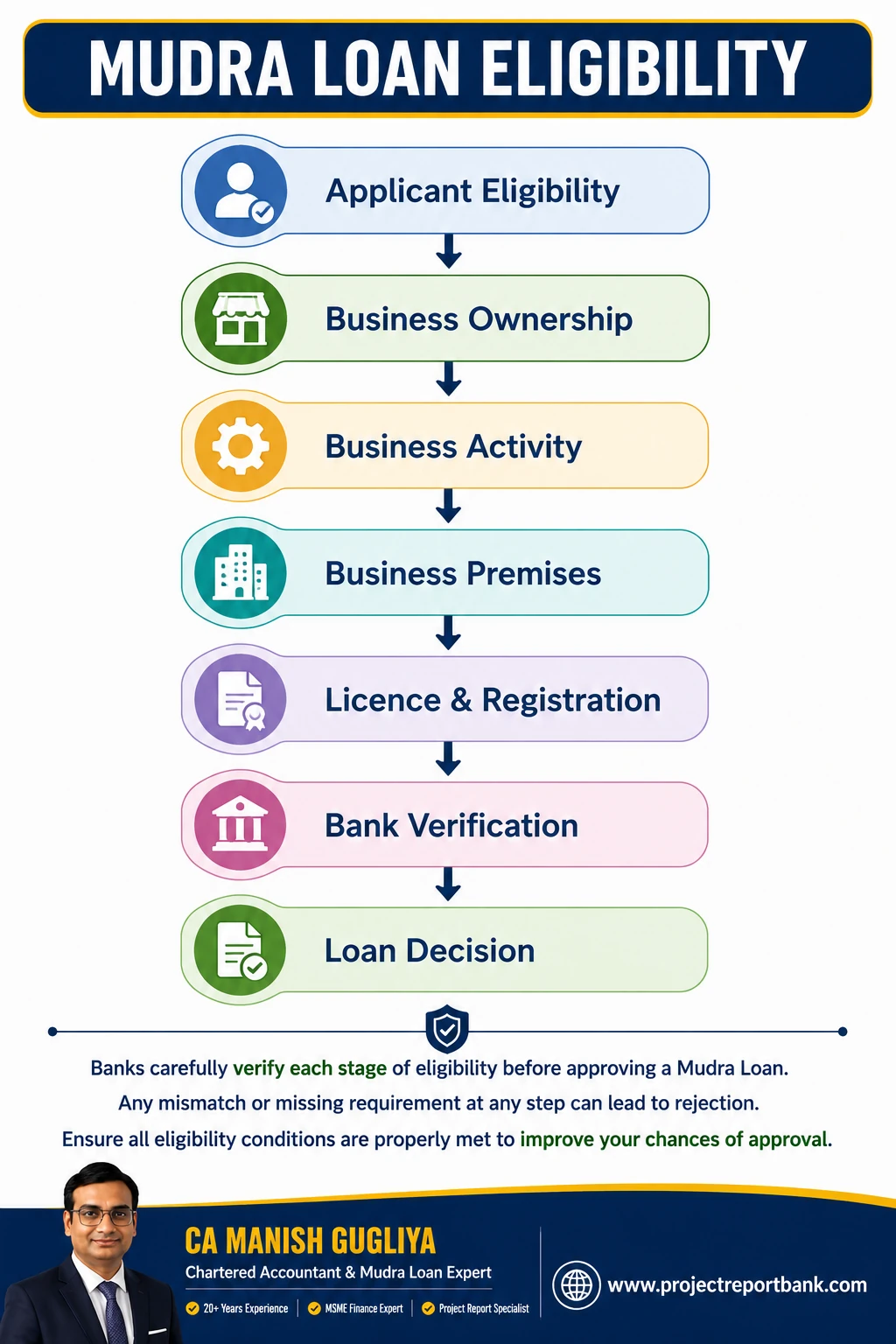
Banks verify every stage of a Mudra Loan application before making the final approval decision. From applicant eligibility and business ownership to business activity, premises, licences, and field verification, each step helps the bank assess whether the business qualifies under PMMY guidelines. Identifying and resolving eligibility issues in advance can significantly improve your chances of faster approval and reduce the risk of rejection.
Quick Navigation to All Eligibility Guides
Recent Business Ownership Change
Learn how recent ownership transfer can affect Mudra Loan eligibility and what documents banks verify before approval.
Read Guide →Purchased an Existing Business
Understand the eligibility rules and verification process after purchasing an existing business.
Read Guide →Business Licence Renewal
Know whether an expired or pending licence can delay or affect Mudra Loan approval.
Read Guide →Industrial Shed & Commercial Complex
Find out whether businesses operating from industrial sheds or commercial complexes qualify.
Read Guide →Shared Business Premises
Discover how banks assess businesses operating from shared offices or common premises.
Read Guide →Changed Business Activity
Understand how changing your business activity may influence Mudra Loan eligibility.
Read Guide →Seasonal Business Eligibility
Learn whether seasonal businesses are eligible and how banks evaluate their operations.
Read Guide →Ownership Structure Issues
Explore how business ownership structure can become a reason for Mudra Loan rejection.
Read Guide →Multiple Business Owners
Know the eligibility rules when a business has multiple owners or partners.
Read Guide →Non-Eligible Applicant
Understand why banks reject applications from non-eligible applicants and how to avoid this issue.
Read Guide →Understanding Mudra Loan Eligibility
Understanding Mudra Loan eligibility is essential before submitting an application under the Pradhan Mantri Mudra Yojana (PMMY). Many applicants believe that a good CIBIL Score and complete documentation are enough to secure loan approval. In reality, banks evaluate several eligibility factors to determine whether the applicant and the business qualify under the scheme. These checks help banks assess the authenticity, legality, and viability of the business before sanctioning a loan.
Below are the key eligibility areas that every applicant should understand before applying.
Applicant Eligibility
The first step in the approval process is verifying whether the applicant is eligible to apply for a Mudra Loan. Banks confirm the applicant’s identity, legal status, age, and connection with the business. If the application is submitted by a person who is not legally eligible or does not have the authority to represent the business, the loan may be rejected regardless of the quality of the project or credit profile.
If your application was rejected because of applicant eligibility, read our detailed guide:
➡️ https://projectreportbank.com/mudra-loan-rejected-due-to-non-eligible-applicant/
Business Eligibility
Mudra Loans are intended for eligible non-farm income-generating businesses operating in sectors such as manufacturing, trading, and services. Banks verify whether the business activity falls within the scope of PMMY guidelines and whether it is genuine and operational. Certain business categories may require additional verification before approval.
For businesses operating under special conditions, these guides can help:
Seasonal Business Eligibility
https://projectreportbank.com/mudra-loan-seasonal-business-eligibility/Industrial Shed & Commercial Complex Eligibility
https://projectreportbank.com/mudra-loan-industrial-shed-commercial-complex-eligibility/
Ownership Eligibility
Business ownership is one of the most important eligibility factors. Banks verify who legally owns the business and whether ownership details match the documents submitted with the application. Recent ownership transfers, purchased businesses, partnership changes, or unclear ownership structures often lead to additional scrutiny and sometimes rejection.
Explore these detailed guides:
Recent Business Ownership Change
https://projectreportbank.com/mudra-loan-eligibility-recent-business-ownership-change/Purchased Existing Business
https://projectreportbank.com/mudra-loan-eligibility-purchased-business/Ownership Structure Issues
https://projectreportbank.com/mudra-loan-ownership-structure-rejection/Multiple Business Owners
https://projectreportbank.com/mudra-loan-eligibility-multiple-business-owners/
Business Activity Eligibility
Banks also verify whether the business activity mentioned in the application matches the actual operations of the business. If the nature of the business has changed recently, the bank may request additional clarification or supporting documents. Any inconsistency between the declared business activity and the actual business operations can delay processing or affect eligibility.
Read more:
➡️ https://projectreportbank.com/mudra-loan-eligibility-after-changing-business-activity/
Business Premises Eligibility
The location from which the business operates also forms part of the eligibility assessment. Banks verify whether the business premises are genuine, accessible, and suitable for the proposed activity. Businesses operating from shared offices, rented premises, industrial sheds, or commercial complexes may need additional verification depending on the circumstances.
Useful guides:
Shared Business Premises Eligibility
https://projectreportbank.com/mudra-loan-shared-premises-eligibility/Industrial Shed & Commercial Complex Eligibility
https://projectreportbank.com/mudra-loan-industrial-shed-commercial-complex-eligibility/
Licence & Registration Eligibility
Many businesses require valid licences, registrations, or local permissions before they can qualify for financing. Banks check whether these licences are current and consistent with the business activity. Expired, pending, or missing licences may create doubts about business compliance and delay the approval process.
Learn more:
➡️ https://projectreportbank.com/mudra-loan-licence-renewal/
Bank Verification Before Final Approval
Eligibility assessment does not end with document submission. Banks usually conduct multiple verification checks, including reviewing ownership records, confirming business activity, validating licences, inspecting business premises (where required), and ensuring that the information provided in the application is accurate and consistent. Only after successfully completing these checks does the bank make its final lending decision.
Understanding these eligibility requirements before applying allows applicants to identify potential issues in advance, make necessary corrections, and submit a stronger application. The detailed guides linked throughout this cluster explain each eligibility issue in depth and provide practical solutions to help improve your chances of Mudra Loan approval.
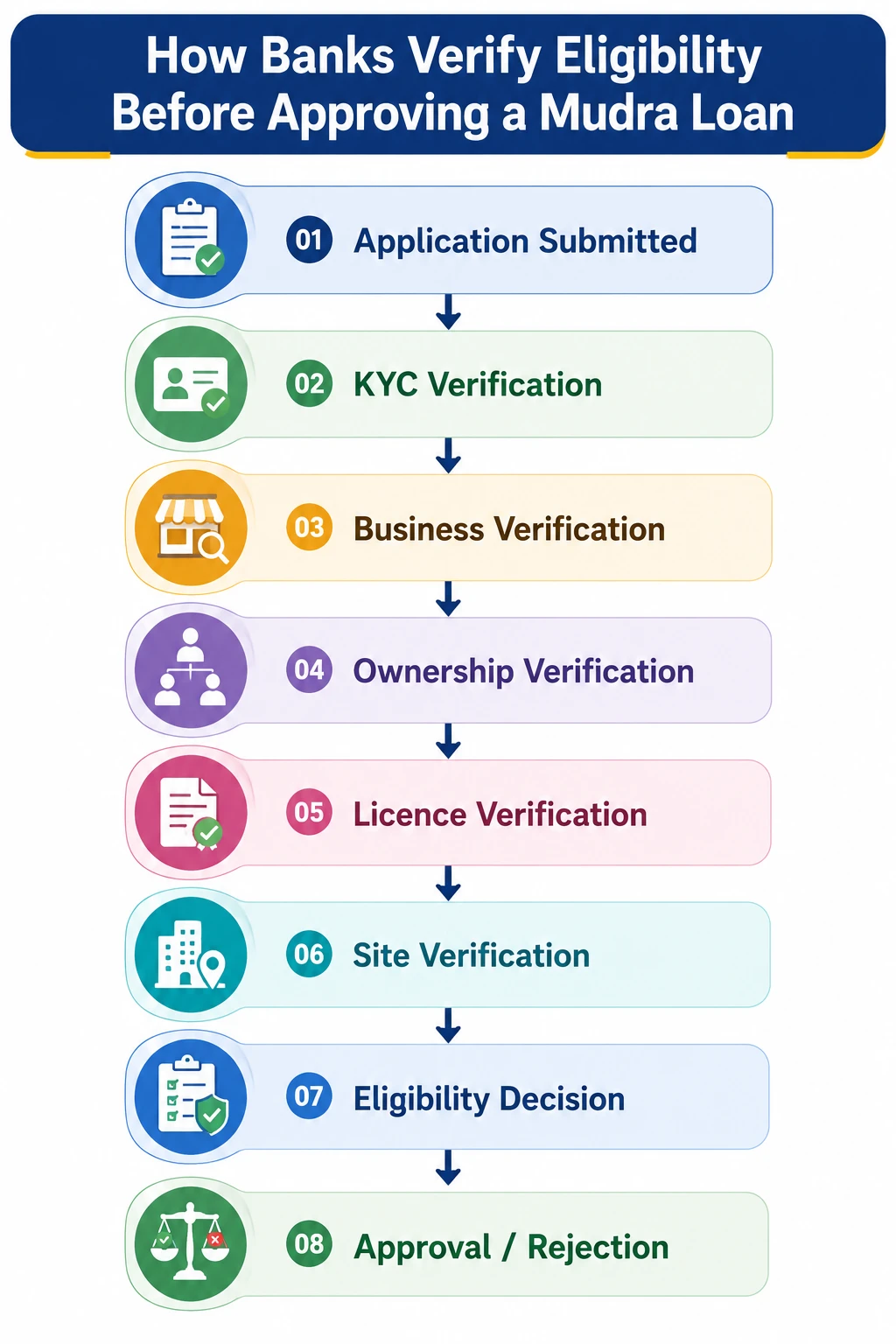
How Banks Verify Eligibility Before Approving a Mudra Loan
Application Submitted
The Mudra Loan verification process begins when you submit your application along with the required documents. At this stage, the bank checks whether the application form is complete, all mandatory details have been provided, and supporting documents are attached. Incomplete applications, missing information, or inconsistencies between the application and documents may delay processing or result in the application being returned for correction before further verification begins.
KYC Verification
The bank verifies the applicant’s Know Your Customer (KYC) details, including identity, address, PAN, Aadhaar, and other applicable documents. Officials ensure that the applicant’s personal information matches the submitted records and complies with regulatory requirements. If the applicant itself does not satisfy the eligibility requirements, the application may be rejected regardless of other strengths. Learn more in our guide on Why a Mudra Loan Is Rejected Due to a Non-Eligible Applicant.
Internal Link: https://projectreportbank.com/mudra-loan-rejected-due-to-non-eligible-applicant/
Business Verification
Once KYC is completed, the bank verifies the existence and nature of the business. Officials confirm whether the business is genuine, operational, and eligible under the Pradhan Mantri Mudra Yojana (PMMY). Businesses operating from industrial sheds, commercial complexes, or seasonal businesses may undergo additional verification depending on their nature.
Related Guides:
Ownership Verification
Banks carefully verify who legally owns and controls the business. They review ownership documents, partnership deeds, proprietor details, company records, or other legal documents to ensure consistency with the loan application. Recent ownership transfers, purchased businesses, partnership structures, or multiple owners often require additional scrutiny before the bank proceeds with approval.
Related Guides:
- Recent Business Ownership Change
- Purchased Existing Business
- Ownership Structure Issues
- Multiple Business Owners
Licence Verification
Where applicable, the bank checks whether the business holds valid licences, registrations, permits, or regulatory approvals required for its operations. Officials ensure that these documents are current and consistent with the declared business activity. Expired or pending licences can delay the verification process and may affect overall eligibility.
Related Guide: Business Licence Renewal
Site Verification
For many applications, banks conduct a physical or field verification of the business premises. During this visit, officials confirm the business location, operational status, infrastructure, and actual business activity. Businesses operating from shared premises, industrial sheds, or commercial complexes often receive closer verification to ensure the declared information matches the actual business operations.
Related Guides:
Eligibility Decision
After completing all verification stages, the bank evaluates whether the applicant satisfies the eligibility requirements under PMMY as well as its internal lending policies. The final assessment considers applicant eligibility, ownership, business activity, premises, licences, and verification findings. If the business has recently changed its operations, the bank may review the updated activity before making its final decision.
Related Guide: Eligibility After Changing Business Activity
Approval / Rejection
The final outcome is communicated after the bank completes its overall assessment. If all eligibility requirements are satisfied and the business meets the bank’s lending criteria, the Mudra Loan is approved. However, unresolved eligibility issues, ownership concerns, invalid licences, or verification failures may lead to rejection. Before reapplying, identify the actual eligibility issue and review the relevant guide in this cluster to improve your chances of approval.
Common Mudra Loan Eligibility Issues
| Eligibility Issue | Risk Level | Detailed Guide |
|---|---|---|
| Recent Business Ownership Change | High | Read Guide → |
| Purchased Existing Business | High | Read Guide → |
| Expired or Pending Business Licence | Medium | Read Guide → |
| Industrial Shed / Commercial Complex | Medium | Read Guide → |
| Shared Business Premises | Medium | Read Guide → |
| Changed Business Activity | High | Read Guide → |
| Seasonal Business | Medium | Read Guide → |
| Ownership Structure Issues | High | Read Guide → |
| Multiple Business Owners | Medium | Read Guide → |
| Non-Eligible Applicant | Very High | Read Guide → |
Complete Guide Library
Recent Business Ownership Change
If you have recently purchased, inherited, or transferred a business, your Mudra Loan eligibility may be affected. Banks carefully verify ownership records to ensure the applicant has the legal authority to operate the business and apply for finance. Any recent ownership change often requires additional documentation and verification before approval.
Who should read this?
Business owners who have recently acquired or transferred ownership.
Common rejection reason:
Incomplete ownership records or recent ownership transfer not properly documented.
Purchased an Existing Business
Buying an existing business can save time, but it also introduces additional eligibility checks during the Mudra Loan process. Banks verify whether the ownership transfer is legally completed, whether licences have been updated, and whether the applicant now has complete operational control. Understanding these requirements helps avoid unnecessary delays or rejection.
Who should read this?
Entrepreneurs who have purchased an existing business.
Common rejection reason:
Ownership transfer or business records not updated.
Business Licence Renewal
Many businesses require valid licences or registrations before banks consider them eligible for Mudra Loan financing. Expired, suspended, or pending licence renewals can create compliance concerns and delay loan processing. This guide explains when licence renewal becomes important and how applicants can resolve licence-related eligibility issues.
Who should read this?
Business owners with licence renewal or registration concerns.
Common rejection reason:
Expired or invalid business licence.
Industrial Shed & Commercial Complex Eligibility
Businesses operating from industrial sheds or commercial complexes may require additional verification depending on the type of business and occupancy arrangements. Banks evaluate whether the premises are suitable for the proposed activity and whether supporting occupancy documents are available.
Who should read this?
Businesses operating from industrial sheds or commercial complexes.
Common rejection reason:
Insufficient proof of business premises or occupancy.
Shared Business Premises Eligibility
Many small businesses operate from shared offices, co-working spaces, or family-owned commercial premises. Although this does not automatically make a business ineligible, banks often conduct additional verification to confirm business operations and occupancy. This guide explains how to prepare for these checks.
Who should read this?
Businesses operating from shared offices or common premises.
Common rejection reason:
Unable to establish genuine business operations at the declared address.
Eligibility After Changing Business Activity
Changing the nature of your business may affect Mudra Loan eligibility if the revised activity differs significantly from previous registrations or documents. Banks verify whether the new business activity complies with PMMY guidelines and matches the submitted application.
Who should read this?
Business owners who recently changed their business activity.
Common rejection reason:
Mismatch between declared business activity and actual operations.
Seasonal Business Eligibility
Seasonal businesses can also qualify for Mudra Loans, but banks carefully assess income patterns, repayment capacity, and business continuity. This guide explains how banks evaluate seasonal enterprises and what documents strengthen eligibility during the loan assessment process.
Who should read this?
Owners of seasonal or periodic businesses.
Common rejection reason:
Insufficient evidence of sustainable seasonal income.
Ownership Structure Issues
The legal ownership structure of a business plays a significant role in Mudra Loan eligibility. Proprietorships, partnerships, LLPs, and companies have different documentation requirements. Any inconsistency in ownership records can delay verification or lead to rejection.
Who should read this?
Businesses with partnerships, LLPs, companies, or changing ownership structures.
Common rejection reason:
Ownership documents inconsistent with the loan application.
Multiple Business Owners
When a business has multiple owners or partners, banks verify the authority of each individual, partnership agreements, and decision-making rights before approving the loan. Proper documentation and clarity regarding ownership responsibilities help avoid unnecessary complications during verification.
Who should read this?
Partnership firms and businesses with multiple owners.
Common rejection reason:
Incomplete partnership documentation or unclear ownership authority.
Mudra Loan Rejected Due to Non-Eligible Applicant
Sometimes the business itself qualifies, but the applicant does not meet the eligibility requirements. Banks verify the applicant’s legal status, ownership connection, and authority to represent the business before approving the loan. This guide explains the most common applicant-related eligibility issues and how to resolve them.
Who should read this?
Applicants whose Mudra Loan was rejected due to eligibility concerns.
Common rejection reason:
Applicant does not satisfy PMMY or bank eligibility requirements.
Eligibility Checklist Before Applying
- ✔ Recent business ownership changes are properly updated and documented .
- ✔ Purchased business ownership and transfer documents are complete .
- ✔ Business licences and registrations are valid and renewed .
- ✔ Industrial shed or commercial premises meet the eligibility requirements .
- ✔ Shared business premises can be verified with proper address and occupancy proof .
- ✔ The current business activity matches the Mudra Loan application .
- ✔ Seasonal business income and operating cycle are properly explained .
- ✔ The legal ownership structure matches all submitted records .
- ✔ Partnership or multiple-owner documents clearly establish borrowing authority .
- ✔ The applicant is legally eligible and authorised to apply for the business .
- ✔ Business ownership proof is complete and consistent.
- ✔ Business address proof is current and matches the application.
- ✔ GST details are correct and updated, wherever applicable.
- ✔ Udyam Registration details match the business name and activity.
- ✔ PAN, Aadhaar, KYC and business records contain consistent information.
- ✔ Partnership Deed, LLP agreement or company documents are available, where applicable.
- ✔ Ownership, tenancy, rent agreement or premises permission documents are ready.
- ✔ Recent bank statements and financial records are organised for verification.
- ✔ The Project Report, cost estimates and repayment projections are bank-ready.
- ✔ Business operations are active, genuine and physically verifiable.
Quick Eligibility Comparison
✅ Usually Eligible
- ✔ Valid business licence and registrations
- ✔ Business activity matches the loan application
- ✔ Complete ownership and address proof
- ✔ Single proprietor with clear documentation
- ✔ Business premises that can be easily verified
- ✔ Updated GST, Udyam and KYC records
🟡 Needs Verification
🔴 Higher Risk
- ✔ Non-eligible applicant
- ✔ Expired business licence
- ✔ Unclear ownership structure
- ✔ Business activity does not match the application
- ✔ Business premises cannot be properly verified
- ✔ Missing ownership documents
Top Eligibility Mistakes That Cause Rejection
An expired or pending licence can raise compliance concerns and delay or weaken the application. Review the guide on Mudra Loan licence renewal requirements .
Differences between the application, registrations, bank records and ownership documents may lead to rejection. Learn more about ownership structure issues .
The activity mentioned in the application should match the actual business and supporting registrations. Read about eligibility after changing business activity .
Shared offices or family-owned premises may require rent agreements, consent letters or occupancy evidence. See the guide on shared premises eligibility .
The applicant must be legally connected to the business and authorised to borrow on its behalf. Review the guide on non-eligible applicants .
Banks may seek additional proof when a business has recently been transferred, inherited or restructured. Read about recent business ownership changes .
Ownership transfer, licences, registrations and operating control should be clearly updated before applying. See the guide on Mudra Loan eligibility for a purchased business .
Partnership deeds, resolutions, consent and borrowing authority should clearly identify who may apply. Read about eligibility with multiple business owners .
Seasonal businesses should clearly show their operating cycle, peak income period and repayment capacity. Review the guide on seasonal business eligibility .
Banks may question eligibility when industrial sheds, commercial units or operating locations lack suitable proof. Read about industrial shed and commercial complex eligibility .
Expert Advice by CA Manish Gugliya
Ensure ownership documents are updated and consistent before submitting your Mudra Loan application.
Always renew licences and statutory registrations before applying to avoid unnecessary verification delays.
The business name, address, ownership and activity should match across every document submitted to the bank.
If your business activity has changed recently, inform the bank and update all registrations before applying.
Declare any ownership transfer, purchase or restructuring honestly and support it with proper legal documents.
Keep GST, Udyam Registration and other business records current to strengthen your eligibility.
Organise ownership proof, address proof, licences and financial records before the bank begins verification.
Correct missing documents, ownership issues and registration errors before submitting the loan application.
Businesses with multiple owners, ownership transfers or complex structures should obtain professional advice before applying.
Apply only after verifying that both the applicant and the business fully satisfy PMMY and bank eligibility requirements.
Frequently Asked Questions
Can a Mudra Loan be rejected due to eligibility issues?
Yes. Even if your CIBIL Score and financial documents are satisfactory, a Mudra Loan application may still be rejected if the applicant or the business does not meet the bank’s eligibility requirements. Banks verify ownership, business activity, premises, licences, and applicant eligibility before approving the loan.
Does a recent business ownership change affect Mudra Loan eligibility?
A recent ownership transfer does not automatically make you ineligible, but banks usually perform additional verification. You should submit updated ownership documents, registrations, and supporting records to demonstrate that the business legally belongs to you.
Can I get a Mudra Loan after purchasing an existing business?
Yes, provided the ownership transfer has been legally completed and all relevant business records have been updated. Banks generally verify whether the applicant has complete ownership and operational control of the business before approving the loan.
Is a valid business licence mandatory for every Mudra Loan applicant?
Not every business requires the same licences, but wherever a licence or registration is legally required, it should be valid and up to date. Expired or missing licences can delay processing or affect the bank’s eligibility assessment.
Can businesses operating from shared premises qualify for a Mudra Loan?
Yes. Businesses operating from shared offices or common commercial premises may still qualify. However, banks may request additional address proof, rent agreements, consent letters, or conduct a site verification to confirm genuine business operations.
Will changing my business activity affect my Mudra Loan application?
It can. If the current business activity differs from the information mentioned in registrations or the loan application, the bank may seek clarification or additional documents. Updating all relevant records before applying helps avoid unnecessary delays.
Are seasonal businesses eligible for Mudra Loans?
Yes. Seasonal businesses are not automatically disqualified. Banks generally assess seasonal income patterns, repayment capacity, business continuity, and the overall viability of the business before making a lending decision.
Can partnership firms and businesses with multiple owners apply?
Yes. Partnership firms, LLPs, and other businesses with multiple owners can apply if the ownership structure is properly documented. Banks usually verify partnership deeds, authorization documents, and the authority of the person applying for the loan.
Why do banks verify business ownership before approving a Mudra Loan?
Ownership verification helps banks confirm that the applicant has the legal authority to operate the business and borrow funds. Clear ownership records reduce the risk of fraud and ensure compliance with the bank’s lending policies.
Can an otherwise eligible business be rejected because of the applicant?
Yes. Even if the business qualifies, the application may be rejected if the applicant is not authorized to represent the business or does not satisfy the bank’s eligibility requirements. Both the business and the applicant are assessed during the approval process.
What documents help prove Mudra Loan eligibility?
Common documents include Aadhaar, PAN, business ownership proof, address proof, business licences, GST Registration (where applicable), Udyam Registration (where applicable), partnership documents, rent or ownership documents for business premises, and other records requested by the bank during verification.
How can I improve my eligibility before applying for a Mudra Loan?
Review your ownership records, renew expired licences, update business registrations, ensure your business activity matches your application, organise all supporting documents, and resolve any eligibility gaps before submitting the application. Proper preparation significantly improves the chances of a smooth verification process and faster loan approval.
Conclusion
Meeting the basic PMMY eligibility criteria is only the first step in securing a Mudra Loan. Before approving an application, banks evaluate several factors, including business ownership, the nature of the business activity, business premises, licences and registrations, and the applicant’s legal authority to represent the business. A weakness in any of these areas can delay the verification process or affect the final lending decision.
Fortunately, many eligibility-related rejections arise from issues that can be corrected before applying. Expired licences, ownership mismatches, recently transferred businesses, incomplete partnership documents, and insufficient proof of business operations are among the most common problems encountered during bank verification. Identifying these issues early gives applicants the opportunity to strengthen their applications.
Taking the time to review your eligibility, update business records, organise supporting documents, and resolve compliance gaps can significantly improve your chances of a smoother verification process and faster Mudra Loan approval.
Use the detailed guides in this Mudra Loan Eligibility Issues cluster to understand each eligibility requirement, resolve specific issues affecting your business, and submit a stronger, more complete Mudra Loan application with greater confidence.
-
Mudra Loan Eligibility Issues: Common Reasons for Rejection & Practical Solutions
-
Mudra Loan Eligibility for Businesses with Recent Ownership Change – How Banks Assess the Applicant
-
Mudra Loan for Purchased Business: Eligibility, Documents & Bank Expectations
-
Mudra Loan Eligibility When Business Licences Are Under Renewal – Will Banks Approve?
-
Mudra Loan Industrial Shed Eligibility: Complete Guide for Commercial & Industrial Premises
-
Mudra Loan Eligibility for Shared Premises: Practical Bank Guidelines Explained
-
Mudra Loan Eligibility After Changing Business Activity – What Banks Consider Before Approval
-
Mudra Loan Eligibility for Seasonal Businesses – Practical Guide by CA Manish Gugliya
-
Mudra Loan Ownership Structure: Proprietorship vs Partnership vs Company
-
Mudra Loan Eligibility for Multiple Business Owners – Can You Apply for More Than One Business?