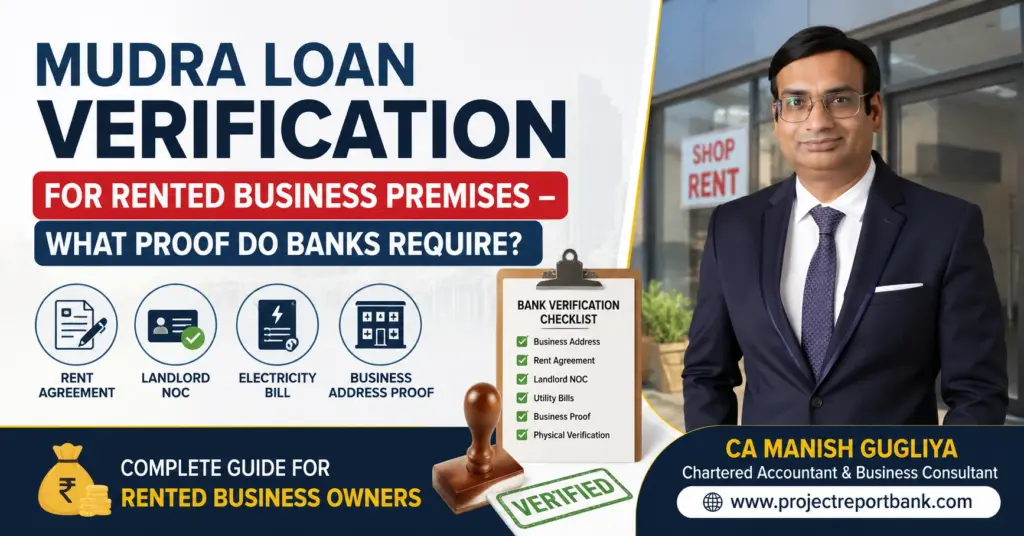
Key Takeaways
I have helped hundreds of entrepreneurs prepare their mudra loan documents over the past two decades. Here is what you need to know about mudra loan verification for rented business premises:
- Owning property is NOT compulsory. Banks regularly approve mudra loans for genuine rented shops, workshops, parlours, and home-based businesses when documentation is proper.
- Key documents required: rent agreement, address proof like utility bills, basic business registration proof (Shop Act, GST, Udyam), and simple income proof such as bank statements – not heavy collateral.
- Physical verification is a short field visit – the officer checks your signboard, business activity, stock, takes a few photos, and asks basic questions. It is not an income-tax raid.
- Most rejections happen due to preventable mistakes: missing rent agreement, wrong address on the application form, shop locked during the visit, or landlord denying tenancy.
- MUDRA Yojana offers collateral free business loans up to ₹20 lakh, and loans under the mudra scheme have no processing fee.
Introduction – Why Business Premises Verification Matters for Mudra Loan
I am CA Manish Gugliya, a practising Chartered Accountant with over 20 years of experience helping entrepreneurs prepare bank-ready project reports, CMA data, and loan documentation. One of the most common stages where a pm mudra loan application gets stuck is the business premises verification – especially when the business operates from rented premises.
Why do banks insist on this? Under RBI guidelines, financial institutions must confirm that the business actually exists, is operational at the declared address, and that the loan amount will be used for genuine business operations, not personal expenses. MUDRA loans support micro and small enterprises in India, and this verification step protects both the bank and the borrower from fraud.
The good news: rented premises, shared spaces, and even small home-based rented setups are all normally acceptable. The condition is simple – your documents and on-site reality must match what you wrote in the loan application.
This guide covers eligibility on rent, the exact documents required, rent agreement and landlord NOC rules, what happens during the verification visit, common failure reasons, and how to prepare so your application process goes smoothly. For readers with specific situations, I have also linked to detailed guides on home-based business verification and business-not-operational issues.

Table of Contents
Can You Get a Mudra Loan If Your Business Is on Rent?
Yes – absolutely. The Pradhan Mantri Mudra Yojana (PMMY) is a government initiative that provides financial assistance to non corporate, non-farm small businesses. MUDRA stands for Micro Units Development and Refinance Agency. Owning the shop or factory is not a condition to apply for a mudra loan.
Most small traders, beauty parlours, coaching centres, and workshops actually run on rented premises. Banks understand this. Individuals and MSMEs can apply for MUDRA loans, and applicants must be aged between 18 to 65 years.
Mudra loan categories include Shishu, Kishor, and Tarun based on loan size. A shishu loan offers up to ₹50,000 for startups. Kishore loans range from ₹50,000 to Rs 5 lakh for businesses in the growth phase. A tarun loan provides ₹5 lakh to ₹10 lakh for established businesses. There is also Tarun Plus, ranging from ₹10 lakh to ₹20 lakh for expanded businesses. The minimum loan amount under MUDRA Yojana is ₹30,000, and the maximum loan amount can go up to ₹20 lakh under Tarun Plus across these four categories.
What matters to the bank is not who owns the building – but whether your business is genuine, your current address is correct, and your cash flow can be verified from basic income proof like bank statements and bills. Even if your house is rented and used for business (home bakery, tuition classes), you can still avail loans under this scheme.
Why Banks Verify Rented Business Premises Before Approving Mudra Loan
From the bank’s side, verification is a safety check, not harassment. In my consulting work, I have seen how one good verification report can “unlock” a file that was sitting idle for weeks. Here is what the bank wants to confirm:
- The business actually exists at the declared address
- The shop or workspace is open and active with visible stock, tools, or machinery
- The business activity matches the description in the mudra loan application and project report
- The address proof in documents (rent agreement, electricity bill, GST, Udyam Registration) matches the site board and actual location
Banks are required by RBI and internal compliance rules to prevent bogus businesses, round-tripping of funds, and multiple loans taken on the same fake address. MUDRA Yojana integrates micro-units into the formal credit system, and physical verification helps maintain the integrity of that system. This process is standard for all small business loans and business installment loan products – not unique to PMMY.
Documents Banks Usually Require for Rented Business Premises under Mudra Loan
Every bank branch has slight variations, but here is the core list of required documents. Businesses must submit last six months of bank statements during the loan application process. A bank statement from the previous 12 months is necessary for higher categories.
| Document | Purpose | Status |
|---|---|---|
| Rent agreement (unregistered) | Proves you occupy the premises | Mandatory for most branches |
| Registered rent agreement | Stronger legal proof; preferred for Kishore/Tarun | Mandatory where bank policy demands |
| Landlord NOC letter | Permits commercial use from residential premises | Conditional – when needed |
| Recent electricity bill / utility bills | Address proof and active occupancy | Mandatory / Helpful |
| Property tax receipt | Sometimes asked in municipal areas | Optional |
| Rent payment proof (bank transfer / UPI) | Shows traceable rental payments | Helpful |
| Shop & Establishment Certificate | Business registration proof | Mandatory for formal setups |
| GST Registration / gst certificate | Business identity, gst details, turnover | Mandatory for Kishore / Tarun |
| Udyam Registration | MSME identity | Strongly encouraged |
| Municipal trade licence / FSSAI | Local authorisation | As applicable |
| Aadhaar card | KYC – required for all | Mandatory |
| Pan card | KYC and tax identity | Mandatory |
| Voter ID / driving licence | Additional KYC or address proof | Helpful |
| Passport-size photographs | Identity | Mandatory |
| Last 1–2 years income tax returns | Income proof | Required for Kishore / Tarun |
| Balance sheet and profit & loss | Financial health | Required for larger loans |
| Partnership deed | If partnership firm | Mandatory if applicable |
| Business visiting card / letterhead | Shows same address | Helpful |
| Geo-tagged photos of premises | Some banks use mobile apps | Helpful |
| Trade references | Some banks request supplier or buyer references | Optional |
The mudra application form must be completed and submitted along with proof of business ownership. Keep scanned copies in pdf format as backup. For the complete master checklist, you may also refer to my detailed Mudra Loan documents required guide.
Registered Rent Agreement, Landlord NOC, and Other Rental Proofs – What Is Really Necessary?
Clients ask me constantly: “Is a registered rent agreement compulsory?” and “Will my old handwritten agreement work?” Let me clarify.
A registered rent agreement is stamped and registered at the sub-registrar office – common for 11 to 36 month commercial leases. A simple unregistered rent agreement (sometimes called “pacca kiraya nama”) is signed by both parties but not registered. For many small mudra loans, PSU and private banks accept an unregistered agreement along with an electricity bill and landlord details, particularly in smaller towns.
However, a registered commercial rent agreement becomes important for higher-ticket Kishore and Tarun loans, larger manufacturing sheds, or branches in metro cities with stricter internal policies.
A No Objection Certificate is sometimes required from the landlord – specifically when: the rent agreement is old or informal, utility bills are only in the landlord’s name, the premises are residential with society restrictions, or the bank wants written permission for commercial use. For example, a rented salon inside a housing society almost always needs a landlord NOC. A street-facing kirana shop on a standard 11-month agreement usually does not.
Never create fake or backdated rent agreements. Banks sometimes cross-check directly with the landlord. Such fraud can permanently damage your credibility and future business loan prospects.
What Actually Happens During Bank Verification Visit for a Rented Business Premises?
Let me walk you through this like I am preparing a nervous first-time borrower.
After you submit your loan application form and primary documents, the bank assigns a field officer (branch staff or outsourced agency) to visit the business address on your application. The officer may call before visiting, or may arrive unannounced.
Here is the typical sequence for a Mudra Loan business verification process:
- Officer checks the outside address, shop number, and looks for a clear signboard with your business name
- Confirms you (the proprietor or partner) are present, sometimes verifying identity against aadhaar card or pan card
- Takes 4–6 photos: outside with signboard, inside showing stock or machinery, counter or sitting area, and sometimes a photo with you
- Asks 4–5 basic questions: how long you have been running the business, average daily sales, rent amount, staff strength, and how you plan to use the loan (working capital, stock, machinery)
- May informally speak to neighbours or adjacent shopkeepers to confirm business genuineness
After the visit, the officer submits a “business premises verification report” to the branch. This report strongly influences the final loan processing decision.
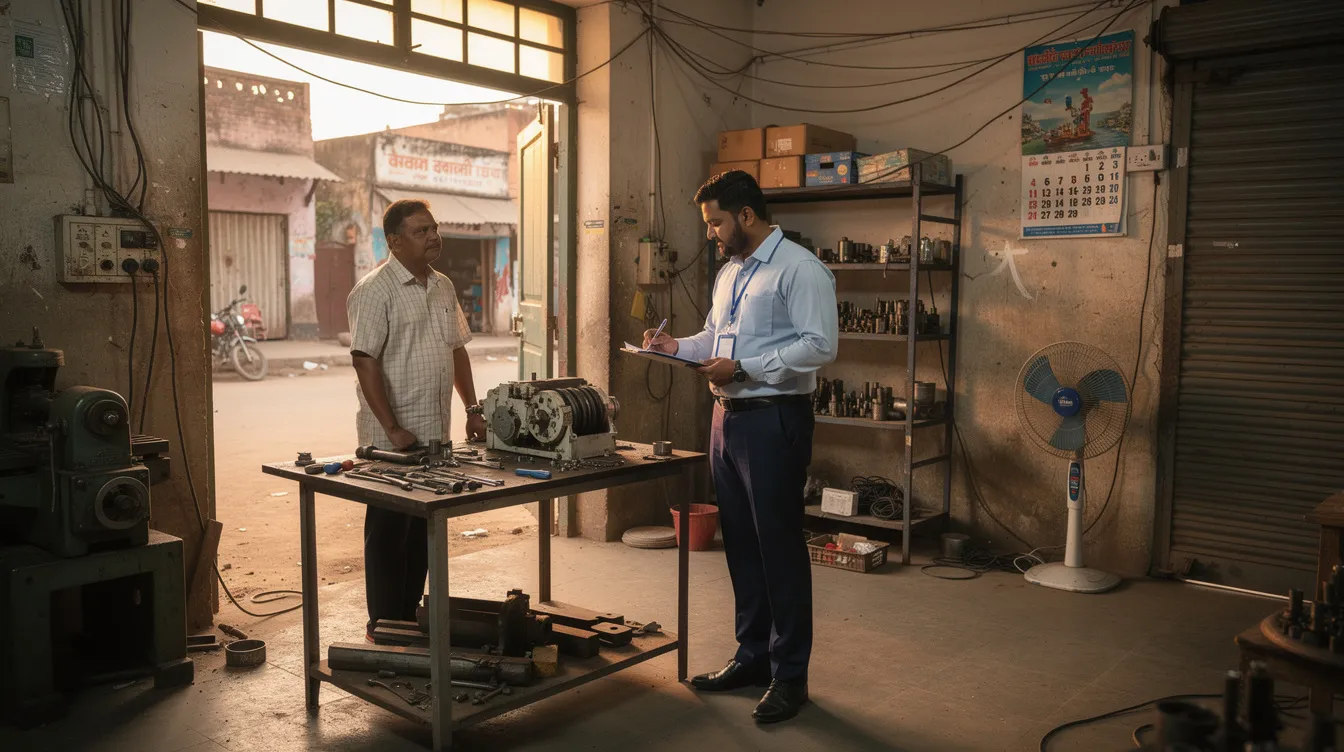
What Does the Bank Officer Check On-Site? Practical Checklist for Rented Premises
Use this as your preparation checklist – make sure each item is visible before the officer arrives:
- Business name board outside (matching the name on your application exactly)
- Visible stock, raw material, or finished goods
- Machinery, tools, or equipment relevant to your business
- Furniture: chairs, counters, display racks
- At least some activity – customers, work-in-progress, or staff present
- Nature of business matching the project report (a tailoring shop should have sewing machines, not only mobile accessories)
The officer may ask to see documents on the spot: rent agreement, GST or Shop & Establishment certificate, a recent electricity bill, and sometimes your bank passbook showing business transactions.
Cleanliness, proper lighting, and organised stock create a positive impression. It indirectly signals that your business is serious and can handle the repayment capacity expected for a business installment loan.
Common Reasons Mudra Loan Verification Fails for Rented Business Premises
In my consulting work, a large number of Mudra Loan rejections between 2023–2025 were not due to CIBIL or income problems but due to avoidable premises verification issues. According to MSMEGyan, mismatched or incomplete documents are the single most common cause of rejection.
Common failure reasons include:
- No rent agreement – only an oral arrangement with the landlord
- Wrong or incomplete address – room number or galli name missing from the application
- Shop locked when the officer visited two or three times
- Signboard mismatch – different business name than what is on the application
- GST or Udyam address outdated – never updated after shifting to a new rented location
- Landlord denies tenancy or tells the officer the tenant may leave soon
- Temporary stalls, weekly market setups, or virtual offices with no real operational setup
If you are facing rejection specifically due to address issues, my guide on Mudra Loan rejected due to address proof issues covers the remedies in detail. For post-inspection problems, read about Mudra Loan rejected after site inspection.
How to Prepare Your Rented Business Premises Before Verification – Step-by-Step
Think of this as your “one day before and day-of” checklist:
✔ Keep all original documents in one folder at the business premises: aadhaar card, pan card, rent agreement, latest electricity bill, business registration proof, last 6 months bank statements, and purchase or sale bills
✔ Install or update a clear signboard with your business name exactly as written on the mudra loan application – even a simple flex board works, but it must be visible from the road
✔ Arrange stock, machinery, or tools so they are visible – for service sectors (salon, coaching, clinic), keep chairs, equipment, and whiteboards in place
✔ Inform your landlord in advance that a bank officer may visit or call, so there is no accidental denial
✔ Be physically present during likely visit hours (banking hours on working days), with at least one staff member or helper
✔ Keep the premises neat, avoid unrelated personal items, and be ready to answer simple questions about sales, expenses, and how you plan to use the working capital or equipment funding
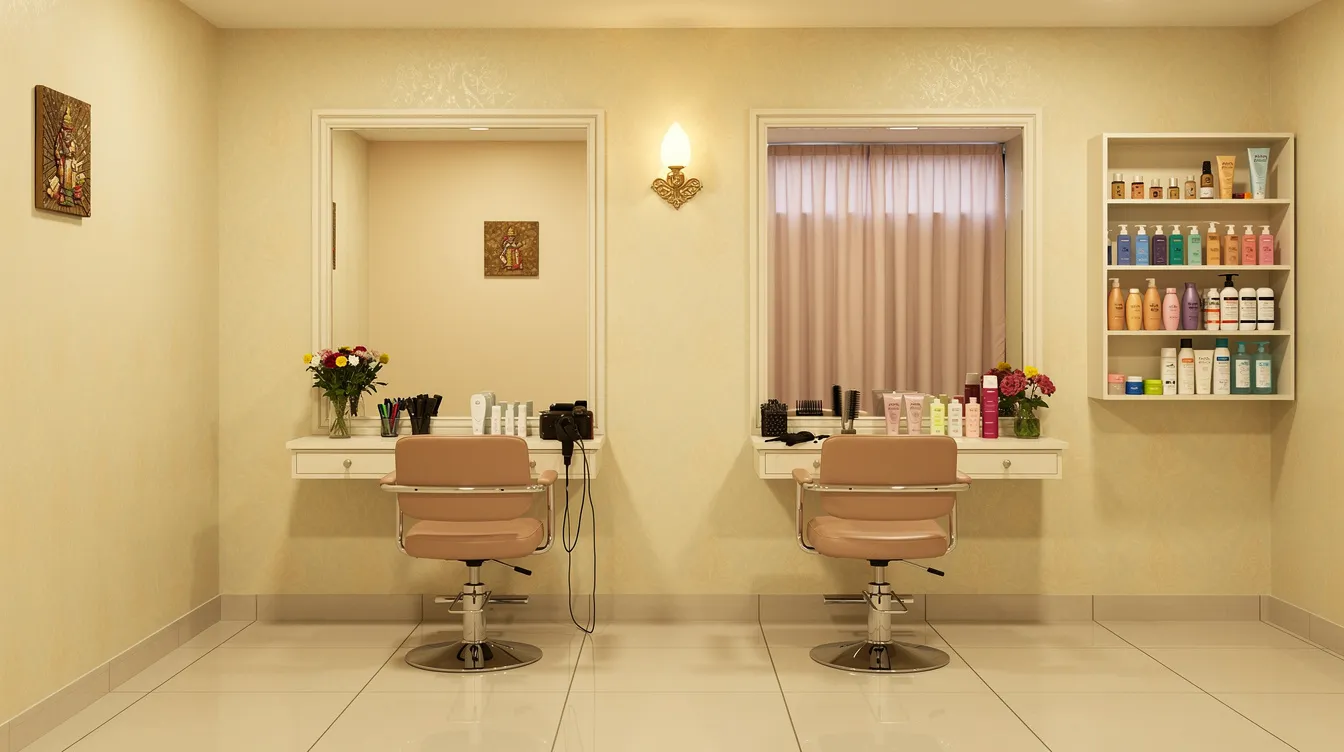
Special Cases: Home-Based Businesses, Shared Premises, and Co-working Spaces on Rent
Many entrepreneurs operate from rented homes, shared workshops, or co-working offices. Banks do consider these for micro enterprises and small enterprises in the service sectors, but documentation needs extra care.
Home-based rented businesses (home bakery, tiffin service, tuition classes, stitching): your business address will match your residential address. Acceptable proof includes rent agreement, electricity bill, and aadhaar showing the same current address. Local licences like FSSAI for food businesses help. In residential societies, a landlord NOC or society permission is often required. For detailed guidance, see my article on Mudra Loan verification for home-based businesses.
Shared premises: If two businesses share a rented workshop, banks may ask for partnership deed details, sub-rent letters, or primary tenant confirmation.
Co-working spaces: Show the co-working agreement, monthly invoices, and a provider letter confirming your desk or cabin. This is more acceptable for consultants, designers, and IT freelancers than for trading businesses that require funds for stock storage. You can apply for a mudra loan through banks, non banking financial companies, micro finance institutions, or small finance banks. You can also apply for a mudra loan online through the Jan Samarth portal.
Real-Life Style Case Studies of Mudra Loan Verification on Rented Premises
These cases are based on typical files from my practice (no real client identities revealed):
Case 1 – Tailoring Shop Approved: A ladies tailoring shop in Bhopal – 120 sq. ft. rented space, 2 sewing machines, unregistered 11-month rent agreement, Udyam Registration. Clear signboard, active stitching during the visit, proper other documents. Sanctioned ₹3.5 lakh Kishore loan smoothly.
Case 2 – Restaurant Rejected: A 900 sq. ft. family restaurant in a rented residential building. The tenant never took written landlord permission. The landlord denied consent to the bank officer. Immediate rejection despite good bank statements and CIBIL. Lesson: always secure landlord NOC in writing.
Case 3 – Mobile Repair Shop Approved: A 70 sq. ft. kiosk-style mobile repair business – handwritten rent note, electricity bill, and 12 months of bank statements. Officer physically saw active customers and repair tools. Approved for ₹1.8 lakh.
Case 4 – Home Bakery Approved After Address Correction: A rented 2BHK home bakery in Pune faced delay because aadhaar showed the old address. After filing an address update, submitting rent agreement plus FSSAI licence, the bank completed verification and sanctioned ₹4 lakh.
Case 5 – Salon Delayed Due to GST Mismatch: A unisex salon shifted to a new rented location but never updated the GST address. The officer saw one address on GST and another on the signboard. Report kept pending until GST amendment was filed. Keep all address proof documents consistent.
Expert Tips from CA Manish Gugliya for Smooth Mudra Loan Verification on Rented Premises
Drawing from handling hundreds of Mudra Loan and MSME business loans files, here are my top practical tips:
- Never create fake rent agreements, electricity bills, or dummy signboards. Officers are experienced and such tricks permanently damage your banking credibility.
- Pay rent through traceable modes – bank transfer, NEFT, or UPI – so your bank statements also serve as rental proof and business continuity evidence.
- Ensure address consistency across every document: mudra loan application, rent agreement, GST or Udyam registration, bank passbook, and trade licence. Fix mismatches before applying.
- Inform your landlord and neighbours before the expected verification. It prevents accidental denials.
- Use a professionally prepared, realistic project report so that what is written matches what the officer sees – business size, machinery value, working capital needs. An unrealistic report will raise red flags even if the shop looks fine.
- Remember: loans under MUDRA Yojana have no processing fee, unlike a personal loan or vehicle loan. MUDRA loans can be repaid over a tenure of up to 5 years. The interest rate varies by lender. Banks evaluate repayment capacity based on your income proof, not property collateral. If you have successfully repaid earlier loans, mention it – it builds confidence.
You have already done an excellent job by researching this topic. Now act on it before you walk into the bank. For applicants from sc st obc categories, additional documents or subsidies under specific state schemes may apply – check with your branch.
Frequently Asked Questions on Mudra Loan Verification for Rented Business Premises
Here are practical doubts that are not fully answered above:
Can I change my rented business address after taking a Mudra Loan?
Yes, but you must immediately inform the bank, update your GST, Udyam, and other business registration, and may face a fresh verification visit. Silently shifting without intimation can cause serious problems at renewal or during later inspections.
Can I use a family member’s rented premises as my business address?
This is possible if the family member provides written permission or NOC, the rent or sub-rent arrangement is clearly documented, and your business signboard with your name is fixed at that address. Banks need clarity – not ownership.
Can the bank reject my Mudra Loan even if the verification officer was satisfied?
Yes. The final approval process also depends on CIBIL score, existing EMIs, correctness of all additional documents, income tax returns, and internal risk policy. A positive site report is necessary but not the only factor. The bank also looks at your repayment capacity, term loans history, and balance sheet where applicable.
Is it mandatory to have a separate current account before applying?
For very small cases, banks may accept savings account statements. But opening a current account in your business name a few months before applying significantly improves your overall business registration proof and gives the branch confidence in your cash flow.
Can applicants who do not have GST registration still apply for Mudra Loan?
For shishu loan applicants with very small turnover, GST registration may not be mandatory. However, for Kishore and Tarun categories, banks strongly expect a gst certificate. Check if your turnover and business type legally require GST – and if so, register before applying.
- Mudra Loan Project Report Issues & Solutions: Complete Guide to Avoid Project Report Rejection


- Mudra Loan Documentation Issues: Complete Guide to Avoid Document-Related Loan Rejections

- Mudra Loan Bank Verification: Complete Guide to the Business Verification Process

- Mudra Loan CIBIL Issues, Rejection Reasons & Solutions (2026) – Complete Guide

- Mudra Loan Re-Verification – Why Banks Visit Again and What Applicants Should Do (2026)
- How Banks Verify Existing Business Turnover Before Approving a Mudra Loan 2026

- Mudra Loan Field Investigation Report – What It Contains and How It Affects Loan Approval 2026

- Mudra Loan Phone Verification – Questions Banks Ask and How to Answer Correctly 2026

- Mudra Loan Verification for Service Businesses – Office Inspection & Approval Guide 2026

- Mudra Loan Site Inspection for Manufacturing Units – What Bank Officers Verify Before Approval 2026

- Mudra Loan Verification for Rented Business Premises – What Proof Do Banks Require? 2026

- Mudra Loan Verification for Home-Based Businesses – Bank Rules and Approval Tips 2026

- Mudra Loan Rejected Because the Business Was Not Operational During Verification – How to Avoid It

- Mudra Loan Business Verification Process (2026): Step-by-Step Guide to What Banks Actually Check

- Mudra Loan Rejected Due to Industry Specific Project Report Mistakes – What Banks Really Expect 2026