Key Takeaways
- Home-based businesses are fully eligible for mudra loans under Pradhan Mantri Mudra Yojana. You can access shishu loans (up to ₹50,000), Kishore (up to ₹5 lakh), the tarun category (up to 10 lakh), and even Tarun Plus (up to ₹20 lakh for those who have successfully repaid loans earlier).
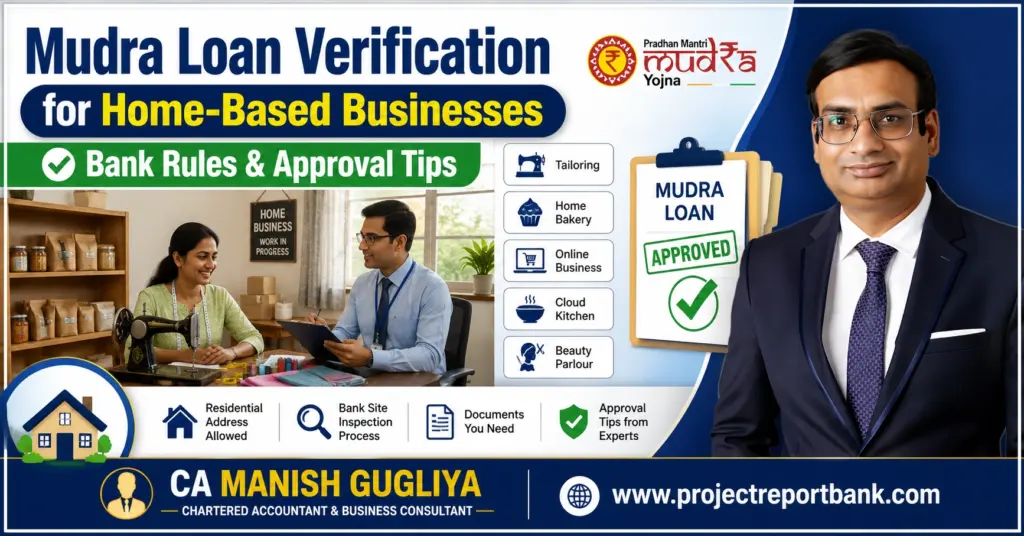
- Mudra Loan Verification for Home-Based Businesses means the bank mainly checks business genuineness, residential address verification, basic records, and whether your activity can actually generate income to cover repayment.
- Bank Verification for Home Business is usually a simple site visit lasting 10–20 minutes. The officer matches your documents with your actual workspace – kitchen, workshop, parlour room – and asks a few basic questions.
- Practical Mudra Loan Approval Tips that work: put up a signboard, keep your workspace tidy, maintain invoices, take photos of your setup, prepare a project report, and ensure your details match across Aadhaar, bank statement, application form, and project report.
- Don’t fear the process. Proper preparation and genuine business activity are what matter most.
Introduction – Mudra Loan Verification for Home-Based Businesses
I’m CA Manish Gugliya, and over 20+ years of practice I’ve helped thousands of entrepreneurs – many of them women running home bakeries, tailoring units, tuition classes, and online selling businesses – get their loans approved. The biggest fear I hear: “Sir, my business is from home. Will the bank even accept my residential address?” The answer is yes.
The mantri mudra yojana pmmy is a flagship scheme of the Government of India, launched on 8 April 2015, designed to provide collateral free loans to micro and small businesses. Under this mudra scheme, the government offers financial assistance through four categories: Shishu (up to ₹50,000), Kishore (₹50,001–₹5 lakh), Tarun (₹5 lakh–₹10 lakh), and Tarun Plus (₹10 lakh–₹20 lakh). Mudra loans are collateral-free, ensuring faster approvals for small businesses across India. Over ₹33 lakh crore in loans have been sanctioned since 2015, and 70% of PMMY beneficiaries are women entrepreneurs.
Mudra Loan Verification for Home-Based Businesses is simply about three things: confirming your home business really exists, checking your residential address, and ensuring the loan amount is used for business – not personal expenses.
Can a home-based business get a Mudra loan? Yes. Banks regularly approve Mudra loans for genuine income-generating activities from home. If your documents, address verification, and basic business records are in order, you are eligible – no shop required.
This article covers step-by-step Bank Verification for Home Business, document checklists, common rejection reasons, and CA-level Mudra Loan Approval Tips for loans from ₹50,000 to ₹10 lakh and beyond.

Table of Contents
What Is a Home-Based Business under PMMY?
A home-based business is any non corporate, non-farm micro or small enterprise where production or services run from a house or residential flat but still earn regular income. The pradhan mantri mudra yojana focuses on income generation – not whether your address is commercial.
Examples of eligible home-based businesses:
- Tailoring unit with 2–3 sewing machines
- Home bakery or cloud kitchen delivering via Swiggy/Zomato
- Beauty parlour, mehendi, or makeup services from a spare room
- Coaching or tuition classes from your drawing room
- Freelance graphic design or online selling on Amazon/Flipkart
- Handicraft manufacturing – agarbatti, candle, pickle, papad making
- Trading or small consulting work from home
Eligible businesses include small producers and service providers involved in manufacturing, trading, or services. Agriculture-related businesses are not eligible for mudra loans, though agriculture-allied activities (like making organic manure packets at home) may be covered. Even part-time businesses can apply, but banks prefer seeing regular, serious activity capable of repaying the EMI.
What is a home-based business for Mudra loan? It is any legal, income-generating micro or small business operated from a residential address – no commercial shop needed.
Can You Get a Mudra Loan for a Home-Based Business?
Yes. Under home-based business Mudra loan rules, financial institutions including commercial banks, small finance banks, NBFCs, and MFIs can finance Shishu, Kishore, Tarun, and Tarun Plus categories even from a residential address, as long as the business is genuine, legal, and income-generating. The scheme promotes financial inclusion for small businesses. PMMY offers collateral-free loans to small businesses – no collateral is required for loans up to ₹10 lakh. Mudra loans are available up to ₹20 lakh under Tarun Plus for those who have availed and repaid earlier Tarun loans.
Banks accept electricity bills, property tax receipts, a rent agreement, or registered leave-and-licence as valid address proof. Applicants must be aged between 18 to 65 years and must not be a defaulter. You can apply for a Mudra loan online or offline, and online approval can sometimes be obtained in under an hour.
There is no rule requiring a shop. Tailoring from a 2nd-floor flat, online selling from a bedroom, tutoring from a drawing room – all qualify with proper documentation. From my CA experience, most first-time applicants take between ₹1 lakh and ₹3 lakh, but strong cases with turnover proof and Udyam/GST can expand up to ₹10 lakh or even ₹20 lakh.
How do banks verify home-based businesses for Mudra? The bank conducts a short site visit, asks basic questions about your activity, inspects your workspace and equipment, and checks that the address in your documents matches the house visited.
Why and How Banks Verify Home-Based Businesses
Bank Site Inspection and Home Office Verification are mandatory internal risk checks. The aim is not to harass you but to ensure funding under the mudra scheme reaches a real, functioning beneficiary micro unit. Mudra loans are guaranteed by the Credit Guarantee for Micro Units (CGFMU) under credit guarantee schemes, so lenders must verify carefully. The lender assesses repayment capability through recent bank statements and income records, and lenders evaluate the business plan and check the applicant’s credit track record.
| Reason for Verification | What the Bank Looks For |
|---|---|
| Business exists | Equipment, products, raw material visible |
| Residential address verification | Address matches Aadhaar, electricity bill |
| Machinery/tools check | Relevant equipment present or proforma invoices ready |
| Stock/raw material | Inventory consistent with claimed business |
| Safety of home layout | Gas cylinder, electrical setup for cloud kitchen/bakery |
| Loan end-use | Equipment purchase vs personal use |
| Earning capacity | Approximate monthly cash flow from orders |
| Fake documentation check | Documents match ground reality |
For very small shishu loans (up to ₹50,000), some banks rely mainly on documents and tele-verification. For Kishore and Tarun pmmy loans above ₹1–2 lakh, banks almost always conduct a physical Bank Site Inspection. Verification of a Mudra loan for a home-based business involves a structured process.
Typical Mudra Loan Inspection flow:
- Bank officer calls to schedule a visit
- Officer visits your home at the agreed time
- Short interview about your business model, pricing, and customers
- Officer checks workspace, machinery, stock, and documents
- Officer takes photos, writes notes, and submits report to branch manager
Does the bank officer visit your home? Yes, especially for Kishore and Tarun loans. The visit is common but simple and usually takes only 10–20 minutes if you are prepared with documents, a clean workspace, and honest answers.

What Exactly Does the Bank Officer Check During Home Business Verification?
Here is a practical, CA-designed table showing what the officer inspects during Home Business Verification:
| Verification Item | Why It Matters |
|---|---|
| Business signboard or name sticker near door | Shows the business is real and accessible to customers |
| Dedicated workspace (kitchen, sewing area, parlour room) | Confirms space exists for claimed activity |
| Machinery/equipment (mixers, ovens, sewing machines, parlour chairs) | Validates what the loan will fund or already supports |
| Inventory and raw material (flour, fabrics, cosmetics) | Proves ongoing business activity |
| Finished products or samples | Shows actual output |
| Business records (order diary, WhatsApp chats, online dashboard) | Demonstrates customer base and cash flow |
| Electricity and gas safety | Checks the setup is safe for home use |
| Family members or small team helping | Confirms supporting workforce |
| Live orders or demo of activity | Real-time proof of business |
| Address matching with Aadhaar / electricity bill | Business address verification |
| Photographs taken by officer | Official record for bank file |
Expert note: If you cannot show machinery you are taking loan for, keep proforma invoices and explain clearly when and from where you will buy the equipment.
Expert note: Proof of business continuity requires bank statements or utility bills – keep last 6 months ready.
The inspection result does not usually change interest rates directly, but a weak or doubtful site visit can lead to loan rejection. A strong visit helps smooth sanction. From my experience, most home-based clients pass verification easily after following simple preparation tips, even for loans up to 10 lakh. The borrower simply needs to be genuine and prepared.
Documents Required and How to Prepare for Mudra Loan Home Business Approval
Home Business Loan Documents Checklist
The verification process includes submitting KYC, business proof, and financial records. Here is a complete list:
- Aadhaar and PAN (identity proof)
- Recent passport-size photo
- Electricity bill or property tax receipt (residential address verification)
- Rent agreement or NOC from owner (if rented)
- Bank statements for last 6–12 months
- Simple project report and CMA data
- Udyam Registration (business registration for MSME)
- GST registration (if turnover requires it)
- Local trade licence or Shop & Establishment certificate where applicable
- Quotations for machinery, furniture, and equipment
- 1–2 years ITR if available
- Purchase and sales bills
- Screenshots of online sales dashboards
- Photos of workspace and products
- Any existing loan statements and other documents as requested
Business proof for home-based setups can include trade licenses and GST registration. Lenders validate the legitimacy of the business operating from a residential address. The loan application process includes the submission of a business project report.
| Document / Proof | Used For |
|---|---|
| Electricity bill | Residential address verification |
| Photos of workspace | Home office verification |
| Udyam certificate | Business proof |
| Bank statement | Turnover trail and repayment assessment |
| Quotations | Loan end-use justification |
| Project report | Capacity and working capital planning |
What documents are required for Mudra Loan Verification for Home-Based Businesses? You need identity proof (Aadhaar, PAN), address proof (electricity bill, rent agreement), business proof (Udyam, GST), bank statements, quotations for assets, a project report, and photos of your workspace. Fill the application form completely, and submit all supporting documents together.
Preparation Tips Before Bank Site Inspection
- Clean and organise your workspace thoroughly
- Keep products, tools, and raw material visible
- Put up a temporary signboard or printed name sticker on your door
- Arrange all invoices and bills in one file
- Keep original Aadhaar, PAN, and passport (if you have one) handy
- Ensure address on Aadhaar matches your application – attach explanation if different
- Prepare a written list of your main customers and suppliers
- Rehearse a simple explanation of your business model and pricing
- Keep a rough monthly sales and expense estimate ready
- Avoid giving contradictory answers about turnover or details
- Inform family members about the visit so they can help
- Keep your phone reachable on the scheduled day
- Never show completely empty stock – even small quantities help
- Do not exaggerate turnover or capacity
- Be honest about whether the business is new or existing
Common Verification Failures and CA-Level Approval Tips
Many home-based applicants lose approval at the verification stage for completely avoidable reasons. With proper guidance, every issue below can be fixed before you even apply. Applications are processed quickly if documents are complete.
| Common Mistake | Practical Solution |
|---|---|
| Business not started, no samples | Start even small-scale; show real products |
| Empty premises, no tools | Arrange basic equipment before visit |
| Fake or mismatched address | Use genuine address; update Aadhaar if needed |
| No proof of any sales | Maintain order diary, WhatsApp chats, UPI receipts |
| Copied project report that doesn’t match reality | Get a customised report prepared with help from a CA |
| Quotations for very high-end machines | Use realistic quotations matching home-based scale |
| Personal and business bank accounts mixed | Open a separate current account for business |
| Not available when officer visits | Stay reachable; confirm timing in advance |
Approval Tips from CA Manish Gugliya:
- Keep everything genuine – never submit fake bills or inflated numbers
- Show even small real orders instead of fabricated invoices
- Align project report numbers with what is practically possible from a home setup
- Don’t apply for ₹10 lakh if your current scale supports only ₹2–3 lakh – match the loan amount to reality
- Justify your working capital requirement clearly in the project report
- Avoid last-minute changes in address or business activity on the form
- Maintain a clean credit history – eligibility for a Mudra loan requires that the applicant is not a defaulter
Interest rates under pradhan mantri mudra yojana are not fixed nationally; each lending institution sets its own. Loans up to ₹10 lakh are unsecured (collateral free), so banks rely heavily on a clean track record and a truthful verification report. Mudra loans are collateral-free and support micro enterprises across all categories.
Even rejected applicants can often succeed on a second attempt by correcting documentation, strengthening business proof, and using a professionally prepared project report. The micro units development and refinance agency (MUDRA – mudra stands for Micro Units Development and Refinance Agency) was set up as a refinance agency to support this expansion of credit to micro units through various financial institutions.
Case Study, FAQs and Conclusion
Case Study: Home Bakery in Jaipur
Sunita, a woman entrepreneur in Jaipur, ran a home bakery from her residential kitchen. She wanted ₹3 lakh under Kishore to buy a commercial oven and working capital for ingredients. Here’s what she did right:
- Put a clear signboard reading “Sunita’s Home Bakery” on her front door
- Arranged her existing mixer, trays, and ingredients neatly in the kitchen
- Kept sample cakes and cookies on display during the officer’s visit
- Showed her order diary, Swiggy/Zomato screenshots, and UPI payment records
- Submitted a project report matching her actual capacity and pricing
The bank officer completed the site inspection in 15 minutes. Sunita’s loan was sanctioned within 7 working days. Her story proves that genuine preparation matters more than a fancy shop. The benefits of the scheme are accessible to anyone willing to prepare properly. She didn’t need a subsidy – just a well-documented, honest application.
Mudra Yojana offers loans up to ₹20 lakh. Loans under PMMY can go up to ₹20 lakh. Loans are available for amounts up to ₹20 lakh. Tarun Plus loans range from ₹10 lakh to ₹20 lakh for expanding businesses. Shishu loans offer up to ₹50,000 for startups. Kishore loans range from ₹50,001 to ₹5 lakh for growth. Tarun loans provide ₹5 lakh to ₹10 lakh for established businesses. Loan categories under Mudra include Shishu, Kishore, and Tarun. Many lenders require a physical verification visit to confirm business activity. The ministry continues to make this scheme more accessible each year.
In conclusion, home-based entrepreneurs – especially women and first-timers – should not fear Mudra Loan Inspection. Keep your business genuine, prepare your documents, and where needed, take professional help for project report and CMA data. Whether you need ₹50,000 or want to expand to Tarun Plus, the opportunity is real. Start preparing today, and apply online or visit your nearest bank branch with confidence.
Can I get a Mudra Loan without a separate shop?
Yes. There is no requirement for a commercial premises. Banks approve mudra loans for genuine home-based businesses operating from residential addresses. Your home kitchen, spare room, or study area is sufficient as long as business activity is real and documented. Over ₹33 lakh crore loans have been sanctioned since launch – many to home-based units.
Is a signboard compulsory for Home Business Verification?
A signboard is not legally mandatory, but it strongly helps during Mudra Loan Inspection. Even a small printed name sticker near your door shows the bank officer that a real business operates here. It costs almost nothing but creates a positive first impression during residential address verification.
Can I apply from a rented house?
Absolutely. Banks accept a rent agreement or NOC from the property owner along with utility bills. You do not need to own the house. 70% of Mudra Yojana beneficiaries are women entrepreneurs, and many operate from rented premises.
Will the bank check neighbours during verification?
Banks do not typically interview neighbours. The officer checks what is on your premises and whether your stated business matches reality. Focus on your own workspace, documents, and honest answers rather than worrying about what neighbours might say.
Is the interest rate different for home-based businesses?
No. Interest rates for home-based businesses are the same as for other PMMY borrowers. Rates depend on the bank’s policy, borrower profile, and loan category – not on whether your address is residential or commercial. Mudra loans are provided by banks, NBFCs, and MFIs, each setting their own competitive rates.
- Mudra Loan Documentation Issues: Complete Guide to Avoid Document-Related Loan Rejections

- Mudra Loan Bank Verification: Complete Guide to the Business Verification Process


- Mudra Loan CIBIL Issues, Rejection Reasons & Solutions (2026) – Complete Guide

- Mudra Loan Re-Verification – Why Banks Visit Again and What Applicants Should Do (2026)
- How Banks Verify Existing Business Turnover Before Approving a Mudra Loan 2026

- Mudra Loan Field Investigation Report – What It Contains and How It Affects Loan Approval 2026

- Mudra Loan Phone Verification – Questions Banks Ask and How to Answer Correctly 2026

- Mudra Loan Verification for Service Businesses – Office Inspection & Approval Guide 2026

- Mudra Loan Site Inspection for Manufacturing Units – What Bank Officers Verify Before Approval 2026

- Mudra Loan Verification for Rented Business Premises – What Proof Do Banks Require? 2026

- Mudra Loan Verification for Home-Based Businesses – Bank Rules and Approval Tips 2026

- Mudra Loan Rejected Because the Business Was Not Operational During Verification – How to Avoid It

- Mudra Loan Business Verification Process (2026): Step-by-Step Guide to What Banks Actually Check

- How to Prepare a Perfect Mudra Loan Document File Before Visiting the Bank 2026

- Mudra Loan Rejected Due to Signature Mismatch – Practical Guide 2026 by CA Manish Gugliya