
Key Takeaways
- Many Mudra loan applications under Pradhan Mantri Mudra Yojana (PMMY) are rejected when banks conclude that the local market is already saturated with similar businesses and fresh demand is limited.
- “Mudra loan rejected because the proposed business already has high local competition” is a formal remark that credit officers actually write in sanction notes, rejection letters, or site inspection reports.
- Banks under PMMY and mantri mudra yojana pmmy evaluate viability, repayment capacity, and market demand-not just eligibility criteria on paper.
- Applicants can improve their approval chances by changing location, sharpening their business model, conducting a basic market survey, and submitting a stronger project report with realistic financial projections.
- This article walks step by step through what banks check, why they cite “high competition,” and how to reapply more confidently for a Mudra business loan.
Introduction: Why Mudra Loans Get Rejected Due to High Local Competition
Many otherwise eligible borrowers are surprised to see “proposed business already has high local competition” as the main rejection reason on their Mudra loan file. They assume that meeting KYC requirements and submitting documents is enough. It is not.
The Mudra scheme was launched in April 2015 under Pradhan Mantri Mudra Yojana to provide collateral-free funding to micro and small enterprises in non-farm sectors such as manufacturing, trading, and services. Mudra loans offer up to ₹20 lakh for small businesses and are classified into three categories: Shishu, Kishore, and Tarun. Shishu loans provide up to ₹50,000 for startups, Kishore loans range from ₹50,001 to ₹5 lakh, and Tarun loans are available from ₹5 lakh to ₹10 lakh.
From a banker’s perspective-and I say this after 20+ years of preparing project reports and consulting on MSME finance-every branch has witnessed failures where too many similar shops opened in the same lane and could not pay their EMIs. That experience makes credit officers check competition very carefully before they approve any loan.
This article will show you how banks assess competition, when it leads to rejection, and how you can redesign your proposal, project report, and location to get a better outcome next time.

Table of Contents
What Does “High Local Competition” Mean in a Mudra Loan Application?
When a bank writes “proposed business already has high local competition,” it means there are too many similar businesses operating within a small catchment area and there is not enough new demand to support one more entrant. High competition might be seen as a risk by lenders because it directly threatens the income and profits of a new enterprise.
Typical signs of a saturated market include:
- Several shops offering the same product within 200–500 metres
- Frequent shop closures or “To Let” boards on nearby premises
- Heavy discounting just to survive, indicating thin margins
- Low daily footfall spread across too many outlets
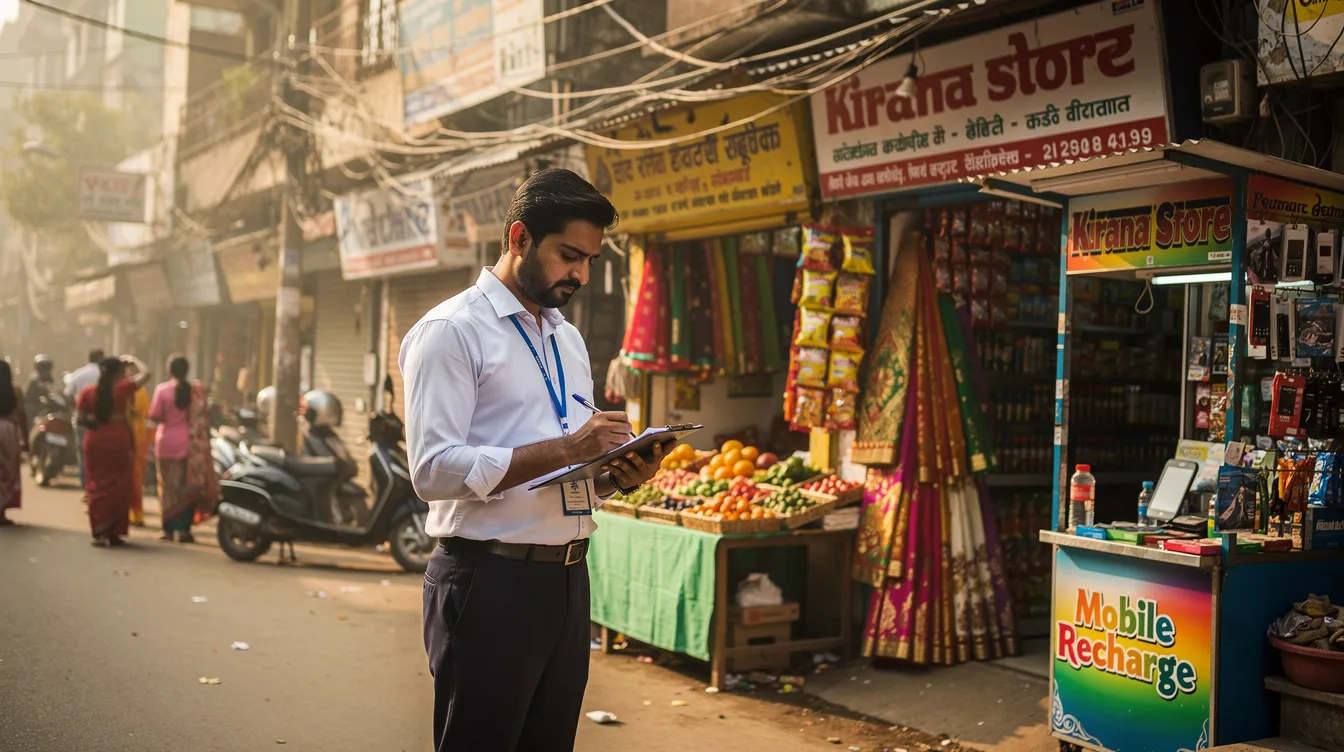
Consider a new kirana store planned in a Jaipur colony that already has five kirana shops within a 300-metre stretch. Or a beauty parlour in a small town lane where four parlours are struggling with low walk-in customers. In both cases, a credit officer will question where the new customers will come from.
“Local” typically means the area from which a business expects daily walk-in or service customers-one or two nearby colonies for a grocery store, or a radius of 3–5 km for a mobile repair shop. Competition is not inherently bad, but without a clear advantage or additional demand, bankers expect weak sales and repayment stress.
Why Banks Evaluate Local Competition Before Approving a Mudra Business Loan
Although mudra loans are part of a government scheme, every bank and lender is still responsible for protecting public money. Banks require realistic assessments of local demand and competitors before approving any loan amount.
Repayment capacity depends directly on expected sales volume and margins. Both shrink when the market is already crowded. High local competition can affect business viability for loans because credit officers are trained to evaluate business sustainability over 3–5 years, not just the first quarter after disbursement.
In simple terms, saturated markets score poorly on three core banking risk measures:
- Business viability – can the enterprise generate enough income?
- Income stability – will revenue remain consistent month after month?
- Default probability – is the borrower likely to miss EMI payments?
Lenders may view businesses in oversaturated areas as high-risk. Under internal Mudra loan guidelines, branches are encouraged to prioritise proposals where local demand is clear, growth potential exists, and working capital requirements are realistic. When a proposal is found non-viable due to weak market conditions, the rejection is usually final unless the applicant reworks the plan.
How Banks Practically Check Local Competition and Market Saturation
Banks do not rely only on the application form. They carry out field verification, local enquiries, and independent checks before sanctioning a Mudra loan. Lenders analyze the market to assess business viability through multiple methods:
- A field officer walks around the proposed location, counts existing similar shops, notes their condition (busy, idle, or closed), and records observations in the site inspection report.
- Officers use Google Maps, municipal trade licence lists, and sometimes GST or UDYAM registration data to estimate similar enterprises already operating in that PIN code.
- For manufacturing and service micro units, bankers check industrial areas, local associations, and existing MSME clusters to gauge whether the segment is growing or saturated.
- Informal conversations with local people-nearby shopkeepers, neighbours, even the panwala-help officers understand whether there is unmet demand or whether recent entrants have already closed due to losses.
All these observations feed into an internal Mudra loan market survey or site inspection note, which strongly influences the final credit decision. This process applies across commercial banks, small finance banks, and other eligible borrowers under the scheme.
Situations Where High Competition Commonly Leads to Mudra Loan Rejection
From practical experience with hundreds of Mudra loan project reports across states like Madhya Pradesh, Maharashtra, and Uttar Pradesh, certain business types are more frequently rejected for “high local competition.” A high number of competitors can lead to lower projected revenue figures, making the proposal unviable in the bank’s assessment.
Here are common scenarios:
- Grocery / General Store: A colony already has six similar shops within a 300-metre stretch and daily footfall is visibly low. No room for a seventh.
- Tea and Snacks Stall: The applicant wants to open a fifth stall outside a small factory gate. Two stalls closed in the last 12 months due to poor sales.
- Salon / Men’s Parlour: A tier-3 town bazaar road where rent is high and four parlours already operate side by side. Walk-in customers are divided among them, making profitability doubtful.
- Mobile Repair and Accessories: The local market building already has multiple branded and non-branded repair outlets offering heavy discounts to attract customers.
- Flour Mill (Atta Chakki): A village where people already depend on an existing mill plus easy access to packed atta from nearby towns-no strong reason for customers to shift.
In such cases, unless the applicant clearly shows a differentiated model-home delivery, online orders, niche products-the default outcome is usually Mudra loan rejection due to competition.
Does High Competition Always Mean Mudra Loan Rejection?
No. Competition itself is normal in business and many success stories exist where Mudra loans have been sanctioned even in busy markets because the applicant had a clear edge.
Banks may still approve the business loan if the applicant demonstrates:
- A better location within the same area-corner shop with stronger visibility, parking space, or access from multiple lanes
- A unique product mix (grocery plus organic staples, or salon plus specialised skin treatments) that attracts its own customer base
- Prior experience or an existing informal customer following-lenders assess if businesses can secure a loyal customer base despite competition
- A shift from rented to owned premises, reducing fixed costs and improving margin projections
- An online plus offline strategy-WhatsApp ordering, home delivery, UPI-based subscription models-showing broader market reach beyond walk-in footfall
Proving unique value can increase approval chances significantly. But applicants must bring these points clearly into their project report and discussion with the credit officer. Otherwise, the bank assumes the business is just another similar shop in a crowded lane.
How to Prove Business Viability in a Crowded Market
Once a branch has flagged your area as “high competition,” your best response is not argument but evidence-a basic market survey, real numbers, and a refined business plan.
Here is what works:
- Conduct a simple market survey: Count daily walk-ins at comparable shops, note peak hours, talk to potential customers about unmet needs, and document findings in a 1–2 page note. Demonstrating demand can improve loan application success.
- Perform demand analysis: Estimate total nearby households or office employees, average monthly spend on your product or service, and your realistic target share. Competitor analysis is important for creating a business strategy that shows the bank you have done your homework.
- Prepare sales and revenue projections: Month-wise turnover for the first year, gradually increasing over 2–3 years, aligned with capacity and realistic working capital limits.
- Build a competitor analysis table: List main competitors, their strengths and weaknesses, pricing levels, and the gaps your enterprise will fill. Targeting specific customer segments can differentiate a business from generic competitors.
- Define a clear USP: Extended timings, better hygiene, specialised products, subscription offers, or bilingual staff for tourist areas-whatever makes your business different, put it in writing.
Importance of a Strong Project Report and CMA-Style Data
Banks are far more comfortable approving mudra loans in competitive areas when the project report clearly captures business viability, financial projections, and risk mitigation. A Mudra loan project report outlines your business plan and serves as the primary reference point for credit appraisal.
A good Mudra loan project report should include:
- Business description, promoter profile, and nature of the enterprise
- Market analysis with competition details and demand indicators-include business description, market analysis, and funding needs in the report
- Realistic implementation schedule with dates
- Profit and loss projections, cash flow statement, and break-even analysis showing when the business will start covering all fixed costs including EMI
- CMA-style data covering fund flow, working capital cycle, stock and debtor assumptions
Banks prefer project reports in a standard format for Mudra loans. Sample project reports can guide structure and content preparation if you are unsure where to begin. A well-structured project report increases loan approval chances, and strong financial documentation can convince lenders even in competitive locations.
Professional preparation-by an experienced CA familiar with Mudra loans-often makes the difference between “non-viable due to competition” and “manageable risk with clear plan.” If you have received remarks like Mudra loan project report rejected, you can usually strengthen the report and reapply with improved data.
Practical Ways to Reduce Competition Risk Before Reapplying
Here are step-by-step options to reduce the impact of local competition on your next Mudra loan application:
- Change or fine-tune the location: Moving a grocery shop closer to a new housing society or bus stop, or setting up a tea kiosk at a bus stand instead of inside a crowded market, can completely change the risk profile in the bank’s eyes.
- Choose underserved niches: Focus on office tiffin services, a ladies-only salon, or specialised repair for high-end mobiles. Adjusting the business model might be necessary in competitive markets where generic retail is already oversaturated.
- Add value-addition services: Home delivery, digital ordering via WhatsApp, card and UPI acceptance, loyalty programmes, and after-sales service each expand your reach beyond just walk-in retail.
- Start smaller: Adjusting the maximum loan amount downward and beginning with a leaner setup can reduce risk. A phased expansion plan is more acceptable than a large upfront investment in a crowded market.
- Diversify income streams: Consider allied agricultural activities, online reselling, B2B supply to other shops, or weekday catering to develop multiple revenue channels rather than depending entirely on local walk-in customers.
Common Mistakes That Lead to “High Competition” Mudra Loan Rejections
Many Mudra loan rejections could have been avoided with basic groundwork before selecting business type and location. Here are the most common reasons applicants fail:
- Copying neighbours’ businesses without checking whether those neighbours are actually profitable or just surviving with thin margins
- Unrealistic sales projections-showing ₹10 lakh monthly turnover in a lane where no shop currently crosses ₹3 lakh signals lack of understanding
- Ignoring local demand indicators like empty shops, frequent “To Let” boards, or heavy discount boards-red flags bankers will not overlook
- Poor or generic project reports that do not mention the exact location, competition, or demand, forcing the bank to assume the worst about viability. Lack of a clear business plan can cause loan rejection.
- Relying on verbal assurances (“my relatives will buy,” “everyone knows me”) without written analysis-this weakens the case in formal banking appraisal
- Incomplete documentation can lead to immediate loan rejection, and applying without business registration can lead to rejection even before the competition question arises. Additionally, a CIBIL score below 650 may result in application denial regardless of market conditions.
Step-by-Step Action Plan After Your Mudra Loan Is Rejected for High Competition
A rejection under PMMY is not the end. With structured steps, many applicants successfully reapply and get approval for a refined proposal.
Step 1 – Get the written rejection reason. Obtain the rejection letter or written remarks from the branch confirming the cause was “high local competition / non-viable market.” You have the right to know the rejection reason in writing.
Step 2 – Revisit the proposed location. Visit at different times of the day, perform your own mini market survey, and honestly assess whether a location change or niche change is necessary.
Step 3 – Redesign your business model. Based on your observations, adjust product mix, service scope, pricing strategy, or customer segment to reduce direct competition. Create a clear USP.
Step 4 – Update your project report. Work with a professional-such as an experienced CA-to revise the project report, financial projections, and working capital assessment so they match the improved plan and a realistic loan amount. Submit the form with complete documentation and a repayment plan that reflects ground reality.
Step 5 – Choose your lender carefully. Consider approaching another bank, a small finance bank, or an NBFC with your revised proposal. Alternative lenders may have different risk assessment criteria. Be prepared to explain clearly during the interview how you have addressed the earlier competition concerns.
Step 6 – Submit and follow up. Apply online or at the branch, maintain regular follow-up, and be available for any field verification the new lender wants to conduct.

Frequently Asked Questions on Mudra Loan Rejection Due to High Local Competition
Below are specific questions eligible borrowers commonly ask after seeing “proposed business already has high local competition” noted on their Mudra loan application. Answers draw from real banking behaviour without any guarantee of approval-banks make independent lending decisions in every case.
Can banks legally reject a Mudra loan only because of high competition?
Yes. Under Pradhan Mantri Mudra Yojana, final lending decisions remain with the bank, and they are permitted to decline proposals they consider non-viable due to saturated markets and weak projected cash flows. “High local competition” is treated as a valid risk factor because it affects expected income and therefore EMI repayment capacity. Meeting eligibility criteria alone does not guarantee approval-the bank must also be satisfied with business viability.
Does a crowded market always lead to Mudra loan rejection?
Not always. Many successful Mudra loans-including under the beneficiary micro unit category-have been sanctioned in busy markets where the applicant could show a stronger value proposition, strategic location, or an already running enterprise with good bank statements. If despite competition your project report shows healthy margins, realistic sales, and a clear USP, the branch can still approve the business loan. The bank evaluates the net effect, not just the competitor count.
How can I prove to the bank that there is enough demand for my business?
Prepare a simple written market survey summarising nearby population or office count, current suppliers, estimated monthly demand, and your realistic target share. Support it with basic calculations. Carry photos of the area, informal feedback from potential customers, and month-wise sales projections that align with ground reality. Discuss these details openly with the credit officer rather than waiting for the bank to discover gaps on its own.
Can I change my location or business model and reapply for a Mudra loan?
Absolutely. Applicants are free to revise their business concept-shifting to a nearby underserved locality, choosing a more specialised niche, or adding services like home delivery-and then submit a fresh application with a new project report. Explaining in writing how the new plan addresses the earlier “high competition” concern significantly improves the chances of a positive re-assessment by the same or another bank. India launched PMMY precisely to encourage micro businesses and small and micro businesses to develop and grow.
Does prior business experience help overcome competition concerns?
Banks consider promoter experience a strong positive. Someone who has earlier run a similar business or worked in the same trade is seen as better equipped to compete, control costs, and maintain a loyal customer base. Providing old bank statements, GST returns, or informal turnover records from previous employment can support your Mudra loan case even in a competitive location. Experience signals lower risk-and that is exactly what the credit officer needs to sign off on the file.
About the Author
CA Manish Gugliya is a practising Chartered Accountant with more than 20 years of experience in Project Report Preparation, Mudra Loan Consulting, MSME Finance, CMA Data, Business Planning, Business Valuation, and Startup Advisory. Through Project Report Bank, he has helped entrepreneurs across India prepare bank-ready project reports and understand practical banking requirements for business finance.
- Integrated Value-Added Rice Products Processing Plant Project Report & DPR
- Integrated Rice Plant Bank Loan, Feasibility, ROI, IRR, Payback & Sensitivity Analysis


- Integrated Rice Processing Plant Financial Projections, Working Capital & DSCR

- Integrated Rice Products Revenue Model, Market Strategy & Profitability

- Integrated Value-Added Rice Plant Project Cost & Means of Finance

- Raw Material Procurement & Inventory Planning for Integrated Value-Added Rice Plant

- Common Utilities, Warehousing, Packaging & Material Handling for Integrated Rice Plant

- Integrated Rice Processing Plant Land, Building & Multi-Line Plant Layout – A Practical Guide for DPR & Bank Finance

- Integrated Rice Processing Plant Capacity Planning & Product Mix

- Integrated Value-Added Rice Plant Machinery & Equipment Cost – A Practical DPR-Oriented Guide

- Integrated Poha, Puffed Rice & Rice Snacks Manufacturing Process & Line Integration

- Instant Poha Manufacturing Plant Project Report & DPR – Bankable Guide by Project Report Bank

- Ready-to-Cook Rice Breakfast Mixes Manufacturing: Products, Process & Plant Setup

- Cup Poha Manufacturing, Packaging & Business Model – A Practical Guide for Entrepreneurs in India

- Instant Poha Market Potential, Pricing, Branding, Sales Channels & Distribution Strategy