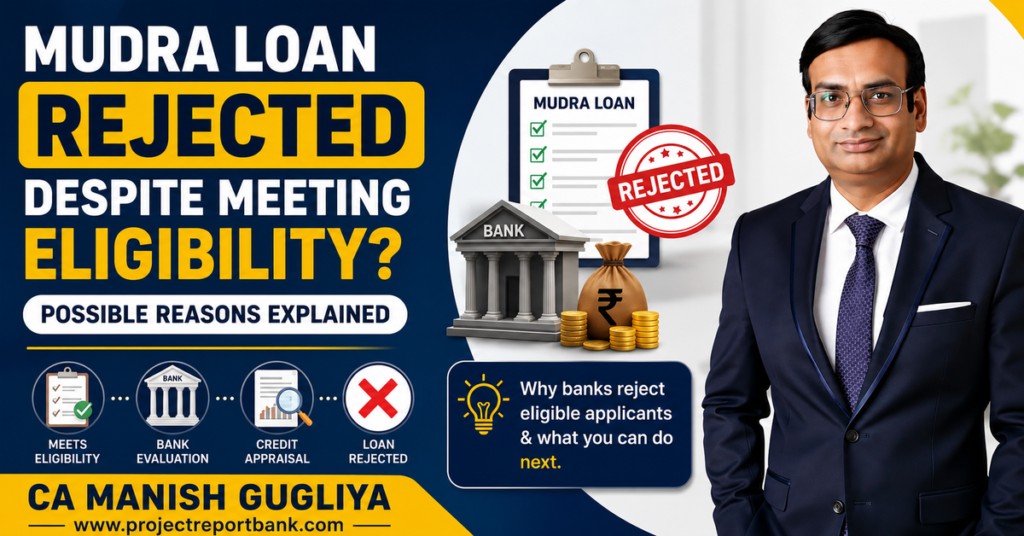
Many small business owners feel frustrated when their mudra loan application gets rejected even after meeting every published eligibility condition. They have the right age, documents, business activity, and even a satisfactory cibil score. So why did the bank say no? The answer lies in understanding the difference between eligibility and final credit approval. This guide explains exactly why this happens and what you can do about it.
Key Takeaways
- Meeting mudra loan eligibility (age, business type, documents, basic credit score) only allows you to apply for a mudra loan. It never guarantees loan approval.
- Banks carry out a full credit appraisal after eligibility – checking repayment capacity, business viability, past banking behaviour, and project report quality – and can reject even fully eligible applicants.
- Common hidden reasons for mudra loan rejection after eligibility include weak cash-flow, an unrealistic business plan, negative field verification findings, or internal bank risk limits at the branch level.
- Incomplete or mismatched documents cause most mudra loan rejections, even when applicants believe they have submitted everything correctly.
- Later sections explain what to improve (your simple business plan, documents, current account conduct) and how to re-apply or challenge an unfair rejection, with references to relevant guides on ProjectReportBank.
Table of Contents
Why Your Mudra Loan Was Rejected Even After Meeting Eligibility (Direct Answer First)
Yes, a bank can reject your mudra loan even if you fully meet the eligibility criteria. This is because eligibility and final loan approval are two completely different stages. Mudra loan applications can be rejected despite meeting eligibility criteria – and it happens more often than most people think.
Here is what actually happens:
- Eligibility only checks basic conditions: are you an Indian citizen, at least 18 years old, running a non-farm income-generating business activity, and applying within the correct loan amount slab (up to ₹20 lakh under 2026 rules)?
- After this, the lending institution does its own credit appraisal – studying your monthly income, bank statements, credit history, current account behaviour, and your clear business plan before making a decision.
- Individual banks retain discretion to approve or reject mudra applications based on their own internal policies.
From my experience as a Chartered Accountant reviewing business proposals: I have seen applicants with Udyam registration, GST filing, and a cibil score of 720 still get rejected because the bank found projected sales unrealistic compared to the last 12 months of transaction history. For cases where you feel the rejection is unfair, see guides on your rights after Mudra loan rejection and how to appeal a rejected Mudra loan.
Your mudra loan was rejected despite eligibility because the bank was not satisfied with creditworthiness – not because you were ineligible under the PMMY scheme.
What Does “Meeting Mudra Loan Eligibility” Actually Mean?
Think of eligibility as an entrance gate. If you pass through it, the bank branch will accept and register your loan application. But it can still say no after studying your file in detail.
Here are the typical eligibility points as of 2026:
- Indian citizen, aged 18 to 65 years (varies by lender)
- Non-farm, non-corporate income-generating micro units or small enterprises
- Loan amount within four categories: Shishu (up to ₹50,000), Kishore and Tarun loans (up to ₹10 lakh), and Tarun Plus (up to ₹20 lakh for repeat borrowers)
- No willful default or existing NPA status – existing loan defaults trigger immediate rejection of mudra applications
- Mudra loan applications require PAN, Aadhaar, and business proof such as shop licence, rental agreement, or utility bills
- Udyam Registration is recommended for mudra loan applications and adds credibility
Different banks may add their own conditions. Most banks insist on a running current account or minimum months of business history. For example, an e-rickshaw owner in Uttar Pradesh might meet all PMMY rules but get rejected by HDFC Bank because his existing personal loan EMI is too high – yet get mudra loan approved at a regional rural bank with a more flexible risk appetite.
After eligibility, your file moves to the much deeper credit appraisal stage, which is the real decision point.
Does Meeting Eligibility Guarantee Mudra Loan Approval? (With Comparison Table)
No. Meeting eligibility never guarantees mudra loan approval. It only allows the bank to consider your application.
Many applicants confuse government backed scheme eligibility with a legal right to receive the money. Mudra loans are collateral-free but not guaranteed approvals. Courts have upheld this distinction – in Mathew K. Jacob vs Union of India, the Kerala High Court confirmed that meeting scheme eligibility does not create entitlement to a loan.
| Meeting Eligibility | Final Loan Approval |
|---|---|
| Initial screening of basic conditions | Full credit decision by the bank |
| Checks age, business type, documents | Evaluates income, cash flow, repayment plan |
| Allows your application to be accepted | Determines whether money is actually sanctioned |
| Based on PMMY scheme rules | Based on bank’s commercial judgement |
From a Chartered Accountant’s perspective, I always keep these two stages separate when advising clients. First, ensure eligibility. Then, build a strong case for creditworthiness. Even if a portal like Jan Samarth shows you as “eligible,” the final approval depends on the bank’s internal appraisal. For more on this, read about whether a bank can reject a Mudra loan without reason.

Why Banks Carry Out Credit Appraisal After Eligibility
Credit appraisal is the bank’s own study of whether you will realistically be able to repay the mudra loan without defaulting. Banks assess commercial viability before sanctioning mudra loans – this is their responsibility toward depositors.
Here is what banks typically check:
- Expected cash flow from your business activity and whether it covers the proposed EMI
- Stability of monthly income over the past 6–12 months
- Existing EMIs from any personal loan or business loan you already carry
- Current account behaviour: cheque bounces, frequent overdrafts, large unexplained cash deposits
- How the requested loan amount will actually be used (working capital, equipment, raw materials)
Even though no collateral is required for mudra loans, lenders need evidence that the loan can be repaid, not just eligibility. Banks protect depositor money by judging the business model instead of taking property as security.
In my experience, branches that have seen high Mudra NPAs in recent years often apply stricter unofficial filters. Branch managers under NPA pressure make it tougher for borderline cases. Detailed appraisal is especially rigorous for category loans above ₹50,000 – a basic business plan is mandatory for Kishore and Tarun loans, while small Shishu loans may face lighter scrutiny.
Major Reasons an Eligible Applicant May Still Be Rejected
This section is not a long list. Instead, it focuses on how bankers actually think when they examine an eligible-but-rejected file.
- Weak repayment capacity: If your proposed EMI exceeds 50–60% of net monthly income after business expenses, banks reject. High debt-to-income ratios can result in the rejection of mudra loans regardless of eligibility.
- Doubtful business viability: The bank finances businesses, not just applicants. If your same business shows inconsistent revenue or the local market is saturated, risk is too high.
- Poor project report or business plan: Unrealistic revenue projections, missing expense breakups, or a generic template downloaded from the internet reduce banker confidence.
- Negative credit issues or banking behaviour: A cibil score of 720 with frequent cheque bounces in the last 6 months still worries the credit officer. A CIBIL score below 650 often leads to rejection. Negative bank statement activity signals instability to lenders.
- Adverse field verification: The bank visits your business address proof location and finds discrepancies between your application and reality.
- Branch risk constraints: If a branch has already crossed its mudra loan target or faces high NPA rates, branch managers apply stricter filters.
For deeper reading, explore guides on why Mudra loan project reports get rejected and when banks reduce the Mudra loan amount.
Deep Dive: Repayment Capacity, Business Viability & Project Report Quality
In my practice, most eligible-but-rejected mudra cases fail in exactly these three areas – not on formal eligibility.
Repayment capacity:
- Banks look at average monthly surplus from your bank statements and calculate what EMI you can afford
- If you already carry heavy EMIs or your repayment history shows late payments, the bank sees risk
- Credit scores below 750 can lead to rejection, and a CIBIL score above 700 significantly improves approval chances
Business viability:
- Banks study your business transactions over the past 6–12 months and compare them with your projections
- Seasonal businesses (like food processing units) need to show they can handle lean months
- If projected turnover is disconnected from your actual business history in bank records, the loan officer questions credibility
Project report quality:
- Many applicants submit a generic template. Banks discount these immediately
- Common mistakes: exaggerated first-year revenue, ignoring competition, no clarity on working capital needs
- Submit a clear business plan for loans above ₹50,000 with realistic sales estimates, expense break-up, repayment schedule, and sensitivity analysis
- A well-prepared project report with actual quotations and month-wise cash flow makes bankers far more comfortable
For help building a strong report, see the perfect project report guide.
How Credit Appraisal, Field Verification & Overall Risk Assessment Can Override Eligibility
After desk review, banks often conduct field verification visits and combine those findings with credit appraisal to take a final view – which can still be “no” for an otherwise eligible applicant.
Credit appraisal red flags:
- Unexplained cash deposits in the current account or large unrecorded loans from relatives
- Frequent overdrawn balances or inconsistency between invoices and bank credits
- A credit report showing multiple recent loan inquiries
Field verification realities:
- Business address proof not traceable or shop at a different address than documents show
- Business recently opened with very low stock, but application claims longer vintage
- Neighbours contradict business existence or say business activity is different from what was declared
- Banks require proof of ongoing business operations for loan approval – if the field officer finds otherwise, the file is rejected
In one common pattern, a salon owner in Indore had all documents and a decent CIBIL score, but the field visit revealed the shop had opened only 10 days earlier while the form claimed “1 year in business.” Rejected immediately. For related situations, read about whether banks can reject without verification.

Difference Between Eligibility and Creditworthiness (Key Concept Section)
Eligibility answers: “Can you apply under the Mudra scheme?” Creditworthiness answers: “Is it safe for the bank to give you this loan amount now?”
Eligibility includes:
- Scheme guidelines under PMMY (non-farm, non-corporate business)
- Correct loan category (Shishu, Kishor, Tarun, Tarun Plus)
- Age, nationality, and no active NPA status
- Mudra loans are for non-farm, non-corporate income-generating activities
Creditworthiness includes:
- Repayment behaviour and repayment history (CIBIL score and past EMI performance)
- Stability of business income and transaction history in bank statements
- Debt-to-income ratio and existing EMI burden
- Strength and realism of the basic business plan
When I review a file, I first tick scheme eligibility and then spend most of my time strengthening creditworthiness – cleaning financials, adjusting the loan amount, and correcting projections. Most “eligible but rejected” cases fail on creditworthiness, not eligibility. Focusing on this distinction is the fastest way to improve your chances.
Practical Case Studies: Eligible on Paper, Still Rejected
These are simplified versions of real patterns I have seen while handling mudra loan project reports across Madhya Pradesh, Maharashtra, Bihar, and Uttar Pradesh.
- Bakery owner, Maharashtra: CIBIL 735, valid Udyam, all documents fine. Asked for ₹9 lakh under Tarun loan category. Rejected because past 12-month turnover was only ₹4 lakh – applying for an unjustified loan amount led to rejection. Revised to ₹3.5 lakh and got approved.
- Salon owner, Indore: Claimed 1 year of operation. Field verification found shop was 10 days old with minimal stock. Rejected despite meeting every eligibility checkbox.
- Fabrication unit, Bihar: Used a generic project report from the internet. Costs and profits were unrealistic. After a CA-prepared report with actual quotations, a smaller Kishor loan was approved.
- Food trader, UP: Clean documents but many EMIs from past personal loan obligations plus frequent cheque bounces in the current account. Banks reject applications where repayment behaviour shows instability. Fix: settled past dues and cleaned up banking conduct.
- Tiffin service, MP: Eligibility met, but GST returns were missing and the business address on Udyam registration did not match bank statement and Aadhaar. Incomplete or mismatched documents caused rejection.
- Mobile repair shop, Maharashtra: Applied at Canara Bank with a good credit score but no business proof beyond a verbal claim. Banks require proof of ongoing business operations. Applied again with shop licence and rental agreement – approved at a small finance bank.
CA Manish Gugliya’s Professional Perspective & Insight Boxes
These observations come from reviewing hundreds of mudra and MSME proposals – not just reading scheme documents.
💡 Insight: Many applicants think “no collateral required” means “no questions asked.” In reality, banks still conduct full commercial assessment of every file.
💡 Insight: A good cibil score helps, but it does not guarantee approval. A score of 720 with three cheque bounces in six months still raises red flags.
💡 Insight: Before you apply, run your own EMI vs income check. If the proposed EMI exceeds half your net monthly income, either reduce the loan amount or wait until income grows.
💡 Insight: Inflating projections in your project report to “impress” the bank has the opposite effect. Credit officers compare your numbers against your bank statements – and they spot exaggeration quickly.
💡 Insight: Multiple lenders offer mudra loans including public and private sector banks, non banking financial companies, microfinance institutions, regional rural banks, and small finance banks. If one lender rejects you, a different lender with a different risk appetite might approve the same business.
💡 Insight: I often rework clients’ applications by splitting the request into term loan and working capital correctly, reducing the overall amount, and providing a month-wise cash-flow. This usually makes bankers comfortable enough to sanction.
What Should You Do If Your Mudra Loan Is Rejected Despite Eligibility?
Rejection is common and does not permanently close the door. Many applicants in 2024–2026 have succeeded on their second, better-prepared attempt.
Step-by-step checklist:
- Requesting a written reason for rejection is advisable – ask the bank branch for it in writing
- Pull your full credit report and check for defaults, late payments, or errors
- Compare your project report projections with actual business capacity shown in your bank statements
- Ensure all documents match to avoid automatic rejection – verify that PAN, Aadhaar, and business address proof all show consistent information
- Register your business on the Udyam portal for credibility if you have not already
- Follow up weekly after submitting your application for updates
Improving your file:
- Prepare a realistic business plan with month-wise cash flow and a conservative repayment plan
- Regularise your current account operations for at least 3–6 months before re-applying
- A CIBIL score above 700 significantly improves approval chances – settle any overdue obligations first
If rejection seems unfair:
- Complaints against loan rejections can be escalated within the bank’s grievance system – start with the branch manager, then regional office, then banking ombudsman
- You can also apply online or in person at a different bank. You are not required to approach the same bank again
Approval can never be guaranteed, but a stronger project report, cleaner banking record, and well-structured loan application greatly increase your chances in the next round.
Common Myths About Mudra Loan Eligibility and Approval
Many first-time entrepreneurs mix up PMMY rules, bank practices, and WhatsApp rumours. Here is what is actually true:
| Myth | Reality |
|---|---|
| If I am eligible, the bank must approve my loan | Banks always retain commercial decision power. Eligibility allows application, not sanction. |
| A good CIBIL score alone guarantees approval | CIBIL is one factor. Repayment capacity, business viability, and project report matter equally. A CIBIL score is not mandatory for mudra loans, but having one below 650 often leads to rejection. |
| Banks cannot ask for a current account | Banks can and often do require a current account for Kishor and Tarun loans. |
| Mudra loan means no security, no guarantor, no questions | Mudra loans up to ₹10 lakh are meant to be collateral-free, but banks may still seek co-obligation. Read more about whether banks can ask security for Mudra loans and whether a guarantor is mandatory. |
| Field verification is just a formality | Field visits are a key filter. Discrepancies found during visits directly cause rejection. |
| Secured loans and mudra loans follow the same process | Mudra loans skip collateral but add heavier scrutiny on cash flow and business model instead. |
Frequently Asked Questions
These FAQs cover practical doubts about eligible applicants facing mudra loan rejection that were not fully answered above.
Can I immediately re-apply to another bank after my Mudra loan is rejected?
Yes. You are free to apply to a different bank, small finance bank, or regional rural bank. However, before you do, fix whatever caused the first rejection – whether it was your credit history, loan amount, or project report. Simply submitting the same file to another lender usually produces the same result.
Must banks give written reasons for Mudra loan rejection?
Banks should provide reasons when asked. Requesting a written reason helps you understand what went wrong – whether it was weak repayment capacity, credit issues, or documentation problems – and lets you address those specific gaps before your next attempt.
Does a CIBIL score above 700 guarantee Mudra loan approval?
No. A score above 700 helps significantly, but approval also depends on your business viability, quality of the project report, and current account behaviour. I have seen applicants with scores of 735 get rejected because their requested loan amount was unjustified by past turnover.
Can I get a Mudra loan without a current account, especially for Shishu category?
For small shishu loans (up to ₹50,000), some banks may disburse into a savings account. But for Kishor and Tarun loans, most banks insist on a current account linked to your business transactions. This helps the bank monitor how the loan funds are used.
What should I fix if rejection mentions “weak business model” or “insufficient repayment capacity”?
Wait 3–6 months. During this time, improve your current account behaviour (consistent deposits, no cheque bounces), build your business history with documented revenue, and prepare a realistic project report. Then apply again – ideally with help from a CA who can match your projections to your actual bank statements.
- Mudra Loan Rejection Reasons: Complete Guide to Why Banks Reject Applications


- How to Identify the Actual Reason Behind Your Mudra Loan Rejection

- How Banks Assess Mudra Loan 2026 Risk Before Rejecting an Application

- Mudra Loan Interview Rejected: Common Mistakes and How to Prepare Successfully (2026 Guide)

- Mudra Loan Rejected Because the Proposed Business 2026 Already Has High Local Competition

- Mudra Loan Rejected Because Business Category Is Outside Bank Lending Preference 2026

- Mudra Loan Rejected Because of Inconsistent Information in the Application 2026 – Common Mistakes & How to Fix Them
- Mudra Loan Rejected Due to Doubts About Business Continuity – Why Banks Lose Confidence & How To Avoid It (2026 Guide)

- Mudra Loan Rejected After Site Inspection 2026 – What Banks Usually Observe
- Integrated Value-Added Rice Products Processing Plant Project Report & DPR
- Integrated Rice Plant Bank Loan, Feasibility, ROI, IRR, Payback & Sensitivity Analysis

- Integrated Rice Processing Plant Financial Projections, Working Capital & DSCR

- Integrated Rice Products Revenue Model, Market Strategy & Profitability

- Integrated Value-Added Rice Plant Project Cost & Means of Finance

- Raw Material Procurement & Inventory Planning for Integrated Value-Added Rice Plant

- Common Utilities, Warehousing, Packaging & Material Handling for Integrated Rice Plant

- Integrated Rice Processing Plant Land, Building & Multi-Line Plant Layout – A Practical Guide for DPR & Bank Finance

- Integrated Rice Processing Plant Capacity Planning & Product Mix