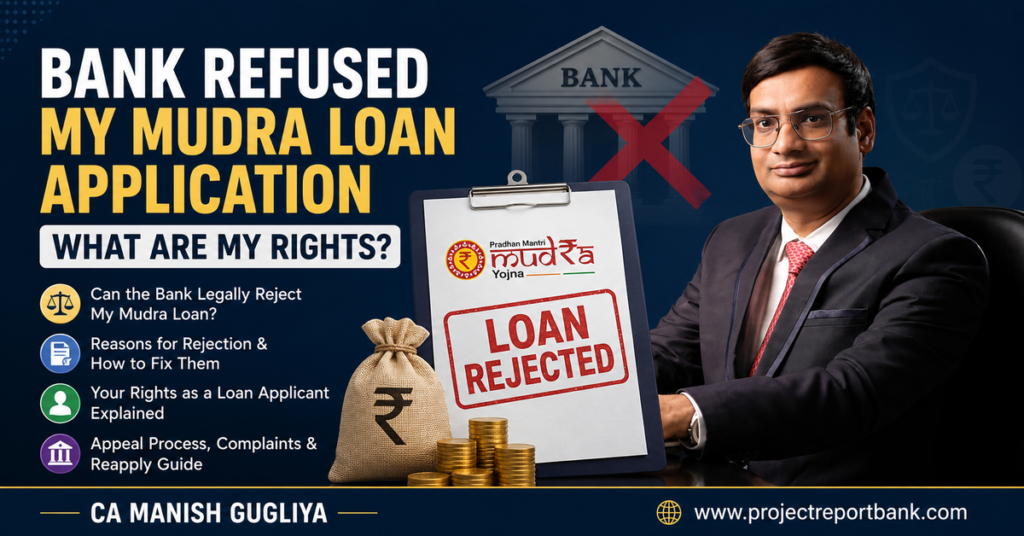
Key Takeaways
- Yes, banks can legally reject your mudra loan application. Eligibility under PM Mudra Yojana does not guarantee automatic loan approval – each bank or financial institution evaluates your credit, repayment capacity, and business viability independently.
- You have the right to receive a written explanation for rejection. Borrowers have the right to receive a written explanation for loan rejection, especially for loans up to ₹2 lakhs, as per RBI’s Fair Practices Code. Lenders must communicate in writing the main reason for rejection for loans up to ₹2 lakhs.
- You can appeal service-related issues through the bank’s grievance redressal and escalate to the RBI Banking Ombudsman if unresolved. Applicants can file a complaint if their loan application is rejected arbitrarily.
- You can reapply for a mudra loan after rejection – at the same bank or a different lender – after identifying and fixing rejection reasons before reapplying.
- A growing number of rejections stem from weak project reports, incomplete or mismatched documents, and poor credit history. Professional help with project reports and CMA data can significantly strengthen a fresh application.
Introduction: When Your Mudra Loan Is Rejected Without Clear Reasons
Imagine this: you walk into your nearest bank branch – say SBI or HDFC Bank – submit your mudra loan application with all the documents you could gather, and wait for 15–20 days. Then someone at the branch tells you the loan is “not sanctioned” or, worse, that the “Mudra scheme is closed.” No written letter, no proper explanation.
This situation is far more common than you might think. Many applicants believe that because Mudra is a government backed scheme, every application must be approved. That is not how it works. As a practising Chartered Accountant with over 20 years in mudra loan consulting and MSME finance, “mudra loan rejected what to do” is one of the most frequent questions I receive from entrepreneurs. This guide covers why banks reject, whether rejection is legal, what your rights are, how to appeal, and how to improve your chances next time.

Table of Contents
What Is PM Mudra Yojana and How Does It Actually Work?
PM Mudra Yojana was launched in April 2015 under the Micro Units Development and Refinance Agency Ltd. (MUDRA). It provides collateral-free loans for non-farm, income-generating small and micro businesses. Mudra loans can be applied for up to ₹20 lakh, and the mudra loan application process is free of charge. Applications can be submitted through banks, NBFCs, or MFIs – you can also apply online through portals like Jan Samarth Mudra Loan.
The scheme covers four categories of loans:
| Category | Loan Amount | Typical Use |
|---|---|---|
| Shishu | Up to ₹50,000 | Small vendors, micro businesses |
| Kishore | ₹50,001 to ₹5 lakh | Expanding shops, service providers |
| Tarun | ₹5 lakh to ₹10 lakh | Established businesses needing working capital or equipment |
| Tarun Plus | ₹10 lakh to ₹20 lakh | Repeat borrowers with good repayment record |
Shishu loans offer up to ₹50,000. Kishore loans range from ₹50,001 to ₹5 lakh. Tarun loans provide between ₹5 lakh and ₹10 lakh. Tarun+ loans extend from ₹10 lakh to ₹20 lakh. Eligible borrowers include shop owners, manufacturers, traders, service providers, and startups. Lending institutions include public sector banks, private banks, regional rural banks, small finance banks, and non banking financial companies. Basic eligibility criteria require a valid business activity, Aadhaar, PAN, and business proof such as Udyam Registration or GST.
Can Banks Legally Reject Mudra Loan Applications?
Yes. Banks reject mudra applications at their sole discretion based on credit appraisal. Mudra yojana is a scheme framework – it does not override a bank’s internal credit policy. Even if you meet all eligibility criteria, the bank may decline based on risk perception, repayment capacity, or business viability.
Terms like “collateral-free” and “government backed” mean the government provides refinance support and guarantee cover – they do not mean every loan application gets a rubber stamp. Most banks evaluate your cibil score, banking behaviour, existing liabilities, and the strength of your business plan before making a decision. Neither the RBI nor the government can force a bank to sanction a specific loan. They can only intervene on process issues – such as a bank refusing to accept your form or misinforming you that the scheme is closed.
Top Reasons Why Mudra Loan Applications Get Rejected
After reviewing thousands of mudra loan rejection cases, here are the most common patterns. For a deeper breakdown, read our guide on reasons for Mudra Loan Rejection.
| Reason | How Bank Sees It | What You Can Do |
|---|---|---|
| Low CIBIL score | High default risk | Clear dues, wait 3–6 months |
| Existing loan defaults | Applicant must not have a history of loan defaults | Settle outstanding loans |
| Incomplete or mismatched documents | Unreliable applicant | Correct KYC, ensure address consistency |
| No business proof | Cannot verify business activity | Get Udyam Registration, shop licence |
| Weak project report | No clarity on fund utilisation | Get professional project report |
| Lack of clear business plan | Bank cannot assess viability | Prepare a clear business plan |
| Unjustified loan amount | Mismatch between need and ask | Match loan amount to actual requirement |
| Poor banking history | Cheque bounces, irregular transactions | Maintain regular transactions for 6 months |
A cibil score below 650 often leads to rejection – though CIBIL score is not mandatory but preferred for mudra loans, a weak score makes branch managers hesitant. Businesses not registered on the Udyam portal face higher rejection rates. Incomplete or mismatched documents cause most mudra loan rejections. Applying for an unjustified loan amount – say requesting ₹10 lakh for a business that earns ₹8,000 monthly – will almost certainly be declined. Common reasons for rejection include low credit scores and insufficient documentation. Mudra loans require proof of ongoing business operations, so if your bank statements show zero business transactions or your business address proof shows a different address from your application, expect trouble. Lack of a clear business plan results in many rejections.
For those with low scores, explore whether a Mudra Loan Without CIBIL Score is feasible – typically only for small shishu loans.
What Are Your Rights After a Mudra Loan Rejection?
You do not have a right to get a mudra loan approved. But you do have procedural and practical rights:
- Right to submit your application and receive acknowledgment. Banks should acknowledge receipt of loan applications and keep applicants informed about processing timelines.
- Right to fair consideration. Your application must be assessed under the bank’s credit policy, not refused outright without review.
- Right to know why. Banks are obligated to provide the reasons for rejecting a loan application. You can request a written rejection from the bank. Under RBI’s Fair Practices Code, lenders must communicate in writing the main reason for rejection.
- Right to use grievance redressal. If a bank refuses to accept your application or misinforms you, you can escalate.
- Right to reapply. You can reapply for a mudra loan after rejection, at the same bank or a different financial institution, once you have addressed the deficiencies.
Banks must not refuse to accept your form or claim the scheme is “closed” when it is active. If they do, insist on submitting and getting a receipt.
What Should You Do Immediately After Your Mudra Loan Is Rejected?
Step 1: Meet the branch manager. Ask specifically which factors – cibil score, missing documents, weak business plan, or income concerns – led to non-sanction. It is essential to correct KYC mismatches to avoid loan rejection.
Step 2: Review your documents. Re-check Aadhaar, PAN, bank statements (last 6–12 months), business registration, rental agreement, utility bill for address proof, GST certificate, and quotations. Mismatched documents – like a different address on PAN versus the application – are a common trigger.
Step 3: Pull your cibil report. Identify any overdue loans, write-offs, or excessive enquiries. A score below 650 significantly hurts your chances.
Step 4: Strengthen your project report. Banks require a basic project report showing how the funds will be utilized for certain category loans – especially kishore and tarun loans. A simple business plan showing realistic income, expenses, and a repayment plan makes a real difference.
Step 5: Fix your banking behaviour. Route business transactions through your current account, avoid cheque bounces, and maintain regular transactions for at least 6 months before reapplying.
Step 6: Decide your next lender. If rejection was due to the branch’s risk appetite, another bank may evaluate differently.
How to Appeal or Complain After a Mudra Loan Rejection
There is no formal appeal that forces a bank to reverse a credit decision. But the grievance redressal process is utilized for resolving loan rejection issues when procedure was not followed. Here is the practical escalation, detailed further in our Mudra Loan Appeal Process guide:
- Branch Manager – discuss and request written reasons.
- Regional / Zonal Office – write to the bank’s MSME cell if the branch is unresponsive.
- Bank Grievance Portal – file a complaint at the bank’s grievance portal after rejection.
- RBI Ombudsman – applicants have the right to lodge a complaint with the Banking Ombudsman if grievances are unresolved. The Reserve Bank of India provides an integrated Ombudsman Scheme for unresolved complaints. Escalate to the RBI Banking Ombudsman if necessary.
- MUDRA Helpline – contact the MUDRA helpline for assistance with rejections.
Keep copies of every document, rejection letter, SMS, and complaint reference number. If rejection is clearly due to poor credit or NPA history, complaints will not change the decision – focus on rebuilding your credit history instead.
Can You Apply to Another Bank After Mudra Loan Rejection?
Yes. Each lender – whether a public sector bank like Canara Bank, a private bank, or a small finance bank – conducts its own appraisal. Rejection at one institution does not automatically bar you elsewhere. Mudra loans are available through banks and NBFCs, and you can approach any of them.
However, your cibil report will show previous enquiries. Avoid submitting multiple simultaneous mudra applications – space them out and fix the underlying issues first. Only one active Mudra loan per PAN is generally permitted. Different lenders have different appetites: regional rural banks may be more open to small shishu loans in semi-urban areas, while larger banks may prefer Kishore-level documentation. You can also apply online through the Complete MSME Mudra Loan Guide process.
Documents and Project Report That Improve Mudra Loan Approval Chances
Strong documentation is often what separates mudra loan approved applicants from rejected ones. Here is what matters:
- KYC: Aadhaar, PAN, photographs, business address proof (rental agreement, utility bill, or ownership papers)
- Business proof: Udyam Registration is recommended for mudra loan applications. GST registration if applicable – for certain activities, a Mudra Loan Without GST may still be possible for shishu loans
- Financial documents: Bank statements (6–12 months showing transaction history), ITRs where available
- Quotations: For machinery, equipment, or stock – realistic, not inflated
- Project report: A detailed bankable project report with cost estimates, sales projections, cash flow, DSCR calculation, and break-even analysis. For the full checklist, see Mudra Loan Documents Required.
For kishore and tarun loans, CMA Data – covering fund flow, ratios, and working capital assessment – is critical. Accurately prepared CMA builds bank confidence in your numbers.
How a Professional Project Report and CMA Data Help You Re-Apply Successfully
In my practice, the single most impactful change we often make for rejected applicants is preparing a proper bankable project report and CMA data. Many applicants come with a one-page basic business plan that tells the bank nothing about money flow, break-even, or debt servicing.
A strong project report includes: promoter background, detailed business activity description, asset list with loan amount breakup, realistic revenue and expense forecasts, cash flow showing how EMI will be serviced, and sensitivity analysis. When the bank’s credit officer sees a DSCR above 1.5 and consistent cash flow, the comfort level rises significantly. Interest rates, repayment terms, and sanction probability all improve with better documentation.
Common Mistakes to Avoid in Mudra Loan Applications
Many applicants do not qualify simply because they repeat avoidable errors. Applying for tarun loans without any existing business track record almost guarantees rejection. Submitting inflated quotations or fake business proof gets flagged immediately. Not routing income through your bank account means the bank sees no turnover. Frequent cheque bounces signal financial stress. Not checking your cibil report before applying is like walking into an exam without studying.
Other common mistakes: leaving blanks on the mudra loan application form, using mismatched signatures, relying on agents promising “guaranteed mudra loan approval” in exchange for money, submitting unclear photocopies without carrying originals, ignoring SMS requests for additional documents, and filing multiple loan applications at the same bank simultaneously. Before your next application, use a checklist.
Expert Tips from CA Manish Gugliya
- Start with a realistic loan amount matched to your repayment capacity, not your wish list.
- Build 6–12 months of banking history with regular transactions, even for small shishu loans.
- Use Udyam Registration as standard business proof – it is free and improves credibility.
- Separate personal and business banking using a proper current account.
- Maintain clean credit by paying every EMI on time.
- Prepare a simple business plan before visiting the bank branch – even a two-page document helps branch managers understand your business.
- Choose a lender where you already have a positive relationship and transaction history.
- Apply when your bank statements show stable or rising turnover, not immediately after heavy withdrawals.
Even if one or two banks refuse, systematically applying these tips over 6–12 months raises your chances considerably.
Real-Life Style Case Study: From Rejection to Mudra Loan Sanction
“Ravi,” a 29-year-old mobile repair shop owner in Indore (Madhya Pradesh), applied in January 2025 for a ₹4 lakh Kishore Mudra loan at a large PSU bank. His application was rejected – cibil score was 620, bank statements showed irregular deposits, and his project report was a single-page document prepared by a local agent.
Ravi visited the branch manager, who explained the specific issues. He then cleared a small overdue personal loan, opened a separate current account for his shop, and routed all sales through banking channels for six months. He obtained Udyam Registration and approached ProjectReportBank.com for a customised project report with five-year projections and a DSCR above 1.5.
In September 2025, Ravi applied to a regional rural bank with the improved profile. The bank sanctioned ₹3.5 lakh – slightly less than requested, which is realistic. The key lesson: fixing the actual rejection reasons and presenting a professional project report converted a “No” into a “Yes.”

Frequently Asked Questions
If my Mudra loan is rejected once, how long should I wait before reapplying?
It depends on why you were rejected. If the issue was incomplete documents, you can reapply within weeks after correcting them. If cibil score or banking behaviour was the problem, wait 3–6 months while clearing dues and building a positive transaction history. Rushing back to the same bank without changes will likely result in the same outcome.
Can the bank reduce my requested loan amount instead of rejecting it?
Yes. Many banks offer partial sanction – approving a lower loan amount that matches your demonstrated repayment capacity. If this happens, consider accepting it, building a repayment track record, and then applying for enhancement later. Partial sanction is better than outright rejection.
Does opening a current account guarantee mudra loan approval?
No. A current account helps because it shows the bank your business activity and transaction history. But loan approval depends on overall credit appraisal – your cibil score, business viability, project report, and documentation all matter. Think of a current account as one strong factor, not a guarantee.
Is there any fee to file a complaint about mudra loan rejection?
Complaints to the RBI Integrated Ombudsman Scheme are free. You do not need a lawyer or consultant to file them. Similarly, complaints on the bank’s internal grievance portal or CPGRAMS cost nothing. Be wary of anyone charging money to “get your complaint resolved.”
Can students or homemakers get Mudra loans without prior business experience?
Technically, any Indian citizen with a viable business idea can apply. However, many applicants without prior experience struggle because banks look for evidence of business activity. First-time entrepreneurs should start with a small Shishu loan, prepare even a simple business plan, and consider reading our Mudra Loan for Startups guide for practical steps.
Conclusion and Call to Action
Mudra loan rejection is common and lawful – but it is not the end of your entrepreneurial journey. You have rights to fair treatment, written reasons, and grievance redressal. More importantly, with the right documents, a professional project report, correct CMA Data, and improved financial behaviour, many small business owners succeed on their second or third attempt.
If your mudra loan application has been rejected due to a weak project report, inaccurate financial projections, documentation gaps, or poorly prepared CMA Data, consider getting professional assistance. At ProjectReportBank.com, CA Manish Gugliya and his team prepare customised bankable Project Reports and CMA Data tailored to your business and lender requirements.
No consultant can guarantee loan approval – but professional documentation significantly increases the chances of a positive credit decision when your underlying business is viable.
About CA Manish Gugliya
CA Manish Gugliya is a practising Chartered Accountant (FCA) with over 20 years of experience in project report preparation, CMA Data, Mudra loan consulting, MSME advisory, startup consulting, financial projections, business valuation, and bank loan documentation. He has assisted thousands of entrepreneurs across India – from first-time shop owners to established MSMEs – in preparing bankable project reports and financial documents for Mudra Loans and other business finance products. Through ProjectReportBank.com, he and his team offer customised state-specific project reports aligned with bank formats, RBI norms, and PMMY guidelines. His commitment is to practical, ethical advice and realistic expectations – never a promise of guaranteed approval.
- Can Bank Reduce Mudra Loan Amount Without Your Consent? Complete Practical Guide (2026)


- What to Do If You Cannot Pay Your Mudra Loan EMI (2026 Guide)

- Can a Bank Refuse a Mudra Loan Because the Target Is Completed? Complete Guide (2026)

- Bank Refused My Mudra Loan Application – What Are My Rights?

- Mudra Loan for Used Vehicles (2026): Eligibility, Documents, Bank Rules & Complete Guide

- Rejected Mudra Loan – What to Do Next? Appeal Process Explained (2026)

- Mudra Loan Project Report Madhya Pradesh – Bank-Ready DPR & CMA Guide

- Project Report for Mudra Loan Maharashtra: Complete Guide for MSMEs, Startups and Small Businesses (2026)

- Mudra Loan Uttar Pradesh: Complete Guide for MSMEs, Startups and Small Businesses (2026)

- Mudra Loan Bihar 2026: Eligibility, Documents, Online Application Process & Project Report Guide

- Jan Samarth Mudra Loan 2026: Complete Guide to Online Application, Eligibility, Documents & Approval Process

- MSME Mudra Loan: Complete Guide for Small Businesses, Startups & Manufacturing Units in India (2026)

- Is the Mudra Loan Subsidy Real or Fake? Get the Facts Here

- Mudra Loan Without CIBIL Score: How to Qualify and Apply

- Mudra Loan for Used Machine (2026 Guide) – Eligibility, Documents, Valuation & Approval Tips