Mudra loans are now available up to ₹20 lakh under Pradhan Mantri Mudra Yojana, but the reality of who can actually access this higher limit is often misunderstood. A Mudra loan supports formal institutional credit access for micro-enterprises, and the scheme encourages entrepreneurship among small businesses across India. However, the ₹20 lakh ceiling does not mean every applicant can walk into a bank and request that amount.
This guide explains the latest rules, clarifies the eligibility criteria, and helps you understand whether you can realistically get a mudra loan 20 lakh for your business.
Key Takeaways
- A mudra loan 20 lakh is now possible under the new Tarun Plus category, but only for eligible borrowers who have previously availed and successfully repaid a Tarun category loan (₹5 lakh to ₹10 lakh).
- The Mudra Loan limit of ₹20 lakh is a scheme ceiling, not a guaranteed sanction. Each borrower’s actual loan amount depends on the lending bank’s credit appraisal, business viability check, and repayment capacity assessment.
- Tarun Plus (covering loans above ₹10 lakh and up to ₹20 lakh) became effective from 24 October 2024 and is not open to first-time mudra applicants directly.
- Mudra loans remain collateral-free under Pradhan Mantri Mudra Yojana, but detailed financial and business scrutiny applies for amounts above 10 lakh.
- ProjectReportBank.com, guided by CA Manish Gugliya (FCA, 20+ years experience), provides professional project report and CMA data support for Mudra and MSME business loans.
Can You Get a Mudra Loan of ₹20 Lakh?
Yes – but only under the Tarun Plus category, and only if you meet specific eligibility criteria. Loans are available for amounts up to ₹20 lakh under the current PMMY framework.
Here is the critical distinction most entrepreneurs miss:
- The maximum scheme ceiling is ₹20 lakh. That is the upper boundary the government has set.
- The actual sanctioned amount for any individual borrower depends entirely on what the bank determines after evaluating your business, cash flow, credit history, and repayment capacity.
A “mudra loan 20 lakh” does not mean every applicant can apply for ₹20 lakh as their first loan. Eligibility for Tarun Plus requires a previous loan repayment under the Tarun category. Without that track record, the Tarun Plus bracket is simply not available to you.
Even if you are eligible, the bank may sanction ₹12 lakh, ₹15 lakh, or ₹18 lakh instead of the full ₹20 lakh – based purely on how your proposal and financials stack up.
For a broader overview of the Tarun Plus Mudra Loan category, including its detailed terms and features, refer to the dedicated guide on ProjectReportBank.com.
Table of Contents
What Is the Latest ₹20 Lakh Mudra Loan Rule Under PMMY?
The overall Mudra Loan maximum limit under PMMY has been enhanced from ₹10 lakh to ₹20 lakh through the introduction of a new category called Tarun Plus.
Key facts about this change:
- Tarun Plus is the new category for loans above ₹10 lakh and up to ₹20 lakh under Pradhan Mantri Mudra Yojana.
- The enhancement was announced in the Union Budget 2024–25 and the Gazette Notification making it effective was issued on 24 October 2024.
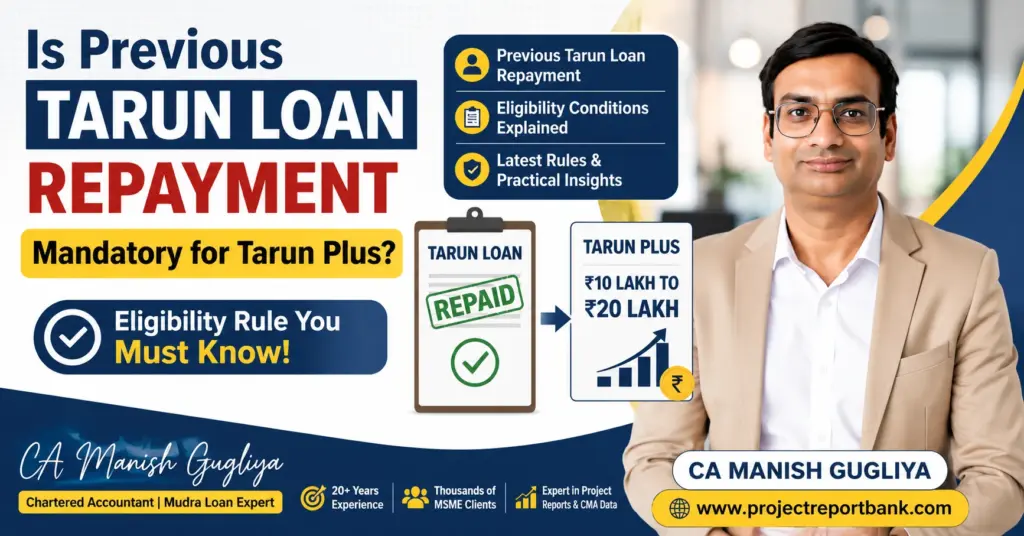
- Tarun Plus is available only to entrepreneurs who have already availed a Tarun loan (₹5 lakh to ₹10 lakh) and have successfully repaid it, with proper loan closure and NOC where applicable.
- Earlier articles mentioning the Mudra Loan ceiling of ₹10 lakh are now outdated. Applicants should follow the latest PMMY rules issued by the ministry of finance through the Department of Financial Services.
The Pradhan Mantri Mudra Yojana has disbursed more than ₹40.07 lakh crore across 57.79 crore loans since launch – the Tarun Plus expansion is the next phase of this scheme’s evolution.
Who Can Get a Mudra Loan Above ₹10 Lakh (Tarun Plus Eligibility)?
A mudra loan 10 lakh to 20 lakh falls under the Tarun Plus bracket and is not open to every PMMY applicant.
The core Tarun Plus eligibility criteria are:
- Previous Tarun loan: You must have availed a Mudra loan in the Tarun category (above ₹5 lakh and up to ₹10 lakh).
- Successful repayment: That Tarun loan must be fully repaid – all EMIs cleared, no major overdue, loan marked closed in the bank system.
- Satisfactory conduct: Ideally, you should have obtained a Mudra Loan NOC after closure as proof of successful repayment.
- Age: Applicants must be aged between 18 to 65 years.
In practical terms, an entrepreneur wanting ₹12 lakh, ₹15 lakh, or ₹18 lakh after repaying an earlier Tarun loan falls squarely into the Mudra Loan above 10 lakh category – provided the bank’s appraisal supports it.
Beyond PMMY rules, the bank will also check your CIBIL or equivalent credit reports, existing liabilities, business performance, and cash flow before deciding the sanction amount. A satisfactory credit track record across all your obligations matters, not just Mudra repayment.

Can a First-Time Mudra Applicant Get ₹20 Lakh?
No. A fresh Mudra applicant cannot normally get a direct 20 lakh Mudra Loan under Tarun Plus.
First-time applicants usually enter PMMY through Shishu, Kishore, or Tarun categories depending on their project size and funding requirement – but not directly into Tarun Plus. The mudra scheme design expects entrepreneurs to progress step-by-step:
- Start with a smaller Mudra loan (Shishu or Kishore)
- Move to Tarun after building a track record
- Only then become eligible for Tarun Plus after proven repayment history
Banks may still finance higher requirements for new businesses through other MSME business loans or term loans outside PMMY, based on security and appraisal. But under the mudra scheme itself, assuming direct eligibility for 20 lakh as a first loan can lead to rejection or delay. Applicants should structure proposals realistically.
Who Cannot Directly Get a ₹20 Lakh Mudra Loan?
Several categories of applicants generally cannot directly access a PM Mudra Loan 20 lakh:
- First-time entrepreneurs who have never taken any Mudra loan and therefore do not meet the Tarun Plus prior-Tarun condition.
- Shishu or Kishore-only borrowers who have successfully repaid previous loans in those categories but have never moved into the Tarun bracket.
- Defaulting Tarun borrowers who had a Tarun loan but defaulted, settled at a lower amount, or have irregular repayment history – “successfully repaid” is not met.
- Weak-profile applicants with low credit scores, heavy existing EMIs, or a non-viable business plan may also be declined even if they technically meet the prior-Tarun condition.
- Applicants whose project cost doesn’t justify the amount – if your business needs only ₹8 lakh, forcing a ₹20 lakh application raises red flags.
Banks assess the nature of your proposed activity, the viability of your business plan, and whether existing loans affect your Mudra Loan eligibility.
Mudra Loan Categories After the ₹20 Lakh Limit Increase
Mudra loans are classified into four categories under PMMY, each representing a stage of business growth and funding size. You can think of them as phases – each designed for a particular sector and scale of enterprise.
| Category | Loan Range | Who It’s For |
|---|---|---|
| Shishu | Up to ₹50,000 | Shishu loans offer up to ₹50,000 for startups, street vendors, micro traders, and early-stage home-based businesses needing small working capital |
| Kishore | ₹50,001 to ₹5 lakh | Kishore loans range from ₹50,001 to ₹5 lakh for growing micro enterprises, basic machinery purchases, and slightly larger operations |
| Tarun | Above ₹5 lakh to ₹10 lakh | Tarun loans provide ₹5 lakh to ₹10 lakh for established businesses planning expansion, additional equipment, or capacity enhancement |
| Tarun Plus | Above ₹10 lakh to ₹20 lakh | Tarun Plus loans range from ₹10 lakh to ₹20 lakh, specifically for entrepreneurs who previously availed and repaid a Tarun loan |
For a more detailed comparison of all types of Mudra Loans, including Shishu, Kishore, Tarun, and Tarun Plus categories, see the dedicated guide.

Is ₹20 Lakh Automatically Sanctioned After Repaying a Tarun Loan?
No. Even if you qualify for Tarun Plus by repaying a Tarun loan, there is no automatic right to get a full ₹20 lakh Mudra Loan. Borrowers should distinguish between scheme eligibility and bank sanction – these are fundamentally different things.
Key appraisal factors the bank will evaluate:
- Business turnover trends and profit margins
- Cash flow adequacy and projected Debt Service Coverage Ratio (DSCR)
- Existing loans and current EMI burden
- Credit profile – CIBIL score and overall repayment behaviour
- Bank statements showing genuine business transactions
- GST returns and ITR demonstrating compliance and income
- Project report with realistic cost estimates and revenue projections
In practical banking situations, many Tarun Plus applicants receive less than the requested amount. Someone asking for ₹20 lakh might get ₹14 lakh or ₹16 lakh if the bank determines that is what the business genuinely requires and can repay.
Can You Apply for ₹12 Lakh, ₹15 Lakh or ₹18 Lakh Instead of the Full ₹20 Lakh?
Yes. Under Tarun Plus, any amount above ₹10 lakh and up to ₹20 lakh is permissible based on need and eligibility. The ₹20 lakh figure is the upper ceiling, not a compulsory loan amount.
A common misunderstanding among applicants is that requesting the maximum always helps. In reality:
- Banks prefer clearly explained funding needs with proportional promoter contribution
- Seeking the highest possible amount without justification can weaken your case
- Entrepreneurs should break down the requirement into machinery cost, renovation, stock, marketing, and margin money to show how their chosen figure was arrived at
A well-prepared project report and CMA data can help the banker understand why a mid-range Tarun Plus amount (say ₹14 lakh or ₹17 lakh) is more appropriate than always insisting on the full 20 lakh Mudra Loan limit.
Example – Who May Qualify for Tarun Plus (Illustrative Case)
Consider Ms. Sharma, who runs a small food processing unit. In 2022, she took a Tarun Mudra loan of ₹8 lakh to purchase processing equipment. She repaid it fully by mid-2025 – every EMI cleared on time, no defaults, clean bank statements throughout.
Now she needs ₹15 lakh to buy a larger machine, expand her workspace, and increase raw material stock. Her situation:
- Good repayment history on previous Tarun loan
- Regular GST and ITR filing showing stable turnover
- Clean bank statements reflecting genuine business transactions
- Clear project cost breakdown for the expansion
The bank reviews her project viability, DSCR, and existing term loans before finalising the sanctioned amount. They approve ₹15 lakh under Tarun Plus – not the ₹18 lakh she initially requested – because the business plan supports ₹15 lakh comfortably.
This case shows the intended progression: Shishu/Kishore → Tarun → Tarun Plus, with each phase backed by repayment track record and demonstrated business growth.
Example – Who Cannot Directly Apply Under Tarun Plus (Illustrative Case)
Mr. Kumar wants to start an auto repair workshop in 2026 and needs ₹18 lakh. He has never taken any Mudra loan before and has limited banking track record. He heard that PM Mudra Loan 20 lakh is available without collateral and wants to apply directly.
Under current PMMY rules, Mr. Kumar cannot claim Tarun Plus because:
- He has no previous Tarun loan to his credit
- The “successfully repaid” condition cannot be satisfied
- His lack of Mudra repayment history means the bank has no reference point for his loan behaviour under the scheme
Mr. Kumar may explore other MSME business loans or term loans where collateral or a co-borrower might be needed. Alternatively, he could begin with a Tarun loan (up to ₹10 lakh), build his business, repay it, and then become eligible for Tarun Plus in the next phase.
Tarun Plus is a progression-based product, not an entry-level ticket to a high-limit collateral-free loan.
Is a ₹20 Lakh Mudra Loan Collateral-Free?
Yes. Mudra loans offer collateral-free financing up to ₹20 lakh under PMMY as per current official guidelines. No collateral is required for loans up to ₹10 lakh, and the Tarun Plus extension to ₹20 lakh also remains collateral-free under the scheme rules.
Important distinctions:
- Banks may take primary security over assets created from the loan (machinery, equipment, stock purchased), but this is not the same as external property collateral.
- The Credit Guarantee Fund for Micro Units (CGFMU) from NCGTC covers eligible Mudra loans, giving banks confidence to lend without demanding separate collateral from the beneficiary micro unit.
- Loans under PMMY are collateral-free up to ₹10 lakh by explicit scheme mandate, and this collateral-free nature extends to Tarun Plus as well.
“Collateral-free” does not mean “no evaluation.” Banks still follow full KYC, credit checks, cash-flow analysis, and business viability appraisal – especially for a Mudra Loan above 10 lakh.
Interest rates for Mudra loans are generally lower than traditional loans, and the interest rate under Mudra is decided by each bank or financial institution within regulator guidelines, often comparable with other MSME loans and linked to risk rating.
What Can a ₹20 Lakh Mudra Loan Be Used For?
A Mudra Loan 20 lakh is strictly for income-generating micro and small business activities – not for personal or speculative use. Loans are available for various income-generating activities across multiple sectors.
Typical eligible uses include:
- Machinery and equipment: Purchase of capital assets for small manufacturing units, service centres, repair workshops, and processing units
- Working capital: Stocking inventory, raw materials, spares, and managing day-to-day business expenses tied to revenue generation
- Business expansion: Adding production lines, upgrading technology, expanding shop or outlets
- Sector examples: Eligible businesses include shop owners, vendors, and service providers. Also eligible are trading businesses, small restaurants, salons, clinics, local logistics services, food processing units, and allied agriculture activities like dairy or poultry processing
Loans can be used for business expansion, purchasing equipment, or managing working capital – any proposed activity that generates income for the micro enterprise.
Agricultural businesses are not eligible for Mudra loans. Core agricultural production (crop farming, plantation, land development) falls outside PMMY scope and must be financed under separate agriculture schemes by the government of India.

Documents a Bank May Check for a Mudra Loan Above ₹10 Lakh
Documentation requirements vary by bank and borrower profile, but larger Mudra Loan amounts (10 lakh to 20 lakh) naturally attract more scrutiny. That said, Mudra loans are processed quickly with minimal documentation when all papers are in order – applications are processed within a few days if documents are complete.
Personal and business KYC:
- Aadhaar, PAN, address proof, photographs
- Business registration papers: GST registration, Udyam Registration, shop licence, partnership deed, or other legal entity incorporation documents
Financial documents:
- Last 6–12 months bank statements
- Recent ITRs (2–3 years where applicable)
- GST returns showing regular and compliant filings
- Basic profit & loss and balance sheet for the enterprise
Tarun-specific proof:
- Previous Tarun loan sanction letter and repayment track
- Closure letter or Mudra Loan NOC after closure to prove successful repayment
Project documentation:
- Structured project report with cost estimates
- Quotations for machinery or equipment
- Projected cash flows, sales estimates, and break-even analysis
Loan applications can be submitted online or through participating lending institutions. You can apply through banks, NBFCs, or MFIs – and you can apply for a Mudra loan online or offline, depending on the lender’s process. You can also apply online through the Udyamimitra portal.
Why a Project Report Becomes Important for a Higher Mudra Loan Amount
In my professional experience with MSME project reports, the difference between a ₹5 lakh proposal and a ₹15-20 lakh proposal is significant – not just in amount, but in the level of detail the bank expects.
When an entrepreneur seeks a Tarun Plus Mudra Loan of ₹10 lakh to ₹20 lakh, the credit officer needs clarity on:
- Total project cost and means of finance (loan plus promoter’s own contribution)
- Machinery or equipment cost with supporting quotations
- Working capital requirement with stock and receivable cycle
- Projected sales, operating expenses, and profitability
- Cash flow projections showing surplus for EMI coverage
- DSCR (Debt Service Coverage Ratio) and break-even analysis
From a project-finance perspective, a professionally prepared project report does not guarantee sanction. But it helps present the business model, risk factors, and mitigation strategies in a clear, banker-friendly format. Without it, the bank may view the proposal as vague and either reject or scale down the loan extended.
Whether a project report is mandatory for Mudra Loan depends on the specific lender, but for amounts above ₹10 lakh, having one dramatically improves your chances. ProjectReportBank.com specialises in preparing Mudra Loan project reports and CMA data, helping individual borrowers and non corporate small businesses present robust financials to commercial banks and small finance banks.
Does Successfully Repaying Tarun Guarantee Tarun Plus Approval?
No. Repayment of a Tarun loan is a necessary condition to enter the Tarun Plus category – it is not a guarantee of sanction.
Banks still conduct full credit appraisal, verify business performance, assess future plans, and ensure that the proposed Tarun Plus amount is justified. Issues like delays in earlier EMIs, cheque bounces, or weak current financials can lead to partial sanction or even rejection, despite formal Tarun loan closure.
The distinction is straightforward:
- PMMY scheme rules define who may apply (category eligibility)
- Bank’s internal credit policy decides how much can actually be sanctioned
Applicants should focus on strengthening their banking behaviour, documentation, and business results well before approaching the bank for a higher Mudra Loan amount. An applicant who has successfully repaid previous loans and maintained clean financial discipline will always be assessed based on stronger footing.
Common Misunderstandings About the ₹20 Lakh Mudra Limit
Myth: “Every small business can now get a 20 lakh Mudra Loan.” Reality: Only Tarun Plus-eligible borrowers – those who have availed and repaid a Tarun loan with a satisfactory profile – can even be considered for above 10 lakh. This is not financial assistance available to everyone by default.
Myth: “Once I clear my Tarun loan, the bank must automatically give me 20 lakh.” Reality: Repayment provides access to the Tarun Plus category. Sanction still depends on appraisal of business viability, turnover, and repayment capacity.
Myth: “If the loan is collateral-free, approval is easy.” Reality: Collateral-free only removes the need for property security. All other checks – CIBIL, income verification, turnover analysis, and document scrutiny – remain strict.
Myth: “It is always smarter to ask for the full ₹20 lakh.” Reality: Overstating your requirement without matching business potential and a credible business plan can lead to rejection or lower sanction. Realistic funding aligned with genuine project cost works better.
What If You Need More Than ₹10 Lakh but Are Not Eligible for Tarun Plus?
Entrepreneurs who need ₹12–15 lakh or more but do not satisfy Tarun Plus conditions should not force-fit themselves into Mudra. The mudra scheme has specific guidelines, and trying to circumvent them creates problems.
Alternative routes to explore:
- Regular MSME term loans and working capital limits (CC/OD) from commercial banks or NBFCs outside PMMY, where security, guarantees, or co-borrowers may be required
- State government MSME schemes that may offer financial assistance with different eligibility criteria
- Phased funding: Start with a Tarun loan (up to ₹10 lakh), establish performance, repay it, then move to Tarun Plus
Do not misrepresent or split projects artificially just to fit into Mudra categories. This can create future compliance and repayment issues. Discuss options with your existing bank branch, sharing a realistic project cost and collateral position.
ProjectReportBank.com can help structure your proposal and projections even for non-Mudra MSME business loans if Tarun Plus is not applicable to your situation. The knowledge and necessary skills to present a strong funding proposal apply regardless of which scheme you undertake.
How to Improve Your ₹20 Lakh Mudra Loan Proposal
Here are practical, action-oriented steps to strengthen your application before approaching the bank:
- Clean repayment history: Maintain timely EMI payments on all existing loans. Avoid cheque bounces and clear any overdue before filing a new application. Your discipline on previous loans of any nature matters.
- Route business through your bank account: Ensure all revenue and expenses flow through your bank account so statements reflect real business transactions. This helps the bank verify turnover claims.
- File GST and ITR on time: Regular compliance shows the bank you are running a legitimate, trackable enterprise. Micro enterprises engaged in any sector benefit from demonstrating proper tax compliance.
- Prepare realistic financial projections: Show how the additional funds (say ₹12–18 lakh) will expand revenue and generate enough surplus to comfortably cover EMIs. Do not signify inflated numbers that you cannot defend.
- Full disclosure of existing liabilities: Banks check external credit reports alongside your application. Hiding other loans backfires. The bank will possess this information regardless.
- Contribute your own margin: Borrowers usually need a margin contribution of around 20% for project costs. Investing your own funds improves the perceived commitment and risk-sharing. Do not rely entirely on bank finance.
- Get a professionally prepared project report: A strong project report with CMA data from an experienced CA gives credibility to your proposal. It should cover project cost, means of finance, projected profitability, and repayment schedule.
- Keep previous loan closure proof ready: Obtain closure certificate or NOC from the bank where you repaid your Tarun loan. This serves as a reference point for the new lender.

Need a Project Report for Your Mudra Loan?
When you are seeking a Tarun Plus Mudra Loan between ₹10 lakh and ₹20 lakh, the way you present your business proposal matters as much as the business itself. A professionally structured project report can present project cost, means of finance, projected profitability, cash flow, and repayment capacity in an organised manner that bankers expect.
At ProjectReportBank.com, guided by CA Manish Gugliya (FCA), we prepare project reports and CMA data specifically for Mudra and MSME loan proposals. Our reports are designed to match what banks look for – realistic assumptions, clear breakdowns, and defensible projections.
A project report does not guarantee loan approval. But it presents your case with the clarity and professionalism that eligible borrowers need when seeking larger amounts from any bank or financial institution.
Frequently Asked Questions
Is the interest rate for a 20 lakh Mudra Loan fixed by the government?
No. Interest rates for Mudra loans are set by individual lenders based on various factors including their base rate/MCLR, external benchmark, risk rating of the borrower, and internal credit policy. There is no single government-fixed interest rate for Mudra. Each bank, NBFC, or financial institution decides its own rate within regulatory guidelines. However, interest rates for Mudra loans are generally lower than traditional business loans since the credit guarantee reduces lender risk.
Can a Kishore borrower directly jump to Tarun Plus for ₹20 lakh?
No. A borrower who has only taken a Kishore loan (upto rs ₹5 lakh) cannot normally jump straight to Tarun Plus. They would first need to avail and successfully repay a Tarun loan (₹5 lakh to ₹10 lakh). The progression is designed to be incremental – Kishore → Tarun → Tarun Plus. There is no educational qualification or other shortcut that bypasses this requirement.
What is the usual repayment period for Mudra Loans in the ₹10–₹20 lakh range?
Repayment tenure is decided by the lending institution based on the nature of the project and projected cash flows. Term loan tenures typically range from 3 to 7 years, though repayment periods for Mudra loans can extend up to 84 months in some cases. Working capital limits may have shorter renewal cycles, often annually. For detailed information, refer to the guide on Mudra Loan repayment period.
Do I always need a CA-prepared project report for Tarun Plus?
Not every bank mandates a CA-prepared project report by rule. However, for practical purposes, having a professionally prepared project report significantly improves the clarity and presentation of a 20 lakh Mudra Loan proposal. When the loan amount crosses ₹10 lakh, banks want to see structured data – project cost, profitability, DSCR, and break-even. A report from an experienced CA helps present this systematically.
Is there any subsidy available on a ₹20 lakh Mudra Loan under PMMY?
There is no direct interest subsidy under PMMY for Tarun Plus loans. The primary benefit is collateral-free access to credit and coverage under the Credit Guarantee Fund for Micro Units (CGFMU) operated by NCGTC, which acts as a refinance agency support mechanism. The bank may charge a guarantee fee to the borrower. MUDRA stands for Micro Units Development and Refinance Agency, and its role is to facilitate and extend funding access – not to provide direct subsidy on loans.
In summary: Yes, Mudra financing can go up to ₹20 lakh, but the above-₹10 lakh to ₹20 lakh bracket falls under Tarun Plus and is specifically meant for entrepreneurs who previously availed and successfully repaid a Tarun-category loan. Meeting this condition establishes access to the category – it does not guarantee sanction of ₹20 lakh. Your final loan amount remains subject to the lender’s assessment of your business proposal, funding requirement, repayment capacity, and applicable credit criteria.
If you are planning to apply, focus on building strong fundamentals: clean repayment records, genuine business performance, and a well-prepared project report that makes your case clearly.
- Is Previous Tarun Loan Repayment Mandatory for Tarun Plus? (Tarun Plus Eligibility & Previous Loan Clarified)

- Kishor to Tarun Plus Mudra Loan: Can You Skip Tarun and Apply Directly?

- Can First-Time Mudra Borrowers Get ₹20 Lakh Under Tarun Plus?

- Mudra Loan Interest Rate 2026 – Has It Really Changed in FY 2026-27?

- Is There Any New Subsidy on Mudra Loan in 2026? Latest Update for FY 2026-27

- Is Mudra Loan Available in 2026? Latest PMMY Status Explained for 2026-27

- Mudra Loan Latest Update 2026-27: What Borrowers Should Know (By CA Manish Gugliya)
- Mudra Loan Old vs New Rules: What Has Changed in 2026-27?

- Can You Get a Mudra Loan Up to ₹20 Lakh? Latest Rules Explained