Modern roller flour milling is not simply wheat grinding. It is a controlled, multi-stage industrial process designed to systematically separate the wheat kernel into its anatomical components-endosperm, bran and germ-and convert them into distinct commercial products. The roller flour milling process transforms raw wheat into refined flour through a carefully engineered sequence of cleaning, conditioning, gradual size reduction, sifting, purification and product separation.
The configuration of a flour mill varies according to wheat variety, desired flour specifications, extraction rate, product mix, plant capacity and degree of automation. Understanding this process is essential for any entrepreneur, manufacturer or investor evaluating a roller flour mill project.
Key Takeaways
- The roller flour milling process is a controlled sequence where wheat passes through cleaning, conditioning, break rolls, plansifters, purifiers and reduction rolls before being separated into atta, maida, suji and bran. The milling process follows stages of cleaning, conditioning, breaking, sifting, purification, and reduction.
- Modern roller flour mills aim to separate wheat endosperm from bran and germ as efficiently as possible. Process design depends on wheat type, extraction rate, mill design and desired product mix.
- The process flow chart typically follows: wheat receiving → pre-cleaning → storage → fine cleaning → conditioning/tempering → multiple break rolls → plansifters → purifiers → reduction rolls → repeated sifting → product bins → blending → packing.
- Commercial factors like extraction rate, yield, flour quality and energy use are directly influenced by how well the milling process is designed, controlled and automated.
- For a realistic Detailed Project Report or project report on a roller flour mill, the technical milling process and flow sheet must be aligned with capacity, machinery configuration and market requirements.
What Is the Roller Flour Milling Process?
The roller flour milling process is the industrial wheat flour manufacturing process where wheat kernels are gradually broken open and the endosperm is separated from bran and germ using pairs of rotating steel rollers, plansifters and purifiers. Wheat flour milling involves shearing, scraping, and size reduction across multiple controlled stages.
The basic working principle of a roller mill involves:
- Two horizontal rolls rotating at different speeds, creating a speed differential that draws in wheat or stock
- Compression and shear forces that break particles and release endosperm from the bran layers
- Roll surface adjusted for each passage-corrugated (fluted) surfaces for break rolls, smooth surfaces for reduction rolls
- Roll gap carefully set at each stage to control particle size and extraction
Modern roller flour milling uses multiple stages-break system, purification, reduction system and repeated sifting-instead of a single grinding operation. This provides better control over particle size, ash content, flour colour and extraction rate. Roller flour milling is a controlled multi-stage process rather than a single grinding operation.
Traditional stone chakki milling produces whole wheat atta with all bran and germ present, typically generating more heat and less control over particle size. Industrial roller flour mills, by contrast, are designed for selective separation and can produce different products-atta, maida, suji and bran-from the same wheat. The entire process is designed around the wheat kernel anatomy, and the objective is to maximise usable endosperm as flour while maintaining the product specifications required by bakeries, biscuit manufacturers and other buyers.
Roller Flour Mill Process Flow Chart
The following is a simplified roller flour mill process flow chart showing the major steps from wheat receiving to finished-product packing.
Wheat Receiving ↓ Pre-Cleaning ↓ Storage / Wheat Silos ↓ Fine Cleaning (Separator, Aspirator, Grader) ↓ Magnetic Separation ↓ Destoning (Stone Removal) ↓ Wheat Scouring ↓ Wheat Conditioning / Tempering ↓ First Break Rolls ↓ Plansifter ↓ Purifiers ↓ Additional Break Rolls (B2, B3…) ↓ Reduction Rolls (Smooth) ↓ Repeated Sifting ↓ Bran Separation ↓ Atta / Maida / Suji Streams ↓ Blending / Fortification (where applicable) ↓ Packing ↓ Finished Product Storage
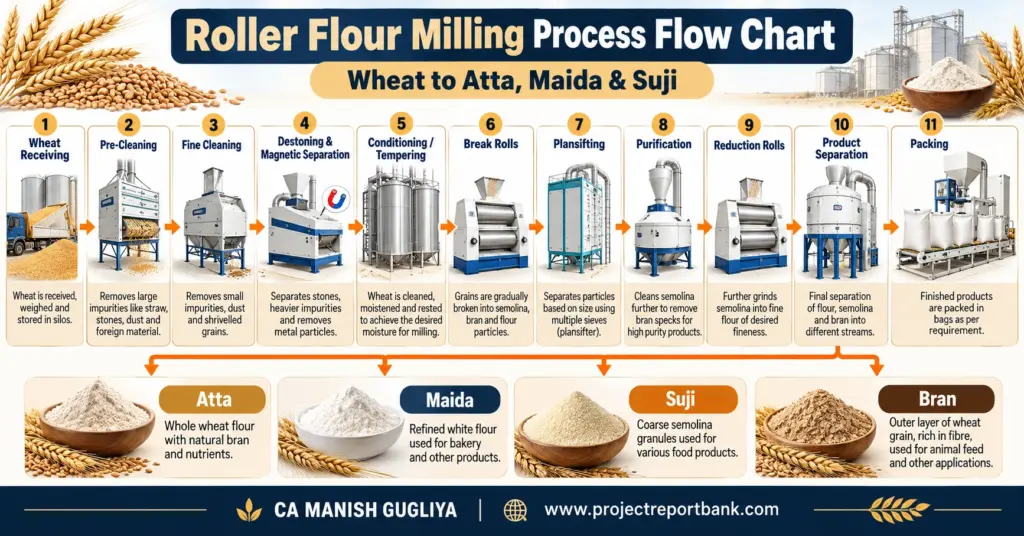
Key points about this flow chart:
- Actual roller flour mill flow sheets are considerably more detailed, with multiple break and reduction passages and several sifting loops.
- The number of roller passages, sifters and purifiers depends on mill capacity, mill design and desired product mix.
- Large plants typically use gravity-based vertical layouts, pneumatic conveying, and continuous closed-loop stock movement.
- A formal roller flour mill flow sheet uses standardised symbols for each machine and is a key part of technical documentation in any DPR or feasibility study.
The following sections explain each stage of this process step by step.
Step-by-Step Roller Flour Milling Process
This section walks through the flour mill process step by step, following the flow chart above. It is especially relevant for entrepreneurs preparing a Detailed Project Report or technical write-up on the milling process.
Each sub-section describes a specific stage: its purpose, typical operations, the wheat or flour behaviour at that point, and how it affects quality, yield and downstream stages. Exact equipment selection, mill design and number of passages vary by plant capacity, product mix and level of automation, but the basic logical sequence remains similar across modern industrial wheat flour manufacturing processes.
1. Wheat Receiving and Preliminary Inspection
Wheat arrives at the flour mill by truck, rail or in bags, is weighed at a weighbridge and sampled before unloading. In India, typical raw wheat comes from local mandis, FCI procurement channels or directly from aggregators.
Preliminary inspection covers:
- Impurities such as stones, straw, chaff and mud balls
- Insect infestation or mould
- Damaged, shrivelled or discoloured kernels
Basic laboratory checks may include moisture content, protein and gluten indicators, test weight and grain hardness. These parameters directly influence roller settings and yield expectations.
Raw wheat quality is crucial. Poor-quality wheat reduces flour extraction, increases ash and specks, overloads cleaning equipment and affects the shelf life and quality of final atta and maida. From a project report perspective, assumptions on average wheat quality and procurement sources must be aligned with the intended product quality and regional supply pattern.
2. Wheat Pre-Cleaning
Pre-cleaning is performed immediately after receiving, before wheat enters storage silos or godowns, primarily to remove coarse impurities and reduce dust load.
Typical targets include:
- Large foreign materials like straw, sticks, jute threads and large clods
- Oversize impurities and chaff
- Basic dust and light particles using aspiration (air flow and air resistance)
Common pre-cleaning equipment includes a coarse vibrating separator or rotary separator to screen out large and fine impurities, plus aspiration channels to remove light materials. Efficient pre-cleaning protects downstream machinery from damage, minimises dust hazards and reduces storage hygiene issues.
Pre-cleaning capacity is often designed slightly higher than the roller flour mill capacity to avoid bottlenecks in the industrial wheat milling process.
3. Wheat Storage and Blending
After pre-cleaning, wheat is stored in silos or godowns, often in multiple bins to keep separate lots based on variety, quality and season. Hard and soft wheat, or grain from different regions, may be stored separately.
Storage serves as a buffer against supply fluctuations, allows wheat to equalise in moisture, and provides practical logistics between receiving and processing. The practice of wheat blending-combining different lots to achieve more consistent milling behaviour in terms of hardness, moisture and protein-stabilises product quality for atta, maida and suji customers.
In a professional project report, realistic assumptions on storage capacity and days of inventory are important because they directly affect land, building and working capital requirements.
4. Fine Cleaning of Wheat
Fine cleaning is the detailed cleaning step just before milling. Cleaning involves removing foreign materials, dust, and impurities from raw wheat so that the grain entering the roller mill is as clean as practically possible.
Typical machines and their purposes:
| Machine | Purpose |
|---|---|
| Separator | Removes undersized and oversized particles compared to wheat kernel size |
| Aspirator | Uses air flow to remove light impurities like husk, dust and immature kernels |
| Magnetic separator | Captures iron nails, wires and ferrous particles for food safety |
| Destoner | Separates stones and heavy impurities based on bulk density difference |
| Scourer | Rubs the wheat surface to remove adhering dust, soil and outer bran layers |
| Grader | Classifies wheat by grain size for uniform behaviour in conditioning and milling |
Thorough fine cleaning reduces ash and specks in final flour, improves bran separation and purifier efficiency, and lowers wear and tear on rolls and sifters. Cleaning system design must consider expected impurity load and local wheat characteristics. Under-sized cleaning sections become a chronic bottleneck in many new plants.
5. Wheat Conditioning or Tempering
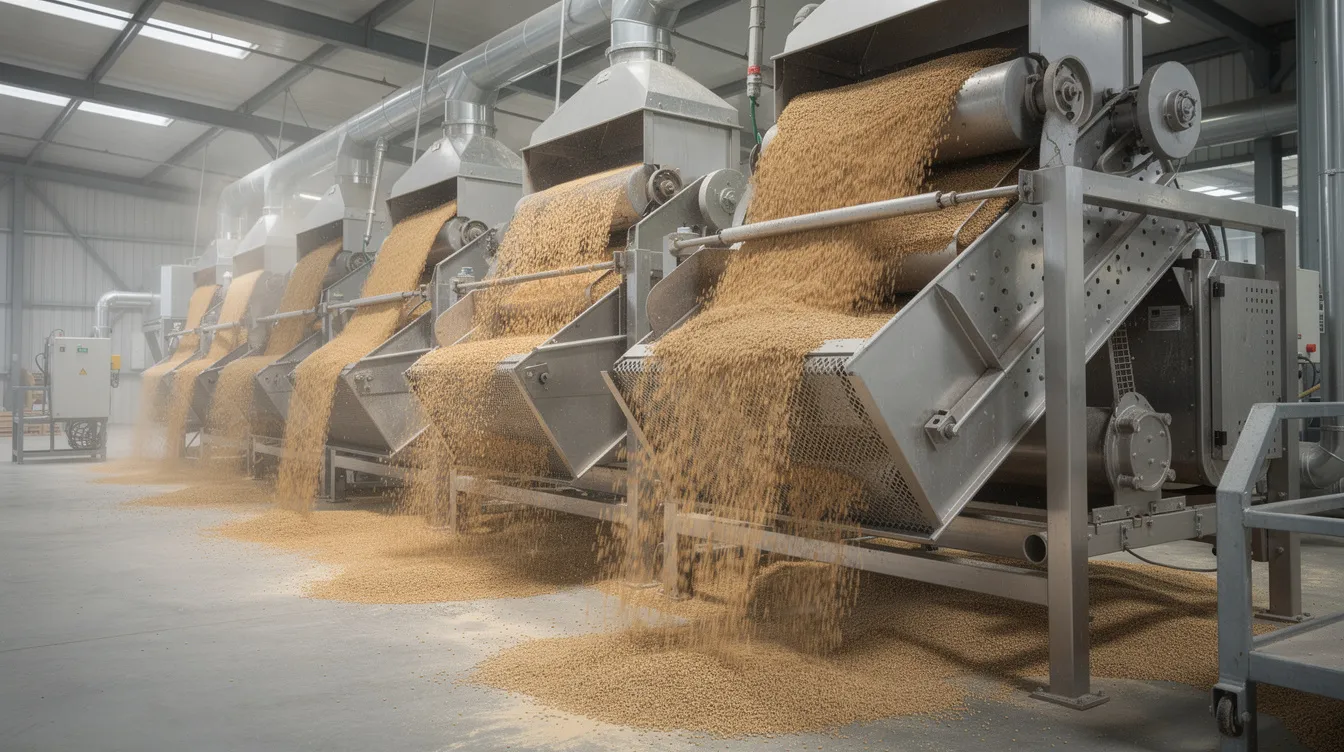
Conditioning, also called tempering, is the controlled process of adding water to clean wheat and allowing it to rest for a defined period. Tempering adds water to clean wheat to toughen the bran layer, while the endosperm softens, improving separation in the roller milling process.
The basic steps involve:
- Measuring incoming wheat moisture
- Adding calculated water through a dampener or spraying system
- Mixing thoroughly for even moisture distribution
- Holding wheat in tempering bins so moisture migrates into the kernel
Conditioning achieves several outcomes. Bran becomes tougher and more elastic, reducing breakage into fine particles that would contaminate maida and suji. Endosperm softens and becomes more friable, making it easier to release as semolina and middlings on the break rolls. Overall flour extraction can improve and ash content in refined flour can be better controlled.
Target moisture and tempering time vary with wheat variety and hardness. Over-conditioning may cause milling difficulties and microbial growth risk, while under-conditioning increases bran powder and reduces flour quality and yield.
In a DPR, conditioning capacity-bin size and number-must match planned throughput and operating hours. Insufficient tempering volume is a common mistake that limits achievable extraction in commercial flour mill production processes.
6. Break Roll Milling
The break system is the first milling stage where conditioned wheat kernels are opened using corrugated break rolls to release endosperm in the form of coarse grits and semolina, while keeping bran as intact as possible. The break system uses corrugated steel rollers rotating at different speeds to crack wheat open.
How break rolls work:
- Two horizontal rolls rotating at different speeds, typically with a differential of 2.5:1 to 3:1
- Differential speed operation generates shearing and tearing forces in roller milling, opening the kernels gradually
- Roll gap and corrugation profile are set to gently open kernels across multiple passes
Multiple break passages are used. First break (B1) opens most kernels and separates a mixture of semolina, fine particles and bran. Second and third break (B2, B3) re-process larger bran pieces to release remaining endosperm. Each passage feeds into its own sifting circuit.
The objective of break rolls is not to make finished flour immediately. It is to efficiently separate and grade endosperm pieces while keeping bran in larger flakes. Good break release-the proportion of endosperm recovered in early passages-is critical for high flour extraction and lower power consumption in the subsequent reduction roll process.
7. Plansifting
The stock discharged from each roller passage goes to a plansifter, a large multi-deck sieve machine that classifies material according to particle size using multiple sieves with different mesh sizes.
A plansifter works by oscillating several stacked sieve frames. Finer particles pass through upper sieves while coarser particles move to the tail end. Multiple outlets collect different fractions:
- Finished flour meeting target fineness
- Suji or semolina fractions (coarse endosperm)
- Middlings (intermediate material requiring purification or further reduction)
- Bran or bran-rich stock for by-product handling
Plansifters enable the closed-loop nature of modern wheat flour milling. Material that is not yet at the required size or purity is routed back to appropriate roller passages instead of being wasted. Sieve cloth selection, sieve arrangement and regular maintenance play a significant role in both yield and product consistency.
8. Purification of Semolina and Middlings
The purifier is a key machine in the roller flour mill used to clean semolina and middlings streams by separating relatively pure endosperm particles from bran specks. Purifiers use air currents to remove lighter bran particles from heavier endosperm particles, combined with sieving on vibrating screens.
The product layer moves over a vibrating sieve while upward air flow lifts lighter bran particles away. Heavier, cleaner endosperm particles remain and are collected for further reduction milling or suji production.
Purification is especially important for maida manufacturing because it reduces bran contamination, improves flour colour, lowers ash content, and helps maintain consistent granulation for bakery and biscuit applications. Not all small mills use full purifier systems, but for higher-capacity modern roller flour mills producing refined products, purifiers significantly impact extraction, quality and profitability. Air settings, feed rate and sieve choice must be tuned based on wheat characteristics-this tuning is a key operational skill.
9. Reduction Roll Milling
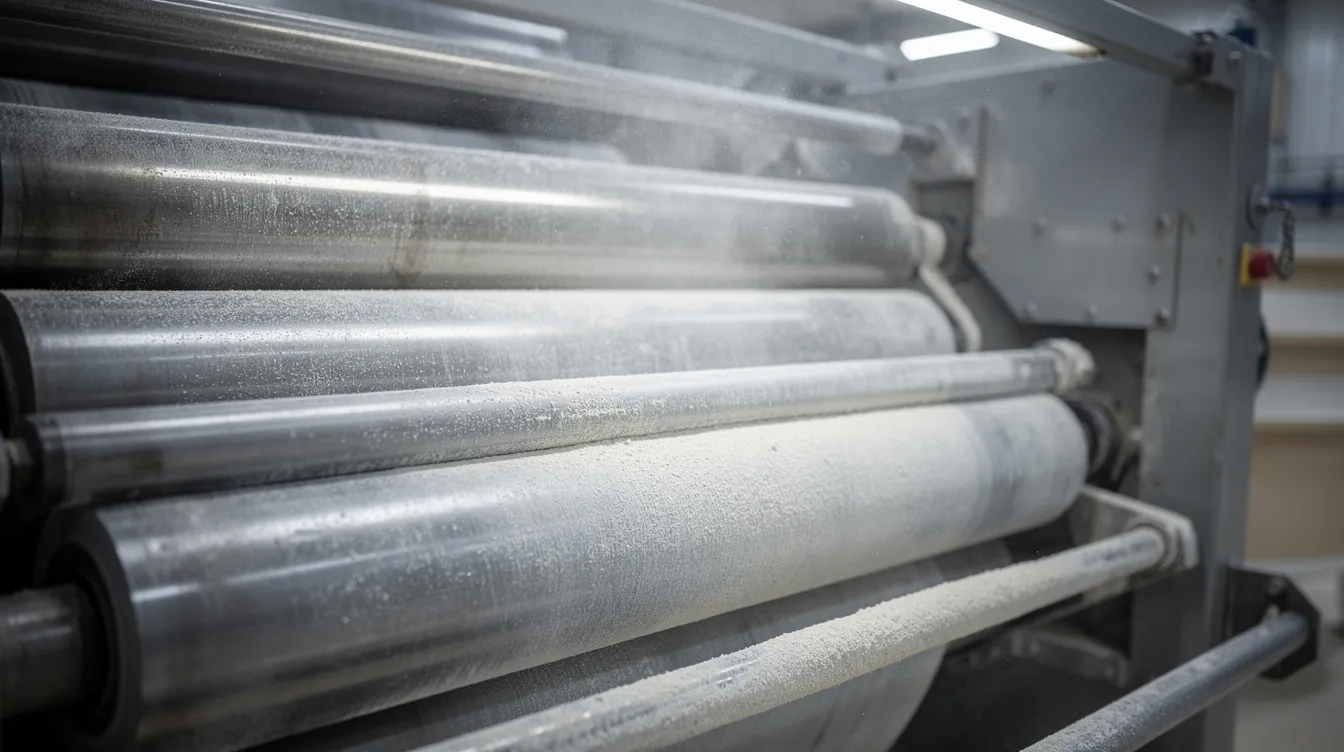
After purification, relatively clean endosperm particles are sent to the reduction system. Smooth rollers are used in the reduction system to progressively grind semolina into fine flour while minimising heat and bran contamination.
Wheat flour mills use specific corrugated and smooth rolls at different stages. The key differences between break and reduction rolls:
| Feature | Break System | Reduction System |
|---|---|---|
| Objective | Open wheat kernels, release endosperm | Grind purified endosperm into fine flour |
| Roll Surface | Corrugated (fluted) | Smooth (plain or lightly textured) |
| Feed Material | Whole or partially broken wheat kernels | Semolina and middlings |
| Main Output | Coarse semolina, middlings, bran flakes | Fine flour |
| Position in Process | Early milling stages | Later milling stages |
Multiple reduction passages (C1, C2, C3, etc.) are used, each followed by plansifting. Roll settings, differential speeds and feed distribution in the reduction system are key levers for controlling flour fineness, starch damage, energy consumption and yield.
10. Repeated Sifting and Classification
Each roller passage-both in the break and reduction systems-is followed by sifting, and sometimes purification. The milling process is therefore not linear but a continuous loop: Roll → Sift → Purify → Roll → Sift, until each stream reaches its desired particle size and purity.
- Flour fractions are directed to flour bins
- Semolina and middlings may be routed back to purifiers or further reduction rolls
- Bran streams are consolidated and sent to bran bins
This staged classification maximises usable flour extraction from endosperm, minimises bran powder contamination in refined flours, and allows the miller to adjust the product mix through blending of different streams. Modern control systems and flow indicators help operators monitor these loops, but process understanding and regular sampling remain essential. A good roller flour mill flow chart will clearly show all these recirculation paths.
11. Separation of Atta, Maida, Suji and Bran
Different product fractions are collected in separate bins after sifting and purification. The final proportions of each product depend on the plant’s product strategy and customer market.
- Atta: Usually whole wheat flour prepared by recombining flour streams with controlled quantities of fine bran; used mainly for chapati and roti
- Maida: Refined wheat flour produced mainly from pure endosperm streams from the reduction system; low ash, fine particle size; used in bakery, biscuits, noodles and other processed foods
- Suji (semolina/rava): Coarser purified endosperm granules separated on sifters and purifiers; used in biscuits, pasta, vermicelli and other products
- Bran: Outer layers of wheat separated throughout the break and sifting stages; sold as cattle and poultry feed or used in value-added bran products
Flour blending combines different flour streams to achieve desired specifications before products are sent to packing lines. The expected product split must align with local demand patterns and realistic extraction assumptions.
How Atta, Maida and Suji Are Produced from the Same Wheat
In a modern roller flour mill, the same batch of cleaned and conditioned wheat is fractionated by both particle size and kernel anatomy. This allows the miller to derive multiple milled products from the same raw materials.
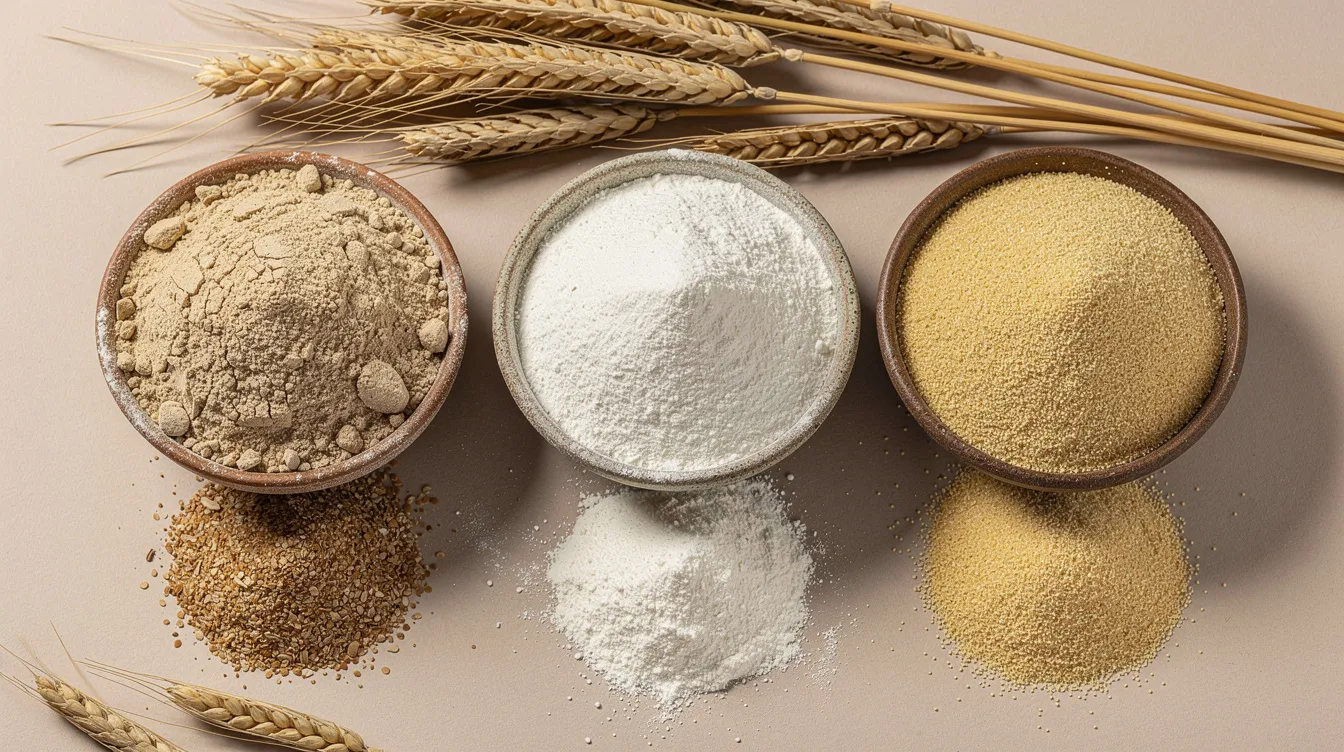
Coarse, pure endosperm particles can become suji or be ground further into maida. Fine endosperm flour fractions form the base for maida. Selected flour and fine bran streams are blended to make atta with desired fibre content. Bran-rich and germ-containing streams become by-products.
| Product | Source in Flow | Particle Characteristics | Primary Commercial Use |
|---|---|---|---|
| Atta | Recombined flour + fine bran streams | Medium-fine with fibre | Chapati, roti, household use |
| Maida | Reduction system pure endosperm flour | Very fine, low ash | Bakery, biscuits, noodles |
| Suji | Purified semolina from sifters/purifiers | Coarse granular endosperm | Pasta, vermicelli, upma, rava |
| Bran | Break and sifting stage bran lines | Flaky, fibrous outer layers | Animal feed, bran-based products |
There is no single universal product ratio. The roller flour mill manufacturing process can be tuned to emphasise specific products, provided wheat quality and plant design support it. Indian FSSAI norms and customer specifications for protein, ash and granulation also influence how much of each stream is diverted on a daily basis.
Break System vs Reduction System in Roller Flour Milling
Understanding the difference between the break system and the reduction system is essential to grasp how the roller flour mill process works.
- Break system: Opens wheat kernels, releases endosperm as coarse particles, and keeps bran intact
- Reduction system: Grinds purified endosperm particles into fine flour with minimal bran contamination
| Aspect | Break System | Reduction System |
|---|---|---|
| Objective | Crack open kernels | Grind endosperm to flour |
| Roll Type | Corrugated | Smooth |
| Feed Stock | Whole/broken wheat | Semolina, middlings |
| Main Output | Semolina, middlings, bran | Fine flour |
| Position | First stages | Later stages |
For DPRs and banker presentations, such a conceptual comparison is often sufficient to demonstrate that the promoter understands the basic roller mill working principle and the wheat to flour process.
Role of Plansifter and Purifier in a Roller Flour Mill
Installing roller mills alone does not guarantee good flour quality. Efficient sifting and purification are equally important in the wheat flour milling process.
Plansifters separate stock by particle size, direct suitable fractions to product bins or further grinding, and help maintain uniform granulation of atta, maida and suji. Purifiers clean semolina and middlings by removing fine bran, improve flour colour and ash levels, and increase usable extraction for maida and suji.
Good classification and purification reduce rejected stock and regrind load, lower energy consumption by avoiding over-grinding, and improve consistent quality across batches. In mill design and wheat milling flow diagrams, the number and capacity of plansifters and purifiers must match roller capacity to avoid process bottlenecks.
What Is Flour Extraction Rate?
Flour extraction rate is the proportion of usable flour and by-products recovered from a given quantity of wheat after accounting for cleaning and process losses in the roller flour milling process. Extraction is not just maida-total usable product may include atta, maida, suji and bran.
Extraction depends on wheat variety and quality, cleaning intensity, conditioning efficiency, milling settings, and desired flour quality and ash limits. There is an important trade-off: higher extraction may push more bran particles into flour, affecting colour and baking quality, while lower extraction gives cleaner flour but leaves more endosperm in by-products.
In a Detailed Project Report, extraction and product mix assumptions must be realistic and supported by the planned mill design and wheat sourcing. Overstated extraction figures can make project profitability appear better than practically achievable.
Typical Yield from Wheat in a Roller Flour Mill
Exact yield percentages vary widely based on local wheat quality and moisture, plant technology and process control, product mix strategy and market-driven specifications. A tonne of cleaned wheat is typically distributed among atta, maida and suji (combined edible products), bran and other by-products, and unavoidable process and handling losses.
It is not appropriate to assume one fixed industry-standard split for all mills. Serious entrepreneurs should base their DPR on miller feedback, trial runs and realistic assumptions suited to their region and technology.
In my professional project-finance work, I treat extraction and yield as sensitive variables in financial models, running scenario and sensitivity analysis on them instead of locking in optimistic values.
Factors Affecting Roller Flour Milling Efficiency
Even with similar machinery, two roller flour mills can show very different performance depending on how key factors are managed.
- Wheat quality and consistency across lots (variety, hardness, moisture, impurity load)
- Conditioning accuracy: correct moisture addition and adequate resting time
- Roller mill adjustment: gap settings, differential speed, corrugation profiles and roll surface maintenance
- Feed distribution: uniform supply of stock to rolls and sifters to avoid overloading
- Sifter and purifier efficiency: maintained sieves, proper air flow, correct cloth selection
- Aspiration and dust control: adequate air volumes, clean filters
- Operator skill and process supervision
- Preventive maintenance: timely replacement of rolls, bearings, sieve frames and seals
Automation and PLC-based controls can help stabilise these factors, but they cannot fully replace process understanding. Small changes in efficiency-marginally improved extraction or reduced regrind load-can materially impact long-term profitability, making process optimisation a continuous management focus.
Quality Control During Flour Milling
Systematic quality control during the flour mill production process is essential to meet regulatory standards and customer specifications. Final quality control measures check flour for moisture, ash, protein, and particle size. Moisture and temperature must be controlled to prevent flour damage during production and storage.
Key parameters to monitor:
- Moisture content of both wheat and finished products
- Ash content as an indicator of bran contamination
- Protein and gluten characteristics for specific end uses
- Granulation and particle size distribution for atta, maida and suji
- Flour colour, specks and odour
- Foreign matter and metal detection
- Microbiological hygiene and pest control
- Minerals and nutritional parameters where relevant
Compliance with FSSAI standards for wheat flour, maida, suji and atta is mandatory. Wheat flour fortification standards apply where required. Quality control is integrated with the milling process through routine sampling at different stages and adjustment of roller gaps, purifier settings or blending based on test results.
Process Automation in Modern Roller Flour Mills
Process automation is an enabler of consistency and efficiency in the modern roller flour mill process, especially in medium and large plants.
Typical automation elements include:
- PLC or DCS-based control panels for sequencing machines
- Automatic wheat feeders and dosing systems for steady flow
- Level sensors in wheat bins, flour bins and bran bins
- Pneumatic conveying systems with automated diverter valves-flour production can utilize pneumatic conveying systems for transport between sections
- Online instruments for moisture, temperature or differential pressure monitoring
- Automated bagging and packing machines with weight controllers
Automation reduces human error, improves traceability and enhances safety by interlocking critical drives and aspiration systems. However, even in an automated flour milling process, skilled operators are required for process adjustments, troubleshooting and optimisation. Automation should be viewed as support, not a substitute for knowledge. You may save preferences for specific control parameters, but the machine must still be supervised by trained staff.
Material Flow and Plant Layout Considerations
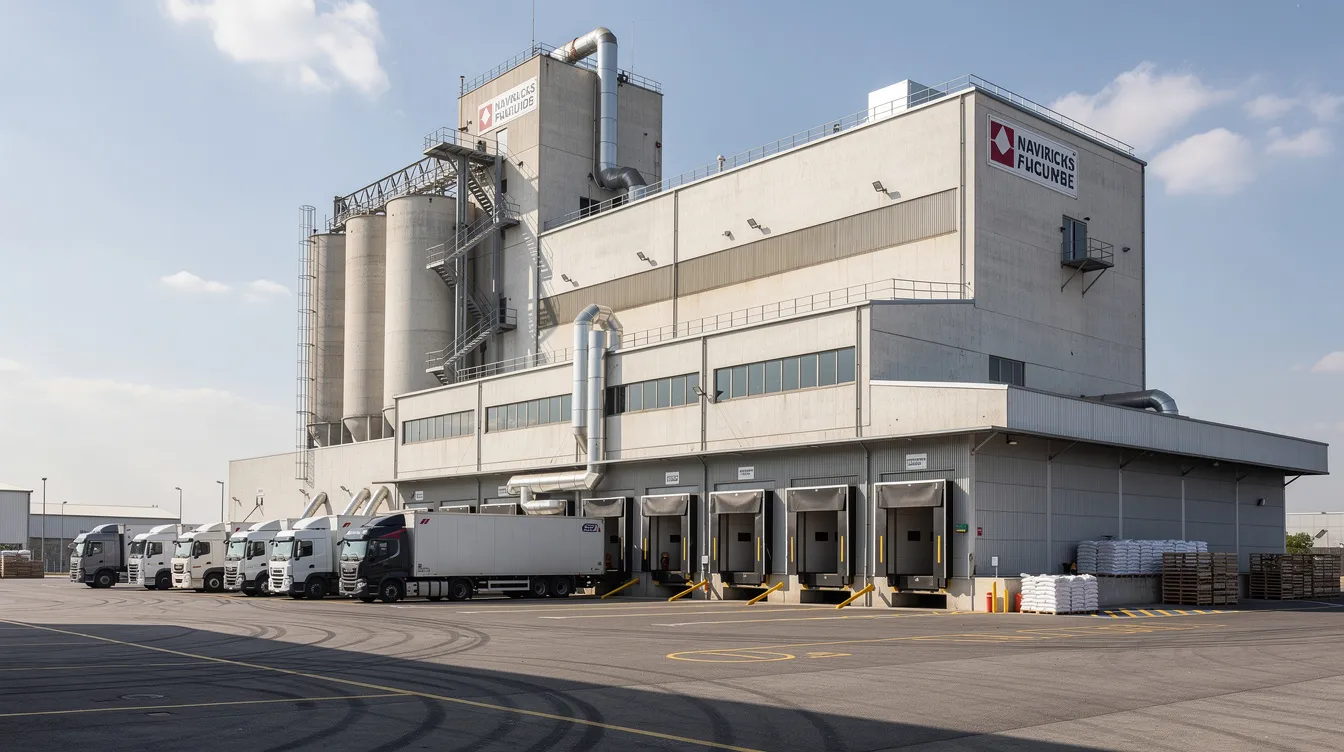
The roller flour milling process strongly influences the flour mill’s physical layout, especially in multi-storey vertical mills where gravity is used to move material downward through the milling section, sifting and packing.
Typical zoning:
- Ground or lower floors: wheat receiving, pre-cleaning, some storage
- Intermediate floors: fine cleaning, conditioning equipment and tempering bins
- Upper floors: roller mills, plansifters, purifiers and pneumatic systems
- Separate areas: packing section, finished-goods warehouse, bran storage
Material flow uses gravity where feasible, pneumatic conveying for intermediate transport, and mechanical conveyors or elevators for vertical movement. The layout aims to minimise cross-contamination between raw and finished products, excessive re-handling, and dust accumulation.
Machinery Used at Different Stages of Roller Flour Milling
Each stage of the roller flour mill manufacturing process has typical machinery associated with it. Mill design includes standardized symbols for equipment like plansifters in professional technical drawings.
| Process Stage | Typical Machinery | Main Function |
|---|---|---|
| Wheat Receiving | Intake hopper, belt conveyor | Unload and transfer wheat |
| Pre-Cleaning | Pre-cleaner, separator, aspiration channel | Remove coarse and light impurities |
| Fine Cleaning | Separator, destoner, magnetic separator, scourer, aspirator | Deep cleaning and de-stoning |
| Conditioning | Dampener, tempering bins/silos | Add moisture and rest wheat |
| Milling (Break & Reduction) | Roller mills (corrugated and smooth) | Controlled size reduction |
| Classification | Plansifter | Separate by particle size |
| Purification | Purifier | Separate clean endosperm from bran |
| Conveying | Bucket elevators, screw conveyors, pneumatic lines | Move material between sections |
| Packing | Automatic or semi-automatic bagging machines | Pack atta, maida, suji, bran |
This article does not discuss machinery prices or vendors. For cost and supplier-level detail, readers may refer to a dedicated machinery and equipment cost discussion as part of the wheat flour mill project report documentation.
Correct sizing of each machine according to desired capacity is essential. Design calculations include roller length and sifting area standards to avoid bottlenecks in the milling process flow chart.
Process Design Depends on Plant Capacity
The fundamental steps of wheat cleaning, conditioning, break milling, sifting, purification, reduction and product separation are common to most roller flour mills, but their configuration changes with plant capacity. A typical wheat flour mill can process 120 tons per day in larger configurations, while smaller units operate at 30 or 60 TPD.
How capacity impacts process design:
- Number of break and reduction passages and length of roller mills
- Number and size of plansifter sections and purifiers
- Scale of wheat silos, tempering bins and product bins
- Choice between manual, semi-automatic and fully automatic material handling
Higher-capacity plants generally use more sophisticated pneumatic systems, multi-storey layouts, robust automation and stronger dust control. Small mills may simplify the flow sheet with fewer passages and limited purification, but must still follow the same logical sequence for acceptable product quality.
Why the Milling Process Matters in a DPR
In any Detailed Project Report for a flour mill, the roller flour milling process is not just technical theory. It directly influences financial projections, working capital needs and risk analysis.
Key ways the process affects DPR assumptions:
- Machinery configuration: number and type of roller mills, sifters, purifiers and cleaning machines required for targeted capacity
- Installed capacity and achievable throughput: dependent on process bottlenecks and realistic operating hours
- Raw-material requirement and yield: linked to expected extraction, wheat quality and process losses
- Power consumption: driven by roller mill load, pneumatic systems and dust control
- Manpower requirements: depending on process complexity and automation level
- Product mix and sales realisation: proportion of atta, maida, suji and bran determined by the flow sheet
A Detailed Project Report includes market survey and feasibility analysis. It covers total capital investment and profitability analysis. The report includes a cash flow statement and repayment schedule. It details land and building requirements with associated costs. The DPR provides a projected balance sheet for five years. Unrealistic assumptions-such as too-high extraction rate or full utilisation from day one-can make projected DSCR, IRR or payback period look attractive on paper but difficult to achieve in practice.
Promoters planning a new roller flour mill should get a professional DPR where the process, capacity, machinery, project cost, means of finance and financial modelling are developed together.
Common Process Planning Mistakes in New Roller Flour Mill Projects
The following mistakes are commonly observed in new flour mill projects in India, specifically on the process and flow-sheet side:
- Selecting machinery solely on rated TPD without checking how the entire flow sheet balances from cleaning to packing
- Under-sizing the cleaning and conditioning sections, leading to poor wheat preparation and chronic bottlenecks
- Ignoring wheat quality variation between seasons and regions, and not planning flexibility in process settings
- Over-optimistic extraction assumptions for maida and suji without adequate purification capacity
- Insufficient tempering bin volume, causing rushed conditioning and weaker bran separation
- Inadequate aspiration and dust control, resulting in hygiene issues, product contamination and maintenance problems
- Poor linkage between the milling section and packing sections, causing delays and double handling
- Inadequate finished-product and bran storage capacity, leading to frequent stoppages
- Lack of planning for future expansion or product diversification such as fortification or speciality flours
Serious project promoters should involve experienced process engineers and DPR consultants early in planning to avoid costly mid-course corrections after commissioning.
Roller Flour Milling Process – Practical Example
This is an illustrative narrative example, not a financial model.
Consider a batch of cleaned wheat entering a modern roller flour mill:
Cleaning and conditioning: After pre-cleaning and fine cleaning (separator, destoner, scourer, magnetic separator), the wheat is dampened to the target moisture level and rested in tempering bins for several hours. The surface of each kernel toughens while the interior softens.
Break system: The conditioned wheat passes through first break rolls, which gently crack open the kernels. The resulting mixture goes to a plansifter, which separates flour, semolina, middlings and bran flakes. Larger bran pieces with attached endosperm pass to second and third break rolls for further processing.
Purification and reduction: Semolina and middlings from the sifters pass through purifiers, where air flow lifts away lighter bran specks. The cleaned endosperm then enters the reduction system, where smooth rolls gradually grind it into fine flour across two to four reduction passages, each followed by sifting.
Product routing: Fine flour streams are directed into atta and maida bins depending on specification. Suji streams are collected separately. Bran is consolidated as a by-product. The finished products are blended for consistency and packed.
This example intentionally does not assign fixed yield percentages. Actual product splits must be derived from plant-specific trials and miller experience. Such an illustrative walkthrough can help bankers, investors and non-technical stakeholders understand material movement in a roller flour mill process flow chart when reading a DPR or feasibility report.
Frequently Asked Questions
What is the typical tempering time for wheat in a roller flour mill?
Tempering time varies with wheat hardness, initial moisture, ambient conditions and target product mix. Hard wheat varieties generally require longer tempering than soft wheat. The key objective is to achieve uniform kernel moisture and desired bran toughness rather than aiming at a fixed number of hours.
In practical project planning, tempering bin capacity is usually designed for several hours of holding time at rated throughput, with a safety margin for operational flexibility. Millers often fine-tune tempering based on experience and the performance of break rolls and sifters during the season.
Can the same roller flour mill switch between higher atta and higher maida output?
Within limits, the same roller flour mill can adjust its product mix by changing how streams are blended into atta versus maida, adjusting purifier and sifter cut-points, and modifying which streams are directed to suji or bran.
Such flexibility depends on the mill’s flow sheet, bin arrangement and market demand. Plants designed only for bulk maida production may have less flexibility for high-atta operations. Sudden large shifts in product mix may also require adjustments in packaging, branding and customer contracts, not just process parameters.
How often do rolls and sifters need maintenance or replacement?
Maintenance frequency depends on operating hours, wheat abrasiveness, cleaning quality and maintenance culture. Break rolls require periodic refluting or grinding to maintain corrugation sharpness and uniform break release. Reduction rolls need regrinding when surfaces become worn. Sifter cloths and sieves require routine inspection, cleaning and replacement when blocked, torn or stretched.
A preventive maintenance schedule, integrated into the DPR and operating plan, is more reliable than purely reactive maintenance after failures occur.
Is roller flour milling suitable only for very large plants?
Roller flour milling technology can be applied at different scales. While very large mills enjoy economies of scale, small and medium MSME units also use compact roller flour mill configurations across many Indian states. Smaller plants may have fewer break and reduction passages, limited purifiers and simpler automation, but following the basic process steps remains important for acceptable product quality.
Scale choice should be based on market assessment, raw-material availability, investment capacity and risk appetite rather than only on technical capability.
How different is roller flour milling from small chakki mills in terms of end products?
Small stone-chakki mills typically produce whole wheat atta with almost all bran and germ included, giving higher fibre, stronger taste and shorter shelf life, mainly for household consumption. Roller flour mills are designed to fractionate wheat into atta, maida, suji and bran by separating kernel components, enabling production of refined flours needed for biscuits, bread, noodles and industrial food products.
Many Indian markets use both technologies. For DPR and project-planning purposes, chakki mills and roller flour mills are different project types with different machinery, product mixes and economics.
Conclusion
The roller flour milling process is an integrated sequence of wheat cleaning, conditioning, controlled break milling, plansifting, purification, reduction milling and final product separation into atta, maida, suji and bran. Process design, wheat quality, extraction philosophy and automation level together determine flour quality, yield, power consumption and long-term plant economics.
For entrepreneurs planning a flour mill, understanding the roller flour mill process flow chart is essential before freezing machinery configuration, plant capacity and financial projections in a Detailed Project Report.
In my experience while preparing project reports and financial models for manufacturing plants, linking process assumptions-such as extraction rates and operating hours-with realistic mill design and wheat procurement conditions is crucial for a bankable and implementable project.
Serious project promoters, MSMEs and investors who require project-specific DPRs, CMA Data or feasibility analysis for roller flour mills may reach out to Project Report Bank via WhatsApp or the enquiry form at www.projectreportbank.com for customised professional advisory.
CA Manish Gugliya FCA, DISA (ICAI) Project Report, CMA Data, Project Finance & Financial Modelling Consultant www.projectreportbank.com