Setting up a roller flour mill in India requires substantial capital investment, and one of the first questions any serious promoter asks is: how much will it actually cost? The answer is not a single number. Investment varies depending on TPD capacity, automation level, product mix, wheat storage strategy, land cost, building specifications, packaging requirements and geographic location. Production capacity impacts the overall flour mill setup cost more than any other single variable.
This guide provides a structured, financially practical breakdown of roller flour mill setup cost in India across capacities from 25 to 300 TPD, covering every major cost head that appears in a professionally prepared Detailed Project Report.
Key Takeaways
- As a broad planning range, a 25 TPD industrial wheat flour mill may need around ₹4–6 crore total project outlay (assuming owned land), while 100 TPD plants often fall in the ₹12–18 crore band and 300 TPD plants may require ₹50–75 crore depending on location, automation and storage strategy.
- Total roller flour mill project cost includes land, factory building, plant and machinery, wheat storage (godown or silos), electrical infrastructure, utilities, pre-operative expenses, contingency and working capital – a machinery quotation alone is not the full investment.
- Working capital, especially wheat inventory, can represent 25–40% of overall funding requirement, so it must be estimated professionally using realistic procurement and credit assumptions.
- Flour mill setup costs range from ₹10 lakh to ₹2 crore for very small units, while large fully automatic flour mills can exceed ₹3 crore in machinery alone – and total project cost scales significantly beyond that.
- Serious promoters should prepare a customised Roller Flour Mill DPR with financial projections, CMA Data and a bank loan proposal before committing capital. Project Report Bank provides this advisory under the guidance of CA Manish Gugliya.
What Is a Roller Flour Mill?
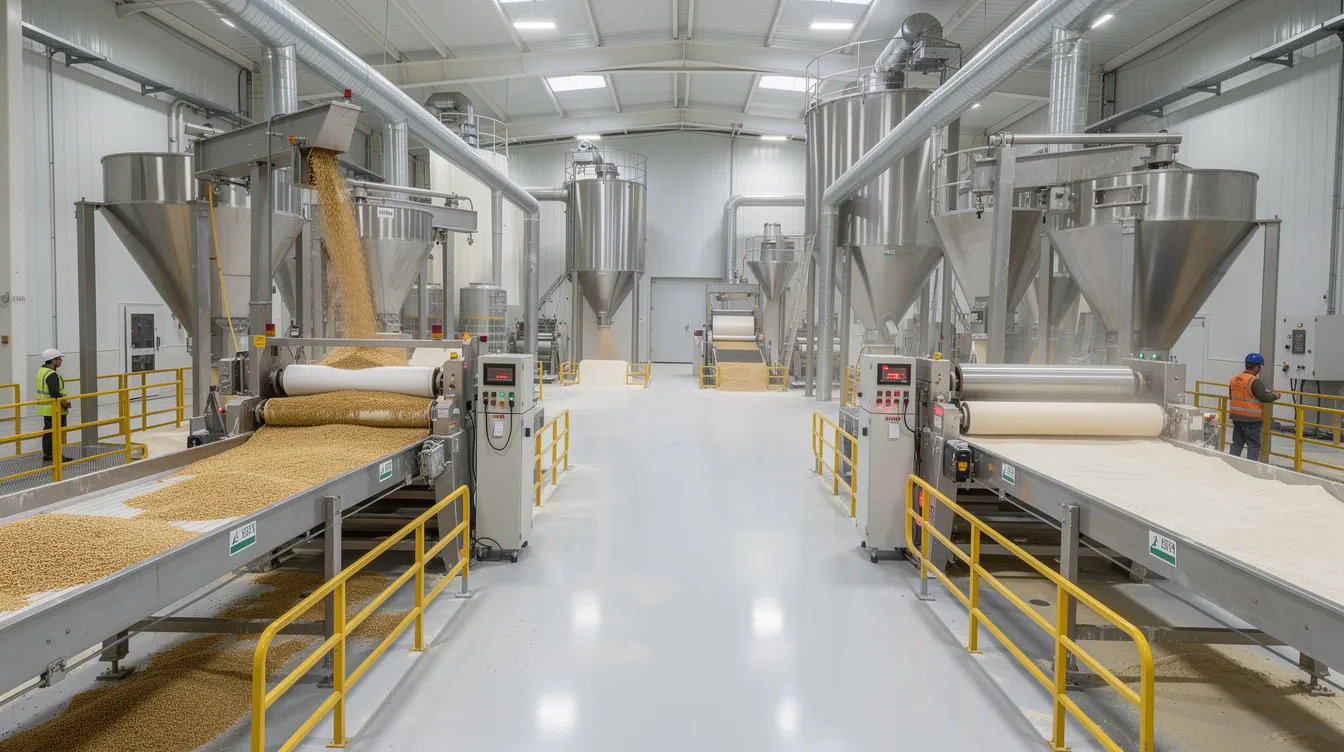
An industrial roller flour mill is a wheat processing plant that uses pairs of steel roller mills, plansifters, purifiers and associated equipment to convert raw wheat into finished products. The typical product range includes atta (whole wheat flour), maida (refined flour), suji or rava (semolina), bran and other wheat fractions. Product mix affects both machinery configuration and overall project cost.
The process flow broadly involves cleaning, conditioning (tempering), roller milling through multiple passes, sifting, purification, blending and packing. A detailed explanation is best covered in a separate roller flour mill process and flow chart resource.
Roller flour mill capacity is typically measured in Tonnes Per Day (TPD). Small-scale mills typically have a capacity of 1–2 TPD, while medium-scale plants usually range from 20–40 TPD and large flour mills can produce 80–120 TPD or more. This article focuses on commercial and industrial capacities of 25–300 TPD – not household atta chakki plants or small scale flour mill operations.
The financial and technical difference between a basic mill or atta chakki machine and an industrial roller flour mill plant is significant. A small-scale flour mill costs between ₹10 lakh to ₹25 lakh for basic setup, while a medium-scale flour mill costs around ₹35 lakh to ₹80 lakh. Industrial roller flour mills require considerably more investment because of advanced machinery, larger civil works, higher power consumption, storage infrastructure and proper budgeting for working capital.
Roller Flour Mill Setup Cost in India – Quick Overview
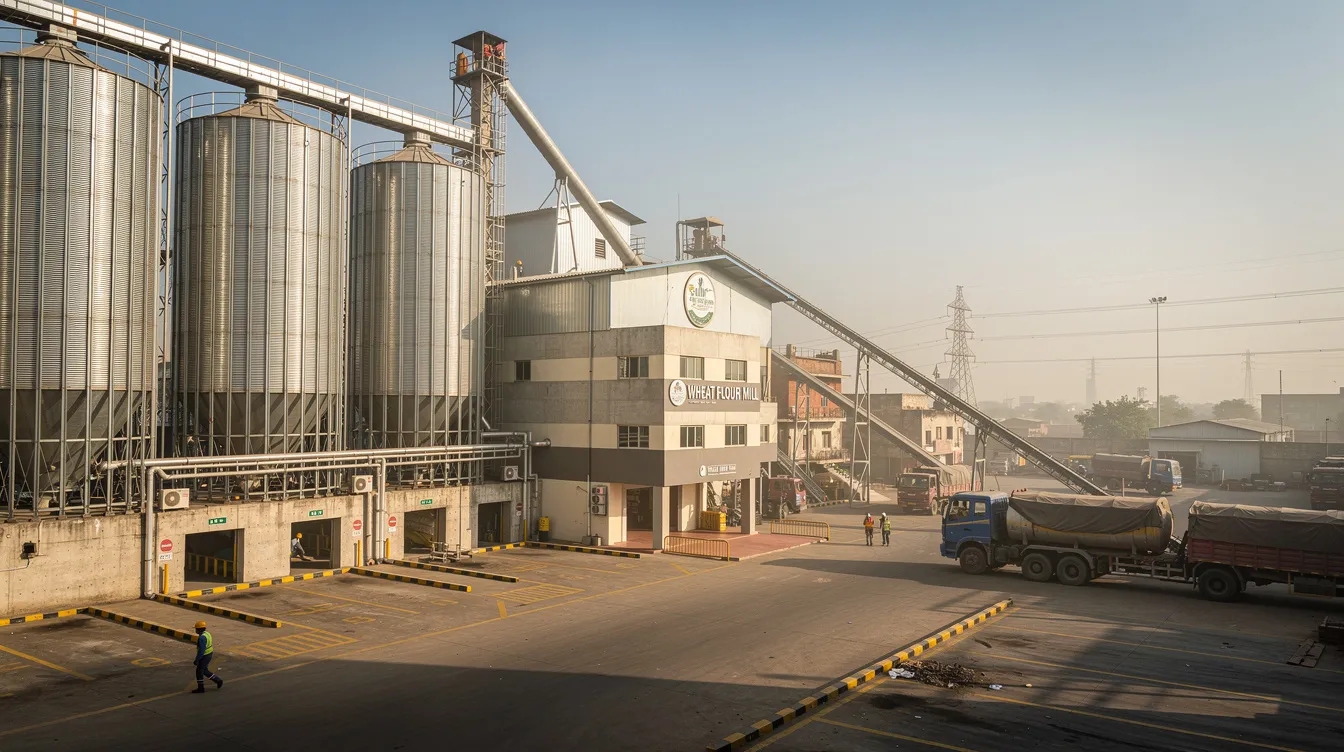
Here is a capacity-wise summary of indicative total project outlay for roller flour mills in India, based on recent project data and DPR benchmarks for 2024–2026. Flour mills have varied cost structures depending on capacity, equipment, and operational strategy, so these are planning ranges only.
| Capacity (TPD) | Typical Scale | Indicative Fixed Investment (Land Owned) | Indicative Working Capital Margin | Indicative Total Project Outlay |
|---|---|---|---|---|
| 25 TPD | Small industrial | ₹3–4 crore | ₹1–2 crore | ₹4–6 crore |
| 50 TPD | Small-medium | ₹5–7 crore | ₹2–3 crore | ₹7–10 crore |
| 100 TPD | Medium-large | ₹9–13 crore | ₹3–5 crore | ₹12–18 crore |
| 150 TPD | Large | ₹15–22 crore | ₹5–8 crore | ₹20–30 crore |
| 200 TPD | Very large | ₹22–32 crore | ₹8–12 crore | ₹30–45 crore |
| 300 TPD | Large scale | ₹35–55 crore | ₹12–20 crore | ₹50–75 crore |
If land must be purchased, total cost depends on whether the site is in a tier-2 industrial area or a prime industrial estate. Semi-automatic configurations with conventional godowns fall at the lower end; a fully automatic flour mill plant with silos, PLC controls and automated retail packing lines will push the cost toward the higher end.
These numbers are indicative planning benchmarks. Actual roller flour mill project cost must be derived from vendor quotations, civil estimates and professional financial modelling.
Major Components of Roller Flour Mill Project Cost
Understanding the detailed breakdown of cost – land, civil works, machinery, utilities, pre-operative expenses and working capital – is essential before approaching banks or investors. Key components of flour mill setup include plant and machinery, land, utilities, and licenses. The following sub-sections describe each major cost head used in a typical Roller Flour Mill DPR.
Land Cost
Typical industrial land requirement ranges from 0.75–1.0 acre for 25–50 TPD plants, 2–3 acres for 100–150 TPD, and more for 200–300 TPD plants with silos and expansion space. Land costs range from ₹10 lakh to ₹1 crore per acre in tier-2/3 industrial districts, while prime industrial estates (for example, certain MIDC clusters in Maharashtra) can reach ₹5–10 crore per acre.
Promoters should provide for internal roads, truck movement, loading and unloading space, open storage and future expansion. Many DPRs present fixed capital excluding cost of owned land, since promoters often already hold industrial plots.
Factory Building and Civil Construction
Key building requirements include a multi-storey production block or steel structure, wheat reception hall, raw material storage godowns or silo interface structures, finished goods warehouse, packing area, utility room, laboratory, office and staff amenities.
Typical built-up areas: 12,000–18,000 sq.ft. for 25–50 TPD; 25,000–40,000 sq.ft. for 100–150 TPD; more for larger plants. A 150 TPD roller flour mill project in Rajasthan had total civil cost of approximately ₹3.1 crore for factory, administrative and storage buildings.
Construction rates vary: basic PEB steel structures may cost ₹900–₹1,200 per sq.ft., while heavy RCC with food-grade finishes, dust-proofing and insulation can reach ₹1,500–₹1,800 per sq.ft. Additional civil works – foundations for heavy machinery and silos, drains, boundary wall, weighbridge pit, approach roads and fire safety infrastructure – must all be included in the roller flour mill building cost.
Roller Flour Mill Plant and Machinery Cost
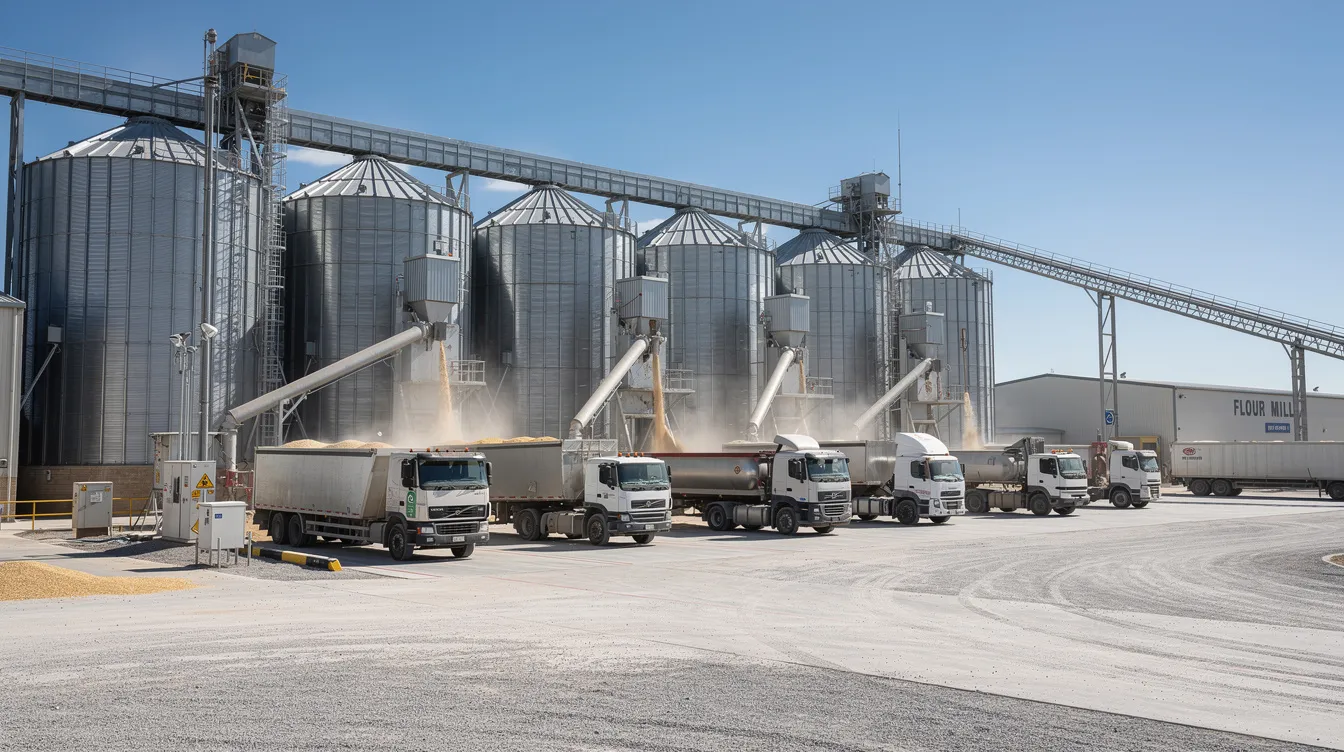
Plant and machinery is one of the largest fixed-cost components, often accounting for 35–50% of fixed capital in a typical automatic roller flour mill. Major equipment groups include the wheat cleaning section (pre-cleaner, destoner, aspirator, magnetic separator, scourer), conditioning and dampening systems, roller mills, plansifters, purifiers, bran finisher, conveyors and elevators, pneumatic conveying, flour and bran handling systems, and packing systems. Cleaning machines remove impurities from raw grains at the very first stage. Roller mills are commonly used for wheat flour production worldwide.
Indicative machinery cost ranges:
- 25 TPD: approximately ₹2.0–2.8 crore
- 100 TPD: approximately ₹5.5–7.5 crore
- 200 TPD: approximately ₹10–13 crore
A small-scale flour mill may require ₹15–25 lakh for machinery at very basic capacities. A fully automatic flour mill can cost between ₹50 lakh to ₹2 crore for the flour mill machine set depending on throughput, and can exceed ₹2 crore for higher-capacity units. Semi-automatic flour mills are less expensive than fully automatic ones but involve higher labor costs.
According to MoFPI published cost norms, machinery for a 1 TPH (approximately 25 TPD) fully automatic wheat flour plant is normed at around ₹22.70 lakh, scaling to ₹129.55 lakh at 3 TPH. These norms exclude civil, land and electrical infrastructure.
Imported European lines and high-end PLC automation cost significantly more than Indian semi-automatic configurations. For an equipment-wise analysis, refer to our detailed guide on roller flour mill machinery and equipment cost.
Wheat Storage and Silo Cost
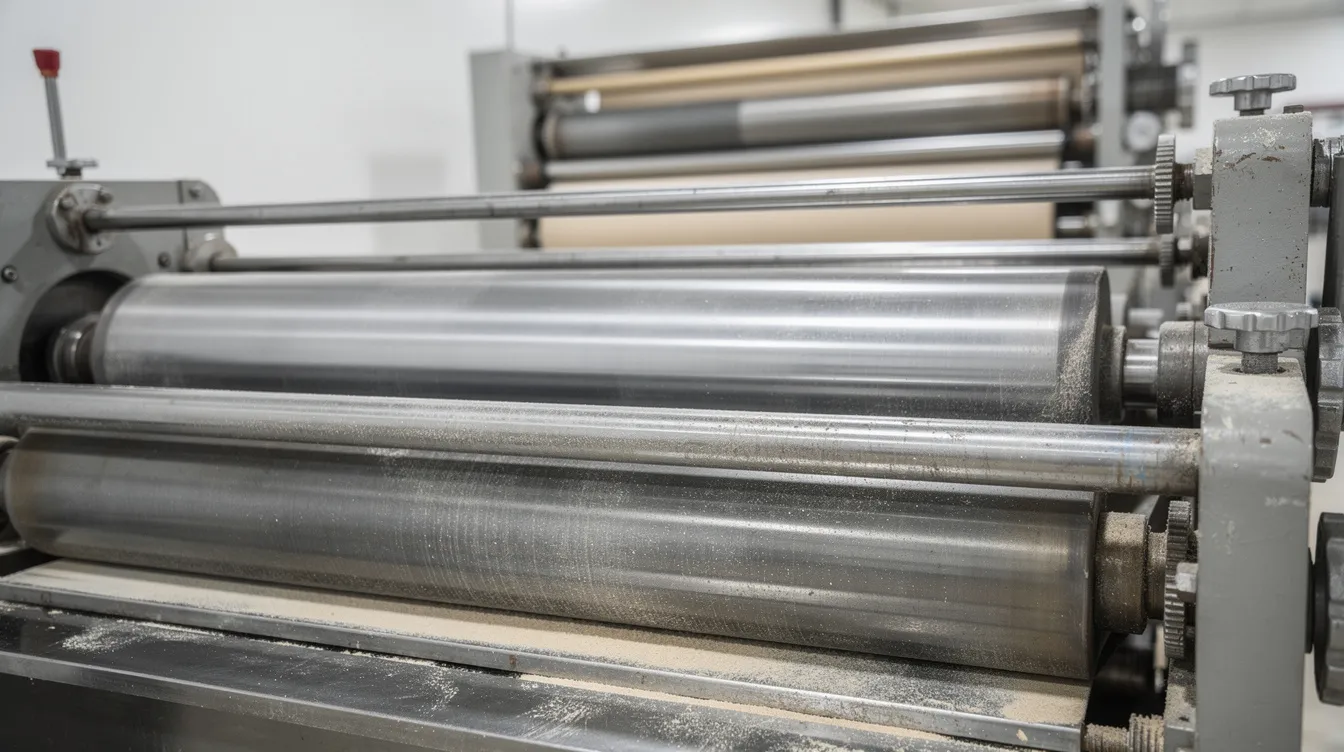
Two main options exist: conventional godown storage in bags, and bulk wheat storage in steel silos with grain handling systems. Raw material storage strategy directly influences both fixed cost and working capital.
Raw material inventory days – 15–30 days for regular purchase versus 60–120 days for seasonal bulk procurement – determine required storage capacity. Conventional brick or PEB godowns may cost ₹700–₹1,400 per sq.ft. for civil construction plus racking and handling. Steel silos typically cost ₹15,000–25,000 per tonne capacity for galvanised steel, and up to ₹30,000–40,000 per tonne for higher specifications with aeration, temperature monitoring and conveyors.
Silo-based wheat storage improves handling efficiency and reduces grain losses (from 8% or more annually in godowns to under 0.5% in silos), but substantially increases initial roller flour mill plant cost.
Electrical Installation and Power Infrastructure
Essential electrical elements include transformer or dedicated HT connection, main LT panels, MCCs, cabling, lighting, earthing, VFDs, power factor correction and motor control systems for all flour mill machines.
Sanctioned load scales with capacity: 25 TPD plants typically require 250–350 kW; 100 TPD plants 700–900 kW; 200+ TPD plants may need 1.3–1.5 MW. DG sets for backup in unreliable power areas add materially to project cost. Electricity and utilities can constitute about 10% of the total project investment for flour mills, and monthly electricity costs can reach ₹1 lakh to ₹5 lakh depending on capacity and tariff.
Utility and Supporting Equipment
Key items include air compressors, central dust collection and aspiration systems, water treatment, boiler or hot water system for conditioning, grain fumigation systems and weighbridges. Material handling assets such as forklifts and pallet trucks depend on scale and distribution model.
Quality-control laboratory equipment – gluten analyzers, ash content meters, moisture meters, sieve shakers – is necessary for plants producing atta, maida and suji to different quality parameters. Utility and ancillary equipment can add 8–15% to total plant and machinery cost and must be budgeted in the flour mill project cost.
Packaging Line Cost
Packaging machines weigh and seal flour in predefined quantities, but investment varies enormously with market strategy. Selling in 50 kg bags to institutional buyers requires only basic bag-filling and stitching equipment (a few lakhs). Fully automatic FFS pouch machines for branded retail packs in 1–10 kg consumer SKUs can cost ₹75 lakh to ₹2 crore depending on speed, automation level and number of packaging units.
Packaging line decisions should align with marketing strategy and will influence working capital through packaging materials inventory and receivables in retail distribution.
Installation, Freight and Erection Cost
Ex-factory machinery price is only part of the cost. Freight, insurance, unloading, internal shifting and skilled erection can add 8–15% to equipment invoice values. Vendor supervision charges, calibration and trial-run expenses must be explicitly included in the DPR. Promoters should not estimate project cost from ex-factory machinery prices alone.
Pre-operative and Preliminary Expenses
Typical heads include company incorporation, registration, project report preparation, consulting and architectural fees, statutory approvals and branding design. Licenses required for flour mills include FSSAI, GST registration, and local municipal approvals. Licensing and legal costs range from ₹50,000 to ₹5 lakh. Regulatory clearances impact the overall costs of setting up a flour mill.
Interest during construction, upfront bank fees, trial production and launch marketing costs are also capitalised here. For medium and large roller flour mills, pre-operative expenses may account for 4–8% of fixed capital.
Contingency Provision
A contingency provision of 5–10% on relevant cost heads (civil, machinery, electrical, utilities) is standard in professional project reports. Omitting contingency can lead to cost overruns and funding gaps during implementation. This provision is a realistic buffer, not padding – any unused balance improves project cost efficiency.
Capacity-Wise Roller Flour Mill Setup Cost in India
Cost depends on capacity but does not increase strictly in proportion to TPD. Certain infrastructure and utilities show economies of scale, while storage and working capital may grow disproportionately at higher capacities. Investment costs for roller flour mills vary by production capacity and automation level. A 20TPD flour mill processes 20 tonnes of wheat daily, which is considered the entry point for medium-scale operations.
25 TPD Roller Flour Mill Cost
This is an entry-level industrial wheat flour mill suitable for small regional markets – typically semi-automatic cleaning and packing, bagged wheat storage, limited automation. Indicative fixed capital: ₹3–4 crore (land owned); working capital margin: ₹1–2 crore; total project outlay: approximately ₹4–6 crore. Main cost drivers: land and building standards, machinery quality and brand, and whether the plant produces atta only or atta plus maida plus suji.
50 TPD Roller Flour Mill Cost
A small-to-medium commercial flour mill suitable for district-level distribution. Fixed capital: ₹5–7 crore (excluding new land purchase); working capital margin: ₹2–3 crore; total outlay: ₹7–10 crore. Compared to 25 TPD, certain costs (laboratory, basic utilities, office) do not double, so cost per TPD decreases slightly, but larger storage and stronger electrical infrastructure are required.
100 TPD Roller Flour Mill Cost
This is a common benchmark capacity for state-level atta maida suji plant operations with institutional and wholesale focus. Fixed capital: ₹9–13 crore (excluding land; higher with imported machinery or steel silos); working capital margin: ₹3–5 crore; total project cost: ₹12–18 crore. Decisions on silos versus godowns, fully automatic retail packing versus bulk bags, and advanced technology choices must be commercially justified by market demand. Fully automated plants ensure lower operational costs and consistent product quality over time.
150 TPD Roller Flour Mill Cost
Plants at 150 TPD and above fall into the large scale industrial category, typically supplying FMCG brands and institutional buyers. A Rajasthan project at this capacity showed plant and machinery plus utilities at approximately ₹12–13 crore, with civil works around ₹3.1 crore. Total project cost with working capital: roughly ₹20–30 crore. Higher throughput demands larger transformers, DG sets, compressed air systems and more extensive loading infrastructure.
200 TPD Roller Flour Mill Cost
A very large industrial plant designed with bulk wheat handling, possible silos and high capacity automation. Indicative fixed capital: ₹22–32 crore (excluding expensive land); working capital margin: ₹8–12 crore; total outlay: ₹30–45 crore. Economies of scale reduce machinery cost per TPD, but larger storage requirements and a diverse product range increase working capital and packaging line complexity. Machines deliver optimally only when supported by adequate utilities and storage infrastructure.
300 TPD Roller Flour Mill Cost
A large scale wheat processing plant catering to multiple states or major FMCG and institutional buyers, almost always requiring bulk handling, silos and advanced quality control. An EIRI project report for a 300 TPD plant showed land and building at ₹15.54 crore with total capital investment at approximately ₹37.92 crore. Indicative total project outlay: ₹50–75 crore. Such projects need substantial promoter equity, bank term loans and structured working capital limits backed by detailed financial projections and feasibility studies.
Roller Flour Mill Machinery Cost vs Total Project Cost
This is a critical distinction. Roller flour mill machinery price in India is often only 40–60% of fixed capital, and significantly lower than total funding requirement once working capital is included.
Consider a hypothetical 100 TPD plant where the main machinery quotation is ₹6 crore. Adding civil construction (₹3–4 crore), electrical and utilities (₹1.5–2.0 crore), pre-operative expenses and contingency (₹1–1.5 crore) and margin for working capital (₹3–5 crore) easily pushes total cost to ₹14–18 crore.
- Promoters must not plan funding or negotiate bank loans based only on ex-factory machinery quotations.
- A full DPR-based cost assessment is essential. For a comprehensive project report, see our guide on roller flour mill project report and DPR.
Working Capital Requirement for a Roller Flour Mill
Working capital for flour mills primarily involves raw wheat procurement and operational expenses. Operational costs for flour mills are heavily influenced by raw material procurement and power consumption. Monthly labor costs can range from ₹2 lakh to ₹10 lakh depending on manpower needs and plant size.
For roller flour mills, wheat stock is usually the largest working capital component. Mills that procure seasonally to secure competitive prices or ensure consistent quality may hold 60–120 days of inventory, dramatically increasing funding requirements.
Working capital needs vary based on procurement strategy (daily versus seasonal bulk), market segments served (cash-and-carry versus institutional credit), product mix (bulk bags versus branded consumer packs) and credit terms with suppliers. Banks typically finance a portion via cash credit or OD limits, with promoter margin (often 20–30% of the working capital requirement) forming part of the total cost.
Example of Working Capital Calculation
For a hypothetical 100 TPD roller flour mill (illustrative methodology only):
| Component | Assumption | Amount (₹ lakh) |
|---|---|---|
| Wheat inventory | 30 days at ₹28,000/tonne | ~840 |
| Packing material stock | 15 days | ~25 |
| Finished goods inventory | 7 days of production | ~210 |
| Receivables | 15 days of sales | ~155 |
| Operating expenses | 1 month (wages, power, admin) | ~35 |
| Total current assets | ~1,265 | |
| Less: Creditors (wheat + packing) | 15 days | ~(450) |
| Net working capital | ~815 | |
| Margin money for WC (25%) | ~204 |
The margin money for working capital (promoter’s share) is shown as part of total roller flour mill project cost in DPRs. Actual calculations are customised during DPR and CMA data preparation.
Means of Finance for a Roller Flour Mill
A typical financing structure includes promoter contribution (equity and owned funds), term loan from banks for fixed assets, working capital limits (CC/OD) and possibly unsecured loans from promoters or associates. Government schemes and subsidies may provide financial support for setting up milling projects under MSME or food processing programs, but eligibility depends on current policies and state-specific provisions.
The exact debt-equity mix depends on bank norms, project risk profile, collateral availability and projected DSCR – not on a single universal ratio.
Bank Loan for Roller Flour Mill Project
Banks evaluate roller flour mill proposals based on promoter experience, total project cost and means of finance, technical feasibility, market potential, implementation schedule and financial projections covering profitability, cash flow and DSCR.
Key documents typically required: detailed project report, machinery quotations from established vendors, civil cost estimates, land and building documents, CMA data, projected balance sheets and cash flows, licenses and approvals, and KYC and financials of promoters. Detailed Project Reports are essential for understanding project feasibility and investment requirements.
Strong DSCR, realistic capacity utilisation and conservative selling price assumptions improve sanction prospects. For bankable documentation, Project Report Bank provides bank finance DPR and loan proposal assistance starting at ₹25,000 (30% advance at commencement, 70% after first complete draft, before final release).
Promoter Contribution Required
Promoter contribution is typically expressed as a percentage of total project cost (fixed assets plus margin for working capital). Many banks look at 20–30% as a starting point, but this is not a fixed rule. Factors influencing the requirement include project size, collateral coverage, project risk, promoter track record, availability of subsidies and internal cash generation from existing businesses.
Factors That Increase Roller Flour Mill Setup Cost
Major factors that push investment higher:
- Expensive industrial land in prime locations
- Heavy-duty RCC multi-storey construction with high-spec food-grade finishes
- Premium imported machinery and highly advance techniques in automation
- Silo-based bulk wheat storage with long holding periods
- Sophisticated branded retail packaging with multiple high-speed packaging systems
- Captive power or large DG backup arrangements
- Extensive laboratory and online quality monitoring for excellent quality control
- Infrastructure designed for future high capacity expansion from Day 1
Promoters should consciously decide which of these represent strategic investments versus features that can be phased in later.
Factors That Can Reduce Initial Project Cost (Without Compromising Viability)
Practical cost optimisation strategies include:
- Choosing suitable industrial land in tier-2 clusters at cost effective price levels instead of premium estates
- Starting with godown storage and upgrading to silos when volumes justify it
- Adopting an automation level appropriate for capacity and labor costs
- Designing buildings with provision for expansion rather than building for ultimate capacity immediately
- Competitive bidding and vendor comparison for machinery, civil works and utilities
Avoid short-sighted cost cutting that affects food safety, environmental compliance, product quality or long term profitability. Customized solutions should balance economy with operational reliability.
Cost Per TPD – Is It a Reliable Benchmark?
The concept of roller flour mill cost per TPD is widely recognised in informal discussions and vendor marketing. While useful for initial ballpark comparisons, it is not reliable for final investment decisions. Two 100 TPD plants can have very different total costs based on machinery requirements, machinery origin, storage, packaging, land and civil construction.
Promoters should use capacity-wise detailed project costing rather than relying solely on a thumb rule like “₹X lakh per TPD.”
How Product Mix Affects Project Cost
Mills focused only on bulk atta for local markets require simpler machinery, packing lines and warehousing. A plant producing multiple products – atta, maida and suji – in various consumer SKUs needs additional purifiers, plansifters and quality control systems. The offered plant configuration directly reflects product strategy.
A maida suji plant cost is typically higher than a plain atta-only setup because producing refined maida and fine suji requires more processing stages. Branded retail packs need advanced packing machines, labelling, stronger warehousing and more working capital for packaging materials inventory and higher receivables.
Roller Flour Mill Setup Cost – Illustrative Project Cost Format
A professional DPR typically presents total cost under these headings:
- Land and site development
- Building and civil works
- Plant and machinery (including taxes, freight and erection)
- Electrical installation
- Utilities and other fixed assets (compressors, dust collection, lab, weighbridge)
- Storage and silos
- Packing machinery and equipment
- Office equipment and furniture
- Preliminary and pre-operative expenses (including IDC)
- Contingency
- Margin money for working capital
- Total project cost
Each line item is populated from actual quotations, civil estimates and operating assumptions, forming the basis for bank appraisal.
Financial Projections Required Before Finalising Investment
Beyond estimating project cost, promoters must evaluate financial performance through structured projections over 7–10 years. Key outputs include capacity utilisation ramp-up, wheat procurement cost, recovery and extraction rates for atta, maida, suji and bran, selling price assumptions, gross margins, power and labour expenses, depreciation, interest, tax, PAT, cash accrual, break-even point, payback period, DSCR analysis, ROI and IRR on total investment. Expert guidance through financial projections and modelling is critical for bank and investor discussions.
Why Wheat Price and Recovery Percentage Matter
Wheat is the largest cost component. Calculating wheat-to-flour yield is crucial for assessing a roller flour mill’s efficiency and profitability. Even small changes in procurement price or extraction rates significantly influence financial results. Common pitfalls include overestimating combined flour yield, underestimating wheat price volatility, overvaluing bran and by-product realisation, and assuming premium selling prices without brand strength. Scenario and sensitivity analysis helps test how profit, DSCR and IRR change with variations in wheat price, selling price and capacity utilisation.
Should You Prepare a DPR Before Ordering Machinery?
From a project finance perspective, serious promoters should prepare a detailed, bankable roller flour mill DPR before committing to machinery orders or paying large advances. The DPR establishes target capacity and product mix, realistic project cost, means of finance, projected profitability, DSCR, working capital cycle and risk factors. Machinery selection and plant layout are often refined after preliminary DPR analysis to balance technical preferences with financial viability. Flour mills require careful planning regarding infrastructure, manpower, and financial assessments.
Roller Flour Mill DPR for Bank Finance
A professional DPR for bank finance typically covers: project background, promoter profile, industry and market overview, detailed technical description and process flow, list of plant and machinery with quotations, land and building details, project cost and means of finance, implementation schedule, projected financial statements, working capital assessment, DSCR, IRR, break-even, sensitivity analysis and risk mitigation. Banks rely on the DPR, CMA data and financial projections to appraise loan requests. Incomplete or generic reports may delay sanction.
Common Mistakes While Estimating Roller Flour Mill Setup Cost
Frequent errors in real-world projects include:
- Using only machinery price as project cost
- Grossly underestimating civil and electrical costs
- Ignoring adequate raw material storage and handling systems
- Providing very low or no contingency
- Underestimating working capital and relying excessively on supplier credit
- Assuming immediate full-capacity utilisation from Year 1
- Ignoring pre-operative expenses and interest during construction
- Not updating quotations for current market leading prices
Correcting these mistakes early through detailed project planning can prevent funding gaps and operational stress after commissioning. A successful project begins with realistic cost estimation.
How to Estimate Your Actual Roller Flour Mill Project Cost
A concise framework for promoters:
- Decide proposed capacity (TPD) and market coverage
- Finalise product mix – atta only versus atta, maida, suji; bulk versus branded packs
- Estimate land requirement and factory building plan with provision for future expansion
- Obtain multiple quotations for roller flour mill machinery and packing lines from credible, established vendors
- Decide storage strategy and calculate required capacity
- Estimate electrical, utility and other fixed assets
- Add pre-operative expenses and contingency to arrive at fixed capital
- Work out working capital requirement based on wheat stock, production cycle and credit terms
- Prepare revenue and profitability projections with realistic assumptions
- Decide means of finance (equity, term loan, WC limits)
- Test DSCR, ROI and IRR to confirm viability
- Consolidate all into a detailed DPR and implementation plan
Promoters unfamiliar with financial modelling should engage a professional advisory firm for accurate costing and projections.
Frequently Asked Questions
The following questions address practical queries not fully covered above.
How much does it cost to start a commercial roller flour mill in India?
A small commercial roller flour mill around 25 TPD generally needs total project outlay of about ₹4–6 crore assuming land is owned. Plants in the 50–100 TPD range often require ₹7–18 crore depending on automation, land and storage. The cost depends on machinery origin, product range, plant size and operational strategy. A huge demand for wheat flour products across India makes this a widely recognised investment opportunity, but actual figures require project-specific DPR and vendor quotations.
What is the land requirement for a 100 TPD roller flour mill?
Around 1.5–2.5 acres is commonly adequate for a 100 TPD plant with bagged storage and scope for moderate expansion. Land requirement rises if silos, truck parking, large warehousing and an electricity connection substation are planned. Local zoning norms and fire safety rules may also influence minimum plot size. Building requirements should account for future expansion.
Is a roller flour mill project eligible for MSME registration?
Many roller flour mill units, especially those within certain investment limits in plant and machinery, can register under MSME/Udyam as manufacturing enterprises. Classification depends on current MSME definitions of investment and turnover. Registration itself does not guarantee subsidy or loans but helps access schemes and competitive prices on certain services. A huge assortment of government programs exists across states but eligibility must be verified at time of application.
What is the typical payback period for a roller flour mill?
Payback period varies with capacity utilisation, margins and debt structure. Well-planned projects with realistic assumptions may target payback in 4–7 years, but results depend on market conditions, energy efficiency, optimal performance of machinery and operational discipline. Detailed IRR and payback analysis through professional financial modelling is needed before committing investment.
Can I get a bank loan without a detailed project report?
For roller flour mill projects above approximately ₹3–4 crore, banks almost always require a detailed project report, CMA data and financial projections. Small loans may be sanctioned on simplified appraisals, but for capacity beyond micro or small scale unit level, a professional DPR is practically essential. The DPR demonstrates project feasibility, DSCR and repayment capacity – without which meaningful bank appraisal is not possible.
Conclusion: Estimating Roller Flour Mill Setup Cost in India the Right Way
The correct approach to estimating roller flour mill setup cost in India is not to rely on a generic cost-per-TPD figure, a single machinery quotation or an outdated estimate. A viable project cost should integrate plant capacity, land and building, machinery, storage, utilities, installation, pre-operative expenses, contingency, working capital, financing structure, profitability, DSCR, ROI, IRR and sensitivity analysis.
Machinery cost alone is never the total investment. A promoter who understands the complete financial structure of the proposed flour mill is far better positioned to negotiate with banks, manage implementation and achieve long term profitability with sales service to a sustainable market.
Planning a roller flour mill project? Contact Project Report Bank for a customised Roller Flour Mill DPR, project cost assessment, financial projections, CMA Data and bank finance proposal. Professional advisory services are provided under the guidance of CA Manish Gugliya, with Bank Finance DPR starting at ₹25,000 (30% advance at commencement, balance after first complete draft). Share your proposed capacity and location on WhatsApp to get started.
CA Manish Gugliya FCA, DISA (ICAI) More than 20 years of professional experience in project reports, financial projections, CMA Data, project finance and business advisory.