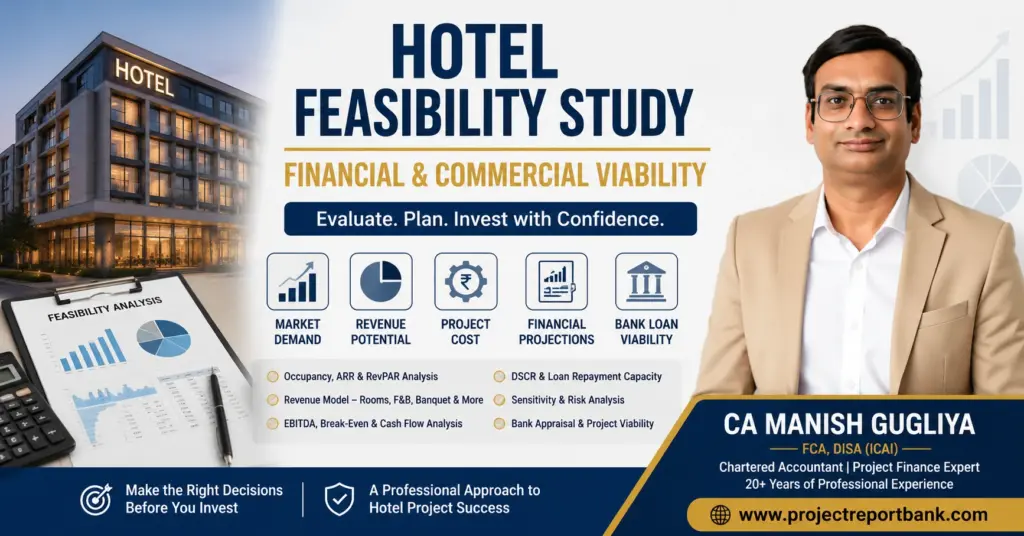
Key Takeaways
- A hotel feasibility study evaluates whether a specific hotel project can realistically generate sufficient market demand, revenue, cash flow and returns before a promoter commits significant capital or applies for a bank loan. It is not based only on projected profit – it requires integrated analysis of location, demand, room inventory, occupancy, ARR, RevPAR, project cost, operating expenses, EBITDA, DSCR, ROI and IRR.
- Financial institutions often require a feasibility report before approving loans. Banks in India examine hotel feasibility through DSCR, loan repayment capacity, promoter contribution and realistic financial projections rather than optimistic assumptions.
- A structured feasibility report (or DPR) helps promoters make informed decisions on hotel size, category and brand, and supports hotel project appraisal by lenders and investors. A well-supported feasibility study boosts confidence in financing discussions and can save investors millions in failed ventures.
- This article is written from the professional perspective of CA Manish Gugliya (FCA, DISA ICAI), a practising Chartered Accountant with over 20 years of experience advising promoters on hotel project feasibility, project reports, CMA Data and bank finance.
Explore Hotel Bank Loan, Project Finance & Feasibility Guides
Explore our hotel finance guides covering bank loans, term loan assessment, DSCR, working capital, CMA Data, project cost, financial projections, feasibility, documentation and debt structuring.
Introduction: Why Hotel Feasibility Decides Project Success
A proposed hotel in Jaipur’s heritage corridor, a beach resort on Goa’s coastline, or a business hotel near Gurugram’s corporate hub – each sounds commercially promising. Yet, in my professional experience, a surprising number of hotel investments underperform or stall because feasibility was never analysed rigorously before committing capital. The hospitality industry rewards thorough planning and punishes assumptions built on enthusiasm alone.
A hotel feasibility study can save millions in failed ventures by checking every link in the business chain before construction begins:
Location → Demand → Room Inventory → Occupancy → ARR/ADR → Revenue → Operating Cost → EBITDA → Cash Flow → Debt Servicing → Investor Return
In India, hotel project feasibility is evaluated both for new greenfield hotel projects and for expansion, renovation or conversion of existing properties. From a bank appraisal perspective, a realistic feasibility study is almost always required before sanctioning hotel project finance or term loans. Without credible feasibility analysis, promoters risk over-building, over-borrowing, and over-estimating demand – three mistakes that frequently turn attractive hospitality projects into financial burdens.
- A feasibility study can prevent costly miscalculations in hotel projects
- Feasibility studies guide decisions on project approval or abandonment
- A comprehensive feasibility study protects the promoter’s equity by testing assumptions before they become irreversible commitments
What Is a Hotel Feasibility Study? Scope and Components
A hotel feasibility study is a structured evaluation of whether a proposed hotel project – say, a 60-room business hotel in Pune or an 80-room luxury resort in Udaipur – is commercially and financially viable. It evaluates commercial and financial viability in an integrated manner, covering demand, competition, revenue potential, project cost, operating economics and investment returns.
Feasibility studies are typically prepared before acquiring land, finalising room inventory, confirming hotel category (budget, midscale, upscale), signing a brand franchise agreement, planning a major renovation, or approaching a bank for a hotel term loan. A feasibility study evaluates the ideal number of hotel rooms, the appropriate category, and whether the proposed project can sustain itself financially over time. A comprehensive report includes market analysis and financial projections covering revenue, cost, cash flow and debt servicing.
The four major components are:
| Feasibility Type | Key Questions | Main Outputs |
|---|---|---|
| Market Feasibility | Is there sufficient demand? What are market dynamics and tourism trends? | Demand estimates, segment analysis, seasonality patterns |
| Commercial Feasibility | Can the hotel attract guests at profitable room rates? | Location analysis, pricing strategies, competitive positioning |
| Technical Feasibility | Is the site suitable? Can the hotel be built to required standards? | Site evaluation, design feasibility, regulatory compliance review |
| Financial Feasibility | Will the project generate adequate returns and cash flow? | Revenue projections, EBITDA, DSCR, ROI, IRR, break-even |
Market feasibility analysis examines demand and supply dynamics specific to the location. Together, these four components form the backbone of the business plan, the hotel DPR and the bank loan proposal.
Commercial Feasibility of a Hotel Project
Commercial feasibility answers one central question: “Can this proposed hotel attract enough paying guests at profitable rates over a sustained period?” This is distinct from financial structuring – it is about whether the market conditions and location can support the hotel concept before capital allocation decisions are made.
A feasibility study shapes the operational strategy of a hotel. Operational strategies include recommendations on service offerings and pricing based on what the target market will actually support. Site selection impacts hotel project success and market alignment. A feasibility study evaluates site suitability by examining physical characteristics, accessibility, visibility, and proximity to demand generators.
Key commercial drivers in Indian hotel development include:
- Business and industrial demand: IT parks (Bengaluru, Hyderabad), industrial clusters (Sanand, Manesar), business centers in metro cities generating steady corporate travelers and business travelers
- Tourism and weddings: Tourist circuits (Golden Triangle, Char Dham), wedding and banquet demand in Tier-2 cities, key attractions driving leisure tourism, pilgrimage circuits
- Highway and transit: Busy corridors like Delhi–Jaipur, Chennai–Bengaluru generating transit demand for midscale and budget hotels
- Institutional and medical demand: Proximity to hospitals, education hubs, convention centres supporting medical tourism and government/PSU travel
Site evaluation includes assessing accessibility, visibility and proximity to demand generators. Site analysis examines physical characteristics like soil conditions and accessibility, while critical site factors include land size, zoning, and transportation access. Seasonality patterns – weekend leisure peaks, weekday corporate peaks, monsoon off-seasons – must be explicitly reflected in occupancy and ARR assumptions.
Market validation confirms sustainable consumer demand for a hotel concept. A resort project on a beach in Kerala, for example, may have excellent weekend demand but near-zero weekday occupancy outside peak season. Branded versus independent positioning (franchise with an international chain versus stand-alone local brand) significantly influences demand, pricing power, marketing cost and required investment. Hotel owners considering branded hotel operations should evaluate brand fees, compliance costs and the premium on guest expectations.
Hotel Market Demand Analysis and Competition Review
Feasibility studies assess market demand and competition to determine whether the proposed hotel can capture sustainable occupancy without unrealistic assumptions. Demand analysis studies potential customers for hotel services across distinct segments.
Demand segments to evaluate:
- Corporate travelers and business travelers (visiting factories, offices, IT campuses)
- Leisure tourists (domestic and international)
- MICE (meetings, incentives, conferences, exhibitions)
- Wedding and social event guests
- Pilgrimage and religious tourism
- Medical tourism visitors
- Government/PSU travelers
- Long-stay guests
In my professional experience, a hotel promoter should identify one or two primary demand generators rather than assuming every segment will contribute equally. For instance, in an industrial cluster like Manesar, corporate demand may account for 60–70% of room nights. Market research should estimate annual room-night demand using concrete inputs: number of corporate offices with visiting staff, tourist arrivals to the city, marriage seasons, and peak pilgrimage months.
Supply and demand analysis includes evaluating existing and planned competing hotels. Supply analysis evaluates existing competition within a 5-10 kilometer radius of the proposed site. Market analysis includes competitor benchmarking and tourism trends relevant to the location.
Competition analysis framework:
| Hotel | Category | Rooms | Location | ARR (₹) | Occupancy | Key Facilities | Primary Segment |
|---|---|---|---|---|---|---|---|
| Hotel A | Midscale | 70 | City centre | 4,200 | 62% | Restaurant, banquet | Corporate |
| Hotel B | Upscale | 110 | Airport road | 5,800 | 58% | Multi-cuisine, spa | Business/MICE |
| Hotel C | Budget | 40 | Railway station | 2,100 | 68% | Basic F&B | Transit |
| Hotel D | Midscale | 55 | Highway | 3,600 | 55% | Restaurant, parking | Transit/corporate |
Comparing a proposed midscale hotel with luxury resorts or budget lodges produces misleading feasibility assumptions. Promoters should use OTA listings, online reviews, industry reports, and local tourism board statistics to support market positioning and competitor analysis of competitor hotels.
Occupancy, ARR and RevPAR Assumptions
Occupancy rate, ARR (Average Room Rate) and RevPAR (Revenue per Available Room) are the three metrics central to hotel profitability analysis and every hotel investment appraisal.
Core formulas:
- Occupancy (%) = Occupied Room Nights ÷ Available Room Nights
- ARR = Room Revenue ÷ Occupied Room Nights
- RevPAR = Room Revenue ÷ Available Room Nights = Occupancy × ARR
While preparing a hotel DPR, occupancy assumptions should follow a ramp-up pattern rather than assuming stabilised occupancy rates from day one. A typical 60-room midscale hotel in a Tier-2 city might realistically achieve 45% occupancy in Year 1, 55% in Year 2, and stabilise at 60–65% by Year 3 or 4.
| Year | Available Room Nights | Occupancy % | ARR (₹) | RevPAR (₹) | Notes |
|---|---|---|---|---|---|
| 1 | 21,900 | 45% | 3,800 | 1,710 | Ramp-up period |
| 2 | 21,900 | 55% | 4,000 | 2,200 | Building market presence |
| 3 | 21,900 | 62% | 4,200 | 2,604 | Approaching stabilisation |
| 5 | 21,900 | 65% | 4,600 | 2,990 | Stabilised operations |
ARR assumptions must be supported by actual room rates in the competitive set. A detailed analysis of hotel occupancy, ARR, RevPAR and break-even analysis can help promoters build realistic long-term assumptions.
Revenue Feasibility and Hotel Revenue Streams
A realistic revenue model is essential for assessing the financial feasibility of a hotel project. Room revenue alone may not justify the investment in many cases – additional revenue streams from F&B, banquets and ancillary services often account for 30–40% of total revenue.
Primary revenue streams:
- Room revenue (typically 55–65% of total)
- Restaurant and bar income
- Banquet and conference revenue
- Wedding and social event income
- Spa and wellness services
- Laundry, parking, rentals and other ancillary income
Revenue projections estimate earnings based on occupancy and room rates. The illustrative formula:
Room Revenue = Number of Rooms × 365 Days × Occupancy % × ARR
For a 50-room hotel at 65% occupancy and ₹4,000 ARR: 50 × 365 × 0.65 × ₹4,000 = ₹4.745 crore annual room revenue. To put this in perspective, a 100-room hotel at 70% occupancy can earn ₹10.22 crores annually in room revenue alone, depending on ARR.
F&B and banquet assumptions should be independently justified based on seating capacity, expected covers per day, average spend per cover, and local demand – not simply taken as a flat percentage. Revenue forecasts for each stream should reflect ramp-up, seasonality and realistic market conditions. A detailed breakdown of hotel revenue modelling for rooms, F&B, banquet and other income provides additional guidance for revenue management.
Hotel Project Cost, Means of Finance and Working Capital
Underestimating project cost or over-leveraging the capital structure is a frequent cause of financial stress in hotel projects, even when occupancy is reasonable. In my professional experience, cost overruns of 10–15% are common in hotel development, and the impact on loan servicing can be severe.
Key components of hotel project cost:
- Land acquisition and registration
- Site development and civil construction
- Interiors, furniture and fixtures (FF&E)
- Kitchen, laundry and specialised equipment
- HVAC, electrical, plumbing and fire-fighting systems
- Lifts, IT, security and landscaping
- Pre-operative expenses and professional fees
- Interest during construction (IDC)
- Contingencies and initial working capital
According to Hotelivate-Savills Construction Cost Insights 2025, average hotel development cost in India (excluding land) is approximately ₹1.04–1.36 crore per key, with budget hotels around ₹25–60 lakh per key and upscale hotels reaching ₹70–130 lakh per key.
Means of finance are typically structured as promoter’s equity (30–40% of project cost), term loans from banks (60–70%), and sometimes unsecured promoter loans. From a bank appraisal perspective, excessive debt can weaken project feasibility even when operating profitability appears attractive. A detailed guide on hotel project cost and means of finance explains the structuring in depth.
Hotels need adequate working capital even though many guests pay at check-out – corporate receivables, OTA settlement cycles (often 15–30 days), payroll timing and utility expenses create genuine cash flow gaps. A separate assessment of hotel working capital requirement is essential during the ramp-up period when revenue has not yet stabilised.
Operating Expenses, EBITDA and Break-Even Analysis
Financial feasibility depends not only on revenue but on realistic estimation of operational costs and resulting EBITDA. Feasibility studies assess operational costs and revenue projections to determine whether the hotel can generate sustainable margins.
Major hotel operating expenses:
| Cost Category | Typical Range (% of Revenue) | Nature |
|---|---|---|
| Payroll and staff welfare | 22–28% | Largely fixed |
| Food and beverage cost | 28–35% of F&B sales | Variable |
| Power, fuel and water | 8–12% | Semi-variable |
| Housekeeping and laundry | 3–5% | Semi-variable |
| Repairs and maintenance | 3–5% | Semi-variable |
| OTA commissions and marketing | 6–10% | Variable |
| Administration and insurance | 4–6% | Fixed |
| Management/brand fees | 3–8% (if branded) | Variable |
High fixed costs (payroll, rent, insurance, minimum utilities) create operating leverage – making occupancy and ARR assumptions critical for break-even analysis. A 5% drop in occupancy can shrink EBITDA by 12–18% in a typical midscale hotel because fixed costs remain unchanged.
Operating break-even occupancy can be estimated by dividing total fixed operating costs by the contribution per occupied room (ARR minus variable cost per occupied room). If fixed operating costs are ₹2.8 crore per year and contribution per occupied room is ₹2,800, the break-even occupancy for a 50-room hotel is approximately 55% – a number that must be comfortably below projected stabilised occupancy.
Financial Projections, DSCR, ROI and IRR for Hotel Projects
A hotel feasibility study ultimately needs integrated financial projections: Profit & Loss, Balance Sheet and Cash Flow, along with loan repayment schedules and key ratios. Financial projections are crucial for securing funding and form the core of every hotel DPR for bank loan submissions.
Financial feasibility projections typically span 5 to 10 years and include income statements, balance sheets and cash flow statements. Financial projections include revenue forecasts and expense estimates covering every significant line item. Financial feasibility assesses if revenue covers operational costs and debt servicing obligations. Profitability assessments are crucial for securing funding from investors and lenders alike.
DSCR (Debt Service Coverage Ratio)
DSCR = Cash Available for Debt Servicing ÷ Total Debt Service (Interest + Principal Repayment)
From a bank appraisal perspective, DSCR is the single most scrutinised ratio. Banks generally expect DSCR above 1.25 in stabilised years, though the threshold varies by lender and project risk. Good profitability does not automatically mean adequate debt servicing ability – principal repayment schedules, interest burden and cash accrual after tax all influence DSCR independently. Detailed analysis is covered in the hotel DSCR and loan repayment capacity guide.
ROI and IRR
ROI indicates average annual cash return relative to total promoter investment. IRR (Internal Rate of Return) considers the time value of cash flows over the project’s life – it is the discount rate at which the NPV of all project cash flows equals zero. Acceptable returns depend on risk, financing structure, location, property ownership and investor expectations, so no universal “ideal” benchmark should be quoted.
| Indicator | Year 1 | Year 3 | Year 5 | Year 7 | Year 10 |
|---|---|---|---|---|---|
| Revenue (₹ Cr) | 4.20 | 6.50 | 7.40 | 8.10 | 9.20 |
| EBITDA (₹ Cr) | 0.85 | 1.95 | 2.30 | 2.55 | 2.95 |
| PAT (₹ Cr) | (0.30) | 0.55 | 0.85 | 1.10 | 1.50 |
| Cash Accrual (₹ Cr) | 0.50 | 1.35 | 1.65 | 1.90 | 2.30 |
| DSCR | 0.65 | 1.30 | 1.55 | 1.75 | 2.10 |
Illustrative figures only – actual projections depend on project-specific assumptions.
A detailed guide on hotel financial projections for bank loan and DPR explains the modelling approach in depth.
Sensitivity Analysis, Risk Assessment and Bank Appraisal Perspective
In professional hotel feasibility studies, base-case projections are always stress-tested through sensitivity analysis and risk assessment. Sensitivity analysis tests various economic scenarios to assess financial resilience before the promoter or bank commits significant resources to the project.
Key variables for sensitivity testing:
- Occupancy 5–10% lower than projected
- ARR 5–10% lower than projected
- Project cost 10–15% higher
- Opening delayed by 6–12 months
- Power tariffs, payroll or interest rates higher than assumed
- Banquet/F&B income lower than projected
| Parameter | Base Case | Moderate Stress | Severe Stress |
|---|---|---|---|
| Stabilised Occupancy | 65% | 58% | 50% |
| ARR (₹) | 4,200 | 3,900 | 3,600 |
| Revenue (₹ Cr) | 7.20 | 6.10 | 5.10 |
| EBITDA (₹ Cr) | 2.15 | 1.55 | 0.95 |
| DSCR | 1.45 | 1.10 | 0.72 |
| Cash Surplus/(Deficit) | Surplus | Marginal | Deficit |
Illustrative sensitivity table for a 50-room midscale hotel – not a benchmark.
Risk analysis identifies potential threats to hotel project success. Risk assessments identify potential pitfalls like construction delays and economic downturns. Risk mitigation flags zoning roadblocks and infrastructure limits in hotel projects. Legal regulations impact the feasibility of hotel projects including zoning and licenses. Feasibility studies highlight risks like seasonal fluctuations and regulatory considerations.
Mitigation strategies include diversifying revenue sources and securing insurance. Effective risk mitigation involves developing contingency plans for projects that account for market risks, operational risks and potential risks from regulatory changes. Stress testing helps both promoters and lenders understand whether the project remains financially manageable if actual performance is weaker than originally projected.
For bank submissions, a clear feasibility report supports preparation of CMA Data for bank loan applications. Banks examine promoter background, experience, equity contribution, security, completion risk, market risk and financial risk. A detailed resource on how banks appraise hotel projects covers the lender’s assessment framework comprehensively.

Hotel Feasibility Study vs Hotel DPR and Role of a Chartered Accountant
A hotel feasibility study asks: “Should this proposed project be undertaken in this form?” A Detailed Project Report (DPR) goes further: “How will this project be implemented and financed?” The two are related but not identical.
Feasibility Study typically covers:
- Project concept and market positioning
- Location analysis and demand analysis
- Competition study and market research
- Capacity, category and positioning decisions
- High-level project cost and economic feasibility indicators
- Revenue model and operating assumptions
- Financial feasibility indicators and sensitivity analysis
Hotel DPR for bank loan additionally includes:
- Detailed technical specifications and project scope
- Itemised project cost and means of finance
- Implementation schedule and regulatory compliance details
- Security, collateral and promoter profile
- CMA Data, detailed financial projections, DSCR and repayment schedule
An experienced Chartered Accountant assists promoters with hotel feasibility studies, financial projections, CMA Data, DSCR analysis and bankable DPRs. It is important to note that projections are based on assumptions provided by the promoter and prevailing market data – they do not guarantee any particular result, loan sanction, or investment return.
Every hospitality project is location-specific and category-specific. A feasibility study for a 40-room budget hotel near a railway station, a 70-room midscale city hotel, or a 100-room resort project in a tourist destination must be customised differently to reflect actual risks, market dynamics and opportunities.
Illustrative 50-Room Hotel Feasibility Example
All figures below are illustrative assumptions for conceptual understanding only. They are not benchmarks or guaranteed outcomes.
Proposed hotel: 50-room midscale hotel in a Tier-2 Indian city (e.g., Indore or Lucknow) with one multi-cuisine restaurant (60 covers) and a modest banquet hall (200 pax capacity).
Year 3 (Stabilised Year) Assumptions:
| Parameter | Assumption |
|---|---|
| Rooms | 50 |
| Available Room Nights | 18,250 |
| Occupancy | 65% |
| Occupied Room Nights | 11,863 |
| ARR | ₹4,000 |
| Annual room revenue | ₹4.745 crore |
| F&B + Banquet revenue (38% of room revenue) | ₹1.80 crore |
| Other income | ₹0.15 crore |
| Total Revenue | ₹6.70 crore |
Operating Expenses (Year 3):
| Expense | % of Revenue | Amount (₹ Cr) |
|---|---|---|
| Payroll | 24% | 1.61 |
| F&B cost | 12% | 0.80 |
| Power and fuel | 9% | 0.60 |
| Other operating and admin | 18% | 1.21 |
| Total Operating Cost | 63% | ₹4.22 crore |
| EBITDA | 37% | ₹2.48 crore |
Project Cost and Financing:
- Total project cost: ₹28 crore (including land, building, interiors, equipment, pre-operative expenses)
- Promoter contribution: ₹9.80 crore (35%)
- Term loan: ₹18.20 crore (65%) at 10.5% interest, 10-year repayment with 2-year moratorium
Year 3 Debt Service:
- Interest: ₹1.73 crore (approx.)
- Principal repayment: ₹1.82 crore
- Total debt service: ₹3.55 crore
- Depreciation: ₹1.05 crore (approx.)
- Tax (at effective rate): ₹0.10 crore
- Cash accrual (PAT + depreciation): ₹1.38 + 1.05 = ₹2.43 crore
DSCR (Year 3): ₹2.43 crore ÷ ₹3.55 crore ≈ 0.68 – which is below acceptable thresholds, indicating the project needs adjustment in cost, financing structure, or assumptions.
This is precisely why feasibility analysis matters. If the DSCR were inadequate even at 65% stabilised occupancy, the promoter must reconsider project cost, loan quantum, repayment tenure, or category positioning before proceeding. Adjusting the moratorium period, increasing promoter contribution, or reducing project cost could improve viability.
Approximate break-even occupancy: With fixed operating costs of approximately ₹2.90 crore and contribution per occupied room of approximately ₹2,700, break-even occupancy ≈ 59% – which is close to the stabilised assumption, leaving limited margin for error.
Real-life feasibility work requires detailed city-specific data, an in depth analysis of local market conditions, and thorough discussion with the promoter. This example is purely for conceptual understanding.
Common Mistakes in Hotel Feasibility Studies and How to Avoid Them
In my professional experience, many hotel project reports fail not because of lack of effort but due to recurring analytical mistakes:
- Unrealistically high occupancy: Assuming 75–80% from Year 1 inflates revenue and EBITDA, giving false comfort to investors and banks
- Aggressive ARR without justification: Setting ARR above what competitor hotels actually achieve distorts revenue projections
- Ignoring ramp-up period: New hotel projects typically take 18–24 months to reach stabilised occupancy rates
- Underestimating project cost: Not accounting for FF&E escalation, pre-opening expenses and contingencies leads to cost overruns that stress the financing structure
- Overestimating banquet and wedding income: Banquet income depends on local demand, competition and seasonality – not on hall capacity alone
- Underestimating payroll and power costs: These two items together can represent 30–35% of total operating expenses
- Ignoring OTA commissions: Commissions of 15–22% on OTA-sourced bookings materially affect net room revenue
- No sensitivity analysis: Without stress testing, neither the promoter nor the bank understands how the project performs under adverse market conditions
- Copying projections from another city or hotel category: A budget hotel’s economics in Varanasi cannot be applied to a midscale hotel in Chandigarh
A feasibility study can prevent costly miscalculations in hotel projects. Correcting these errors early – before land acquisition or construction – protects promoters from committing large, irreversible capital based on over-optimistic expectations. Thorough feasibility studies with conservative, well-justified assumptions provide valuable insights that aggressive projections never can.
Professional Advisory – CA Manish Gugliya
CA Manish Gugliya (FCA, DISA ICAI) assists entrepreneurs and hotel promoters with hotel project reports, bank finance DPRs, financial projections, CMA Data, project cost structuring, DSCR and repayment analysis, and financial feasibility analysis. Every hotel project requires project-specific assumptions based on location, category, room inventory, facilities, financing structure and promoter strategy.
Disclaimer: Hotel feasibility depends on project-specific market, technical, financial and regulatory factors. Financial projections are based on assumptions and available data. No feasibility study can guarantee loan sanction, profitability, specific ROI or occupancy levels. Actual outcomes may differ from projections due to changes in market conditions, economic downturns, competition, costs or regulatory environment.
FAQ – Hotel Feasibility Study and Project Viability
Is a hotel feasibility study mandatory for obtaining a bank loan in India?
While not legally mandatory in all cases, most banks and financial institutions insist on credible feasibility and financial projections before sanctioning hotel term loans. They may rely on the promoter’s DPR, an internal credit appraisal, or a third-party feasibility report. Without a well-executed feasibility study, securing project finance becomes significantly more difficult, and the risk of loan rejection increases substantially.
How long does it typically take to prepare a hotel feasibility report?
A comprehensive hotel feasibility report typically requires 3–6 weeks depending on data availability, the number of site visits needed, the complexity of the proposed project, and the depth of financial analysis required. Rushing the study to meet a deadline can compromise the quality of demand analysis, competition review and financial projections – which ultimately undermines the report’s credibility with banks and investors.
Can an existing operating hotel also undergo a feasibility study?
Yes. Feasibility and re-positioning studies are frequently undertaken before expansion, renovation, rebranding or refinancing an existing property. An existing hotel’s actual operating data (occupancy, ARR, cost structure) provides a stronger foundation for projections than a greenfield study, but market changes, new competition and planned capital expenditure must still be evaluated against the project’s viability.
What information should a promoter provide for a reliable hotel feasibility study?
A promoter should provide land details (ownership, area, location maps), preliminary architectural drawings, proposed room inventory and facilities, target segments, initial project cost estimates, intended financing pattern, any existing market data or expressions of interest from hotel brands, and the promoter’s own experience in hospitality or related industries. The more specific and accurate the inputs, the more reliable the feasibility analysis.
Does a positive feasibility report guarantee project success or bank sanction?
No. A feasibility study is a decision-support tool based on assumptions and available data at a point in time. It cannot guarantee actual results, loan approvals or investment returns. Project outcomes depend on future market conditions, execution quality, economic factors and individual bank credit policies. However, a well-prepared feasibility report significantly improves the quality of decision-making and strengthens the promoter’s position when approaching lenders or investors to secure funding for new hotel projects.
Continue Exploring Our Hotel Project Finance & Bank Loan Guides
Continue with our detailed hotel finance resources covering bank loan appraisal, project cost, CMA Data, working capital, DSCR, financial projections, feasibility, documentation and loan repayment structuring.