Key Takeaways
If you have closed your Mudra Loan and need the NOC or No Dues Certificate right away, here is what matters most:
- After full repayment of your Mudra Loan, you must still obtain a written NOC, No Dues Certificate, or loan closure letter from the lending bank or NBFC. The final EMI alone is not the last step.
- The core process is straightforward: confirm zero outstanding balance → request the NOC in writing (at branch or online) → collect the NOC → verify all details → store it safely with the final loan statement.
- Terminology differs across lenders. Some call it a No Objection Certificate, others issue a No Dues Certificate or loan closure certificate. The purpose is the same – documented proof that your Mudra Loan account is closed with no outstanding dues.
- Preserving the NOC protects you in future disputes, tax or audit queries, and is essential for correcting your CIBIL or credit report if the Mudra Loan still shows as active. Without an NOC, loans may appear active on credit reports, and an active loan status can lower your credit score by 20-50 points.
Introduction: NOC After Mudra Loan Closure
If you have just paid the last EMI on your Mudra Loan under the Pradhan Mantri Mudra Yojana (PMMY), or made a foreclosure payment to close it early, congratulations – the financial obligation is behind you. But the administrative process is not quite finished. You still need documentary proof from the lender that your Mudra Loan account has been formally treated as closed.
Banks may call this document a “No Objection Certificate (NOC),” a “No Dues Certificate,” a “loan closure certificate,” or simply a “closure letter.” The terminology varies, but all broadly serve the same purpose: an official confirmation that nothing remains payable on that particular loan account.
In my professional experience as a Chartered Accountant, many small borrowers assume that once the auto-debit stops or the final cheque clears, everything is complete. Months or years later, they discover the loan still appears open in their credit report, or the bank raises a query about residual interest. This article focuses specifically on how to get your Mudra Loan NOC after closure – what to check in it, what documents to keep, and what to do if the bank delays issuance or your CIBIL score is affected.

What Is a Mudra Loan NOC?
A Mudra Loan NOC is a written confirmation from the lending bank or NBFC stating that your Mudra Loan account – typically a working capital or term loan up to ₹10 lakh – has been fully repaid and closed as per their records. An NOC certifies full repayment of your loan and confirms no outstanding dues remain.
- No Objection Certificate (NOC): Confirms the lender has no objection to marking the loan as closed. In the case of home loans or vehicle loans, this also supports removing hypothecation or releasing a lien on the asset. Since collateral is generally not required for MUDRA loans under PMMY, the NOC primarily serves as closure evidence.
- No Dues Certificate / Loan Closure Certificate / Closure Letter: Different names used by different lenders. Each documents confirm that no principal, interest, or charges remain payable as on a specific closure date.
- The noc letter typically mentions the borrower’s name, Mudra Loan account number, and a clear statement of zero dues. This document is your legal proof that the lender does not claim further dues on that particular account.
Table of Contents
Why Should You Get an NOC After Closing a Mudra Loan?
Getting a written NOC after Mudra Loan closure is not a formality – it is a safeguard.
- Proof of full repayment: If years later anyone questions whether the loan was settled, the noc certificate is your evidence.
- Credit bureau correction: Lenders and credit bureaus rely on closure data. NOC is essential for updating credit reports to reflect loan closure. If your loan status is wrong, the NOC helps you get it updated correctly.
- Protection against future claims: NOC protects borrowers from future claims by lenders. Without an NOC, lenders may still claim assets used as collateral in secured loan types. Even for unsecured Mudra Loans, missing an NOC can lead to legal claims or disputes.
- Business documentation: For proprietors and small firms, the NOC and final account statement support tax, audit, and financial records – especially where the loan was used as working capital.
- Future loan applications: Missing an NOC complicates future loan applications. Having a clean closure record improves your eligibility and approval chances when applying for future loans, whether another Mudra Loan, a personal loan, or even home loans. Bankers reviewing your income and credit profile will see that your earlier loan was handled responsibly.
When Should You Ask for the Mudra Loan NOC?
The best time to request the NOC is immediately after verifying that your outstanding balance has reached zero.
- After the last scheduled EMI: Once the final EMI under the agreed Mudra Loan repayment period has been debited and posted, contact the branch within a few days.
- After foreclosure / pre-closure: If you repay the entire outstanding earlier than the original tenure, obtain a foreclosure statement first, pay the exact amount, and request the NOC once the payment reflects as full closure. Many lenders, such as Bank of Baroda, charge no pre-closure fee on Mudra Loans.
- After clearing overdue charges: If there were penalties or delayed EMIs, ensure every charge is paid and get an updated statement before requesting the NOC, so it clearly records “no dues.”
- Don’t wait years: Try to obtain the NOC while the loan account is still easily traceable in the bank’s current system. Delays make verification harder, especially after branch mergers or system migrations.
How to Get NOC After Mudra Loan Closure – Step-by-Step
This is the core process every Mudra Loan borrower should follow after repayment.
Step 1: Confirm the Outstanding Balance Is Zero
Before requesting the NOC, verify that no principal, interest, or other charge is pending. Loan closure entails a bank verification to confirm zero dues, and the bank verifies that the balance is zero before issuing the NOC.
- Check your latest loan account statement through internet or mobile banking.
- Visit the servicing branch and request a printed statement as on date.
- You can also check your Mudra Loan outstanding balance for a detailed walkthrough.
Even small residual dues – like overdue interest at prevailing interest rates – can delay noc issuance. This verification step is critical.
Step 2: Make the Final Payment
Whether it is the last scheduled EMI or a foreclosure amount, ensure you pay using traceable modes: NEFT, RTGS, cheque, branch transfer, or UPI linked to the loan. Keep transaction references and receipts carefully – repayment receipts serve as proof of the final payment for NOC requests.
If you are considering early closure, refer to the Mudra Loan foreclosure process for complete guidance. After payment, obtain or download a receipt or updated statement showing the closing payment.
Step 3: Allow the Payment to Be Posted to the Loan Account
Banks and NBFCs may take a few working days to realise the payment, apply it to the loan account, and reconcile interest up to the date of closure. You typically need to wait 7 working days after loan closure for the account to reflect the updated status.
During this period, the account may still appear as “Active” or “Running” – do not panic, but track updates through statements or online banking.
Step 4: Contact the Lending Bank or Branch
Once the account shows zero dues, reach out to the original Mudra Loan branch, relationship manager, or customer care. Request your NOC through the lender’s preferred channel – some banks accept requests via internet banking or email, while others require a physical visit.
Keep your loan account number, branch name, and last payment date handy. Whether you bank with SBI, Axis Bank, IndusInd Bank, or any other lender, the process starts with this contact.
Step 5: Submit a Written NOC Request If Required
The bank may require a formal written request to issue an NOC. Many branches ask for a simple application or email. Include:
- Borrower name and business name (if applicable)
- Mudra Loan account number
- Branch details
- Date of final repayment
- Contact details (mobile, current address)
- A clear line requesting the “No Objection Certificate / No Dues Certificate / loan closure letter”
Attach a copy of the final loan statement or payment receipt to speed up processing. Submit the application and keep acknowledgement for your records. A dedicated sample application format is provided below.
Step 6: Collect or Download the NOC
Depending on the lender, you may receive the NOC as:
- A printed letter collected from the branch
- A scanned copy sent by email
- A link sent via SMS
- A download from the bank’s net banking or loan portal
Some banks allow NOC requests through online channels as well as in-branch. Public and private sector banks may issue NOCs on official letterhead. Not every bank offers a digital option, so follow whatever authenticated process your specific lender prescribes. Insist on an officially signed, stamped, or digitally authenticated document – never accept a verbal assurance or informal message as your noc.
Step 7: Verify the NOC Carefully
Verify NOC details like loan account number and closure date. Check:
- Correct borrower name (matching your KYC and loan agreement)
- Correct Mudra Loan account number
- Date of certificate and effective closure date
- Clear mention of “no dues” or “loan closed”
- Bank name and branch with authorised signatory or digital authentication
Pay attention to the exact language. If the document says “settled” instead of “closed,” this may imply a compromise rather than full repayment, which can affect your cibil score. Contact the bank immediately if there is any error in name, account number, or wording.
Step 8: Preserve the NOC and Final Loan Statement
- Keep the original NOC safely in a secure file.
- Save a scanned copy in cloud storage or email.
- Store the final loan statement, final EMI or foreclosure receipt, and any closure email or SMS together with the NOC.
From a Chartered Accountant’s perspective, this consolidation of documents is invaluable if any mismatch appears in future audits, bank queries, or credit report disputes.

Documents You May Need to Get a Mudra Loan NOC
Exact requirements differ across banks, but the following documents are commonly needed:
- Mudra Loan account number and sanction letter or copy of loan agreement
- Identity and address proof – Aadhaar, PAN, voter ID, passport, or driving licence – as some branches request these when you submit the application in person
- Final payment receipt or transaction reference (NEFT/RTGS/UPI/cheque details). Necessary documents for obtaining an NOC include identity proof and payment receipts.
- Latest loan account statement or foreclosure statement showing zero outstanding
- A signed written request letter or application form prescribed by the bank, submitted by the borrower, proprietor, or authorised signatory on behalf of the business
Sample Application for Mudra Loan NOC
Below is a simple template you can adapt. Fill in your own details and submit it at the branch or via email.
To, The Branch Manager, [Bank Name], [Branch Name, City]
Date: [e.g., 15 July 2026]
Subject: Request for No Objection Certificate / No Dues Certificate – Mudra Loan Account No. [e.g., ML-123456789]
Respected Sir/Madam,
I, [Borrower’s Full Name], proprietor of [Business Name, if applicable], wish to inform you that my Mudra Loan bearing account number [ML-123456789] has been fully repaid as on [Date of Final Payment]. The last payment was made via [NEFT/RTGS/UPI/Cheque No.] on [Date].
I kindly request you to issue a No Objection Certificate / No Dues Certificate / Loan Closure Letter confirming that no dues are outstanding against the above loan account.
Enclosed: Copy of final loan statement and payment receipt.
Borrower Name: _ Current Address: _ Mobile Number: _ Signature: _
Keep a photocopy or scanned copy of the signed application and the bank’s acknowledgement for your records.
What Details Should a Mudra Loan NOC Contain?
There is no single mandatory national format, but a proper NOC should include:
- Borrower’s full name (and firm name, if the loan is in the business name) as appearing in the Mudra Loan documents
- Complete Mudra Loan account number or customer ID – to avoid confusion with any other facility from the same bank
- A core statement confirming the bank has received full repayment of loan principal, interest, and applicable charges, and that no dues are pending as on a specific closure date
- Date of issue and effective loan closure date
- Bank name, branch, and either an authorised signatory’s signature with seal or a verifiable digital authentication mark
How Long Does It Take to Receive Mudra Loan NOC?
The noc issuance process typically takes 7 to 30 days, depending on the lender’s internal process. NOC issuance should occur within approximately 15 days post-closure in most cases, though factors like cheque realisation, clearance of overdue interest, and internal reconciliation can cause delays.
I generally advise borrowers to request an acknowledgement or reference number when submitting the NOC application so they can follow up systematically. If there is an unusual delay despite zero outstanding dues and a proper application, escalate within the bank’s grievance mechanism.
What If the Bank Does Not Give NOC After Mudra Loan Closure?
Follow a practical escalation sequence:
- Reconfirm that no amount is actually outstanding by re-checking the loan statement and discussing any disputed charges with the branch.
- Submit a written NOC request with all details and get an acknowledgement on a copy or via email.
- For continued delays, contact the bank’s customer care or designated grievance officer, attaching the earlier request and account statement.
- Most banks publish an escalation matrix on their website (branch → regional office → nodal officer). Follow this hierarchy before considering any external forum.
- A well-documented trail of applications, emails, and statements strengthens your position. In a recent consumer court ruling, a borrower was awarded ₹20,000 compensation when a bank delayed issuing the NOC and failed to update the credit report after full repayment.
Mudra Loan Closed but Still Showing Active in CIBIL – What Should You Do?
Even after loan repayment and noc issuance, the update in your credit report depends on the lender’s periodic reporting cycle – not on the NOC document itself. Without an NOC, loans may appear active on credit reports, and an active loan status can lower your credit score by 20-50 points. An incorrectly marked loan can stay on your report for up to 7 years.
- Wait a reasonable period (typically 30-45 days) after closure, then check your credit report.
- If the Mudra Loan still shows active or overdue, contact the bank with copies of the NOC and final statement and request correction.
- For a detailed step-by-step dispute process, refer to the guide on Mudra Loan closed but still showing active in CIBIL.
NOC After Normal Repayment vs Mudra Loan Foreclosure
- Normal repayment: NOC is requested after all scheduled EMIs are paid and the statement shows zero dues. The loan type and tenure remain as originally agreed.
- Foreclosure / pre-closure: The borrower obtains a foreclosure quote, pays the entire outstanding before the original tenure ends, and requests the NOC once the bank confirms closure.
- In both scenarios, your responsibility is the same: verify zero dues, ensure the NOC correctly mentions “no dues,” and preserve it with final loan documents.
Is NOC the Same as a Loan Closure Certificate?
Different lenders label their closure document differently – No Objection Certificate, No Dues Certificate, loan closure certificate, or closure letter. The key is what the content confirms, not the title on the letterhead.
As long as the document clearly states that the specific Mudra Loan account is closed and no dues are outstanding, it serves the practical purpose of an NOC. Where a bank issues both a generic closure letter and a formal No Dues Certificate, keep copies of both for complete records. For credit bureaus, any document showing full closure and zero dues can be used as supporting evidence in a dispute, regardless of the exact title.
Should You Check Your Credit Report After Getting the NOC?
Yes. Monitoring your credit report post-NOC is important for status verification.
The sequence is: (1) you repay the loan, (2) the bank closes the loan account, (3) you receive the NOC, (4) the bank reports the new loan status to credit bureaus, (5) the bureau updates your report. The NOC does not itself change the CIBIL data – it is evidence you may use if the reported status is wrong.
If you notice discrepancies, use the guidance in the dedicated CIBIL article rather than ignoring the issue.
Common Mistakes Borrowers Make After Mudra Loan Closure
- Not requesting an NOC at all, then struggling to prove the Mudra Loan was fully repaid years later.
- Assuming auto-closure: Believing the bank will automatically close the account and report to CIBIL without follow-up from the borrower.
- Ignoring residual charges: Failing to check the final loan statement for small interest or fee amounts that prevent the bank from issuing a clean NOC.
- Losing the original NOC without keeping scanned copies – obtaining a duplicate later requires extra visits and paperwork.
- Not reading the NOC wording: Overlooking errors in name, account number, or phrasing such as “settled” instead of “closed,” which can affect your credit profile.
- Never checking the credit report – discovering the error only when a new loan or credit card application is rejected due to an “active” Mudra Loan entry among your closed loans.
CA Manish Gugliya’s Practical Advice on Mudra Loan NOC
As a Chartered Accountant dealing with business finance and loan documentation, I recommend treating Mudra Loan closure as a complete process rather than just the final payment. The framework is simple:
Pay → Verify → Obtain Closure Proof → Preserve Documents → Check Credit Reporting
In my experience, borrowers who carefully keep their NOC, final statement, and proof of final payment rarely face major disputes later – even if bank systems or credit bureau records contain errors. The documentation speaks for itself.
Owners of micro and small businesses should treat their Mudra Loan file like any other long-term business document, preserving it for the loan duration plus several years for tax and compliance comfort. Never feel hesitant about asking your branch for a clear, written No Dues confirmation. You have every right to avail this document after your loan has been repaid in full.
Frequently Asked Questions
Below are common doubts borrowers have about obtaining their Mudra Loan NOC after closure.
Is NOC compulsory after Mudra Loan closure?
While RBI regulations may not use the word “compulsory” for every unsecured Mudra Loan, in practical terms you should always obtain a written NOC or No Dues Certificate. It is your primary proof of full repayment. Without it, you have no formal evidence to counter any future claim, and it complicates everything from credit report disputes to new loan applications.
Can I get my Mudra Loan NOC online?
Some banks provide digital NOCs through internet banking, loan portals, or email links that you can download. Others still require a branch visit. Check your specific lender’s website or call customer care to confirm available channels. There is no universal online system across all banks for Mudra Loan NOC.
What if I lose my original Mudra Loan NOC?
Approach the bank branch immediately with your KYC documents (Aadhaar, PAN, or any identity proof), Mudra Loan account details, and any available closure proof. Submit a written request for a duplicate NOC and keep the bank’s acknowledgement. Store the new NOC safely – both physically and as a scanned digital copy – to avoid repeating the problem.
Does getting an NOC immediately improve my CIBIL score?
No. The NOC itself does not directly change your CIBIL score. The lender periodically reports the updated status (“closed”) of your Mudra Loan to the credit bureau, after which the report and score may improve – provided there are no other negative factors. Obtaining the NOC gives you evidence to escalate if the update does not happen within a reasonable time.
Can I apply for another loan after receiving the Mudra Loan NOC?
Yes. Once the Mudra Loan is properly closed and your records reflect a clean repayment history, you can use the NOC and closure documents as positive support while applying for fresh credit. Approval will depend on the new lender’s eligibility checks, your income assessment, and overall credit profile – but a properly closed prior loan strengthens your application.
Conclusion
Mudra Loan repayment is not complete until you have verified zero dues, obtained a proper NOC or No Dues Certificate, and ensured that every detail in the document is accurate. The final EMI is an important milestone, but it is not the last administrative step.
Preserve the NOC, the final loan statement, and all payment proofs. Confirm, after a reasonable period, that your credit report reflects the correct “closed” status. This simple discipline protects you and your business from avoidable problems for years to come.
CA Manish Gugliya Chartered Accountant & Mudra Loan Expert ProjectReportBank.com
- Mudra Loan Closure Process: How to Properly Close a Mudra Loan After Full Repayment

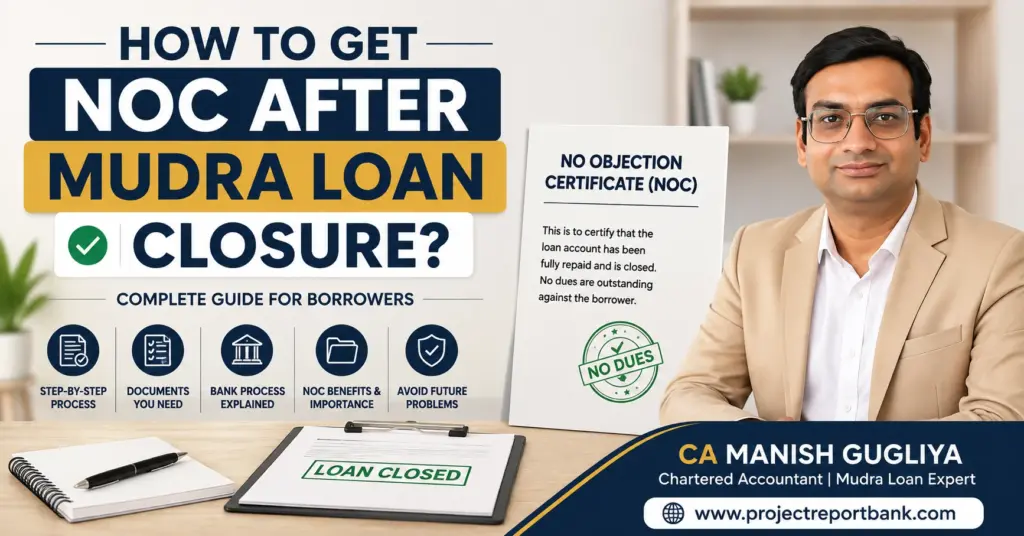
- Mudra Loan NOC After Closure: Step-by-Step Guide by CA Manish Gugliya
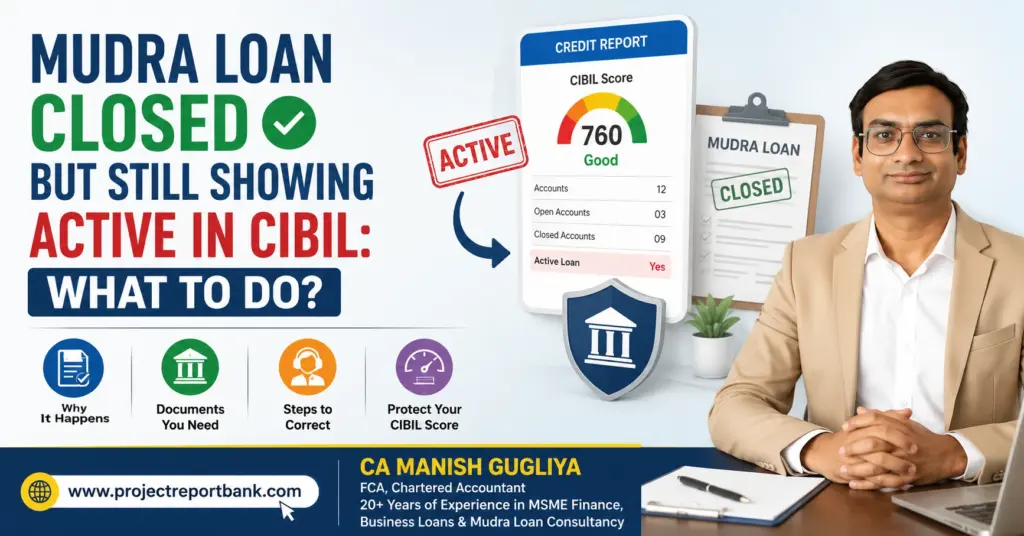
- Mudra Loan Closed but Still Showing Active in CIBIL: What to Do?
- Can a Bank Refuse to Renew a Mudra Loan? Reasons, Rules & Next Steps
- What Documents Are Required for Mudra Loan Renewal? (Practical Guide by CA Manish Gugliya)
- Can a Mudra Loan Be Renewed? Eligibility, Process & Practical Guide (By CA Manish Gugliya)
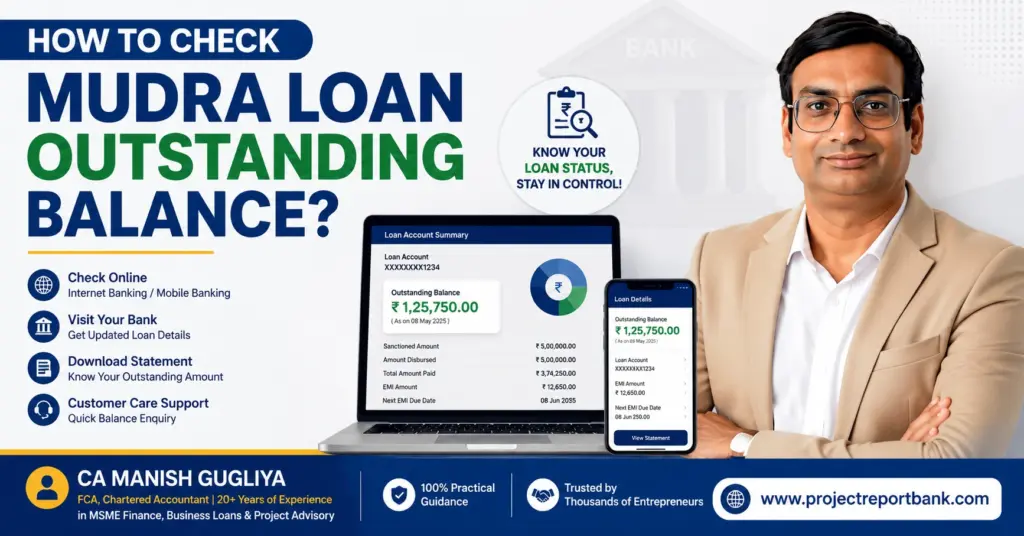
- How to Check Mudra Loan Outstanding Balance? (Practical Guide for Borrowers)
- Can You Foreclose a Mudra Loan? Process, Charges & Rules (Expert Guide by CA Manish Gugliya)
- Can Mudra Loan Repayment Period Be Extended? (Practical Guide by CA Manish Gugliya)