Key Takeaways
Many genuine Mudra loan files show “pending after site inspection” for a few days or even weeks. A Mudra loan application may remain pending after a site inspection, and this is usually a normal processing stage-not an automatic rejection.
- “Pending after site visit” generally means: physical verification is completed, the inspection report is with the bank branch, and internal credit appraisal and approvals (Branch Manager / Regional Office) are still in process.
- A Mudra loan can still be approved or rejected after site inspection, depending on verification findings, documents submitted, business viability, the bank’s lending policy, and cibil score checks.
- Realistic time range: Mudra loan final approval after site visit may take 3–4 working days to 3–4 weeks, depending on workload, completeness of required documents, and whether higher-level approvals are needed.
- In this article, you will learn what happens inside the bank after inspection, reasons for delay, positive and warning signs, practical follow-up steps, and when to escalate.
Introduction: Why Mudra Loan Status Often Shows “Pending After Site Inspection”
Imagine a small trader in Jaipur who applied for a ₹3 lakh Kishore Mudra loan in June 2026. The bank officer visited his shop five days ago, clicked photos, asked a few questions-and left. Now, his online status still reads “pending after verification.” Naturally, he is anxious.
Under the Pradhan Mantri Mudra Yojana (PMMY), the government of India supports micro units development and refinance agency SIDBI to provide financial assistance to non-corporate and non-farm small and micro enterprises. Mudra loans offer collateral-free financing up to ₹20 lakh for various income-generating activities-from food processing to transport vehicles to trading. Any indian citizen (or indian residents) aged between 18 to 65 years, running a small business as a proprietorship, partnership, or other legal entity, can apply online or offline through banks, small finance banks, micro finance institutions, or NBFCs. The online application requires uploading scanned copies of kyc documents.
“Mudra loan pending after site inspection” is one of the most common queries I receive as a consultant. This article is written from my experience as CA Manish Gugliya (FCA, DISA ICAI), having prepared project reports and CMA data for MSME and Mudra finance cases with public and private banks for over 20 years. I will explain, in simple language, what happens after the site visit, what “pending” actually means, realistic timelines, and what practical steps you should take.
Table of Contents
What Is a Mudra Loan Site Inspection and Why Do Banks Do It?
A bank site inspection for Mudra loan is the physical visit by a bank staff member (or outsourced agency) to your business place-and sometimes your residence-after your initial loan application form and documents are submitted. The inspection process for Mudra loans is part of the application approval process. You need to submit a loan application form and identity proof, along with address proof, business proof, business registration documents, and a rental agreement or rent agreement if the premises are rented.
The main purposes of this visit include:
- Business verification: Confirm that the business actually exists-whether it is a shop, workshop, manufacturing unit, or home-based setup-and matches the description in the application process and business plan.
- Address verification: Match the current address on your aadhaar card, pan card, and rental agreement with the actual location.
- Activity verification: Check products, services, basic stock, equipment, and tools. For example, if your application says “garment trading,” the inspector will look for stock and invoices.
- Capacity verification: For manufacturing or service units, verify machines, staff strength, and installed capacity versus projections in your project report.
- Applicant interaction: A brief discussion with the proprietor or partners about experience, monthly sales, expenses, and how Mudra funds will be used for business purposes.
Inspectors usually photograph the shop front with signboard, inside view with stock or machinery, and the applicant standing at the workplace. Some inspectors also verify a driver’s licence or other documents as additional identity proof if needed.
After the visit, a formal inspection report is prepared with standard checkboxes and remarks on business stability and applicant credibility.

What Does “Mudra Loan Pending After Site Inspection” Actually Mean?
When your status shows “Mudra loan site inspection completed but pending” or “Mudra loan status pending after verification,” it generally means:
- The physical verification is done.
- The inspection report has been submitted (or is about to be submitted).
- The file has moved into internal review and credit appraisal, which takes additional time.
Many banks-especially public sector banks-update status in simple phrases like “under process after verification,” “pending at branch after site inspection,” or “file under review after physical verification.” All of these reflect the same intermediate stage in the loan process.
Here is the critical point:
- Pending ≠ approval.
- Pending ≠ rejection.
- Pending only means “decision is not yet taken; more internal steps are remaining.”
Pending Mudra loan applications may indicate that credit appraisal is ongoing. For a shishu loan (upto rs 50,000 for start ups), the gap between inspection and decision is usually shorter. For Kishore and Tarun loans, more scrutiny keeps the file pending longer.
Also note: status shown on the jansamarth portal or a bank’s internal mudra loan online tracking system is often updated in batches. There can be a 2–3 day lag between actual internal movement and what you see as “pending.”
What Happens Inside the Bank After the Inspection Report Reaches the Branch?
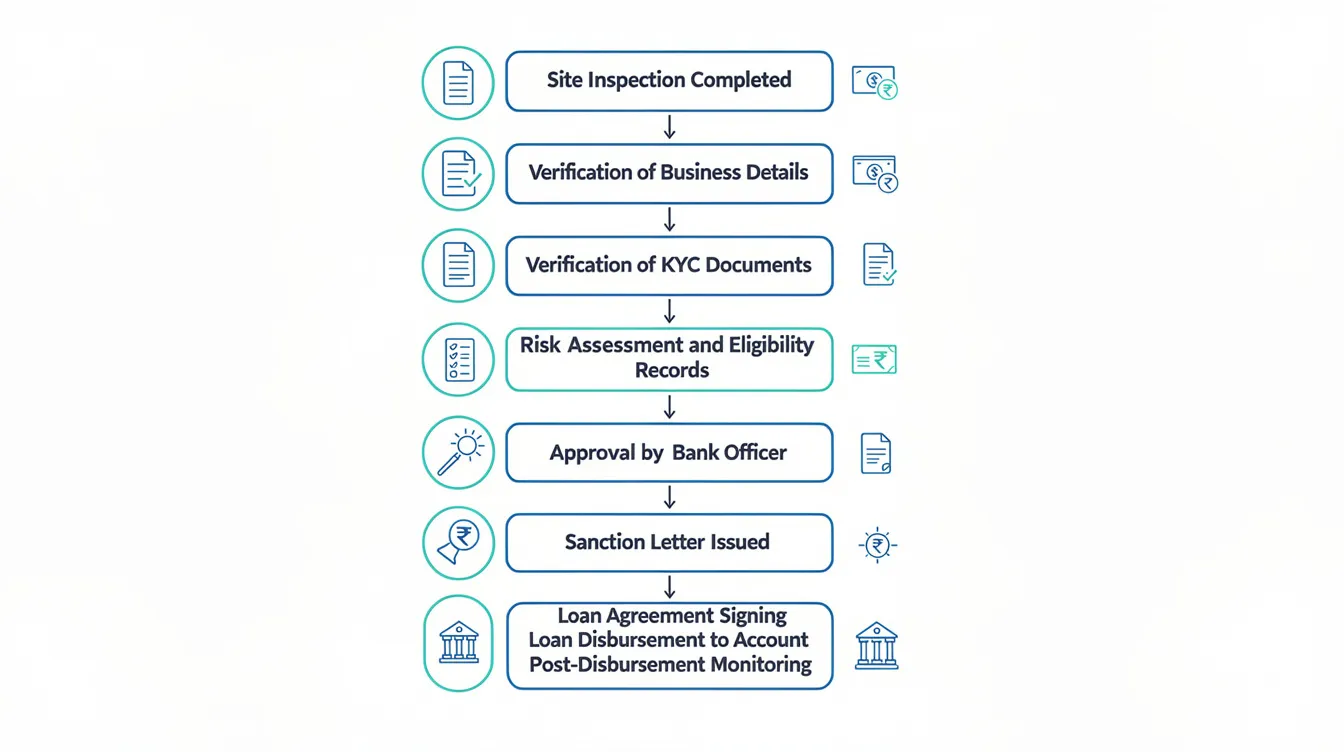
After site inspection, the action shifts from field verification to desk-based credit appraisal. Banks perform internal compliance checks before sanctioning Mudra loans. Upcoming tasks include verifying documentation and checking for discrepancies in the application. Here is the typical flow:
- Step 1 – Site Inspection Completed: The inspector visits, collects data, takes photographs, and submits the report.
- Step 2 – Verification Report Prepared: A consolidated inspection report is finalized in the standard Mudra verification format.
- Step 3 – Credit Officer Review: The processing officer reads the report, cross-checks it against the loan application, documents required, and business plan. Any discrepancy between claimed and observed details is flagged.
- Step 4 – Financial Assessment: The officer recalculates projected turnover, margins, net worth, and repayment capacity (DSCR-a ratio that shows whether your cash flow is enough to cover EMIs). This is compared with the bank’s norms for that loan amount.
- Step 5 – Risk & Compliance Checks: Cibil score review, existing loan verification, KYC risk flags, and comparison with RBI/PMMY guidelines. The officer verifies your credit profile and checks for any defaults.
- Step 6 – Branch Manager Review: The BM goes through the file, inspection report, and credit note before approval-or forwards the file upward if higher sanction power is required.
- Step 7 – Regional Office / Higher Authority: Files above certain limits or with higher risk factors are sent to the Regional Office. This adds 5–10 working days.
The sequence in simple terms: Application → Documents → Site Inspection → Report → Credit Appraisal → Approval / Query / Rejection. “Pending after site inspection” is usually between “Report” and “Approval / Query / Rejection.”
Common Reasons Why Mudra Loan Remains Pending After Site Inspection
Most pending cases are due to routine internal steps and workload, not because the bank has decided to reject. However, some cases stay pending because of documentation or risk concerns. Common reasons for pending Mudra loan applications include document discrepancies.
Here are the typical reasons:
- Branch Manager approval pending: BM is busy with audits, monthly closing, or other urgent work; your file is on the “to-sign” list but not yet cleared.
- Verification report under review: Discrepancies between what was declared in the loan application and what was seen on site need clarification.
- Regional Office approval needed: Mandatory for certain loan category amounts or risk grades.
- Financial assessment underway: Officer is re-examining sales estimates, profit margins, and cash flow in the business plan to check if EMI is realistically payable based on repayment capacity.
- Existing loan and CIBIL verification: Extra time to pull cibil score data or verify other loans (home loan, credit cards, working capital loans, term loan facilities). Verification of eligibility criteria may be a reason for Mudra loan delays.
- Additional document requirement: Waiting for updated bank statements, income tax returns or tax returns, Udyam registration, shop licence, or other documents. Status may still show “pending” until papers are uploaded.
- Internal compliance checks: Cases flagged for KYC issues, PAN–Aadhaar mismatch, or unusual cash transactions go through enhanced due diligence.
- Heavy branch workload and holidays: Quarter-end closings, statutory audits, festivals, and flooded applications may create administrative delays in processing Mudra loans.
- Policy-related checks: If business type is on the bank’s “cautious” list, the officer may seek policy clarification.
A KPMG/NITI Aayog impact assessment found that lack of documentation and CIBIL check failures are among the leading reasons for delays. In most genuine cases, these issues resolve with basic clarifications and complete documentation.
How Long Does Mudra Loan Approval Usually Take After Site Inspection?
There is no single fixed number of days. Approval for Mudra loans typically takes a few days to weeks, depending on bank type (PSU, private, RRB), branch workload, loan amount, and completeness of documents submitted. Mudra loans are processed quickly with minimal documentation-but the actual timeline varies by loan category.
Realistic time ranges based on experience:
| Loan Category | Loan Amount | Typical Time After Inspection |
|---|---|---|
| Shishu loan | Upto rs 50,000 for start ups | 3–7 working days |
| Kishore | ₹50,001 to ₹5 lakh for expansion | 7–15 working days |
| Tarun | ₹5 lakh to ₹10 lakh for established businesses | 10–21 working days |
| Tarun Plus | ₹10 lakh to ₹20 lakh for expanded businesses | 15–25+ working days |
Mudra loans can be up to ₹20 lakh depending on the category. Factors that shorten or stretch the timeline include: a strong cibil score, clear required documents, transparent business turnover, versus cases with missing bills, cash-only sales, or conflicting information.
Online portals may still show “pending” even when the sanction letter is printed, until the bank branch updates or disburses the loan. Always confirm with the branch once a reasonable time has passed.
Can a Mudra Loan Be Rejected After Site Inspection?
Yes, a Mudra loan can be rejected after site inspection. The visit does not automatically mean loan approval-it is only one part of the bank’s verification process. Collateral is not required for Mudra loans, but creditworthiness and business viability still matter.
Common rejection reasons that emerge after verification:
- Negative verification findings: Business not found at the given address, shop locked for several visits, or neighbors stating that the activity started only to obtain the loan.
- Misrepresentation: Major mismatch between declared and actual business. For example, application shows a manufacturing unit, but only vacant land or a residence is found with no machinery.
- Documentation mismatch: PAN name not matching Aadhaar, bank statements not belonging to the applicant, fabricated invoices, or manipulated passbook entries.
- Poor financial viability: Business plan not realistic; expected EMI higher than real surplus cash flow; business already running at a loss with no turnaround plan.
- Weak credit profile: Serious past defaults, current overdues, write-offs, or multiple unpaid loans. Each bank or financial institution has its own internal cutoffs.
- Policy restrictions: Business falling under a negative list or not covered under the PMMY guidelines. For example, purely agricultural activities are excluded under the mudra scheme.
Even if rejected, you can politely ask for the broad reason, improve your documentation or business performance, and re-apply later. Banks must follow applicable RBI and PMMY guidelines, but they retain legitimate discretion in lending decisions. Mudra loans are collateral-free for micro and small enterprises, but the loan is never “guaranteed.”
Positive Signs vs Warning Signs While Your Mudra Loan Is Pending After Inspection
While waiting, you can gauge where your case stands based on the bank’s behavior. Here is a practical comparison:
| Positive Signs | Warning Signs |
|---|---|
| No major additional clarifications asked after verification | Bank repeatedly revisits basic questions about nature of business and turnover |
| Contact number and email reconfirmed for sanction letter | Large mismatch pointed out between declared and visible business activity |
| Staff mentions file has gone to BM or Regional Office “only for approval” | CIBIL or repayment issues discussed in detail with you |
| Internal status shows “recommended” or “proposal prepared” | File kept on hold for more than 30 days without clear next step |
| Only minor queries (e.g., fresh bank statement, updated address proof or utility bills) | Officer informally suggests that proposal may not fit policy |
| Positive tone in phone calls from the branch | No communication at all for over 3 weeks |
Even several positive signals do not guarantee approval, and some files with warnings can still be sanctioned after justification. But this table helps you decide whether to start preparing a backup plan for business loans from other sources.

Situations That May Cause Further Delay in Mudra Loan Processing After Site Visit
Sometimes there is neither clear approval nor rejection even after 2–3 weeks. In such cases, the file is usually stuck between different internal checkpoints.
- BM transfer or leave: Branch Manager transferred, on long leave, or caught in audit cycles; decisions accumulate and are cleared together after a few days.
- Regional Office scrutiny: Larger loans or special category sectors need RO clearance, adding 5–10 working days-especially if RO seeks more clarifications from the branch.
- Additional verifications: Bank may send a second officer for re-inspection, phone verification of suppliers or landlords, or business turnover checks from GST / UPI / POS records.
- Compliance review: Files selected for AML (anti-money laundering) or KYC audits may experience longer hold periods. This is routine, not personal.
- Technical or system issues: Jansamarth portal downtime, core banking outages, or data mismatches between Aadhaar and PAN can slow final sanction entry.
- Applicant-related delays: Not providing required address proof or bank statements on time, not answering calls, or frequently changing declared business plan during appraisal.
If delay crosses approximately 30 calendar days without clear communication, a polite written follow-up to the branch-and if needed, to the Regional Office-is appropriate. Keep your mobile number updated so the bank can reach you.
What Should Applicants Do While the Mudra Loan Is Pending After Site Inspection?
You are not helpless during this stage. Disciplined follow-up and readiness can speed up the final decision. The scheme supports micro and small businesses across India, and Mudra loans help boost employment creation and income generation-so the bank has every reason to process genuine files efficiently.
Practical checklist:
- Keep your phone reachable: Answer all calls from the bank. Save branch and officer numbers.
- Keep documents updated and handy: Latest 6–12 months’ bank statements (you must submit a bank statement from the last six months), GST returns, Udyam certificate, rent agreement, electricity bill or utility bills as address proof. Proof of income includes the latest Income Tax Return.
- Respond quickly to requests: Submit asked documents within 24–48 hours so your file doesn’t slip behind newer applications.
- Maintain normal business operations: Ensure the shop or unit remains open during working hours. If a second visit happens, the business should be visibly running.
- Follow up professionally: Visit the bank branch once every 7–10 days or send a polite SMS/email asking for status. Avoid daily pressure.
- Clarify your business plan confidently: Be ready to explain how Mudra funds will be used for stock, machinery, or working capital in 2–3 simple points.
- Explore backup options: If delay is significant, consider alternative funding-smaller ticket business loans, NBFC options, or phased capital investment-without abandoning the Mudra file.
You can also apply for a Mudra loan through a current account at the same bank branch to build familiarity. Banks that already know your transaction history offer loans with more comfort and easy access.
Mistakes Applicants Should Avoid While Their Mudra Loan Is Under Review
Some borrowers unintentionally create red flags after site inspection by changing statements, avoiding calls, or manipulating documents. Here is what to avoid:
| Mistake | Possible Impact |
|---|---|
| Giving different turnover figures to different officers | Makes financial projections look unreliable; officer may mark file as high-risk |
| Submitting altered bank statements or fake bills | Leads to immediate rejection; future applications also affected |
| Not informing bank about change of shop or address | Verification and documents will not match; treated as misrepresentation |
| Being rude or aggressive during follow-up | Reduces willingness of officer to support your proposal |
| Ignoring SMS/email asking for additional documents required | File may stay “pending” indefinitely and eventually be closed as incomplete |
| Taking new large loans elsewhere while Mudra loan is in process | Increases total EMI burden; CIBIL updates may trigger reconsideration |
Maintaining honesty, consistency in information, and respectful communication gives the Branch Manager more comfort in recommending your proposal. A valid photo identity proof and correct current address on all documents eliminate unnecessary friction.
Practical Tips from CA Manish Gugliya for Faster and Smoother Mudra Loan Processing
These tips come from handling hundreds of MSME and Mudra loan files with multiple banks over more than two decades. They are meant to set practical, realistic expectations-not promise guaranteed results.
- Prepare a clear business plan: Even for a shishu loan, write 1–2 pages describing business activity, expected monthly sales, main expenses, and how Mudra funds will be used. Attach this with your application form. Banks that offer loans under the mudra scheme look for clarity, not perfection.
- Keep KYC and address proof consistent: Ensure aadhaar card, pan card, bank passbook, and rental agreement show the same or logically connected addresses. Inconsistency causes extra verification.
- Show banking discipline: 6–12 months before applying, avoid cheque bounces, maintain minimum balance, and route business receipts through the bank account. Strong bank statements speak louder than words about your interest rate management and discipline.
- Be transparent about existing loans: Disclose all loans and credit cards in the loan application. Hiding them backfires when CIBIL is checked. You need a valid business registration and honest net worth declaration.
- Choose the right bank branch: Preferably one where you already maintain a current account or savings account with regular transactions. An existing relationship speeds up verification. Whether it is a bank or financial institution like an NBFC or a small finance bank, familiarity helps.
- Follow proper escalation steps: If there is unusual delay, talk to the processing officer first, then BM, then consider written representation to Regional Office. Avoid political or unauthorized pressure-it usually backfires. The processing fee for Mudra loans is generally nil for Shishu and nominal for Kishore/Tarun.
Even the best-prepared file is subject to each financial institution’s internal credit policy and RBI/PMMY guidelines. No consultant or officer can “guarantee” Mudra loan approval.
Conclusion: How to View “Mudra Loan Pending After Site Inspection” Calmly and Correctly
“Mudra loan pending after site inspection” is normally an intermediate stage between physical verification and final sanction. It reflects that the bank has moved into internal review-not necessarily towards rejection. MUDRA loans are provided to non-corporate and non-farm small and micro enterprises, and the application process is designed to verify genuine borrowers.
Final loan approval depends on a combination of on-site findings, documentation quality, business viability, cibil score, and alignment with the bank’s policy and PMMY rules-not only the inspection itself. Loans are available for various income-generating activities, and the scheme genuinely supports micro enterprises across India.
Remain patient but proactive. Keep documents updated, respond quickly, track your Mudra loan site verification status, and follow up professionally. Use the waiting period to refine your business plan and strengthen your internal systems-this helps both during appraisal and after disbursement for actual business growth.
From my experience: if you understand the loan process and cooperate with the bank, most genuine small business Mudra proposals stand a fair chance under the scheme-while always respecting that the final decision rests with the lending institution.
FAQs on Mudra Loan Pending After Site Inspection
These FAQs address practical doubts that typically arise after site verification but are not fully covered in the main sections above.
Does “pending after site inspection” mean my Mudra loan is approved?
No. It only means the physical verification step is completed and the decision is awaited. The file is still going through credit appraisal, financial assessment, and internal approvals. Monitor your status on the bank portal or jansamarth portal, and wait for official communication before assuming anything.
How long should I wait before visiting the bank branch after verification?
Give the branch at least 5–7 working days after inspection before your first follow-up visit. After that, check once every 7–10 days. Keep your approach polite and professional-processing officers handle many files and appreciate patience from applicants.
Can I change my loan amount or business plan after site inspection?
Minor changes (like adjusting a stock item or slight budget revision) are usually acceptable if communicated early. However, major changes-like altering the loan amount significantly or changing business activity-may require a fresh application. Discuss with the processing officer before making any changes.
Will re-application hurt my chances if my Mudra loan was once rejected after inspection?
Not necessarily. If you address the earlier reasons for rejection-like improving your cibil score, strengthening your business plan, or correcting documentation gaps-you can re-apply after a reasonable gap (usually 3–6 months). Each application is evaluated independently based on current eligibility criteria and merit.
Is there any way to speed up Mudra loan approval after inspection?
The most effective approach is to submit complete documentation on time, respond promptly to bank calls, and maintain transparent business records. There is no shortcut or unofficial payment that guarantees faster processing. Ensure every required document-including identity proof, business proof, and bank statements-is accurate and ready.
- Mudra Loan Delay in Processing: Complete Guide to Every Stage, Reason & Solution


- Mudra Loan Processing Time: Stage-Wise Timeline from Application to Disbursement


- Can Festivals, Holidays or Financial Year-End Delay Mudra Loan Processing?

- Mudra Loan Pending Due to Internal Bank Approval: What Should You Do?

- Mudra Loan Sanctioned but Disbursement Delayed: Reasons & Solutions (By CA Manish Gugliya)

- Why Is My Mudra Loan Still Under Credit Appraisal?

- Mudra Loan Pending After Site Inspection: What It Really Means (From a Banker’s Desk)

- Mudra Loan File Sent to Regional Office: What Happens Next?

- Why Is My Mudra Loan Stuck at Branch Manager Approval?